
Quick Read
Science becomes much easier when students stop treating it as a subject made up of isolated facts.
At eduKate Singapore in Punggol, we help students learn Science as a connected system:
Understand the concept → recognise the question → identify the evidence → apply the correct scientific idea → explain clearly → check the answer
Our Science tuition is designed for students who need to:
- strengthen weak foundations;
- understand difficult scientific concepts;
- improve answering techniques;
- develop accurate scientific vocabulary;
- connect different topics together;
- handle application and inference questions;
- prepare for PSLE Science;
- build stronger foundations for Secondary Science;
- improve examination consistency.
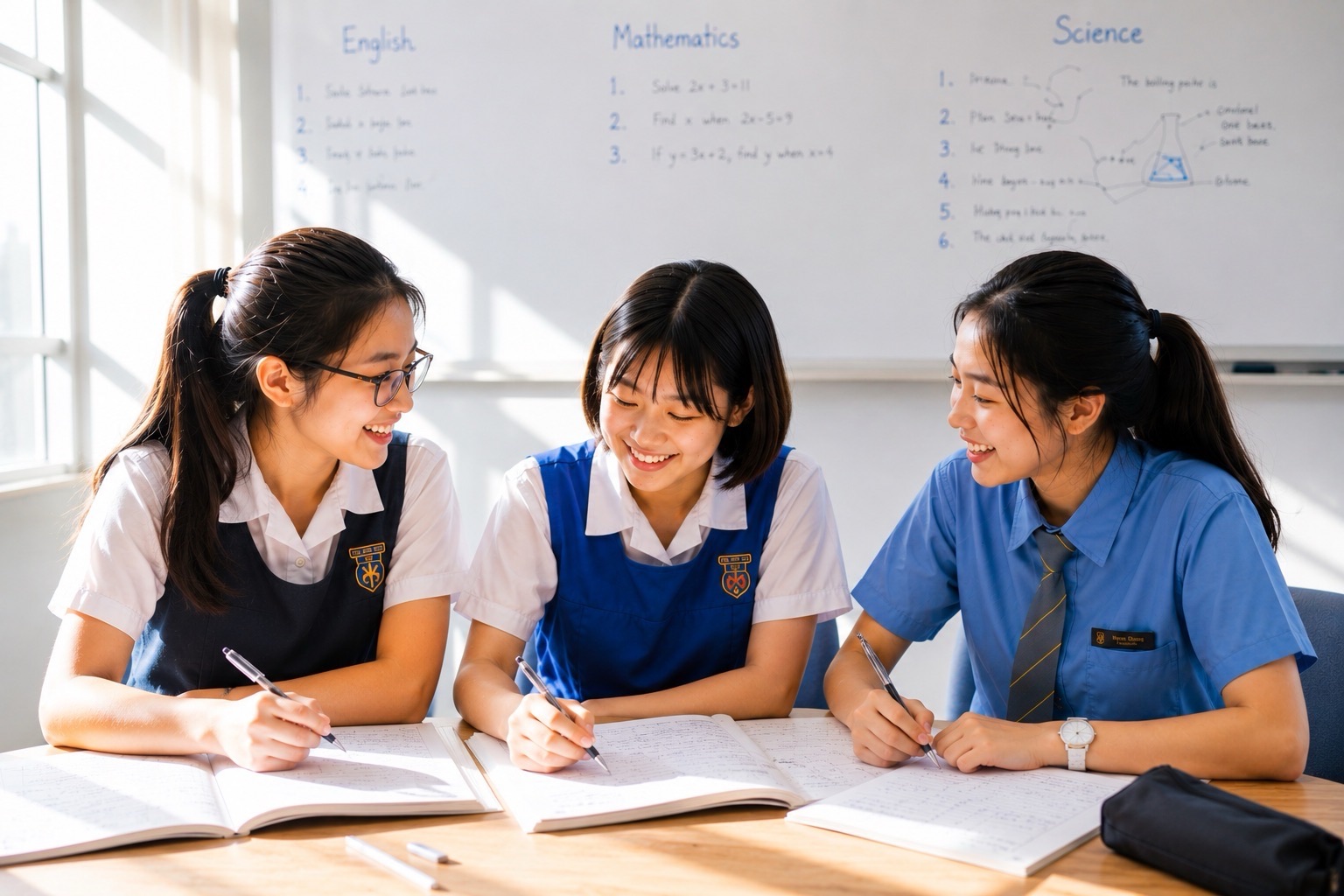
We teach in small groups of up to 3 students, allowing lessons to respond to the individual student’s actual weaknesses rather than simply moving through worksheets at the same speed for everyone.
Location: Punggol, Singapore
Levels: Primary Science through Secondary Science
Focus: Understanding, application, examination technique and independent problem-solving
Expert Science Tuition in Punggol
Science tuition should do more than help a student memorise facts.
A student may know that plants need light for photosynthesis, understand that forces affect motion, or remember the parts of the digestive system — yet still lose marks when the examination question presents the same idea in an unfamiliar experiment, diagram or real-world situation.
That is because successful Science learning requires several abilities to work together.
Students need to:
- understand the scientific concept;
- recognise which concept a question is testing;
- identify the important information;
- connect observations to scientific principles;
- use accurate scientific vocabulary;
- explain cause and effect clearly;
- answer according to what the question actually asks.
Our Science tuition in Punggol is therefore built around helping students understand how Science works, rather than simply accumulating more worksheets.
The eventual goal is not just better examination performance.
It is for the student to become capable of looking at an unfamiliar situation and thinking:
What is happening here?
What scientific principle explains it?
What evidence supports my answer?
That is the beginning of genuine scientific thinking.
Why Can Science Become Difficult?
Science often looks straightforward in the early stages.
Students learn about plants, animals, materials, forces, energy, electricity and the human body.
But as they progress, the subject changes.
Questions increasingly require students to combine several skills simultaneously.
A student may have to:
- interpret a diagram;
- identify a variable;
- compare two conditions;
- infer what happened;
- recall the relevant scientific principle;
- apply it to an unfamiliar situation;
- and explain the result precisely.
A weakness anywhere in that chain can cause the final answer to fail.
For example:
The student understands evaporation.
But the question is presented as an experiment involving two wet cloths placed in different environments.
The student now has to recognise that the experiment is testing evaporation, identify the variable affecting the rate of evaporation and explain why one cloth dries faster.
Knowing the definition alone is no longer enough.
This is why Science tuition should not simply ask:
“Does the student know the topic?”
We should also ask:
“Can the student use the topic?”
Science Learning at a Glance
| Science Skill | What the Student Needs to Do |
|---|---|
| Concept Knowledge | Understand scientific principles accurately |
| Observation | Notice relevant changes, patterns and evidence |
| Interpretation | Understand diagrams, tables and experiments |
| Application | Use knowledge in unfamiliar situations |
| Comparison | Identify meaningful similarities and differences |
| Inference | Explain what evidence suggests |
| Scientific Vocabulary | Use precise terms correctly |
| Cause and Effect | Explain why something happens |
| Experimental Reasoning | Understand variables, controls and outcomes |
| Examination Technique | Answer exactly what the question requires |
Strong Science students gradually learn to coordinate all of these abilities.
The Earliest Weak Link in Science
One important part of our teaching approach is identifying the earliest weak link.
The mistake seen on the examination paper may not be the original problem.
For example:
Weak vocabulary
↓
inaccurate understanding of the question
↓
wrong scientific concept selected
↓
poor explanation
↓
marks lost
Or:
Concept memorised without understanding
↓
unfamiliar question appears
↓
student cannot recognise the concept
↓
application fails
Or:
Student understands the concept
↓
cannot express cause and effect precisely
↓
answer becomes vague
↓
marks are not awarded
Simply correcting the final sentence may not solve the underlying weakness.
The earlier weakness needs to be repaired.
That is why small-group tuition can be particularly useful.
With only a few students, the tutor can observe how each student arrived at an answer, rather than merely checking whether the final answer was correct.
Primary Science Tuition in Punggol
Primary Science establishes much of the conceptual foundation students will continue using later.
Students encounter ideas relating to:
- living and non-living things;
- diversity;
- cycles;
- systems;
- interactions;
- energy;
- forces;
- materials;
- the environment;
- the human body;
- plants;
- electricity;
- heat;
- light;
- magnets.
But Primary Science is not merely about remembering these topics.
Students must gradually learn how scientific ideas interact.
For example:
A plant question may involve:
light + photosynthesis + water + transport systems + growth + environmental conditions
A question about animals may involve:
adaptation + habitat + food relationships + survival
An electricity question may involve:
circuit structure + conductors + energy + troubleshooting
This connected understanding becomes increasingly important as students approach PSLE Science.
PSLE Science Tuition in Punggol
PSLE Science requires students to do significantly more than recall textbook information.
A question may present:
- a new experiment;
- an unfamiliar organism;
- a graph;
- a diagram;
- an investigation;
- a change in environmental conditions;
- or several pieces of information that must be connected.
The student must then determine which scientific concepts are relevant.
This makes PSLE Science partly a knowledge problem and partly a reasoning problem.
What Students Need for PSLE Science
Students should develop four broad capabilities.
1. Strong Conceptual Foundations
The student must understand the topic accurately.
Memorising keywords without understanding their relationships creates fragile knowledge.
2. Question Recognition
Students need to recognise what scientific principle lies underneath the question.
An unfamiliar surface does not necessarily mean unfamiliar Science.
3. Application
Students must transfer what they know into new situations.
This is one of the largest differences between simply studying Science and performing well in Science examinations.
4. Precise Explanation
A scientifically correct idea can still lose marks when expressed vaguely.
Students therefore need to learn how to construct complete causal explanations.
Why PSLE Science Answers Lose Marks
A common frustration for parents is:
“My child seems to know the Science. Why are marks still being lost?”
There are several possibilities.
The student may:
- answer a different question from the one asked;
- use everyday language instead of scientific terminology;
- mention an observation without explaining the cause;
- state the cause without connecting it to the outcome;
- omit an important step;
- misunderstand a comparison;
- fail to use information provided in the question;
- memorise an answer format that does not fit the new situation.
These errors look similar on the examination paper, but they arise from different weaknesses.
Effective tuition should identify which one is actually occurring.
Scientific Vocabulary Matters
Science has its own language.
Words such as:
- increase;
- decrease;
- transfer;
- absorb;
- reflect;
- reproduce;
- dissolve;
- conduct;
- evaporate;
- condense;
- variable;
- organism;
- adaptation;
- force;
- energy;
carry specific meanings.
Students who understand the general idea but use inaccurate language may struggle to communicate their reasoning.
This is why vocabulary in Science should not be treated as a separate memorisation exercise.
Students need to understand:
the word + the concept + the relationship + the correct situation in which the word applies
Accurate scientific vocabulary improves both thinking and communication.
From Observation to Explanation
One of the most useful habits in Science is learning to separate:
What happened?
from:
Why did it happen?
Consider an experiment.
A student observes that Plant A grows taller than Plant B.
That is an observation.
But Science usually wants the mechanism.
The student may need to explain that Plant A received more of a required resource, allowing a biological process to occur at a different rate.
The exact explanation depends on the experiment.
This movement from:
observation → scientific cause → resulting effect
is fundamental to good Science answering.
Secondary Science Tuition in Punggol
Secondary Science increases both the depth and the density of scientific knowledge.
Students encounter more formal explanations and increasingly quantitative relationships.
Depending on the course and level, they may study areas of:
- Biology;
- Chemistry;
- Physics;
- laboratory work;
- experimental reasoning;
- measurement;
- data interpretation;
- scientific models;
- calculations;
- evidence-based explanation.
At this stage, students can no longer depend heavily on isolated memorisation.
The knowledge network becomes larger.
New topics frequently depend on earlier ones.
A weakness that begins in Secondary 1 may therefore continue affecting a student in Secondary 3 or Secondary 4 if it is never repaired.
Preparing for O-Level Science
O-Level Science requires students to coordinate several forms of knowledge.
They must know scientific content, but also understand:
- relationships between variables;
- experimental design;
- graphical information;
- scientific calculations;
- evidence;
- mechanisms;
- practical observations;
- question command words;
- appropriate answer depth.
This creates an important distinction:
Knowing Science is not exactly the same as being able to demonstrate Science under examination conditions.
Students need both.
Our tuition therefore works toward two objectives:
Scientific competence
and
examination competence
Neither should replace the other.
Understanding Before Memorising
Memorisation has a legitimate role in Science.
Students need facts, definitions, terminology and relationships available in memory.
But memorisation should sit on top of understanding.
Consider the difference between these students:
Student A
Memorises:
Heat travels from a hotter region to a colder region.
Student B
Understands the same principle and can apply it to:
- a metal spoon in hot soup;
- insulation;
- cooking;
- cooling;
- different materials;
- experimental results.
Both students may know the same sentence.
Only one has developed a usable scientific model.
That difference becomes increasingly important as questions become unfamiliar.
How We Teach Science at eduKate Singapore
Our Science lessons are organised around a simple progression.
Step 1: Understand
The student first develops a clear mental model of the concept.
We want the student to know what is happening and why.
Step 2: Connect
The concept is connected to related knowledge.
Students begin seeing Science as a network rather than separate chapters.
Step 3: Recognise
Students learn to recognise the same concept when it appears in different question formats.
Step 4: Apply
The concept is used in unfamiliar situations.
Step 5: Explain
Students practise expressing the scientific mechanism accurately.
Step 6: Check
Errors are examined to determine whether the problem arose from:
- knowledge;
- interpretation;
- reasoning;
- vocabulary;
- application;
- calculation;
- or examination technique.
Step 7: Transfer
The student attempts a different question using the same underlying scientific principle.
Transfer is important.
If the student can only answer the original question, the learning is not yet secure.
Small Group Science Tuition: Maximum 3 Students
eduKate Singapore teaches in small groups of up to three students.
This allows us to observe more than whether an answer is right or wrong.
We can ask:
Why did you choose this answer?
Which information in the question did you use?
What scientific principle is involved?
What would happen if this condition changed?
Can you explain the same idea another way?
These conversations reveal how the student is thinking.
That makes it easier to locate misconceptions before they become permanent.
A three-student classroom also gives students opportunities to hear alternative reasoning while retaining substantial tutor attention.
What Happens When a Student Gets a Science Question Wrong?
A wrong answer is information.
Instead of immediately replacing it with the model answer, we first need to determine what failed.
Was it:
Concept?
The student did not understand the Science.
Recognition?
The student knew the concept but did not realise it applied.
Interpretation?
The graph, experiment or diagram was misunderstood.
Vocabulary?
The student could not express the idea accurately.
Reasoning?
The cause-and-effect chain was incomplete.
Recall?
The information was learned previously but could not be retrieved.
Examination technique?
The student answered too little, too much or answered the wrong command.
Different failures require different repairs.
Giving every student another worksheet does not necessarily address any of them.
From Primary Science to Secondary Science
PSLE should not be viewed as the end of Science learning.
It is one checkpoint in a longer progression.
Primary Science introduces students to:
observation → concept → evidence → explanation
Secondary Science expands this into:
scientific models → mechanisms → measurement → experimentation → quantitative relationships → deeper explanation
Students who leave Primary school with genuine scientific understanding generally have a stronger foundation for this transition.
This is another reason we focus on durable understanding rather than examination tricks alone.
Science Examination Technique
Good examination technique should make knowledge easier to demonstrate.
It should never substitute for knowledge.
Students learn to pay attention to command words such as:
- state;
- identify;
- describe;
- explain;
- compare;
- suggest;
- calculate;
- predict.
These words indicate different intellectual tasks.
For example:
State may require a concise fact.
Describe may require what is observed.
Explain usually requires a mechanism or causal relationship.
Compare requires reference to both items.
A student who understands the Science but ignores the command word can still lose marks.
How Parents Can Support Science Learning
Parents do not need to reteach the entire Science syllabus at home.
Several simple habits are highly useful.
Ask the child:
“Why?”
“How do you know?”
“What evidence tells you that?”
“What would happen if we changed this?”
These questions encourage scientific reasoning.
Everyday situations can also become useful Science conversations:
- Why does condensation appear on a cold drink?
- Why do clothes dry faster in some conditions?
- Why are some materials used as electrical insulators?
- Why do shadows change?
- Why does food spoil?
- Why do certain plants grow better in particular environments?
Science becomes more durable when students recognise that the concepts they learn describe the world around them.
Does My Child Need Science Tuition?
Not every student requires tuition.
Additional support may be useful when a student consistently:
- memorises without understanding;
- struggles with open-ended questions;
- loses marks despite knowing the topic;
- cannot explain answers clearly;
- finds application questions difficult;
- has accumulated gaps from earlier levels;
- performs inconsistently;
- avoids Science because it feels confusing;
- needs structured examination preparation.
The useful question is not simply:
“Are the marks low?”
A better question is:
“What is preventing the student from turning learning into reliable performance?”
That is what we try to diagnose.
Frequently Asked Questions About Science Tuition in Punggol
What is the ideal group size for Science tuition?
Different students learn well in different environments. At eduKate Singapore, we work with groups of up to three students because this allows substantial tutor interaction while preserving useful discussion between learners.
When should my child start PSLE Science tuition?
There is no universal starting point.
A student with strong foundations may need relatively little intervention. A student carrying misconceptions from earlier topics may benefit from addressing them earlier rather than waiting until immediately before PSLE.
The best starting point depends on the student’s current learning state.
Can Science improve through practice papers alone?
Practice papers are useful for testing performance, but they do not automatically repair conceptual weaknesses.
If the underlying Science is weak, repeated papers may simply reproduce the same error.
Students need a combination of:
learning → practice → diagnosis → correction → retesting.
Why does my child understand Science but still lose marks?
The problem may be application, question interpretation, vocabulary, explanation structure or examination technique rather than basic knowledge.
The error needs to be diagnosed before an effective solution can be chosen.
Is memorisation important in Science?
Yes, but it is only one part of learning.
Scientific facts and vocabulary need to be remembered, but strong students can also connect, interpret and apply that knowledge.
How can my child improve open-ended Science questions?
Students need to practise identifying the concept being tested, selecting relevant evidence and constructing a complete cause-and-effect explanation.
Simply memorising model answers is less reliable when the examination changes the context.
Does Primary Science help prepare students for Secondary Science?
Yes.
Primary Science develops important foundations in observation, scientific concepts, evidence, relationships and explanation. Secondary Science then develops these abilities at greater depth.
Science Is About Understanding the World
A good Science education should eventually create something more valuable than a collection of examination answers.
It should help students become comfortable asking:
What do I observe?
What changed?
What caused the change?
What evidence do I have?
What explanation best fits the evidence?
Those questions sit near the heart of scientific thinking.
Examinations matter.
PSLE matters.
O-Level Science matters.
But the capabilities developed while preparing for them can remain useful far beyond the examination hall.
Expert Science Tuition in Punggol with eduKate Singapore
At eduKate Singapore, our Science tuition in Punggol focuses on helping students move from:
remembering → understanding → applying → explaining → independently solving.
We work to identify the student’s earliest weak link, strengthen the underlying Science and then develop the examination skills needed to turn that knowledge into reliable performance.
Our small-group format of up to three students allows lessons to remain responsive to individual learning needs while still giving students the benefits of discussion and comparison.
Whether the immediate goal is:
- improving Primary Science;
- preparing for PSLE Science;
- strengthening the transition into Secondary Science;
- repairing weaknesses in Secondary Science;
- or preparing more confidently for O-Level examinations;
the objective remains the same:
Build a student who understands the Science well enough to use it.
That is a stronger foundation for examination success — and for everything that comes after it.
