
Children are often told that reading more will improve their writing.
Reading can supply language, knowledge, story structures, sentence patterns and a sense of what clear writing sounds like. But transfer is not automatic.
A child can read widely and still produce weak compositions if the useful features of the text are never noticed, explained, practised or used independently.
Reading becomes writing instruction when the student can move from “I noticed this” to “I can use the underlying principle in a different piece of writing”.
The Reading-to-Writing Transfer Loop
notice → name → explain → imitate the structure → vary → use independently → revise → retrieve later
Each step matters.
- Notice: identify a meaningful choice in the text.
- Name: give the choice a usable label.
- Explain: connect the choice to its effect on meaning.
- Imitate: reproduce the pattern with different content.
- Vary: change context, sentence shape or purpose.
- Use: apply it inside independent writing.
- Revise: decide whether it genuinely improves the new piece.
- Retrieve: use the principle again after time has passed.
What Reading Can Contribute to Writing
| Reading feature | Possible writing transfer |
|---|---|
| precise verb | more accurate action and characterisation |
| sentence variation | control of pace and emphasis |
| transition or connector | clearer logical relationship |
| paragraph opening | stronger topic or scene orientation |
| character viewpoint | consistent knowledge, emotion and attention |
| evidence and explanation | more developed informational or argumentative writing |
| text structure | better sequence, comparison, cause–effect or problem–solution organisation |
| ending | resolution that follows from the earlier text rather than arriving suddenly |
The text should be selected for the writing job. A suspenseful narrative is useful for studying event control; a clear informational article may be better for studying explanation and evidence.
Transfer 1: Vocabulary in Context
Reading exposes students to words inside real relationships.
Instead of copying an impressive word, ask:
- What exactly does it describe?
- What words usually appear near it?
- What tone does it create?
- Is it formal, conversational, technical or literary?
- What simpler word could replace it?
- In which new context would it still be accurate?
Then use the word in a different sentence and retrieve it later.
A precise familiar word is stronger than a rare word used only because it appeared in a model composition.
Transfer 2: Sentence Structure
Students can imitate a sentence’s structure without copying its content.
Model:
Although the path was narrow, the hikers continued because the shelter was already visible.
Underlying structure:
concession + main action + reason
New sentence:
Although Jia Wei felt nervous, he raised his hand because the group still needed an answer.
The content is new. The student has transferred a relationship pattern.
Transfer 3: Paragraph Function
Paragraphs are not merely blocks of several sentences.
They perform jobs:
- introduce a setting or claim;
- develop one reason;
- provide an example;
- show a change in time or viewpoint;
- escalate a problem;
- present a consequence;
- resolve or qualify an earlier idea.
After reading a model paragraph, ask the student to label its function and describe how each sentence contributes.
Then write a new paragraph with the same function on a different topic.
Transfer 4: Cohesion
A text feels connected because the writer manages reference, repetition and logical movement.
- pronouns point clearly to nouns;
- key words repeat when continuity is needed;
- synonyms vary language without changing the topic;
- transition words describe real relationships;
- known information appears before new information where useful.
Students can highlight these chains in a passage, remove one link, observe the damage, then apply the principle to their own paragraph.
Transfer 5: Narrative Causality
Strong narratives create consequences rather than simply listing events.
goal → obstacle → pressure → decision → consequence
While reading, ask:
- What does the character want?
- What prevents it?
- Which detail changes the decision?
- What consequence follows?
- How does the ending depend on the earlier story?
Then use the same causal architecture with different characters, setting and events.
Transfer 6: Viewpoint and Voice
Reading different narrators helps students understand that the same event can be represented differently.
- What does this narrator know?
- What does the narrator misunderstand?
- Which details receive attention?
- What language reveals attitude?
- How would another character tell the event?
A useful transfer task is to rewrite a short event from another character’s perspective while preserving the facts.
Transfer 7: Evidence and Explanation
Informational and argumentative texts show how claims are supported.
claim → evidence/example → explanation → implication
Students can identify which sentence states the point, which supplies support and which explains the connection.
Then write a new paragraph on a different topic using the same evidence architecture.
Reading Does Not Improve Writing Through Copying Alone
Copying can help handwriting, spelling or sentence familiarity in limited tasks. It does not by itself teach independent composition.
Warning signs include:
- memorised phrases appear in the wrong context;
- writing quality collapses when the prompt changes;
- one polished paragraph sits beside several weak paragraphs;
- the student cannot explain why the phrase works;
- the model’s plot is reproduced regardless of the pictures.
The repair is structural imitation followed by variation and independent use.
Reading Widely and Reading Closely Have Different Jobs
| Wide reading | Close reading |
|---|---|
| builds volume, knowledge and familiarity | examines how a selected passage works |
| supports interest and reading stamina | makes language and structure visible |
| should often remain low-stakes | can support deliberate instruction |
| does not require analysis of every page | focuses on a small number of high-value features |
Students need both. Analysing every book can damage reading enjoyment; reading passively without ever noticing craft may produce little writing transfer.
A Reading-to-Writing Lesson
- Read: understand the passage as a whole.
- Select: choose one high-value feature.
- Notice: identify the exact words or structure.
- Explain: connect the feature to its effect.
- Imitate: write a new example with different content.
- Integrate: use it inside a paragraph or composition.
- Revise: decide whether it fits the new purpose.
- Retrieve: use it later without the model.
A Four-Week Transfer Cycle
Week 1: Sentence Relationships
Notice cause, contrast, condition, sequence and emphasis. Build new sentences with the same relationships.
Week 2: Paragraph Function
Map topic, support, example and explanation—or setup, pressure and change in a narrative scene.
Week 3: Viewpoint and Evidence
Compare how details change with perspective and how claims are supported.
Week 4: Independent Application
Use selected principles in a new writing task, then explain and revise the choices.
The cycle is an example, not a compulsory schedule. The student’s current writing should determine the priority.
How the Transfer Changes Across Primary School
| Stage | Useful transfer work |
|---|---|
| Primary 1–2 | oral retelling, sentence patterns, sequence and clear who–did–what relationships |
| Primary 3–4 | paragraph sequence, connector logic, viewpoint and descriptive purpose |
| Primary 5–6 | inference, rhetorical effect, evidence, narrative causality and independent revision |
The stages overlap. Prior knowledge and actual performance matter more than a rigid age label.
Diagnostic Signals
| Observed pattern | Possible weak link | Response |
|---|---|---|
| Reads widely but writes generic sentences | craft is not being noticed | use selective close reading |
| Copies phrases but cannot adapt them | surface imitation | name and vary the underlying structure |
| Has ideas but paragraphs do not connect | text-structure transfer | map paragraph functions |
| Uses new vocabulary inaccurately | context and collocation | compare usage across examples |
| Can analyse a model but not write | application step is missing | move immediately into a small production task |
| Uses the skill once, then loses it | retrieval is missing | schedule delayed reuse |
What Small-Group Tuition Can Add
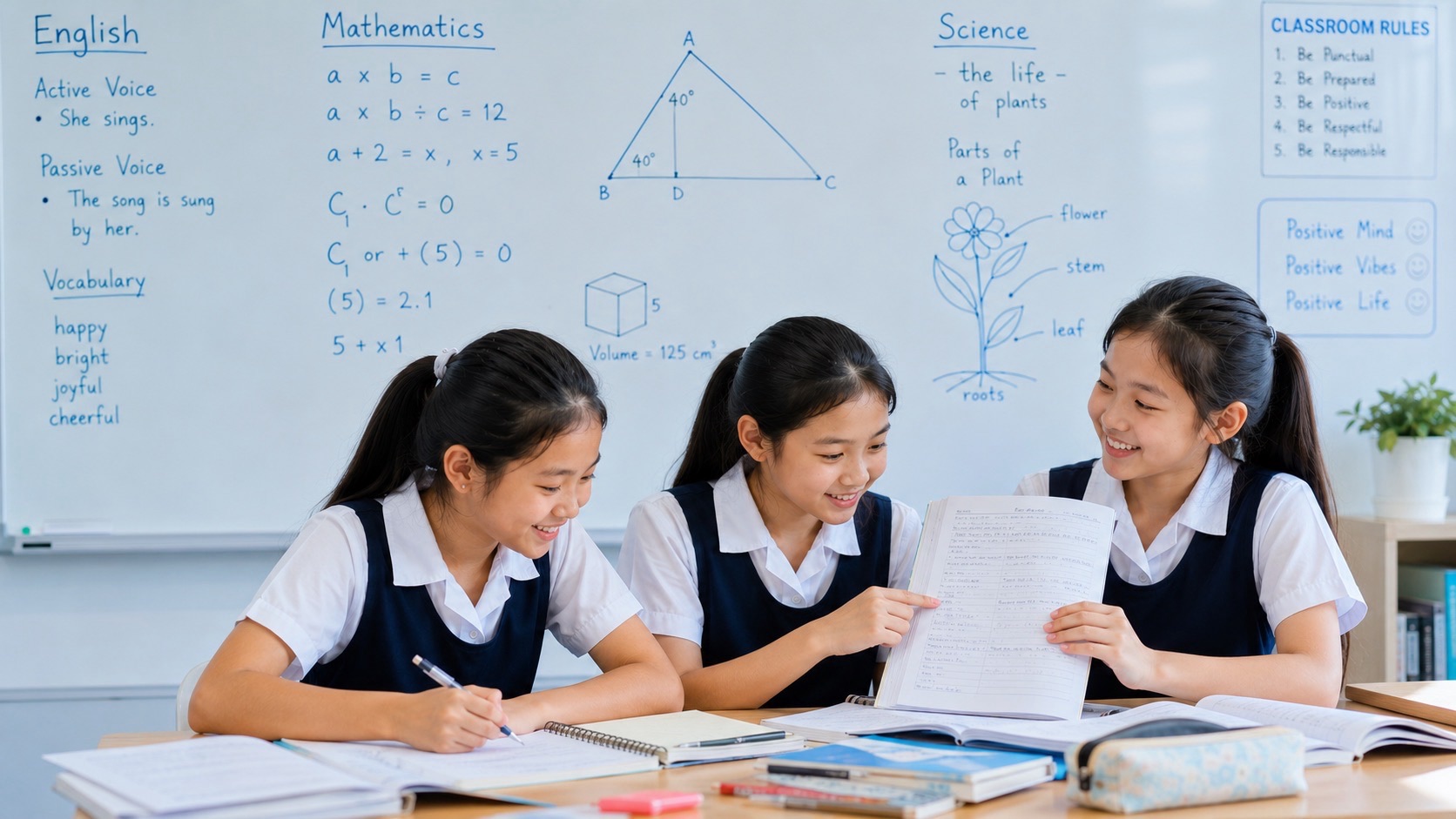
In a group of up to three, students can notice different features in the same text and compare how those features might be transferred.
- one learner may focus on sentence clarity;
- one may examine paragraph structure;
- one may be ready for viewpoint or rhetorical effect;
- all can evaluate whether a new use preserves the original principle.
The tutor should ensure that comparison produces independent writing rather than imitation of the strongest student.
What Parents Can Do at Home
- Ask which sentence or paragraph the child liked and why.
- Choose one structure to imitate with different content.
- Discuss character decisions and consequences.
- Compare two openings or endings.
- Let some reading remain purely for enjoyment.
- Ask the child to use one noticed principle in later writing.
How to Tell Whether Transfer Is Happening
- the student can explain why a model choice works;
- new vocabulary is used accurately in a different context;
- sentence and paragraph structures appear without copying;
- reading observations improve independent revision;
- the principle survives a new topic or genre;
- the student retrieves it weeks later;
- writing choices become more deliberate and less decorative.
What Tuition Cannot Promise
- Reading one model does not guarantee better writing.
- Reading more does not automatically solve a specific grammar or planning weakness.
- Copied phrases are not evidence of transfer.
- One programme cannot guarantee examination results.
- A child who already reads and writes independently may not need tuition.
Related eduKateSG Guides
- Can English Tuition Build a Love of Reading?
- Primary Composition Writing
- Primary English Comprehension Diagnosis
- Transition Words in Primary English
Current Curriculum Reference
