
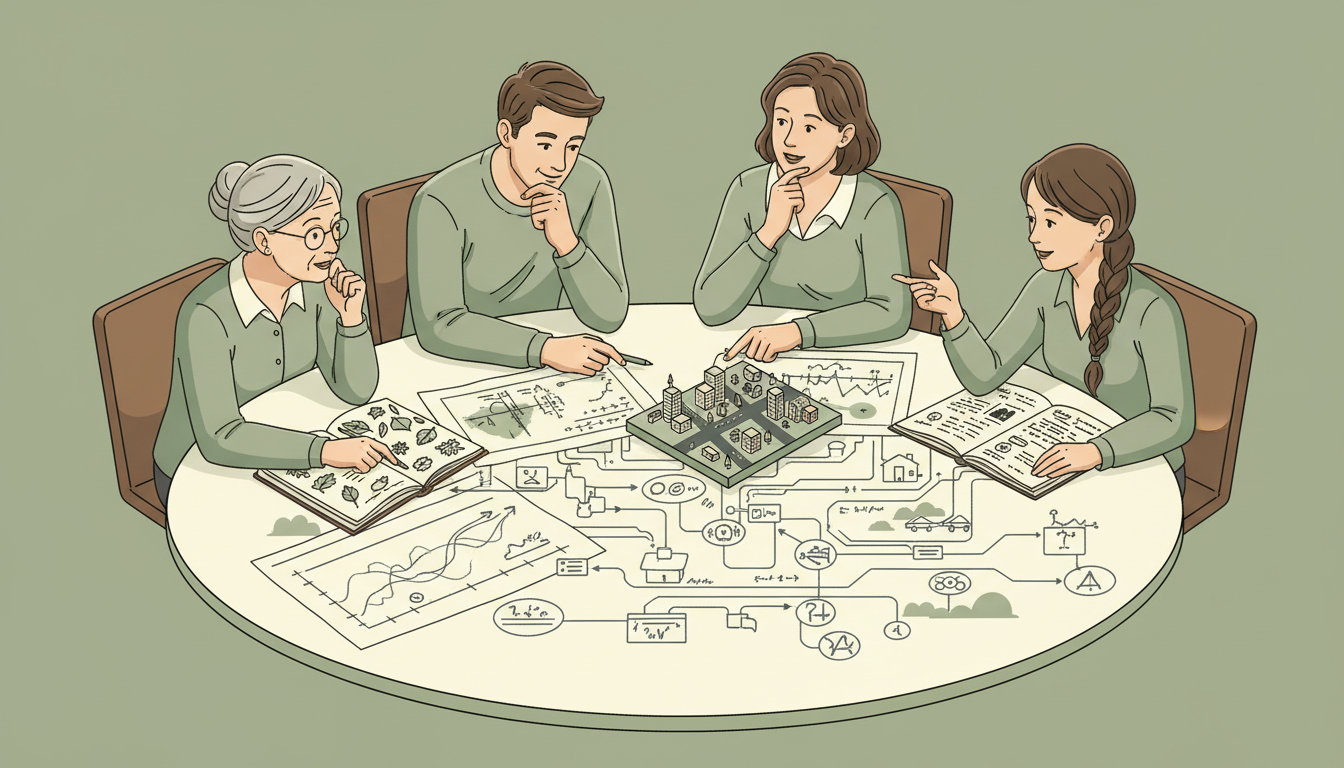
A polytechnic final-year project becomes credible career evidence when a student can demonstrate how a problem was framed, a solution was tested, results were interpreted and their own contribution was verified. An attractive prototype is not the same as a proven outcome. Honest methods, limitations, team credit and sharing permission matter just as much as appearance.
This guide explains the distinctive role of FYPs in Singapore polytechnic learning, with Nanyang Polytechnic programme examples and public Republic Polytechnic student showcases. It follows scope, baseline, validation, teamwork, confidential information and portfolio evidence. It does not assume all diploma courses use an identical timetable or project rubric.
GS8 applied continuation · Guide 10 in How the Capability Divide Works in Singapore. Related chapters: Polytechnic Internships Become Career Evidence and Transferable Skills Become Hiring Evidence. Official sources reviewed 23 October 2026; all numerical laboratories below are invented.
Find your question
- What is a testable question? · Why measure a baseline? · Units and denominators
- Verification versus validation · Team credit · Sharing permission
- Employer interview explanation · Fair interpretation · FAQs
| Part of the FYP | What it should demonstrate | A common error to avoid |
|---|---|---|
| Problem and scope | A clear question with feasible limits | Promising to solve an entire national problem |
| Methods and baseline | Reproducible procedure and relevant comparison | Choosing a flattering, noncomparable control |
| Results and limits | Evidence with units and honest uncertainty | Treating one successful demo as universal proof |
| Individual contribution | Actual work in the team and verification | Claiming the whole team’s achievement as personal work |
| Public portfolio | Only permitted and accurately described material | Publishing confidential partner data or code |
1. A final-year project is a controlled explanation of a problem
A good final-year project does more than display an attractive prototype or poster. It identifies a problem, defines what would count as progress, chooses a method, records limitations and explains the contribution the student actually made. A working demonstration can be persuasive, but a polished interface without test evidence does not tell a future employer whether the student understands why the solution behaves as it does.
The educational value comes from connecting theory to a decision that can be checked. In some diploma courses the project is done for an industry partner; in others the challenge is academic or entrepreneurial. Either way the student should know who can approve scope changes, which work belongs to a team and what the school’s actual marking rubric requires.
2. Why the project is not simply another internship
An internship primarily places a learner inside the host’s day-to-day processes and professional practices. A final-year project often has a defined question or artefact and an investigation, design or validation process. Both can involve industry and both can build career evidence, but the proof differs. Knowing how to operate an existing process is not the same as explaining why a new process meets an explicit requirement.
This guide follows problem framing, baselines, tests, reproducibility, team contributions and permission to share. The linked polytechnic internship guide separately examines company supervision, allowance and school assessment. Employers can value both types of evidence without assuming that an impressive demonstration replaces workplace qualifications or safe operating experience.
3. NYP offers a useful example of how different pathways are structured
Nanyang Polytechnic’s Advanced & Digital Manufacturing course describes a structure with a 12-week internship and a 12-week final-year project, or a 24-week internship route. Its Work-Integration Units connect workplace-contextualised projects to competency development. This is one concrete programme example, not a fixed schedule that every polytechnic student follows.
The learner should read the current course page and assessment specification before making a plan. Another course may integrate its projects differently; a particular student may not have a choice between the two routes. The lesson is that internships and FYPs have distinct functions even when both connect education to industry.
4. Turn a broad ambition into a problem that can be tested
“Improve public transport” is too broad for most student projects. “Check whether a fictional stop-alert interface remains legible under three simulated lighting conditions” can be investigated with a defined method. The student should name the specific user, task, constraint and expected outcome without claiming that one prototype can solve the whole original problem.
For an invented sustainability project, the goal could be reducing measurement errors in a campus water-monitoring mock-up. That still requires choosing which error matters, what the baseline is and how the proposed change will be tested. A good supervisor helps narrow the scope until a real evaluation is possible instead of allowing the proposal to promise more than its time and evidence can support.
5. A research question and a product specification are not interchangeable
A research question asks what evidence would help decide between explanations. A product specification describes what a solution must do. A project can include both but should not confuse them. If a student builds a notification app, testing whether users notice alerts is different from verifying that the app sends alerts after an authorised trigger.
Write a short statement for each: “We want to learn whether X changes under Y” and “Our system must perform Z within specified constraints.” The first calls for fair comparison and observation; the second calls for technical verification. Together they create a stronger project than a list of features accompanied by vague claims that users loved it.
6. Define the baseline before showing an improvement
An improvement needs a reference point. If an application detects faults more quickly, the team must describe the older procedure or alternative method being compared and how the same task was performed. A baseline is not a deliberately broken competitor selected to flatter the prototype. It should be relevant and measured with comparable conditions.
In an invented example, a student compares a paper checklist with a digital checker for the same 30 simulated entries. They must state which errors were planted, who performed the checks and what counts as a false positive. Without those definitions a headline such as “faster and better” cannot be interpreted. The chosen baseline determines what conclusion the evidence can support.
7. The metric must correspond to the actual outcome
A project team may measure interface clicks because software can count them, while the real goal is whether users make fewer costly mistakes. Click count is an activity measure; task accuracy is an outcome measure. Both can be useful, but a good report identifies which one is primary and why it represents the problem being addressed.
For a fictional scheduling tool, relevant metrics might include the number of conflicting bookings detected, the proportion of correctly classified cases and the time needed to confirm an exception. Do not invent a universal acceptable percentage or claim a performance benchmark without a source. The supervisor and team should agree on meaningful measures before seeing the most flattering results.
8. An example calculation: a shorter average can still hide an unsafe miss
Imagine a fictional project testing ten equally defined administrative tasks. A revised method takes a total of 130 minutes and the previous method 150 minutes, giving averages of 13 and 15 minutes per task. The change is 2 minutes per task on that constructed set. But suppose the faster method fails to flag one mandatory approval; time saved does not make that miss acceptable.
The correct conclusion is conditional. The method is faster on this sample under the test assumptions, but it has an unresolved accuracy or authorisation problem. State both results, not only the pleasing improvement. These timings are teaching numbers, not published research or a measured Singapore polytechnic project.
9. Units, denominators and sampling frames matter
A project may compare percentages collected from different denominators without noticing. Saying “20% had an error” is ambiguous without a count of records tested and a definition of error. A result from five volunteer users should not be described as a universal rate for all future customers. Consistent units are part of sound engineering and social research.
Create a methods table before collecting results: variable, unit, population or test set, collection method, expected limitations and storage location. When conditions change, note the change instead of silently merging the data. A careful small study is often more informative than a large unsourced claim.
10. Repeatability is a practical kind of truthfulness
A teammate should be able to follow the stated method with the same inputs and obtain appropriately comparable results. That requires version information, settings, definitions and a record of significant decisions. A screenshot of a successful run cannot substitute for a reproducible procedure.
The team can create a simple demonstration pack using fictional or authorised test data, a clear setup guide and a known expected output. Do not upload protected company code or datasets merely to satisfy a reader’s curiosity. When a result cannot be reproduced, the report should say so and investigate the cause before declaring success.
11. Distinguish design verification from user validation
Verification asks whether the project was built correctly against specified requirements. Validation asks whether the right problem was addressed for the intended user and setting. A sensor can meet its laboratory accuracy target yet be awkward to maintain in a real room; a mobile app can look usable in a classroom yet fail when notifications arrive while a user is outdoors.
Use both forms of evidence where appropriate. A verification checklist might measure dimensions or accepted values, while a bounded user test investigates whether tasks can be completed. Neither should be presented as legal certification or clinical validation where specialised regulatory processes apply.
12. One successful demonstration is not reliability evidence
A prototype may work during presentation because the conditions are unusually controlled. Reliability requires asking what happens under a plausible range of inputs, user actions and failures. This does not demand an unrealistic industrial-grade testing programme from every student; it requires an honest distinction between a prototype demonstration and a product proven ready for deployment.
For a fictional app, test a missing field, a repeated request, a disconnected state and an invalid input where these are relevant. Record what the system does rather than quietly removing awkward cases. A failed edge case can be useful educational evidence if the team locates and explains the defect.
13. Negative results can make a project stronger
A design change may fail to improve the chosen metric. That result does not automatically make the project worthless. If the experiment was well designed, the team may learn that an assumption was wrong or that a different constraint dominates the system. Inventing a success number would destroy the value of that discovery.
A useful final report includes the original hypothesis, what was tested, what actually happened, what cannot be concluded and what should be changed in a future attempt. A student who can explain a failed test accurately may demonstrate more scientific maturity than someone who presents a perfect story without verifiable data.
14. Team projects require individual contribution evidence
When a group builds a prototype, team success and individual competence are not identical. One member may design the user interface, another test the data handling and another prepare the evaluation method. A claim that each person independently built the whole system would be misleading unless supported.
Create a contribution ledger describing tasks, decisions, revisions and reviews. Team members should confirm major attribution claims. In an interview, a graduate can say what they owned, what collaborators contributed and how shared decisions were made. The goal is fair credit rather than a competition to minimise other people’s work.
15. A useful project log captures decisions, not just activity
“Worked on the prototype for five hours” says little about learning. “Rejected a new data-cleaning rule because it mislabeled missing values as zero” reveals a substantive technical decision. A concise log should contain the question, evidence, choice made and resulting test or next step.
Students should keep enough information to reconstruct important design changes and mistakes while respecting institutional and partner data rules. If a choice was imposed by an external constraint, say so. The most valuable log explains why the project reached its result instead of merely demonstrating that the team stayed busy.
16. The supervisor’s job is to make the standard visible
A project supervisor can help narrow objectives, identify unsafe assumptions, guide methods and challenge conclusions. They should not need to supply the entire solution for the team. Learners grow when they can explain their own choices and understand why a correction was requested.
An effective review meeting begins with the current claim, the evidence supporting it and one unresolved risk. The supervisor can then ask for a specific new test or clearer limitation. A general request to “improve the project” is less useful because it fails to reveal which gap must be closed.
17. Industry partners add realism and permission boundaries
An industry partner can give access to a real class of problems and explain operational constraints that would be absent from a purely academic exercise. NYP describes final-year projects and work-integrated learning with employers, while Republic Polytechnic has reported publicly showcased student collaborations. Such examples demonstrate the availability of authentic problems, not that every student project is commercially deployed.
When a project involves a partner, agree what data and designs can be used, how work is reviewed and what can later be published. A partner’s enthusiasm does not itself waive confidentiality or intellectual property restrictions. Clear terms allow students to learn without accidentally disclosing protected information.
18. Public showcase evidence should not be overstated
Republic Polytechnic’s 2026 AI for Good Festival featured student-developed AI projects in collaboration with organisations. A public demonstration can show the concept and learning context, but it is not equivalent to independent certification of safety, clinical effectiveness or industrial readiness. Specific claims in a public article should remain within what the organiser actually reported.
A student discussing a similar FYP should distinguish prototype, pilot, tested deployment and mature service. It is legitimate to say a demonstration explored a technical approach. It is not legitimate to claim a product solved a national problem simply because it appeared at a festival.
19. Intellectual property is a permission question, not a confidence question
Students often want to use project screenshots, code and data to apply for jobs. The right to do that depends on school rules, ownership arrangements, third-party licences and any partner agreement. A project report submitted privately for academic assessment is not automatically free to redistribute on a portfolio website.
If a prospective employer asks for proof, offer an authorised public summary, a properly anonymised independent demonstration or a conversation about the method. Never assume that removing a company logo eliminates trade secrets. When uncertain, obtain written clearance or construct a new fictional case.
20. Authorship and software licensing are separate matters
An individual may have written a piece of code while the programme uses licensed libraries, datasets or company systems. Being the author does not automatically grant permission to publish dependent materials or sell the resulting tool. A student who understands licence conditions and attribution requirements shows more mature professional judgment.
Create a permission map naming original student work, team work, third-party components and partner-owned inputs. The public portfolio should include only material approved for that use. An employer evaluating a candidate can still assess reasoning through a small fresh task rather than demanding protected files.
21. The one-page career evidence summary
A strong project summary fits a clear structure: problem and stakeholder; objective and constraints; individual responsibility; method and baseline; relevant results; important limitations; and what the student can now do independently. It should not open with a catalogue of unrelated software logos.
Use numerical results only when they were actually measured and the relevant denominator and conditions are provided. A student can also describe a qualitative finding with care, such as a recurring usability issue identified during a documented task test. The aim is a trustworthy conversation starter that survives detailed follow-up questions.
22. One-minute interview explanation: evidence before enthusiasm
A graduate might say: “Our team built a simulated appointment checker. I designed the exception-handling rule. We tested it against known cases and found that one approval category was misclassified. I revised the check and documented what remains untested.” This is an invented statement but demonstrates the useful pattern of role, action, validation and limit.
The candidate should be ready to explain how one test case was built and what they would change under a new requirement. If they cannot, a polished poster will not establish independent understanding. The interview should reward truthful competence, not exaggeration.
23. What makes a project different from a start-up pitch
An FYP can investigate a prototype without proving commercial demand, a sustainable business model or regulatory clearance. A student team that designs an app may learn valuable engineering even if nobody wants to pay for it. Conversely, a project may have a potential customer yet still require further safety, licensing or scale testing.
Keep educational assessment and commercial claims distinct. A pitch about possible market demand is a hypothesis until tested with suitable evidence. Do not imply that a university credit or project grade certifies the viability of a business. Each question requires its own method.
24. A team disagreement can reveal a methodological error
Suppose one member wants to exclude two inconvenient test results and another argues they belong in the dataset. The decision should depend on pre-agreed exclusion rules and the data’s validity, not which choice improves the chart. A project team needs a way to resolve such disputes through transparent methods and supervisor input.
This is an excellent teaching case because it connects ethics and data analysis. If a sensor failed to record any meaningful value, flag the failure according to a stated rule. If the result is merely surprising, do not discard it automatically. The discipline is transferable to workplace reporting and research.
25. A worked comparison with a confounding variable
An invented team tests two queue-notification interfaces. Version B appears faster than Version A, but B is tested only with students who have already practised the task. Familiarity could explain some of the difference. It would be misleading to credit the full improvement to interface design.
A better test would balance training or account for it in analysis. If the project cannot do that, it can still report the observed association and its limitations. Recognising a confounder is useful evidence of reasoning. The example is instructional, not a real published trial.
26. The method should survive a changed requirement
A student may build a prototype for one kind of input and later face an employer asking how it would handle missing or contradictory data. The strongest answer explains the original design, checks which assumptions still hold and identifies required new tests. Copying the old result into a new context would hide the limits of transfer.
This connects directly with the transferable hiring evidence guide. A student’s project offers evidence of how they think, but the recruiter still needs a role-relevant question. Good transferable competence includes asking whether the new context changes the rule.
27. The final report should separate observed results and interpretation
A methods chapter explains what was done; a results chapter reports what happened; a discussion interprets meaning and limits. Mixing the three can turn a weak observation into a broad conclusion without the reader noticing. Students need not adopt one universal report structure, but the intellectual separation should remain clear.
A well-written conclusion avoids saying “our invention will transform the industry” without evidence. It can say that a defined test showed a particular result under stated conditions and that further work is required before broader use. Precision does not make a project less impressive; it makes its value more credible.
28. Parents can ask what the student learnt rather than what the device looks like
A parent may see an attractive display but have difficulty judging its educational value. Better questions are: which problem was chosen, what evidence supports the conclusion, what did the learner do independently, which result surprised the team and what would be tested next? The student can answer without disclosing restricted partner information.
Parents should not need to solve the project themselves. Their contribution is to encourage accurate explanation, realistic schedules and safe academic practice. The school and supervisor remain responsible for formal assessment and technical oversight. An excellent FYP should ultimately strengthen the student’s independence.
29. A final-year project is a bridge, not a lifetime label
One good FYP can open a conversation about an occupation, but it does not fix a graduate’s career permanently. The student may discover they prefer testing to programming, laboratory work to product design, or implementation to research. A disappointing result may still reveal valuable interests and skills.
What matters for capability is whether the learner leaves with a reusable way to frame a problem, collect evidence, test claims, work fairly with others and respect the boundaries of what has been proved. That is a stronger basis for future learning than the prestige of a project title alone.
Frequently asked questions
Is every Singapore polytechnic required to have a separate 12-week FYP?
No. NYP provides programme examples with distinct internship and FYP periods or a longer internship route. Check the specific school and diploma.
Can my FYP be used as a personal business?
Possibly, subject to school, partner, intellectual property, licence and legal conditions. Academic submission alone is not commercial clearance.
Is a public showcase proof a prototype is safe for everyone?
No. A showcase demonstrates a project in a stated context; safety or regulatory approval needs separate evidence.
How should we split team credit?
Describe the real contributions of each member and joint decisions, using an agreed ledger or other authorised record.
Does a failed hypothesis mean the student fails?
Not necessarily. Academic assessment depends on the course rubric; accurate negative results can demonstrate good research practice.
How can students show confidential project work to employers?
Use approved summaries, safe mock-ups or an independent fictional reproduction with clear labelling.
Are measured percentages always useful?
Only when the outcome, denominator, method and limitations are stated. A number without context can mislead.
Should students remove inconvenient test data?
Only according to justified, documented rules. Surprising results should not be discarded merely to improve the headline.
Can an FYP replace a regulated professional qualification?
No. A project demonstrates particular work, not statutory registration or mandatory certification.
What is the smallest credible project report?
A clear problem, contribution, method, result, limitation and permitted evidence of what the learner can do.
Can a project continue after graduation?
Sometimes, but continuation depends on ownership, permissions, practical resources and any organisational agreements.
What should a recruiter ask about an FYP?
Ask about the candidate’s actual contribution, a specific test, an unresolved defect and how the method would change in a new situation.
Control Tower | Trustworthy FYP Evidence
Input: defined question, constraints, team, methods and permitted resources.
Mechanism: baseline → build → verify → validate → record limits → test transfer.
Checks: individual contribution, units, reproducibility, data rights and consent.
Failure modes: cherry-picked results, missing denominators, inflated claims, hidden co-authors, leaked partner materials.
Repair: rerun a fair test, disclose uncertainty, correct attribution and obtain sharing permission.
Outcome: a student able to explain credible work beyond the display booth.
Official project examples and further reading
- NYP Diploma in Advanced & Digital Manufacturing — course structure with examples of internship and FYP routes.
- NYP Diploma in Applied AI & Analytics — Work-Integration Units and FYP links to demonstrated skills.
- NYP CO:LAB Cross-Disciplinary Business Centre — May 2026 industry learning model for business students.
- RP AI for Good Festival 2026 — public student projects; a showcase is not independent product certification.
- SP Internship Guidelines — confidentiality and school/host boundaries, relevant when comparing project and placement evidence.
- Connected reading: Polytechnic Internship Evidence, Transferable Hiring Evidence, How Education Works and Singapore Capability Divide hub.
All people, interface timings, test sizes, data errors and project examples explicitly described as invented are teaching constructions, not reported Singapore diploma assessment results. The featured conceptual research illustration is not a photograph of these experiments. Source review date: 23 October 2026.