
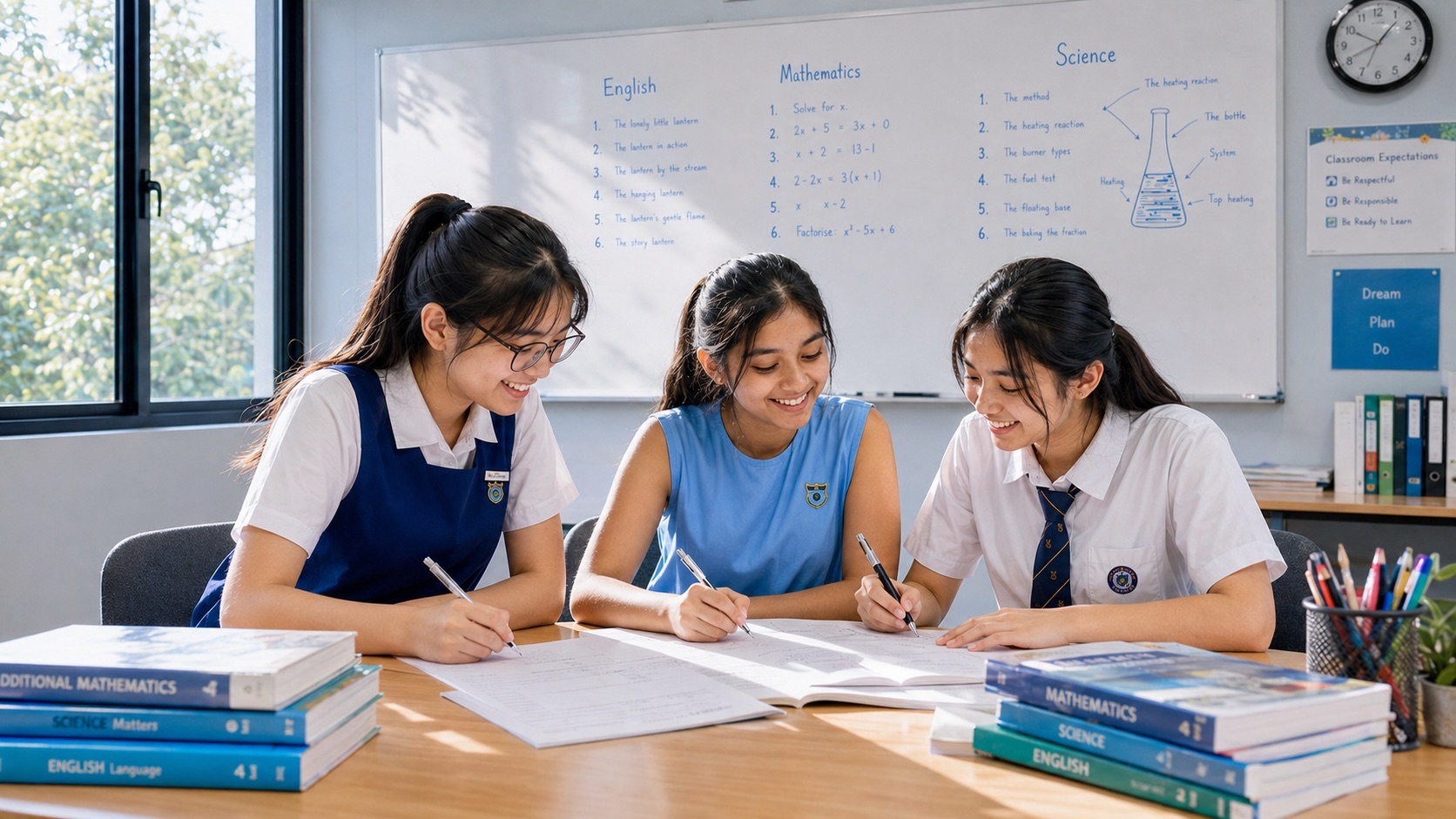
Checked and rebuilt: 17 September 2026. This 2017 page is preserved as an editorial Mathematics transition owner. Its title, publication date, URL and existing media remain unchanged. The page is not a commercial tuition page: its job is to explain why the move from Primary to Secondary Mathematics feels discontinuous for many learners, how parents can tell which part of the transition is actually failing, and how to build enough symbolic, representational and study control for Secondary Mathematics to become manageable rather than mysterious.
The transition from Primary 6 to Secondary Mathematics is often described as “the work gets harder”. That is true but incomplete. The subject changes shape. Numbers increasingly become symbols. Familiar one-topic exercises become mixed problems. Diagrams stop being optional illustrations and become mathematical representations. Working becomes external memory. Algebra begins to carry ideas across topics. Negative numbers expand the number system. Graphs become relationships rather than pictures. Methods become less obvious from the wording. Earlier weaknesses that could be worked around in Primary school become dependencies that later chapters call repeatedly.
That is why a student can finish Primary school with respectable marks and still feel as though Secondary Mathematics suddenly speaks another language. The problem is not necessarily intelligence, effort or motivation. Often, the student is being asked to operate a more abstract system with a study method that was designed for a more cued environment.
The scientific job of this article is therefore to make the transition visible as a set of interacting mechanisms: number-system extension, algebraic language, equality, symbolic manipulation, representation switching, graph sense, prerequisite control, method selection, visible working, retrieval, checking, mixed-topic transfer and examination execution. Once the correct mechanism is identified, the repair can be much smaller and more precise.
Quick answer for busy parents
- Secondary Mathematics is not just more content. It asks students to reason with symbols, structures and relationships more directly.
- Full Subject-Based Banding is fully implemented in secondary schools from the 2024 Secondary 1 cohort. Students may offer subjects at G1, G2 or G3 levels according to the school system and their learning profile; the old stream labels no longer describe the current structure.
- From 2027, the Singapore-Cambridge Secondary Education Certificate (SEC) replaces the N- and O-Level certificates. Mathematics continues at different subject levels; the transition skills in this guide matter regardless of whether a student is taking a G2 or G3 Mathematics pathway.
- Algebra is a language shift. Letters are not decorations. They represent quantities, variables, relationships and general rules.
- Equality becomes more important. Students must preserve equivalent expressions across several transformation steps.
- Negative numbers expand the number system. Rules should be connected to position, direction, operations and structure rather than memorised as sign slogans alone.
- Representation switching becomes a core skill. Words, tables, graphs, diagrams, formulae and equations must translate into one another.
- Method selection becomes its own capability. Knowing a method is different from recognising when to use it.
- Working becomes an external memory system. Clear lines preserve state, reduce working-memory load and make errors recoverable.
- Earlier gaps compound faster. Fractions, ratio, percentage, algebra, units and arithmetic fluency often reappear inside later topics.
- More questions are not always the answer. Repair the earliest weak dependency, then retest on a changed question.
- The strongest transition outcome is independence. The student can identify the problem type, choose a representation, select a method, execute, check and recover without constant adult prompting.
Current Singapore context: why parents should update the mental model
Singapore’s secondary structure has changed since many parents were in school. MOE states that Full Subject-Based Banding has been fully implemented since 2024. Students can offer subjects at G1, G2 or G3 subject levels, and the system is designed to provide greater flexibility according to strengths, interests and learning needs. From 2027, the Singapore-Cambridge Secondary Education Certificate becomes the common certification framework for graduating students, replacing the old N- and O-Level certificates.
SEAB’s 2027 SEC syllabus listings show Mathematics offered at G2 and G3, alongside Additional Mathematics at corresponding subject levels where applicable. For parents, the useful conclusion is not to obsess over labels. The transition mechanism is still mathematical: can the student operate successfully at the level of abstraction, representation, symbolic fluency and problem complexity required by the subject they are taking?
Current official references:
- MOE: Full Subject-Based Banding and the 2027 SEC transition
- SEAB: Secondary Education Certificate syllabuses for school candidates
- SEAB: 2027 SEC G2 syllabuses
- SEAB: 2027 SEC G3 syllabuses
The transition is a systems change, not one hard chapter
Parents sometimes search for the chapter that caused the difficulty: negative numbers, algebra, graphs, equations, geometry. But the transition is often distributed across several systems.
A student may know the individual ideas but fail because:
- symbolic notation consumes too much working memory;
- sign control is fragile;
- fractions slow every algebraic manipulation;
- equations are solved by memorised moves with no equality model;
- the student cannot translate a word problem into algebra;
- graphs are read visually but not connected to equations;
- working is compressed too aggressively;
- mixed questions remove the topic cue that the student relied on;
- checking occurs only after the paper is finished, if at all.
The page therefore treats Secondary Mathematics as a dependency network. The first question is not “Which chapter is weak?” It is “What mathematical operation is the student unable to perform reliably when several chapters ask for it?”
Change 1: the number system expands
Primary Mathematics builds strong experience with positive whole numbers, fractions, decimals, ratio, percentage and measurement. Secondary Mathematics asks the learner to treat number more structurally. Negative numbers become ordinary objects of calculation. Rational-number operations become infrastructure. Magnitude, order and sign must be managed across algebraic expressions, coordinates, graphs and formulae.
Negative numbers are not just “numbers with a minus sign”
Students often learn sign rules as slogans:
- same signs add;
- different signs subtract;
- negative times negative is positive.
These rules can produce answers, but they are fragile when the surface form changes. A stronger model connects several meanings.
Position model
Negative numbers have positions relative to zero on the number line. −5 is less than −2 because it lies further left.
Direction/change model
Positive and negative quantities can represent opposite directions or changes, depending on context.
Difference model
Subtraction can be interpreted as distance or change between values, not only “taking away objects”.
Operation structure
Multiplication and division sign patterns should ultimately fit a coherent algebraic system rather than remain independent chants.
Common negative-number transition errors
- thinking −8 is greater than −3 because 8 is greater than 3;
- confusing subtraction with a negative sign;
- losing brackets around negative values;
- changing signs twice during substitution;
- applying multiplication sign rules to addition;
- forgetting that a negative coordinate is a position, not a mistake.
Parent diagnostic for signed numbers
Ask the student to:
- place −5, −2, 0, 3 and 7 on a number line;
- compare −4 and −9;
- evaluate 3 − (−2);
- substitute x = −3 into 2x + 5;
- explain why brackets matter.
If the number-line comparison is unstable, do not begin with harder algebra. Restore signed-number meaning first.
Change 2: arithmetic becomes algebraic language
In Primary Mathematics, the numbers in a question are usually known. In algebra, a letter can stand for:
- an unknown value;
- a variable that can change;
- a general number;
- a parameter controlling a relationship;
- a coordinate;
- a measurement;
- a quantity linked to another quantity.
The student must learn to interpret the role from context.
Expressions are objects, not unfinished answers
A common transition error is treating an algebraic expression as something that must be “finished”.
For example:
3x + 5
is already a complete expression. It represents a relationship between x and the resulting quantity. There may be nothing to calculate until x is known.
Expression versus equation
Students should distinguish:
- Expression: 3x + 5
- Equation: 3x + 5 = 20
An equation asserts equality between two expressions. That equality creates a constraint and makes solving possible.
Formula versus equation
A formula such as:
A = lw
describes a general relationship among quantities. It can be used for substitution, rearrangement and reasoning. Students who see it only as “a rule to plug numbers into” may struggle later when a different variable must become the subject.
Change 3: equality becomes the control system for algebra
Primary students sometimes survive with a procedural interpretation of “=” because many questions place the answer at the right. Secondary algebra punishes that misconception.
When solving:
3x + 5 = 20
every legal transformation must preserve equality.
Subtract 5 from both sides:
3x = 15
Divide both sides by 3:
x = 5
The common classroom shorthand “move 5 to the other side and change sign” can be efficient after understanding is secure. But the underlying reason is a balanced transformation, not a magical migration.
Balance model for equations
A balance metaphor remains useful into Secondary Mathematics:
- both sides begin equal;
- doing the same valid operation to both sides preserves equality;
- simplification should not change the solution set.
What equation errors reveal
Sign-changing by ritual
The student memorises “move across, change sign” but cannot explain when multiplication becomes division or why.
One-sided operation
The student adds, subtracts, multiplies or divides on one side only.
Distribution error
The student expands a bracket incompletely, such as 3(x + 2) = 3x + 2.
Fraction-bar error
A denominator applies to an entire numerator but is treated as though it belongs to one term only.
Substitution error
A negative substituted value is not bracketed, producing sign errors.
Change 4: symbolic fluency becomes working-memory infrastructure
Students often think algebra speed is cosmetic. It is not. When basic symbolic operations remain effortful, they consume the mental space needed for the new idea.
Suppose a question is really testing graph interpretation, but every substitution step is slow and error-prone. The graph topic receives less attention because algebra is consuming the available working memory.
This is why several Secondary topics may improve when one algebraic carrier skill is repaired.
Carrier skills in early Secondary Mathematics
- integer operations;
- fraction operations;
- ratio and percentage reasoning;
- algebraic simplification;
- expansion and factorisation;
- solving linear equations;
- substitution;
- formula use and rearrangement;
- coordinate reading;
- graph interpretation;
- unit control;
- clear written state tracking.
Change 5: method selection becomes a separate skill
In a topical worksheet, the heading may tell the student which method is expected. In mixed work, that cue disappears.
The learner must ask:
- What is the mathematical structure?
- What is known?
- What is unknown?
- What representation exposes the relationship?
- Which method fits?
Knowing a method is not the same as recognising it
A student may solve ten simultaneous-equation questions correctly in a chapter exercise, then fail a word problem requiring simultaneous equations because the problem never announces the method.
This is a transfer problem, not necessarily a procedural problem.
The method-selection ladder
- Labelled practice: method is announced.
- Unlabelled same-topic practice: method is no longer named.
- Mixed-topic practice: several plausible methods appear nearby.
- Changed representation: same concept appears in graph, word, table or diagram form.
- Unfamiliar context: the relationship must be reconstructed without familiar wording.
Change 6: representation switching becomes central
Secondary Mathematics increasingly asks students to move among:
- verbal descriptions;
- algebraic expressions;
- equations;
- tables;
- graphs;
- coordinate diagrams;
- geometric diagrams;
- formulae;
- statistical displays.
A learner can know a concept in one representation and still fail when it appears in another.
Representation switching is not optional enrichment
Consider a linear relationship.
It may appear as:
- a story involving a fixed fee plus a rate;
- a table of x and y values;
- an equation y = mx + c;
- a straight-line graph;
- a coordinate problem;
- a comparison of two plans.
The student who sees these as different chapters carries a higher cognitive load than the student who recognises one relationship appearing in several forms.
Change 7: graphs become relationships
Primary learners may meet graphs mainly as ways to display data. Secondary Mathematics increasingly treats graphs as mathematical objects representing relationships.
Students need to connect:
- coordinates to ordered pairs;
- gradient to rate of change;
- intercept to starting value or structural meaning;
- shape to relationship type;
- equation to graph;
- graph to solutions.
Graph-reading error taxonomy
- axes reversed;
- scale skipped;
- coordinate order reversed;
- point read without units/context;
- gradient treated as “steepness” only with no rate meaning;
- intercept copied but not interpreted;
- graph and equation treated as unrelated.
Change 8: working becomes external memory
As calculations lengthen, mental storage becomes expensive. Written working performs several jobs:
- stores intermediate states;
- keeps signs visible;
- preserves substitutions;
- shows which formula is being used;
- lets the student backtrack;
- lets the teacher diagnose the first wrong line;
- reduces repeated rereading of the question.
Working is not only for the marker
Students who skip steps often say, “I can do it in my head.” That may be true for one line. But a multi-step problem may require several temporary quantities. If those quantities must be remembered while the student also selects a method, applies algebra and checks units, working memory becomes crowded.
The working threshold
Write an intermediate state when:
- it will be reused;
- signs or fractions are easy to lose;
- several transformations occur;
- units matter;
- there are multiple branches or cases;
- the calculation is difficult to reconstruct after interruption.
Change 9: errors propagate further
In a one-step Primary question, an arithmetic slip may cost one answer. In a Secondary solution, an early sign or substitution error can contaminate many later lines.
This makes first-wrong-line diagnosis increasingly important.
The first-wrong-line method
- Start at the beginning of the student’s working.
- Find the last line that is definitely correct.
- Identify the first line that is definitely wrong.
- Classify the error.
- Repair the cause.
- Redo only enough work to prove the repair.
- Retest later on a changed question.
Secondary Mathematics error buckets
1. Concept error
The underlying mathematical idea is misunderstood.
2. Representation error
The situation is translated incorrectly into algebra, graph, diagram or equation.
3. Method-selection error
The student knows the required method but fails to recognise it.
4. Algebraic manipulation error
The chosen method is correct but symbolic transformations fail.
5. Arithmetic error
Basic numerical execution fails inside an otherwise correct method.
6. Sign error
Negative signs, subtraction or distribution are mishandled.
7. State-tracking error
An earlier value is reused after it has changed.
8. Unit error
Quantities are combined or reported with missing/incompatible units.
9. Reading/constraint error
The student solves the wrong job or ignores a condition.
10. Checking error
An implausible result survives because no validation route is used.
Change 10: prerequisite gaps become multiplicative
Secondary Mathematics is cumulative in a stronger sense than “last year’s work may appear again”. Later topics often require earlier methods as invisible subroutines.
Examples:
- weak fraction arithmetic makes algebraic fractions harder;
- weak ratio/proportion makes rates and similarity harder;
- weak algebra makes graphs, formulae and later Additional Mathematics harder;
- weak coordinates make straight-line graphs and geometry harder;
- weak angle facts make geometric reasoning slower;
- weak unit control damages measurement and applied questions.
Visible topic versus hidden bottleneck
A student may say, “I am weak at graphs.” But the first wrong line may show:
- coordinate confusion;
- substitution weakness;
- negative-number error;
- gradient arithmetic error;
- equation rearrangement weakness.
Repairing “graphs” broadly would be inefficient.
Change 11: vocabulary becomes more compressed
Mathematics contains specialist language: coefficient, factor, term, expression, equation, inequality, gradient, intercept, congruent, similar, probability, mean, median, range, and many more.
The vocabulary is not ornamental. It compresses mathematical distinctions.
Vocabulary errors can become method errors
If a student does not distinguish:
- factor from multiple;
- expression from equation;
- solve from simplify;
- evaluate from expand;
- gradient from intercept;
- congruent from similar;
the wrong operation can begin before any calculation occurs.
Change 12: command words matter more
Students should notice what the question asks them to produce:
- calculate;
- solve;
- simplify;
- expand;
- factorise;
- show that;
- prove;
- explain;
- estimate;
- state;
- sketch.
These are different mathematical jobs. A correct calculation can still fail if it answers a different command.
Change 13: checking must occur during the solution
End-of-paper checking remains useful, but long solutions need local checks.
Examples:
- substitute a solution back into an equation;
- check graph coordinates against the equation;
- compare a calculated length with the diagram’s rough scale;
- verify units;
- estimate magnitude;
- check whether probability lies in a valid range;
- ask whether a negative physical quantity makes sense in context.
Change 14: mixed-topic practice becomes more important
Topical practice answers the question:
Can the student execute this method when the method is announced?
Mixed practice asks:
Can the student identify the method when it is not announced?
Both are necessary. Moving to mixed practice too early creates noise. Staying in topical practice too long creates false confidence.
Change 15: examination execution becomes a separate layer
A student can know the Mathematics and still lose marks through:
- poor time allocation;
- spending too long on one question;
- weak paper navigation;
- missing units;
- not returning to skipped questions;
- overchecking easy work and underchecking high-risk work;
- fatigue-driven sign errors;
- rushed reading near the end.
Execution should be trained after the mathematical system is sufficiently stable. Timing a confused method only automates confusion under pressure.
Why “I was good at Primary Mathematics” may stop being enough
Primary success can be built on several combinations of strengths:
- strong arithmetic;
- good memory;
- careful model drawing;
- pattern recognition;
- high worksheet familiarity;
- strong parental support;
- reliable school scaffolds.
These remain useful. But Secondary Mathematics increasingly asks the learner to generate the representation, choose the method and maintain symbolic control with fewer prompts.
Study-method mismatch
A student who learned by repeatedly doing nearly identical questions may feel successful until questions become mixed. A student who memorised algebraic moves may feel fine until a formula must be rearranged in an unfamiliar direction. A student who relied on correction immediately after every question may struggle when independent recovery is required.
The transition therefore requires not only new Mathematics but a more mature learning loop.
The Secondary Mathematics learning loop
- Represent: express the problem in a workable mathematical form.
- Select: choose a method.
- Execute: carry out the method with visible state control.
- Check: validate locally and globally.
- Diagnose: find the first wrong line if the result fails.
- Repair: fix the earliest weak dependency.
- Retrieve: return after a delay.
- Vary: change numbers, wording or representation.
- Mix: place the method among other plausible methods.
- Transfer: use it in an unfamiliar context.
A parent transition diagnostic dashboard
| System | Healthy evidence | Watch for |
|---|---|---|
| Signed numbers | Number-line order and operations stable. | Sign slogans used inconsistently. |
| Equality | Equivalent transformations explained. | “Move across and change sign” with no model. |
| Algebra language | Term, coefficient, expression, equation distinguished. | Commands misread. |
| Manipulation | Expansion, factorisation and simplification accurate. | Frequent sign/distribution errors. |
| Fractions | Operations sufficiently fluent to support algebra. | Every fraction stalls working. |
| Representation | Words, tables, graphs and equations translate. | One representation works only. |
| Method selection | Recognises method without topic heading. | Needs method supplied. |
| Working | Intermediate states visible and labelled. | Too much kept mentally. |
| Checking | Uses substitution, estimate, units or graph sense. | Accepts implausible answers. |
| Retrieval | Earlier work remains available weeks later. | Every new chapter erases the last. |
| Mixed transfer | Performance remains stable when topics mix. | Topical high, mixed low. |
| Independence | Can identify where stuck. | Waits for adult to choose the next step. |
A 60-minute transition diagnostic for parents
This is not a replacement for school assessment. It is a structured observation session.
10 minutes: arithmetic carriers
Use a few fractions, percentages, signed-number comparisons and basic calculations. Observe whether arithmetic consumes excessive time.
10 minutes: algebra language
Ask the student to identify term, coefficient, expression and equation; simplify a short expression; substitute a negative value.
10 minutes: equation control
Use one simple linear equation and ask the student to explain why each step preserves equality.
10 minutes: representation switching
Give a short verbal relationship and ask for a table or equation; give a simple graph and ask what relationship it represents.
10 minutes: mixed-method recognition
Use four short questions from different topics without labels. Ask the student to name the likely method before calculating.
10 minutes: review
Ask where the work first became difficult. Compare the student’s diagnosis with what you observed.
Do not convert the session into a single score. The goal is to locate the earliest recurring bottleneck.
Catch Up, Keep Up, Move Ahead
Catch Up
Use when carrier skills are unstable: signed numbers, fractions, equality, algebra language, basic manipulation, coordinates or unit control. Reduce problem complexity while repairing the dependency.
Keep Up
Use when current topics are understandable but retrieval, working, checking or mixed-question transfer are not yet automatic.
Move Ahead
Use when carrier skills survive delay and mixed transfer. Deepen through unfamiliar representations, explanation, proof-like reasoning, alternative methods and connected extension rather than merely increasing chapter distance.
The transition rule: repair before acceleration
Moving ahead can be useful for a ready learner. It is the wrong solution when current work is fragile.
Do not use harder material to hide:
- weak signed-number control;
- fraction avoidance;
- equality misconceptions;
- unstable algebraic manipulation;
- topic-cue dependence;
- poor working;
- adult prompt dependence.
What healthy transition progress looks like
- the student is less startled by letters and symbols;
- negative numbers behave like ordinary members of the number system;
- equation steps can be explained relationally;
- algebraic errors are becoming local rather than systemic;
- graphs and equations begin to connect;
- working becomes clearer, not merely longer;
- mixed questions no longer cause a dramatic collapse;
- checking becomes selective and purposeful;
- the student can name the type of difficulty;
- adult prompts are fading.
Why the transition can feel emotionally larger than it is mathematically
Secondary 1 changes many things at once: new school, teachers, timetable, peers, subjects, travel patterns, CCAs and expectations. Mathematics difficulty may therefore arrive inside a broader increase in cognitive and emotional load.
Parents should avoid interpreting one weak test as proof of permanent decline. Look for patterns across several weeks:
- Is the student learning from corrections?
- Are the same errors recurring?
- Is homework time rising sharply?
- Does the student understand during explanation but forget later?
- Does mixed practice cause a much larger drop than topical practice?
- Is fatigue a major factor?
The smallest effective intervention principle
If one sign-control routine fixes a recurring negative-number error, do not immediately add a full tuition programme. If algebraic manipulation is sound but word problems fail, do not reteach every algebra chapter. If several carrier skills are unstable and the student cannot recover independently, broader support may be justified.
Use the smallest intervention that changes the mechanism, then verify through delay, variation and transfer.
When to consult the school or teacher
Useful reasons include:
- home and school evidence differ sharply;
- the student appears to misunderstand the subject level or course expectations;
- the same carrier-skill weakness persists despite meaningful repair;
- homework time is becoming disproportionate;
- the student cannot identify what is being taught or assessed;
- anxiety is increasing;
- the family is considering a change in subject level and needs school-specific guidance.
When not to intervene heavily
Do not overreact to:
- one weak test during the first transition term;
- one new algebra notation;
- slower speed while the student learns to write more working;
- a temporary performance dip when topics first become mixed;
- another student being further ahead;
- a mistake the learner can explain and independently correct.
The larger point
The move from Primary to Secondary Mathematics is not a cliff in intelligence. It is a change in the operating system of the subject. The learner must hold more abstract objects, move among representations, choose methods with fewer cues, preserve equality across symbolic transformations, externalise more working, retrieve earlier dependencies and check longer solution chains.
Once parents and students see those changes separately, “Secondary Math is hard” becomes a diagnosable statement. The right question is no longer “How many more questions should we do?” It becomes “Which part of the mathematical system is carrying too much load, and what is the smallest repair that makes the whole system move again?”
Extended parent reference: the Primary-to-Secondary Mathematics capability atlas
The transition becomes easier to manage when “Secondary Math readiness” is decomposed into observable capabilities. A student can be strong in arithmetic but weak in symbolic language. Another can manipulate symbols but fail to recognise the right method in an unfamiliar context. Another may understand concepts but lose marks because working is too compressed. The atlas below helps parents locate the carrier system rather than treating a low mark as one undifferentiated problem.
Number-system capabilities
- Integer order: negative and positive values are placed correctly on a number line.
- Signed comparison: understands why −8 < −3.
- Addition/subtraction with signed numbers: preserves operation meaning.
- Multiplication/division sign control: applies sign rules reliably.
- Bracket control: keeps negative substituted values visible.
- Fraction fluency: common fraction operations no longer consume excessive working memory.
- Decimal fluency: decimal place value and operations remain stable.
- Ratio reasoning: comparison and scaling relationships are preserved.
- Percentage reasoning: percentage as multiplicative comparison remains usable.
- Magnitude sense: implausible answers are noticed.
Algebraic-language capabilities
- Variable interpretation: understands that a letter may represent an unknown, varying quantity or general number.
- Term recognition: identifies terms separated by addition/subtraction at the top level.
- Coefficient recognition: understands the numerical multiplier of a variable.
- Constant recognition: identifies terms without variables.
- Expression/equation distinction: knows whether an equals sign is present and what that changes.
- Formula interpretation: reads a general relationship among quantities.
- Command-word control: distinguishes simplify, expand, factorise, solve and evaluate.
- Algebraic reading: can verbalise an expression without changing its structure.
Algebraic-manipulation capabilities
- Collecting like terms: combines only structurally compatible terms.
- Expansion: distributes multiplication across brackets accurately.
- Factorisation: recognises common structure and reverses expansion.
- Substitution: replaces variables accurately, including negative values.
- Equation solving: uses equality-preserving operations.
- Fractional algebra: manages numerators/denominators without breaking structure.
- Formula rearrangement: changes subject while preserving equality.
- Sign preservation: negative signs survive each transformation.
- State tracking: later lines use the current expression rather than an earlier state.
Equality and equivalence capabilities
- Relational equality: “=” means same value.
- Equivalent expression recognition: sees different forms of the same quantity.
- Balanced transformation: can explain why the same valid operation on both sides preserves solutions.
- Solution checking: substitutes a proposed solution back into the original equation.
- Identity versus equation awareness: begins to recognise that some statements are true for all permitted values while others constrain a variable.
Representation capabilities
- Words → expression: translates verbal quantity relationships into symbols.
- Expression → words: explains what an algebraic form represents.
- Table → graph: plots coordinate relationships accurately.
- Graph → table: reads coordinates and scale.
- Equation → graph: connects symbolic form with graphical relationship.
- Graph → equation reasoning: uses gradient/intercept or other structural information appropriately.
- Diagram → equation: turns geometric or measurement relationships into algebra.
- Units → model: preserves unit meaning through representation change.
- Representation choice: selects the form that reduces complexity.
Graph and coordinate capabilities
- Axis reading: identifies what each axis represents.
- Scale reading: interprets intervals accurately.
- Coordinate order: reads (x, y) correctly.
- Quadrant awareness: signed coordinates locate points accurately.
- Gradient interpretation: understands rate/change, not only visual steepness.
- Intercept interpretation: identifies the axis crossing and, where relevant, contextual meaning.
- Graph checking: tests whether a coordinate satisfies the related equation.
Geometry and measurement capabilities
- Angle facts: common angle relationships are accessible.
- Property recall: shape properties can be retrieved when needed.
- Diagram reading: given information is separated from visual appearance.
- Unknown labelling: variables or labels are used to organise the diagram.
- Multi-step dependency: knows which angle/length must be found before another.
- Unit control: length, area and volume units are not mixed.
- Formula selection: formula is chosen from quantity meaning rather than memorised surface cues.
Proportional-reasoning capabilities
- Equivalent ratio: scales both terms consistently.
- Unit rate: recognises “per one” comparison when useful.
- Percentage scaling: links percentage to multiplicative comparison.
- Direct comparison: distinguishes additive from multiplicative change.
- Conversion control: moves between fraction, decimal and percentage representations.
- Applied transfer: proportion is recognised inside rates, maps, similarity or percentage problems.
Method-selection capabilities
- Task classification: identifies what mathematical job is required.
- Candidate generation: can name more than one plausible method.
- Constraint filtering: rejects methods that do not fit the information.
- Efficiency judgement: selects a method that is manageable and checkable.
- Method switching: abandons an unproductive route without losing the whole problem.
- Unlabelled recognition: identifies the method when the topic heading is absent.
Working-memory and written-working capabilities
- Intermediate-state recording: writes values that will be reused.
- Line integrity: each line follows from the previous one.
- Sign visibility: negatives and brackets remain visible.
- Unit visibility: units remain attached where needed.
- Diagram annotation: important values are transferred to diagrams.
- State update: changed values replace old values.
- Backtracking: student can locate the last correct line after an error.
Checking capabilities
- Substitution check: verifies algebraic solutions.
- Magnitude check: rejects implausible results.
- Unit check: verifies final units.
- Graph check: compares values with graphical position.
- Alternative-method check: sometimes verifies through a second route.
- Constraint check: confirms answer satisfies conditions.
- Sign check: re-reads high-risk negative operations.
Retrieval and learning-control capabilities
- Spaced retrieval: earlier methods remain accessible after time.
- Cumulative review: older topics are revisited while new topics are learned.
- Error logging: recurring mechanisms are recorded, not merely wrong answers.
- Prompt fading: adult/teacher hints decrease over time.
- Mixed-topic switching: method selection remains stable when topics alternate.
- Self-diagnosis: student can describe whether the block is concept, algebra, representation, method or execution.
- Recovery: student has a strategy when stuck rather than freezing.
- Transfer: a learned method survives changed wording or representation.
Symptom-to-cause transition table
| What you see | Likely bottleneck | Quick check | First repair |
|---|---|---|---|
| Negative signs vanish during algebra. | Signed-number/bracket control. | Substitute −3 into 2x + 5. | Bracket negative values explicitly. |
| Student can simplify but cannot solve. | Expression/equation distinction or equality control. | Ask what “solve” means. | Balance model and command words. |
| Expansion errors recur. | Distribution structure weak. | Expand 3(x + 2) and −2(x − 4). | Area/distribution model then symbolic practice. |
| Graph questions feel impossible despite good plotting. | Equation/graph connection weak. | Test a coordinate in the equation. | Table ↔ equation ↔ graph routine. |
| Topical work high, mixed tests low. | Method recognition weak. | Ask for method before calculation. | Unlabelled mixed classification. |
| Long questions collapse halfway. | Working-memory/state tracking. | Ask what intermediate quantities must be remembered. | Label and externalise state. |
| Many topics seem weak at once. | Shared prerequisite gap. | Inspect first wrong line across several topics. | Repair common carrier skill. |
| Student says “I know it when teacher does it”. | Prompt dependence. | Give same structure with changed numbers and no cue. | Prompt-fading ladder. |
| Student is accurate but extremely slow. | Retrieval or symbolic fluency. | Separate concept explanation from execution speed. | Short cumulative fluency practice. |
| Student is fast but error-prone. | Compressed working/checking. | Require visible intermediate state. | Working threshold + local checks. |
| Fraction algebra causes shutdown. | Primary fraction operations not automatic enough. | Test numerical fractions without variables. | Repair fraction carrier first. |
| Word problems fail, equations succeed. | Representation/model selection. | Ask student to write equations from verbal relationships only. | Words → quantities → variables → equations. |
| Geometry reasoning stops after one fact. | Dependency planning. | Ask what must be found before target. | Goal-backward diagram plan. |
| Answers have no units. | Quantity meaning detached from calculation. | Ask “what does this number measure?” | Unit label at target and final line. |
| Student forgets old topics quickly. | Blocked practice, weak cumulative retrieval. | Retest a topic after 2–3 weeks. | Spaced mixed review. |
The transition error buckets parents can use
1. Number-system error
Signed numbers, fractions, decimals or proportional quantities are unstable.
2. Language error
Mathematical terms or command words are misread.
3. Equality error
Transformations are performed procedurally without preserving equivalence.
4. Algebra-carrier error
Simplification, expansion, factorisation, substitution or equation solving is too fragile.
5. Representation error
The problem is known in one form but not another.
6. Method-selection error
The student can execute but cannot recognise when to use the method.
7. Working-memory error
Too many intermediate quantities are held mentally.
8. State-tracking error
An outdated value, sign or expression is reused.
9. Retrieval error
Old methods decay quickly without re-exposure.
10. Checking error
Incorrect results survive because no validation routine is used.
11. Transfer error
Knowledge works only in familiar wording or topic blocks.
12. Execution error
Timing, navigation or fatigue damages otherwise sound Mathematics.
The transition stop rule
Stop or change practice when:
- the same misconception repeats after feedback;
- the student is copying a method without naming the relationship;
- practice has become pure volume;
- every question requires an adult to identify the topic;
- fatigue produces sign and copying errors that are not present when rested;
- the student cannot explain what is being practised;
- a harder worksheet is being used to avoid repairing an earlier dependency;
- timing pressure is being added before method control is stable.
The four receipts of transition mastery
- Explanation: the student can explain the relationship, not only the procedure.
- Delay: the method remains available after several days or weeks.
- Variation: changed numbers, wording or representation do not break it.
- Transfer: the student recognises and uses the method inside mixed or unfamiliar work.
Practice library: signed-number control
Practice 1: number-line order
Place a mix of positive and negative values, then explain comparisons.
Practice 2: operation meaning
Compare 3 − 5, 3 + (−5), and −5 + 3.
Practice 3: negative substitution
Substitute a negative number into expressions containing squares and products.
Practice 4: sign-error detective
Analyse a deliberately wrong solution where a negative sign disappears.
Practice library: algebra language
Practice 5: name the object
Classify examples as expression, equation, formula or inequality.
Practice 6: command-word match
Match simplify, solve, expand, factorise and evaluate to the correct kind of output.
Practice 7: read the expression aloud
Verbalise 3(x − 2) + 5 without changing the bracket structure.
Practice 8: write from words
Translate “five more than twice x” and similar phrases into symbols.
Practice library: equality and equations
Practice 9: balance step
For each line of an equation solution, state what operation was applied to both sides.
Practice 10: reverse the shorthand
Turn “move the 5 across and change sign” into the actual equality-preserving operation.
Practice 11: solution check
Substitute the final x-value into the original equation.
Practice 12: wrong-line diagnosis
Find where a one-sided operation first breaks equivalence.
Practice library: symbolic manipulation
Practice 13: like-term sort
Group terms that can and cannot combine.
Practice 14: expansion with signs
Use positive and negative multipliers outside brackets.
Practice 15: factorisation as reverse expansion
Expand, then reconstruct the original factorised form.
Practice 16: state comparison
Ask whether two expressions are equivalent by expanding or simplifying both.
Practice library: representation switching
Practice 17: words to equation
Write an algebraic model before calculating.
Practice 18: equation to table
Generate several ordered pairs.
Practice 19: table to graph
Plot and label axes.
Practice 20: graph back to equation idea
Describe how y changes as x changes.
Practice 21: diagram to algebra
Assign a variable to an unknown length or angle and write a relationship.
Practice library: method selection
Practice 22: method before answer
Give five mixed questions and ask only for the method and reason.
Practice 23: two plausible methods
Generate two routes, then compare efficiency and error risk.
Practice 24: wrong-method explanation
Show a valid method applied to the wrong structure and explain why it does not fit.
Practice 25: unlabeled mixed set
Remove chapter headings and alternate topics.
Practice library: working and state tracking
Practice 26: write the reusable quantity
Identify which intermediate value will be needed later and label it.
Practice 27: one logical step per line
Use this temporarily for algebra where sign errors are frequent.
Practice 28: last-correct-line audit
Stop after an error and find the last line that is definitely valid.
Practice 29: compress after control
Once accuracy is stable, combine safe routine steps to improve efficiency.
Practice library: checking
Practice 30: estimate first
Predict magnitude before a numerical calculation.
Practice 31: substitute back
Check equations and coordinates.
Practice 32: unit scan
Circle or annotate the required unit before starting.
Practice 33: graph plausibility
Compare sign and magnitude of a coordinate with its plotted region.
Practice library: retrieval and transfer
Practice 34: two-day retest
Return to one repaired mechanism after a short delay.
Practice 35: two-week retrieval
Include one old topic in each new-topic practice set.
Practice 36: representation variation
Change words to graph, table to equation, or diagram to algebra.
Practice 37: context variation
Use the same Mathematics in a different applied setting.
Practice 38: mixed-topic classification
Before solving, label the structural method rather than the chapter name.
Twenty-five transition myths worth retiring
Myth 1: Secondary Mathematics is difficult mainly because there is more content.
The increase in abstraction, representation switching and method selection is at least as important.
Myth 2: Strong Primary marks guarantee an easy transition.
Primary strengths may not include every carrier skill Secondary Mathematics depends on.
Myth 3: Weak Secondary marks prove the child was never good at Mathematics.
A new demand can expose a previously hidden dependency gap.
Myth 4: Algebra is just arithmetic with letters.
It generalises relationships and requires symbolic equivalence control.
Myth 5: “Move it across and change sign” is the concept of solving equations.
It is shorthand for equality-preserving operations.
Myth 6: Negative-number rules should simply be memorised.
Meaning and structure make the rules more recoverable.
Myth 7: More working means weaker Mathematics.
Good working is a cognitive tool for complex problems.
Myth 8: Fast working means strong understanding.
Speed can coexist with sign errors, poor transfer or no checking.
Myth 9: Slow working means weak understanding.
The student may understand but still be developing retrieval or notation efficiency.
Myth 10: Topic practice is enough.
Mixed practice is needed to test method selection after topical control is built.
Myth 11: Mixed practice should start immediately.
Mixing too early can obscure which method is not yet learned.
Myth 12: Every weak chapter needs separate tuition or reteaching.
Several visible weaknesses may share one earlier bottleneck.
Myth 13: Graph errors are always graph-topic errors.
They may begin in signs, coordinates, substitution or algebra.
Myth 14: Fractions are a Primary topic that can be left behind.
Fraction fluency continues to support algebra and applied Mathematics.
Myth 15: Memorising worked solutions builds transfer automatically.
Transfer needs changed questions and method reconstruction.
Myth 16: Checking should happen only at the end of the paper.
Long solutions benefit from local checks.
Myth 17: A calculator removes the need for number sense.
Magnitude, signs, units and plausibility still need human judgement.
Myth 18: Students should always use the shortest method.
The best method balances efficiency, reliability and recoverability.
Myth 19: Harder questions always produce faster improvement.
Difficulty added above a weak prerequisite can create noise rather than learning.
Myth 20: Starting Additional Mathematics early is always an advantage.
Algebraic readiness matters more than curriculum distance.
Myth 21: Full SBB means Mathematics expectations are vague.
Students still take clearly defined subject levels; the parent job is to understand the level actually offered by the child.
Myth 22: Subject level is a permanent judgement of mathematical ability.
The current system is designed to allow flexibility at appropriate junctures; parents should focus on present learning evidence and school guidance.
Myth 23: A weak first Secondary test requires immediate intensive intervention.
Look for recurring mechanisms across several pieces of evidence.
Myth 24: More worksheets are always the safest response.
Targeted repair and delayed transfer testing are usually more informative.
Myth 25: The goal of transition support is to make school work feel easy.
The goal is independent control even when the Mathematics remains appropriately challenging.
Parent case study 1: the strong calculator, weak algebra reader
The student performs numerical calculations quickly but misreads expressions such as 3x + 5 and treats every letter as an unknown to solve.
Intervention: expression/equation/formula classification and verbalisation before harder algebra.
Parent case study 2: the sign-loss student
The student understands equations but loses negative signs in substitution and expansion.
Intervention: bracket negative values, one logical step per line and short sign-focused retrieval.
Parent case study 3: the topical star, mixed-paper drop
Chapter worksheets are excellent; mixed assessments fall sharply.
Interpretation: method recognition is the bottleneck.
Intervention: unlabelled classification sets before full mixed papers.
Parent case study 4: the no-working student
The learner insists on doing multi-step algebra mentally and loses track of intermediate states.
Intervention: define a working threshold and require visible states only where reused or high-risk.
Parent case study 5: the “weak at graphs” student
Graph questions fail, but the first wrong line is usually substitution or coordinate sign control.
Intervention: repair carrier skill, then return to graph questions.
Parent case study 6: the fraction bottleneck
Algebraic ideas are understood but any fraction produces a large slowdown.
Intervention: short numerical fraction repair outside the algebra context, then reinsert fractions.
Parent case study 7: the adult-prompt learner
The parent can always get the child started by saying “use simultaneous equations” or “factorise first”.
Interpretation: execution may be strong; method selection is outsourced.
Intervention: parent asks “what structure do you see?” and fades method labels.
Parent case study 8: the anxious first-term student
One poor result produces a belief that Secondary Mathematics is impossible.
Intervention: diagnose the actual error buckets, choose one repair target and collect new evidence before making a global judgement.
The monthly Secondary transition dashboard
- Are signed numbers stable?
- Can the student distinguish expressions, equations and formulae?
- Can algebraic transformations be explained?
- Are fraction operations sufficiently fluent?
- Can words, tables, graphs and equations translate?
- Can methods be identified without chapter headings?
- Is working clear enough to backtrack?
- Are recurring errors classified by mechanism?
- Do older topics remain available?
- Are local checking habits emerging?
- Does mixed practice remain reasonably close to topical performance?
- Is adult prompting decreasing?
Closing principle: the transition is healthier when the learner can name the structure before naming the chapter
Secondary Mathematics becomes less fragmented when students begin to recognise reusable structures: equivalent transformations, proportional relationships, linear relationships, coordinate relationships, geometric constraints and probability models. Chapter names still matter, but structure travels further.
The long-term transition goal is a student who can look at an unfamiliar question and say: “I may not have seen this exact wording, but I recognise the mathematical relationship and I know how to represent it.”
Parent operating manual: how to support the transition without becoming the student’s second Mathematics teacher
The transition improves fastest when the family knows what job home support should perform. Parents do not need to reteach every chapter. They need a system for noticing recurring bottlenecks, preserving useful routines, communicating with the school when necessary and gradually returning responsibility to the student.
The central parent role is not to supply the next method. It is to help the student build a reliable loop:
read → represent → choose → work → check → diagnose → repair → retrieve again.
What should change between Primary 6 and Secondary 1 study?
Primary revision can sometimes remain relatively chapter-based. Secondary revision needs a stronger cumulative layer because old techniques are repeatedly called inside new topics.
A healthy week increasingly contains four different kinds of Mathematics work:
- Current learning: understand the topic being taught now.
- Carrier maintenance: keep algebra, signed numbers, fractions and other dependencies accessible.
- Correction repair: revisit the mechanisms behind recent mistakes.
- Mixed retrieval: practise identifying methods when the chapter label is absent.
These jobs should not all occupy equal time every week. The proportions shift according to evidence.
A simple Secondary 1 weekly architecture
Lane 1: current chapter
Use school notes, classwork and assigned practice. The question is: Do I understand the new concept and can I execute the core method?
Lane 2: algebra carrier
Use a small amount of cumulative symbolic work. The question is: Are the operations that many later topics depend on becoming cheaper and more reliable?
Lane 3: correction loop
Choose one or two recurring errors from school work. The question is: What is the earliest wrong decision, and does the repair survive a changed problem?
Lane 4: old-topic retrieval
Include a few older questions. The question is: Can I still access this method now that the chapter has moved on?
Lane 5: mixed recognition
Once topical control is reasonably stable, use a small mixed set. The question is: Can I identify what kind of Mathematics is required without being told?
Home-practice architecture: 20 minutes
- 5 min carrier retrieval;
- 10 min current or repaired mechanism;
- 5 min one changed question and explanation.
Home-practice architecture: 40 minutes
- 10 min cumulative algebra/number work;
- 15 min current school topic;
- 10 min correction repair;
- 5 min self-check and error-log update.
Home-practice architecture: 60 minutes
- 10 min retrieval warm-up;
- 20 min current-topic work;
- 15 min one diagnosed weakness;
- 10 min mixed recognition or representation switching;
- 5 min review: what required help, what can be retested later?
Longer is not automatically better. A student whose accuracy collapses after forty minutes may gain more from two shorter sessions than one long block.
The first six weeks of Secondary 1
The first weeks should be used to observe the new demand pattern rather than rush to conclusions.
Week 1: language and notation
Notice:
- new symbols;
- new command words;
- teacher conventions for working;
- calculator expectations where relevant;
- how homework is organised.
Parent job: make sure the student can describe what is being learned and where resources are stored.
Week 2: signed-number control
Watch whether negative signs and brackets create disproportionate error.
Parent job: do not dismiss repeated sign errors as carelessness. Test whether signed-number meaning is actually stable.
Week 3: algebra language
Watch whether the student distinguishes expressions, equations, variables, coefficients and constants.
Parent job: ask for explanation, not memorised definitions alone.
Week 4: working habits
Observe whether multi-step problems remain visible on the page or disappear into mental arithmetic.
Parent job: help define a working threshold rather than demanding every tiny step.
Week 5: correction behaviour
Watch what happens after a wrong answer.
Does the student:
- copy the correction;
- understand the first wrong line;
- redo the same question only;
- try a changed question later;
- record a recurring mechanism?
Week 6: mixed recognition
Use a few unlabelled questions from the first several topics. A large drop from topical to mixed performance reveals method-recognition load.
The first twelve weeks: what parents should be looking for
Do not judge the transition only by one test score. Over the first term, look for direction of travel.
Healthy signs include:
- new notation becomes less intimidating;
- working becomes clearer;
- errors become more specific;
- the student asks better questions;
- old topics remain available;
- mixed work becomes less disruptive;
- corrections take less adult explanation;
- the student can identify what to revise before being told.
Marked-paper diagnosis: do not start with the total score
A marked test is a data source. The most useful parent question is not “Why did you get 62?” It is:
Where did marks leave the paper, and which losses share a common mechanism?
The marked-paper audit
Step 1: separate blank, attempted and completed questions
Blank questions may indicate time, confidence, recognition or knowledge problems. They should not automatically be grouped with wrong attempted questions.
Step 2: inspect the first wrong line
For each attempted question, find where the solution first stops being valid.
Step 3: classify the error
Use a short set of categories:
- task reading;
- concept;
- representation;
- method selection;
- algebra/sign;
- arithmetic;
- state tracking;
- unit;
- checking;
- time/execution.
Step 4: count mechanisms, not only marks
Five questions may have been lost because of one sign-control weakness. That is more actionable than treating them as five separate topic failures.
Step 5: choose the highest-leverage repair
Repair the mechanism that contaminates the greatest number of topics or marks.
Step 6: retest on changed questions
Do not use only the original paper. The student may remember the correction. Transfer needs a fresh task.
A marked-paper error log
| Question | First wrong line | Error bucket | Repair | Retest |
|---|---|---|---|---|
| Algebra Q4 | −2(x−3) expanded as −2x−6 | sign/distribution | negative expansion set | 3 days |
| Graph Q7 | point (−2,3) plotted in wrong quadrant | signed coordinate | quadrant/coordinate retrieval | next week |
| Word problem Q9 | no equations formed | representation | words→variables→equations | 4 days |
| Geometry Q12 | stopped after first angle | dependency planning | goal-backward diagram | next mixed set |
Keep the log small. It is a decision aid, not an administrative project.
The correction ladder
- Can the student see the error independently?
- Can the student classify it?
- Can the student repair the original question?
- Can the student explain why the repair works?
- Can the student solve a changed question?
- Can the student recognise the same mechanism later in mixed work?
A red correction mark completes only the first part of this ladder.
How to use school homework intelligently
Homework has several possible jobs:
- first practice;
- retrieval;
- fluency;
- transfer;
- teacher diagnosis.
Parents should avoid converting every assignment into perfect work before submission. If the parent supplies every method, the teacher loses evidence of what the student can do independently.
What to do when the child is stuck on homework
Use a prompt ladder.
Prompt 1: reread the command
“What exactly is the question asking you to produce?”
Prompt 2: identify quantities/objects
“What do we know? What is unknown?”
Prompt 3: choose a representation
“Would a diagram, equation, table or graph help?”
Prompt 4: identify a related method
“What have you learned that has a similar structure?”
Prompt 5: reduce the problem
“Can you solve a simpler version with easier numbers?”
Prompt 6: model one step
Adult demonstrates only enough to restart the student.
Prompt 7: full explanation
Use only when the concept is genuinely absent, then schedule a later independent retest.
Prompt fading is part of Mathematics learning
Help should decrease in resolution as the student improves.
A useful progression:
- adult names the method;
- adult names the topic;
- adult asks a structural question;
- adult asks only what the target is;
- student starts independently;
- student diagnoses own block.
If the student remains permanently at Step 1, support may be producing correct homework without producing independence.
Cumulative retrieval: how to stop chapters disappearing
One of the biggest Secondary Mathematics changes is the length of the memory horizon. A method learned in Term 1 may be needed again months later inside another topic.
Use a simple cumulative structure:
- this week: mostly current work;
- last month: a few retrieval items;
- earlier term: one or two mixed questions;
- high-risk carrier: small repeated exposure until stable.
Retrieval is not rereading
Looking at notes can support understanding, but retrieval asks the learner to produce the method or relationship before checking the notes.
Examples:
- state the expansion rule before opening the notebook;
- solve one signed-number item from memory;
- sketch the shape of a known graph relation;
- write the steps for solving a linear equation, then compare with notes;
- explain a formula from memory.
Spaced retrieval without overload
A simple calendar can use:
- same day: brief correction;
- 2–3 days: changed question;
- 1 week: mixed retrieval;
- 3–4 weeks: older-topic check;
- before assessment: cumulative mixed practice.
The exact intervals can vary. The principle is that the learner must meet the idea after some forgetting has occurred.
Blocked practice versus mixed practice
Blocked practice
Many questions using one method. Best when the method is new or execution is not yet stable.
Mixed practice
Several methods appear together. Best when the student needs recognition and switching.
The common mistake
Families sometimes move directly to full mixed papers before basic methods are secure, or remain in blocked chapter drills long after method execution is stable. The right sequence is:
learn → stabilise → vary → mix → time.
When to add timed practice
Timing is useful when:
- concepts are mostly stable;
- method selection is reasonably reliable;
- the student can recover from mistakes;
- working is clear enough to diagnose;
- the remaining issue is pace, navigation or fatigue.
Do not use the stopwatch to solve a concept problem.
Working-quality checklist
- Is each line mathematically connected to the previous line?
- Are negative signs visible?
- Are brackets preserved until safely expanded?
- Are substitutions shown when high risk?
- Are units attached where necessary?
- Are intermediate values labelled when reused?
- Can another person identify the first wrong line?
- Can the student resume after interruption?
How much working is enough?
Too little working overloads memory. Too much working can slow fluent routine operations and clutter the page. The goal is minimum sufficient external state.
A mature learner gradually compresses steps that have become safe while keeping high-risk transformations visible.
Algebra carrier map
Many Secondary topics depend on algebra, but “algebra” itself has layers.
| Carrier | Later pressure if weak |
|---|---|
| Signed-number control | substitution, coordinates, equations, graphs |
| Like terms | simplification, equations, formulae |
| Expansion | equations, factorisation, algebraic manipulation |
| Factorisation | equation solving and later algebraic structure |
| Fractions | algebraic fractions, ratios, formulae |
| Equation solving | word problems, graphs, geometry, applied modelling |
| Substitution | formulae, functions, coordinate/graph work |
| Formula rearrangement | applied Mathematics, Science-linked quantitative work |
Proportion carrier map
Primary fraction, ratio and percentage thinking continues to support:
- rates;
- scale;
- similar figures;
- percentage change;
- direct proportion;
- data interpretation;
- applied word problems.
If proportional questions repeatedly fail, inspect whether the student is reasoning additively where the relationship is multiplicative.
Geometry carrier map
Geometry transition depends on:
- angle facts;
- shape properties;
- diagram reading;
- algebraic unknowns;
- unit control;
- logical dependency chains.
A student can know every angle fact individually and still fail because they cannot decide which angle must be found first.
Graph carrier map
Graph work depends on:
- signed numbers;
- coordinate order;
- scale;
- substitution;
- equation meaning;
- rate/gradient thinking;
- representation switching.
G2 and G3 Mathematics: support the level the student actually takes
Parents should avoid attaching status judgements to subject levels. The useful question is whether the student is learning successfully at the level actually offered and whether the school sees evidence for any future adjustment.
Across G2 and G3 Mathematics, the transition principles in this page remain useful:
- algebraic language;
- signed-number control;
- representation switching;
- clear working;
- method selection;
- cumulative retrieval;
- checking;
- independence.
Specific content depth and assessment demands differ by subject level. Families should use the student’s current school materials and current SEAB syllabus as the operational reference rather than assuming one generic Secondary Mathematics course.
How to respond if the child is considering a subject-level change
This is a school-guided decision, but parents can bring better evidence into the conversation.
Useful evidence includes:
- recent assessments across several months;
- marked-paper error patterns;
- homework independence;
- retrieval after delay;
- mixed-topic performance;
- time required to complete ordinary work;
- teacher observations;
- student confidence and willingness to engage.
A single easy chapter or difficult test should not dominate the decision.
Secondary 1 to Secondary 2 progression
By the end of Secondary 1, the student should ideally have moved from “new symbolic environment” to “working symbolic environment”. Secondary 2 then becomes a year of consolidation and dependency strengthening before upper-secondary branching becomes more consequential.
What should improve by Secondary 2?
- signed-number operations are low-cost;
- basic algebraic manipulation is routine;
- equations are solved with stable equality control;
- graphs and coordinates are less isolated from algebra;
- working is clearer;
- mixed-topic recognition is improving;
- cumulative retrieval is established;
- the student can recover from an unfamiliar question without immediate adult rescue.
Secondary 2 as a repair corridor
Weaknesses that remain in Secondary 2 deserve attention because upper-secondary Mathematics and Additional Mathematics, where taken, can call these carrier skills at higher frequency and complexity.
High-leverage Secondary 2 repair priorities often include:
- algebra fluency;
- fraction and ratio control;
- equation solving;
- graphs;
- geometry dependencies;
- method selection;
- working discipline;
- retrieval.
When Additional Mathematics enters the conversation
Additional Mathematics should not be treated as a prestige badge or simply “more difficult E-Math”. It places much heavier demands on symbolic fluency, algebraic structure, functions and later connected topics.
Before Additional Mathematics, ask whether the student can:
- manipulate algebra without consuming all available attention;
- handle fractions and signs reliably;
- solve equations independently;
- interpret graphs and functions conceptually;
- maintain clear multi-line working;
- retrieve prerequisite methods after delay;
- work through unfamiliar questions without immediate collapse;
- manage current workload sustainably.
A-Math readiness is a carrier-skill question
A student with strong current algebra may be ready for deeper symbolic work even if they are not the fastest calculator. A student with high overall marks but fragile algebra may find A-Math disproportionately costly.
Readiness should therefore be judged by the actual dependency profile and the school pathway, not by status or comparison with peers.
When acceleration is reasonable
Connected extension can help when:
- current-level concepts are secure;
- carrier skills survive mixed work;
- the student retains old topics;
- working and checking are independent;
- the student enjoys challenge;
- extension does not crowd out current school performance or rest.
When acceleration is masking a gap
Do not move ahead merely because the student can complete familiar worksheets quickly if:
- sign errors recur;
- fractions are avoided;
- equations rely on ritual;
- graphs do not connect to equations;
- mixed work falls sharply;
- adult prompting identifies methods;
- old topics disappear quickly;
- workload is already unhealthy.
Parent–teacher handover questions
When speaking with a Mathematics teacher, useful questions include:
- Which carrier skill is creating the greatest current cost?
- Is the difficulty conceptual, algebraic, representational or execution-based?
- Does the student perform differently in topical versus mixed work?
- Are written steps sufficient for the current level?
- Which older prerequisite should we revisit?
- Is speed a problem, or only accuracy/recognition?
- Are sign and fraction errors recurring across topics?
- Does the student ask for help appropriately?
- What should home practice reinforce without conflicting with school method?
- What evidence would show the repair is working?
A useful handover note
A concise parent/student handover might read:
- Signed numbers: secure except negative substitution under squares.
- Algebra: simplification strong; negative expansion recurring.
- Equations: independent.
- Graphs: plotting secure; gradient meaning developing.
- Fractions: accurate but slow.
- Mixed work: moderate drop from topical.
- Working: tends to skip intermediate substitutions.
- Current priority: sign control + unlabelled method recognition.
This is more useful than “weak at algebra”.
AI and digital tools: support judgement, do not outsource it
AI, calculators, graphing tools and online answer systems can help students inspect Mathematics, but they can also hide the exact reasoning the transition needs to build.
Useful bounded AI workflow
- Student attempts first.
- Student identifies the first uncertain line.
- Tool may explain or contrast methods.
- Student restates the explanation in their own words.
- Tool is removed.
- Student solves a changed question independently.
Weak workflow
Student photographs the question, receives a full solution, copies it and moves on. The page becomes correct while the method-selection and recovery systems remain unchanged.
Calculator discipline
A calculator can reduce numerical execution load where permitted, but it does not decide:
- what equation to enter;
- whether brackets are correct;
- whether units match;
- whether the sign is sensible;
- whether the result answers the question;
- whether an exact form should be preserved;
- whether the magnitude is plausible.
Calculator fluency should therefore sit on top of mathematical modelling and checking rather than replace them.
Thirty troubleshooting scenarios for the Primary-to-Secondary transition
1. “My child suddenly hates Math.”
Separate emotional response from mathematical mechanism. Identify whether the frustration begins with notation, pace, mixed questions, homework load or repeated failure.
2. “They understand in tuition but not in school tests.”
Check prompt dependence, method recognition and timed execution.
3. “They understand the teacher but cannot start alone.”
Execution may be intact while representation or method selection is outsourced.
4. “Every error is a sign error.”
Run a short signed-number and negative-expansion repair outside harder topics.
5. “Fractions destroy algebra questions.”
Repair numerical fraction fluency first, then reinsert variables.
6. “They keep saying move it across.”
Ask what operation is actually performed on both sides.
7. “They cannot tell simplify from solve.”
Repair mathematical command language before more calculation.
8. “Graphs are fine until negatives appear.”
The graph owner may be healthy; signed coordinates are the carrier.
9. “They draw graphs but cannot explain gradient.”
Connect change in y to change in x through tables and context.
10. “Geometry takes forever.”
Check whether angle facts are unavailable or whether dependency planning is the real bottleneck.
11. “They use the wrong formula despite knowing it.”
Check quantity interpretation, units and method recognition.
12. “They forget every chapter after the test.”
Add cumulative retrieval rather than rereading whole notes.
13. “They make careless arithmetic errors.”
Inspect whether working-memory load or fact fluency is the real cause.
14. “They refuse to show working.”
Define specific situations where visible state reduces risk rather than demanding maximum working everywhere.
15. “Their working is extremely long.”
Once accuracy is stable, identify safe routine steps that can be compressed.
16. “They get stuck and erase everything.”
Teach last-correct-line recovery. Preserve valid work and restart from the earliest wrong state.
17. “They know methods but choose the wrong one.”
Use method-before-answer mixed classification.
18. “They need a chapter heading to perform.”
Remove labels gradually and mix a small number of well-known methods.
19. “They cannot explain what they did.”
Use one worked question and require the mathematical job of each line.
20. “They can explain but are too slow.”
Build fluency after conceptual control through short cumulative retrieval.
21. “One test score dropped sharply.”
Do not generalise immediately. Audit paper type, topics, execution and recurring mechanisms.
22. “Results fluctuate wildly.”
Check retrieval stability, sleep/fatigue, mixed recognition and exam navigation.
23. “My child wants to start A-Math early.”
Use the algebra/readiness gate first. Depth in current algebra may be the better challenge.
24. “My child is at G2 and thinks that means they are bad at Math.”
Separate subject level from identity. Focus on current learning evidence and school-guided progression.
25. “My child is at G3 but struggling badly.”
Use the same diagnostic system; do not assume level alone tells you the cause or solution.
26. “Homework needs hours every night.”
Check whether workload, method inefficiency, prerequisite gaps or perfectionism are driving the time cost. Speak with school if the pattern persists.
27. “The tutor gives much harder questions.”
Ask whether harder work repairs the identified mechanism or merely increases difficulty.
28. “AI explanations make everything look easy.”
Test transfer with a fresh question after the explanation is removed.
29. “They cannot check because they do not know if the answer is right.”
Teach independent check routes: substitution, estimate, unit, graph, boundary, alternative method.
30. “They panic when a question looks unfamiliar.”
Train a recovery script: target → givens → representation → familiar structure → first safe step.
The unfamiliar-question recovery script
- What is the target?
- What information is given?
- What units or constraints matter?
- Can I draw, tabulate or define a variable?
- What familiar relationship is hidden here?
- What is one safe first step?
- What can I check after that step?
This script does not guarantee a solution. It prevents immediate collapse and turns “I have never seen this” into a sequence of mathematical decisions.
Parent questions that reveal transition quality
- What exactly is the question asking for?
- What is known?
- What is unknown?
- What representation would reduce the problem?
- What does this symbol mean?
- Is this an expression or equation?
- What does the equals sign guarantee?
- What operation did you perform on both sides?
- Where could a negative sign be lost?
- What old topic is this question using underneath?
- What method are you considering?
- Why does that method fit?
- What other method might work?
- Which method is easiest to check?
- What intermediate value must be written down?
- What unit should the answer have?
- What is a reasonable magnitude?
- Can you substitute the answer back?
- Does the graph support the sign/magnitude?
- What was the first wrong line?
- What was the last line you trust?
- What error bucket does this belong to?
- Is this the same error as last week?
- What should be retested in three days?
- Can you solve a changed version now?
- Can you identify the method without the chapter heading?
- What did you need help with: concept, representation, method or execution?
- Can the prompt be reduced next time?
- What old topic should stay in this week’s retrieval?
- What does success look like one month from now?
Closing parent-operating principle
The family does not need to make every Secondary Mathematics problem easy. The useful home environment makes problems diagnosable. The student learns that getting stuck has categories, that a wrong answer can reveal an upstream dependency, that corrections must transfer, and that adult help should become smaller over time.
The transition is working when the student increasingly owns the loop: I can identify what I know, identify what I do not know, choose a way to represent it, try a method, inspect the result and decide what to do next.
Long-term runway: from Secondary 2 repair to upper-Secondary readiness
The Primary-to-Secondary transition is not complete simply because a student survives Secondary 1. The real handover is successful when the foundational symbolic system remains stable enough to support later Mathematics without requiring repeated rescue. Secondary 2 is therefore an important consolidation corridor: it is late enough that the student has experienced the new abstraction, but early enough that key dependencies can still be repaired before upper-Secondary demands become denser.
What should be reasonably stable before upper Secondary?
The exact curriculum and subject level matter, but the following carrier systems are broadly useful:
- signed-number operations;
- fraction, decimal, ratio and percentage fluency;
- basic algebraic simplification;
- expansion and factorisation at the student’s taught level;
- linear-equation control;
- substitution;
- formula interpretation;
- coordinate and graph reading;
- angle/shape reasoning;
- unit control;
- clear multi-step working;
- cumulative retrieval;
- method selection in mixed questions;
- local checking and recovery.
A weakness in one of these does not mean the learner is “not ready” in a global sense. It tells the family where the highest-leverage work may sit.
Secondary 2 diagnostic: the dependency audit
Choose a small mixed sample rather than a long paper. Include:
- one signed-number question;
- one fraction/proportion question;
- one algebraic simplification;
- one linear equation;
- one substitution/formula item;
- one coordinate or graph item;
- one geometry question;
- one unfamiliar word problem;
- one question requiring an explanation or justification.
Observe which carrier system creates the first slowdown or breakdown. The total number of correct answers matters less than whether the same upstream mechanism explains several errors.
Upper-Secondary readiness is not the same as being “ahead”
A student may be months ahead in chapter coverage but still have fragile algebra, weak retrieval or poor working. Another may remain exactly on school pace but have strong symbolic fluency and transfer. The second learner often has the stronger runway.
Useful readiness evidence includes:
- current work survives a delay;
- methods can be recognised without topic labels;
- algebraic errors are rare and local;
- the student can switch representations;
- mixed practice does not cause a severe collapse;
- working can be backtracked;
- the student can explain a correction;
- adult prompts are reducing.
Additional Mathematics readiness: what parents should actually inspect
Where Additional Mathematics is offered and relevant to the student’s pathway, readiness should be based on dependency evidence rather than prestige, peer comparison or the idea that “strong students must take A-Math”.
Algebraic fluency
The student should be able to manipulate expressions without every routine step consuming full attention.
Equation control
Solving equations should be relational enough that unfamiliar forms can be reconstructed rather than memorised only as moves.
Fractions and signs
These should not repeatedly derail otherwise understood algebra.
Function/graph readiness
The student should be comfortable thinking of one quantity as related to another and moving among tables, graphs and equations.
Working discipline
Long symbolic chains should remain readable enough to diagnose.
Retrieval
Earlier algebra should remain available while new chapters are added.
Workload fit
The student needs enough capacity to sustain current subjects, sleep, CCA and recovery. A mathematically possible choice can still be a poor workload choice.
A-Math readiness dashboard
| Area | Healthy evidence | Watch for |
|---|---|---|
| Algebra | routine manipulation reliable | frequent sign/distribution errors |
| Fractions | numerical fractions manageable | fractions dominate working load |
| Equations | independent and checkable | ritual “move across” only |
| Graphs/functions | relationships move among forms | graphs treated as isolated pictures |
| Mixed recognition | method identified from structure | topic heading required |
| Working | multi-line state remains visible | steps disappear mentally |
| Retrieval | older algebra accessible | previous chapters repeatedly forgotten |
| Workload | sustainable current schedule | existing subjects already overwhelming |
When acceleration is a good educational decision
Acceleration can be reasonable when the student:
- has robust current-level control;
- retains learning after delay;
- enjoys mathematical challenge;
- can explain rather than merely imitate;
- shows strong mixed-question recognition;
- has time capacity;
- is not using future work to avoid current gaps.
When acceleration is not the right intervention
Do not move ahead simply because the learner is bored with repetitive worksheets if the underlying issue is:
- weak current question quality;
- lack of transfer;
- poor mixed practice;
- fragile algebra;
- careless state tracking;
- prompt dependence;
- weak checking.
Depth, alternative representations and explanation can create significant challenge without racing through the syllabus.
Depth before distance: advanced tasks without premature syllabus acceleration
Depth task 1: compare methods
Solve a problem in two valid ways and compare reliability, elegance and checking.
Depth task 2: create a counterexample
Test whether a proposed rule is always true.
Depth task 3: reverse a problem
Start with an answer or graph and construct a question that produces it.
Depth task 4: representation cycle
Move relationship through words → table → equation → graph → words.
Depth task 5: error design
Create a plausible wrong solution and explain why a student might make it.
Depth task 6: condition change
Modify one constraint and predict how the solution method changes.
Depth task 7: explain to a younger learner
Teaching exposes whether the student owns the concept or only the procedure.
Depth task 8: prove reasonableness
Give more than one check for the same result.
No tuition, one-to-one or small group?
This page is not a sales decision page, but parents often reach the transition asking whether external support is necessary. The right answer depends on the bottleneck and the level of independence already present.
No additional tuition
Often reasonable when:
- school teaching is understood;
- homework is manageable;
- corrections are learned from;
- gaps are not accumulating;
- the student can retrieve older work;
- confidence is healthy.
Short targeted support
Can be useful when one specific carrier skill—such as fractions, signed numbers or equation control—requires a focused repair that school/home routines have not resolved.
One-to-one support
May help when the diagnostic picture is highly uneven, anxiety is significant, the student needs close observation of working, or pacing differs substantially from an ordinary group. The support should still fade prompts rather than create dependency.
Small-group support
Can work well when students are reasonably compatible and benefit from explanation, comparison of methods, independent attempts and tutor observation.
The important measure is not the format itself. Ask whether support changes the student’s mathematical decision system.
How to judge whether extra support is working
Look for:
- fewer recurring errors;
- clearer working;
- stronger delayed retrieval;
- less method prompting;
- better mixed-question recognition;
- more accurate self-diagnosis;
- reduced homework friction;
- transfer into school assessments.
More completed worksheets are not sufficient evidence by themselves.
A 12-week Primary-to-Secondary repair plan
Weeks 1–2: establish the diagnostic baseline
- collect recent school work;
- classify first-wrong-line errors;
- test signed numbers, fractions and algebra language;
- identify one or two carrier priorities;
- do not add full-paper timing yet.
Weeks 3–4: repair the highest-cost carrier
Examples:
- negative-number/bracket control;
- fraction fluency;
- distribution;
- equation balance;
- word-to-equation representation.
Keep questions simple enough that the carrier mechanism remains visible.
Weeks 5–6: variation
- change numbers;
- change clause/wording;
- change representation;
- require explanation;
- reduce adult prompts.
Weeks 7–8: mixed recognition
- combine repaired method with several known topics;
- ask for method before answer;
- use small unlabelled sets;
- continue spaced retrieval.
Weeks 9–10: applied transfer
- word problems;
- graphs;
- geometry dependencies;
- units;
- unfamiliar contexts.
Weeks 11–12: execution and independence
- light timing where appropriate;
- paper navigation;
- local checking;
- self-generated revision priorities;
- final delayed retest.
A 30-day rapid transition reset
Days 1–3
Audit two marked papers or recent assignments. Find the three most common first-wrong-line mechanisms.
Days 4–10
Repair the highest-leverage carrier in short sessions.
Days 11–17
Use changed questions and one alternate representation.
Days 18–24
Mix the repaired mechanism with other known topics.
Days 25–30
Reduce prompts, use a delayed assessment and compare with the baseline evidence.
The transition transfer test
A repair is becoming durable when it survives:
- new numbers;
- new wording;
- new representation;
- a delay;
- mixed topics;
- reduced prompting;
- assessment conditions.
The independence ladder
Level 1: adult/teacher supplies the method
Student can execute once started.
Level 2: adult supplies the topic
Student chooses a method within the topic.
Level 3: adult asks a structural question
“What relationship is present?”
Level 4: student identifies the representation and method
Help enters only if execution breaks.
Level 5: student diagnoses the first wrong line
Correction becomes partially self-directed.
Level 6: student plans retrieval and repair
The learner owns the learning loop.
Transition glossary for parents
| Term | Parent-friendly meaning |
|---|---|
| Abstraction | Reasoning with general relationships and symbols rather than only concrete numbers or objects. |
| Variable | A symbol representing a quantity that may be unknown or able to change. |
| Expression | A mathematical combination of numbers, variables and operations without an equality claim. |
| Equation | A statement that two expressions have the same value. |
| Equivalence | Different mathematical forms representing the same value or relationship. |
| Representation | A way to express a relationship: words, symbols, table, graph or diagram. |
| Carrier skill | A skill reused inside many later topics, such as algebra or fraction control. |
| Method selection | Recognising which mathematical approach fits the problem. |
| State tracking | Keeping the current values/expressions visible after they change. |
| Retrieval | Producing knowledge from memory rather than rereading it. |
| Mixed practice | Practice in which multiple methods/topics are interleaved so the learner must choose. |
| Transfer | Applying learning successfully when the numbers, wording, context or representation changes. |
| Prompt fading | Gradually reducing hints as independent control grows. |
| First wrong line | The earliest step in a solution where the reasoning becomes invalid. |
| SEC | The Singapore-Cambridge Secondary Education Certificate introduced for graduating cohorts from 2027. |
| Full SBB | Full Subject-Based Banding, the current secondary-school structure allowing subjects at different G1/G2/G3 levels according to school and student pathways. |
Expanded frequently asked questions
1. Why does Secondary Mathematics feel so different from Primary?
Because the subject becomes more symbolic, methods are less obvious, representations change more often and earlier skills are reused inside longer solution chains.
2. Does a weak first Secondary test mean my child is weak at Mathematics?
No. One result is insufficient. Inspect recurring mechanisms across several pieces of work.
3. Why are negative numbers such a common problem?
They extend the number system and interact with subtraction, brackets, substitution and coordinates. A small sign misconception can therefore appear in many topics.
4. Should my child memorise sign rules?
Fluent rules are useful, but connect them to number meaning and algebraic structure so they can be recovered when the surface form changes.
5. Why is algebra so important?
Algebra becomes infrastructure for equations, graphs, formulae, geometry, applied problems and Additional Mathematics.
6. What does it mean to be “weak in algebra”?
It can mean very different things: notation, signed numbers, like terms, expansion, factorisation, equations, substitution, representation or method selection. Diagnose the layer.
7. Is “move across and change sign” wrong?
It can be a useful shorthand after understanding, but the underlying concept is applying equality-preserving operations.
8. Why does my child know a topic but fail mixed questions?
The missing capability may be method recognition rather than execution.
9. When should mixed practice begin?
After the main methods are individually stable enough that mixing tests recognition rather than creating pure confusion.
10. How much old-topic revision is needed?
A small cumulative layer each week is usually more sustainable than repeatedly revising entire chapters.
11. Why does my child forget a topic after the test?
The learning may have been blocked and short-term. Add delayed retrieval and changed questions.
12. Should we buy more assessment books?
Only if the material serves a diagnosed job. More volume does not fix the wrong mental model.
13. Is faster always better?
No. Speed should follow reliable method selection and execution. Fast errors are not mastery.
14. Is slow working always a concern?
No. Separate conceptual understanding from retrieval speed, notation efficiency and cautious checking.
15. How much working should be shown?
Enough to preserve high-risk state and make the solution recoverable. Routine safe steps can compress as fluency grows.
16. Why does my child refuse to show working?
Some students associate working with weakness. Reframe it as external memory and error control.
17. How should corrections be done?
Find the first wrong line, classify the mechanism, repair it, then use a changed delayed question to test transfer.
18. Should the student redo the entire paper?
Sometimes, but targeted repair is often better first. A later section or full-paper retest can then test integration.
19. What if the child cannot start word problems?
Focus on representation: define quantities, unknowns, units and relationships before calculation.
20. Why can the student plot a graph but not interpret it?
Plotting is execution. Interpretation requires connecting graph features to mathematical relationships.
21. Are fractions still important in Secondary?
Yes. Fraction fluency supports algebra, ratios, rates, formulae and later topics.
22. Should parents teach different methods from school?
Avoid creating unnecessary method conflict. Use school conventions as the operational baseline and add conceptual explanation where useful.
23. How do I know whether the student needs extra support?
Look for persistent recurring mechanisms, increasing workload, poor delayed transfer or prompt dependence despite normal school/home correction.
24. Is tuition necessary for everyone during Secondary 1?
No. Many students transition adequately with school learning, healthy home routines and targeted repair when needed.
25. What should good tuition change?
It should improve diagnosis, representation, method selection, retrieval, transfer and independence—not only increase question volume.
26. Is one-to-one always better for a struggling student?
No. It can help some profiles, but quality of diagnosis and prompt fading matter more than format alone.
27. When is small-group support useful?
When students are compatible enough to attempt independently, compare explanations and receive targeted correction.
28. What if my child is doing well and wants more challenge?
Use depth, mixed transfer, alternative methods and explanation before assuming acceleration is necessary.
29. When should Additional Mathematics be considered?
Follow school pathway guidance and inspect algebraic fluency, symbolic control, retrieval, workload and interest.
30. Does not taking Additional Mathematics mean a student is weak?
No. It is a subject/pathway choice, not a global judgement of mathematical worth.
31. How should G2 and G3 Mathematics be viewed?
As defined subject levels in the current system. Focus on learning fit, current evidence and school-guided progression rather than status labels.
32. Can students change subject levels?
Full SBB is designed to provide flexibility at appropriate junctures, but specific decisions depend on school processes and the learner’s evidence. Discuss them with the school.
33. How does the 2027 SEC change preparation?
The certification framework changes, but the core learning needs remain: strong subject-level Mathematics, retrieval, method selection, working and transfer. Use current SEAB syllabuses for the student’s actual level.
34. Should we start exam papers in Secondary 1?
Use assessment formats appropriate to the school and level, but full-paper drilling is not the first answer to a carrier-skill problem.
35. When should timed practice begin?
When knowledge and method recognition are stable enough that time is the variable you actually want to train.
36. Can a calculator fix weak arithmetic?
It can reduce some computation load when permitted, but it does not fix modelling, sign, bracket, unit or plausibility errors.
37. How can AI help with Mathematics?
It can explain alternatives and help diagnose a step, but independent changed-question transfer should follow.
38. How do I prevent AI dependence?
Require student-first attempt, targeted questions, explanation in the student’s own words and a fresh no-tool problem afterward.
39. How do I know confidence is healthy?
The student can attempt unfamiliar work, tolerate temporary uncertainty and use a recovery routine rather than needing guaranteed success.
40. What is the strongest sign the transition has succeeded?
The student increasingly recognises structure, selects methods, maintains visible state, checks results and recovers from errors independently.
Parent decision tree: what to do when Secondary Mathematics starts slipping
- Is this one result or a recurring pattern? One result → observe; pattern → continue.
- Can the student explain the current concept? No → concept repair.
- Are signed numbers/fractions stable? No → carrier repair.
- Can algebraic notation be read accurately? No → language/notation repair.
- Can the student execute the method when named? No → method teaching/fluency.
- Can the student recognise the method when unlabelled? No → mixed recognition.
- Can words/graphs/diagrams translate into algebra? No → representation switching.
- Is working sufficient to preserve state? No → working threshold.
- Are recurring first-wrong-line errors visible? Yes → target highest-leverage mechanism.
- Does repair survive a delay? No → spaced retrieval.
- Does repair survive changed wording? No → variation/transfer.
- Does the student need adult method prompts? Yes → prompt fading.
- Is workload becoming unhealthy? Yes → consult school and reduce unnecessary volume.
- Are systems stable? Yes → deepen, mix and eventually train execution.
A final Primary 6→Secondary handover checklist
| Area | Parent/student note |
|---|---|
| Number sense | signed numbers / fractions / percentages status |
| Algebra language | expression/equation/formula understanding |
| Algebra execution | like terms / expansion / equations / substitution |
| Representation | words ↔ table ↔ graph ↔ equation |
| Graphs | coordinates / scale / gradient interpretation |
| Geometry | facts / diagram reasoning / dependency chains |
| Working | state visible enough to backtrack |
| Checking | substitution / estimate / units / graph plausibility |
| Retrieval | older topics survive delay |
| Mixed recognition | method selection without chapter labels |
| Independence | prompt level needed |
| Workload | sustainable study / sleep / CCA balance |
Final synthesis: the transition is a change in mathematical agency
The most important Primary-to-Secondary change is not that equations become longer or that symbols replace some numbers. It is that the learner must increasingly make decisions that Primary tasks often made on the learner’s behalf.
The student must decide what the symbols mean, what representation to build, which method fits, what working should be externalised, where a sign could fail, whether the result is plausible, what the first wrong line reveals and how to retrieve the method again weeks later.
That is why the transition can initially feel like a loss of ability. The student is not merely being asked to calculate. The student is being asked to manage the Mathematics.
A healthy transition gradually returns control to the learner. New notation becomes ordinary. Algebra becomes infrastructure rather than a foreign language. Graphs and equations begin to describe the same relationships. Errors become diagnosable. Working becomes purposeful. Mixed questions become recognisable. Support fades.
The endpoint is not a student who never gets stuck. It is a student who, when stuck, can still ask productive questions: What is the target? What structure is here? What do I know? What can I represent? What is one safe next step? How can I check it?
That is the mathematical independence Secondary school increasingly demands, and it is the strongest preparation for whatever subject level, upper-Secondary pathway or later Mathematics the learner chooses.