
Quick Read
Looking for a Primary Maths tutor in Sengkang?
The best place to begin is not with more worksheets.
Begin by finding out where your child’s Mathematics actually starts to break down.
A Primary Mathematics student may appear to have a problem with difficult questions when the real weakness began much earlier:
weak number sense → uncertain basic operations → difficulty recognising relationships → difficulty representing word problems → wrong method selection → inaccurate working → poor examination performance
Good Primary Mathematics tuition should therefore do more than teach the next chapter.
It should help a child:
- understand mathematical concepts clearly;
- strengthen number sense and foundational skills;
- read mathematical language accurately;
- represent word problems;
- select suitable methods;
- show organised working;
- reduce repeated errors;
- transfer methods to unfamiliar questions;
- build confidence;
- and eventually solve Mathematics independently.
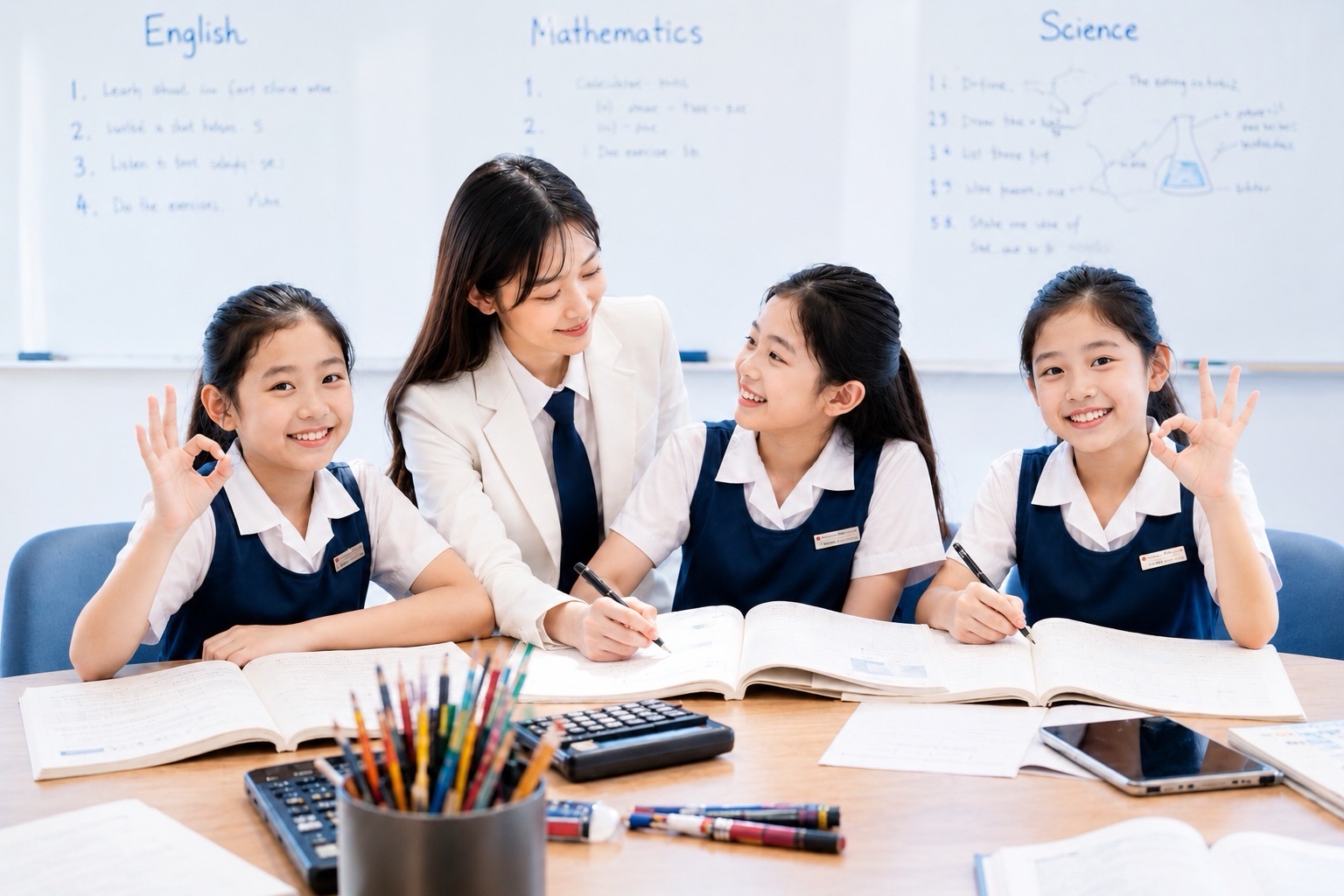
At eduKateSG, Primary Mathematics tuition is available for Primary 1 to Primary 6 and PSLE Mathematics in small groups of three students. Lessons for Sengkang families are conducted at eduKateSG’s nearby Punggol location at 83 Punggol Central, close to Punggol MRT and Waterway Point.
Primary Mathematics at a Glance
| Stage | Main Mathematics Priority |
|---|---|
| Primary 1 | Number sense, basic operations and mathematical confidence |
| Primary 2 | Stronger number relationships and early problem solving |
| Primary 3 | Multiplication, division, fractions and multi-step thinking |
| Primary 4 | Working accuracy, models, transfer and stronger problem solving |
| Primary 5 | Increased abstraction, complexity and PSLE preparation |
| Primary 6 | Integration, transfer, accuracy, timing and PSLE performance |
Start Here
If your child:
Does not understand what the question is asking
→ investigate mathematical language and comprehension.
Understands the question but does not know what to do
→ investigate concepts, relationships and method selection.
Knows the method but keeps making mistakes
→ investigate working control, number fluency and checking.
Can do familiar worksheets but struggles with new questions
→ investigate transfer.
Can solve questions at home but loses marks in tests
→ investigate examination control, timing, recovery and pressure.
The objective is not simply to make your child complete more Mathematics.
The objective is to make Mathematics increasingly understandable, usable and independent.
Mastering Primary Mathematics in Sengkang
Primary Mathematics is one of the most important learning systems a child builds during the first six years of school.
It begins with numbers that appear simple.
One more.
One less.
Five plus three.
Which number is greater?
But those early ideas gradually become fractions, ratios, percentages, geometry, measurement, data interpretation and multi-step problem solving.
By Primary 5 and Primary 6, a child is no longer being tested only on whether a calculation can be performed.
The student increasingly needs to decide:
What information matters?
What relationship exists between the quantities?
What am I trying to find?
How can I represent the situation?
Which mathematical idea should I use?
In what order should I use it?
Does my answer make sense?
That is why Primary Mathematics mastery is much more than learning formulas or completing assessment books.
It is the gradual construction of a mathematical thinking system.
Singapore’s current Primary Mathematics syllabus similarly places problem solving at the centre of learning and aims to develop mathematical concepts and skills alongside reasoning, communication, application and metacognition. It organises mathematical content principally through Number and Algebra, Measurement and Geometry, and Statistics.
A strong Primary Maths tutor therefore has to teach both Mathematics content and mathematical control.
What Does a Top Primary Maths Tutor Actually Do?
Parents searching for the “top Primary Maths tutors in Sengkang” may naturally compare class sizes, worksheets, results, teaching experience and lesson locations.
These things matter.
But there is a deeper question:
What happens to the child during tuition?
A tutor can give a child fifty questions.
Another tutor can identify the one misconception causing the child to answer fifty questions incorrectly.
Those are very different forms of tuition.
A strong Primary Mathematics tutor should be able to:
- identify what the student already understands;
- locate important missing foundations;
- explain difficult ideas in a form the child can understand;
- make the student’s working visible;
- distinguish conceptual errors from careless errors;
- select practice that repairs the actual weakness;
- vary questions so the student learns to transfer;
- increase difficulty when the foundation becomes stable;
- prepare the student for assessment conditions; and
- gradually reduce dependence on the tutor.
The end point of good tuition is therefore not:
“My tutor can show me how to solve this.”
It is:
“I can work out how to solve this myself.”
Primary Mathematics Is a Connected System
Many students experience Mathematics as separate school chapters.
Whole Numbers.
Fractions.
Decimals.
Measurement.
Area.
Volume.
Percentage.
Ratio.
Geometry.
Graphs.
Problem sums.
But Mathematics does not actually behave like a shelf of unrelated chapters.
The topics depend on one another.
For example, a student struggling with percentage may actually have a weak fraction foundation.
A student struggling with ratio may have weak multiplication and division relationships.
A student struggling with problem sums may calculate perfectly once somebody else tells them which operation to use.
That child does not primarily have a calculation problem.
The child has a problem-representation or method-selection problem.
This distinction matters.
If the diagnosis is wrong, additional practice may produce additional frustration without repairing the actual weakness.
The Primary Mathematics Capability Chain
A useful way of understanding Primary Mathematics is:
Understand → Represent → Select → Execute → Check → Transfer
Each stage matters.
1. Understand
The child must understand the mathematical idea and the language used in the question.
Words such as:
- altogether;
- remaining;
- difference;
- equally;
- more than;
- fewer than;
- fraction of;
- percentage of;
- ratio;
- average; and
- increase
are not simply English vocabulary.
Within a Mathematics problem, they carry relationships.
2. Represent
The child has to turn the question into something mathematically manageable.
That representation might be:
- a number sentence;
- a model;
- a diagram;
- a table;
- a list;
- a relationship;
- a unit comparison; or
- a sequence of intermediate quantities.
This is often where strong problem solvers separate themselves from students who merely memorise solution patterns.
3. Select
Once the situation is understood, the learner must choose what Mathematics to use.
That could involve:
- addition;
- subtraction;
- multiplication;
- division;
- fractions;
- ratio;
- percentage;
- geometry;
- measurement;
- algebraic reasoning; or
- several of these together.
Method selection is one of the most important transitions from elementary calculation to real mathematical problem solving.
4. Execute
The child must now perform the method accurately.
This involves:
- arithmetic fluency;
- organised working;
- correct notation;
- place-value control;
- careful copying;
- sequencing;
- units; and
- calculation accuracy.
5. Check
Students need to learn that finishing the calculation does not automatically mean finishing the question.
They should ask:
Is the answer reasonable?
Did I answer what was actually asked?
Are my units correct?
Did I copy the figures correctly?
Can I estimate the answer?
Can I reverse the operation?
Checking is not something to remember only after finishing a PSLE paper.
It should become part of mathematical behaviour.
6. Transfer
Transfer is the test of whether learning has become usable.
A child may appear strong because ten practice questions are almost identical.
Then the wording changes.
The diagram changes.
The information appears in another order.
An unnecessary number is inserted.
Two familiar topics are combined.
Suddenly the method disappears.
This reveals an important difference between:
recognising a rehearsed question
and
understanding the Mathematics well enough to reconstruct the solution.
Good tuition must eventually test transfer.
Primary 1 Mathematics Tuition in Sengkang
Primary 1 establishes the child’s first formal mathematical framework.
At this stage, speed should not be the only objective.
The learner is building familiarity with:
- numbers;
- counting;
- number relationships;
- number bonds;
- addition;
- subtraction;
- shapes;
- measurement;
- money;
- time;
- patterns; and
- simple problem-solving language.
A Primary 1 child who becomes dependent on procedures without understanding quantities may still complete early worksheets successfully.
The weakness can remain hidden.
The priority should be to make numbers meaningful.
A child should gradually understand not merely that:
8 + 7 = 15
but how quantities can be decomposed, combined and recognised efficiently.
Strong foundations make later Mathematics easier.
Primary 2 Mathematics Tuition in Sengkang
Primary 2 expands the mathematical system.
Students need greater control over number relationships and begin managing increasingly complex problem situations.
The child should become less dependent on:
- counting from one;
- guessing operations;
- copying examples mechanically; and
- adult prompting.
Instead, the student begins developing:
- fluency;
- mathematical vocabulary;
- multiplication and division foundations;
- mental calculation;
- representation;
- step-by-step reasoning; and
- early independent checking.
This is an excellent stage to correct fragile foundations before the Mathematics curriculum becomes substantially more demanding.
Primary 3 Mathematics Tuition in Sengkang
Primary 3 is often an important transition.
The number of mathematical relationships increases.
Students encounter greater demands involving multiplication, division, fractions, measurement, geometry and multi-step problems.
A child who previously succeeded through procedural memory may begin to struggle.
Parents sometimes see this as:
“The questions suddenly became difficult.”
But another possibility is:
The questions have begun revealing weaknesses that were already present.
Primary 3 tuition should therefore continue developing basic fluency while strengthening representation and problem-solving control.
Primary 4 Mathematics Tuition in Sengkang
Primary 4 is a particularly important consolidation year.
The learner is no longer at the very beginning of Primary Mathematics, but there is still valuable time to repair weaknesses before the heavier Primary 5 and Primary 6 workload arrives.
At this stage, attention should increasingly move toward:
- accurate working;
- question interpretation;
- models;
- multi-step problems;
- transfer between topics;
- fractions;
- measurement;
- geometry;
- data;
- problem-solving discipline; and
- reducing recurring mistakes.
Primary 4 is also a useful point to ask:
Can the child solve Mathematics independently?
A student who requires constant prompting may know more Mathematics than their test results suggest — but does not yet have enough control to deploy it independently.
That becomes increasingly important as school assessments become harder.
Primary 5 Mathematics Tuition in Sengkang
Primary 5 creates another significant increase in mathematical load.
Earlier foundations are now expected to operate together.
Students encounter more complex relationships and must work with increasing independence.
Weaknesses in:
- multiplication;
- division;
- fractions;
- number relationships;
- model drawing;
- problem interpretation; and
- multi-step reasoning
can begin appearing across several different topics.
This is why simply drilling the newest school chapter may not be enough.
Sometimes the tutor has to move backward before the student can move forward.
Repairing a prerequisite is not falling behind.
It can be the fastest route to making later Mathematics accessible again.
Primary 6 and PSLE Mathematics Tuition for Sengkang
By Primary 6, the task changes again.
The student already has years of Mathematics behind them.
The challenge is increasingly one of integration.
The learner must combine:
- concepts;
- calculation;
- representation;
- reasoning;
- problem solving;
- working accuracy;
- transfer;
- checking;
- time management; and
- examination control.
For 2026, the current 2021 Primary Mathematics syllabus extends through Primary 6, completing its progressive implementation across P1–P6.
At this stage, PSLE preparation should not become endless indiscriminate paper completion.
Practice papers are useful.
But every completed paper should generate information.
Where were the marks lost?
Was the problem:
- knowledge?
- interpretation?
- representation?
- method selection?
- calculation?
- working?
- transfer?
- carelessness?
- timing?
- checking?
- anxiety under pressure?
A paper becomes much more valuable when it is used diagnostically.
Why Does My Child Struggle With Maths Word Problems?
This is one of the most common concerns parents have.
A child may be able to calculate:
360 ÷ 6
without difficulty.
Yet when the same relationship is embedded inside several sentences, the child becomes unsure.
Why?
Because a word problem requires several capabilities at the same time.
The student must:
- read the language;
- identify relevant information;
- understand the mathematical relationships;
- identify the unknown;
- construct a representation;
- select the appropriate operation or strategy;
- calculate correctly; and
- communicate the answer.
That means “bad at problem sums” is not a diagnosis.
It is only a visible symptom.
A good tutor asks:
Which part of the problem-solving chain is failing first?
That is a much more useful question.
“My Child Is Careless in Mathematics”
Carelessness is another common description.
Sometimes it is accurate.
But the word can hide several different problems.
A student may:
- copy a number wrongly;
- overlook a unit;
- skip a step;
- confuse an operation;
- calculate mentally when written working is needed;
- rush because earlier questions consumed too much time;
- fail to estimate;
- misunderstand the question;
- lose track of several intermediate values; or
- have weak number fluency that overloads working memory.
These are not all the same error.
Therefore:
Repeated mistakes should be classified before they are corrected.
If a particular mistake keeps returning, it is evidence.
The question becomes:
What system would prevent this error from happening again?
That is more powerful than simply telling the child to “be more careful”.
Find the Earliest Weak Link
This is one of the most important ideas in Primary Mathematics tuition.
Imagine a Primary 5 student struggling badly with fractions.
The immediate reaction might be:
Do more Primary 5 fraction worksheets.
But investigation may show that the student does not have stable multiplication facts.
Or does not understand division.
Or does not understand what a fraction represents.
Or cannot compare quantities reliably.
Then the visible Primary 5 problem is not necessarily the starting point.
The tutor should search backward.
For example:
weak multiplication relationships
↓
weak division control
↓
unstable fractions
↓
difficulty with percentage
↓
difficulty with ratio
↓
difficulty with multi-step problem solving
Repairing the earliest important weakness may improve several downstream problems at once.
That is why effective tuition should not merely follow the worksheet.
It should follow the learner.
Why Small-Group Primary Maths Tuition?
eduKateSG’s current Sengkang Mathematics programme is structured around three-student classes with 1.5-hour weekly lessons, subject to suitable class availability.
The important advantage of a small group is not simply that there are fewer students.
It is that the tutor can see more of each child’s thinking.
In Mathematics, that matters.
A final answer of 48 does not tell us how the student arrived at 48.
A tutor needs to see:
- the first line;
- the representation;
- the chosen operation;
- the intermediate calculations;
- the hesitation;
- the erased working;
- the shortcut;
- the misconception; and
- the checking behaviour.
The mistake often becomes visible before the final answer is wrong.
With three students, the tutor can intervene closely while still preserving the useful benefits of a small learning group.
Students can also see that different people may approach the same problem differently.
That helps Mathematics become reasoning rather than answer copying.
What Should Happen During Primary Mathematics Tuition?
A useful lesson can move through several stages.
Diagnose
What does the student understand now?
Where is the earliest important weakness?
Explain
The tutor makes the underlying mathematical relationship clear.
Model
The student sees how mathematical thinking becomes organised working.
Guide
The learner attempts similar problems with support.
Practise
The student begins controlling the process independently.
Vary
The question changes.
The learner must determine whether the old method still applies.
Transfer
The student faces a less familiar problem without being told what method to use.
Review
Mistakes become evidence for the next teaching decision.
This creates a learning loop:
Teach → Attempt → Observe → Diagnose → Repair → Retest → Transfer
The purpose is not to rush through the largest quantity of material.
The purpose is to make each important capability increasingly reliable.
Catch Up, Keep Up and Move Ahead
Different Sengkang students come to tuition from different starting positions.
There should therefore not be only one tuition mode.
Catch Up
For a child with missing foundations:
diagnose → repair → stabilise → reconnect to current schoolwork
Keep Up
For a child who generally understands Mathematics but needs stronger control:
reinforce → practise → correct → transfer → prepare
Move Ahead
For a mathematically secure student:
extend → vary → challenge → connect → deepen
Moving ahead should not mean racing through chapters for the sake of saying they have been completed.
The strongest advancement occurs when the student’s mathematical capability grows with the content.
Primary Maths Tuition for Sengkang Families
Sengkang and Punggol are neighbouring north-east communities, so some Sengkang parents may prefer a nearby tuition option rather than travelling across Singapore.
eduKateSG’s Primary Mathematics classes serving Sengkang students are conducted at:
eduKateSG Punggol
83 Punggol Central
Singapore 828761
The centre is near Punggol MRT and Waterway Point.
This distinction is important:
eduKateSG is not describing the classroom as being physically in Sengkang.
Rather, the Punggol centre provides a nearby Primary Mathematics tuition option for families travelling from Sengkang.
How Do I Know Whether My Child Needs Primary Maths Tuition?
Tuition may be worth considering when a pattern begins appearing.
For example, your child:
- repeatedly misunderstands school Mathematics;
- has forgotten important earlier skills;
- requires extensive homework assistance;
- struggles particularly with problem sums;
- knows methods but cannot select them independently;
- makes the same mistakes after correction;
- performs much worse in tests than during practice;
- has become fearful of Mathematics;
- is progressing well but needs greater challenge; or
- needs structured preparation for an important school or national examination.
One weak test alone does not automatically mean a child requires tuition.
Look for the underlying pattern.
The most useful question is:
What does my child need that their present learning environment is not currently providing?
Then solve that problem.
Choosing a Primary Maths Tutor in Sengkang
When parents compare Primary Mathematics tutors, consider asking questions beyond:
“How many worksheets will my child receive?”
Useful questions include:
How many students are in the class?
The tutor needs enough visibility to observe the learner’s actual working.
How are weaknesses diagnosed?
Ask whether the tutor simply teaches according to level or also identifies earlier prerequisite gaps.
How are mistakes corrected?
A corrected answer is useful.
Understanding why the error occurred is more useful.
Does the tutor teach problem representation?
Strong Mathematics teaching should help students work out how to begin unfamiliar questions.
Is transfer tested?
Students should eventually encounter questions that are not exact copies of their examples.
Is the student becoming more independent?
This may be the most important question of all.
A successful tutoring relationship should increase the child’s mathematical control rather than make the child permanently dependent on tuition.
What Does “Top Primary Maths Tutor” Mean?
There is no single tutor who is automatically best for every child.
“Top” should therefore not simply mean:
- the most famous;
- the largest centre;
- the most worksheets;
- the fastest class;
- or the most difficult material.
For a particular child, the strongest tutor may be the one who can most reliably convert:
confusion into understanding;
weak foundations into stable foundations;
memorised methods into usable knowledge;
repeated errors into controlled working;
fear into manageable challenge;
and dependence into independence.
That is a more meaningful standard.
Frequently Asked Questions
Do you provide Primary Mathematics tuition for Sengkang students?
Yes.
eduKateSG supports Primary 1 to Primary 6 and PSLE Mathematics students from Sengkang through its nearby Punggol tuition location, subject to suitable class availability.
Where are the lessons conducted?
Lessons serving Sengkang families are conducted at eduKateSG Punggol, 83 Punggol Central, Singapore 828761, near Punggol MRT and Waterway Point.
How large are the Primary Maths classes?
The current programme uses premium three-student small groups with weekly 1.5-hour lessons.
Which Primary levels do you teach?
Primary Mathematics support is available from Primary 1 through Primary 6, including PSLE Mathematics preparation.
Can tuition help if my child is weak at problem sums?
Yes, but the first task should be to establish why the child struggles.
The difficulty may involve mathematical vocabulary, concept knowledge, representation, method selection, multi-step organisation, arithmetic or transfer.
Once the weak component becomes visible, practice can become much more targeted.
My child understands Maths but keeps making careless mistakes. Can tuition help?
Yes.
Repeated “careless” mistakes should be analysed.
The tutor can determine whether errors arise from rushing, weak calculation fluency, poor notation, skipped steps, question misreading, working-memory overload or ineffective checking.
The aim is to create a method that reduces recurrence.
Should my Primary 1 or Primary 2 child have Mathematics tuition?
Not every young child needs tuition.
Where support is needed, early Primary Mathematics tuition should concentrate heavily on understanding, number relationships, mathematical language and confidence rather than premature examination pressure.
A strong beginning can make later learning easier.
When should PSLE Mathematics preparation begin?
PSLE preparation is not simply the moment a child starts completing PSLE papers.
The foundations for PSLE Mathematics are built throughout Primary school.
By Primary 5 and Primary 6, preparation can become increasingly examination-specific, but concept understanding, representation, transfer and accurate working remain essential.
Do more worksheets make a child better at Mathematics?
Practice matters.
But practice is most effective when the student knows what is being practised and receives useful feedback.
Repeating the same misconception twenty times may strengthen the wrong method.
The better sequence is:
Understand → practise → vary → transfer → review
Master Primary Mathematics
Primary Mathematics does not have to become a race through worksheets.
The deeper objective is to build a child who can look at an unfamiliar problem and think:
I know what this information means.
I can work out the relationship.
I have a way to begin.
I can choose a method.
I can show my working.
I can check whether my answer makes sense.
That is mathematical control.
From Primary 1 number sense to Primary 6 PSLE problem solving, each year adds another part of that system.
Strong tuition should help the pieces connect.
For families searching for Primary Maths tutors in Sengkang, eduKateSG provides nearby Primary 1–6 and PSLE Mathematics support through its three-student classes at Punggol Central.
The objective is simple:
Catch up where foundations are weak.
Keep up as school Mathematics develops.
Move ahead when the student is ready.
And throughout the process:
find the earliest weak link, repair it properly, and help the child become increasingly capable of doing Mathematics independently.
