
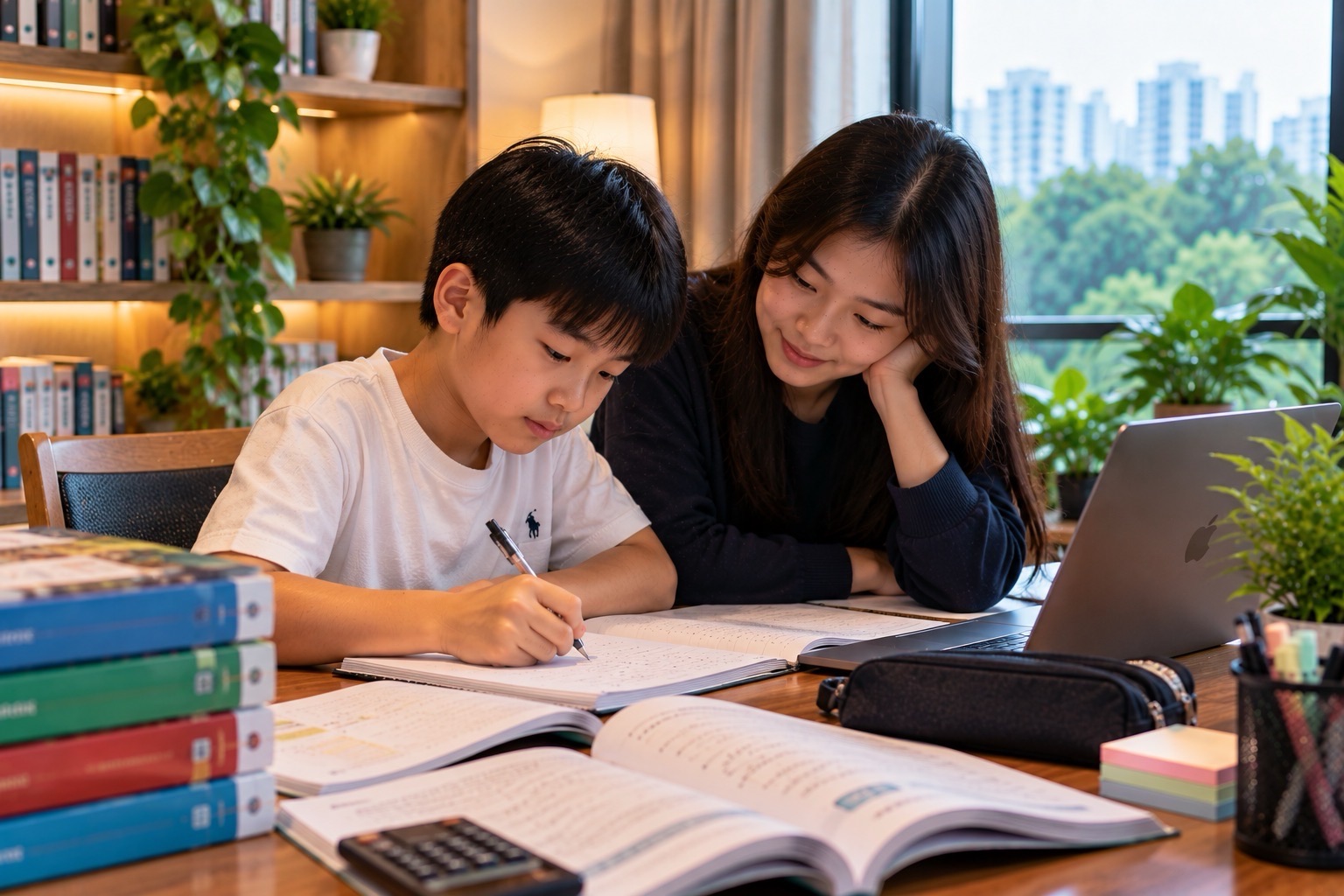
Do you know that an SEC Art portfolio is assessed for much more than the beauty of the final pictures? Under the official 2027 Singapore-Cambridge Secondary Education Certificate (SEC), G1 Art K126 has a **60% portfolio** containing a selection of ten screens of visual materials and two distinct artworks. G2 Art K236 has a **50% portfolio** with up to ten screens and a commentary based on two works. G3 Art K347 has a **50% portfolio** with up to fifteen screens and a commentary on three works. Higher Art K348 adds a separately assessed Higher Art Project. Mixing these rules can produce a portfolio that looks accomplished but does not follow the student’s actual examination requirements.
Parents asking how many Art portfolio screens are allowed, whether research counts, whether the child must draw realistically, or whether digital media and generative AI are acceptable should start with the correct 2027 G-level syllabus. G1 Paper 1 is a 90-minute Art examination weighted 40%, while its portfolio is completed in 18 hours within eight weeks. G2 and G3 have a 2-hour-15-minute Visual Response paper weighted 50%, and a portfolio done in 30 hours within twelve weeks for the remaining 50%. For G2, the commentary is limited to 500 words and fewer than eight A4 pages; for G3, it is up to 800 words and under ten A4 pages. These are concrete official differences.
The bigger educational question is what the student learnt by looking, testing and creating. A learner may paint realistically yet be uncertain how the work communicates an idea. Another may express an intriguing concept but provide little evidence of the exploration that developed it. A third may make excellent digital art yet misunderstand attribution and authentic authorship. Good parent support helps children notice visual qualities, explain the consequences of artistic decisions and reflect independently, without parents creating, editing or disguising their assessed portfolio as the child’s work.
Official 2027 SEC Art portfolio and paper comparison
| Level | Paper 1 | Portfolio Paper 2 | Key submission |
|---|---|---|---|
| G1 K126 | 40%; 90 minutes | 60%; 18 hours within 8 weeks | 10 screens plus 2 separate artworks |
| G2 K236 | 50%; 2 h 15 min | 50%; 30 hours within 12 weeks | 10 screens, two-work commentary max 500 words |
| G3 K347 | 50%; 2 h 15 min | 50%; 30 hours within 12 weeks | 15 screens, three-work commentary max 800 words |
| Higher Art K348 | Core G3 Art scheme | Core G3 Art scheme | Additional independent 12-week Higher Art Project, 1,000–1,200 words |
Do you know? Art is not just drawing well
The 2027 Art syllabuses describe art through perception, communication and appreciation. They address art forms and media, visual qualities and design concepts, artistic processes and context. A technically accurate drawing can be one achievement within this education, but accurate depiction alone does not reveal the student’s ability to develop and communicate an intended meaning.
Imagine two pupils sketching the same empty playground. One focuses on exact proportions, while another uses colour, shadows and viewpoint to explore a feeling of absence. Their aims differ. A useful teacher question is what the choices reveal about the subject rather than which picture looks most like a photograph. Artistic purpose matters.
Parents can encourage curiosity without attaching a permanent label such as ‘talented’ or ‘not artistic’. Ask what the child wanted to communicate, which visual decision mattered and what they would investigate next. These questions support the learning the syllabus intends to develop.
Do you know? K126, K236, K347 and K348: why codes prevent confusion
G1 Art is K126, previously referenced as 6128. G2 Art is K236, with earlier code 6127. G3 Art is K347, earlier 6114; G3 Higher Art K348 references 6124. A generic ‘SEC Art portfolio’ guide may not make these distinctions, even though the student must submit different evidence by level.
Keep the exact code in the child’s project folder and on the school subject-options form. Under Full Subject-Based Banding, subject levels can vary. A G3 Mathematics pupil is not automatically an Art K347 candidate. The actual registered Art level controls the national specification.
The directory describes nationally examinable courses, not a guarantee that every school offers every option, particularly Higher Art. For a later graduating cohort, revisit the eventual examination year’s syllabus before assuming the 2027 numbers remain unchanged.
Do you know? G1 Paper 1 has three very different parts
K126 Paper 1 lasts 1 hour 30 minutes, has 40 marks and accounts for 40% of the subject. Section A carries five marks through matching, fill-in-the-blank and multiple-choice-style knowledge tasks. Section B is short answers worth fifteen marks. Section C is a twenty-mark short practical Art task that applies visual understanding to a stimulus.
This means G1 revision cannot be restricted to drawing from memory. Students may need to recognise visual qualities, interpret artworks or designs, and make a short purposeful concept sketch. Their work should be responsive to the actual supplied task rather than a prepared image reproduced mechanically.
A good home discussion uses an original poster or illustration. Ask which feature draws attention, why the arrangement works and how an alternative sketch would change the effect. Avoid inventing examination images or promising that a particular theme will appear.
Do you know? The G1 portfolio contains two different kinds of submission
Part A of K126 Paper 2 contains a maximum of ten screens of selected visual materials, worth 35 marks. These can document ideas, experiments, research and in-progress work. The selection must show at least two art forms and media, one of which is Design. Part B consists of two artworks of different forms and media, worth 25 marks.
The syllabus says the two completed artworks must not be the same as works selected for Part A visual materials. A student who repeatedly photographs the same final piece from multiple angles cannot assume those images meet every required role. Evidence of process and submitted artworks have different purposes.
Ask the child to explain what each proposed screen demonstrates. One may show a visual influence, another a new material, and a third a change in composition. Each selected item should contribute to the story of learning rather than simply fill space.
Do you know? Why ten screens is a maximum rather than a target for repetition
A maximum screen count tells the candidate how much selected evidence may be included; it does not imply that ten nearly identical images will necessarily score more than fewer purposeful selections. The G1 syllabus says selected visual materials need not be chronological and that headers and annotations, if used, should be kept minimal.
The child should therefore practise curation: choose work that reveals distinct explorations, then explain how each informed an artistic decision. One screen may show a contrast between colour treatments, another how a different medium handles texture. The important feature is learning, not a decorative title on every page.
For formally assessed work, follow the supervisor’s instructions on authenticity and file format. Parents can ask selection questions, but the candidate must make and submit their own evidence under the school’s authorised conditions.
Do you know? The eight-week G1 portfolio window
The K126 portfolio is completed in 18 hours within eight weeks. That is an assessment specification administered by the school, not permission to work 18 unsupervised hours on an invented assignment at home. The candidate’s work must be appropriately authenticated.
Families can help with reasonable routines and reminders, but should not manufacture artworks, rewrite annotations or prepare source material as though the pupil discovered it independently. The Art teacher can explain which ordinary learning materials may be submitted and which practical tasks must be completed under supervised conditions.
A child who is behind should identify genuine existing work, seek teacher guidance and make an honest plan. Retrospective fabricated research can undermine assessment integrity. It is better to understand the current stage and complete appropriate authentic steps.
Do you know? G2 Paper 1 is visual analysis plus exploratory sketching
G2 Art K236 Paper 1 lasts 2 hours 15 minutes and carries 50 marks, weighted 50%. Section A presents an unseen visual stimulus with a two-part visual analysis question worth ten marks. Section B asks for exploratory sketches with annotations, culminating in a concept responding to a visual task, worth forty marks.
A child may be excellent at reproducing a familiar image yet struggle to invent a concept when the stimulus changes. The missing skill may be visual interpretation, selecting an artistic approach or explaining why a design communicates its intended meaning. Another child may generate exciting ideas but leave development unclear.
Use safe original visual challenges that ask the pupil to observe, propose alternatives and explain choices. A good practice exercise is not simply ‘make a beautiful drawing’ but ‘show how your response relates to the stimulus and develops’.
Do you know? G3 Paper 1 shares the structure without becoming an identical paper
K347 Paper 1 also lasts 2 hours 15 minutes, with ten marks for visual analysis and forty for exploratory sketching. It likewise represents 50% of G3 Art. Similar duration and structure, however, do not mean G2 and G3 have interchangeable assessed learning standards.
G3 performance can require appropriately considered analysis, coherent visual investigation and purposeful communication at its own level. The child should be able to discuss what is significant about a visual stimulus and how successive sketches refine an idea. More drawing alone is not necessarily better.
When reviewing an answer, ask why a second sketch exists. Did it resolve a proportion problem, change a concept or improve communication? If the student simply redrew the first image more neatly, teach purposeful variation rather than equating surface polish with exploratory skill.
Do you know? G2 Paper 2: ten screens and a two-work commentary
For 2027 G2 Art, Portfolio Paper 2 carries 50 marks and 50% of the subject. Part A allows a maximum of ten screens showing artistic exploration across at least two art forms and media and is worth thirty marks. Part B requires a commentary on personal artistic growth using two works and is worth twenty marks.
The commentary is limited to 500 words and fewer than eight A4-sized pages. It should reflect what the student has genuinely learnt through visual research, experimentation and development. A report consisting only of daily emotions or generic praise of artworks is unlikely to communicate the intended artistic process.
Parents should not apply the G1 two-separate-artworks requirement automatically to the G2 commentary. The assessed evidence is differently defined. Use K236 and the school’s supervised portfolio guidance rather than a broad internet template.
Do you know? G3 Paper 2: fifteen screens and three works
G3 Art K347 also has a 50% portfolio, but Part A permits a maximum of fifteen screens and expects exploration covering at least three art forms and media. Part B requires a commentary on artistic growth based on three works, with a maximum of 800 words and fewer than ten A4 pages.
These are significant differences from G2’s ten screens, two works and 500 words. A pupil who follows the wrong level’s instructions may spend time on unnecessary formatting or omit required evidence. The supervisor should confirm the exact current submission criteria.
Fifteen screens are not a demand to include everything from the student’s entire Art education. Thoughtful selection should reveal breadth, changes in approach and the role of different media in developing ideas. The commentary should connect those choices, not merely repeat image captions.
Do you know? What do 30 hours within 12 weeks actually mean?
Both G2 and G3 2027 Art portfolios are completed in thirty hours within twelve weeks. This is the formal assessed portfolio schedule, separate from ordinary creative practice across school years. Work must satisfy the supervised and authenticated procedures in the relevant syllabus.
Parents can make room for regular school art learning and help students organise their time. They should not secretly produce digital artworks, commission external pieces or rewrite the commentary. The Art teacher supervises the process and can explain what documentation is required.
If a child is anxious about completion, identify the next genuine decision: which media has not yet been explored, which test needs evidence or which work best demonstrates artistic growth? A specific question is more helpful than adding decorative pages at random.
Do you know? How visual research differs from copying artwork
Research may involve examining artists, contexts, techniques and media to discover new ways of seeing and making. Copying an image can help study a technique in some learning situations, but presenting another person’s composition as an original assessed result violates the purpose of independent portfolio work.
Ask the learner what they noticed in a reference and what idea it helped them develop. If a particular artist’s approach to texture influenced their experiment, the student should explain how the trial differed from the reference and acknowledge the source appropriately.
The formal 2027 Art syllabuses stress academic integrity, proper attribution and respect for intellectual property. Sources should be identified, including digital tools, AI assistance, ready-made materials and external collaboration where relevant. Authentic contribution matters as much as attractive presentation.
Do you know? An artistic process does not have to be perfectly linear
Artistic exploration often involves trying something, discovering an unexpected result and returning to an earlier idea. A portfolio can show a meaningful change of direction without pretending that every step was planned flawlessly at the beginning. That is part of what reflection and experimentation can communicate.
Suppose a pupil intends to represent motion using repeated lines but finds the image confusing. They try a changed arrangement and notice that the viewer follows the movement more clearly. The lesson is not simply that the second drawing is prettier. It is why the visual strategy communicates more effectively.
Parents can ask what the experiment revealed and how the child responded. Resist inserting invented failures to make the journal look authentic. Genuine discoveries, including uncertainty and limitation, can offer useful evidence of creative thinking.
Do you know? What does visual analysis mean when the image is unfamiliar?
Visual analysis is noticing and explaining how significant choices in an artwork or design contribute to its effect. The child may discuss line, colour, tone, composition, texture, space or context, depending on the question. Naming a technique without explaining its role usually does not complete the reasoning.
Imagine a poster with one bright shape among muted surroundings. The learner identifies contrast, then explains why the shape attracts attention and how that emphasis supports the intended message. This is more useful than writing ‘contrast makes it stand out’ on every question regardless of the image.
Ask the student to change the colour or position in a quick sketch and predict what a viewer might notice first. If the child can explain a changed effect using evidence from a new image, the analysis is becoming independent.
Do you know? A practice exercise: two posters, two audiences
Consider an original fictional event notice. One version has all information in tiny text, while another gives the date and location prominent visual hierarchy. Ask which communicates better to people walking past a noticeboard and what design features support that conclusion.
Now change the audience to younger pupils or readers viewing the notice on a phone. The student may need different text sizes, spacing or imagery. The best choice depends on the communication purpose and the visual context rather than one universal layout rule.
A simple sketch and a short explanation can reveal purposeful design thinking. This example is not an official SEC visual-response task or part of the candidate’s assessed portfolio. It is a safe exercise in recognising how art and design can serve a reader.
Do you know? Why context matters in artistic interpretation
An image does not exist outside history, culture, audience and the artist’s choices. Similar visual objects may communicate different meanings depending on composition and surrounding information. A student should distinguish what the image visibly establishes from what they infer.
Imagine an invented artwork showing two empty chairs beside a window. The emptiness may suggest loss, waiting or calm. It would be irresponsible to claim with certainty that the artist was grieving a particular family member without supporting contextual evidence. An interpretation should be defensible while recognising the possibility of other readings.
Encourage the pupil to explain the connection between a visual detail and the proposed meaning. This develops close observation and critical thought, rather than teaching a dictionary in which every colour or shape has only one fixed emotional interpretation.
Do you know? Visual qualities can create conflicting impressions
Bright colours do not always communicate happiness, and dark colours do not always represent sadness. A visually striking colour can feel playful, unsettling or urgent depending on placement, subject matter and relationships to other elements. Parents should be cautious about teaching universal emotional translations for artistic choices.
A short exercise compares a bright red symbol used in a cheerful invitation with the same red used in a hazard notice. Ask what the surrounding forms, words and audience do to its meaning. The student can then create a different context and explain an appropriate choice.
This moves the learner from labelling elements to understanding purposeful visual communication. The value of a formal Art response lies in explaining how choices operate in the specific work, not merely displaying an impressive vocabulary list.
Do you know? G1 and G2 artistic exploration: different evidence structures
At G1, Part A visual materials and Part B distinct artworks make the relationship between exploration and selected work visible. At G2, the portfolio uses visual-material screens and a reflective commentary based on two works. The two submissions are not interchangeable. A family copying a G1 example into K236 may misunderstand the purpose of Part B.
G2 students should select evidence that supports a coherent account of how they worked with media and developed ideas. Their commentary can mention actual changes in technique or understanding, anchored to the two works considered. It should not claim experiments that did not occur.
Ask the child how a particular visual investigation informed one work and what they would do differently in a new context. This supports honest reflection rather than a retrospective sales pitch for a supposedly flawless final product.
Do you know? G3 breadth: why three art forms and media matter
G3’s selection of visual materials must include at least three art forms and media. This breadth gives the learner opportunities to compare what different approaches make possible. It does not mean that changing from one brand of pencil to another automatically demonstrates a new art form.
The student might contrast drawing, print-based work and digital or three-dimensional exploration, according to the school’s permitted content. The key is to describe how the medium affected the visual idea. Different material characteristics can change texture, spatial organisation and the experience of the viewer.
Curating fifteen screens from these explorations is a thinking task. What was learnt from each medium, and which choices show genuine artistic development? A strong selection reflects reasons, not just a collection of unrelated experiments.
Do you know? Higher Art K348: the separate twelve-week project
Higher Art uses the G3 Art Papers 1 and 2 for the normal SEC Art grade and adds an independently assessed Paper 3 Higher Art Project. The 2027 syllabus provides three project questions; the candidate chooses one. Work occurs over twelve weeks from February through April and is assessed out of 100 marks.
The project requires a report of 1,000–1,200 words in A4 PDF format. The student must investigate the chosen task, develop an appropriate response, evaluate process and outcome and communicate a personal artistic engagement. This should not be confused with G3’s ordinary 800-word Portfolio Paper 2 commentary.
School supervision, teacher statements and principal endorsement authenticate the work. Parents should not produce an additional home project or pay someone to write the Higher Art report. The extra component is intended to recognise the candidate’s authentic inquiry.
Do you know? How is a Higher Art Distinction or Merit awarded?
The Higher Art syllabus states that the SEC Art grade comes from the combined Papers 1 and 2. For a Higher Art Distinction, the candidate needs A1 or A2 in the ordinary Art papers combined and A1 or A2 in the Higher Art Project. For Merit, the required level is C6 or better in both, subject to the stated rules.
Thus Paper 3 is not simply another percentage added to the 50/50 Art assessment. It operates independently within the Higher Art award process. Parents should check that distinction before interpreting a child’s performance or comparing Art and Higher Art as if one grade automatically contains more raw marks.
The additional project can reward sustained curiosity and research, but should be considered in light of the pupil’s interest, readiness and full subject workload. The school’s Higher Art offering and selection rules determine access, not possession of expensive supplies.
Do you know? Digital art, school devices and generative tools
The 2027 Art syllabuses recognise personal learning devices for appropriate research and experimentation with digital or time-based art forms. Digital art can be a legitimate medium, but tool access is not a substitute for purposeful ideas and personal work. The child should know what the software allowed them to explore and why the resulting choices matter.
A student who applies a fashionable filter without understanding its effect may learn less than one who tests how repeated forms or colour changes alter a composition. Ask what the learner actually changed and what visual problem it addressed. The explanation should come from the student, not a tool-generated promotional description.
Any use of AI, external images, ready-made materials or software assistance must follow the school’s authenticity and citation conditions. Parents should not treat an AI-generated final picture as entirely the pupil’s independent work or conceal such assistance in formal assessment.
Do you know? Why authentic work is more valuable than a perfect-looking image
An experienced adult can quickly improve a child’s composition or rewrite reflective notes, but doing so may hide the learner’s actual understanding. The syllabus requires authentic work and appropriate attribution. A portfolio is an opportunity for the student to demonstrate what they can see, make, decide and explain.
If a piece is unfinished or a test was disappointing, ask what the child discovered. Perhaps the material could not hold a form or a layout did not communicate as intended. An honest, well-explained observation can be educationally meaningful without being artificially polished.
Parents can support organisation and offer normal conversations about art, but the assessed making, selection and commentary must remain with the pupil under school supervision. Protecting ownership of the work protects the learning it is meant to demonstrate.
Do you know? How to choose appropriate art materials without overspending
A particular art medium should suit the intended idea, school task and permitted assessment conditions. Expensive paint, specialist cameras or drawing tablets do not automatically produce a stronger artistic response. A simple sketch can show thoughtful visual reasoning that a complex digital composition lacks.
Ask what the material contributes—texture, layering, transparency, spatial depth or another quality—and whether a less complicated method could serve the purpose. The Art teacher should advise what is safe, available and appropriate for formal school work.
Do not assume that a generic hobby product recommended online is allowed in Paper 1 or the supervised portfolio. Follow official permitted-media instructions, especially for the short G1 practical task and the Art examination setting.
Do you know? What should a learner do after an unsuccessful art experiment?
An experiment that does not achieve its intended effect can still provide evidence. The child should state what they were trying, what happened and what question remains. A blurry print or confusing arrangement may suggest a change in medium, technique or visual structure.
A pupil might discover that several competing focal points leave the viewer unsure where to look. The next trial could simplify the hierarchy. Rather than declaring the first attempt worthless, ask what it taught about emphasis and composition. A thoughtful revision has an identifiable reason.
That reasoning belongs in ordinary learning and, where authorised, authentic portfolio evidence. It should not be manufactured retrospectively. The value is the real process of noticing, adapting and explaining, not staging a pretend mistake to impress a marker.
Do you know? How to revise for unseen visual stimuli
An unseen visual task assesses the ability to notice and respond to new material. The candidate cannot memorise every possible poster, painting or design image. They can practise a method: inspect carefully, identify significant visual relationships, interpret a likely purpose and propose a response based on relevant evidence.
Begin with short original images and one question at a time. Ask which feature is most noticeable and why. Then change the context and ask for a new sketch or explanation. A child who copies one model arrangement every time needs practice selecting a strategy independently.
Timed sections become useful when the underlying skill is secure. G1’s ninety-minute Paper 1 and G2/G3’s two-hour-fifteen-minute Paper 1 should not be treated as interchangeable exam rehearsals merely because both contain artmaking.
Do you know? A six-week parent-supported artistic learning cycle
Week one: confirm the correct SEC code and teacher’s present task. Ask the pupil to discuss one piece of work and identify a concrete visual weakness. Week two: practise noticing colour, shape, texture or hierarchy in unfamiliar original material. Week three: try two safe, independent alternatives and describe what each communicates.
Week four: practise concise reflection about a real change of approach. Week five: use one current-level visual-response question, focusing on evidence and purposeful development. Week six: return to the original weakness with a changed stimulus and see whether the child can explain the result without prompts.
This is an illustrative learning sequence, not the formal eight-week G1 or twelve-week G2/G3 supervised portfolio timetable. The school controls assessed work, and families should preserve time for other subjects, reading and rest.
Do you know? How can parents tell if Art tuition is actually helping?
A thoughtful tutor begins by identifying the student’s real subject level and the precise skill that is insecure. One child may struggle with form and proportion; another with generating ideas from a brief; another with interpreting a visual stimulus or communicating a coherent artistic intention.
Effective teaching involves an independent initial attempt, explanation, guided variation and another attempt with a changed challenge. A learner who can explain why a revised composition communicates better is showing growth. Reproducing a tutor’s polished example without understanding it is a weaker result.
Parents should look for feedback such as ‘can identify a focal point and explain its effect’ or ‘can compare two media using evidence’. Such descriptions are more actionable than being told the child has completed many beautiful pictures.
Frequently asked Art portfolio questions
Does SEC Art have a portfolio at every level?
Yes. G1 K126, G2 K236 and G3 K347 have compulsory portfolio components under their 2027 school-candidate schemes.
What is the G1 Art syllabus code?
K126, with older reference 6128.
What is G2 Art?
K236 for 2027, with previous reference 6127.
What is G3 Art?
K347 for 2027, with previous reference 6114.
What is Higher Art?
G3 Higher Art K348, with a separate Higher Art Project in addition to the core G3 Art papers.
How much is G1 Paper 1 worth?
Forty per cent; 90 minutes and 40 raw marks under the 2027 syllabus.
How much is G1 Art portfolio worth?
Sixty per cent, with 35 marks for visual materials and 25 for two artworks.
How many G1 screens are required?
A selection of up to ten visual-material screens, with at least two art forms and media including Design.
Does G1 submit two artworks?
Yes. Two artworks of different forms and media, not the same works selected for the visual materials.
How long is the G1 portfolio period?
Eighteen hours within eight weeks under the formal supervised rules.
How long is G2 Art Paper 1?
Two hours fifteen minutes, with visual analysis and exploratory sketching, weighted 50%.
What is the G2 Art screen limit?
Up to ten screens across at least two art forms and media.
What is the G2 commentary limit?
No more than 500 words and under eight A4 pages, based on two works.
How long is G3 Art Paper 1?
Two hours fifteen minutes, with the same broad visual-response sections under the G3 standard.
What is the G3 screen limit?
Up to fifteen screens illustrating at least three art forms and media.
How long is the G3 commentary?
No more than 800 words and under ten A4 pages, based on three works.
Are G2 and G3 portfolios both fifty per cent?
Yes, with 30 hours within twelve weeks according to their 2027 specifications.
Does more artwork always mean higher marks?
No. Appropriate selection, artistic development, visual communication and the level’s rubric matter.
Can children use a personal learning device?
The syllabuses permit appropriate digital experimentation and research, subject to school guidance and authentic-work rules.
Can AI create the whole assessed art portfolio?
It must be the student’s authentic work. External assistance, ready-made material, software and AI use must comply with authorisation and attribution requirements.
What does exploratory sketching mean?
Developing visual ideas through sketches and suitable annotations in response to a stimulus, not merely reproducing a prepared picture.
Is the G1 research selection required to be chronological?
No. The G1 syllabus says the chosen visual-material screens need not be arranged chronologically.
What is Higher Art Paper 3?
A separate 100-mark twelve-week project selected from three released questions, supported by a 1,000–1,200-word report.
Does Higher Art Paper 3 add another fifty per cent to ordinary Art?
No. The project is considered independently for the Higher Art award; core Papers 1 and 2 determine the SEC Art grade.
How do candidates earn Higher Art Distinction?
The 2027 rules require A1/A2 for the combined core papers and A1/A2 in the Higher Art Project.
How is Higher Art Merit awarded?
The published rules require C6 or better in both the core Art result and the project component.
Does everyone have to take Higher Art?
No. It is a separately listed subject with school availability and entry conditions.
Can parents buy every portfolio medium for their child?
That is not necessary or automatically helpful. Ask the Art teacher what forms and materials are suitable, safe and permitted.
Is Art the same as D&T?
No. Their creative practices can overlap, but the examinable subjects and assessment schemes are different.
Can old GCE Art papers still help?
Possibly for aligned concepts, but a complete older paper is not an exact 2027 SEC mock without verifying level and scheme.
What if the child cannot draw realistically?
Identify the actual visual or conceptual skill required. Art also involves ideas, communication, media exploration and reflection.
Should a child cite external visual influences?
Yes. The syllabuses stress attribution of sources, external contributions, software and AI tools.
Can a parent write the commentary?
No. Assessed work should be an authentic account of the candidate’s own artistic decisions and learning.
Does the art portfolio require formal supervision?
Yes. Follow the school’s coursework authentication, assessment and submission requirements.
What should I ask at a parent–teacher meeting?
Ask what specific visual, artistic or reflective skill is missing, and how a changed independent task would demonstrate improvement.
Official SEAB Art syllabus documents
The authoritative examination-year references are G1 Art K126, G2 Art K236, G3 Art K347, Higher Art K348. To choose the exact subject, visit SEAB’s 2027 G1, 2027 G2 and 2027 G3 directories. The school supplies binding portfolio briefs, permitted-media information and supervised submission procedures.
For wider questions about current teaching and terminal examinations, read Why School Exams Differ from MOE and SEAB Syllabuses and How to Read SEAB Assessment Objectives. For related creative-course requirements, see D&T project coursework across G1, G2 and G3. The Clementi small-group teaching reference illustrates diagnosis, explanation and independent transfer as teaching methods, not Art assessment rules.
Teaching Guide: three independent ways to strengthen artistic thinking
First, present a new image outside the candidate’s assessed portfolio and ask them to identify one significant visual choice and the effect they think it creates. Require an explanation supported by what can be observed, not a memorised label alone. Change the image and ask again. A learner who independently selects a relevant feature is demonstrating more reliable visual analysis than one who simply echoes a teacher’s example.
Second, invite two quick sketches for different imaginary audiences, such as a community notice for younger and older readers. Ask what the artist changed in visual hierarchy, space or imagery and why. The best response may use simple materials: its value is the relation between purpose and choice, not expensive equipment. Keep these practice sketches separate from formally supervised examination work.
Third, ask the pupil to describe one authentic experiment that changed their understanding. Which question prompted it? What visual effect did they observe? How did the outcome influence their next attempt? Encourage honest reflection and proper credit for sources. Then confirm the correct SEC code, screen limit and supervision rules with the school before assembling any assessed portfolio.