
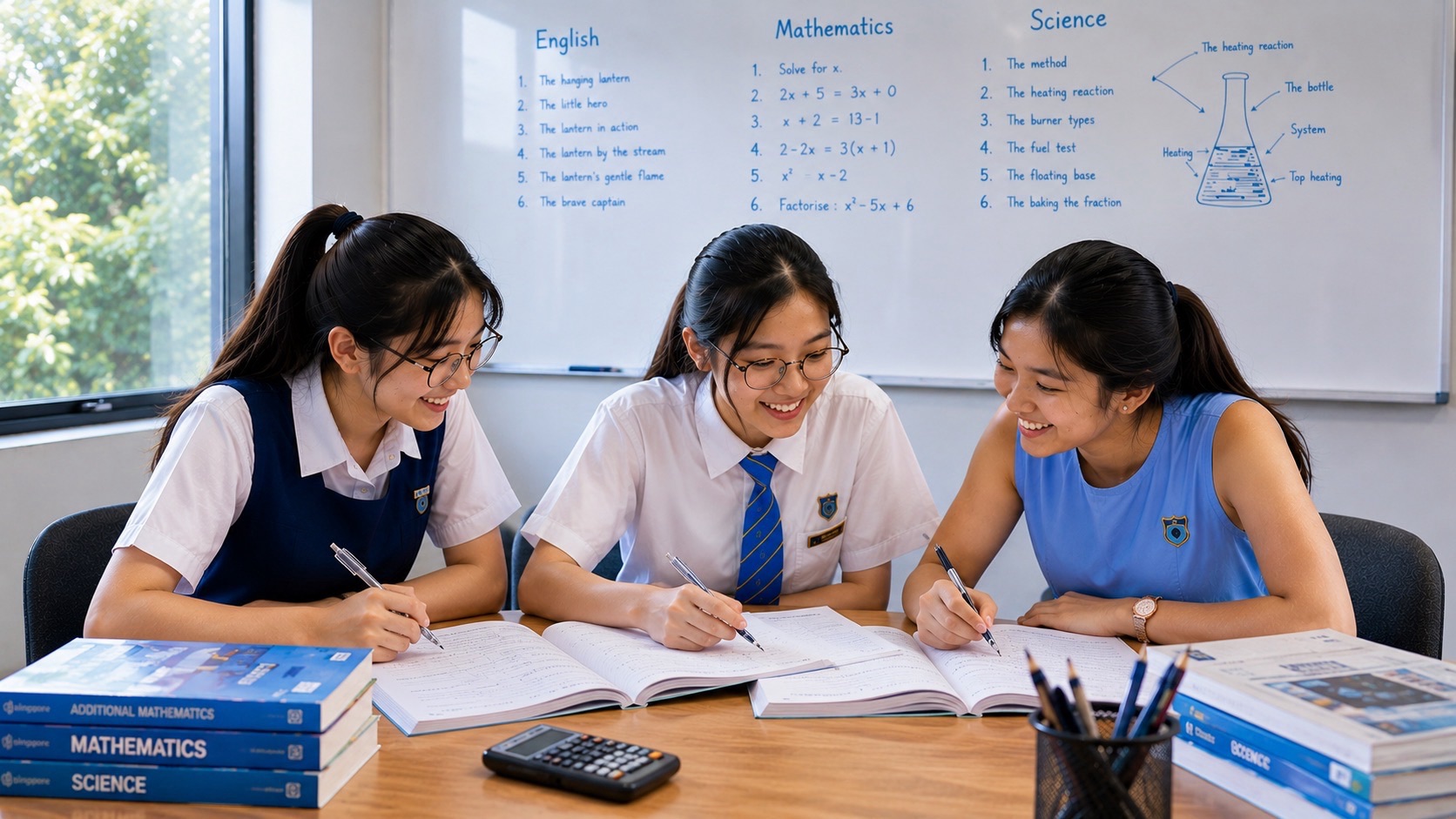
A student’s life in Canberra is built from more than school hours. It is the full daily system of waking, travelling, learning, eating, moving, resting, revising, attending CCA, meeting friends and returning home with enough energy to begin again the next day.
Canberra sits between Sembawang and Yishun on the North–South Line, with newer housing, neighbourhood facilities, park connectors and the growing Bukit Canberra community hub. It is a useful example of a student environment that has been changing quickly while becoming more connected.
This guide looks at Canberra from the student’s point of view: the morning route, the after-school transition, homework, reading, movement, friendships, tuition and the gradual transfer of responsibility from adult to student.
The purpose is not to make the child permanently busy. It is to build a student who can recognise the next useful action, complete it properly, ask for help accurately and still have capacity for tomorrow.
A More Important Transition Than It First Appears
A student can know the neighbourhood well and still struggle with the transition between school and independent work.
The route home may be familiar. The difficult part begins after arrival.
Food, rest, homework, CCA preparation, tuition, revision and project messages all compete for the same finite afternoon. Younger children often depend on adults to decide the order. Older students increasingly need to manage the sequence themselves.
Independence is not the sudden withdrawal of help. It is the gradual transfer of planning, checking and responsibility.
The Hidden Student-Life Problem: Available Time Is Not Study Time
Travel, meals, washing, changing, preparing materials, checking school instructions and recovery all consume real time before serious work begins.
Suppose a student has 180 minutes before the next fixed commitment. If travel uses 35 minutes, food 25, changing and washing 15, a break 20 and preparation 10, then 105 minutes are already committed. This is an illustration, not a local travel estimate.
The student now has 75 usable minutes, not 180.
A realistic timetable begins with the real afternoon rather than the imagined empty afternoon.
Canberra as a Learning Environment
For students, Canberra combines new residential life with direct rail access and a strong network of walking and cycling routes.
That can make ordinary movement easier to include in the week.
The challenge is updating the family routine when a neighbourhood changes without rebuilding the whole timetable every few months.
A neighbourhood can provide opportunity without producing good habits automatically. The student still has to convert access into routine.
The Local Anchors That Shape the Week
Transport
Canberra MRT is on the North–South Line between Sembawang and Yishun. The Canberra Park Connector runs under the MRT viaduct and links Canberra Link toward Sembawang MRT and Sungei Sembawang.
Reading and study
Students can use home, approved school spaces and public libraries in nearby Sembawang and Yishun according to the task and current NLB arrangements.
Movement and recovery
NParks lists the Bukit Canberra themed gardens at 21 Canberra Link as open 24 hours, with Canberra and Sembawang MRT listed nearby. The Canberra Park Connector is 1.3 kilometres long and wheelchair friendly.
Neighbourhood life
Canberra Plaza and Bukit Canberra add food, community and recreation options to the area. Students benefit when each stop has a clear purpose instead of allowing the growing neighbourhood to turn into a longer and longer after-school itinerary.
These anchors give families options. The strongest routine uses the right place for the right job instead of trying to make every location serve every purpose.
What a Prepared Morning Looks Like
- check tomorrow’s lessons;
- identify anything unusual;
- prepare required materials before bedtime;
- know the normal departure time;
- keep a small time buffer; and
- protect the first useful attention of the day from unnecessary scrolling.
A student who can manage these actions is already carrying part of school life independently.
After School: Finish the Transition Before Beginning the Work
- put the school bag in one predictable place;
- eat or drink if needed;
- wash and change;
- check what is due next;
- identify what is uncertain; and
- choose one first task.
A meal, a friend or a short break is not the enemy of learning. The problem begins when the afternoon has no sequence and every activity silently pushes the important work later.
Transport Time Is Real Time
A newer neighbourhood can alter walking routes, meeting points and familiar habits. Families should plan from current conditions rather than relying on how the area worked several years ago.
Walking, waiting and transferring all consume attention. Not every commute needs to become another classroom.
- read a few pages when the journey suits it;
- review a small set of flashcards;
- check the next task without trying to complete it;
- eat or hydrate before the next activity;
- use the journey as decompression; or
- do nothing academic and allow attention to reset.
Primary School Life in Canberra
A Primary-school student should not live like a miniature examination candidate. The aim is to build dependable foundations while preserving reading, movement, curiosity and ordinary family life.
- daily reading;
- short Mathematics practice with proper correction;
- Science observation linked to real objects and events;
- regular outdoor movement;
- consistent homework habits;
- responsibility for packing school materials;
- a stable bedtime; and
- time to talk about what happened in school.
Teach one responsibility at a time. Show the sequence, practise it, then reduce help gradually.
Upper Primary and PSLE: Completion, Repair and Review
Completion
Finish what has been assigned and make sure it is ready to submit.
Repair
Identify the concept, instruction or method that remains unclear and correct it properly.
Review
Return later and check whether the student can still use the learning without the original explanation in front of them.
A strong PSLE routine contains all three jobs. More worksheets are not automatically the answer when one of these processes is missing.
Secondary School Life: Independence Becomes Academic
Secondary students carry more subjects, teachers, deadlines, devices, project groups and CCA demands.
The student therefore needs one reliable view of the whole week and one clear next action for each major commitment.
“Revise Mathematics” is vague. “Redo the two equations that went wrong and explain the first incorrect step” is usable.
Organisation becomes part of academic performance because it determines whether the student can bring attention to the right work at the right time.
A Growing Neighbourhood Teaches Students to Update the Part That Changed
New stations, housing and community facilities can change the best route through a familiar area.
The useful response is selective adaptation.
Keep the stable parts of the routine and revise the part affected by new information.
The same idea helps academically: a corrected concept should update the relevant model without forcing the student to discard everything already understood.
Strong systems change where necessary and remain stable where they still work.
An English Example: Evidence, Interpretation and Limits
Consider this invented sentence: “Aisha reached the entrance, checked the time again and waited before walking in.”
A weak answer might say that Aisha is worried because she checked the time.
A stronger answer explains the relationship: her repeated checking and hesitation suggest uncertainty or concern about what will happen next.
The student should also recognise the limit of the evidence. The passage does not tell us exactly what she is worried about.
A Mathematics Example: Plan With the Conditions Included
Suppose a student has 120 minutes before leaving home. A meal takes 25 minutes, changing and packing take 15 minutes, and a short break takes 10 minutes.
The remaining work time is 120 − 25 − 15 − 10 = 70 minutes.
If the student wants two equal work blocks, each can be 35 minutes.
The lesson is not that every student should work in 35-minute blocks. The lesson is that food, preparation and recovery still occupy real time.
A Mathematics Error: Repair the First Wrong Step
Consider 6(x + 3) = 48.
If a student writes 6x + 3 = 48, the first error is the incomplete expansion of the bracket.
The correct expansion is 6x + 18 = 48. Therefore 6x = 30 and x = 5.
Checking in the original equation gives 6(5 + 3) = 48.
The useful correction is to explain why both terms inside the bracket are multiplied, then use a fresh example.
A Science Observation Without Turning the Neighbourhood Into a Worksheet
Canberra Park Connector and Bukit Canberra provide opportunities to observe drainage, planted areas, pedestrian design and how new housing is linked to green and community spaces.
Students can use public routes safely while recognising that conclusions about planning, ecology or accessibility require more than one personal observation.
The useful habit is to separate what was observed from what would require further evidence.
A single visit, glance or photograph rarely establishes a broad scientific conclusion. Keep the activity safe and modest.
Friendships Need Boundaries, Not Suspicion
A meal after school, a shared journey, a project discussion or a walk can become part of a student’s sense of belonging.
For a study session, define the task first. Let each student attempt the work independently, compare approaches and then write an individual explanation.
For ordinary social time, allow it to remain social time.
Phones: Put Messages Into the System
- check the required school message;
- record the deadline or action;
- download the needed file where appropriate;
- close unrelated conversations; and
- return to the prepared task.
Continuous availability is not the same as responsible collaboration.
Repair, Stabilise or Extend?
Repair
Teach the missing concept, instruction or routine and reconnect it to current work.
Stabilise
Keep successful parts of the routine consistent and reduce unnecessary variation.
Extend
Increase depth through a second method, a changed condition or a more demanding explanation rather than merely adding more commitments.
Where Small-Group Tuition Fits
Tuition should have a defined job: clearer explanation, closer inspection of written work, repair of an earlier skill, guided practice or a structured path toward greater independence.
The eduKateSG Secondary 1 Mathematics small-group guide describes a movement from explanation to guided practice, independent application and correction.
Families should confirm the actual teaching location, travel commitment and class arrangement before deciding whether additional tuition fits the week.
A Practical Weekly Rhythm
Monday to Thursday should protect school, CCA where scheduled, homework triage, focused work, dinner, tomorrow’s preparation and sleep.
Friday can close small unfinished loops. Saturday can hold one serious academic task plus tuition, sport or enrichment when capacity allows. Sunday should consolidate and prepare rather than become an emergency repair shift.
What Parents Can Notice Without Micromanaging
- Does the student begin work independently?
- Are the same mistakes repeating?
- Does the student know upcoming deadlines?
- Is travel using more energy than expected?
- Is tuition reducing confusion?
- Is the child sleeping enough?
- Can the student describe one current weakness accurately?
- Is there still some time in the week that feels like ordinary life?
What Progress Should Look Like
- less resistance at the start;
- materials easier to find;
- more specific questions;
- better correction of mistakes;
- earlier revision;
- more deliberate travel and tuition decisions;
- more regular sleep;
- clearer priorities; and
- more stable results because the process is more stable.
Frequently Asked Questions
Is Canberra a good place for students?
It can be. Canberra combines direct rail access, new housing, park connectors and expanding community facilities.
Where can students study outside home in Canberra?
Students can use home, school spaces and public libraries in nearby Sembawang and Yishun. Community and recreation facilities should be used according to their current access arrangements.
Should students revise during the commute?
Sometimes. A short reading or retrieval task may fit a suitable journey. Other days, recovery is more useful.
How much tuition is too much?
It becomes too much when additional lessons remove sleep, independent practice, recovery or the student’s ability to consolidate what was taught.
Is another study location always better than home?
No. Another setting is useful only when it solves a real problem and leaves enough time for the actual work.
Helpful Reading for Canberra Families
- A Student’s Life | Sembawang
- A Student’s Life | Yishun
- A Student’s Life | Admiralty
- NParks | Canberra Park Connector
- NParks | Bukit Canberra Themed Gardens
A Student’s Life in Canberra
Canberra’s student lesson is selective adaptation. A strong learner updates what changed, protects what still works and keeps the week understandable.
Finish what can be finished. Pause unfinished work with a clear next step. Use movement for recovery. Protect the work that requires concentration.
That is part of education too.
Arrange a Parent–Student Consultation
Ask about learning support on WhatsApp
Properly taught kids shine a bright light into the future.