
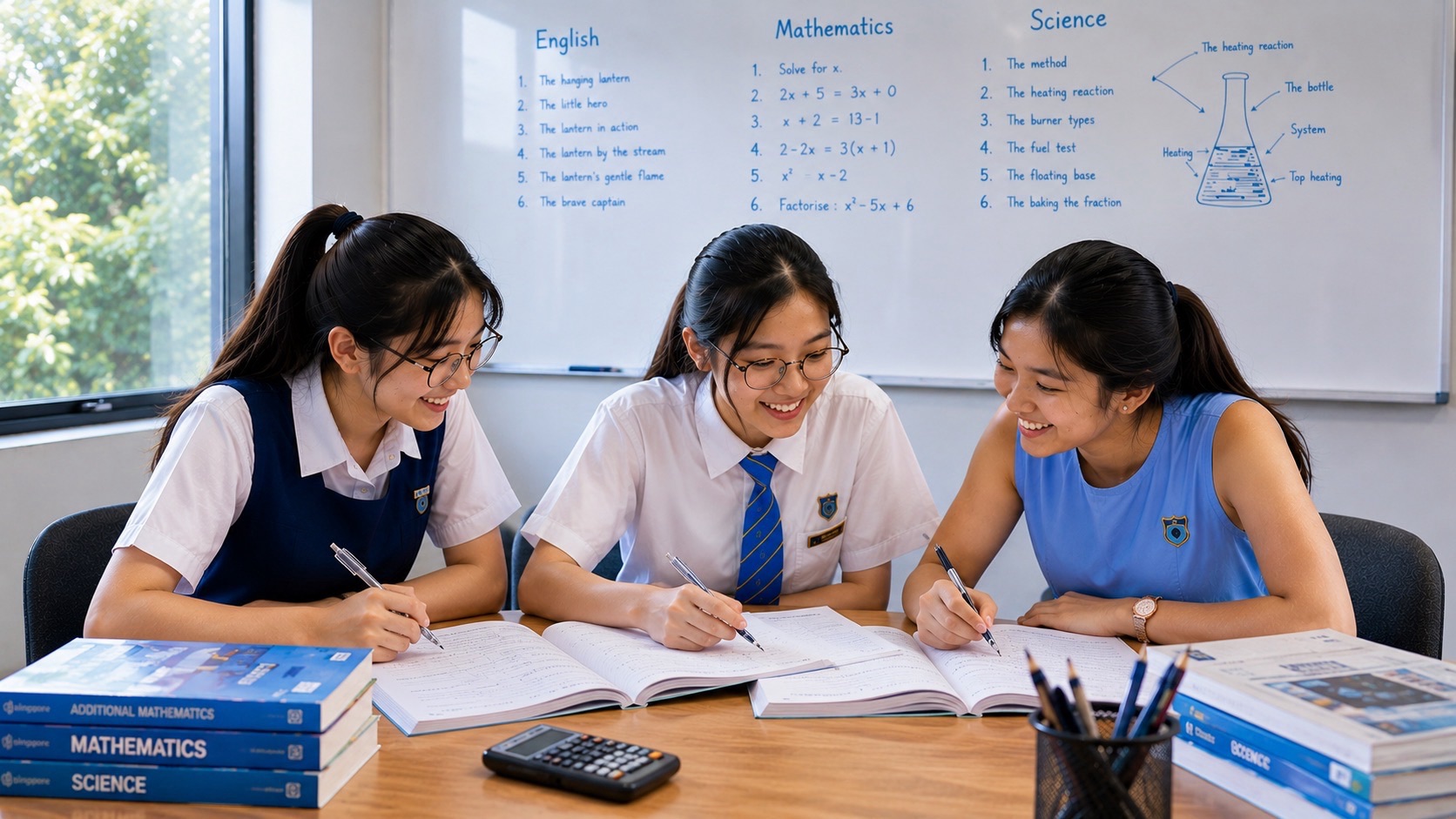
A student’s life in Waterway Sunbeam is built from more than school hours. It is the complete daily system of waking, travelling, learning, eating, moving, resting, revising, attending CCA, meeting friends and returning home with enough energy to begin again the next day.
HDB’s Punggol Town Design Guide identifies Waterway Sunbeam as one of the named precincts in Waterway East District, part of the larger waterfront town organised around My Waterway@Punggol.
For students, the useful lesson is energy. Two students can have the same ninety free minutes and very different capacity to use them well. Planning only by the clock ignores the body carrying the plan.
This guide looks at Waterway Sunbeam from the student’s point of view: preparation, transport, independent work, reading, movement, tuition, friendships, sleep and the gradual transfer of responsibility from adult to student.
Student Life Is a System, Not a Stack of Activities
A timetable can look impressive and still fail. Travel takes time. Meals take time. A student who has concentrated through school may need recovery before beginning another demanding task.
The spaces between activities are real: packing, waiting, walking, changing, finding files, checking instructions, correcting mistakes and preparing for tomorrow all compete for finite attention.
A stronger weekly system includes those hidden costs before another lesson, enrichment class or revision target is added.
Waterway Sunbeam’s Student Lesson: Manage Energy, Not Only Minutes
One student may arrive home rested; another may have completed CCA, travelled across town and eaten late. The timetable may show the same free period, but the learning capacity is different.
Students should learn to notice energy honestly without turning tiredness into a reason to avoid every difficult task.
The goal is calibration: recover when recovery will improve the next block, then begin before the recovery period becomes indefinite.
Students do not need to feel energetic before starting. They need enough capacity to begin the right-sized task.
Waterway Sunbeam as a Learning Environment
Waterway Sunbeam sits within Punggol’s broader waterway, housing and transport system. Families can use HDB’s current Punggol town information for town-level context and current estate information.
The neighbourhood can make healthy routines easier, but it cannot perform the routines for the student. The useful question is which nearby resource solves a real problem in the week.
Convenience should reduce friction. It should not automatically become another activity.
The Local Anchors That Shape the Week
Waterway setting
The precinct is part of the larger Punggol Waterway landscape. The Punggol Waterway Park Connector supports walking and cycling along the waterway and can provide ordinary movement between demanding study periods.
Transport
The wider Punggol network includes MRT, LRT and buses. Families should use current LTA information for actual school-day routes rather than assuming one route serves every home and destination equally.
Reading and study
Students can use home, school and public library spaces differently. The best venue is the one that supports the required work while preserving enough time and energy to complete it.
Recovery
Movement, food, conversation, washing and sleep are not academic distractions when they restore the student’s ability to think. The key is that recovery has a purpose and an ending.
A Prepared Morning Begins the Night Before
Morning friction is often created by unfinished decisions from the previous evening. The student who cannot find a worksheet, charger, transport card or activity attire begins the day by spending attention on preventable problems.
- check tomorrow’s timetable and unusual requirements
- pack the correct books, files and devices
- place keys, card and essential items in one normal location
- know the departure time and route
- leave a small buffer for ordinary delays
- protect sleep instead of pushing avoidable work into the night
The long-term goal is decreasing dependence on adult reminders. A Primary student may need a checklist; a Secondary student should increasingly be able to run the checklist independently.
After School: Build a Landing Sequence
The first hour after school often determines whether the evening works. Without a landing sequence, a student can drift through food, messages, videos and small chores until the best attention is gone.
- put the bag in one predictable place
- eat and hydrate if needed
- wash and change
- check what is due next
- identify the task that needs the best attention
- begin one clearly defined action
A short recovery period can be useful. The important distinction is whether the student knows when the pause ends and what follows it.
For younger students, parents may help define the sequence. Over time, the student should take ownership of more of it: deciding the first task, estimating how long it will take and noticing when the plan is unrealistic.
Use Recovery to Restore Capacity
Useful recovery is specific. Eat because the student is hungry. Shower because the school day needs a clean transition. Walk because sitting has dominated the day. Sleep because attention is collapsing.
Unstructured recovery is different. It often begins as a short pause and expands through messages, video and repeated postponement.
A practical habit is to define the recovery period before it begins and define the first task after it ends.
Students do not need to feel completely refreshed before restarting. They need enough capacity for the next task, and the task should be sized accordingly.
Available Time Is Not the Same as Study Time
Suppose a Waterway Sunbeam student has 150 minutes before the next fixed commitment. A meal takes 25 minutes, washing and resetting take 20 minutes, and packing or preparation takes 10 minutes. That leaves 95 minutes of usable time. This is an illustration, not a local travel estimate.
The calculation matters because students often plan with the full block and then feel they have failed when ordinary life consumes part of it.
Planning with reality is not pessimism. It is accuracy. Once the usable block is known, the student can choose work that actually fits.
With 95 usable minutes, one demanding task and one shorter correction block may be more useful than attempting three large subjects and completing none properly.
Transport Time Is Real Time
The correct calculation includes the whole door-to-door loop: walking, waiting, transferring, the activity itself, the return trip and the time needed to settle afterwards.
Some journeys can support light reading, vocabulary retrieval or planning. Others are too crowded or tiring. Students do not need to turn every minute of travel into academic output.
Sometimes the best use of a journey is simply to arrive calm enough for the next task.
Primary School Life in Waterway Sunbeam
A Primary-school student should not live like a miniature examination candidate. Strong foundations combine schoolwork with reading, movement, sleep, conversation, play and increasing responsibility.
- read every day
- practise Mathematics briefly and correct mistakes properly
- notice Science in ordinary surroundings
- move regularly
- complete homework consistently
- pack school materials with decreasing adult help
- keep a stable bedtime
- talk about what was learned, not only what mark was received
A child who can explain what went wrong, locate the relevant page, attempt a correction and ask a specific question is developing a stronger learning system than a child who simply waits for the next adult instruction.
Upper Primary and PSLE: Completion, Repair and Review
Completion
Finish assigned work properly and on time. Completion matters because unfinished schoolwork creates hidden pressure and prevents later review from beginning cleanly.
Repair
When an answer is wrong, identify the first misunderstanding rather than merely copying the correct response. The earliest wrong step is often where the useful learning lives.
Review
Return later and test whether the knowledge can still be retrieved without the original explanation beside it. A concept that works only while the worked example is visible is not yet stable.
These three jobs should not be collapsed into one. More worksheets cannot compensate for missing repair, and repeated tuition cannot substitute for independent retrieval.
Secondary School Life: Match the Task to the Attention
Secondary students manage more subjects, deadlines, CCA commitments and digital messages. The useful question is not simply what is due, but which task most needs clear thinking.
Complex Mathematics, composition planning and unfamiliar Science explanations usually deserve stronger attention than printing, filing or copying notes.
Do not spend the best hour of the evening on the easiest job merely because it is satisfying to tick off.
Good sequencing protects the tasks that would suffer most if delayed.
Reading: Build a Daily Contact Point With Language
Reading does not need to become another elaborate programme. A student needs frequent contact with good language across fiction, non-fiction, news, essays and subject texts appropriate to age.
The useful reading habit has three layers: understand what the text says, notice how the language works and retain a small number of useful words or ideas for later use.
A student who reads ten pages carefully and can discuss them may gain more than a student who races through fifty pages without attention.
An English Example: Evidence Before Interpretation
Consider this invented line: “Farah set a twenty-minute break, ate, changed and returned to the desk when the alarm sounded even though she still felt slightly tired.”
A weak response may say that Farah is disciplined.
A stronger response explains that she uses a bounded recovery period and resumes work without requiring herself to feel completely refreshed first.
The sentence does not tell us whether the chosen task suits her remaining energy or how long she can sustain attention.
Good comprehension combines inference with restraint. Students should separate what the text states, what the evidence supports and what would be speculation.
A Mathematics Example: Repair the First Wrong Step
Consider 5(x + 1) = 35.
If a student writes 5x + 1 = 35, the first error is an incomplete expansion of the bracket.
The correct expansion is 5x + 5 = 35. Therefore 5x = 30 and x = 6.
Checking gives 5(6 + 1) = 35.
A useful error log records the type of mistake, the reason it happened and a fresh example that proves the correction has transferred.
A Science Example: Observation Is the Start, Not the Conclusion
Punggol’s transport network, housing landscape and waterway environment give students many things to notice: feeder systems, walking routes, drainage, vegetation, heat, shadows, water movement, public-space design and human behaviour.
Observation can start a useful question. It does not automatically establish a scientific conclusion. One hot afternoon does not prove a permanent temperature pattern, and one crowded train does not describe an entire transport system.
Students should ask what evidence would be needed, what variables might matter and which reliable source could confirm a factual claim.
CCA, Enrichment and Tuition Must Fit the Same Body
School, CCA, tuition, sport and enrichment are often planned as separate categories. The student experiences them with the same body and the same twenty-four-hour day.
An activity that looks reasonable on its own may become unreasonable when placed after a long school day and before an early morning.
Families should judge commitments by total weekly load, not by the apparent value of each individual programme.
Where Small-Group Tuition Fits
Tuition should have a defined job: clearer explanation, close inspection of written work, repair of an earlier skill, guided practice with unfamiliar questions or a structured route toward greater independence.
The eduKateSG Secondary 1 Mathematics small-group guide describes a movement from explanation to guided practice, independent application and correction.
The important question is not simply whether a student attends tuition. It is whether the tuition changes what the student can understand, attempt, correct and eventually do without the tutor.
Phones: Convert Messages Into Actions
Phones are often necessary for school communication, transport, family coordination and learning platforms. The problem begins when every useful message opens the door to unrelated attention.
- check the required school message
- record the deadline or action
- download the necessary file where appropriate
- close unrelated conversations
- return to the prepared task
Continuous availability is not the same as responsible collaboration.
Food, Movement and Sleep Are Academic Infrastructure
Students often notice academic problems before they notice the physical conditions creating them. Hunger can look like irritability. Sleep debt can look like poor memory. Long sedentary periods can make concentration harder.
No single meal, walk or early bedtime solves a learning problem. The point is cumulative: physical routines make academic routines easier to sustain.
Sleep should be protected especially before important school days. Late-night rescue work is sometimes unavoidable, but it should not become the normal architecture of the week.
A Practical Weekly Rhythm
Monday to Thursday
School, CCA where scheduled, homework triage, one or two focused work periods, dinner, preparation for tomorrow and protected sleep.
Friday
Close small unfinished loops and leave room for some family or social recovery.
Saturday
Complete one serious academic task early enough that the whole day is not lost to anticipation. Add tuition, sport or enrichment only when capacity allows.
Sunday
Use a shorter consolidation block, some reading and preparation for the next school week.
What Parents Can Notice Without Micromanaging
- Does the student begin work independently?
- Are the same mistakes repeating?
- Does the student know upcoming deadlines?
- Is travel using more energy than expected?
- Is tuition reducing confusion?
- Is sleep regular enough?
- Can the student describe one current weakness accurately?
- Is there still ordinary family and social time in the week?
Useful signals are behavioural: earlier starts, clearer questions, fewer lost materials, more accurate planning and better recovery after difficult days.
What Progress Should Look Like
- less resistance at the start
- materials easier to find
- more specific questions
- better correction of mistakes
- earlier revision
- more deliberate travel and tuition decisions
- more regular sleep
- clearer priorities
- greater independence
Marks matter, but these process signals often improve before the marks do.
Frequently Asked Questions
Is Waterway Sunbeam a good place for students?
It can support a workable student routine within Punggol’s residential and transport network. Whether the week works well still depends on school routes, family routines, study conditions, sleep and the number of commitments being carried.
Where can students study outside home?
Students can use suitable school spaces and public libraries in Punggol when those venues solve a real need.
Should students revise during the commute?
Sometimes. Light reading or retrieval can fit an appropriate journey. Other days, recovery is the better use of the trip.
How much tuition is too much?
It becomes too much when additional lessons remove sleep, independent practice, recovery or the student’s ability to consolidate what was taught.
Helpful Reading for Waterway Sunbeam Families
- A Student’s Life | Waterway Sunray
- A Student’s Life | Waterway Woodcress
- HDB | Punggol
- NParks | Punggol Waterway Park Connector
A Student’s Life in Waterway Sunbeam
Waterway Sunbeam’s student lesson is energy calibration. A realistic week respects the body without surrendering the work.
Finish what can be finished. Pause unfinished work with a clear next step. Use movement for recovery. Protect the work that requires concentration.
That is part of education too.
Arrange a Parent–Student Consultation
Ask about learning support on WhatsApp
Properly taught kids shine a bright light into the future.