
When an Additional Mathematics question becomes confusing, students often ask for “the answer”. A more effective request identifies the last correct line, the next decision that is unclear and the mathematical rule that needs explaining. That approach helps teachers and tutors solve the right learning problem without taking all the reasoning away from the student.
Here is a simple script: “The question asks me to find ____. I have reached ____. I expected ____, but I am stuck because ____.” It works for algebra, trigonometry, functions and calculus. The examples below show how to use it without pretending the child must already know every formula.
A useful question begins one line before the student gets stuck
“I don’t understand Additional Mathematics” is a genuine feeling, but it gives a tutor very little information about the next teaching decision. Compare it with this: “I can differentiate (2x + 1)³, but I don’t know why the answer needs the derivative of the inside expression.” The second question identifies the exact missing idea.
Learning to ask precisely is a mathematical skill. It requires the student to read the question, retain their own attempt, recognise the last step they trust and describe the decision that comes next. That process already does some of the intellectual work before anyone provides an explanation.
Students do not have to know the formal name of the rule before asking for help. “I expected these two expressions to be the same, but expanding them gives different answers” is a strong question. So is “I know the reference angle but cannot decide which quadrants belong in this interval.”
The goal is not to make children sound like miniature examiners. It is to prevent a common cycle: the learner asks for the full solution, receives it, copies it and becomes stuck at the same point tomorrow. A precise question keeps the learner involved in the next decision and makes the tutor’s answer more useful.
The three-part message that makes a maths question answerable
Give the helper three things: the task, the last line you believe is correct and the exact place your reasoning stops. This is more helpful than sending an image of the whole worksheet accompanied by “Help?” The person responding can see what is being attempted and which operation needs attention.
For example: “The question asks for stationary points. I differentiated y = x³ − 3x to get dy/dx = 3x² − 3. I know to set that equal to zero, but I’m not sure how to obtain both x-values.” The missing step is solving x² = 1, giving x = 1 and x = −1. The learner can then continue to find coordinates and classify points.
A good question does not need a polished essay. One sentence of context and one marked line are often enough. The valuable part is distinguishing the work already understood from the point where an explanation is needed.
When sending a photo, include the entire relevant expression and any domain or interval stated in the question. A cropped denominator, missing exponent or omitted angle interval can make an otherwise good explanation wrong.
Try a brief independent audit before requesting the answer
Before reaching for a model answer, spend a short, purposeful interval inspecting the attempt. Check the requested quantity, list what is given and identify the mathematical structure: product, composite function, quadratic equation, polynomial divisor, trigonometric ratio or definite integral.
Then identify the last uncontroversial line. For a long algebra solution, check whether the equality between two consecutive lines remains valid. If the working becomes suspect when a factor was cancelled, check whether the factor could be zero. If a logarithmic step feels uncertain, check that every argument is positive and that a valid law was used.
This short audit is not meant to force the learner to remain stuck indefinitely. If no progress occurs, ask for help with the exact decision. The audit has still served a purpose by locating the question.
Avoid spending twenty minutes repeating the same invalid operation. Productive persistence tests a new hypothesis, checks a condition or tries a smaller example. Unproductive repetition copies the same steps with increasing frustration. Knowing the difference makes help-seeking more efficient and less emotionally exhausting.
How to point to the first doubtful equality
A line of working can look elegant while containing an early mistake that poisons everything afterwards. Instead of asking why the final answer is wrong, ask whether one line follows from the line above it.
Suppose the student writes (x − 3)² = x² − 9. The first doubtful equality is the expansion. A tutor can explain that (x − 3)(x − 3) equals x² − 6x + 9. The student should then revisit the original equation rather than accept all later work as meaningful.
The precise help question is: “Why does squaring a binomial produce a middle term?” That invites an explanation of multiplication and the cross terms. It is stronger than “Can you redo the entire chapter?”
Ask the learner to circle the first doubtful step and place a question mark next to it. The tutor can choose between a quick correction and a deeper prerequisite lesson after seeing the actual cause. The method works for logarithms, factor theorem substitutions, signs in differentiation and trigonometric case handling alike.
Ask what the rule means, not only which formula to use
A student may ask, “Is this the chain rule?” That can be a useful starting point, but it may still invite a yes-or-no answer that leaves the reasoning opaque. A stronger question is: “What feature of this expression makes the chain rule necessary?”
Consider y = (4x − 1)³. It is a power of a function of x. Its derivative is 12(4x − 1)². The factor 4 reflects how the inner expression changes with x. Compare y = (x − 1)³, whose inner derivative is 1 and whose derivative is simply 3(x − 1)².
The student should be able to explain the contrast: both expressions are composed, but their inner derivatives differ. Asking about structure makes the method reusable when the numbers change.
This pattern applies across Additional Mathematics. Instead of “Do I use the discriminant?”, ask “Am I being asked how many real roots exist without solving them individually?” Instead of “Should I use the remainder theorem?”, ask “Does the divisor make evaluation at a particular value useful?” The mathematical feature leads to the method.
A useful question about logarithmic domains
A learner solves log₂(x − 1) = 3 and obtains x = 9. The answer is correct, since x − 1 = 8 and log₂8 = 3. But the important concept may still be missing: why must the argument x − 1 be positive before the equation is manipulated?
Ask: “I know how to convert the logarithm into an exponential equation. How do I decide which values are allowed in the original logarithm?” This question identifies domain as a separate reasoning obligation.
Extend the discussion to log₂(x − 1) + log₂(x + 1) = 3. Combining terms produces x² − 1 = 8 and candidates x = ±3, but the original domain requires x > 1. Only x = 3 is valid. A student who knows the domain rule can reject the invalid negative candidate without confusion.
After the explanation, ask the learner to create a changed problem and state its domain before solving. The help has succeeded when the domain check survives a new equation, not when the tutor says “always check” and the student nods.
A useful question about losing a trigonometric solution
Suppose a student encounters sin θ cos θ = sin θ in the interval 0° to 360° inclusive. They divide both sides by sin θ and obtain cos θ = 1. They then report only 0° and 360°, missing 180°.
The precise question is not “Why is trig so hard?” It is: “Why did dividing by sin θ make the solution θ = 180° disappear?” The explanation is that division by sin θ assumes that sin θ is non-zero. At 180°, sin θ = 0, so that division was not valid.
The correct rearrangement is sin θ(cos θ − 1) = 0. Consider the zero cases separately, then apply the specified interval. The solutions are 0°, 180° and 360°, with duplicates removed.
A transfer task could be sin θ(2cos θ − 1) = 0 in the same interval. The learner must use both factors and identify all permitted angles. This reveals whether the core issue was fixed: equations with a product equal to zero require attention to all possible zero factors.
A useful question about functions and composition order
When a learner sees f(g(x)), the difficulty may be substitution or the order of the functions. Those are different problems. If f(x) = x² + 1 and g(x) = 3x − 2, then f(g(x)) = (3x − 2)² + 1 = 9x² − 12x + 5. Reversing the functions gives g(f(x)) = 3x² + 1.
A student who can expand both expressions but produces the wrong one needs help reading the composition. A precise question is: “Which expression enters which function first, and how can I check the order with a numerical input?”
Try x = 2. For f(g(2)), g(2) = 4 and f(4) = 17; the formula 9x² − 12x + 5 also gives 17. This verification helps reveal the input-output route.
When asking for help, include the definitions of both functions. Writing only “I can’t do f(g(x))” leaves essential information out. A short annotated attempt often allows the tutor to resolve the exact misunderstanding and test whether the learner can generalise to a new pair of functions.
A useful question about an unexpected negative value
A student finds a negative result in a calculus problem and assumes it must be wrong. Before asking how to change the sign, inspect what the result represents. A negative derivative can be a decreasing rate. A negative definite integral can represent a net signed contribution below the axis. Neither is automatically invalid.
For instance, integrating y = x from −1 to 1 gives zero because the negative and positive signed contributions cancel. The area between the graph and the x-axis is different: it is 1 square unit. The question’s wording determines the required quantity.
The precise help question is: “Does this task ask for a signed integral or the total geometric area?” That prompts interpretation before calculation. Similarly, “Is this negative derivative telling me the function is decreasing?” is more informative than “How do I make the derivative positive?”
Mathematics does not reward changing signs merely to produce a pleasant answer. The student should learn to attach meaning to a result, check units where relevant and decide whether the sign is compatible with the situation being modelled.
A useful question about the remainder theorem’s sign
Consider finding the remainder when P(x) is divided by x + 2. A student substitutes x = 2 because they see the number 2 in the divisor. The relevant value is actually −2, because x + 2 = 0 when x = −2.
If P(x) = x³ + 2x − 1, then P(−2) = −8 − 4 − 1 = −13. The student should not memorise only “change the sign”; they should understand how the linear divisor determines the evaluation point.
A specific question for the tutor is: “Why does x + 2 mean I evaluate the polynomial at −2, and what would change if the divisor were x − 2?” This makes the algebraic structure explicit.
A good follow-up is to reverse the operation: “Which divisor would make me evaluate P(5)?” The answer x − 5 shows the learner has understood the correspondence. After two such checks, the tutor can move back to the current polynomial task instead of giving a lengthy unrelated lecture on synthetic division.
Learn to ask for a smaller example, not an easier answer
When a full question is overwhelming, asking for the completed answer removes the intellectual job the student needs to practise. Asking for a simpler example that exposes the same rule keeps the learning goal intact.
A difficult rational expression can be preceded by a simpler example showing that factors may be cancelled while separate added terms cannot. A complicated composite function can be preceded by evaluating f(2) and then f(2x − 1). A multi-part optimisation task can begin with finding a stationary point of a simple cubic.
The smaller example should preserve the same principle. It is not useful to replace a product-rule confusion with a straightforward arithmetic question that does not expose the product structure. The tutor should ask which mathematical choice needs to become visible.
After working through the simpler case, return quickly to the original. If the student can now choose the next line, the simplification served its purpose. If not, the tutor has evidence that another prerequisite or explanation is needed. This is targeted help rather than lowering expectations.
A practical hint ladder that still leaves the student thinking
Different hints remove different amounts of work. A broad cue such as “What is the question asking you to find?” removes little. A structural cue such as “Is this a product or a composite function?” removes more. A method cue such as “Use the chain rule” supplies the decisive choice. Writing the next line supplies still more.
Students can ask for the least specific hint that restores progress. For example: “Please tell me what feature I should look at, but don’t name the formula yet.” That request communicates a desire to make the method-selection decision independently.
If the broad cue is not enough, it is sensible to request a more explicit explanation. Productive instruction is not a test of how much frustration a learner can tolerate. The ladder simply helps identify which part of the reasoning was supplied by the helper.
After a hint, the student should finish the current question and attempt a short changed version without that cue. Otherwise the aid may have helped the page rather than the skill. Marking which hint was needed can guide the next lesson and make learning progress visible.
How to ask about a correct answer that used an invalid method
Sometimes a student’s final number agrees with a model answer even though an intermediate step was mathematically invalid. This is dangerous because a correct result may conceal a misconception that fails on the next question.
Take (x² − 4)/(x − 2). Cancelling the common factor after factorisation yields x + 2 when x ≠ 2. A student who treats the simplified expression as defined at x = 2 may give apparently sensible numerical output in many other cases but still misunderstand the original domain.
A strong question is: “My simplified formula gives the same values for almost every input. Why does the original denominator still exclude x = 2?” This seeks mathematical validity, not just confirmation of a result.
In a second example, a student may square both sides of a surd equation and obtain a candidate that fails the original equation. The right question becomes “Which transformation introduced the extra candidate, and how do I verify the allowed roots?” Correctness includes the legitimacy of each step and the conditions under which the answer is accepted.
What to do when you can name the topic but not the difficulty
A child may know that a question belongs to partial fractions, trigonometry or coordinate geometry without being able to locate the exact missing step. That is a normal point in learning. The next step is to show an unedited attempt rather than invent a sophisticated explanation.
Ask: What did I try first? What result did I expect? At which line did the answer stop making sense? If the learner cannot answer those questions, the tutor can use two diagnostic prompts to distinguish method selection from an earlier algebra gap.
A useful student message is: “I recognise this as a partial-fractions problem and can factor the denominator, but I don’t know how to choose the numerator form for each fraction.” The issue is more specific than the chapter, even if the student does not know the required decomposition.
The tutor should model the missing decision, contrast a second denominator pattern if appropriate, and ask for a fresh example. In a good tutorial, the child leaves with an explanation of why a setup works, not simply a finished model answer to copy.
How to use a photo of working responsibly
A photo can help a tutor diagnose an error if it includes the full question, readable working and the line the student wants to discuss. Crop out irrelevant personal details, names and school identifiers when they are unnecessary to the mathematics. The child does not need to publish their entire marked test online.
Write a short caption beneath the image: “I believe lines 1 to 3 are correct. Why does line 4 not follow?” This gives the reader a clear target. When the expression contains brackets, powers, fractions or a diagram, ensure they remain visible.
If using an automated study tool to discuss the question, students should still inspect the suggested explanation. Automated systems can misread handwriting, omit restrictions or solve a different problem from the one photographed. Compare the response with the actual question and, when uncertain, ask a teacher or tutor.
The aim is to make the question intelligible to a helper while protecting the learner’s own thinking. A clear first attempt with one precise question often produces a better lesson than an unlabelled collection of screenshots.
How to ask a question during a three-student tutorial
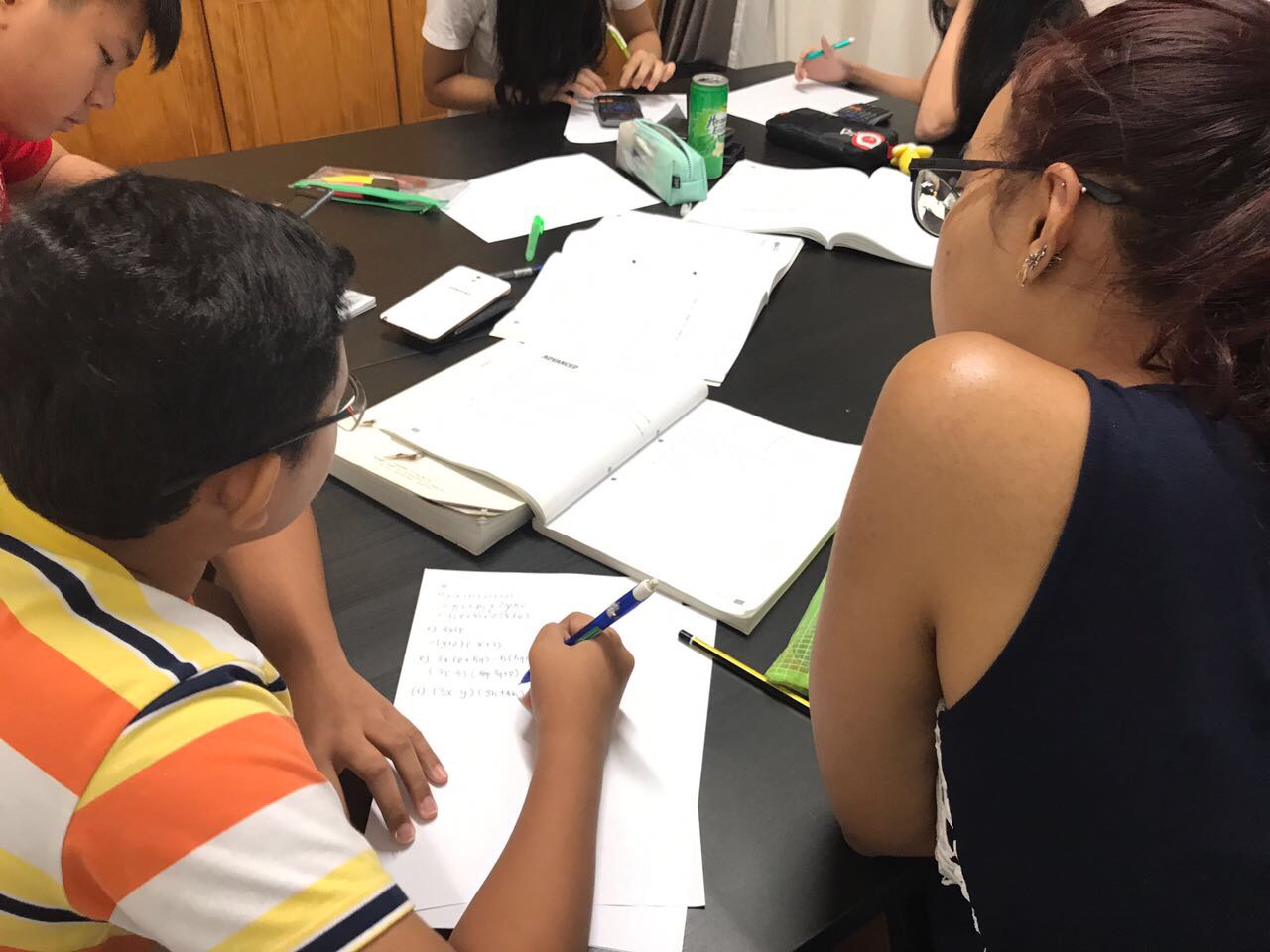
In a small group, students sometimes wait because another learner is speaking, or they quietly copy the demonstrated line to keep pace. A useful habit is to mark the exact step that needs explanation and prepare a short question before the tutor returns to the student’s work.
For example: “My differentiation is correct, but I do not understand the stationary-point classification.” Or: “I got the reference angle but not the second solution.” These questions can be addressed without derailing the whole group’s lesson.
The tutor may ask the student to explain a line or try one more step before intervening. That is appropriate when the goal is to measure independent knowledge, provided the learner is not left with a permanently unresolved obstacle. Close observation is one advantage of a class of no more than three students.
A good tutorial does not require everyone to speak constantly. It requires each child to have meaningful opportunities to reveal their working, receive an explanation and show that they can use it on a new problem. The quality of the mathematical exchange matters more than the number of times a hand is raised.
What parents can ask instead of ‘Did you understand?’
“Did you understand the lesson?” often produces a polite “yes”. The child may genuinely have understood the demonstration but still be unable to choose the method alone. Parents can ask something narrower: “Which line was hardest for you to justify?” or “What question did you ask when you were stuck?”
Another useful prompt is: “Show me one new question you can start without the notes.” Parents do not need to solve it themselves to notice whether the child has a plan, an independent first line and a way to check the result.
Avoid making every conversation a formal oral examination. The purpose is to make reflective study possible and normal. A learner should feel comfortable saying which rule remains unclear and what assistance was needed.
If a child repeatedly cannot identify a question, bring representative schoolwork to the teacher or tutor. The adult can help distinguish difficulty reading the task from a missing mathematical prerequisite. A student should not have to diagnose every error perfectly before receiving teaching.
A five-minute routine for the next time you are stuck
First, reread the command and identify the quantity requested. Second, underline the relevant conditions: real roots, domain, interval, exact form, graph features or initial conditions. Third, mark the last valid line in your attempt. Fourth, write the decision you cannot make in one sentence. Fifth, ask for the smallest explanation or hint that would let you continue.
After the explanation, close the model and redo the critical step yourself. Then solve a closely related example with one meaningful feature changed. If the student still needs the same hint, the teacher should revisit the underlying rule.
Do not let the routine become another source of anxiety. It is a tool for separating a specific difficulty from the feeling that the whole subject is inaccessible. Some genuinely new material requires a full introduction; students should receive it.
Used consistently, the routine also improves homework communication. Instead of saying “This is all impossible”, the learner can report “I understand the quadratic equation but not how the discriminant answers the line-and-curve question.” That statement gives the adult a clear teaching starting point.
An example conversation that preserves independent thinking
Student: “I have y = (2x − 1)⁴. I differentiated it to 4(2x − 1)³, but the answer key has a factor of 8. Which rule accounts for the extra 2?”
Tutor: “What changes inside the bracket when x changes?” Student: “The inside expression changes twice as fast as x.” Tutor: “So how should the outer derivative be adjusted?” Student: “Multiply by 2, giving 8(2x − 1)³.”
Tutor: “Can you try y = (5x + 3)⁴ without a reminder?” Student: “Its derivative is 20(5x + 3)³.” The tutor can then ask the child to verify by expansion or another appropriate check.
The specific values are illustrative, but the teaching sequence matters. The student preserved their attempt, identified the discrepancy, asked about the governing rule and applied it to a changed expression. The helper did not need to redo an entire chapter or provide every line. This is the kind of exchange that builds mathematical independence.
Frequently asked questions about seeking A-Math help
Is it weak to ask for help early? No. After a purposeful independent attempt, asking a precise question is often more efficient than repeated guessing. The concern is dependence on full solutions before making any attempt.
Should I wait until I finish the whole question? Not if an invalid rule will make the remaining working meaningless. Mark the first doubtful step and get clarification.
What if I cannot tell where the error is? Bring the unedited attempt. A teacher can compare steps and diagnose the cause.
Can I ask a classmate? Yes, if the exchange helps you explain a rule and then solve a changed question independently. Copying a neighbour’s completed answer is not equivalent to understanding.
Does this advice change under SEC? The study principles are broadly relevant, but the mathematics should match the learner’s level and syllabus. SEAB lists 2027 G2 Additional Mathematics K232 and 2027 G3 Additional Mathematics K341. Use the 2026 O-Level 4049 reference for the applicable earlier examination pathway.
A question worth bringing to the next lesson
Choose a question you genuinely could not finish. Keep the original working. Draw a line under the last step you believe is sound. Write, “I need to understand why ______, because I expected ______.” Fill the blanks with the mathematics, not with a judgment about yourself.
Ask the tutor or teacher for a short explanation, then attempt the next step without copying. A changed example should follow. That final independent move is what turns a helpful answer into a learned skill.
If the issue may be an earlier skill, read how to diagnose missing prerequisites. For reducing dependence on model answers, use the worked-example independence guide. To select a useful question for each study session, see the weekly A-Math question queue.
Families can explore the Additional Mathematics archive or arrange a parent–student consultation with eduKate Singapore. A good question does not ask somebody else to do all the thinking. It opens the next piece of reasoning so the learner can complete it. Properly taught kids shine a bright light into the future.