
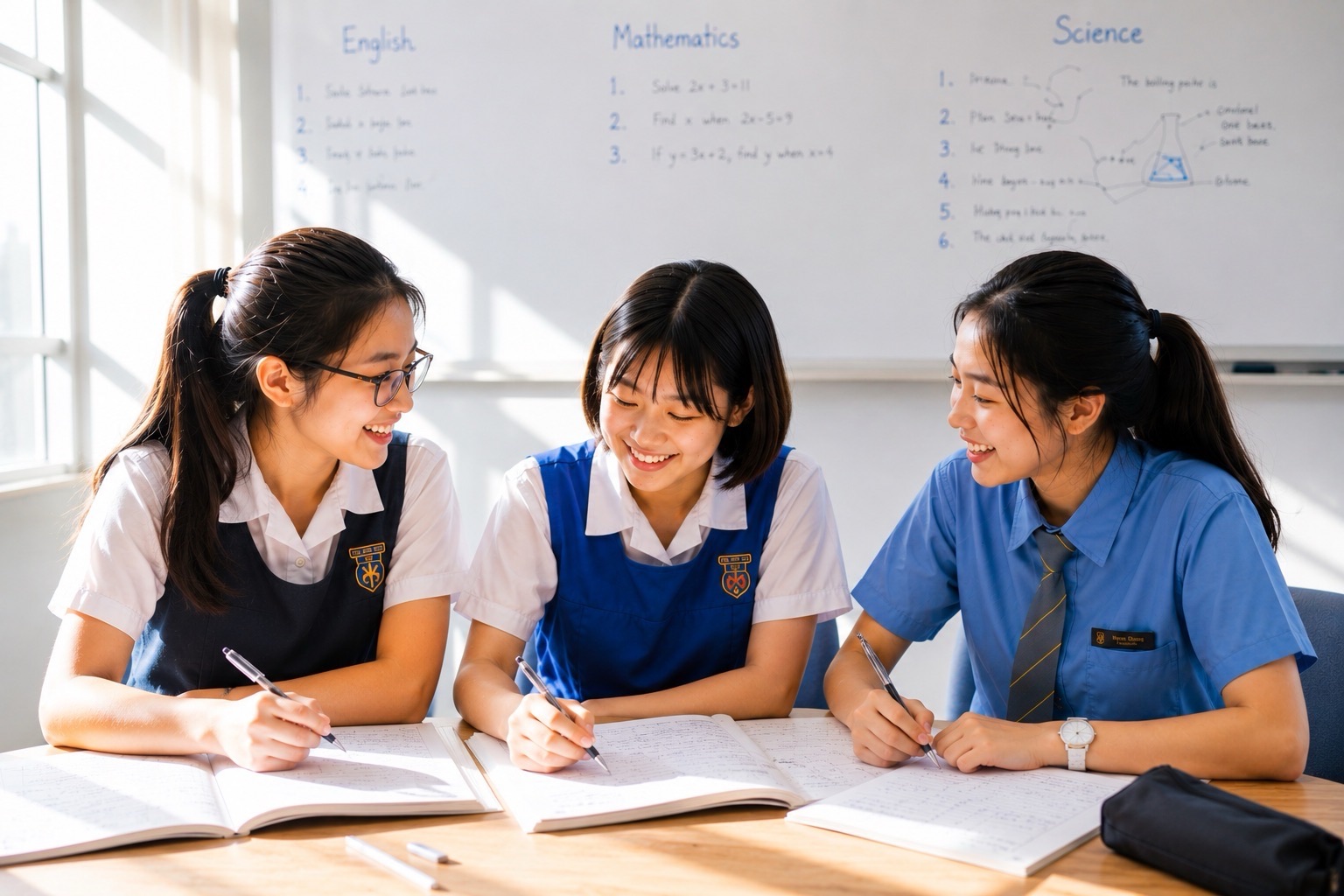
Additional Mathematics tuition for Bishan Secondary 3 and 4 students. Focused 3-pax G2 and G3 A-Math classes near Sixth Avenue MRT.
Additional Mathematics Tuition Bishan
Locate the weakness. Retrieve the right teaching. Build independent mathematical control.
Additional Mathematics tuition for Bishan students at eduKateSG is designed for Secondary 3 and Secondary 4 learners who need more than additional worksheets.
A-Math becomes difficult when algebra, functions, graphs, trigonometry and calculus begin operating as one connected system. The student must recognise mathematical structure, select an appropriate method, preserve accuracy across several lines of working and adapt when a familiar concept appears in an unfamiliar form.
At eduKateSG, classes are limited to three students. Lessons are conducted weekly for 1.5 hours at our Bukit Timah teaching location at 8 Fourth Avenue, near Sixth Avenue MRT. The small-group structure allows the tutor to inspect each student’s working, locate the first unstable step and provide a more precise response.
The operating sequence is:
[
\text{Locate}
\rightarrow
\text{diagnose}
\rightarrow
\text{retrieve}
\rightarrow
\text{teach}
\rightarrow
\text{practise}
\rightarrow
\text{transfer}
]
The purpose is not to create permanent dependence on tuition.
It is to build a student who can increasingly manage Additional Mathematics independently.
Additional Mathematics Tuition Bishan at a Glance
| Programme coordinate | Details |
|---|---|
| Subject | Additional Mathematics |
| Student levels | Secondary 3 and Secondary 4 |
| Subject levels | G2 and G3 Additional Mathematics |
| Class size | Maximum three students |
| Lesson duration | 1.5 hours weekly |
| Teaching location | 8 Fourth Avenue, near Sixth Avenue MRT |
| Students served | Bishan and surrounding central Singapore areas |
| Main work | Diagnosis, algebra repair, concept teaching, retrieval, transfer and examination preparation |
| Student states | Repair, stabilise, extend or transition |
| Placement | By consultation and class suitability |
This is a programme for students travelling from Bishan. It is not a tuition centre physically located inside Bishan.
What Additional Mathematics Tuition Should Actually Do
A tuition class can easily become a second homework room.
The student arrives with unfinished work. The tutor demonstrates several procedures. The student copies the solutions, completes another worksheet and leaves with the impression that progress has been made.
However, several important questions may remain unanswered:
- Can the student recognise the method without being prompted?
- Can the student explain why the method is valid?
- Can the student complete the algebra accurately?
- Can the student retrieve the idea several weeks later?
- Can the student use it when the question changes?
- Can the student coordinate it with another topic?
- Can the student perform it under examination conditions?
A complete A-Math programme must do more than increase exposure.
It must convert exposure into usable capability.
[
\text{Exposure}
\neq
\text{independent control}
]
At eduKateSG, the tutor first identifies the student’s position inside the subject. Only then is the next teaching move selected.
The Additional Mathematics Capability Atlas
A test mark gives useful information, but it does not fully locate a student.
Two students may both score 55%.
The first student may understand the concepts but lose marks through signs, brackets and incomplete working.
The second may execute familiar methods accurately but be unable to recognise which method belongs to an unfamiliar question.
Their scores are similar.
Their learning problems are different.
The Additional Mathematics Capability Atlas therefore locates the student across several coordinates.
1. Time
Where is the student in the two-year A-Math journey?
- beginning Secondary 3;
- midway through the installation year;
- approaching Secondary 4;
- completing the syllabus;
- consolidating;
- or preparing for the national examination?
A repair that is calm and inexpensive in early Secondary 3 may become harder when the student is simultaneously learning new content, revising previous work and preparing for major examinations.
2. Subject level
Is the student taking:
- G2 Additional Mathematics;
- G3 Additional Mathematics;
- the 2026 GCE O-Level syllabus;
- or the Singapore-Cambridge SEC pathway from 2027?
SEAB lists Additional Mathematics at both G2 and G3 for the 2027 SEC examinations, under subject codes K232 and K341 respectively. Students graduating in 2026 remain under the existing GCE O-Level examination framework.
3. Mathematical capability
What can the student currently do without assistance?
The answer may differ across:
- algebraic manipulation;
- equations and inequalities;
- functions and graphs;
- indices and logarithms;
- coordinate geometry;
- trigonometry;
- differentiation;
- integration;
- mathematical reasoning;
- and examination execution.
4. Lifecycle state
The student may currently need to:
[
\text{repair}
\quad
\text{stabilise}
\quad
\text{extend}
\quad
\text{or transition}
]
These are not permanent labels.
A student may require repair in algebra, stabilisation in trigonometry and extension in coordinate geometry at the same time.
5. Floor health
Which earlier capability is carrying the present topic?
A student struggling with differentiation may not have a calculus problem.
The actual difficulty may lie in:
- indices;
- functions;
- algebraic simplification;
- substitution;
- graph interpretation;
- or solving equations.
6. Independence
Can the student:
- begin without being told the first step;
- select between several methods;
- detect that an answer is unreasonable;
- recover after making an error;
- and explain the reasoning?
The final purpose of tuition is to move control progressively towards the student.
The Atlas and Warehouse Combination
Locating the student is only the first half of the work.
Once the tutor knows where the student is, the programme must retrieve the correct teaching response.
This is the role of the A-Math teaching Warehouse.
[
\boxed{
\text{Atlas tells us where}
+
\text{Warehouse supplies what}
}
]
The Warehouse is not simply a large folder of worksheets.
It contains different types of teaching objects for different problems.
A prerequisite repair
Used when the present topic is failing because an earlier mathematical floor is unstable.
For example:
[
\text{weak index laws}
\rightarrow
\text{difficulty with logarithms}
]
A first-principles explanation
Used when the student can reproduce a rule but does not understand what it means or why it works.
A worked-example sequence
Used when the student requires a carefully supported first encounter with a new mathematical structure.
A contrast set
Two questions are placed beside each other so that the student learns why one method applies and another does not.
This develops method selection rather than mere method repetition.
A faded example
Part of a solution is provided initially. Assistance is gradually removed until the student can reproduce the complete reasoning independently.
A transfer question
The numbers, diagram, wording, representation or topic combination changes while the underlying mathematical relationship remains.
A retrieval packet
Earlier material is brought back after a delay so that the tutor can determine whether the knowledge remains available.
A mixed-topic packet
The chapter label disappears. The student must decide which knowledge is relevant.
An examination-control packet
The student works under increasing time and completion constraints while preserving essential working and accuracy.
The tutor should not retrieve all of these at once.
The correct object depends on the student’s Atlas coordinate.
Why A-Math Is Not Merely Harder E-Math
Additional Mathematics is sometimes described as a more difficult version of Mathematics.
That is incomplete.
The major change is not only the level of calculation. It is the level of mathematical coordination.
In a relatively direct question, the student may be able to:
- recognise the chapter;
- recall the formula;
- substitute the values;
- calculate the answer.
In A-Math, the student may instead need to:
- identify the hidden relationship;
- transform an expression;
- select one method from several possibilities;
- connect two topics;
- preserve equivalence;
- interpret the result;
- and communicate a complete mathematical argument.
The official G3 syllabus is organised into Algebra, Geometry and Trigonometry, and Calculus. It also emphasises problem-solving, connections between topics, mathematical reasoning and communication—not only routine procedures.
Therefore:
[
\text{Knowing a procedure}
\neq
\text{knowing when and why to use it}
]
A student can follow a worked solution and still be unable to begin the next question alone.
That is not necessarily laziness or lack of ability.
The student may possess recognition without independent retrieval.
The Lower-Floor Law of Additional Mathematics
Later Mathematics contains earlier Mathematics.
A new chapter may expose an older weakness that had previously remained hidden.
Consider a calculus question requiring a student to find a stationary point.
The visible topic is differentiation.
The complete dependency may be:
[
\text{function}
\rightarrow
\text{differentiate}
\rightarrow
\text{solve an equation}
\rightarrow
\text{substitute}
\rightarrow
\text{interpret the point}
]
The student can understand differentiation correctly and still lose control when solving the resulting equation.
Similarly:
[
\text{weak factorisation}
\rightarrow
\text{weak polynomial control}
\rightarrow
\text{difficulty solving equations}
\rightarrow
\text{difficulty with functions}
]
Or:
[
\text{uncertain fractions}
\rightarrow
\text{unstable algebra}
\rightarrow
\text{trigonometric manipulation errors}
]
This is why repeatedly practising the newest topic may not solve the problem.
The tutor must identify the specific lower floor carrying the current work.
However, “weak foundation” should not become a vague explanation for everything.
The task is to locate the exact dependency:
- which skill is missing;
- where it first becomes necessary;
- how it affects the present topic;
- and whether its repair improves the complete question.
The A-Math Fracture Map
The same wrong answer can be produced by different fractures.
| Visible symptom | Possible fracture | Appropriate response |
|---|---|---|
| Student cannot begin | Retrieval or method-selection fracture | Compare question structures and practise the first decision |
| Long working leads nowhere | Route-selection fracture | Teach structural recognition before calculation |
| Correct concept, wrong answer | Symbol or execution fracture | Inspect signs, brackets, substitutions and line transitions |
| Strong homework, weak tests | Prompt-dependence or examination-control fracture | Remove cues and introduce timed retrieval |
| Calculus remains confusing | Function, graph or algebra fracture | Repair the supporting floor |
| Identities are memorised but not usable | Equivalence and transformation fracture | Teach why each transformation remains valid |
| Previous chapters disappear | Memory and retrieval fracture | Use delayed and interleaved practice |
| Student gives up quickly | Confidence and recovery fracture | Teach entry routines and error recovery |
| Correct final answer, weak marks | Communication fracture | Reinforce essential working and mathematical reasoning |
The repair must correspond to the fracture.
More worksheets are useful only when the worksheet matches the actual problem.
FullOS: Is the Student’s A-Math System Complete?
Before moving forward, the tutor needs to determine the state of the system.
Full state
The student understands the concept, retrieves it independently, executes accurately and transfers it when the form changes.
The next move may be extension, mixed application or examination compression.
Missing state
A prerequisite, concept, representation or method is absent.
The next move is installation.
Neutral state
The student recognises the material but cannot yet use it independently.
The next move is guided practice followed by reduced prompting.
Negative state
The student repeatedly applies an incorrect rule or method.
The next move is not additional repetition. The incorrect structure must be exposed and replaced.
Inverse state
The student appears successful only because the environment supplies hidden support.
Examples include:
- copying a model answer;
- following the chapter order;
- receiving the first step;
- using highly repetitive worksheets;
- or relying on the tutor to confirm every line.
When those supports disappear, performance collapses.
The system looked strong, but the direction of control was reversed: the environment was carrying the student.
The repair is gradual transfer of responsibility.
Why Three-Student A-Math Tuition Changes the Control Geometry
A small class is useful only when it changes what the tutor can see and do.
In a three-student class:
[
\text{working becomes visible}
\rightarrow
\text{reasoning becomes inspectable}
\rightarrow
\text{fractures become locatable}
\rightarrow
\text{correction becomes precise}
]
The tutor can observe:
- where the student hesitates;
- which line contains the first error;
- why a method was selected;
- whether the student understands the notation;
- whether the student is copying a pattern;
- and whether a correction survives in the next question.
Three students also allow limited peer comparison.
A learner can encounter:
- another valid method;
- an error made by someone else;
- a clearer explanation;
- or a different interpretation of the same question.
The group remains small enough for individual correction while retaining the energy of learning with others.
The purpose is not constant tutor intervention.
Prompts should gradually be removed.
[
\text{tutor-managed}
\rightarrow
\text{co-managed}
\rightarrow
\text{student-managed}
]
What Happens During an Additional Mathematics Lesson?
1. The tutor reads the current signals
Evidence may include:
- school assignments;
- recent weighted assessments;
- examination papers;
- incomplete homework;
- recurring errors;
- the student’s explanation;
- or a short diagnostic task.
2. The student is located
The tutor identifies:
- current level;
- subject level;
- present topic;
- prerequisite floor;
- error pattern;
- degree of independence;
- and the next school or examination demand.
3. The problem is separated
The tutor distinguishes among:
- missing concept;
- weak algebra;
- poor retrieval;
- incorrect method selection;
- inaccurate execution;
- weak communication;
- slow performance;
- and incomplete transfer.
4. The Warehouse retrieves the teaching object
This may be:
- a prerequisite repair;
- a first-principles explanation;
- a contrast pair;
- a guided example;
- a faded solution;
- a mixed question;
- or a timed examination section.
5. The tutor teaches at the required resolution
The student should see:
- the rule;
- its meaning;
- why it works;
- where it applies;
- where it does not apply;
- how it connects to earlier knowledge;
- and how to verify the result.
6. The student attempts independently
The tutor reduces assistance.
The student must make the first decision and carry the method through.
7. The correction is traced backwards
Instead of saying only that the final answer is wrong, the tutor identifies the first point where the solution changed direction.
8. Transfer is tested
The next question changes its surface form.
The tutor checks whether the repaired knowledge remains usable.
9. Earlier knowledge returns
Previous topics are reintroduced through retrieval and mixed practice.
This prevents the syllabus from becoming a trail of completed but inaccessible chapters.
Secondary 3 Additional Mathematics Tuition Bishan
Secondary 3 is the installation year.
The student is not merely learning several new chapters. The student is constructing the operating system through which the whole subject will later run.
The main Secondary 3 tasks are:
- stabilising algebra;
- learning new mathematical language;
- connecting equations and graphs;
- developing method selection;
- writing complete solutions;
- retaining earlier chapters;
- and entering unfamiliar questions calmly.
A student who was previously good at Mathematics may still find A-Math unsettling.
This does not automatically mean the student lacks ability.
The subject has changed its demand.
The student must move from short, familiar procedures towards sustained symbolic reasoning.
The Secondary 3 route is:
[
\text{access}
\rightarrow
\text{understanding}
\rightarrow
\text{guided control}
\rightarrow
\text{independent use}
\rightarrow
\text{retention}
]
The dedicated Secondary 3 Additional Mathematics Tuition Bishan page should carry the deeper installation-year discussion, while this subject hub routes parents to it when that is the student’s present coordinate.
Secondary 4 Additional Mathematics Tuition Bishan
Secondary 4 is the integration and conversion year.
By this stage, the student must bring the accumulated system together.
The main tasks become:
- closing remaining gaps;
- retrieving Secondary 3 knowledge;
- combining topics;
- recognising unfamiliar forms;
- reducing unnecessary working;
- improving accuracy;
- preserving essential reasoning;
- controlling time;
- and completing papers calmly.
The student may know most of the syllabus yet remain inconsistent.
Possible causes include:
- slow method selection;
- weak mixed-topic recognition;
- poor recovery after a difficult question;
- excessive restarting;
- incomplete working;
- or a checking routine that is too general.
The Secondary 4 route is:
[
\text{complete}
\rightarrow
\text{connect}
\rightarrow
\text{compress}
\rightarrow
\text{execute}
\rightarrow
\text{verify}
]
For the 2027 G3 syllabus, both papers are 2 hours 15 minutes, carry 50% each and require students to answer all questions. The syllabus also states that omission of essential working can result in lost marks.
Examination preparation must therefore develop more than final-answer accuracy.
It must also develop sustained mathematical communication and control.
G2 Additional Mathematics Tuition Bishan
G2 Additional Mathematics is not simply a shortened label for generic A-Math support.
The student must be taught according to the subject level, syllabus and assessment pathway that apply.
The 2027 G2 Additional Mathematics syllabus is designed to prepare students for G3 Additional Mathematics. Like G3, its content is organised around Algebra, Geometry and Trigonometry, and Calculus, with reasoning, communication and application also emphasised.
A G2 student may require:
- careful installation of the mathematical language;
- stronger lower-secondary Mathematics support;
- slower reduction of scaffolding;
- repeated representation changes;
- and deliberate preparation for possible later movement into G3 A-Math.
The correct programme is not easier work without direction.
It is correctly sequenced work with a defined next route.
G3 Additional Mathematics Tuition Bishan
G3 Additional Mathematics assumes knowledge of G3 Mathematics and develops a stronger route towards advanced mathematical study.
The official syllabus expects students not only to apply standard techniques, but also to solve problems in different contexts, connect topics, translate between representations, select relevant information and reason mathematically.
This makes several capabilities especially important:
[
\text{algebraic fluency}
+
\text{structural recognition}
+
\text{method selection}
+
\text{communication}
+
\text{transfer}
]
A strong G3 student should not merely complete difficult-looking questions.
The student should understand why the method works, recognise when it applies and retain control when several topics interact.
Teaching Ahead Without Racing
Teaching ahead can be useful when it creates a calm first encounter.
It becomes harmful when it turns into an uncontrolled race through the syllabus.
A well-managed future corridor follows this sequence:
[
\text{supported first encounter}
\rightarrow
\text{recognition in school}
\rightarrow
\text{school consolidation}
\rightarrow
\text{independent operation}
]
The aim is not to boast that the student has “finished” the syllabus early.
The aim is to reduce the amount of new information the student must process when the topic appears in school.
Teaching ahead is suitable only when:
- the supporting floors are stable;
- the student retains previous topics;
- the new work is understood rather than copied;
- and advancement does not hide unresolved weaknesses.
Sometimes the fastest route forward is first to move backwards by one carefully chosen floor.
Four Student Routes
Repair
The student has a specific fracture interfering with present work.
The first task is to identify and repair the earliest important dependency.
Stabilise
The student generally understands the subject but produces inconsistent results.
The work focuses on retrieval, accuracy, working discipline and transfer.
Extend
The student is secure and ready for greater depth, unfamiliar combinations and more independent problem-solving.
Transition
The student is approaching a new stage:
- lower Secondary Mathematics into A-Math;
- Secondary 3 into Secondary 4;
- G2 into G3;
- syllabus learning into examination preparation;
- or secondary A-Math into post-secondary Mathematics.
The student’s route may change during the year.
The programme should respond to movement rather than preserve a fixed label.
What Progress Looks Like Before the Marks Move
A test grade is an important signal, but it is delayed and compressed.
Earlier indicators of improvement may include:
- the student begins without waiting for the first prompt;
- algebraic working becomes cleaner;
- signs and brackets are handled more reliably;
- the student can explain why a transformation is valid;
- previous chapters remain retrievable;
- fewer solutions need to be restarted;
- unfamiliar wording causes less panic;
- the student can compare two possible methods;
- checking becomes specific rather than ceremonial;
- and timed work becomes more complete.
These signals show that the internal mathematical system is becoming more stable.
Marks should eventually reflect that improvement, but no responsible tuition programme should promise an automatic grade.
What can be managed is the quality of:
- diagnosis;
- explanation;
- sequencing;
- practice;
- correction;
- retrieval;
- and transfer.
Does Every Bishan A-Math Student Need Tuition?
No.
A student may not require tuition when the student can:
- understand school explanations;
- complete work independently;
- retrieve earlier topics;
- identify and correct mistakes;
- manage the school pace;
- and continue improving steadily.
Tuition becomes more useful when the student’s current environment is not sufficiently exposing or repairing the problem.
The decision should not be based only on whether classmates attend tuition.
It should be based on whether there is a specific learning need that an additional programme can address.
Travelling from Bishan to Sixth Avenue
Lessons are conducted at eduKateSG’s Bukit Timah location at 8 Fourth Avenue, near Sixth Avenue MRT.
Students travelling from Bishan MRT can take the Circle Line to Botanic Gardens, transfer to the Downtown Line and continue to Sixth Avenue. The current LTA system map shows Bishan on the Circle Line, Botanic Gardens as a Circle Line–Downtown Line interchange and Sixth Avenue on the Downtown Line.
[
\text{Bishan}
\rightarrow
\text{Botanic Gardens}
\rightarrow
\text{Sixth Avenue}
]
This creates a one-transfer rail route between Bishan and the teaching location.
Families should still consider the student’s school, home, dismissal time and weekly schedule when deciding whether the journey is practical.
Preparing for an A-Math Consultation
A useful consultation begins with evidence.
Parents may bring or describe:
- the student’s secondary level;
- G2 or G3 subject level;
- graduating year;
- current school topics;
- recent assessment results;
- marked assignments;
- recurring errors;
- available lesson times;
- and the student’s present concerns.
The discussion should make five matters clearer:
- Where is the student now?
- Where does the mathematical process first become unstable?
- Which earlier floor carries the present difficulty?
- Which teaching object should be retrieved first?
- What evidence will indicate that the intervention is working?
Because classes are limited to three students, placement should consider level, pace, current needs and compatibility with the existing group.
Frequently Asked Questions
Is the A-Math class conducted in Bishan?
No. The programme serves students travelling from Bishan, but lessons are conducted at eduKateSG’s Bukit Timah location at 8 Fourth Avenue, near Sixth Avenue MRT.
How do students travel from Bishan?
Students can take the Circle Line from Bishan to Botanic Gardens, transfer to the Downtown Line and continue to Sixth Avenue MRT.
Which levels are supported?
The programme supports Secondary 3 and Secondary 4 Additional Mathematics students.
Does eduKateSG teach both G2 and G3 A-Math?
Yes. Teaching should be matched to the student’s actual subject level, school programme, graduating year and present mathematical position. Additional Mathematics is officially listed at both G2 and G3 under the 2027 SEC framework.
What is the maximum class size?
Each class is limited to three students.
How long is each lesson?
Lessons are conducted weekly for 1.5 hours.
Can earlier E-Math weaknesses be repaired?
Yes, when those weaknesses are preventing progress in Additional Mathematics.
Relevant algebra, fractions, equations, graphs or numerical skills should be repaired at the point where they affect the A-Math system.
Is the class suitable for strong students?
Yes, when there is a suitable placement.
A stronger student may work on transfer, unfamiliar problem forms, efficiency, mathematical communication and greater independence rather than routine repair.
Can tuition guarantee a distinction?
No grade should be guaranteed.
Tuition can improve the conditions for success through careful diagnosis, explanation, correction, retrieval and examination preparation. The final outcome also depends on attendance, effort, independent practice and performance during the examination.
Should a student start in Secondary 3 or Secondary 4?
Secondary 3 is the installation year, while Secondary 4 increasingly becomes the integration and examination-control year.
The correct time to begin depends on whether the student is learning independently and whether current weaknesses are beginning to spread into later topics.
Additional Mathematics Tuition Bishan: From Location to Independent Control
A-Math tuition should not begin with a random worksheet.
It should begin by locating the student.
[
\text{Atlas}
\rightarrow
\text{Warehouse}
\rightarrow
\text{lesson}
\rightarrow
\text{transfer}
]
The Atlas establishes where the student is.
The Warehouse supplies the correct explanation, repair, example, contrast, retrieval task or examination packet.
The tutor turns that material into a carefully managed learning experience.
The student then demonstrates whether the knowledge has become independently usable.
For Bishan families, eduKateSG’s three-student Additional Mathematics classes provide a structured route through Secondary 3 installation, Secondary 4 integration, G2 or G3 requirements and examination preparation.
For students who are behind, we locate and repair.
For students who are coping, we stabilise and connect.
For students who are ready, we extend and transfer.
The immediate target may be the next assessment.
The larger objective is a student who can enter a difficult mathematical problem, organise the available information, select a valid route and continue with calm, accurate control.
That is when Additional Mathematics stops being a collection of intimidating chapters and becomes one understandable mathematical system.