
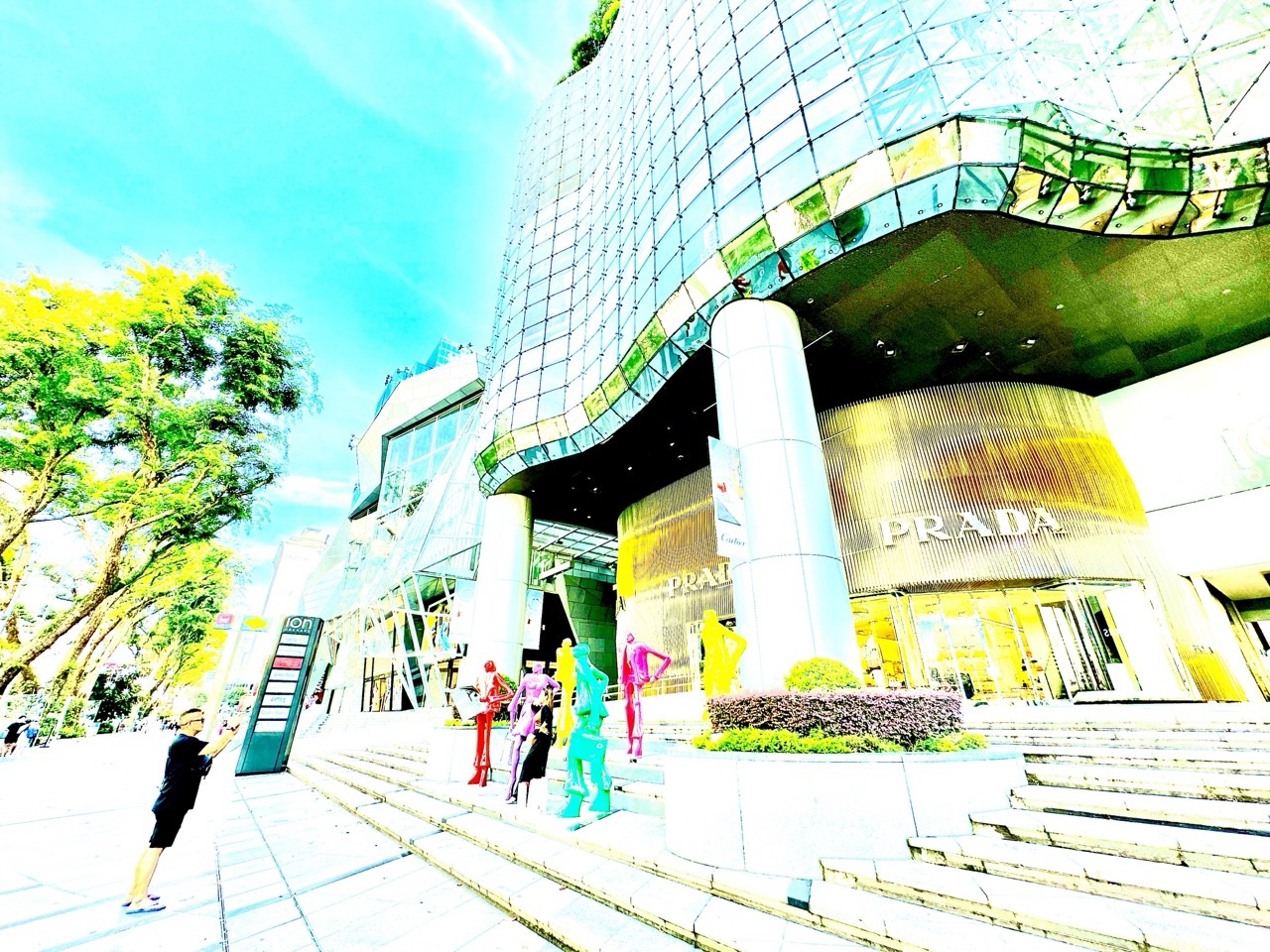
Orchard Road is a wonderful place to practise photography because its best pictures are not limited to shop windows. There are dramatic roofs, reflective glass, familiar department-store façades, art installations, pedestrian crossings, food carts, greenery and people going about their day. You can photograph Singapore’s big-city energy in one small area, with different stories appearing each time you visit.
Here is the quick route for strong photo locations: arrive at Orchard MRT (NS22/TE14), begin with ION Orchard’s exterior, look across to TANGS and Shaw House, explore the Wheelock Place and Wisma Atria surroundings, continue towards Ngee Ann City for an architectural frontage and public-space views, then photograph the Paragon area from safe pavements. If you are still enjoying the day, follow the pedestrian shopping belt towards Somerset. Allow two or three hours for an unhurried walk, longer if you want to compare daytime and evening light.
You do not need expensive equipment. A phone, compact camera or small mirrorless camera can all make memorable photographs here. More important are a clear subject, safe positioning, good timing and an accurate caption. The point is to enjoy and understand the district, not to obstruct a crossing for the one perfect frame.
This guide is built around eduKateSG’s actual October 2026 Orchard Road images. The photograph locations have been identified in the media library, including Leica-labelled frames near Paragon and other photographs at ION Orchard, Shaw House, Wheelock Place, Ngee Ann City and the Orchard junction. A good location guide should use place-correct images, not attractive photographs of a different shopping street.
Orchard Road photography spots: the quick list
- ION Orchard exterior: sweeping architecture, rooflines and glass reflections.
- Shaw House side of the junction: a framed view towards ION Orchard and pedestrian crossings.
- TANGS and Tang Plaza: green-roof heritage cues, hotel tower and juxtaposition with modern buildings.
- Wheelock Place: recognisable glass architecture, café frontage and layered views.
- Wisma Atria: broad exterior steps and the relationship between retail entrances and the street.
- Ngee Ann City: large frontage, fountain and sculpture when visible.
- Paragon: façade, street movement, public-facing art and seasonal displays when installed.
- Scotts Square: a small detour for shopfronts, public art and the nearby hotel streetscape.
- Night Orchard Road: crossing signals, lit shop windows and reflections, photographed from a safe stationary point.
- Everyday moments: an ice-cream vendor, somebody walking dogs or people meeting friends near a station.
A photo itinerary becomes much easier when you choose what kind of story you want: architecture, people, public art, night lighting or the everyday life of Singapore. Trying to capture every possible category in one hour can feel hectic. Pick a theme and enjoy noticing it.

1. ION Orchard: start with the architecture
ION Orchard at 2 Orchard Turn is a natural first subject because its curved exterior is so distinctive. Look up at the roof before you point your camera towards the shop entrances. The combination of sweeping geometry and reflective materials gives you many possible compositions without requiring any special permission to admire it from the public pavement.
Begin with one establishing photograph that includes enough of the exterior to identify the building. Next, make a detail shot focusing on structural lines. The two images work well together: a reader understands the whole place, then sees what makes the architecture distinctive.
An architectural photo can be difficult when you stand too close. A phone’s ultra-wide camera may fit more into the frame, but it can also exaggerate perspective and bend lines near the edges. Try stepping to a safe position farther back before using the widest possible lens. The building’s shape will often look more natural.
Because ION sits beside Orchard MRT, you can begin or finish the walk here. It is convenient for people arriving by train, but the busy exits demand consideration. Do not stop directly in front of the flow of commuters just because a particular angle looks perfect.

2. Shoot ION Orchard from the Shaw House side
One useful way to photograph a famous building is from the other side of a road, where you can include the street and make the architecture feel part of the city. Our October 2026 photograph shows the marked pedestrian crossing towards ION Orchard as viewed from around Shaw House.
This kind of scene has natural layers. The crossing supplies a foreground, pedestrians create movement and ION becomes the recognisable backdrop. The image is more informative than a shop logo alone because it tells a visitor how the place connects to the wider streetscape.
The safety principle is essential: shoot from a safe stationary area on the pavement. A pedestrian crossing is designed for moving across, not pausing to adjust shutter speed or take a selfie. Wait for people and vehicles to move naturally through the composition rather than entering the road for an unobstructed view.
You can also photograph the same position twice, once in daylight and once after dark. The architecture remains constant but the light, colours and mood change. That makes a useful two-frame study of how urban places transform during one day.

3. TANGS, ION and Scotts Square in one skyline
At the Orchard/Scotts junction, several buildings can fit into a wider skyline view. TANGS has an architectural identity connected to its long department-store history, ION adds contemporary glass and curves, and Scotts Square contributes another commercial form. Our photo collection includes a view combining these landmarks.
The challenge here is deciding what your photograph is about. If every building competes equally for attention, the picture can feel busy. Choose one as the anchor, then let the others provide context. For example, a clear ION form in the centre with TANGS to one side tells a strong story about architectural contrast.
Watch the edges of your frame. Street furniture, tree branches and signs can add character, but they can also distract if cut awkwardly. Taking two seconds to adjust composition is often more effective than changing equipment.
For readers, a named skyline caption is particularly helpful. “ION Orchard, TANGS and Scotts Square” tells them what they are seeing and makes the photograph useful for navigation as well as atmosphere.

4. Tang Plaza’s heritage roofline
TANGS at Tang Plaza is associated with green-tiled roof forms and red architectural features inspired by Chinese palace design. That makes it a rewarding photographic subject because the building communicates something different from its modern neighbours.
Try an exterior frame that balances roof details with a little of the hotel tower and the street. If you crop too tightly, you may lose the information that makes the subject recognisable as Tang Plaza. A slight diagonal view can help reveal the roof’s layered forms.
For a history-themed photo story, connect the picture with the National Heritage Board’s account of C. K. Tang. The Orchard Road store opened in 1958, and a larger redevelopment followed in 1982. The current architecture contains references to the earlier identity rather than being an untouched original 1958 building.
A photograph becomes more meaningful when its caption adds that context without becoming an essay. You might write, “Tang Plaza at the Orchard/Scotts junction, with its recognisable green roof and modern tower.” Readers immediately understand both place and character.
5. Shaw House: cinema heritage and street-level views
Shaw House at 350 Orchard Road has an identity closely associated with Shaw Theatres Lido and Isetan Scotts. Its exterior provides a different visual rhythm from TANGS and ION, and the surrounding road can help frame that contrast.
The area is useful for photographs showing a building with movement in front of it. Cars, buses and pedestrians provide scale, while the building supplies a stable reference point. Choose a safe viewpoint where you can wait without blocking a doorway or a narrow passage.
If you are collecting a photo series about the history of entertainment in Singapore, Shaw House makes an obvious subject. The Lido name dates to cinema history beginning in the late 1950s, although the current building and its refurbished cinema are much newer. Avoid presenting a photo of today’s building as an archival image of the original Lido Theatre.
Our pairing of Shaw House and TANGS in one frame is a good example of an urban photograph that communicates both the layout and character of a district.

6. Wheelock Place: use the distinctive glass form
Wheelock Place sits close to Orchard MRT and offers another recognisable exterior shape. The glass architecture, nearby café frontage and neighbouring buildings provide multiple subjects within a small area. It is a useful stop when you want variety without a long detour.
A wide view can show how Wheelock Place relates to the surrounding junction. A closer frame can explore reflections or the repeated structural elements. Glass is sensitive to the angle of sunlight, so the image may look quite different even when taken half an hour later.
Photographing through glass can also introduce unwanted reflections of yourself or nearby objects. Change your angle slightly and pay attention to the edges of the frame. Sometimes reflections enhance the story; at other times they obscure the main subject.
If you enter a shop or café, respect the venue’s rules about indoor photographs and commercial shoots. The public-facing exterior offers plenty of interesting subjects without needing to use a private business as a studio.

7. Wisma Atria: steps, people and the scale of a mall entrance
Wisma Atria’s stepped frontage offers an opportunity to photograph a space that people use, not simply a building they look at. The stairs and access areas create leading lines, while pedestrians provide a sense of scale.
Try standing in a permitted position off to the side so the lines of the stairs direct the eye towards the entrance. If there are people in the scene, let them move naturally. A person ascending or descending can reveal how large the structure is without any staged pose.
Safety and accessibility matter. Do not block the steps to arrange a group photograph, and keep lift and ramp routes clear. Some visitors have mobility needs that are not immediately visible. The best street photographer notices other people’s needs and works around them.
A thoughtful caption can describe exactly what appears in the image: “Steps outside Wisma Atria, Orchard Road.” That is more useful than calling the scene “shopping paradise” without helping the reader identify its location.
8. Ngee Ann City: a broad frontage, fountain and sculpture
Ngee Ann City’s Orchard Road frontage is one of the strongest locations for a composed architectural image. The building has a broad, formal appearance that contrasts nicely with ION’s curves. Our October 2026 photograph records a fountain and outdoor sculpture in front of the complex.
A wide photograph establishes the space, while a more focused frame can examine the sculpture, its materials or the relationship between the fountain and pedestrian movement. If people are passing, consider letting them remain small in the composition rather than turning them into identifiable portrait subjects.
The environment is dynamic. Event arrangements, fountain operation, barriers and temporary installations can change. Do not rely on the presence of a particular feature solely because you saw it in a media library. Photograph what is available on the day and label it accurately.
For a richer story, the site is linked to the Ngee Ann Kongsi’s history and the 1993 opening of Ngee Ann City. The place’s past gives architectural photographs additional meaning beyond retail.

9. Photograph the crowd without treating strangers as props
Orchard Road is crowded at various times of day, and that human movement is part of its visual identity. Our photograph near Ngee Ann City shows a busy pedestrian area. It communicates scale, activity and the way many journeys meet along the shopping belt.
You can make strong street photographs without isolating an individual’s face. Try a wider scene in which the crowd forms texture and movement, or place a recognisable building behind the pedestrians. Silhouettes, shadows and reflections can also suggest human presence without intruding on anyone’s private moment.
When someone becomes the identifiable main subject, consent and respect are particularly important. Do not photograph children closely without appropriate permission, and avoid interfering with people who are working or rushing to appointments.
The goal is not to claim ownership over strangers’ moments. It is to document public city life thoughtfully. A considerate photographer usually discovers richer stories by paying attention rather than directing everybody else.
10. Leica street photography near Paragon
The eduKateSG media library includes Leica-labelled Orchard Road photographs from 9 October 2026, including a pedestrian in stride outside Paragon. These frames are well suited to a street-photography guide because they emphasise everyday movement rather than only tourist landmarks.
A photograph of a person passing a building can tell a story through gesture, shadow and spatial context. Notice where the person sits within the composition, the direction of motion and the relationship to the façade. A successful frame often gives the subject room to move into rather than cropping directly at the leading edge.
It is tempting to try to catch every passer-by. A better approach is to choose an interesting background first and wait patiently for the public scene to develop. Remain in a safe, permitted location and do not follow people or invade personal space.
A small camera can help you stay mobile, but good judgement matters more than brand or lens. A phone can capture the same subject in a different way. The strongest outcome is an image that is observant and respectful, regardless of equipment.

11. Art installations around Paragon
Our October 2026 Leica collection also includes an art installation outside Paragon. It is a useful reminder that not every good photograph requires a person in the foreground or a famous roofline. Public-facing art can provide shape, colour and an unexpected point of interest.
Make an establishing shot that includes the installation and part of its setting. Then explore a closer composition of texture or structure. The pair can help readers understand both what the object looks like and where it was situated.
Some displays are temporary. Do not invent an artist name or claim that an installation is part of an official festival unless you have verified those details. A careful caption such as “Public art installation outside Paragon, photographed in October 2026” is informative and accurate.
Respect any barriers and signage. Public viewing is not permission to climb on an installation, and private-property rules may apply to professional shoots. Art photography should make the experience enjoyable for other visitors too.

12. Scotts Square: an alternative angle on the Orchard district
Scotts Square on Scotts Road is a rewarding small detour for a photographer who has already taken the familiar ION and TANGS views. The exterior has its own proportions, and nearby hotels and pedestrians provide context for an image about the district’s mixed commercial life.
A wide frame can show the building beside its neighbouring streets, while a tighter one can emphasise storefront textures or a public-facing artwork when present. The variety is useful for a photo essay: a sequence of six almost identical luxury façades can become monotonous.
Notice the relationship between public retail areas and private residential parts of the development. Only enter places intended for visitors. A rooftop or residential lobby is not automatically accessible because it appears attractive from the street.
If you photograph an artwork, check whether it has a label before adding an artist attribution. Temporary pieces can change, so date your caption when the installation’s presence is important.

13. Orchard Road at night: pedestrian crossings and shop windows
After dark, the shopping belt becomes a study in light. Illuminated shopfronts, building signage, headlights and signal lights create strong contrasts, especially where crowds move across the road.
A phone’s night mode can help brighten a scene, but it may blur moving people. Hold the phone steady and decide whether that movement supports your story. A sharp architectural background with a little pedestrian motion can make the street feel alive.
Never stop in the roadway to make a photograph. Find a safe stationary place away from the crossing, compose the shot and let the movement happen in front of you. Follow all pedestrian signals when crossing to the next location.
A night photograph can look dramatic without being artificially bright. Keeping the scene’s dark areas adds contrast and allows lights to stand out. If every shadow is lifted to daylight levels, the atmosphere may disappear.

14. Christmas lighting and other temporary displays
Seasonal decorations can create beautiful photographs around ION Orchard, Wheelock Place and Paragon. Our media library includes an image of ION’s exterior lit at night with Christmas-associated displays, but the exact installation and event timetable change by year.
If you are planning a dedicated festive photo outing, distinguish individual mall decorations from the official Christmas on A Great Street programme organised by the Orchard Road Business Association. A photograph of a tree does not establish the date of the street-wide light-up.
For composition, aim to include both the decorated object and a recognisable landmark. A tree photographed alone could be almost anywhere, while a tree with ION’s façade behind it tells readers its location.
Expect crowds during popular evenings. A short patient wait is better than forcing people to move aside or trying to occupy a dangerous angle. Remember that the public street belongs to everyone, not only photographers.

15. The small story: Orchard Road’s ice-cream vendor
An ice-cream vendor near Ngee Ann City can make a delightful subject because it introduces a familiar Singapore street experience into a setting of large commercial buildings. Our October 2026 photograph includes a cart along the pedestrian walkway.
The cart may not be in the same position every day. If you encounter a working vendor, enjoy the scene respectfully and ask permission before making a close-up that focuses on the person rather than the wider streetscape.
A wide photograph can show the interesting contrast between a modest street stall and the large Ngee Ann City façade behind it. The image becomes a little story about the coexistence of traditional snacks and modern retail.
Do not block the queue or treat customers as models. If you want to buy an ice cream, enjoy it; if you do not, simply continue your walk. Good photography does not require turning every observation into a transaction.

16. Daytime versus evening: choosing your light
Early or late daylight can make buildings appear more dimensional because shadows give surfaces depth. Midday often provides strong contrasts that can be challenging, especially for bright glass and dark shaded pavements. Overcast conditions may make colours and details easier to balance.
You do not have to chase an exact golden-hour minute. Singapore’s weather changes quickly, and an afternoon shower or cloud layer can transform the light. Rather than treating that as a disappointment, look for new subjects: reflections, softened textures, umbrellas and contrasts between inside and outside.
At night, lights create natural points of attention. Keep one clear subject and avoid filling the frame with unrelated signs. If a commercial display is brighter than the surrounding building, slightly reducing exposure may preserve its colour.
The best time depends on your story. Architecture can be compelling in daylight. People-watching works across the day. Seasonal lights deserve evening conditions, while street vendors and shopfronts can be interesting at almost any comfortable hour.
17. Camera settings for mobile phones
Start simply. Use the main camera lens whenever possible for good image quality, especially in low light. Tap the subject to focus, keep the horizon reasonably straight and adjust exposure so bright windows are not completely washed out.
For building photos, take a step back before reaching for the ultra-wide lens. Very wide images can exaggerate perspective and make vertical lines appear to fall away. Some distortion is an artistic choice, but it should not happen accidentally because you wanted to fit an entire shopping centre into one frame.
When photographing moving crowds, accept that a slower exposure may introduce blur. If you want people sharp, select a brighter environment or use your phone’s available shutter controls when supported. If you want movement, use it deliberately and keep the building or road markings stable.
Do not over-edit. A light crop and modest exposure adjustment may help, but oversaturated signs and aggressively brightened night scenes can look less believable than the city you actually saw.
18. Tips for Leica and other compact cameras
A compact camera makes it easy to walk, pause and photograph without carrying a heavy bag. For street work, choose a focal length you are comfortable using and learn how much of the scene fits within the frame. This matters more than constantly switching lenses.
Focus on pre-visualising. Choose a background, check how the light falls, and wait for an interesting public moment. A smaller camera can make the process comfortable, but respect for people still determines how and when you photograph.
Shutter speed is especially important with moving subjects. A faster shutter can freeze a pedestrian’s stride, while a slower shutter introduces a sense of motion. Balance that choice against available light and ISO noise. There is no one perfect setting for every Orchard Road scene.
Review photographs when you reach a quiet area, not in the middle of a crossing. A quick glance can confirm exposure or focus, but safety comes first. Photo review can wait until you have stepped away from traffic.
19. How to compose an Orchard Road photo essay
A complete photo essay needs variety, not just excellent individual images. Begin with an establishing shot of the shopping belt. Follow with an architectural detail, a street scene, a public-art image and a smaller everyday moment. End with an evening or closing photograph when you have one.
Sequence the images to help a reader feel they are moving through the city. For example, Orchard MRT leads to ION, then the junction, then Ngee Ann City and Paragon. If you insert a distant building halfway through without explanation, the visual story becomes harder to follow.
Use captions that identify places accurately. “Ngee Ann City frontage with fountain and sculpture” is more useful than “Wonderful Christmas in Singapore” if the photograph was not taken at a documented Christmas event.
A strong essay also includes moments of quiet. A staircase, patch of greenery or small food cart can provide contrast between larger buildings and crowds. The city feels more human when the photographs show a variety of scales.
20. Photo metadata: help people find the right place
For travel and education content, useful metadata is not a string of repetitive keywords. Start with the actual subject, location and date when known. The image’s alternative text should help someone understand what the photograph communicates, rather than advertise a completely different article.
A practical title might be “Orchard Road pedestrian crossing near ION Orchard”. A caption could add “Viewed from the Shaw House side in October 2026.” If a temporary artwork is visible, note that it was photographed on a particular occasion, not that it is always present.
Do not confuse unrelated locations simply because their buildings look similar. An ION image should not be labelled as Paragon, and a Scotts Square interior should not be presented as Wisma Atria. Accuracy gives readers confidence that the guide can help them recognise real places.
When publishing a set of photographs, use a variety of captions that reflect what each image genuinely shows. That produces a useful archive for readers long after a particular display or tenant has changed.
21. Rain, haze and heat: adapt your photo walk
Rain can create beautiful reflections, but wet steps and traffic crossings are not worth taking risks for. If a storm begins, choose an appropriate indoor place and wait until conditions improve. Do not stand in the open during lightning in pursuit of a dramatic cloud photograph.
Singapore’s heat can also make a long shoot uncomfortable. Carry water, wear sensible shoes and take breaks. A short productive photo walk is better than spending several hours outdoors while becoming exhausted.
During haze, follow official air-quality guidance and adjust outdoor time, particularly if somebody in your group is vulnerable. Photography does not override health considerations. An indoor architecture subject may be an alternative when appropriate.
If the day is too hot or wet for your planned route, make a smaller series. Three strong images of one mall and its surroundings can be more meaningful than fifteen rushed images from across the district.
22. Privacy, consent and commercial photography
Street photography is most enjoyable when it is respectful. A broad image of a busy shopping street differs from a close-up portrait of an identifiable person. If your creative idea depends on an individual being the main subject, ask permission when appropriate and be especially careful around children.
Private shopping centres may set rules for filming, tripods, lighting equipment and commercial shoots. Do not assume you have unrestricted production rights simply because you can enter to shop. Read posted rules and contact management for formal work.
Keep emergency exits, doors, escalators, lifts and accessible paths clear. A camera does not give you priority over pedestrians. If a security officer asks you to move from a restricted area, comply and choose another viewpoint.
The best photographers leave the location exactly as welcoming as they found it. That mindset makes the work better for the community and helps preserve access for casual visitors.
23. A 60-minute Orchard Road photo route
For a compact outing, begin at Orchard MRT and photograph ION Orchard’s exterior. Take one wide frame and one roof detail. Then look across towards TANGS and Shaw House from a safe pavement location, making a third image that connects the buildings.
If time remains, explore the Wheelock Place or Wisma Atria area for a different architectural shape. Avoid crossing the same busy junction repeatedly merely to try one more angle. A focused sequence can tell a complete story in a short amount of time.
Review the images after you have found a comfortable place to stop. Which one best tells the reader where you were? Which one feels most atmospheric? The answer may not be the technically sharpest frame.
Finish while you are still enjoying yourself. On another day, make Ngee Ann City and Paragon the main destinations rather than trying to squeeze them into the same hour.
24. A relaxed two- to three-hour photo itinerary
Begin with ION’s roof and exterior, then move towards the Shaw House and TANGS area for wider urban views. Take your time observing architecture and street movement. Continue along the shopping belt towards Ngee Ann City and its public frontage, then visit the Paragon area for art and people-watching when accessible.
Include a rest stop. You can browse a mall, have a drink or simply sit somewhere appropriate and review your route. A good street-photography afternoon should leave room for the photographer to notice rather than only march.
If you want a longer series, continue towards Somerset, where the architectural atmosphere changes again. Otherwise, finish near Orchard MRT or a convenient return station. The best endpoint depends on where you are, your energy and the weather.
The purpose of an itinerary is to reduce unnecessary decisions, not to dictate every photograph. If an unexpected but respectful street scene catches your interest, it is fine to stay a little longer.
25. A photo-learning activity for students
Orchard Road is a useful place to connect photography with classroom ideas. In Mathematics, compare the geometry of different façades. In Geography, discuss why malls cluster around transit. In English, turn a photograph into a concise descriptive paragraph. In History, connect a building with its earlier commercial role.
A simple challenge is to produce five photographs that tell a complete story: arrival, architecture, people, a small detail and departure. Ask the student to write one precise caption for each. The captions should tell the truth about the place and avoid making claims the image cannot support.
Another exercise is to choose two frames of the same subject, one wide and one close. Ask what information each includes or excludes. The learner begins understanding composition as a decision about information, not merely decoration.
Keep the activity enjoyable. Children do not need expensive equipment or formal photography lessons to learn observation, visual literacy and respectful behaviour in public spaces.
Frequently asked questions about Orchard Road photo spots
Where is the best place to photograph Orchard Road?
ION Orchard’s exterior, the TANGS/Shaw House junction, Ngee Ann City’s frontage and Paragon’s streetscape offer useful starting points. The best location depends on your interest in architecture, people or art.
Which MRT station should I start at?
Orchard MRT NS22/TE14 is convenient for ION Orchard, TANGS and Shaw House. Somerset MRT is useful for the farther part of the shopping belt.
Can I take photos without shopping?
Yes. Public street views and many visible architectural features can be appreciated without purchases. Private venue rules still apply.
What time is best for Orchard Road night photography?
Evening highlights shop windows and street lights. Arrive earlier if you also want daylight architecture shots, and allow for crowds and weather.
Is Orchard Road good for Leica street photography?
It has varied architecture and everyday pedestrian activity, making it an interesting urban subject for Leica, phone and other cameras. Equipment choice does not replace good judgement or respect for others.
Can I photograph strangers on Orchard Road?
Be respectful of people’s privacy and consent, especially if someone is identifiable and is the principal subject. Avoid intrusive close-up photography and keep the experience comfortable for others.
Can I use a tripod in a shopping mall?
Venue rules vary and commercial equipment may require permission. Never obstruct walkways or access routes; contact management if planning a formal shoot.
Are the sculptures outside malls permanent?
Not necessarily. Some installations are temporary exhibitions or promotions. Check current venue information and date the photographs accurately.
Where is a good location for festive photos?
ION Orchard, Wheelock Place and Paragon can feature seasonal displays. Confirm the current year’s programme and installation dates rather than relying on older photographs.
How much time should I allow?
One hour is enough for a focused Orchard MRT cluster. Two to three hours provides more time for the Ngee Ann City and Paragon stretch, food breaks and unhurried photographs.
Can I photograph after rain?
Rain can produce interesting reflections, but avoid slippery steps and hazardous road positions. Shelter during severe weather and resume only when safe.
Is a phone good enough?
Absolutely. A thoughtful composition, stable camera and accurate caption matter more than having the most expensive device.
Which locations have reliable architecture regardless of events?
Major building façades such as ION Orchard, TANGS, Shaw House, Wheelock Place, Ngee Ann City and Paragon are stable landmarks, although surrounding construction or access can change.
Can I include Orchard Road photographs in a blog?
Use images you own or are licensed to publish, respect applicable privacy and venue rules, and label their locations accurately. A photograph found online is not automatically free to reproduce.
Orchard Road rewards the curious photographer
Orchard Road looks very different when you stop treating it only as a shopping destination. Its buildings show different architectural eras, its public art invites closer attention and its pedestrians reveal the rhythms of a living city. You can return many times and still find a different story.
Choose a small route, photograph patiently and respect the people using the street. Whether your favourite image is ION’s dramatic roof, a Leica street moment outside Paragon or a quiet view of Ngee Ann City, you will have documented something meaningful about Singapore.
More photo-related Orchard Road guides and official sources
- Orchard Road walking guide: Orchard MRT to Somerset.
- Free things to do on Orchard Road, including art and photo stops.
- ION Orchard architecture and art guide.
- TANGS and Tang Plaza history and architecture.
- Ngee Ann City frontage and history.
- Paragon shopping, art and street photography.
- Wheelock Place architecture and exterior guide.
- Orchard Road Christmas photo locations.
- ION Art Gallery and public-facing art programming.
- National Heritage Board: building histories.
- Orchard Road Business Association: current event information.
- Official Singapore haze guidance.
Updated October 2026. Photographs are from eduKateSG’s Orchard Road collection, including Leica-labelled October 2026 street frames. Images document the sites and scenes at the time they were taken; temporary displays and pedestrian access may change. Follow current safety and venue guidance.