
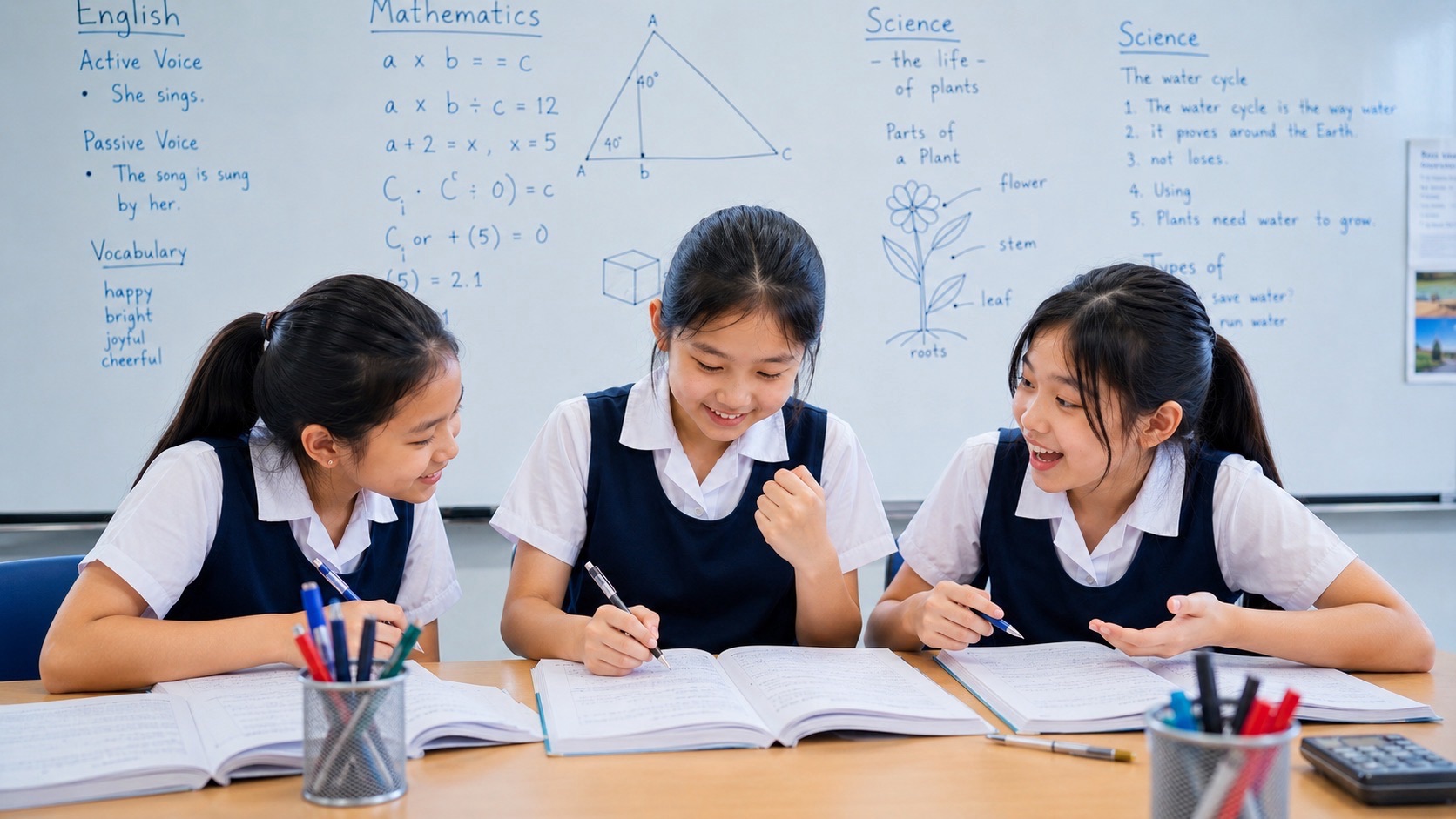
This Bukit Timah Primary 4 practice pack gives children five original questions each in English, Mathematics, Science and Chinese. Choose the subject your child is working on at school, try the questions on paper, then open the worked answers to see the thinking behind each one.
Try one set at a time. If your child asks for help, note where they paused before offering a hint. After checking the answers together, choose one question to try again after a short break. These activities practise selected Primary 4 skills. Use your school’s assessment notice for the topics and formats your child is expected to know this term.
- English — read a short story, explain an inference and write a concise message.
- Mathematics — practise fractions, decimals, factors, perimeter and remainders.
- Science — work through roots, digestion, matter, light and heat.
- Chinese — read a short passage, choose evidence and practise speaking and listening.
Choose a practice set
English practice
Read about the library sign
Sofia and Ben were helping at the school book exchange. They had put a sign on the classroom door that said “Book exchange inside”. Just before the session began, their teacher moved the exchange to the school hall because both classes were sharing it. Ben started carrying a box of books downstairs. Sofia saw two pupils walking towards the classroom with books in their hands. She borrowed a marker, turned over the old sign and wrote “Book exchange moved to the hall”. Then she asked one of the pupils to help her pin it to the door at eye level.
Try the questions
- Where did the teacher move the book exchange?
- Why did Sofia change the sign? Use a detail from the story.
- What does the expression “at eye level” tell you about where Sofia wanted the sign?
- Join the sentences using although, keeping their meaning. “Ben had started carrying the books downstairs. Some pupils were still heading towards the classroom.”
- Write a short message from Sofia to a classmate. Say where the book exchange is now and what the classmate should bring if they want to take part. Use a friendly tone.
Show the English answers and explanations
- The teacher moved it to the school hall. The passage states the destination directly.
- She changed it so pupils would know where to take their books. Two pupils were walking towards the old classroom with books in their hands, so the old sign could still send them to the wrong place. Connect what Sofia saw to what her action would change.
- She wanted it about as high as the pupils’ eyes so that they could see it easily while walking towards the door.
- “Although Ben had started carrying the books downstairs, some pupils were still heading towards the classroom.” The opening clause prepares the reader for a surprising difference between what Ben was doing and what the pupils knew.
- One possible message: “Hi Asha, the book exchange has moved to the school hall. Bring a book to exchange if you’d like to join us. See you there!” Check for the destination and what to bring. The reader should be able to act on the message without reading the story.
If Question 2 was hard, underline the sentence where Sofia sees the two pupils. Explain out loud what she expected them to do next if she left the old sign up.
Mathematics practice
Try the questions
- Two clubs run activities every 6 days and every 8 days. They both meet today. In how many days will they next meet on the same day?
- A jug contains 5/6 litre of juice. Tariq pours out 1/4 litre. How much remains?
- Three notebooks each cost $2.45. Amira pays with a $10 note. How much change should she receive?
- A rectangular garden is 12 m long and 7 m wide. There is a 2 m opening along one edge for a gate. How many metres of fencing are needed to enclose the rest of the garden?
- There are 53 pupils going on an outing. Each minibus can take eight pupils. What is the smallest number of minibuses needed?
Show the Mathematics answers and explanations
- The multiples of 6 begin 6, 12, 18, 24. The multiples of 8 begin 8, 16, 24. The first positive number shared by both lists is 24 days. Today is the starting point.
- Five sixths is 10/12 and one quarter is 3/12. Subtract the numerators because both fractions are now in twelfths. The result is 7/12 litre.
- Three notebooks cost $2.45 × 3 = $7.35. Subtract that amount from $10.00. Amira should receive $2.65. Estimate first: three items costing about $2.50 each should leave about $2.50 in change.
- The full boundary is 12 + 7 + 12 + 7 = 38 m. Subtract 2 m for the gate opening. The answer is 36 m. Area would tell us how much ground is inside the garden. The question asks about the length around it.
- Six buses take 48 pupils, leaving five without seats. One more bus is needed. The answer is seven minibuses. Check that six is too few and seven provides enough seats.
Try Questions 4 and 5 again with the same numbers but a different final question. How much space is inside the garden? How many pupils are in the partly filled bus when all other buses are full? The revised answers are 84 square metres and five pupils.
Science practice
Try the questions
- A young plant is placed in a pot after many of its roots are damaged. The soil is moist. Explain why the plant may still wilt.
- Describe what the teeth do when a person chews an apple. Why does breaking the apple into smaller pieces help digestion?
- A child pours 150 mL of water from a measuring jug into a wide bowl. Nothing spills. What changes about the water and what stays the same?
- Arun places a small single-LED torch, a cardboard square and a screen in a line. He keeps the torch and screen still. He moves the cardboard towards the torch. How would you expect the size of the shadow on the screen to change?
- An adult compares two identical cups with the same amount of water. The cups start at 55 °C and stand in the same room. One cup has a fabric sleeve and the other has no sleeve. After five minutes, the water in the sleeved cup is 50 °C and the other water is 45 °C. Which cup’s water lost less heat over the five minutes? Use the readings to explain.
Show the Science answers and explanations
- Roots take in water from the soil. The damaged roots may take in too little water even when the soil is moist. The plant may wilt as a result.
- Teeth cut and crush the apple into smaller pieces. This begins the physical breakdown of food and exposes more of the food to digestive action. Chewing alone does not complete digestion.
- The water takes the shape of the bowl where it is held. Its volume remains 150 mL. A change in the shape of the container does not add or remove water.
- The shadow should become larger, assuming the setup stays aligned and the square remains between the torch and screen. As the square moves nearer the torch, it blocks a wider region of light reaching the screen.
- The water in the sleeved cup lost less heat in this test. Both samples had the same amount of water and starting temperature. The sleeved cup fell by 5 °C, whereas the unsleeved cup fell by 10 °C. With equal starting amounts of water, the smaller temperature drop supports the conclusion.
For Question 5, try pointing to the two readings first and giving the explanation second. That keeps your conclusion tied to what the test actually showed.
Chinese practice
Read the short passage
星期六早上,小雨和爸爸去公园散步。走到长椅旁,她看见地上有一个蓝色的水壶。爸爸问:“你想怎么做?”小雨说:“失主可能会回来找。我们先去问公园的工作人员吧。”工作人员把水壶收好。后来,一个男孩跑来找水壶。他看见工作人员手里的水壶,高兴地说:“这就是我的!谢谢你们。”
Try the questions
- 小雨在哪里看见蓝色的水壶?
- 小雨为什么建议去找工作人员?用短文里的意思回答。
- 哪个词表示男孩找到水壶后的心情?
- 用“先……再……”写一个句子,说说小雨看到水壶以后可以怎么做。
- 请家人把下面的话读一遍。听完后回答:你要在什么时候、到哪里集合?
Listening prompt for the reader: “原定九点在公园门口集合。因为下雨,集合时间改成九点半,地点改到图书馆门口。”
Show the Chinese answers and explanations
- 她在公园的长椅旁看见地上有一个蓝色的水壶。 The question asks for where. “在长椅旁” identifies the location more precisely than “在公园”.
- 因为失主可能会回来找水壶,小雨想请工作人员帮忙。 The passage states why she thought someone might come back. The second part of this answer explains how her suggestion could help.
- “高兴”。 He has found the missing bottle. The word in the passage describes how he speaks.
- Example: “小雨可以先把水壶交给工作人员,再和爸爸继续散步。” Accept a clear and reasonable sequence. Because the question says 可以, the second action can be a possible next step rather than a quoted event.
- 九点半,在图书馆门口集合。 The first sentence describes the original plan. “改成” and “改到” introduce the new time and place.
To practise speaking, explain what you would do after finding an item on the playground. Try one complete sentence with “因为”, then add one detail about what you would do next.
How to use the additional practice
The four short sets above give you a starting point. The additional activities below help you examine the thinking more closely. All passages, question situations and numerical data on this page are original practice material. They are not official MOE or SEAB questions, a school examination paper, or a complete test of the Primary 4 curriculum. Primary 4 assessment is school-based; PSLE is the later national examination at the end of Primary 6.
For curriculum reference, the MOE Primary Mathematics syllabus includes Primary 4 work on factors and multiples, fractions and decimals. The MOE Primary Science syllabus places plant parts and functions, digestion, matter, light and heat at Primary 4. Check the school’s teaching sequence before choosing a set. A question can be suitable for the year without having been taught in your child’s current term.
Use a clean sheet for the first attempt and keep the explanation covered. Encourage your child to show a drawing, calculation or passage detail where it helps. If you give a hint, write it beside the attempt. A correct response with help is useful learning, but it tells you something different from a response produced independently. The aim is to identify the next teaching step, not to attach a subject-level label to the child.
More Mathematics: explain, calculate and check
1. Compare decimals using place value
Question. Arrange 2.46, 2.406 and 2.64 from smallest to largest. Then round 2.406 to one decimal place. Explain why a number with more decimal digits is not automatically larger.
Worked answer. Write 2.46 as 2.460 and 2.64 as 2.640. Adding a zero at the end of the decimal part does not change the value. All three numbers have two ones. Compare the tenths: 2.640 has six tenths, while the other two have four tenths. Compare the hundredths in those two numbers: 2.406 has zero hundredths and 2.460 has six hundredths. The order is 2.406, 2.46, 2.64.
To round 2.406 to one decimal place, inspect the hundredths digit, which is zero. The answer is 2.4. Do not use the final digit merely because it is at the end of the number. The place being retained determines which digit you inspect. If your child says 2.406 is largest because 406 is larger than 64, return to a place-value chart and compare matching columns.
2. Find a fraction of a set and the remaining number
Question. A class has 40 coloured counters. Three eighths of the counters are yellow. All the other counters are green. How many green counters are there?
Worked answer. The whole set contains 40 counters. One eighth is 40 ÷ 8 = 5 counters. Three eighths is 5 × 3 = 15 counters, so 15 are yellow. The number of green counters is 40 − 15 = 25. A second method finds the remaining five eighths directly: 5 × 5 = 25. Both methods describe the same set.
Check by adding the two colours: 15 + 25 = 40. A response of 15 shows that the child may have found the yellow counters correctly but stopped before answering the final question. Ask, “What does your number represent?” If the child cannot connect eighths to eight equal groups, use eight drawn boxes with five counters in each before trying another example.
3. Add fractions with different denominators
Question. Lina uses 3/4 metre of ribbon for one card and 1/6 metre for another. How much ribbon does she use altogether?
Worked answer. The two fractions name different-sized parts of a metre. Rewrite them using twelfths: 3/4 = 9/12 and 1/6 = 2/12. Now add the number of twelfths: 9/12 + 2/12 = 11/12 metre. The denominator stays 12 because each part is still one twelfth of a metre. The total is less than one metre, which is sensible because one sixth is smaller than the extra quarter needed to make a whole metre.
A common incorrect answer is 4/10, obtained by adding both numerators and denominators. It is smaller than 3/4 even though more ribbon has been added. That estimate helps reveal the problem before the calculation is corrected. Draw two equal-length metre bars divided into twelfths to show why nine parts and two parts make eleven of the same-sized parts.
4. Distinguish perimeter from area
Question. Rectangle A measures 12 cm by 3 cm. Rectangle B measures 10 cm by 5 cm. Do they have the same perimeter? Do they have the same area?
Worked answer. Rectangle A has perimeter 12 + 3 + 12 + 3 = 30 cm. Rectangle B has perimeter 10 + 5 + 10 + 5 = 30 cm. Their perimeters are equal. Their areas are different: A has area 12 × 3 = 36 cm², while B has area 10 × 5 = 50 cm². B covers 14 cm² more area. Equal lengths around the boundaries do not guarantee equal amounts of space inside.
Ask your child to trace a boundary with a finger when explaining perimeter and shade the inside when explaining area. Then check the units. Centimetres describe the boundary length; square centimetres describe area. A calculation can be correct while its label still answers the wrong measurement question.
5. Read a table before choosing an operation
Question. A class records the number of books borrowed on four days: Monday, 18; Tuesday, 25; Wednesday, 17; Thursday, 20. How many books were borrowed altogether? How many more books were borrowed on Tuesday than on Wednesday?
Worked answer. For the total, add all four daily counts: 18 + 25 + 17 + 20 = 80 books. For the comparison, use only the two days named: 25 − 17 = 8 books. The second question does not ask for another total. Before calculating, circle the relevant data and say whether the question asks you to combine quantities or find a difference.
More English: reading, evidence and revision
Read the passage: the seed tray
Jia and Ravi were carrying a tray of seedlings to the school garden. Their teacher had asked them to leave it beside the watering cans. At the garden gate, Ravi noticed a bicycle leaning across the narrow path. “We can lift the tray over it,” he said. Jia looked at the small pots wobbling against one another. She put her end of the tray on a nearby bench and asked Ravi to hold the other end steady.
“Let’s ask who owns the bicycle,” she said. A member of the gardening club came over when she called. He moved his bicycle and apologised. Jia and Ravi picked up the tray again. This time they walked through the clear path without tilting it. At the watering cans, Ravi counted the pots. Every seedling was still upright.
Try four questions
- Where had the teacher asked the pupils to leave the tray?
- Why was Jia concerned about lifting the tray over the bicycle? Use a detail from the passage.
- What does the final sentence suggest about the result of Jia’s decision?
- Write a short message to the gardening club asking members to keep the path clear. Explain why and use a polite tone.
Answers with the reasoning made visible
1. The teacher asked them to leave the tray beside the watering cans. “In the garden” identifies a general area but leaves out the more precise location requested. Check which part of the question asks for a place before selecting information from the passage.
2. Jia was concerned that the pots might fall over or the seedlings might be damaged if they lifted or tilted the tray. The supporting detail is that the small pots were already wobbling against one another. The answer connects an observed problem to a possible consequence. The passage does not say that the pots actually fell, so “because the seedlings were broken” would invent an event.
3. Her decision helped them carry the seedlings through safely without any pots tipping over. The final sentence says every seedling was still upright. This supports the outcome, but it does not prove that Jia is always more careful than Ravi or that Ravi never follows instructions. Keep an inference within the evidence available in this story.
4. One possible message is: “Dear gardening club members, please keep the narrow path by the garden gate clear. We need to carry trays of seedlings through it, and objects across the path could make the pots tip over. Thank you for helping us.” Other wording is acceptable if the request, location and reason are clear. A polite message can be direct without blaming someone.
Improve a weak answer without replacing the child’s idea
Suppose the first response to Question 2 is, “Because it was dangerous.” Ask, “Dangerous for what, and which detail made Jia think so?” The child can then revise it to, “The wobbling pots might tip over when they lifted the tray.” This keeps the child’s valid idea and makes it specific. It does not require memorising a model paragraph. A short answer can be complete when it contains the relevant connection.
For the message, check whether a reader who has not seen the story could act on it. “Please don’t do that again” leaves the action unclear. “Please keep the path beside the garden gate clear” identifies it. Then check the explanation and tone. Correct spelling and punctuation after the meaning is in place, so the child understands what the message needs to accomplish.
A sentence-editing task
Question. Correct the verb in this sentence: “Yesterday, Ravi carry the tray to the garden.” Then join these two ideas using because: “The pupils waited. The path was blocked.”
Answers. “Yesterday, Ravi carried the tray to the garden.” The time word places the action in the past. For the second task, “The pupils waited because the path was blocked” clearly links the action to its reason. “Because the path was blocked, the pupils waited” is also suitable. Read the whole sentence aloud to check that both ideas are present and the connection makes sense.
More Science: use evidence and compare fairly
1. Explain what happens to trapped air
Question. A diagram shows a syringe containing air with its opening securely blocked. A person pushes the plunger inward without allowing air to escape. The marked volume changes from 20 mL to 15 mL. Did the air disappear? Explain what happened. Treat this as a reading question; there is no need to carry out the setup.
Worked answer. The air did not disappear. It was compressed into a smaller volume. The blocked opening and the condition that no air escapes are important information. The volume changed from 20 mL to 15 mL, but air remains inside. The example illustrates that a gas can be compressed. Do not say that air has no volume simply because you cannot see it.
If your child answers “five millilitres escaped”, point back to the stated condition. Scientific explanations must fit both the observations and the information provided. A useful follow-up is, “Which sentence rules out escaping air?” This checks reading accuracy without supplying the entire scientific explanation.
2. Decide what a light test shows
Question. A pupil tests two flat sheets, A and B, one at a time between the same torch and a screen. The torch, screen and sheet positions stay unchanged. The room lighting stays the same. Much more light reaches the screen through A than through B. What conclusion can the pupil draw? Can the pupil conclude that A is stronger?
Worked answer. Sheet A allows more light to pass through than sheet B under these test conditions. The observation provides evidence about transmission of light. It does not measure strength, so it cannot show that A is stronger. The pupil would need a different test designed to investigate strength. A material can have several properties; evidence about one property does not automatically establish another.
Keep the conclusion specific to the tested sheets. If the sheets differ in thickness, a claim about every material of those types would go beyond this comparison. For a question about the effect of thickness, the pupil would need to control the material and other relevant conditions while changing thickness. Ask what was changed, what was observed and what the conclusion actually claims.
3. Find the problem in a heat comparison
Question. A child wants to find out whether a sleeve helps keep water warm. Cup A contains 100 mL of water at 60 °C and has a sleeve. Cup B contains 200 mL of water at 40 °C and has no sleeve. After five minutes, the child compares the temperatures. Explain why this is not a fair comparison of the sleeve’s effect.
Worked answer. Both the starting amount of water and the starting temperature differ. The child therefore cannot confidently attribute a difference after five minutes to the sleeve alone. Use identical cups, equal amounts of water, the same starting temperature and the same surroundings. Compare them after the same interval, with the sleeve as the intended difference. An adult should handle any warm water if this becomes a supervised activity; the question can be answered entirely on paper.
Now use these supplied results from an improved test: both cups start at 50 °C; after five minutes the sleeved cup is 47 °C and the other is 43 °C. Their decreases are 3 °C and 7 °C. The sleeved cup’s water cooled less during this interval. This supports the claim that this sleeve slowed cooling in this setup. It does not mean the sleeve produced heat or prevented all heat transfer.
4. Correct a digestion explanation
Question. A pupil writes, “The teeth break food into smaller pieces, so digestion is finished before the food reaches the stomach.” Which part is accurate, and which part needs correcting?
Worked answer. Teeth do break food into smaller pieces during chewing. However, digestion is not finished in the mouth. Food moves through the digestive system and is broken down further. A better sentence is, “Chewing breaks food into smaller pieces, and digestion continues as food moves through the digestive system.” This correction keeps the accurate observation while removing the unsupported conclusion.
Ask your child to identify the true part before rewriting the answer. This prevents the habit of discarding an entire explanation whenever one sentence is wrong. In Science, useful revision often involves keeping an observation and repairing the connection between that observation and the conclusion.
Questions about checking the practice
Must my child use exactly the same words as the worked answer?
No. Accept another answer that is accurate, complete and supported by the question. In English, wording can vary while preserving meaning. In Mathematics, a different valid method can reach the same answer. In Science, check the concept and its link to the evidence. These practice explanations are not an official marking scheme, so use the teacher’s feedback when discussing a school assessment.
What if the answer is correct but the explanation is unclear?
Ask the child to show one intermediate step or point to one relevant detail. For the counter question, ask what 15 represents. For the seed-tray passage, ask which observation supports the concern. This is more informative than insisting on a long explanation for every simple answer. If the child cannot explain a correct result, offer a similar question with changed numbers or details and observe the next attempt.
How should we use an incorrect answer?
Choose the first step that needs repair. For example, if a child correctly calculates a fraction of a set but answers for the wrong colour, practise identifying the requested quantity. If the equal-group idea is missing, teach that first. After discussion, close the worked answer and let the child reconstruct the reasoning. Later, try a fresh example rather than relying only on the memorised correction.
Decide what to practise next
Use the first error you can explain. A child who knows what happened in a passage but cannot give evidence needs a different exercise from a child who could not follow the events. A child who can calculate accurately but forgets the gate opening needs to check what each quantity represents. Set one goal for the next short session and use a fresh example to see whether the child can act on it.
Explore the Primary 4 and Primary 5 subject guides for longer subject explanations. If you are preparing for the school’s option form, read Primary 4 school assessment and Primary 5 subject choices. For the official subject documents, use the MOE primary curriculum directory. Families preparing for the later national examination can consult the SEAB PSLE information hub for the relevant examination year.