
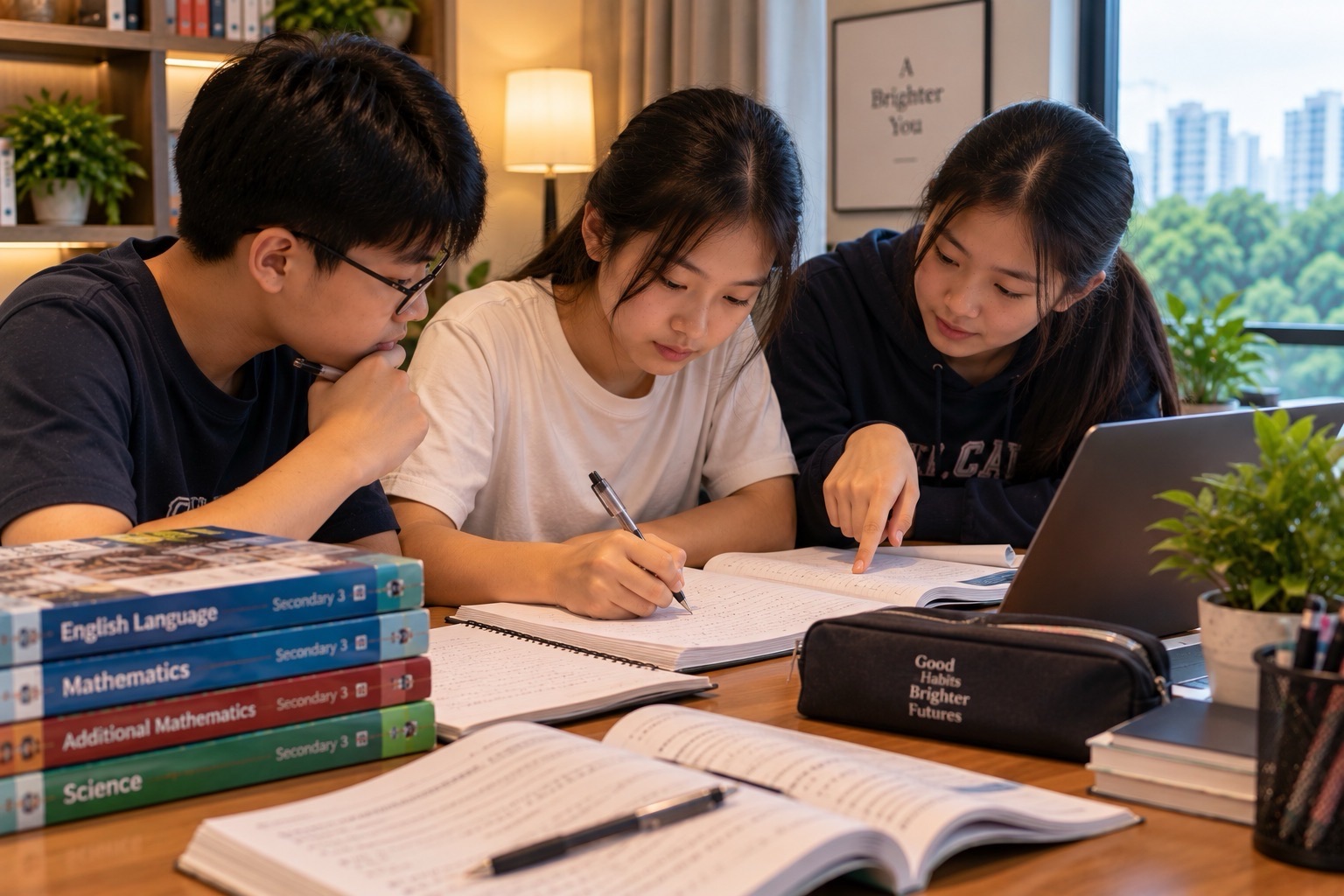
ChatGPT for students can be a useful study partner when a learner is stuck between understanding a lesson and applying it independently. A child might ask why an algebraic expansion is wrong, request vocabulary examples or practise explaining a Science concept. The learning opportunity is not merely receiving an answer; it is being asked a useful question, correcting a misconception and solving the next problem without help.
Parents searching for ChatGPT for students, ChatGPT homework help, ChatGPT Study mode, is ChatGPT safe for teenagers or how to study with AI need clear guidance about what the tool can actually do, who is eligible to use it and why fluent answers must still be checked.
This guide explains age rules, Study mode, responsible prompts, real English, Mathematics and Science examples, privacy, teacher permissions and how to distinguish legitimate tutoring assistance from AI doing a student’s assessed work. It follows a practical principle: attempt → ask for one useful hint → explain the correction → practise a changed problem → check the result independently.
Quick answer: ChatGPT is an AI assistant that can explain topics, ask questions, quiz learners and discuss their work. Study mode can guide students with questions instead of immediately supplying solutions, though it can still make mistakes or provide a direct answer. OpenAI’s current age guidance states that the service is not meant for children under 13, and users aged 13–17 need parental consent. For children under 13, any classroom interaction must be conducted by an adult.
What Can ChatGPT Help Students Learn?
ChatGPT can support explanations, practice questions, revision planning, vocabulary exploration and comparison of alternative methods. A learner might ask for an explanation at their current level and then request a more demanding example.
This flexibility can be useful because children do not always know exactly where their understanding first became unstable. One pupil may remember a Mathematics formula but select it incorrectly. Another may understand a Science observation but be unable to put the causal explanation into accurate words.
The risk is that a system generating plausible sentences can also generate incorrect information, overlook a condition or misunderstand the question. It should not be treated as the sole authority on official school syllabuses, examination rules, calculations or specialised facts.
The strongest purpose is therefore to make the student’s reasoning visible, not hide it behind an answer produced by a machine.
Use school materials, a teacher and checked sources to establish the requirements that matter for the actual assessment.
Age Rules: Important for Singapore Families
OpenAI’s official age-requirement help explains that ChatGPT is not intended for children younger than thirteen and that teenagers from thirteen through seventeen require parental consent.
For a Singapore Primary 4 or Primary 6 pupil below thirteen, parents should not encourage independent use by entering an inaccurate birth date. If AI is incorporated into a learning activity for under-thirteens, the adult must conduct the actual interaction.
Eligible teenagers may use a ChatGPT experience with age-appropriate safeguards. Features and account controls can vary by age, region, plan and whether a school or parent manages aspects of access.
The educational goal is not to persuade the child to create an account as early as possible. A parent or teacher can demonstrate a checked explanation, then provide an ordinary worksheet and ask the pupil to solve it without the AI.
School policy remains relevant even when the child meets the platform’s age criteria.
What Is ChatGPT Study Mode?
OpenAI’s Study mode guide describes a learning-oriented interaction that can ask questions, explain concepts in stages and check a student’s understanding.
The learner can ask for hints rather than a completed answer. Study mode can also help build quizzes, flashcard-style practice and review routines when suitable tools and account features are available.
As of October 2026, Study mode is available across ChatGPT plans on web, iOS and Android, with the plan’s ordinary usage limits still applying. It does not provide an unlimited private tutor or guarantee that every explanation is correct.
To turn it on in a supported regular chat, look for Study under the tool menu; the web interface also offers a Study entry point. OpenAI’s help notes that the Study selector is not offered in Temporary Chats, GPTs or Projects.
The key behaviour remains educational: ask the child to attempt the next step and explain it, rather than only display a final number.
How to Ask for Help Without Giving Away the Thinking
A weak prompt is: Do all my Mathematics homework and give the answers. It bypasses the reasoning the assignment was designed to build.
A stronger prompt is: I am learning Secondary 1 expansion. I tried 3(x + 2) = 3x + 2. Ask me one question to help me identify the first mistake. Do not solve the next question for me.
The second prompt identifies the level, topic, existing attempt and kind of assistance desired. This gives the learning interaction a specific purpose.
For English, try: Here is my own sentence. Identify the grammar rule I might have missed, then let me correct it myself.
For Science, try: Ask what observation supports my claim and help me distinguish the observation from its explanation.
Do not expect AI to know the exact teacher instructions unless they have been provided and checked. When permitted, a short anonymised task description is often enough.
Worked Mathematics Example: The Distributive Property
Suppose a student writes 4(x + 3) = 4x + 3. The first error is not a difficult calculation; it is forgetting that multiplication applies to every term inside the bracket.
A tutor can ask: What does 4(x + 3) mean? It means four groups of x + 3. Four groups contain four x terms and four groups of three.
Therefore the valid expansion is 4x + 12.
A numerical test provides another way to see the difference. Set x = 2. The original expression is 4(2 + 3) = 20. The correct expansion gives 8 + 12 = 20; the incorrect expression gives 8 + 3 = 11.
The student should explain why checking one value exposed the error, then derive the general distributive relationship rather than assume testing only one value proves all identities.
Finally, close the chat and expand 3(2x + 5) independently. The result is 6x + 15. That is the actual evidence of transfer.
Worked Mathematics Example: When an AI Solution Loses a Root
Consider x² = x.
Dividing both sides by x gives x = 1 only if x is not zero. Applying that operation without checking its condition can lose a valid solution.
Rearrange: x² − x = 0, then factorise: x(x − 1) = 0. The two solutions are x = 0 and x = 1.
Both satisfy the original equation. For x = 0, the equality is 0 = 0; for x = 1, it is 1 = 1.
If an AI answer gives only x = 1, the learner should not accept it because the explanation sounds logical. The original equation is the mathematical authority.
Ask the child to identify the unsafe operation and explain why dividing by zero is not permitted.
The value of the conversation is discovering a constraint, not copying the correct set of roots.
Worked Primary Science Example: Condensation
A child sees water droplets on the outside of a cold cup and asks for an explanation.
A scientifically suitable account is that water vapour in surrounding air cools sufficiently near the cold surface and condenses into liquid droplets. The water does not ordinarily pass through the wall of an intact cup.
An AI reply such as cold creates water would be too vague or misleading. It omits the source of the water and the change of state.
A good adult-led interaction asks the learner first: What did you observe? Where might the water have come from? What condition changed?
Then compare the explanation against a reliable Science source and an age-appropriate example.
The independent follow-up could be: Why might a bathroom mirror become misty after a hot shower? The learner should explain this different situation without reopening ChatGPT.
For deeper Science learning, see How Primary Science Works.
Worked English Example: Vocabulary in Context
Imagine a student asks about the word reluctant.
A basic meaning is hesitant or unwilling to do something. However, it does not necessarily mean the person refused. Someone can be reluctant and still act.
Compare Maya was reluctant to speak, but she answered eventually with Maya refused to speak. These sentences describe different outcomes.
Ask the learner to explain the distinction, then produce an original sentence that shows both reluctance and its cause. For example: He was reluctant to cross the muddy field because his shoes were new.
An AI can suggest a sentence, but the student should be responsible for choosing an appropriate setting and grammar.
A few days later, check whether the meaning is retrievable without a word bank or AI answer.
That is how vocabulary becomes usable knowledge rather than a copied definition. See How Vocabulary Really Works.
ChatGPT and Composition: Protect the Student’s Voice
A complete AI-generated composition may be fluent, grammatically clean and far beyond the student’s independent writing level. Submitting it as original work can defeat the assessment and violate the teacher’s rules.
A better workflow starts with the child’s own plan. Ask the learner what happened first, why the character acted and which details matter to the story.
If help is permitted, AI could ask questions about paragraph organisation or point out a recurring grammar error without writing the entire essay.
The student then revises in their own words and explains what changed. If a sentence becomes more sophisticated but the pupil cannot explain it, the improvement belongs to the document rather than the learner.
For an argument, check whether each claim has evidence. For a narrative, check sequence, cause and effect, appropriate vocabulary and a believable resolution.
Follow How PSLE English Composition Really Works for wider writing principles.
Study Mode Can Still Be Wrong
OpenAI’s current Study mode limitations explicitly warn that the tool can make mistakes and does not replace teachers, tutors or course materials.
The problem is not solved merely by asking the system to be more confident or more detailed. Extra words can repeat a wrong premise.
For Mathematics, substitute proposed values back into the original equation. For Science, compare the explanation with the relevant concept and conditions. For English, use the original passage to check which inference is justified.
For official information such as Singapore assessment requirements, confirm the current school, MOE or SEAB source.
When the model gives two different answers in successive turns, preserve the original question and investigate which reasoning step diverged. That can become a valuable learning exercise.
The student’s responsibility is to understand the evidence, not vote for the most convincing paragraph.
Quizzes and Flashcards: Better Than Repeated Rereading?
Students can ask ChatGPT to generate practice questions about a checked topic. This can be useful for retrieval, especially after an initial explanation.
However, generated questions may contain faulty premises, ambiguous answer keys or material outside the current syllabus. Validate important facts and review the questions before a younger learner memorises them.
For vocabulary, include production questions that require using the word in a fresh sentence, not only selecting a synonym. For Mathematics, require a method and a valid check rather than a lucky choice.
For Science, ask what evidence supports a conclusion and whether the stated experimental conditions are sufficient.
After a short quiz, schedule a separate delayed practice session. Remembering an answer ten seconds after seeing it is not the same as remembering it several days later.
Compare this approach with Anki for Students and Quizlet for Students.
Explain Why the Wrong Answer Was Tempting
An important teaching prompt is: Why did I think the wrong answer was correct?
Suppose a child calculates the perimeter of a rectangle when asked for area. They may know both formulas but have selected the wrong concept.
The repair is not simply repeating the formula. Draw the rectangle, shade the surface for area, trace the boundary for perimeter and identify the different units.
For a 6 cm by 4 cm rectangle, the area is 24 cm² and perimeter is 20 cm. Both values can be obtained correctly, but only one answers an area question.
Ask ChatGPT, where permitted, to generate a different rectangle so the student can choose which relationship is required.
The educational aim is the first wrong decision becoming visible and repairable.
Prompting for One Hint at a Time
When a student gets stuck, there are several levels of help. A small question might ask what the unknown means. A bigger hint might suggest a representation. A complete worked solution removes most of the remaining thinking.
The learner should request the least help that moves them forward.
A practical script is: Do not reveal the answer yet. Ask me which operation I would try first and wait for my response. If I am wrong, give a smaller example.
It is sensible to allow a full solution after the student has genuinely attempted the problem and needs to understand the error. The goal is not withholding information as punishment.
Ask the child to reproduce the explanation later without assistance. That distinguishes guided success from independent control.
A conversation can feel interactive while the system still performs most of the work. Keeping the student’s decisions explicit prevents this.
What About Uploaded Homework and Class Materials?
Study mode can use images, worksheets and source material when upload features are available in the account. OpenAI’s help explains that the system can sometimes misread an image or miss relevant content.
A photographed equation may lose a minus sign or parenthesis, changing the problem completely. Compare the recognised text with the original before following any solution.
More importantly, do not upload confidential class tests, private teacher notes, pupil records or identifiable classmates’ information into an external service unless the school authorises it.
For a permitted question, typing an anonymised expression may be safer and clearer than uploading an entire worksheet containing personal details.
The relevant instruction is the teacher’s specific policy, not the existence of an upload button.
Technology can support practice without making every school document part of a third-party AI conversation.
Privacy Settings and Data Controls
OpenAI’s Data Controls guidance explains settings for deciding whether new conversations may be used to help improve models. Controls depend on account and workspace, and teenagers or managed users may have additional restrictions.
In ordinary personal accounts where the option is available, a user can review Settings → Data Controls and the Improve the model for everyone setting. Turning that setting off does not automatically delete previous chat history.
Families should read the current service guidance rather than assume that an AI conversation is always equivalent to private paper tuition.
Avoid placing student passwords, sensitive personal details, private addresses or confidential school documents in prompts. A short fictional or anonymised example is usually sufficient for practising algebra, grammar or Science.
Data minimisation is an educational habit in its own right: supply only the information necessary to solve the learning problem.
Does ChatGPT Replace a Teacher or Tuition?
No. The tool can offer useful practice and explanations, but it does not know the full classroom context unless given accurate information and it may misunderstand the student’s misconception.
A teacher observes the child’s working, notices repeated patterns, chooses suitable examples and checks whether learning transfers over time. A tutor can adjust the explanation to a particular student’s responses, attention and stage.
An AI system may support some of these activities, especially when learners use it responsibly, but it should not be presumed to know the correct Singapore school pathway or assessment expectations without verification.
The best arrangement combines source-based learning, careful teaching, age-appropriate technology and independent practice.
Ask what first gap needs repair, then choose the smallest effective support. Sometimes that is a diagram or a pencil, not another conversation.
A Twenty-Minute Responsible AI Study Routine
A short study session can preserve the child’s intellectual role:
- Minutes 1–4: Read the actual school task and attempt the first step independently.
- Minutes 5–8: Ask one focused question or request a hint at the child’s level.
- Minutes 9–12: Compare the explanation with a reliable note, textbook or calculation check.
- Minutes 13–16: Explain the corrected principle in the child’s own words.
- Minutes 17–20: Close the AI conversation and solve a new related problem or write a fresh response.
If the child cannot complete the final independent check, record the weak concept and seek further explanation. Do not count the session as mastered merely because the conversation reached a correct answer.
For a three-student tutorial, rotate solver, reasoning checker and explainer roles. Each learner should make an initial attempt before seeing suggestions.
A digital tool is useful when it improves the next unaided performance.
ChatGPT Compared With Perplexity and Gemini Notebook
Perplexity for Students emphasises AI-supported research and source-linked answers. Gemini Notebook for Students emphasises work with a selected source collection and study aids.
ChatGPT can support interactive questioning, explanation and practice. All three may be useful, but they do different jobs and none guarantees factual correctness.
Use an official source when checking a current rule, a textbook or teacher note when aligning to school content, and a suitable AI study interaction when the student needs guided practice.
A citation does not automatically prove a claim. A generated summary does not prove understanding. An encouraging conversational reply does not replace a written solution.
The child’s own reasoning and the evidence supporting the answer remain central.
Common Problems and First Repairs
The AI gives the whole answer. Ask for one hint at a time, then attempt a changed question independently.
The explanation conflicts with the textbook. Check the original task and a reliable subject source instead of choosing by confidence.
The student copies sophisticated writing. Return to an original draft and practise one grammar or structure correction in their own words.
The Maths problem is misread. Recheck brackets, signs, indices and units in the input.
The AI invents a syllabus rule. Verify directly with the current school, MOE or SEAB source.
A child is below the age requirement. Do not create an inaccurate-age account. Any educational interaction for under-thirteens must be adult-conducted.
Private class information appears in a prompt. Stop using identifying material and follow school data policies.
The learner becomes dependent on hints. Reduce scaffolding gradually and include delayed independent checks.
The first repair must target the true problem: access, privacy, accuracy, concept understanding or academic integrity.
Frequently Asked Questions
Can Secondary students use ChatGPT?
Eligible students aged 13–17 need parental consent under OpenAI’s current age guidance. Schools may impose additional rules on use for classwork.
Can Primary children use ChatGPT by themselves?
ChatGPT is not intended for children under 13. In any education activity involving under-thirteens, actual interaction must be conducted by an adult.
What is Study mode?
Study mode is an experience that can ask guiding questions, offer step-by-step explanations and test understanding rather than simply provide answers. It can still make mistakes.
Is ChatGPT free for students?
Free access exists, with features, models and limits varying by plan and account. Study mode follows the ordinary account’s usage limits.
Can it help with PSLE Mathematics?
A parent or teacher may use it to prepare or discuss age-appropriate explanations and checked practice examples, but it cannot replace MOE-aligned teaching, school assessments or independent reasoning.
Is it cheating to use AI for homework?
That depends on the assignment and school rules. Practising a principle with permission differs from submitting generated work as independently authored.
Does Study mode always withhold the final answer?
No. It may sometimes give a direct answer. Ask explicitly for hints and one question at a time when practising independently.
Can ChatGPT read a photographed worksheet?
Where image uploads are available it can inspect an image, but recognition and reasoning can be wrong. Check the exact question and use only material the school permits sharing.
How can parents tell whether it helped?
Ask the learner to solve a new example and explain the result with the AI closed, preferably again after a delay.
Official Sources and eduKateSG Learning Routes
- ChatGPT — Official Service
- OpenAI Help — Study Mode in ChatGPT
- OpenAI Help — Age Requirements and Classroom Precautions
- OpenAI Help — ChatGPT for Teens
- OpenAI Help — Data Controls
- eduKateSG — Perplexity for Students
- eduKateSG — Gemini Notebook for Students
- eduKateSG — How Vocabulary Really Works
- eduKateSG — How PSLE English Composition Really Works
- eduKateSG — Online Math Solvers
- eduKateSG — How Primary Science Works
The lasting lesson: use ChatGPT to reveal misunderstandings and practise repairing them. A correct answer on a screen is useful; a student who can reason through the next question independently has learnt something lasting.