
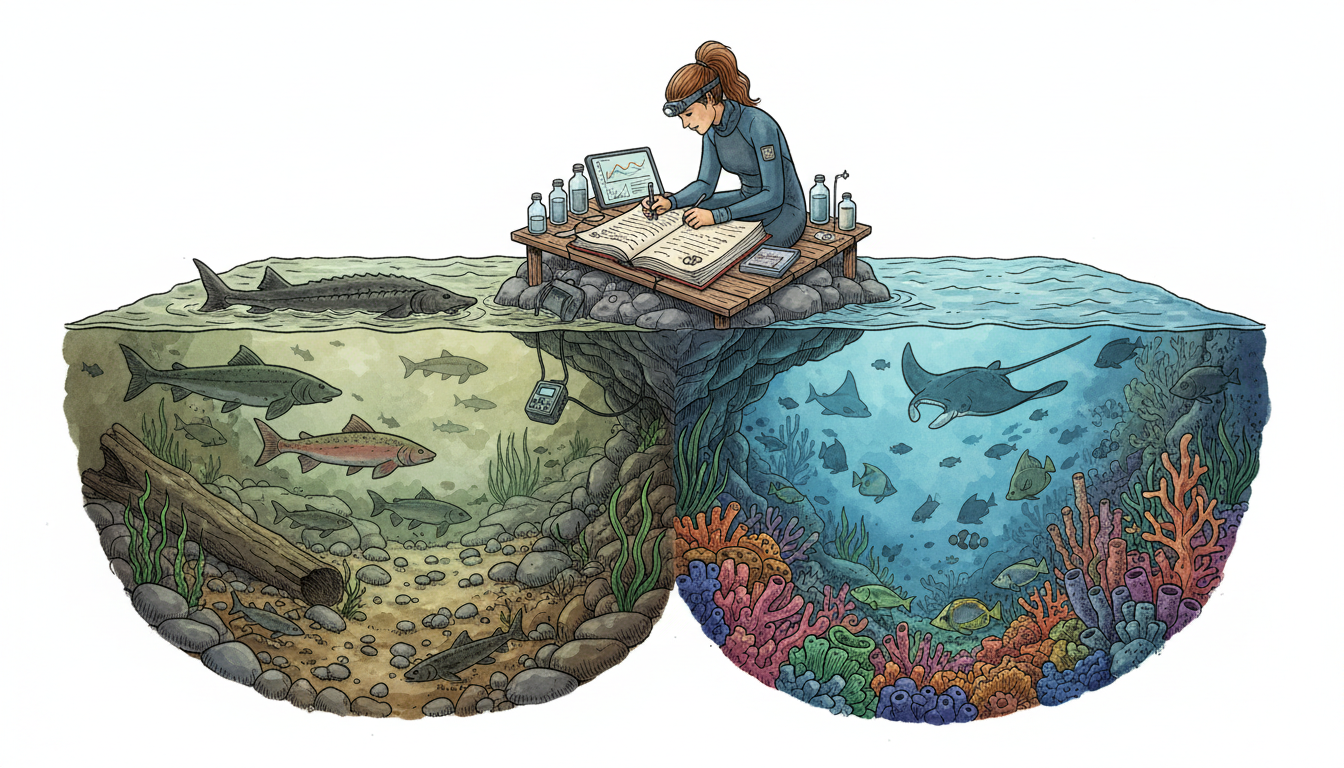
I like to begin an ocean Chemistry lesson with a deceptively simple question: if the sea contains so much water, how can a little more carbon dioxide make a meaningful difference to it? A student who can answer this has already travelled beyond memorising acids, bases and the pH scale. They are beginning to understand chemical equilibrium on a planetary scale.
This Chemistry Hougang article explains ocean acidification, carbon dioxide dissolving in seawater, carbonate and bicarbonate ions, and the challenges faced by coral reefs and shell-forming organisms. It is written for curious Secondary students, JC learners and families deciding how to build real Chemistry understanding. Anyone searching for Chemistry tuition Hougang may start with a syllabus topic, but the wider subject reaches into climate science, ecology, fishing communities and the oceans shared by every continent.
The most useful lesson is that a small change on one scale can be important when the scale is logarithmic and the system is interconnected. We will also learn to say what a measurement does not prove. Ocean acidification is not the same as all coral bleaching, and a lower ocean pH does not imply seawater has become acidic in the everyday sense of having pH below 7.
What is ocean acidification?
Ocean acidification refers to a long-term reduction in seawater pH, driven mainly by the ocean’s uptake of increasing atmospheric carbon dioxide. The gas dissolves, participates in chemical equilibria and alters the distribution of carbonate-system species. This can increase hydrogen-ion activity and reduce the relative availability of carbonate ions, which matter in calcium carbonate shell and skeleton formation.
According to the National Oceanic and Atmospheric Administration’s ocean-acidification explanation, the average surface ocean pH has fallen by about 0.1 pH unit since the Industrial Revolution. NOAA explains that a 0.1-unit fall corresponds to roughly a 30% increase in hydrogen-ion concentration under the simplified logarithmic interpretation.
Seawater remains generally alkaline at typical ocean surface pH values, yet has become less alkaline than it was. Words matter here. Acidification describes a direction of chemical change, not a claim that every part of the ocean is now below pH 7.
There is spatial and seasonal variation. Surface waters, deeper waters, estuaries and coastal areas differ in temperature, salinity, biological activity and local inputs. A single worldwide average cannot describe every reef or shellfish habitat.
Start with the gas dissolving in water
In school, students often meet a statement like “carbon dioxide dissolves in water to form an acidic solution.” That is useful as a first idea, but we need to distinguish several connected steps.
The carbonate system is often summarised using these simplified equilibria:
CO₂(aq) + H₂O ⇌ H₂CO₃
H₂CO₃ ⇌ H⁺ + HCO₃⁻
HCO₃⁻ ⇌ H⁺ + CO₃²⁻
Actual seawater equilibrium descriptions often group dissolved CO₂ and carbonic acid together and work with activities rather than bare concentrations. For a beginning learner, the essential point is that adding dissolved carbon dioxide changes the relative amounts of several chemical species.
The Woods Hole Oceanographic Institution’s explanation of carbon dioxide in seawater shows why extra hydrogen ions shift carbonate chemistry toward bicarbonate, thereby affecting carbonate availability.
There is no need to memorise three equations without understanding them. First name the important particles. Then explain that the relationships are reversible and interdependent. Only after that should we calculate.
Why pH is not an ordinary percentage scale
pH is logarithmic, conventionally expressed in terms of hydrogen-ion activity. In a simplified school setting, we often use pH ≈ −log₁₀[H⁺], with the understood standard-state and dilute-solution approximations. At more advanced levels the difference between activity and concentration must be respected.
Suppose we compare two hypothetical measurements: pH 8.2 and pH 8.1. A student might say the second sample is only “0.1% more acidic” because the displayed numbers differ by 0.1. That is incorrect.
A difference of 0.1 pH unit corresponds to a hydrogen-ion activity ratio of:
10^(8.2 − 8.1) = 10^0.1 ≈ 1.26.
So the lower-pH sample has about 26% greater hydrogen-ion activity than the higher-pH sample, when the numbers are interpreted consistently. Rounded descriptions may say “roughly 30%”. This does not mean the ocean contains 26% more total acid by mass, nor that coral skeletons dissolve 26% faster.
That is the hidden strength of the example: we can calculate one thing precisely while recognising what the calculation cannot establish.
Another useful pH misconception
At 25°C in dilute water, pH 7 is often used as the familiar neutral reference. But neutral pH can change with temperature, and seawater is chemically complex. Do not equate pH 7 with a universal environmental target or assume that all waters with pH above 7 are interchangeable.
A student can learn the logarithmic arithmetic early and then add proper qualifications in JC and university. Scientific growth involves correcting the model’s boundary, not pretending the basic model was useless.
The missing carbonate ions matter for shells and reefs
Many marine organisms build structures containing calcium carbonate, CaCO₃. The simplified formation relation can be represented as:
Ca²⁺(aq) + CO₃²⁻(aq) ⇌ CaCO₃(s).
This is a model of a chemical equilibrium, not a complete description of how a living coral controls mineral deposition. Organisms influence local chemistry and biological processes, while the surrounding seawater supplies conditions that can favour or hinder mineral formation.
As additional CO₂ changes seawater chemistry, the availability of carbonate ions and the saturation state of important calcium carbonate minerals can decrease. This matters for organisms that build or maintain shells and skeletons. The response differs by species, life stage and environmental conditions.
The NOAA ocean-acidification programme explains the links among CO₂, dissolved carbon chemistry and changes in carbonate availability. The US Environmental Protection Agency discusses the possible consequences for different marine organisms and the limits of predicting whole-ecosystem outcomes.
A responsible Chemistry explanation avoids saying that every shell immediately dissolves whenever ocean pH decreases. Calcification, dissolution and ecological effects depend on the organism, the mineral, the degree of saturation, physiological responses and other conditions.
Coral bleaching and ocean acidification are not the same process
You may have seen photographs of coral reefs turning pale or white. Coral bleaching often involves stress that disrupts the association between corals and their photosynthetic symbionts, with elevated ocean temperatures being a major driver of mass bleaching events.
Ocean acidification refers to changing carbonate chemistry caused mainly by increased CO₂ uptake. These stresses can interact, but a bleached coral photograph does not on its own demonstrate acidification, and an ocean pH measurement does not by itself prove bleaching.
I am careful with this distinction because it is easy to turn a powerful photograph into the wrong chemical explanation. Scientific integrity requires identifying what a piece of evidence actually shows.
A student examining coral health should ask about temperature, light, carbonate chemistry, water quality, local habitat conditions and time. Not all measurements answer the same question. Nor should every reef response be assumed identical worldwide.
Worked example: what does a pH change tell us, and what does it not?
A simplified classroom graph records the following hypothetical pH readings for one sampling site:
- Year A: pH 8.15
- Year B: pH 8.10
- Year C: pH 8.05
Suppose, only for the arithmetic exercise, that all measurements are directly comparable and their uncertainty is sufficiently small to resolve the differences. From Year A to Year C, pH falls by 0.10.
The ratio of final to initial hydrogen-ion activity is:
10^(8.15 − 8.05) = 10^0.10 ≈ 1.26.
We can say that the model implies about a 26% relative increase in hydrogen-ion activity across this difference. We cannot say that 26% of corals died, that all carbonate vanished or that the same trend occurred everywhere.
To investigate the ecological implications, we would need more evidence: carbonate-system measurements, habitat observations, relevant biological indicators, temporal coverage and appropriate analysis of other stressors.
This worked example teaches the difference between a quantified chemical change and a much wider ecological conclusion.
Ocean buffering: why seawater does not behave like pure water
Seawater contains dissolved salts and numerous interacting acid–base species, including bicarbonate and carbonate. Its ability to resist pH change depends on the composition of the system and processes that add or remove dissolved components.
Students often hear that “buffers keep pH constant”. That is too strong. A buffer may moderate changes over a limited range, but it does not make a system immune to sustained added acid or base. Ocean chemistry changes under continued CO₂ uptake even though buffering processes exist.
At upper Secondary level, I would stress reversible reactions and the importance of chemical species. At JC level, equilibrium expressions and acid–base relationships can help explain why the system responds to changes in dissolved CO₂. University work may use total alkalinity, dissolved inorganic carbon, partial pressure of CO₂, equilibrium constants and activity corrections.
These more advanced quantities are different from a simple pH reading. They help distinguish the carbonate chemistry that a pH value alone cannot fully specify.
A global ocean and different local realities
A reef in the tropical Pacific, a cold-water marine ecosystem and a temperate estuary occupy different chemical and ecological settings. Temperature affects gas solubility and chemical equilibria. Biological activity removes or releases CO₂. Freshwater runoff changes salinity, while coastal pollution and nutrient inputs can change local processes.
So the world has a global driver—more atmospheric CO₂—but local expressions of the problem can vary. An explanatory model needs both levels. We should not ignore a planetary trend because two local sites differ, nor erase local differences with a worldwide average.
The ocean also connects people. Fisheries, aquaculture, tourism, biodiversity conservation and coastal livelihoods can depend on marine ecosystem health. Scientific discussions about acidification often involve Biology, ecology, Economics, Geography and public policy as well as Chemistry.
What I hope a teenager learns is that a chemical change is rarely isolated from the systems around it. That does not diminish Chemistry; it makes the discipline more valuable.
How scientists know whether seawater chemistry is changing
Ocean researchers use appropriately calibrated instruments, collected water samples, laboratory methods and time-series observations. Different measurements illuminate different properties: pH, dissolved inorganic carbon, alkalinity and dissolved CO₂-related variables are not interchangeable.
A single pH reading at a beach on one day cannot establish a global trend. Trend analysis requires comparable methods, adequate coverage, treatment of seasonal variation and an understanding of uncertainty.
In the laboratory, sample collection and storage matter. Carbon dioxide exchange with air, temperature change and other handling effects can alter what is measured. Professional ocean chemistry requires suitable analytical procedures and quality assurance.
For a Secondary student, the immediate transferable habit is straightforward: name the measured variable, units, instrument and what conclusion the measurement supports. For a JC learner, add calibration, assumptions and precision. For a university student, add more rigorous carbonate chemistry and sampling protocols.
Our Chemical Analysis Explained: Experiments, Spectroscopy and Reliable Evidence develops this measurement mindset in greater detail.
A change in pH is not a full climate solution
If someone proposed adding a chemical to raise pH in one sample, I would ask where the substance came from, how much would be needed, what else would change, how the treatment would affect organisms, and whether it would address the underlying CO₂ burden.
Many real environmental interventions have costs and side effects. A short-lived local adjustment is not automatically a solution to long-term, global ocean acidification. Environmental and climate proposals require robust analysis, governance and careful evaluation of risks.
Reducing the increase in atmospheric CO₂ addresses the dominant global driver, while local conservation and pollution-management actions may also affect resilience in particular contexts. Policy choices involve evidence beyond one chemical equilibrium equation.
Students should be wary of both hopelessness and miracle claims. The scientific way forward is to define the mechanism, identify the options and test their consequences honestly.
A compact school-to-university learning roadmap
Lower Secondary: distinguish change, substance and explanation
Learn solutions, gases, carbon dioxide, states of matter, acids and bases, and careful interpretation of graphs. Explain why dissolving gas in a liquid can lead to chemical effects without claiming that every dissolved substance behaves identically.
Upper Secondary: use equations and quantities correctly
Recognise bicarbonate, carbonate, hydrogen ions and calcium carbonate as distinct chemical species. Apply charges and formula writing. Interpret percentage changes and log scales only when the syllabus has introduced the necessary Mathematics.
JC H1/H2: justify equilibria and models
Use acid–base and equilibrium reasoning appropriately. Distinguish a change in one equilibrium species from a measured change in the whole ocean system. State assumptions and explain why the result has a limited domain.
Polytechnic and university: analyse real environmental systems
Study chemical oceanography, instrumental measurements, carbonate equilibria, biogeochemistry, ecosystem data, modelling and uncertainty. Advanced work may require collaboration with marine biologists, climatologists and community stakeholders.
The fundamental question remains the same: what was observed, what chemical process explains it, and how far can that explanation be trusted?
A four-week research project without changing seawater
I recommend observation and reading rather than unsupervised chemical treatment of marine materials, acids or living organisms. There is no reason to manipulate real reef material to learn the principles.
Week 1 — Learn the language. Create a one-page glossary: CO₂, H₂CO₃, HCO₃⁻, CO₃²⁻, CaCO₃, pH, acidification and buffering. For each, explain whether it names a substance, ion, material or measured property.
Week 2 — Do the logarithm. Compare hypothetical pH values 8.20 and 8.00. The implied activity ratio is 10^0.20 ≈ 1.58. Describe this correctly as a relative hydrogen-ion activity change, not a prediction of reef damage.
Week 3 — Evaluate evidence. Read NOAA’s overview and identify three kinds of evidence relevant to carbonate chemistry and marine effects. Distinguish a global trend from one local observation.
Week 4 — Communicate a limitation. Write a 300-word explanation for a younger student. Include one balanced equilibrium, one pH calculation, one biological consequence and one reason further evidence is needed.
Ask a teacher or tutor to challenge the explanation with an unfamiliar scenario. The student should be able to defend the reasoning without memorising a paragraph word for word.
A self-check with full answers
Does ocean acidification mean the ocean is now generally below pH 7?
No. Acidification means a decrease in pH over time; typical surface seawater remains alkaline even though it has become less alkaline.
If pH drops by 0.1, is that a 0.1% change in hydrogen ions?
No. Under the logarithmic relation, the hydrogen-ion activity changes by about a factor of 1.26, or roughly 26% relative change.
Why are carbonate ions important for some marine organisms?
They are part of calcium carbonate mineral formation, which is important to the shells and skeletons of many calcifying organisms.
Can coral bleaching photographs prove the pH of the ocean?
No. Photographs may show a condition of coral tissue, but pH and carbonate chemistry require appropriate measurements. Bleaching and acidification are distinct, though potentially interacting, stressors.
Does adding CO₂ to seawater create a single irreversible reaction?
No. The carbonate system involves interacting reversible equilibria. The distribution of species responds to chemical and environmental conditions.
Does a lower pH directly predict the precise number of organisms harmed?
No. Biological outcomes require species-specific, environmental and ecological evidence in addition to the chemical measurements.
Parents: teaching more than an examination answer
I would ask a Chemistry tutor whether the learner can explain the log-scale pH difference, distinguish the chemical species, and identify what additional evidence a biological claim requires. Those three abilities are more revealing than how rapidly the student can recite the word “acidification”.
A student may need repair in charges and formulas before they can understand carbonate chemistry. Another may know the equations but be unable to explain a graph. A third may rush from a correct measurement to an exaggerated conclusion. These learners need different teaching decisions.
Strong Chemistry tuition for Hougang students should combine syllabus mastery with transferable reasoning, not replace exam preparation with unrelated trivia. The wider ocean example is valuable precisely because it exposes whether the student’s acid–base and equilibrium ideas are stable.
Questions students and families often ask
Is ocean acidification covered in O-Level or JC Chemistry?
Curriculum emphasis varies by subject, level and examination year. The underlying acids, bases, equilibrium and data interpretation may be relevant even when ocean acidification is used only as an enrichment example. Check the current applicable syllabus.
Is this problem the same as global warming?
No. They have an important shared driver—rising atmospheric CO₂—but ocean acidification concerns seawater chemical changes, while global warming concerns Earth’s energy balance and warming. Effects can interact.
Can coral reefs adapt?
Organisms and communities differ in their responses and potential adaptive capacities. It is not sound to assume that every reef will respond identically or that adaptation will always offset changing conditions.
Does this topic lead to a career?
Yes, it connects to analytical Chemistry, oceanography, marine science, environmental chemistry, geochemistry, ecological research and policy-related work, with different educational requirements.
Sources and further reading
- NOAA — Ocean Acidification: Education Resource
- NOAA Ocean Acidification Program — What Is Ocean Acidification?
- Woods Hole Oceanographic Institution — Carbon Dioxide in Seawater
- US EPA — Effects of Ocean and Coastal Acidification on Marine Life
Continue the Chemistry Hougang learning library
- Why Chemistry Matters in Water, Food and Air
- How to Think Like a Chemist: Atoms, Models and Evidence
- Green Chemistry, Batteries and Sustainable Materials
- Nitrogen Cycle, Fertilisers and Global Food Security
- Chemical Analysis: Experiments, Spectroscopy and Evidence
- Food Chemistry: Fermentation, Enzymes and Food Safety
- Semiconductor Chemistry: Silicon, Doping and Microchips
- Hydrogen Fuel, Electrolysis and Energy Storage
If your child struggles with a pH calculation, bring the written working and ask where the reasoning fails—units, logarithms, chemical equilibrium or interpretation. Families seeking targeted learning guidance can arrange a consultation with eduKate Singapore.