
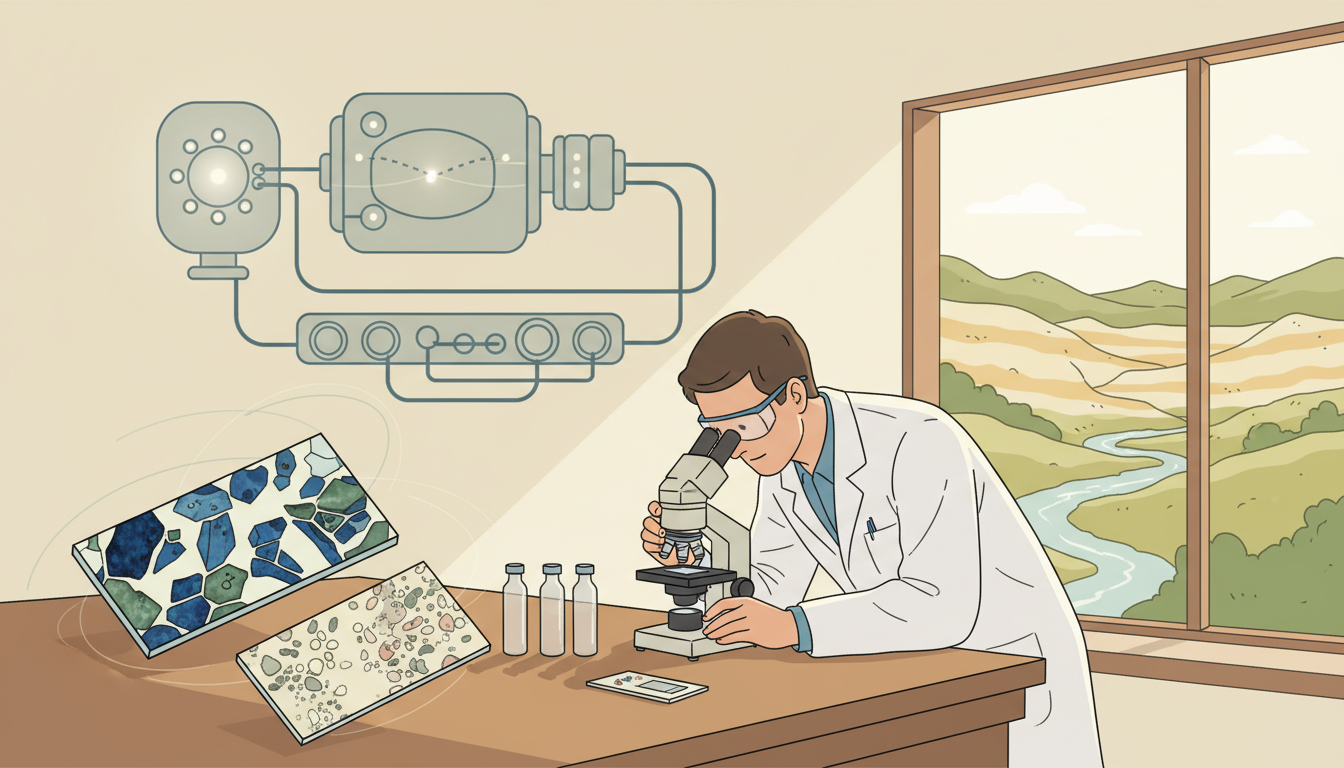
If you have ever looked at the periodic table and thought, “How could anyone remember all of that?”, I want to show you a more interesting way to read it. The table is not simply a wall of boxes awaiting memorisation. It is an extraordinary map of the ingredients of matter, a map that can help us predict chemical behaviour long before we have handled the substance concerned.
This Chemistry Hougang guide is for students asking how to learn the periodic table, parents deciding what strong Secondary Chemistry tuition should achieve, and JC or university learners who want to connect chemical knowledge to the wider world. A useful Chemistry tutor does not need to turn every element into a separate flashcard. The better goal is to understand why the patterns exist, what they allow us to predict, and where the predictions need qualifications.
I like to begin in an unexpected place: the night sky. Some of the hydrogen in the water we drink traces back to the early universe. Carbon and oxygen atoms were produced by nuclear processes in earlier generations of stars. The oxygen in a breath and the silicon in an electronic device carry an origin story older than Earth. Yet the periodic table describes what those atoms are now, and how their electrons govern ordinary chemical behaviour. That is the bridge between astronomy and Chemistry.
The quick answer: what does the periodic table tell us?
The periodic table orders elements by atomic number, the number of protons in an atom’s nucleus. Each element has a unique atomic number. An atom of carbon has six protons, whether it belongs to a tree, a diamond or a molecule in the atmosphere. If a nucleus has seven protons, it belongs to nitrogen, not carbon.
The horizontal rows are called periods, while the vertical columns are groups. Many elements in the same group show related chemical behaviour because their outer-electron arrangements follow patterns. This does not mean every property is identical, nor that every simple rule applies unchanged to transition metals or complex materials.
The table helps us ask practical questions: is an element likely to form a positive or negative ion? How many electrons are involved in bonding in a simple main-group example? Why might two elements form compounds with similar formula patterns? Why does a material conduct electricity, resist corrosion, or react with water?
I describe it as a prediction map, not a fortune-telling machine. It tells us where to look for likely behaviour. Observations, more detailed theory and appropriate conditions still determine what actually happens.
First distinction: an element, an atom and an isotope are different ideas
An element means the class of atoms defined by one proton number. An atom is an individual unit of that element, with a nucleus and electrons. An isotope is a variant of an element whose atoms have the same number of protons but different numbers of neutrons.
Chlorine-35 and chlorine-37 both contain 17 protons. Their neutral atoms each have 17 electrons, but their neutron numbers differ. They are both chlorine. Their different masses are important in isotopic analysis and various scientific applications, but isotope variation does not turn one element into another.
An ion, meanwhile, has gained or lost electrons and carries an electric charge. Chloride, Cl⁻, still contains a chlorine nucleus; gaining an electron has not changed its atomic number. Magnesium ions and neutral magnesium atoms share proton number 12, even though their electron counts and chemical behaviour differ.
That vocabulary is worth teaching carefully in Secondary 1 and 2. In upper Secondary, it supports bonding and formula writing. In JC, it supports electronic configuration and deeper periodicity. At university, it underpins spectroscopy, isotopic tracers, material analysis and laboratory measurements.
Worked example: how an element becomes part of a compound
Start with magnesium, whose atomic number is 12. A neutral magnesium atom has 12 protons and 12 electrons. In a familiar simplified shell model, the electrons are arranged 2, 8, 2.
When magnesium forms Mg²⁺, it loses two electrons. It still has 12 protons, but now has 10 electrons. The common stable oxide ion O²⁻ has a negative charge of two. Combining one Mg²⁺ with one O²⁻ gives an electrically neutral formula unit, MgO.
Now use chloride instead. Each chloride ion, Cl⁻, carries charge −1. One Mg²⁺ requires two Cl⁻ ions for overall neutrality, so the formula is MgCl₂, not MgCl or Mg₂Cl.
The useful lesson is not “memorise magnesium chloride”. It is track the chemical identities and the charges. This one principle transfers to a large number of upper-secondary formula questions.
Diagnose the error before it spreads
A learner writes MgCl because “magnesium and chlorine are two elements, so it is one of each”. I would ask them to write the charges, make the total charge zero and explain what the subscripts mean. If they change Cl to Cl₂ merely because chlorine occurs as diatomic molecules in its elemental state, we distinguish an element’s molecular form from the ionic species present in the compound.
One misunderstanding may appear in formula writing, equation balancing and mole calculations. Fixing the underlying concept is much more efficient than correcting the same surface mistake three times.
The universe made the nuclei; chemistry rearranges the electrons
Here is a distinction that changes how students think about the origins of matter. Ordinary chemical reactions rearrange atoms and electrons into different substances. They do not transform carbon nuclei into nitrogen nuclei. Nuclear processes, involving changes to atomic nuclei, are responsible for creating different elements in astrophysical settings.
NASA’s Where Your Elements Came From explains how hydrogen traces back to the early universe, while heavier elements have multiple nucleosynthetic origins. The details of where some rare elements are created remain scientific research questions. I would rather teach a student this beautiful, evolving picture than the inaccurate shortcut that “all elements come from stars in exactly the same way”.
The periodic table then gives chemists a common language to describe these elements after they exist. Electrons and chemical bonding explain water, minerals, medicines and everyday reactions. Nuclear astrophysics explains the formation of nuclei across cosmic history. These fields connect but answer different questions.
For a student who enjoys Astronomy, this is a doorway into Chemistry. For a student who enjoys Chemistry, it is a reminder that the laboratory is part of a much larger physical universe.
Why rows and groups matter more than memorising boxes
Let’s start with Group 1. Lithium, sodium and potassium belong to the alkali metals. Their atoms have a characteristic outer-electron pattern and readily form +1 ions in many compounds. They show some related reactivity, but it would be unsafe and incorrect to treat them as interchangeable materials.
Group 17 contains the halogens. Chlorine, bromine and iodine form a family with related chemistry, including the ability to form −1 ions in many ionic compounds. Their elemental forms have different physical states and properties under common conditions, and actual reactions depend on the reagents and environment.
Group 18 contains the noble gases. They are generally much less chemically reactive than many other elements under ordinary conditions, because their electron configurations make many reactions unfavourable. The word “generally” matters: noble-gas compounds can exist under suitable circumstances. A scientific rule that names its boundary is better than an absolute statement that later has to be unlearned.
Across a period, the number of protons increases, and electron arrangements change in a structured way. In introductory main-group Chemistry, this helps explain recurring patterns in atomic size, metallic character and bonding. The full explanations require careful attention to shielding, subshells and electron interactions.
A practical comparison that exposes real understanding
Ask: why do potassium and sodium show related behaviour but not identical behaviour? A student might answer, “They are in the same group.” That correctly identifies a pattern but does not explain the difference.
A stronger answer uses their outer electrons, different numbers of occupied electron shells and attraction between the nucleus and valence electrons. Then it recognises that reaction speed and observed intensity can also depend on surface area, conditions and the particular reaction. This is the difference between naming a position on the table and using the table to reason.
Is a ‘natural’ element safer than a synthetic one?
No. “Natural”, “manufactured”, “metal” and “chemical” are broad descriptions, not reliable measures of safety. Sodium metal reacts vigorously with water; sodium ions occur in ordinary table salt. Chlorine gas and chloride ions do not share the same exposure risks simply because both contain chlorine nuclei.
A student should never infer a substance’s effects from the element name alone. The chemical species, dose, route of exposure, form, concentration and conditions matter. We do not taste, burn or mix unknown substances as a way of testing periodic trends.
This distinction is especially valuable for people evaluating household chemical claims, cosmetics, environmental reports and social-media explanations. Knowing the periodic table gives us vocabulary. Knowing its limits gives us judgment.
The periodic table inside today’s technologies
Silicon, glass and electronics
Silicon is a central material in modern electronics, but a pure silicon crystal is not the same substance as silicon dioxide in sand or glass. Their structures and bonding determine very different electrical and mechanical properties. Semiconductor behaviour cannot be inferred from the element name alone; material purity, structure, doping and fabrication matter.
That is a useful bridge to university courses in materials science, solid-state physics and electrical engineering. The Chemistry question begins with electronic structure and bonding, then expands into device design and manufacturing.
Lithium, cobalt and rechargeable systems
Elements such as lithium and cobalt are important in some battery technologies, but not all batteries use the same chemistry. The choice of electrode and electrolyte materials affects energy density, rate, stability, cycle life, cost and safety. Elemental abundance is also different from how easily a material can be extracted, refined, transported and recovered.
A responsible Chemistry education connects atomic and ionic behaviour to a whole materials system. It also teaches students not to dismantle or experiment with rechargeable cells outside supervised, approved laboratory settings.
Nitrogen, phosphorus and agriculture
Plants need nutrients, and nitrogen and phosphorus are parts of many essential biological molecules. But their usefulness depends on the chemical forms available in soils, biological transformations and environmental pathways. The periodic table is a beginning, not a complete explanation of agriculture. That is why I connect this topic with fertilisers, the nitrogen cycle and food security.
Rare elements and resource questions
Some elements are widely present in Earth’s crust but may be difficult or costly to obtain at usable purity. Other elements occur in small concentrations within minerals or as by-products of extraction. A chemical engineer may therefore care about recovery, separation processes and environmental burdens as much as the elemental identity itself.
I ask students, “If an element is abundant, does that mean its useful form is easy to obtain?” Not necessarily. The question forces them to connect chemistry to geology, industry and economics.
Worked example: why relative atomic mass may not be a whole number
Imagine a fictional element X with two isotopes whose mass numbers are 20 and 22. Suppose a simplified sample contains 90% of the first and 10% of the second by number. Using mass numbers as approximate isotope masses, the estimated relative atomic mass is:
(0.90 × 20) + (0.10 × 22) = 20.2.
The answer is not 20 or 22 because it is a weighted average. In a rigorous real-world determination we use measured isotope masses and actual isotopic abundances, not just whole-number mass numbers. Terrestrial isotopic compositions can also vary for some elements.
IUPAC’s Periodic Table of Elements and its educational isotopes project help students see why atomic weights are more nuanced than an integer printed in a box.
Now extend the lesson. A sample’s isotopic signature can carry information about processes or origins, though interpretation depends on the measurement method and reference materials. That is one route from a school weighted-average problem to environmental Chemistry and isotope geochemistry.
How the same element becomes a different learning problem at each stage
Lower Secondary: read without guessing
A beginning learner should locate atomic numbers, identify groups and periods, distinguish atoms, ions and isotopes at the appropriate syllabus level, and recognise that an element and a compound are different. The tutor should test whether the learner can explain what each number means.
Upper Secondary: predict and account for charge
Students need enough electronic-structure understanding to interpret bonding, periodic trends, common ions and chemical formulas. They should learn to represent species correctly before calculating with them, and recognise when a description of a family’s behaviour has exceptions.
JC H1/H2: explain trends and anomalies
The learner moves from pattern recognition toward explaining trends using nuclear charge, shielding, orbital concepts and bonding. They also practise multi-step reasoning: which variable changes, what property is being compared, and what assumptions the simplified explanation relies on.
Polytechnic, university and practice: measure the real material
At advanced levels, many questions concern composition, phases, defects, interfaces, isotope ratios, spectroscopy and material performance. A chemist may compare simulations with analytical results, or discover that a real material’s behaviour depends strongly on impurities and processing history. A periodic-table position is still relevant, but it is not an adequate materials specification.
A ten-minute periodic-table test that is genuinely diagnostic
I would use five questions rather than another whole-page copying exercise:
- Explain the difference between atomic number and mass number without referring to where each is printed.
- Explain why Mg²⁺ still belongs to magnesium.
- Predict and justify the charge-balanced formula for magnesium chloride.
- Tell me what the periodic table can suggest about Group 1 behaviour, and name one limitation.
- Explain why silicon in an electronic chip and silicon dioxide in glass should not be treated as identical substances.
The first two diagnose particle identity. The third diagnoses symbolic chemistry. The fourth diagnoses the boundary of a model. The fifth tests transfer to real materials. A student who answers all five clearly has demonstrated far more than someone who recites twenty element symbols.
A small self-check with full answers
Question 1: oxygen-16 versus oxygen-18
Both contain eight protons. How many neutrons are in each isotope, and are they still the same element?
Answer: oxygen-16 contains eight neutrons; oxygen-18 contains ten. Both are oxygen because both nuclei have eight protons. Neutral atoms of each have eight electrons.
Question 2: fluoride versus fluorine
Is F⁻ a different element from fluorine?
Answer: no. It is a negatively charged ion of fluorine. The proton number remains nine; a fluoride ion has one additional electron relative to a neutral fluorine atom.
Question 3: calcium oxide
A calcium ion carries charge +2 and an oxide ion −2. What is the simplest neutral formula?
Answer: CaO, because one of each ion gives total charge zero. Writing Ca₂O₂ would not give the simplest formula-unit ratio.
Question 4: periodic-trend trap
Does an element’s group alone prove exactly how fast it reacts with water?
Answer: no. Group placement helps anticipate related chemistry, but actual rate and observations also depend on chemical identity, conditions, surface and experimental design.
Question 5: origin and change
When magnesium reacts with oxygen to form magnesium oxide, has the magnesium nucleus changed into a different element?
Answer: no. This is an ordinary chemical change involving electrons and bonding. Magnesium nuclei remain magnesium nuclei.
A realistic four-week study sequence for Hougang learners
Week 1 — identity. Practise atomic number, atoms, ions, isotopes, charges and simple representations. Record why each answer is true, not only the answer itself.
Week 2 — families. Compare selected groups and periods, then study one exception or important qualification. Explain your reasoning without looking at a printed definition.
Week 3 — compounds and materials. Move from electron structures to charges, formulas and properties. Use magnesium oxide, sodium chloride and silicon dioxide as examples of why chemical form matters.
Week 4 — unfamiliar transfer. Read a reputable article about a material or an element’s cosmic origins and connect one claim to what you know. Identify which claims go beyond the school model.
Review older questions after two or three days rather than rereading notes repeatedly on one evening. If mistakes keep recurring, write a short error explanation and ask a teacher or tutor to diagnose the missing link.
Parents: what to ask a Chemistry tutor
The question I would bring is not “How many periodic-table worksheets will my child finish?” I would ask, “How will we know they can use periodic patterns to explain an unfamiliar chemical situation?”
A thoughtful Chemistry tutor for a Hougang student should be able to separate weak memorisation from weak particle understanding, poor formula construction and difficulty writing an explanation. The lesson should use a few well-chosen examples, then a changed-context problem the learner must complete independently.
If a child understands the basics securely, expansion toward Astronomy, materials or environmental science can make the subject exciting. If the foundations are weak, moving faster into JC vocabulary usually makes the problem worse. Depth comes before acceleration.
FAQ
Must I memorise all 118 elements to do well in Secondary Chemistry?
Usually not. Learn the elements, groups, symbols and data required by your current syllabus, then learn how to use the periodic table. Check the actual examination year’s requirements; avoid assuming that memorising all element names is the best use of revision time.
Why do elements in the same group sometimes behave differently?
They share important outer-electron patterns but differ in size, shielding, electron energies and other properties. Real chemistry also depends on the compounds and reaction conditions.
Why are atomic masses decimal numbers?
Many elements occur as mixtures of isotopes. A tabulated standard atomic weight represents isotopic composition rather than simply the mass number of one atom.
Can the periodic table predict whether a medicine will work?
No. The elements and bonding help explain molecular possibilities, but drug efficacy and safety require chemistry, biological research and clinical evidence. Read our guide to how medicines are developed for that next step.
Does studying elements help with advanced Chemistry careers?
Yes, as a foundation. Professionals also need mathematical, laboratory, computing, communication, ethical and safety skills appropriate to their field.
Sources to explore
- IUPAC — Periodic Table of Elements
- IUPAC — Periodic Table of Elements and Isotopes for Education
- NASA — Where Your Elements Came From, September 2026
- NASA — Where do life’s building blocks come from?
Continue your Chemistry journey
- How to Think Like a Chemist: Atoms, Models and Evidence
- How Medicines Work: Drug Discovery and Molecular Design
- Nitrogen Cycle and Fertilisers: Chemistry Behind Food Security
- Chemical Analysis Explained: Spectroscopy and Reliable Evidence
- Secondary 2 Chemistry: Chemical Formulae and Counting Atoms
- Why Chemistry Matters in Water, Food and Air
If your child is struggling, bring their latest written solutions, corrections and one question they cannot explain. The useful next step is to diagnose the misunderstanding and build a practice plan they can gradually manage alone. Families exploring support can arrange a consultation with eduKate Singapore.