
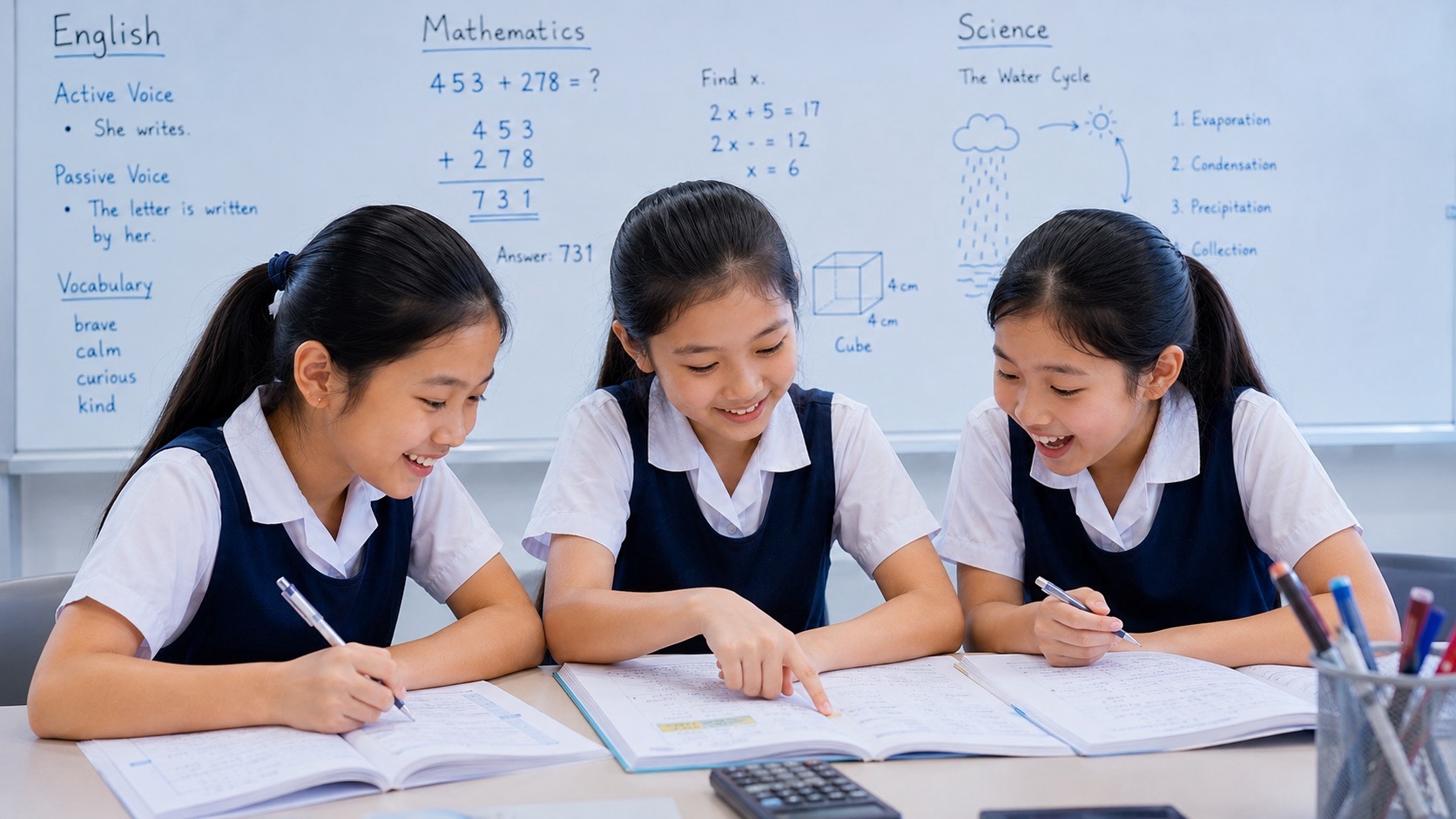
A Primary Six child opens a PSLE English composition practice task and sees three pictures. They immediately try to squeeze all three into a single story, add a dramatic storm, and hope the familiar ending about learning a lesson will fit. Sometimes the writing is lively. Unfortunately, the title seems to have disappeared somewhere between the bicycle, the kitten and the surprise visitor.
The core aim of Bukit Timah English tuition for picture composition is to help a child turn a visual idea into a relevant, purposeful story. Good PSLE English continuous writing begins with interpreting the topic, choosing a suitable picture, shaping a meaningful event and developing it coherently. The images offer possibilities; they do not replace the child’s decisions as a writer.
This is a skill that can be practised with excitement rather than anxiety. A child does not need the world’s most dramatic plot. Often the best compositions grow from a modest situation, a believable choice and a consequence that gives the story meaning. The task is to make the chosen picture and the assigned topic work together.
The First Mistake: Treating the Pictures as a Three-Panel Comic
Some pupils assume that three pictures mean a story must begin with Picture One, continue through Picture Two and end with Picture Three. That assumption can lead to a forced plot, especially if the pictures were designed to offer different possible directions.
For the 2026 PSLE English Language syllabus, Paper 1 continuous writing gives a topic with three pictures that provide different angles of interpretation. The composition must be based on at least one of those pictures and be at least 150 words. This is the official 2026 arrangement, not a claim that every school worksheet or future format must be identical.
That phrase “at least one” matters. A child can choose an image that supports a strong story rather than forcing all three together. Using more than one may work when they genuinely belong, but adding a picture merely because it appears on the page can damage relevance and coherence.
The first teaching job is therefore to help the learner make a selection and explain the choice.
The Core Aim: Move from Picture to Meaning
A picture gives objects, people, settings and actions. A story needs something more: motivation, cause, consequence and change. We can use five planning questions.
- What do I actually see? Describe only the visible details without inventing motives too early.
- What might have happened before? Offer plausible background possibilities, not a wild explanation detached from the image.
- What decision or problem could grow from this scene? Identify a moment that gives the story movement.
- Why does that event fit the assigned topic? Connect the situation directly to the required theme.
- What would change by the end? Imagine a consequence that follows naturally from the character’s actions.
These questions turn looking into story planning. A pupil learns to use an image as evidence for a creative starting point while recognising that a composition allows imaginative developments beyond what is literally shown.
That balance is important. The story should not simply describe the photograph in detail, but it should not abandon the picture after the first line either.
An Original Practice Task: “An Unexpected Discovery”
Imagine a practice topic titled An Unexpected Discovery. The three hypothetical picture choices are:
Picture A: an old biscuit tin found behind a cupboard during a classroom clean-up.
Picture B: a young cyclist stopping beside a small, unfamiliar path in a park.
Picture C: a family looking at a faded photograph discovered in a drawer.
These images are invented for this article; they are not an official SEAB question. Each could support the topic, but the story possibilities differ.
Picture A might develop into a tale about finding old class memories. Picture B might involve discovering a hidden community garden. Picture C could lead to learning something new about a relative’s past.
The child does not need to write all three stories. Ask them to choose the picture they can develop most convincingly. Then require one clear answer: What is the discovery, and why is it unexpected?
If the answer is simply “It was very surprising,” the story may not yet have a useful centre.
Make the Topic Visible in the Story
Suppose Clara chooses Picture A: the biscuit tin behind the cupboard. Her initial idea is to write about pupils cleaning a classroom, talking about homework and going home. The tin appears in one sentence, then disappears. That would be a weak use of the prompt, even if the prose is fluent.
A stronger plan puts the discovery at the heart of the plot:
Clara and her classmates clean an old room before a school event. A cupboard is moved. Behind it, they find a tin containing letters written by students many years earlier. They ask their teacher about the letters and learn that the writers once helped build the school’s first garden. The class decides to display a few of the letters at the event, respecting the teacher’s guidance, and gains a new sense of connection to the place.
Notice what gives the story coherence. The discovery changes how the characters understand something familiar. The tin is not a random decorative object; it causes the middle and informs the ending.
The story can be written in different styles. It need not contain a frightening secret or a magical twist. The writer’s job is to make the event meaningful, not necessarily spectacular.
Choose One of Three Story Directions
Many students think they must settle on the first plot that comes to mind. A quick comparison can produce a more suitable idea without wasting time.
Ask the learner to generate three one-sentence possibilities from a chosen picture:
- A problem to solve: finding an unexpected object creates a practical decision.
- A relationship to understand: the discovery changes how a character sees another person.
- A mistaken assumption to correct: something appears ordinary but later reveals a different significance.
Then choose the option that offers the clearest connection to the title and enough events for a complete composition.
This is not a demand to brainstorm for half an hour. Three concise possibilities can prevent a pupil from committing to a familiar but irrelevant story opening.
The Difference between an Event and a Plot
A pupil may plan, “I found a tin, I opened it, I saw letters, and I went home.” Those are events. They are not yet a satisfying plot because the reader has little reason to care what happens next.
A plot makes events depend on one another. The tin is discovered because the class is cleaning the room. The letters matter because they reveal an overlooked history. That discovery influences a decision about the school event. The decision creates a natural ending.
A useful test is to ask, “If I removed this event, would the story still make the same sense?” If the answer is yes, the event may be decorative. If removing it breaks the chain of cause and consequence, it is likely doing useful work.
The English composition story-structure guide explores how to build that chain. Picture composition adds the earlier decision of choosing and interpreting visual material.
A Practical Four-Part Plan
For a short exam composition, a flexible plan can be more useful than a highly elaborate outline.
Opening: establish the situation and a reason the main character is present.
Development: introduce the event or decision that makes the story relevant to the topic.
Turning point: allow the character to act, discover something or face a consequence.
Ending: show what has changed because of the central event.
These are planning jobs, not compulsory paragraph counts. A story may use five paragraphs, or more, depending on its length and structure. The critical issue is that each section moves the reader towards the central idea.
Encourage pupils to state the purpose of each part aloud before writing. If they cannot explain the turning point, they may need to revisit the plan rather than decorate the opening with extra adjectives.
An Example Opening That Does Its Job
For the classroom tin story, the writer could begin:
“By the time our class reached the old activity room, dust had settled along the windowsills and the cupboards stood crookedly against the wall. We had promised to help our teacher prepare the room for the school’s celebration. None of us expected the cupboard near the door to hold anything interesting.”
The opening establishes place, purpose and a small expectation. It does not need a thunderstorm or a description of the sun rising. Most importantly, it makes the discovery possible through the characters’ actions.
A less useful version might begin with a long general paragraph about how “life is full of unexpected twists and turns” without giving the reader a concrete scene. The language is not wrong, but it delays the story.
Ask your child: “What does the reader need to know before the main event?” Include that, and avoid adding several sentences whose only job is to sound impressive.
Turning a Picture into a Scene
A visual prompt naturally invites description, but description should support the event. If the image shows a tin behind a cupboard, the writer can choose sensory details that make the discovery feel present: the scrape of furniture on the floor, dust on the lid, the weight of an object that was almost overlooked.
Yet not every possible detail needs to enter the story. A child who spends half the composition describing the classroom’s paint colour may leave too little room for the discovery’s consequences.
Try the three-detail test. Ask the pupil to choose one detail that establishes setting, one that draws attention to the important object, and one that reveals the character’s response. Write a short scene using only those details, then decide whether anything else is needed.
Selective description usually creates more purpose than stacking adjectives around every noun.
Dialogue Should Change Something
Imagine this exchange:
“Look at this!” Clara shouted.
“What is it?” Ryan asked.
“I don’t know,” Clara replied.
“Let’s open it,” said Ryan.
“Okay,” said Clara.
The dialogue is understandable but makes little progress. It mostly repeats information the reader can already infer.
Now consider:
“Wait,” Ryan said, catching Clara’s hand before she opened the tin. “That label has a date on it. We should show Mrs Lim first.”
The dialogue reveals an observation and changes what the characters do next. It is carrying the plot.
Teach students to ask whether the conversation introduces information, reveals a motive or changes a choice. If the answer is no, some dialogue can be shortened or replaced with narration.
Emotions Must Be Connected to Actions
Pupils are often told to “show, don’t tell”, then try to replace every feeling word with trembling hands and pounding hearts. This can become as repetitive as simply writing “I was frightened”.
More useful writing connects emotion to the particular situation. Clara might hesitate to open the tin because the old date suggests it belongs to someone else. Her caution tells us something about her character and produces a decision to consult the teacher.
An emotion deserves space when it affects what happens. Anxiety may delay an action; excitement may make a child overlook a detail; disappointment may change a plan. The reader then understands the feeling through cause and consequence.
There is also nothing inherently wrong with a straightforward sentence such as “I was disappointed.” Sometimes a concise statement is exactly what the story needs. Variety and purpose matter more than a rigid ban on telling.
Why Forced Moral Endings Feel Weak
A common ending reads, “From that day onwards, I learnt that honesty is the best policy.” If the story was about finding old school letters, that moral may not follow from the events.
A more believable ending could show Clara helping arrange the old letters for the school exhibition, then looking at the room differently. The discovery has changed her understanding of a place she thought she already knew.
Reflection is strongest when the reader can trace it back to a choice or event. If the story concerns courage, show where the character faced a fear. If it concerns kindness, show whom the action helped. If it concerns an unexpected discovery, let the result of that discovery remain visible in the last scene.
The aim is an earned ending, not an exam-friendly slogan pasted onto a finished composition.
Relevance Is More Important Than a Dramatic Twist
Suppose a child chooses Picture B, a cyclist discovering a new park path. Halfway through, they add a sudden robbery, an ambulance and a lost treasure, because they believe a composition must become exciting. The story may now be full of events but barely connected to the original discovery.
A modest plot can be stronger when its events are logically connected. Perhaps the cyclist discovers a community garden and later helps the residents prepare it for visitors. The story has a discovery, a decision and an outcome. It need not imitate an action film.
Ask, “Does this twist help the reader understand the assigned topic better?” If not, the child may be confusing excitement with relevance.
That is a useful lesson for both confident writers who overwrite and hesitant writers who think they have no ideas.
A Helpful Method for Comparing the Three Pictures
Before drafting, give each picture a quick test using three questions:
- Topic fit: Can I explain the connection to the title in one specific sentence?
- Story movement: Can this image lead naturally to a problem, choice or change?
- Personal control: Can I write this situation clearly without relying on an elaborate or implausible plot?
Students should not automatically choose the most colourful or complicated image. Sometimes a familiar everyday situation supports a more thoughtful story because the child can picture credible actions and feelings.
A pupil who cannot see a sensible direction from one picture is free to consider another. Choosing wisely is part of the writing process, not a sign of weakness.
What a Purposeful Composition Checklist Looks Like
After drafting, check the composition in an order that reflects the task.
First: task relevance. Is the assigned topic clearly present? Does the story genuinely develop at least one chosen picture, under the applicable instructions?
Second: coherence. Does the reader understand what happened, why the character acted and how the consequences followed?
Third: development. Is the central event given enough space? Does the middle do more than repeat the same emotion or describe unrelated activities?
Fourth: language. Are the sentences clear, tense stable, vocabulary appropriate and dialogue purposeful?
Fifth: ending. Does the conclusion follow from the story rather than introduce an unrelated lesson?
This sequence prevents students from spending their remaining revision time replacing ordinary adjectives while overlooking a missing turning point.
What the Official PSLE Format Actually Says
The 2026 SEAB English Language syllabus places Continuous Writing in Paper 1, alongside Situational Writing. For Continuous Writing, pupils write a composition of at least 150 words on a given topic, using at least one of the three pictures provided. The component carries 36 marks in that 2026 format.
Parents can consult the official SEAB 2026 PSLE English format page and the English Language syllabus linked there. The precise paper structure belongs to that examination year; teaching materials should be updated when a later cohort’s official requirements differ.
The word threshold matters, but word count is not a substitute for relevance or quality. A long composition can still miss the title. A carefully planned piece can use a manageable length well, provided it meets the actual instructions.
A Twenty-Minute Home Practice for Picture Composition
A parent can develop the planning skill without marking a complete composition every session.
- Minutes one to three: describe each picture literally. Avoid inventing a full plot yet.
- Minutes four to six: suggest one possible story direction for each and choose the strongest fit with the topic.
- Minutes seven to ten: state the situation, central event, turning point and consequence.
- Minutes eleven to fifteen: write the central scene, not necessarily the full composition.
- Minutes sixteen to eighteen: check whether the scene advances the topic and follows logically.
- Minutes nineteen to twenty: explain what the next paragraph would need to accomplish.
On another day, ask the learner to plan from a different picture or title. The point is to practise choosing and developing, not to memorise the same story with altered character names.
For a confident pupil, the session can be extended into a complete independent draft followed by a targeted edit. For a reluctant writer, one well-developed scene may be a more encouraging and useful starting point.
How Picture Composition Connects to Reading Skills
A child who can infer what a character may be feeling from a photograph is practising a type of interpretation. A child who understands cause and consequence in a story can use the same relationship when planning a composition.
However, writing from a picture adds an imaginative responsibility. The reader must invent a plausible development beyond what the image literally shows while remaining relevant to the topic. It is not the same as evidence-based comprehension, where unsupported inventions are usually a problem.
Our reading comprehension and inference guide explains how to distinguish observation from interpretation. Picture composition uses those habits as a foundation for creative decisions.
A good tutor teaches the difference clearly: understand what is actually shown, then deliberately create a story that grows from it.
How Three-Student English Tutorials Help
One Primary Six pupil may choose a picture well but plan too many events. Another has a coherent plot but spends all the words on the opening. A third writes fluently but drifts away from the assigned topic.
At eduKateSG Bukit Timah English tuition, up to three students in a class allow the tutor to inspect each learner’s planning decisions. The first student may need to remove an unnecessary scene; the second to develop the turning point; the third to reconnect the narrative to the prompt.
Comparing possible interpretations can be fun. Two pupils may create completely different, valid stories from the same picture. That is not a problem to be corrected away. The job is to make sure each story remains relevant, coherent and original.
A tutor should therefore resist giving every child an identical prewritten plot. The long-term target is flexible independent storytelling.
What Should Parents Measure?
Keep a few plans and completed compositions from different practice topics. Ask whether the child can explain why they chose a picture, where the topic becomes clear, which event changes the story and how the ending follows from it.
Look for less forced inclusion of irrelevant details, better pacing, more purposeful dialogue and more believable character decisions. Language accuracy and expression matter too, but they should support the story rather than conceal its weaknesses.
A polished composition based on a familiar memorised plot is not the strongest evidence of improvement. A fresh, relevant story drafted with less help is.
The eduKateSG English Learning Hub connects picture composition with grammar, vocabulary and oral expression. Families navigating year-specific support can use the Bukit Timah tuition hub.
Questions Parents Ask about PSLE Picture Composition
Must my child use all three pictures?
For the official 2026 PSLE English format, the composition must be based on at least one of the three pictures. The pictures offer different angles on the topic, not necessarily a compulsory sequence. Always check the instructions for the actual paper or school task.
Should my child memorise a dramatic introduction?
Studying strong openings can teach useful techniques, but memorised passages may not fit a new topic or chosen picture. Practise identifying the job of an opening, then write an original one suited to the story.
What if my child cannot think of a creative idea?
Start with an ordinary event, a decision and a consequence. A believable story about a small act of kindness or discovery may be easier to develop well than an improbable adventure.
Does a picture composition need a moral?
Not a pasted-on slogan. An ending can show change, consequence or reflection where the story supports it. Any lesson should arise naturally from what the character experienced.
How can I stop my child from writing off-topic?
Before drafting, have the pupil state the exact connection between the chosen picture, the assigned topic and the central event. Check that connection again after the middle paragraphs have been written.
The Core Aim: From a Picture to an Original Story
The happiest sign of progress is a child who looks at three pictures and no longer panics about which “model composition” to adapt. Instead, they ask which image offers a story worth telling, which event matters and how to make the reader care.
That is the lasting core aim of Bukit Timah English tuition for PSLE picture composition. The pupil learns to make creative choices while respecting the task. A picture becomes a starting point for imagination, and the finished writing belongs unmistakably to the child.