
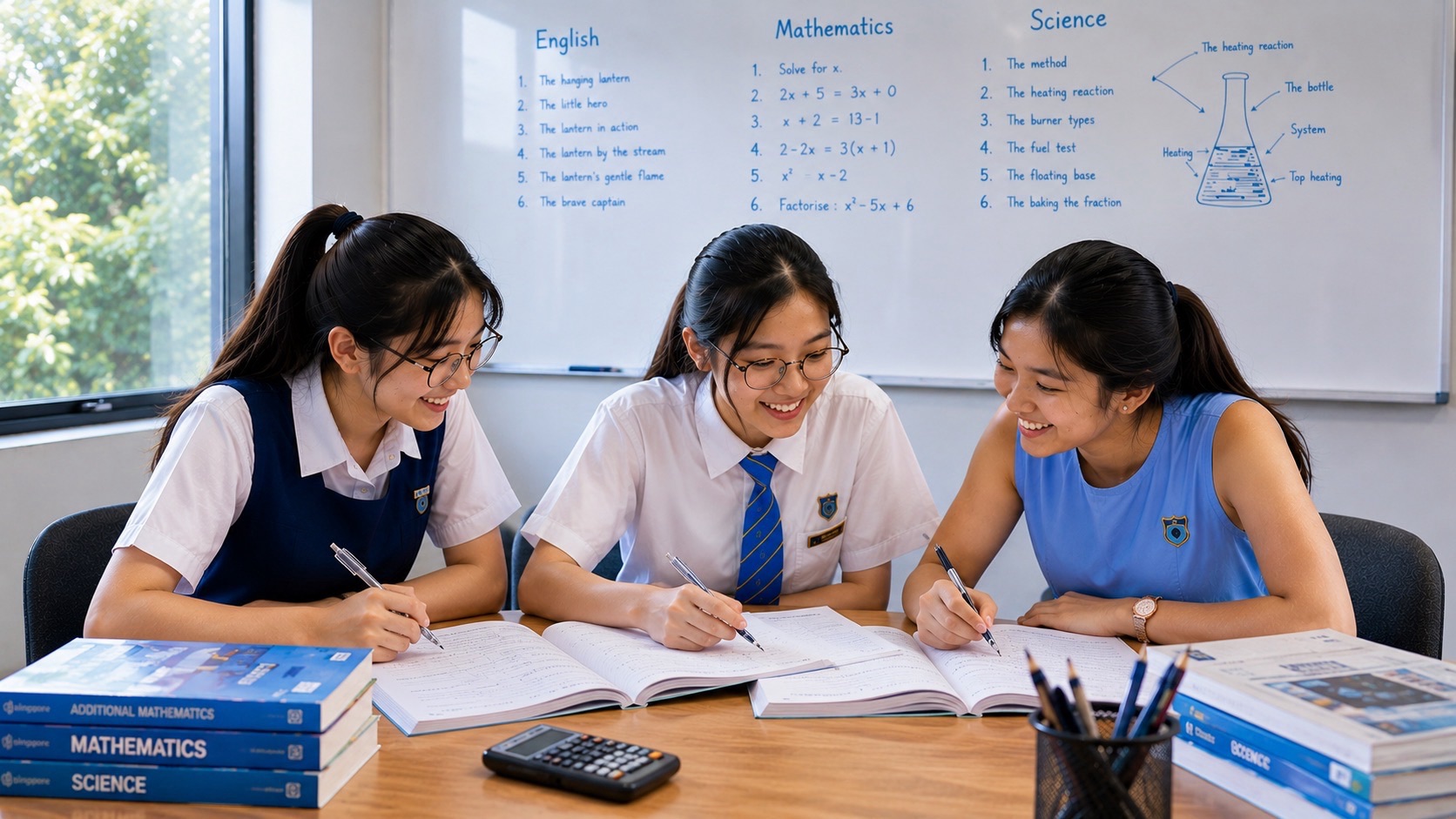
A Secondary school student begins a discussion essay with great confidence: “There are many advantages and disadvantages.” Three paragraphs later, the essay has dutifully mentioned the advantages, the disadvantages and the fact that everything has two sides. It sounds balanced. Yet the reader has learnt very little about the issue. For Bukit Timah parents looking for Secondary English discursive essay writing tuition, this is the problem worth solving.
The core aim of Bukit Timah English tuition for discursive writing is to teach students to explore a question thoughtfully, weigh relevant perspectives and explain why circumstances can change a judgement. Strong Secondary English essay writing does not mean mechanically alternating “for” and “against”. It means helping the reader understand the issue better by examining what matters, to whom and under which conditions.
The wonderful thing about this kind of writing is that curiosity becomes a practical skill. A pupil who asks, “When would this idea work, and when might it fail?” has already moved beyond memorised arguments. The challenge is to turn that curiosity into well-organised paragraphs, precise language and a conclusion that follows from the discussion.
Why “Advantages and Disadvantages” Is Not Enough
Consider the question: Discuss the benefits and challenges of students using digital devices for schoolwork.
A weak essay may say that devices are useful because they help students, then say they are harmful because they distract students. Both observations could be reasonable, but neither has been developed. Help how? Distract under what circumstances? Are all kinds of schoolwork affected equally?
A stronger discussion might distinguish shared writing documents from entertainment apps, quick information retrieval from careful research, and independent work from collaborative projects. It might explain that devices can support revision when students use them purposefully, while also creating distractions and unequal access if schools do not plan carefully.
The central skill is to move from broad labels to specific relationships. A discursive essay becomes worth reading when it explains the mechanisms behind the benefits and difficulties.
The Core Aim: Explore a Question without Losing Direction
A practical planning sequence is define → distinguish → examine → compare → conclude.
- Define: identify what the question asks and any limits on its scope.
- Distinguish: separate different groups, circumstances or meanings that affect the discussion.
- Examine: explain why each significant perspective has merit or limitations.
- Compare: weigh perspectives using meaningful criteria rather than counting points on each side.
- Conclude: draw a reasonable judgement or synthesis based on the discussion.
This is not a five-paragraph formula. Some essays need more comparison, while others need a careful distinction near the beginning. The sequence guides thinking rather than prescribing identical writing for every pupil.
A student should know why each paragraph exists. When they can explain how the next paragraph changes or deepens the discussion, the essay is beginning to have direction.
Argumentative and Discursive Writing Are Related but Different
A helpful distinction is that argumentative writing usually develops a position to persuade the reader, while discursive writing often explores a topic from relevant angles and weighs its complexities. There is overlap: a discursive essay can reach a reasoned judgement, and a good argument should recognise objections.
The difference is often visible in the task wording. “Do you agree that schools should remove homework?” invites a position. “Discuss the role of homework in students’ learning and well-being” invites broader examination of its purposes, benefits, limitations and circumstances.
A learner who treats every discussion question as a courtroom debate may sound combative when the task calls for exploration. A learner who treats every argumentative prompt as neutral pros and cons may never defend a position.
The question controls the writing. Our Secondary English argumentative essay writing guide focuses on claims, evidence, counterarguments and persuasion. This article focuses on balanced exploration and qualified judgement.
A Worked Question: Should Students Have More Independent Learning Time?
Imagine an original practice question: Discuss the value and possible difficulties of giving students more time to learn independently.
A generic opening says, “Independent learning is very important. There are advantages and disadvantages.” That is not grammatically wrong, but it gives the reader no idea of the actual tension.
A more useful opening is:
“Independent learning can allow students to follow questions at their own pace and take greater responsibility for their progress. Yet students do not all have the same experience, resources or confidence to work without guidance. Whether more independent study time is useful therefore depends on how that time is structured and supported.”
The opening defines the issue. It introduces benefits and limitations without declaring one simple answer for everyone.
The paragraphs can now examine what independence allows, when guidance is necessary, and how schools might combine the two.
Develop the Benefit by Explaining How It Works
A paragraph that says “Independent study promotes responsibility” is a beginning. To develop it, ask: What decisions does the student have to make?
For example:
“Independent study can help learners practise planning their own work. When students decide which topic needs attention, set a realistic goal and review the result, they take responsibility for more than completing assigned questions. This can make their learning process more visible to them. However, the benefit depends partly on whether they have enough guidance to judge what effective practice looks like.”
The explanation identifies a mechanism: planning, choosing, monitoring and reviewing. It also includes a relevant qualification. The paragraph is not weakened by recognising a condition; it is made more credible.
Develop the Difficulty without Attacking the Learner
An opposing paragraph might say, “Independent learning is bad because lazy students will not work.” That is unfairly broad. It treats pupils as one group and mistakes a possible outcome for a universal rule.
A better discussion identifies concrete obstacles:
“Some students may struggle to recognise their own misconceptions when working alone. A pupil can finish a worksheet believing an answer is correct without noticing a flawed explanation. Without useful feedback, repeated practice might reinforce the wrong method. Guided check-ins could therefore matter, especially for unfamiliar topics.”
The paragraph makes a fair criticism of unsupported independence while suggesting conditions that may reduce the problem.
The issue is not whether teachers are good and students are bad, or vice versa. It is which learning responsibilities students can manage and what kind of support makes success more likely.
Compare Perspectives Using Explicit Criteria
Students often write one benefit paragraph and one difficulty paragraph, then rush to the conclusion. The reader never learns how to weigh the two.
Useful criteria for this question include:
- Learning quality: does the approach help pupils recognise and correct misunderstandings?
- Accessibility: can students with different resources or confidence levels participate fairly?
- Feasibility: can school staff and families provide the guidance and time needed?
- Long-term value: does the arrangement help learners become more capable beyond one test?
The criteria should come from the issue. A discussion of public transport might instead compare cost, reliability, accessibility and environmental effects. Copying the same four criteria into every topic would be just another formula.
The central move is to compare views on a shared basis. “This side has three advantages and the other has two” is not a meaningful judgement.
A Qualified Conclusion Is Not Indecision
A weak conclusion says, “There are both good and bad points, so everyone has their own opinion.” It repeats the existence of disagreement but explains nothing.
A stronger conclusion might read:
“Giving students more opportunities to learn independently can be worthwhile when they have clear goals and access to feedback. Nevertheless, independence should develop progressively rather than replace appropriate teaching. The more useful question is how independent time and guided support can complement each other for learners at different stages.”
The conclusion synthesises the earlier discussion. It makes a judgement, identifies conditions and avoids pretending there is one perfect arrangement for every student.
A qualified conclusion is not indecisive. It is an answer that respects the complexity the writer has examined.
Distinct Discussion Points Beat Repetitive Paragraphs
A pupil might plan “saves time”, “works faster” and “increases efficiency” as three separate benefits. These may be variations of one idea rather than three meaningful perspectives.
Before drafting, give each body paragraph a short label. For the digital-device question, distinct perspectives might be:
- Learning access and convenience.
- Quality of attention and distraction.
- Collaboration and communication.
- Differences in access and support.
Now ask what each paragraph will reveal that the others do not. If two repeat the same mechanism, merge them or choose a new direction.
Discursive writing does not improve automatically with paragraph count. It improves when each paragraph deepens understanding.
Another Worked Example: Activities in Public Parks
Consider this practice question: Discuss the benefits and challenges of holding more community activities in public parks.
A superficial discussion says activities are fun but noisy. A more thoughtful essay examines social connection, shared access, maintenance, environmental protection and the needs of other park users.
For example, community events may create opportunities for neighbours who rarely meet to interact. Yet frequent large gatherings might make it difficult for visitors seeking quiet recreation to use the same space. The issue is not “people who like events against people who dislike fun”. It is how one public space meets different needs.
A useful paragraph may explore whether scheduling, suitable locations or appropriate event size could reduce conflict. These are possibilities for discussion, not proof that a particular policy always works.
A discursive essay becomes more interesting when the learner identifies the real tension rather than caricaturing the people who disagree.
Fairness Is an Academic Writing Skill
A mature student learns to describe another perspective accurately even when it is not their favourite. This requires reading, listening and intellectual generosity.
Try asking your child to state the strongest reasonable argument against an opinion they hold. Then ask: “Would someone with that different view recognise your explanation as fair?”
If not, the pupil may have created a weak version of another person’s position simply to dismiss it. This is often called a straw-man argument.
Fair discussion does not require agreement with every view. It requires accurately presenting plausible concerns before comparing their strengths and limitations.
This skill is useful in debates, school projects, group decisions and ordinary conversations.
Evidence, Examples and Fictional Statistics
Some students think an essay sounds sophisticated when it contains dramatic numbers or famous quotations. They may invent a survey, cite an unnamed expert or write a statistic that was never checked.
Avoid that. An imagined scenario can illustrate how something might happen, but it does not prove a general claim. A statement about actual research should be based on a genuine, appropriately interpreted source when research is available.
For independent learning, a student could describe a hypothetical pupil who identifies a weak Mathematics topic and plans extra revision. The example shows a possible mechanism. It does not establish that independent study raises everyone’s examination scores.
Teach the difference between possibility, observation and verified evidence. Careful qualifiers such as “may” and “under these circumstances” can improve accuracy when they reflect genuine uncertainty.
The strongest writer does not need to pretend to know more than they do.
Connectors Must Express Real Relationships
Many pupils learn lists of advanced connectors and then insert them automatically.
Furthermore introduces an additional point. However should introduce a real contrast. For example should lead to an illustration. Nevertheless can show that a point remains relevant despite a concession. Therefore should follow from the reasoning.
Ask students to remove the connector and explain the relationship in everyday language. If two statements do not genuinely contrast, the word however cannot make them opposite.
Our grammar and sentence accuracy guide
How an Ordinary Paragraph Becomes a Useful Discussion
Compare these two versions.
Basic: “Online learning is good because it is convenient. However, it is bad because students get distracted.”
Developed: “Online resources can make it easier for pupils to revisit an explanation after class, particularly when they need more time with an unfamiliar idea. Yet convenience does not guarantee effective learning. A student who switches repeatedly between lessons and entertainment may spend an hour online without giving the work sustained attention. The value of online learning therefore depends partly on how activities are designed and how the learner manages distractions.”
The second version is not stronger merely because it is longer. It distinguishes access to learning from quality of attention, then identifies a condition that affects the outcome.
A useful editing question is: What can the reader understand after this paragraph that they could not understand before?
If the paragraph adds nothing new, it needs clearer thinking, not just more adjectives.
The Purpose of a Discursive Introduction
Students sometimes write, “Since the beginning of time, mankind has debated technology.” The claim is sweeping, difficult to support and often unrelated to the precise task.
A useful introduction identifies the issue and explains why it deserves examination. It may define a term, describe a tension or identify two competing needs.
For the public-park question:
“Public parks are shared spaces that allow people to exercise, rest and spend time outdoors. Organised events can bring residents together, but they may also compete with other uses of the same area. Deciding whether parks should host more activities requires attention to both community participation and the needs of visitors seeking quieter recreation.”
The opening establishes the agenda without a dramatic quotation. The reader understands what the essay will examine, and the writer has a direction for the next paragraphs.
Discursive Writing and the 2027 SEC English Pathway
Discursive writing is a useful approach to suitable prompts that invite consideration of different perspectives. But families should not assume that every Secondary English assessment has a separately labelled “discursive essay” section.
In the official 2027 Singapore–Cambridge SEC G3 English Language syllabus K300, Paper 1 includes Continuous Writing, with candidates selecting one of four topics and writing 350–500 words. The syllabus states that topics may cover different kinds of writing, including narrative or argument.
A discursive approach may be helpful for a discussion-oriented question, but students must respond to the exact instruction and genre expectations rather than force every prompt into one structure.
The 2027 G2 and 2027 G1 English pathways have separate syllabus documents. G3 details should not automatically be applied to all subject levels.
What Secondary One and Two Students Should Learn
In Secondary One, begin with one clear issue and two genuinely different perspectives. A learner may discuss whether students benefit from joining school clubs, considering interests, responsibilities and schoolwork balance.
In Secondary Two, deepen the comparison. Can the pupil identify when a benefit might not appear? Can they distinguish a personal example from a general claim? Can they explain why different students may reasonably see the same issue differently?
The immediate goal is reliable paragraph development, not imitating an advanced examination essay. Good foundations give students room to write more mature pieces later.
The language should grow with the reasoning. A student who can explain a point clearly in plain English is ready to make it more precise, not simply longer.
What Secondary Three and Four Students Should Learn
Older students can practise topics involving real trade-offs: digital resources in schools, public-space use, study independence, community responsibilities or the role of technology in daily life.
They should learn to define the scope of a broad question, prioritise important considerations, use believable examples and compare perspectives without repeating the same claim.
A stronger student may also examine assumptions in the task. For instance, “Should technology replace traditional teaching methods?” assumes a clear division between “technology” and “traditional teaching”, when both may coexist in one lesson. Noticing that distinction can improve the entire essay.
Introduce timed drafting when the pupil has a workable plan and stable paragraph reasoning. Rushing an unclear argument usually creates longer versions of the same problems.
A Fifteen-Minute Home Practice Routine
Parents need not mark a full essay every evening. Try a short discussion exercise.
- Minutes one to three: identify the central question and define its important terms.
- Minutes four to six: list two distinct benefits and two genuine concerns.
- Minutes seven to nine: choose one criterion for weighing the views.
- Minutes ten to twelve: expand one point with a reason and plausible example.
- Minutes thirteen to fifteen: write a qualified conclusion that follows from the comparison.
A particularly useful parent question is: “Under what condition would you change your mind?” It encourages flexible reasoning rather than blind commitment to a first opinion.
If the pupil struggles to generate ideas, begin with a friendly spoken discussion. Once the reasoning is clear, write a paragraph. Good English tuition connects speaking, thinking and writing instead of treating them as isolated tasks.
How a Three-Student Tutorial Helps
Three students may all be told their essays lack depth. One repeats the same point in several paragraphs. Another has distinct ideas but organises them poorly. A third explores both sides fairly but never compares them.
The first needs help with distinctions; the second needs structure; the third needs criteria and a justified conclusion. Giving everyone the same model essay misses those differences.
At eduKateSG Bukit Timah English tuition, groups of up to three students allow a tutor to ask each learner why their points differ, whether their examples support the claim and what judgement follows from the discussion.
Students can hear alternative perspectives without copying one prescribed viewpoint. The objective is stronger reasoning expressed in their own language.
How Parents Can Measure Real Progress
Keep plans and paragraphs from several unfamiliar questions. Look for whether the student defines the issue, recognises relevant perspectives, explains reasons, compares them on sensible criteria and reaches a conclusion grounded in the essay.
Progress may appear as fewer vague claims, less repetition, better qualifiers and more relevant examples. A concise paragraph that explains a real distinction can be stronger than a page of generalities.
Ask your child to describe the main tension of an essay in one sentence. If they can do so clearly, they are more likely to write with direction rather than simply alternate sides.
The English Learning Hub connects essay writing to vocabulary, reading and sentence accuracy. The Bukit Timah tuition hub gives families the wider local school-year route.
Frequently Asked Questions about Discursive Essays
Must the essay give both sides equal space?
Not mechanically. Fair representation matters more than equal sentence counts. Give more attention to the most relevant points and explain why they matter to the question.
Can a discursive conclusion favour one view?
Yes, when the task permits a judgement and the conclusion follows from the comparison. A nuanced conclusion can recognise conditions while still explaining which approach is preferable in the situation discussed.
Is a fixed paragraph formula helpful?
A framework may help a learner organise thoughts, but it should not dictate identical wording or paragraph counts. Each paragraph needs a clear job in the discussion.
What if my child runs out of examples?
Start with a small, believable situation. Ask who is affected, what changes and what could go wrong. Clearly distinguish a hypothetical illustration from a verified fact.
Are discursive essays the same as argumentative essays in SEC English?
The skills overlap, but the required response depends on the actual question. The official G3 syllabus describes continuous writing topics covering different types, including narrative or argument; students should not assume a single formula applies to every prompt.
The Lasting Aim: Learning to Weigh Ideas
The most encouraging change in a discursive writing lesson is when a student stops treating uncertainty as weakness. They realise that a question can involve genuine benefits and costs, that circumstances change the comparison, and that mature writing explains those conditions instead of hiding them.
That is the core aim of Bukit Timah English tuition for Secondary discursive essay writing. A pupil who learns to represent viewpoints fairly, develop reasons clearly and draw proportionate conclusions has gained more than an examination technique. They are learning to think alongside others while retaining independence and clarity.