
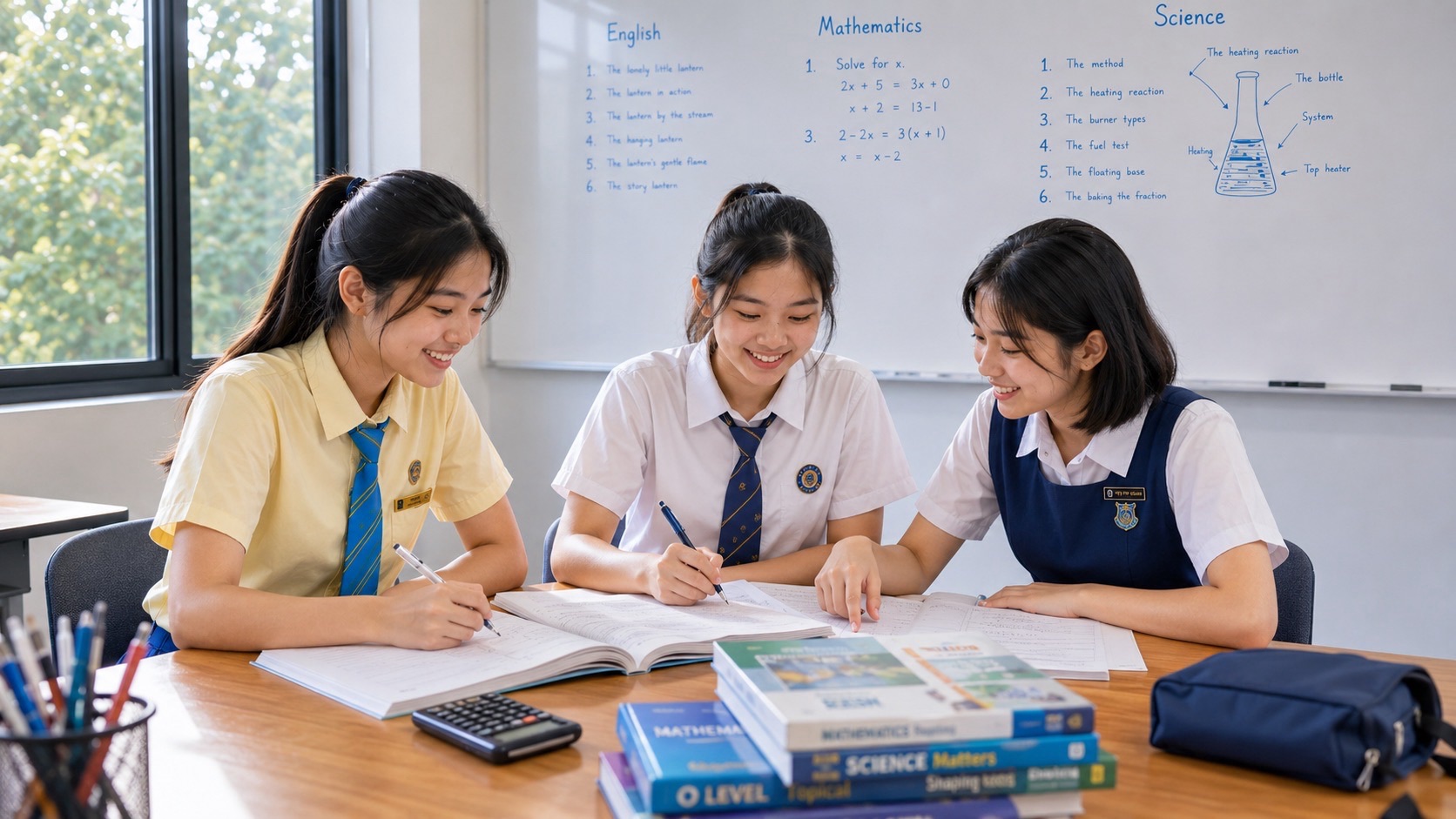
A Secondary 4 student can explain an electrical circuit beautifully on paper. Then the practical examination begins and a loose connection produces an unexpected meter reading. What matters now is not merely whether the student remembers the equation. Can they check the apparatus, make a reliable observation, record a table with units and explain why an odd result deserves investigation? That is where the experimental part of Science becomes real.
The core aim of Bukit Timah Secondary 4 G3 Combined Science tuition for the 2027 SEC practical examination is to help candidates prepare for Paper 5 Practical Test by learning safe experimental technique, accurate measurement, graph plotting, qualitative observations, conclusions and experiment improvements. In the 2027 Singapore-Cambridge Secondary Education Certificate, G3 Combined Science codes K326, K327 and K328 include a 1-hour-30-minute, 30-mark practical paper worth 15%. Strong SEC Science practical tuition teaches students to explain what the measurements support rather than memorise a single experiment and hope it reappears.
This article is a parent-first preparation roadmap for Secondary 4 students around Bukit Timah. We will establish the actual examination format, distinguish the Physics–Chemistry, Physics–Biology and Chemistry–Biology combinations, practise original numerical and observation tasks, and offer a twelve-week revision programme. All practical examples here are teaching illustrations, not leaked questions or promises about the experiments that will appear in 2027.
At a glance: the 2027 G3 Combined Science codes
- K326: Science (Physics, Chemistry), previously associated with reference code 5086.
- K327: Science (Physics, Biology), previously associated with reference code 5087.
- K328: Science (Chemistry, Biology), previously associated with reference code 5088.
- Shared assessment: candidates sit Paper 1, Paper 5 and the two relevant subject theory papers.
- Practical Paper 5: 1 hour 30 minutes, 30 marks, contributing 15% of the subject grade.
- Crucial check: revise the two sciences actually registered; the examination combination determines which practical tasks may be relevant.
The SEAB 2027 G3 school-candidate syllabuses and official K326–K328 Science syllabus are the controlling references for these published 2027 details. A candidate taking a later year’s examination should check the updated year-specific documents, even where the general course name remains unchanged.
The actual G3 Combined Science assessment structure
In the 2027 scheme, Paper 1 contains 40 compulsory multiple-choice questions, lasts 1 hour and carries 40 marks worth 20%. The candidate then takes two relevant structured and free-response theory papers, one for each registered science. Each theory paper lasts 1 hour 15 minutes, carries 65 marks and contributes 32.5%.
The subject theory papers are Paper 2 Physics, Paper 3 Chemistry and Paper 4 Biology. For K326, take Papers 2 and 3. For K327, take Papers 2 and 4. For K328, take Papers 3 and 4. All three combinations take Paper 1 and the 30-mark Paper 5 practical test.
The practical paper is not a fifth subject. It assesses hands-on and investigative skills in the two science disciplines comprising the candidate’s Combined Science subject. The number of practical questions may vary within the description in the syllabus, so do not treat one past practice layout as a guaranteed exam blueprint.
What Paper 5 actually tests
The official syllabus lists experimental skills and investigations: following instructions, using apparatus and materials, making and recording observations and estimates, interpreting and evaluating results, planning investigations, and suggesting improvements. These skills are distinct but connected.
A student can read a thermometer correctly and still produce a weak conclusion. Another may know the expected scientific relationship but fail to zero a balance or label the graph axes. Good practical tuition diagnoses which stage failed: procedure, measurement, recording, inference or evaluation.
The syllabus also specifies that a modification or extension may be requested in one or more practical questions without requiring the candidate to carry it out. Depending on the setting, this element contributes 10–20% of the available practical marks. That makes explaining improvements an assessable skill, not optional decoration.
The practical paper is 15%, but practical understanding helps theory too
The 2027 syllabus allocates 15% directly to Paper 5. Yet experimental reasoning also supports data-based and investigation-style questions in theory papers. Learning to read uncertainty, identify controls and explain a surprising result therefore benefits more than one part of Science.
The distinction is important for revision planning. A parent should not divide preparation into “theory as serious work” and “practical as an occasional extra.” The two rely on the same scientific habits, expressed in different environments.
The eduKateSG Science Process Skills and Fair Tests guide develops this shared reasoning; the present article concentrates on the 2027 G3 SEC practical setup and subject-specific expectations.
How the three combinations affect practical preparation
K326: Physics and Chemistry
A K326 candidate needs skills relevant to Physics and Chemistry: for example, accurate electrical or thermal measurement and observation of a chemical change, reaction rate or appropriate qualitative test. The exact live practical is not known in advance to this guide. The priority is transferable scientific technique across both subjects.
K327: Physics and Biology
A K327 candidate needs Physics measurement and biological investigation skills. They may be asked to interpret observations involving living systems or biological material, but school-approved practical methods and the actual syllabus determine appropriate expectations. Paper 5 is common in form but not identical in subject content to K326.
K328: Chemistry and Biology
A K328 candidate combines Chemistry observation and measurements with Biology practical skills. The Chemistry and Biology practical components follow the relevant syllabus sections. Physics-only practical revision is not the same priority for K328 as for a candidate registered for K326 or K327.
The official practical description says Physics question(s) are common to K326 and K327, Chemistry question(s) to K326 and K328, and Biology question(s) to K327 and K328. This is an especially useful fact when selecting format-matched school practice.
Practical skill 1: read before touching
The first task is to understand the procedure and the question’s requested output. Is the candidate supposed to measure a temperature at fixed intervals, vary a length, record a gas observation or produce a graph? What is the independent variable? What counts as a completed reading?
A student who rushes to assemble apparatus can miss a fixed starting condition or skip a measurement. A correct setup with incomplete observations may be less useful than an ordinary setup whose data are complete and accurate. The practical method has to serve a defined question.
Some instructions concern safety, including chemical handling, electrical ratings or sharp tools. These must take precedence over speed. Never attempt to improvise examination practicals with household mains electricity, hazardous reagents or unsupervised heat.
Practical skill 2: accuracy, units and recording
A numerical observation should include the physical quantity and correct unit. If a ruler shows centimetres, a thermometer Celsius and a digital balance grams, the pupil should not swap the units simply because the numbers look similar. A table heading such as Time / s or Temperature / °C is clearer than “time” or “reading.”
The scale’s interval matters. A measuring instrument with marks every 0.5 cm cannot reasonably support a string of arbitrary digits. For suitable analog readings, estimate within the precision supported by the method and follow the practical question’s specified recording convention.
The broader Laboratory Safety, SI Units and Measurement guide is a useful prerequisite if the child makes repeated ruler, meniscus or parallax mistakes.
Worked example 1: a temperature table
Original teaching data: A liquid cools from 70 °C at 0 minutes to 64 °C at 2 minutes, 59 °C at 4 minutes and 55 °C at 6 minutes. A correct results table labels time and temperature, and a graph places the quantities on properly identified axes as instructed.
Over the first six minutes, the recorded temperature decreases by 15 °C. The graph supports a cooling trend within the observed interval, but the student should not claim that the temperature will continue dropping at exactly the same rate for the next two hours without further information.
Worked example 2: measuring the change, not just the endpoint
Original scenario: A displacement experiment starts with 32 mL of water and ends at 47 mL when a suitable fully submerged solid is added. The displaced volume is 15 mL, equivalent to 15 cm³ under appropriate conditions.
Writing “47 cm³” as the object’s volume confuses the final container reading with the increase. In a real practical, the object must be fully submerged without problematic trapped air or material dissolving. The method’s assumptions matter alongside the subtraction.
Practical skill 3: graphs with meaning
The graph’s horizontal and vertical axes must name quantities and units. Scale intervals should be consistent, plotted points should correspond to the actual data, and any best-fit representation should respect the supplied instructions. A neat curve that ignores a measured point is not scientifically better merely because it looks smooth.
Before plotting, ask whether the independent variable is time, length, concentration or temperature. Determine what the gradient means in that particular graph. A current–potential difference graph is not automatically interpreted in the same way as a force–extension graph merely because both rise.
A pupil should avoid drawing a misleading straight line through data that clearly show another pattern, and should know when additional readings would help establish the trend. Science prizes defensible representation over artistic neatness.
Worked example 3: an electrical graph
Original hypothetical measurements: A suitable ohmic component produces readings of 1.0 V at 0.20 A, 2.0 V at 0.40 A and 3.0 V at 0.60 A under matched conditions. The data are consistent with a linear relationship over the tested range.
If voltage is plotted against current, the gradient is resistance and equals 5 Ω in this example. The pupil should name the two axes before making that calculation. Reversing the axes changes what the numerical gradient represents.
Worked example 4: a spring investigation
Original data: An unloaded spring has length 10.0 cm. With two successive suitable loads, its lengths become 12.0 cm and 14.0 cm. The corresponding extensions are 2.0 cm and 4.0 cm.
The mistake to watch is using total length in place of extension. In a practical, measurements should be made with the ruler properly aligned and spring oscillation settled as instructed. Do not overload springs beyond the safe range.
Practical skill 4: distinguish observation from conclusion
A student sees a white precipitate appear after two solutions are combined in a school chemistry exercise. That is an observation. Identifying a particular ion or chemical product is an inference requiring the appropriate test information and chemical context.
Similarly, “the water changed from 60 °C to 55 °C” is an observation. “The insulating sleeve slowed cooling” is a conclusion supported only when relevant conditions are controlled and compared. Strong practical answers keep the distinction clear.
An error log should preserve the learner’s original words so that the tutor can identify whether the misunderstanding concerns the chemical identity, a graph reading or an overly broad inference.
Worked example 5: a gas is seen
Original scenario: A reaction produces visible bubbles, and the learner writes “oxygen was formed.” Does the observation prove the gas identity? No. Gas release is observed, but the identity needs a suitable test or explicit reaction information.
This is a high-value general lesson. Several different gases can form in chemistry experiments, and boiling can also produce bubbles without a chemical reaction. Do not infer identity from bubbles alone.
The Physics practical route
The 2027 syllabus gives examples of Physics practical experiences, including measurement of physical quantities, thermal investigations, electrical circuits, force or motion relationships, and ray investigations. The syllabus states that its lists are not exhaustive. Therefore, tutors should build competence with methods rather than promise that a single experiment will recur.
Relevant apparatus can include low-voltage cells, ammeters, voltmeters, resistors, rulers, springs, balances, thermometers, ray-tracing equipment and suitable clamps. Students should use the apparatus as instructed, maintain safe circuit limits and record measurements appropriately.
The skill is portable across devices. A pupil who can detect a loose connection in an electrical circuit or a ruler’s misplaced zero mark is developing a method, not memorising a one-off practical performance.
Worked example 6: meter placement
Original question: A lamp’s current must be measured and the potential difference across the lamp recorded. The ammeter belongs in series with the relevant current path, while the voltmeter connects across the lamp.
If an ammeter is placed directly across a battery without suitable current limiting, the arrangement can be unsafe. A pupil should identify the danger from a diagram. Any physical circuit work must use rated educational supplies under qualified supervision.
Worked example 7: reflected or refracted light
Original task: A simple ray experiment uses a transparent rectangular glass block and suitable pins or other approved markers to observe a changed path. The student should trace the incident and emergent directions carefully, use the surface normal where needed and explain the evidence for refraction.
The figure should not be treated as accurate merely because the pencil lines are straight. Parallax, marker position and drawing thickness can affect the result. A tutor can use a prepared diagram to practise these reasoning points without attempting an unsupervised optics setup.
Worked example 8: a temperature experiment with poor controls
Original scenario: Two cups cool under different room conditions, and one is insulated. If the surrounding airflow and starting temperatures also differ, the experiment cannot isolate the insulating effect cleanly.
The appropriate correction is to keep relevant conditions comparable and specify what is measured at matching times. A good practical answer identifies the actual uncontrolled factors rather than writing the vague phrase “human error.”
The Chemistry practical route
The 2027 Chemistry practical notes cover examples of quantitative work with pipettes and burettes, reaction rates, temperature measurement, investigatory exercises, paper chromatography, filtration and qualitative inorganic analysis. The list is guidance rather than a prediction of the exact paper.
Candidates should be familiar with observing appropriate precipitates, gas-test evidence and supplied qualitative-analysis information. The syllabus states that candidates are not required to carry out tests involving sulfur dioxide or describe methods for preparing salts in the specified practical context.
These processes can involve hazardous chemicals and precise apparatus. They belong in school laboratories with proper risk assessment and trained supervision. Tuition can teach procedures, calculations, safety and interpreting observations using diagrams and recorded data without creating unsafe home experiments.
Worked example 9: burette readings
Original teaching data: An initial burette reading is 1.15 cm³ and the final reading is 24.65 cm³. The volume delivered is 23.50 cm³. The calculation uses final minus initial, not the reverse.
The 2027 Chemistry practical notes state that burette readings should normally be recorded to the nearest 0.05 cm³. The pupil should read the instrument correctly, report with suitable precision and keep the calculation consistent with the actual apparatus.
A classroom practice question should distinguish the volume dispensed from the number at the bottom of the scale. It should not claim that every titration must end at one fixed reading.
Worked example 10: concordant results
Original measurements: A suitably controlled titration trial gives titres of 23.45, 23.50 and 23.90 cm³. The first two are close, while the third is noticeably higher. A student should consider the school’s concordance criterion and the procedure before deciding which readings to use in an average.
The published notes illustrate carrying out enough titrations to obtain close titres, for example within 0.20 cm³ when the end point is good. This does not mean randomly deleting a result to improve a desired answer; a sound laboratory procedure and clear reporting remain necessary.
Worked example 11: chromatography observations
Original scenario: A spot of mixed ink separates into multiple visible bands or spots on suitable chromatography paper as a solvent travels. The observation suggests more than one component with differing interactions under the selected conditions.
A chromatogram does not prove every possible dissolved impurity has been detected, and the separation may depend on solvent selection and detection method. The student should report which coloured spots were actually observed before making further claims.
Worked example 12: qualitative analysis
Original scenario: A reagent is added to a solution and a coloured precipitate appears. A useful answer records the colour, whether the precipitate forms or dissolves under stated additions, and what the official qualitative-analysis information supports.
The student should not guess a metal ion from a single colour when multiple candidates or interferences are possible. Follow the tests and named ions specified in the syllabus, and avoid claiming knowledge of a test that was not supplied.
The Biology practical route
Biology practical work can involve observing biological specimens, recording measurements, making drawings, and assessing investigations of life processes. The exact tasks are constrained by the syllabus and laboratory arrangements, and students must follow their school’s approved apparatus and safety procedures.
A learner should be capable of distinguishing a biological observation from a conclusion about an unseen mechanism. A small change in mass, length, colour or rate may support an explanation only when the procedure and controls provide the relevant evidence.
The school practical aim is not to memorise a particular potato-strip or plant-stalk diagram. It is to understand how a biological investigation is designed, measured and evaluated.
Worked example 13: osmosis and tissue mass
Original hypothetical data: A suitable plant tissue specimen has initial mass 5.00 g and final mass 5.40 g after immersion in a specified solution. The percentage change is [(5.40 − 5.00)/5.00] × 100 = 8%.
The mathematical result is a mass increase. A biological explanation involving osmosis must consider the tissue and solution conditions provided. The graph and observations alone do not identify every cell-level pathway without the experimental context.
Worked example 14: an enzyme-temperature investigation
Original scenario: An experiment records enzyme activity at several temperatures and shows a higher rate over one interval followed by a sharp fall at more extreme temperatures. Describe the data before explaining that very high temperatures can disrupt enzyme structure and function.
A child who answers “higher temperature always increases enzyme activity” has memorised only one part of a curve. The correct model must fit the entire tested temperature range and avoid inventing a precise optimum outside the supplied data.
Worked example 15: drawing from a microscope
Original scenario: A student is asked to draw a biological structure observed under a microscope. A scientifically useful drawing records relevant shapes, clear label lines and the structures actually visible or justified by the specimen.
The pupil should not add a nucleus, vacuole or chloroplast merely because the textbook’s idealised cell cartoon includes one. Observed material, preparation and microscope resolution determine what can responsibly be shown.
A practical-planning question: modification and extension
A candidate may be asked how to improve an experiment that uses just two readings to claim a precise trend. A reasonable modification may be to take more suitable readings across the relevant variable range, repeat comparable trials or control an additional important influence, with a clear explanation of why it improves reliability.
Do not propose an improvement without linking it to the actual error. “Repeat three times” may reduce the effect of random variation, but it does not repair a balance that was never zeroed or a confounding change in temperature. The best answer names the limitation and explains how the proposed modification addresses it.
This is the critical difference between a memorised planning phrase and evidence-based experimental evaluation.
Worked example 16: a flawed density test
Original scenario: Two irregular solids are compared, but one traps air bubbles during displacement and the other does not. A student concludes the first material has lower density. The trapped air may distort its measured displaced volume, so the conclusion requires method correction.
A suitable modification is to ensure proper submersion without trapped bubbles using school-approved procedures, then take valid readings. Merely repeating the flawed setup does not remove the systematic problem.
Worked example 17: insufficient sampling range
Original scenario: A graph of reaction rate against temperature uses only two measurements. The student claims the rate always increases at every temperature. A stronger response is that only the trend between the two tested conditions is supported. Additional controlled measurements over a wider safe range would be needed to assess the broader relationship.
This is a planning response: it identifies a limitation, suggests an extension and explains what new evidence the extension would provide. It does not pretend the examiner has already measured those untested values.
How to write a clear practical results table
- Name the changed variable and record the appropriate units in the column heading.
- Name the measured result and record its unit separately.
- Use a consistent reading convention that matches the instrument.
- Leave enough space to show all intended trials without overwriting numbers.
- Record observations faithfully, including unusual results.
- Distinguish raw measurements from derived calculations.
- Use the actual question’s instructions for significant figures, averages and graph plotting.
A tidy table is helpful, but visual neatness is not the same as scientific validity. A table with accurate headings and units is more useful than a perfectly ruled grid of mislabelled measurements.
Graph plotting: a checklist under exam conditions
- Read the task to determine which variable is on each axis.
- Choose a scale that uses the available graph space effectively and is easy to read.
- Label axes with both quantity and unit.
- Plot each supplied point accurately.
- Use an appropriate line or curve as the task instructs.
- If a gradient is requested, select a suitable interval and show calculation steps.
- Do not use an unexplained extrapolation as evidence for unmeasured conditions.
An error of one square can sometimes change a result, but the more general issue is understanding the physical meaning of the graph. A good tutor trains both: accurate plotting and scientifically meaningful interpretation.
The six major practical-error categories
- Safety and procedure: skipped instructions, incorrect apparatus or hazardous handling.
- Measurement: parallax, incorrect instrument range, unzeroed apparatus or units.
- Recording: incomplete table, reversed readings or inconsistent decimal places.
- Representation: graph scale, wrong axis or incorrectly drawn specimen.
- Scientific inference: overclaiming from observations or confusing what was measured.
- Evaluation and planning: improvements unrelated to the actual limitation or lacking a clear reason.
If the same pupil repeatedly makes graph-scale errors, another chemical-reaction note may not help. If the pupil observes a precipitate correctly but names an ion without evidence, the next step is qualitative-analysis reasoning. Tuition should respond to the cause, not only the total mark.
A twelve-week 2027 G3 Combined Science practical roadmap
Week 1: diagnose across the two registered sciences
Check the student’s precise combination—K326, K327 or K328—then review recent laboratory work, teacher feedback and one short paper-based practical task from each component. Record errors by safety, measurement, reporting, interpretation and evaluation.
Week 2: measurements, units and instruments
Practise ruler, balance, thermometer, burette or electrical meter skills according to the relevant sciences. Ask for final-minus-initial calculations and correct units. Use approved lab access for physical practice.
Week 3: tables and graph accuracy
Introduce consistent headings, axis labels, suitable scales and graph plotting. Give one intentionally flawed graph and ask the pupil to identify the scientific and mathematical problems.
Week 4: Physics or the first relevant discipline
For combinations containing Physics, practise circuit observations, forces, temperature or light-path measurements under school supervision or with paper data. For K328, use an appropriate Chemistry or Biology task instead.
Week 5: Chemistry or the next relevant discipline
For combinations containing Chemistry, practise interpreting qualitative observations, titration tables and separation or reaction-rate data. Avoid any unsupervised chemical handling. For K327, substitute course-matched Biology tasks.
Week 6: Biology or a second-stage investigation
For combinations containing Biology, practise biological observations, drawing, comparisons or appropriate data from enzyme and osmosis investigations. For K326, continue with a suitable Physics and Chemistry integration exercise.
Week 7: errors and experimental limitations
Present a table with an anomalous reading or an experiment with an uncontrolled factor. Ask which correction genuinely addresses the problem. Distinguish random variation from systematic errors.
Week 8: planning and modification
Give an original question asking the pupil to extend an investigation. A strong answer names a variable range, practical control or repeat procedure and explains how it improves the evidence.
Week 9: mixed practical simulation
Use an authorised school or centre practical session across the two relevant sciences if available, following actual safety procedures. Otherwise use clearly labelled simulated data rather than pretend that paper alone develops every manual skill.
Week 10: combine speed and correctness
Review time use on measurements, calculations, graphs and written evaluations. Do not reward rushing that produces unreliable observations. Allocate attention based on the actual question’s demands, not a universal time-per-mark promise.
Week 11: revisit persistent mistakes
Choose two recurring causes, such as burette readings and graph gradients or microscope observation and evidence-based conclusion. Present changed-context questions after a delay.
Week 12: consolidate, check safety and rest
Review safe procedures, standard measurement conventions, common unit conversions, observation vocabulary and graph checks. Use short mixed retrieval and avoid exhausting late-night laboratory practice. Check the official examination instructions relevant to the student’s actual sitting.
A 20-minute home session that needs no hazardous apparatus
- Identify the two sciences in the student’s actual SEC combination.
- Read one measurement scale and record the correct unit.
- Compute a final-minus-initial burette or measuring-cylinder change.
- Plot or interpret a short data table.
- Separate an observation from a chemical or biological inference.
- Suggest one modification that addresses a stated experimental weakness.
- Finish with a changed-context question from the other science in the combination.
Home revision can be safe and effective for planning, interpretation and calculations. Actual manipulation with chemicals, flames, sharp biological equipment or electrical supplies must be supervised by appropriately trained staff using authorised facilities. A confident student should know when a practical is not safe to attempt.
Ten original Practical Paper 5 practice questions
- A burette initially reads 0.85 cm³ and finally 22.35 cm³. What volume was delivered?
- Which instrument would measure the current through a suitable low-voltage lamp?
- Why must the ammeter be connected in series rather than across the cell?
- A plant tissue sample increases from 4.00 g to 4.24 g. What is the percentage mass change?
- A temperature–time table shows cooling. What should be on the graph axes?
- Why does a cloudy precipitate not alone prove an exact ion identity?
- Why is a final liquid volume not the same as an object’s displaced volume?
- What is a meaningful improvement for a test where temperature and concentration both change?
- Why does repeating a wrongly calibrated measurement not remove its systematic bias?
- How can a candidate explain the purpose of a proposed experiment extension without having to carry it out?
These are original teaching questions, not past or future SEAB practical questions. The most valuable correction is often a short explanation of why a method or inference was wrong. Families should use subject-specific school practicals where authorised and available.
The practical examiner is interested in a decision, not a perfect-looking table
A beautifully ruled table is useful only when its headings, units and readings actually answer the investigation. For example, a candidate who records a sequence of liquid temperatures must distinguish the observed temperature from a claim about total thermal energy. A fall in temperature can be measured directly; the amount of energy transferred depends on other physical information such as the sample’s mass and properties.
In Physics, a graph must use meaningful axes and scales. In Chemistry, an observation should describe what appeared after a suitable reagent rather than guess a product from its colour. In Biology, counting seed germination and measuring plant height are different response variables. These examples share an important principle: define the scientific quantity before collecting or reporting the result.
A Physics practical clinic: gradients and sources of error
Original scenario: A pupil records the total length of a spring for different loads, then constructs a graph titled “Extension versus Load”. The vertical entries are actually total length, not extension. The graph may look plausible, but its title and data disagree. A specific correction is to subtract the original unloaded length from each observation before plotting extension.
If the school task instead asks for total length, that subtraction may not be required. The tutor should teach the pupil to read the question and define the quantity rather than apply one ritual to every spring problem. Similarly, a ruler positioned with the start of the sample beyond the zero mark may need two scale readings and subtraction. Repeating the same biased setup many times does not automatically remove that offset.
A second issue is graph scaling. If observations range only between 11 cm and 16 cm, a student should choose sensible axis intervals that display the trend without distorting it. A line drawn by eye between scattered points is not always the same as a scientifically justified best-fit line, and an extrapolation far beyond the measured range may be unsupported.
A Chemistry practical clinic: observations versus deductions
Original scenario: A reagent produces a precipitate in a solution, but the student writes only “reaction occurred”. A stronger record describes the precipitate’s appearance under the stated conditions, then connects it to a suitable chemical inference if the test method supports one. The distinction between observation and deduction is important whenever several chemical substances could produce superficially similar results.
An unknown gas may produce bubbles without being identifiable from the bubbles alone. Where gas tests are assessed, use the prescribed safe school techniques and the specific observation needed to support a conclusion. A pupil should not claim that the gas was hydrogen simply because it was colourless. This is a limitation of evidence, not an invitation to invent additional tests at home.
The tutor can help with short, precise sentences: “A white precipitate formed” is an observation, while a statement naming a possible ion is an inference requiring the correct context. A good correction explains which additional stated results justify the chemical conclusion.
A Biology practical clinic: a changing condition has to be isolated
Original scenario: One batch of seedlings receives more light and water, while a second batch receives less of both. After a week, the first group grows taller. The observation is real within the hypothetical experiment, but the design cannot establish that light alone caused the difference. Water availability is an alternative explanation because it also changed.
A specific improvement is to maintain comparable water availability, plant type, growing medium and other relevant conditions while varying the intended light condition. The measured outcome must also be defined: seedling height, number of leaves and number of seeds germinated are different variables and should not be swapped without explanation.
When a student says “use more plants,” ask why. A larger sample may reduce the influence of one atypical specimen, but it does not fix a design where two factors are changed together. Appropriate improvement follows the actual weakness.
The practical’s proposed modification or extension
The published 2027 G3 Combined Science syllabus allows a question to ask for a modification or extension that does not need to be carried out. A modification might improve the reliability of the present comparison, such as measuring from a consistent starting mark or improving control of temperature. An extension might test a related scientific question using a different range or condition, while maintaining a clear outcome measure.
A student should say what is changed, what will be measured and how other relevant factors are controlled. “Repeat with better equipment” is too vague; “use a measuring cylinder with finer graduations to improve the resolution of the volume reading” is more specific when resolution is the identified issue. The improvement must be appropriate to the experiment and safety constraints.
The 10–20% figure for this element refers to its possible share within the practical paper, not an extra percentage added to the overall SEC grade. Distinguishing a proportion of a paper from a proportion of the whole subject is another useful numeracy habit.
Exam preparation should distinguish fluency from recognition
A pupil may recognise the correct circuit when the tutor draws it and still be unable to construct a complete route in a fresh diagram. Another may understand an experimental improvement after reading the model answer but fail to propose one for a different apparatus. The tutoring solution is to remove the prompt and ask for a new representation after a gap.
Build retrieval into each week. Start with one older concept, attempt a changed question independently and then inspect the reason for an error. Mix the registered science components gradually so the student learns when to use a physical model, a chemical relationship or a biological explanation.
Practice timed sections only when the student’s reasoning is reliable enough for the timer to be informative. If a child runs out of time because they keep re-solving a familiar calculation incorrectly, repairing the calculation method may be more useful than forcing another full mock.
What an evidence-based progress report should contain
Parents can reasonably ask for three examples: an original incorrect answer with the student’s reasoning, a corrected version showing what was taught, and an independent response to a different question later. For practical skills, include evidence of safe instrument use or analysis from supervised school work when available. The report should name the remaining limitation rather than promise a specific examination grade.
For example, “now reads a thermometer scale accurately; still overstates conclusions from uncontrolled comparisons” is useful. So is “can draw a correct Physics circuit but needs practice identifying which measurement the voltmeter displays”. These observations explain the next tutoring action and help make limited revision time count.
A realistic weekly schedule protects rest and other subjects. One small data-analysis task, one practical-method question and a few mixed-content problems can be more useful than repeated papers completed without understanding. The value of the three-pupil format lies in correct individual feedback, not the sheer volume of work assigned.
Frequently asked questions
What is the 2027 SEC G3 Combined Science Paper 5 weight?
15% of the subject grade. The official assessment gives Paper 5 30 marks and 1 hour 30 minutes.
What are the G3 Combined Science codes?
K326 is Physics/Chemistry; K327 Physics/Biology; K328 Chemistry/Biology. These replace the previous 5086, 5087 and 5088 references.
How many papers do candidates take?
Paper 1, the relevant two theory papers among Papers 2–4, and Paper 5 practical.
How long is the multiple-choice paper?
Paper 1 lasts one hour and consists of 40 compulsory multiple-choice questions worth 40 marks and 20%.
How much does each subject theory paper count?
Each relevant theory paper is 65 marks, 1 hour 15 minutes and 32.5% of the overall subject.
Is Paper 5 the same for every combination?
The assessment format is shared, but the practical science content follows the two subjects the candidate has registered.
What practical-planning element can appear?
The published syllabus permits a proposed modification or extension that need not be executed, worth about 10–20% of available practical marks depending on the context.
Are Chemistry practical notes provided?
The syllabus specifies that Chemistry Practical Notes are included in the question paper where applicable; candidates cannot otherwise consult their own notebooks or textbooks.
Can a pupil prepare only by reading practical notes?
Reading helps conceptual understanding, but actual apparatus handling, safe technique and observation skills need appropriate supervised practice.
How does G3 Combined Science practical differ from pure Chemistry or Physics practical?
Combined Science uses a shared 30-mark 90-minute Paper 5 worth 15%, while the separate G3 science subjects have their own 40-mark practical papers worth 20% in their published 2027 schemes.
Continue within the eduKateSG SEC Science series
For the previous-year foundation, start at Secondary 3 G2 Combined Science and SEC 2027 or G1 Science and K123 when that is the learner’s actual course. For subject selection, use Pure Science versus Combined Science. Practical prerequisites appear in Laboratory Safety and Measurement and Science Process Skills and Fair Tests.
The immutable eduKateSG tutorial reference describes premium three-pupil sessions near Sixth Avenue MRT, weekly 1.5-hour lessons and close individual feedback. For practical preparation, that design is valuable when a tutor can distinguish one student’s apparatus error, another’s graph-reading issue and a third’s unsupported conclusion—and assign a precise next task to each. It does not replace the need for school-supervised laboratory experience.
A strong practical candidate does not need to predict the secret contents of Paper 5. The real achievement is more durable: they can follow instructions safely, make trustworthy measurements, represent results clearly and explain what the evidence means. That is the core aim of excellent Bukit Timah Secondary 4 Science tuition.