
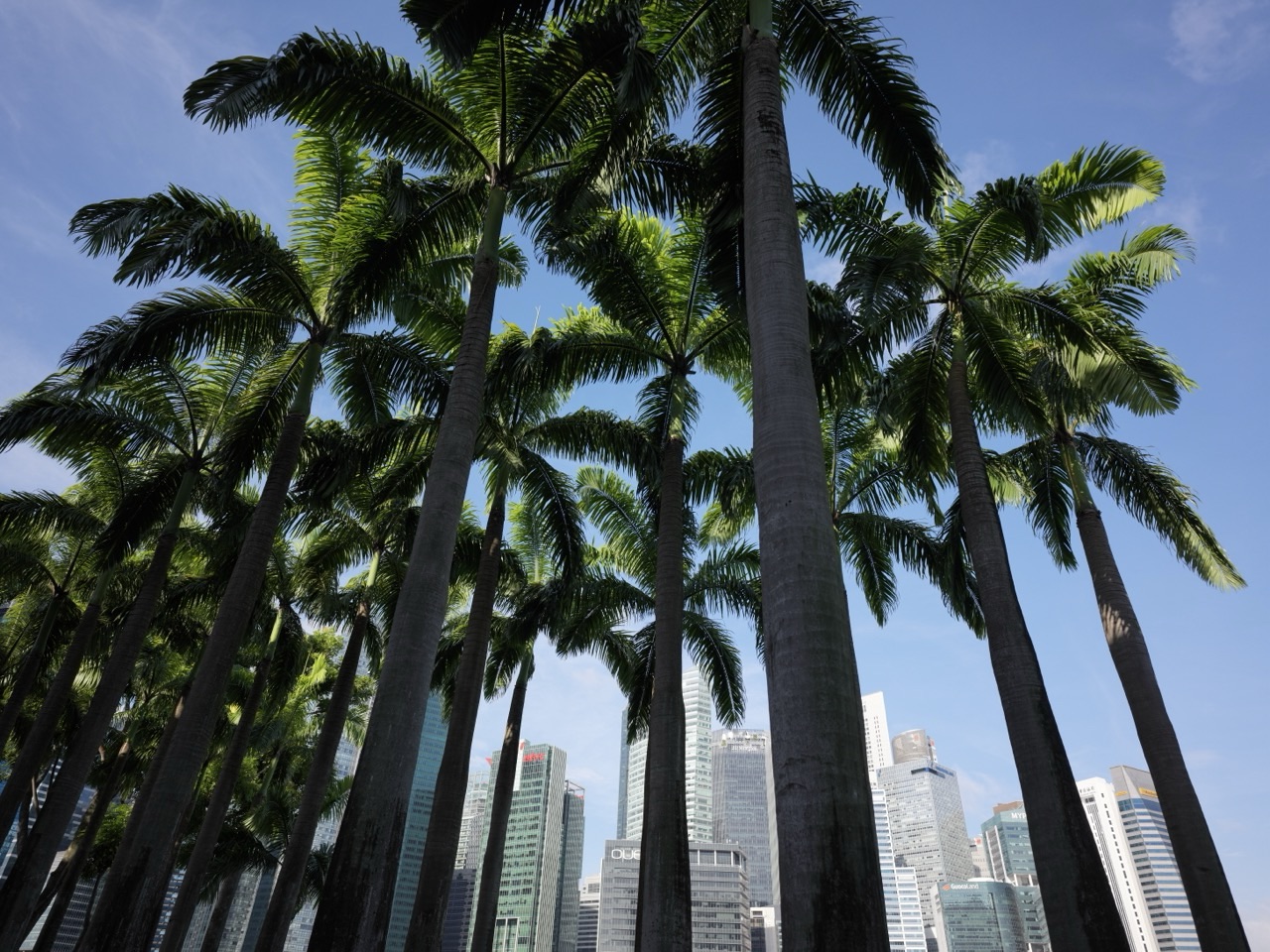
Crazy Rich Singapore | Satellites, Earth Observation and the Space Economy begins with a wonderfully Singaporean contradiction: a tiny country building an industry for a place with almost no land at all.
Did you know Singapore’s space ecosystem now includes about 70 companies and around 2,000 professionals and researchers? In April 2026, Singapore also established the National Space Agency of Singapore, or NSAS, taking over the mandate of the Office for Space Technology & Industry and signalling a bigger national ambition in space.
That makes “Singapore space industry”, “satellite Singapore”, “Earth observation Singapore”, “space technology Singapore” and “NSAS Singapore” powerful search themes. The Crazy Rich story is not rockets launching from Marina Bay. It is Singapore using strengths in microelectronics, precision engineering, communications, data and research to participate in the global space economy from Earth.
Crazy Rich Singapore can look down from orbit.
Did You Know? Singapore’s Space Economy Is Mostly Not About Launching Rockets
When people hear “space industry”, they often imagine launch vehicles.
Singapore’s competitive position is broader and, in many ways, more practical.
- satellite components;
- small-satellite engineering;
- communications;
- Earth observation;
- ground systems;
- data analytics;
- remote sensing;
- satellite operators; and
- space-enabled services.
That means Singapore can participate without owning a giant domestic launch site.
The valuable layer may be the satellite, sensor, processor or data service rather than the rocket.
The National Space Agency of Singapore
NSAS was established on 1 April 2026.
It subsumed the mandate and functions of OSTIn and now leads Singapore’s space ambitions.
The institutional upgrade matters because emerging industries become easier to coordinate when one national body can align regulation, industry development, research and international partnerships.
A new agency does not create a space industry overnight.
It creates a clearer command structure for one that is already growing.
Seventy Companies Is a Real Ecosystem
Singapore’s current space sector includes about 70 companies and around 2,000 professionals and researchers across the value chain.
These organisations span hardware, satellite operation, services, research and downstream applications.
That is enough density to create a local ecosystem rather than isolated projects.
The richer the cluster becomes, the easier it is for a new company to find engineers, suppliers, researchers, customers and investors.
Why Singapore’s Electronics Strength Matters in Space
Satellites are flying electronics systems.
They need processors, sensors, communications hardware, power systems, precision components and fault-tolerant engineering.
Singapore already has deep capabilities in semiconductors and advanced manufacturing.
That connects directly to Crazy Rich Singapore | Semiconductors and the AI Chip Economy and Robotics, Automation and Smart Factories.
The factory technologies used on Earth can become the supply chain for machines sent into orbit.
Why Earth Observation Is Especially Useful to Singapore
Earth-observation satellites collect images and other measurements of the planet.
Those data can support:
- maritime monitoring;
- coastal change detection;
- agriculture;
- weather and climate analysis;
- urban planning;
- disaster response;
- deforestation monitoring; and
- environmental verification.
For a trading, coastal and climate-exposed city-state, those applications are unusually relevant.
Space becomes useful when orbital data improves decisions on Earth.
The First Earth Observation Initiative
Singapore’s 2025 space-sector strategy introduced the country’s first Earth Observation Initiative to support sustainability applications for Singapore and the region.
That is important because the downstream market can be larger than the satellite itself.
A satellite image becomes economically useful only after someone turns it into information a business, agency or farmer can act on.
The raw image is data.
The interpreted result is a service.
The S$60 Million STDP 2.0 Layer
Singapore secured an additional S$60 million in 2024 for the Space Technology Development Programme, with STDP 2.0 continuing from 2025 onward.
The programme supports technology development, validation, experimentation and space access.
This is a classic deep-tech funding problem.
Space hardware is expensive to test, slow to validate and unforgiving of failure.
Public support can help bridge the gap between a laboratory prototype and something trusted enough to fly.
Why Space Is a Data-Centre Industry Too
Satellites generate data.
That data has to be transmitted, stored, processed and analysed.
Earth observation, communications and remote sensing all depend on computing infrastructure back on Earth.
That connects space directly to Crazy Rich Singapore | Data Centres, Cloud and AI Infrastructure.
The satellite may be in orbit.
The commercial product often lives in the cloud.
Why AI Makes Satellites More Valuable
AI can analyse huge volumes of satellite imagery faster than humans alone.
Models can identify ships, land-use changes, crop stress, flood patterns or other features across large areas.
That turns space data into operational intelligence.
The pairing is powerful:
satellites collect the world; AI interprets it.
The Maritime Connection
Singapore is one of the world’s busiest maritime hubs.
Satellite data can support ship tracking, environmental monitoring and maritime-domain awareness across large sea areas.
That links naturally to Crazy Rich Singapore | Port of Singapore, Shipping and Bunkering.
The port sees the ships nearby.
Space can help see the wider ocean.
The Climate and Carbon Connection
Earth observation can help monitor forests, coastlines, land-use change and environmental conditions.
Those capabilities can also support parts of the emerging carbon-market verification stack.
That connects to Crazy Rich Singapore | Carbon Markets, Green Finance and Transition Credits.
A credible environmental market increasingly needs credible measurement.
Why Space Regulation Matters
Satellites operate in a shared global environment.
Orbital debris, radio spectrum, registration and responsible operations all create legal and technical obligations.
Singapore has developed national guidelines around space safety, sustainability and registration.
That matters because the space economy can become fragile if every participant treats orbit as an unlimited dumping ground.
The Global Space Economy Is Growing Fast
Singapore’s space strategy cites projections that the global space economy could grow from roughly US$630 billion in 2023 to around US$1.8 trillion by 2035.
Those projections are not guarantees.
But they explain why countries are investing now.
Space is increasingly becoming infrastructure for communications, navigation, climate monitoring and digital services rather than a niche scientific activity.
Why Talent Is Again the Limiting Factor
Space systems need multidisciplinary teams.
- electrical engineers;
- mechanical engineers;
- software developers;
- materials scientists;
- data scientists;
- remote-sensing specialists;
- systems engineers; and
- regulatory and policy experts.
That means Singapore’s university and research ecosystem is central to space-sector growth.
Read this beside Crazy Rich Singapore | Universities, Research and the Global Talent Economy.
What Students Can Learn from the Space Economy
Physics
Orbits, radiation, communications and remote sensing all depend on physical principles.
Mathematics
Orbital mechanics, signal processing and image analysis require advanced quantitative reasoning.
Computing
Satellite software, AI and data pipelines turn raw signals into useful services.
Geography
Earth observation literally turns geography into data.
English
Space engineering requires precise documentation because ambiguity becomes expensive when hardware is already in orbit.
Civics
Space activity shows why new technologies eventually require new national and international rules.
Ten Vocabulary Words for Singapore Space Tech
1. Satellite
An object placed into orbit around Earth or another celestial body.
2. Earth observation
The collection of information about Earth using satellites or other remote sensors.
3. Payload
The mission-specific equipment carried by a satellite or spacecraft.
4. Ground station
A facility used to communicate with satellites from Earth.
5. Remote sensing
Gathering information about an object or area without direct physical contact.
6. Orbit
The path of an object moving under gravity around another body.
7. Downstream application
A service or product created from space-derived data or capabilities.
8. Space sustainability
Practices designed to keep orbital activity safe and usable over the long term.
9. Satellite operator
An organisation responsible for operating satellites and associated services.
10. Space access
The systems and arrangements required to place technology into space for testing or operation.
Frequently Asked Questions
How large is Singapore’s space industry?
Current Singapore government material cites about 70 companies and around 2,000 professionals and researchers across the space ecosystem.
Does Singapore have a national space agency?
Yes. The National Space Agency of Singapore was established on 1 April 2026.
What happened to OSTIn?
NSAS subsumed the mandate and functions of the Office for Space Technology & Industry.
Does Singapore launch rockets locally?
Singapore’s competitive focus is broader than launch. It includes satellite technology, components, Earth observation, communications, research and downstream services.
What is STDP 2.0?
It is the current phase of Singapore’s Space Technology Development Programme supporting R&D, validation, experimentation and space access from 2025 onward.
Why is Earth observation important?
It can support maritime activity, food security, climate monitoring, urban planning and environmental management across Singapore and the region.
Helpful Reading Across the Singapore Graph
- Crazy Rich Singapore | Semiconductors and the AI Chip Economy
- Crazy Rich Singapore | Data Centres, Cloud and AI Infrastructure
- Crazy Rich Singapore | Robotics, Automation and Smart Factories
- Crazy Rich Singapore | Universities, Research and the Global Talent Economy
References and Current Sources
- National Space Agency of Singapore, Official NSAS website, updated 2026.
- National Space Agency of Singapore, Space Technology Development Programme, updated 17 March 2026.
- National Space Agency of Singapore, Singapore Space Sector: Next Bound of Development, updated 25 March 2026.
- Singapore Economic Development Board, Singapore Aerospace and Space Sector.
Crazy Rich Singapore Looks Down from Orbit
Space is a wonderful Singapore industry because the country does not need to be physically large to participate.
It needs precision, electronics, software, talent and the ability to turn information into useful decisions.
Did you know? A tiny island can become part of the space economy because orbit rewards capability more than acreage.