
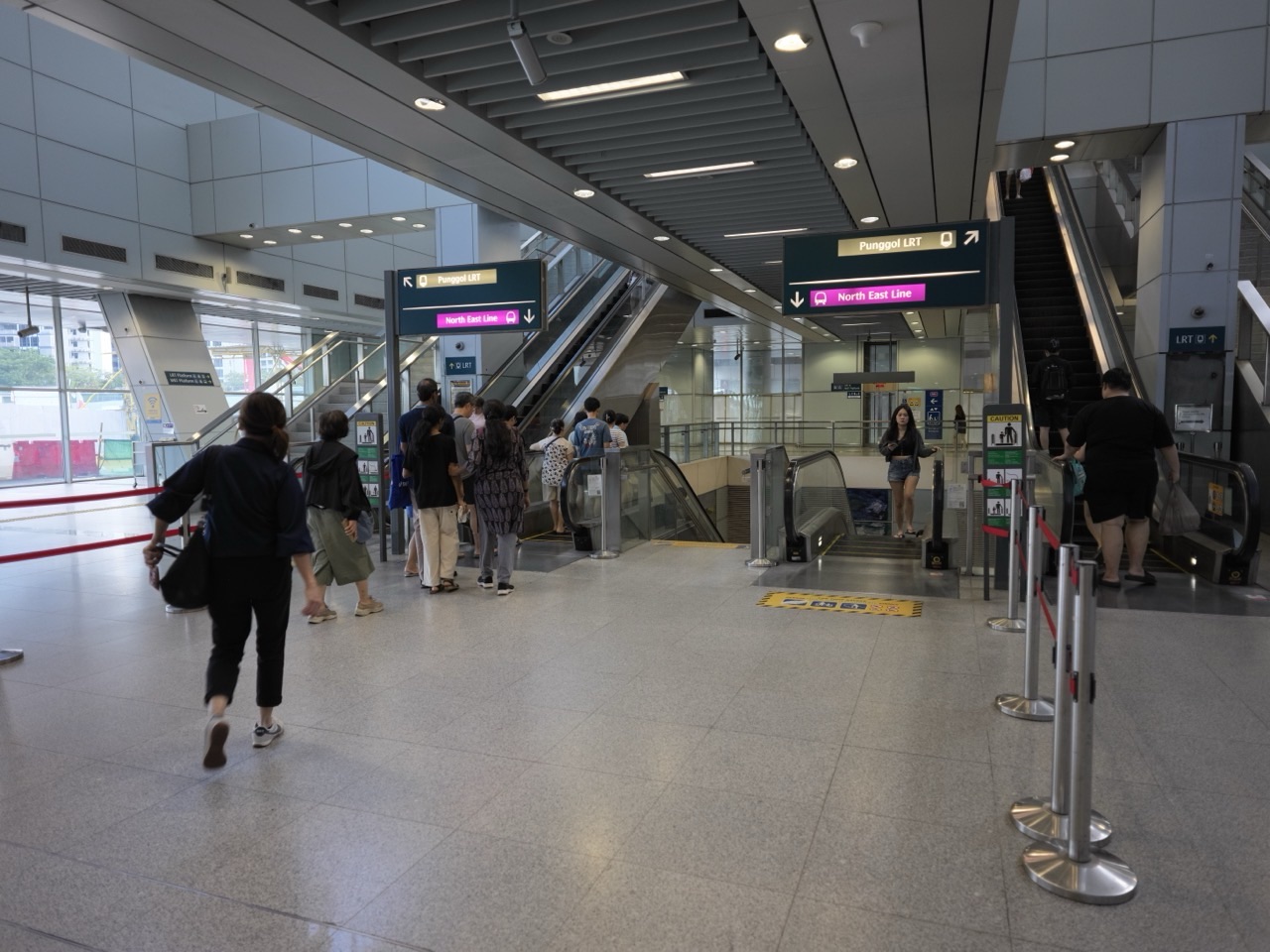
To travel around Punggol and Sengkang in 2027 and 2028, begin with the operating North East Line (NEL), the two light-rail networks and current bus connections—not a future Cross Island Line route. Buangkok (NE15), Sengkang (NE16), Punggol (NE17) and Punggol Coast (NE18) are existing NEL stations. Punggol Coast opened in December 2024 and its integrated bus interchange opened in June 2025. The LRT systems connect many residential precincts to the town centres and the NEL, but route direction, loop choice and the final walk can change the usefulness of any journey.
The most important near-term improvement is the ongoing Sengkang–Punggol LRT upgrade. LTA says the Sengkang West Inner Loop resumed normal service on 4 October 2026 after construction work, and the larger depot is on track for completion in 2027. More two-car trains are being added progressively, with the longer-term fleet targeted to reach 41 two-car vehicles by 2030. By contrast, the Cross Island Line Punggol Extension remains targeted for 2032, not 2027 or 2028. This guide separates operational services, ongoing upgrades, local buses and future plans so residents can make reliable decisions today.
- North East Line: existing stations include Buangkok NE15, Sengkang NE16, Punggol NE17 and Punggol Coast NE18.
- Sengkang LRT: two loops with 14 stations in total, linking neighbourhoods to Sengkang NEL and its interchange.
- Punggol LRT: two loops with 14 stations; check clockwise/anticlockwise and the specific named stop.
- Punggol Coast MRT: opened 10 December 2024; serves the Punggol Digital District and connected facilities.
- Punggol Coast bus interchange: opened 29 June 2025, linked to the MRT and mall.
- Bus 381: extended from Punggol East to Punggol Coast from 13 September 2026.
- Sengkang bus interchange: affected services returned to the integrated transport hub from 31 October 2026.
- Sengkang West Inner Loop: regular service resumed 4 October 2026; older closure and shuttle notices are superseded.
- LRT depot: expansion target 2027; train fleet grows progressively, rather than all trains arriving on one date.
- Cross Island Punggol Extension: targeted 2032; do not count it as a 2027 service.
- Autonomous shuttles: Punggol public trials began in 2026; availability, routes and eventual fares must be verified live.
Information checkpoint: 5 November 2026. Treat future LTA target dates as provisional; current line operations and stopping points can change with new notices.
Chapter 1. Why the north-east requires more than one map
The Punggol and Sengkang transport system is built around trunk rail, neighbourhood light rail and buses. Those services perform different jobs. The North East Line connects larger destinations across the island, while LRT loops help bridge the distance between HDB precincts and the mainline station. A direct bus can sometimes link destinations more comfortably than a journey with two rail transfers.
Start with the exact address rather than the town name. An origin near Buangkok is not interchangeable with one at Punggol Northshore, and an LRT station across a canal may require a longer walk than the map suggests. Compare door-to-door travel time, transfer effort and whether a suitable connection operates at the required hour. A well-planned journey can use fewer changes without necessarily using fewer kilometres.
Chapter 2. The North East Line is the primary trunk
The NEL provides the larger north-east connection toward HarbourFront through established interchanges. Its stations around Buangkok, Sengkang, Punggol and Punggol Coast serve different communities. Selecting the right station may avoid an unnecessary LRT leg. Punggol Coast is already operational and should not appear as a ‘future station’ in a 2027 article.
Check the correct direction and change when travelling to another line. A work journey to the central business district may require a transfer that differs from a weekend trip to an eastern neighbourhood. The station closest to a home may also not be the station nearest the actual destination entrance. First and last train times should be verified from the current SBS Transit timetable.
Chapter 3. Sengkang as a regional interchange
Sengkang station (NE16) connects the NEL to the local LRT network and the bus interchange. Its importance is functional: residents of housing precincts outside easy walking distance of the main line can reach a central point and transfer. At busy periods, the time required to move between platforms and bus bays can matter to a daily commute.
Read the direction carefully at the LRT. Each loop serves a sequence of neighbourhood stations, and taking the wrong loop can add unnecessary travel. For a person with a stroller or walking aid, check lift routes and where to wait. A useful plan includes the path inside the interchange, not merely the station codes written on paper.
Chapter 4. Punggol station and the LRT transfer
Punggol NE17 remains a major transfer point between the NEL, Punggol LRT and the town’s bus network. People travel through it for daily work, food, appointments and access to different precincts. The main transport task is knowing whether the destination is closer to a Punggol LRT stop, the central station or a direct bus route.
A central station can feel familiar even when it is not the fastest starting point. A resident of Punggol North may instead use Punggol Coast NE18 when the origin is near the new district. Compare the actual walk to each platform and how far you must travel after arrival. New connectivity should be evaluated by the trip it genuinely improves.
Chapter 5. Punggol Coast has already opened
LTA opened Punggol Coast station (NE18) in December 2024 as the current northern NEL terminal. It sits in Punggol Digital District, serving the SIT campus, JTC business park and surrounding development. The station has connections for bicycles and access toward the integrated bus interchange. Its opening is an established fact, not a forecast for 2028.
A student or worker headed to the Digital District should use the actual building entrance to choose the station exit. The NEL stops near several destinations, but the final walk may vary. Someone travelling from central Punggol may find an NEL ride or direct bus useful, while a nearby resident may be better off walking. Do not confuse one illustrative LTA travel-time saving with a guarantee for every household.
Chapter 6. The Punggol Coast bus interchange
Punggol Coast Bus Interchange opened in June 2025, integrated with the MRT station and Punggol Coast Mall. LTA said Services 34 and 117/M were among the initial services relocated or extended to the hub. This helps connect the new northern district to other precincts and destinations rather than relying on the MRT alone.
When a bus terminus changes, older route guides can send passengers to the wrong interchange. Read current service maps and the boarding bay before departure. A route starting at Punggol Coast may also stop at central Punggol or other locations, but not every service follows the same pattern. Include the walk between bus berth and destination in your timing.
Chapter 7. Bus 381 and the September 2026 extension
LTA announced that Service 381 was extended from Punggol East to Punggol Coast on 13 September 2026, improving local access to amenities and the new integrated transport hub. This is a concrete route improvement that readers can use when the current timetable confirms the relevant stops. It is different from a proposed bus that has not begun running.
Compare where the service stops relative to the nearest LRT platform. A direct bus can be more comfortable for somebody carrying shopping, using a stroller or avoiding an interchange. Yet the bus may have its own route loop and waiting time. Always check direction and stop number, particularly after route extensions.
Chapter 8. How Sengkang LRT loops work
LTA identifies two loops serving 14 stations on the Sengkang LRT. Each loop serves a group of residential districts connected through the main Sengkang station. A passenger needs to know the station name and correct directional loop, not merely ‘take any LRT from Sengkang’. The loop configuration makes good signage particularly important.
Practice the route at a calm time before using it for an important commute. Note the station where the train changes direction or returns through the loop and where the passenger should board. A newcomer can avoid unnecessary travel by checking platform information and actual stop sequence rather than guessing from the position of the line on a simplified map.
Chapter 9. The October 2026 Sengkang West service resumption
The Sengkang West Inner Loop, via Cheng Lim, was temporarily closed from April 2026 for depot-related track and signalling work. LTA’s 2 October notice brought its return forward, with regular passenger service resuming on 4 October 2026. The replacement Sengkang West shuttle buses ceased after the 2 October evening peak. A 2027 reader should not rely on the temporary closure plan as if it remained current.
The upgrade demonstrates why construction notices need dates. The existence of a printed replacement-bus map does not mean a shuttle still runs. Confirm that regular rail service is operating on the intended loop and check any new, separate adjustment notices. When a line has reopened, the best route might revert to rail rather than a now-discontinued shuttle.
Chapter 10. Why the LRT depot is being enlarged
LTA is expanding the Sengkang–Punggol LRT depot to accommodate more two-car trains and maintenance facilities. The work involves track connections, signalling equipment and additional space to maintain vehicles. The current project update targets completion in 2027. This is infrastructure capacity, not a guarantee that every passenger train immediately doubles in length on the project’s completion date.
A depot is often invisible to ordinary commuters, but its capacity affects how many trains can be stored, maintained and introduced into service. A two-car train can carry more people than a one-car train, yet the actual benefit at a station also depends on schedules and demand. When reading project news, distinguish delivery of a vehicle from commissioning and its use in regular passenger service.
Chapter 11. The two-car fleet projection for 2030
The 2026 LTA update says eight further third-generation two-car light rail vehicles will be procured, supporting a planned fleet of 41 two-car vehicles by 2030. That longer-term target is useful context, but it should not be rewritten as ’41 two-car trains operating from 2027′. Rolling-stock purchases, depot work, testing and passenger deployment happen in stages.
For a commuter, the most reliable evidence of improvement is what runs during the actual peak period. Increased train capacity may reduce crowding on some services, but a particular boarding experience depends on passenger demand, headways and service arrangements. Evaluate the journey directly rather than expecting an identical improvement at every station on the same morning.
Chapter 12. Punggol LRT’s neighbourhood role
Punggol LRT also uses two loops with 14 stations, connecting many housing precincts to Punggol NEL and the town centre. Its usefulness lies in extending rail coverage beyond the distance most people want to walk from one central station. A named stop may serve one side of a precinct while a bus stop provides a better connection to another side.
The fastest route can differ by direction around the loop. Know whether the train serves the desired stop soon or only after passing many other stations. A short bus connection may be easier for an older traveller, particularly when the LRT journey includes a long walk from the final station. The practical decision begins with the building’s exact entrance.
Chapter 13. Teck Lee and northern Punggol access
Teck Lee LRT station began passenger operations in August 2024, improving access around Sentul Walk and the developing Punggol Digital District. This means a 2027 visitor should not list Teck Lee as an unopened station. It is one of the existing alternatives to walking from the main NEL terminal, depending on the exact campus or workplace destination.
A student headed to a particular SIT building should compare Punggol Coast station, Teck Lee and current bus options. A map’s closest station may not be the closest entrance because of path layout. If a covered linkway exists, it can make a longer measured walk more practical during rain. Try the route before the first term or workday.
Chapter 14. Sengkang bus services and the October 2026 move
LTA’s service announcements show that Services 80, 86, 87, 372 and 374 were relocated back to Sengkang Integrated Transport Hub from 31 October 2026. That kind of change affects where passengers board even if their usual service number remains the same. A printed older interchange diagram may still circulate after the relocation.
The best practice is to check the present interchange berth board and operator notice. Someone who used a temporary boarding facility during earlier works should not assume it remains the right pickup. The return direction and the exact stop outside the town centre also need confirmation, especially for children and older relatives.
Chapter 15. Cross Island Punggol Extension is not a 2027 opening
LTA’s current Cross Island Line page targets the Punggol Extension for 2032. It is planned to link Punggol, Riviera and the direction of Pasir Ris and Tampines North through an expanded network. Construction progress can be significant, but the passenger service milestone is beyond this guide’s 2027/2028 window.
A housing advertisement may mention the future Cross Island Line as a benefit. That can be relevant for long-term planning, but it is not a current commuting option. Calculate the first years of a tenancy or home purchase with the operating NEL, LRT and buses. Mark the Cross Island link as a future scenario, and verify new LTA announcements before assigning a date to it.
Chapter 16. The importance of Pasir Ris and Tampines connections
Many residents travel between the north-east and eastern employment, retail or family destinations. Today the route may involve buses, the NEL and a transfer onto another line. The future Cross Island connection could create a different pathway, but it has not opened. The correct 2027 plan uses current lines and services only.
Compare an itinerary that goes through the city with a direct or cross-town bus where one exists. Depending on starting point and destination, a less obvious bus may avoid a large rail detour. However, road traffic and bus frequency still matter. Time both options under realistic weekday conditions and do not assume the route with fewer stations must be faster.
Chapter 17. What autonomous shuttles mean for Punggol
Public autonomous shuttle rides began in Punggol in April 2026 after testing. LTA’s July update described existing fixed routes and planned enhancements allowing more direct journeys between designated pickup points. The regulator emphasises monitoring safety and operator-specific arrangements before wider revenue service. A pilot ride is not a promise that a driverless taxi is available at every address.
Residents should check the actual route, approved stops, operating hours, booking process and fare status on the operator’s current site. During an initial free-trial period, the price may be different from an eventual paid service. If the trip is time-sensitive, keep the regular bus, LRT or lawful ride-hailing alternative instead of relying on a demonstration service.
Chapter 18. First- and last-mile walking paths
The travel time between an HDB entrance and an LRT station is part of the journey. In growing estates, a newly opened building may initially have a different walking approach from one shown on an artist’s rendering. Check available crossings, lighting, sheltered links and whether a canal or road divider changes the actual distance.
A resident who can walk ten minutes on a dry day may prefer a feeder on a wet afternoon. A wheelchair user needs a step-free approach and adequate space at crossings. The right way to compare options is to time the whole route, not use straight-line distance between buildings and stations. Repeat the test when local footpaths or bus stops are changed.
Chapter 19. Travel with children and school schedules
Punggol and Sengkang families often manage morning school reporting and after-school activities. A route involving an LRT loop and an NEL transfer can be easy for a practised secondary student but confusing for a young child. Begin with the correct stop, platform direction, boarding process and safe school gate.
Rehearse a fallback if the child misses the LRT or sees a disruption announcement. They should stay in a safe staffed place, contact a trusted adult and avoid following strangers offering rides. On CCA days, the final feeder or bus may operate differently from the normal dismissal time. A good routine works for the whole week.
Chapter 20. Seniors, accessible travel and the town centre
All public buses and trains in Singapore are wheelchair accessible according to MOT, but the suitability of a particular journey still depends on bus-stop approaches, station lifts and final footpaths. For older people making short neighbourhood visits, a direct bus may be more useful than several transfers. Concession cards may reduce fare costs if the passenger is eligible.
A caregiver should identify an accessible entrance and allow time for boarding. The trip home after an appointment can be more demanding than the trip there. Encourage independence by planning a route the person can repeat, with clear written instructions and a familiar fallback when a normal lift or connection is unavailable.
Chapter 21. Punggol Coast Digital District commuting
The Punggol Digital District combines workplaces, education facilities and retail amenities near Punggol Coast station. This concentrates arrivals and departures at certain hours. Someone working there should identify the actual building entrance and test whether the NEL, a connecting bus or LRT offers the most practical first and last kilometres.
It is easy to overestimate the convenience of a station merely because it shares the name of the district. Some offices or campus entrances are a further walk from the platform than expected. Consider rain, queueing at fare gates and the possibility of different work shift hours. If an employer has its own shuttle arrangements, verify them independently.
Chapter 22. Night travel and shift work
Sengkang and Punggol have station-specific first and last NEL and LRT services. A late train may operate to a particular terminus but not support the connection a passenger needs. Check the complete journey and the final bus or LRT transfer. Someone leaving a shift after midnight should not assume that all neighbourhood transport runs continuously.
A taxi or authorised private-hire ride can be a fallback, though prices and availability vary. Budget repeated late journeys before accepting an irregular work schedule. Choose safe legal pickup points and know how to contact home if one service ends unexpectedly. The correct final arrival includes the walk from the drop-off point to the actual block.
Chapter 23. Fare choices, cards and transfer mistakes
A commuter using both NEL and LRT should tap correctly and use the same accepted card or mobile-wallet instrument at the relevant entry and exit points. The distance-based fare system has transfer conditions. A person who taps with a physical bank card and exits using the corresponding phone wallet may be treated as using different payment instruments.
Compare a monthly pass with actual travel volume and eligible services. A person who works from home part of the week may not save money from a pass, while a daily multi-leg commuter may. Fare adjustments announced for late 2026 should not be projected into an imaginary separate 2028 tariff. Follow the current PTC and SimplyGo schedule.
Chapter 24. Service disruptions: how to avoid obsolete advice
The Sengkang West Inner Loop episode illustrates a common trap. A closure announcement made before a construction stage can remain online even after service resumes. Always check the date and the most recent operator notice. For an active rail disruption, use the live status page and station instructions rather than a forwarded photograph of a replacement-bus route.
If free bridging buses are announced, follow the stops specified for that incident. Not every delay triggers the same arrangement. A passenger should identify which loop and station is actually affected. If a route is still operational, a different interchange or ordinary bus may offer a better alternative than joining a crowd at the wrong place.
Chapter 25. Housing decisions in the north-east
A flat near the Punggol or Sengkang LRT may be attractive, but measure the actual path to the correct platform. Some residents might be nearer to an NEL station than to an LRT connection, especially around Punggol Coast. The suitability of a location depends on work, healthcare, family and school journeys rather than only the presence of a station icon.
Do not assign the 2032 Cross Island Punggol Extension to a 2027 commute. Treat it as future potential with construction and timing uncertainty. Visit the address at peak and after dark; test one independent backup route. A household should be able to live with the transport network that exists on move-in day.
Chapter 26. A robust 2027 and 2028 journey method
Write down the origin address, closest operating bus stop and rail station, intended destination and deadline. Compare the NEL with one or more LRT or direct bus options, including walking and wait. Identify the correct directional loop, not just the station name. When a service change is announced, update only the affected part of the plan.
Keep separate notes for confirmed 2026 operating changes, the 2027 depot completion target and the 2032 Cross Island extension. This prevents future infrastructure from being mistaken for a present-day option. A practical route is one that can be described in plain words to another person and repeated under ordinary weekday conditions.
Worked journeys in Punggol and Sengkang
Student living near Rivervale going to the city
Check the useful Sengkang LRT stop and its loop direction, then the NEL interchange. A bus to a nearby NEL station may sometimes reduce transfers. Test the morning timetable and the last connection after CCA. The route should remain understandable without constant phone navigation.
A reliable plan records the actual boarding stop, correct loop direction, all required transfers and a safe fallback. A future station is not an option until it is formally open. Compare the whole journey, including waiting and the final walk, before declaring one mode better than another.
Employee going to Punggol Digital District
Compare Punggol Coast NE18, Teck Lee and any current bus serving the actual building entrance. Do not automatically alight at Punggol NE17 because it is the familiar station. A longer train ride and shorter walk may be preferable to a shorter train ride and confusing transfer.
A reliable plan records the actual boarding stop, correct loop direction, all required transfers and a safe fallback. A future station is not an option until it is formally open. Compare the whole journey, including waiting and the final walk, before declaring one mode better than another.
Family using Service 381
The route was extended to Punggol Coast from September 2026. Check the correct stop and service direction before planning a weekend errand. A current bus may avoid a lengthy LRT transfer, but only if it actually serves the destination and runs at a practical frequency.
A reliable plan records the actual boarding stop, correct loop direction, all required transfers and a safe fallback. A future station is not an option until it is formally open. Compare the whole journey, including waiting and the final walk, before declaring one mode better than another.
Resident reading an old Sengkang West closure notice
Confirm that the regular inner loop resumed in October 2026. A dated replacement shuttle announcement may no longer apply. Check the current operator notice and avoid relying on old service A or B plans that ceased after the loop returned.
A reliable plan records the actual boarding stop, correct loop direction, all required transfers and a safe fallback. A future station is not an option until it is formally open. Compare the whole journey, including waiting and the final walk, before declaring one mode better than another.
Visitor planning a Punggol autonomous shuttle ride
Find the current operator registration, approved pickup points and whether service is a free trial or revenue journey. A pilot may not operate at all hours. Have a conventional bus, LRT or lawful ride-hail fallback if there is a timed appointment.
A reliable plan records the actual boarding stop, correct loop direction, all required transfers and a safe fallback. A future station is not an option until it is formally open. Compare the whole journey, including waiting and the final walk, before declaring one mode better than another.
Parent teaching a child to use the Punggol LRT
Practise recognising the station name and correct loop before an independent journey. Agree on what to do if the child goes in the wrong direction. A direct return on the train may be safer than leaving at an unfamiliar stop and walking across multiple roads.
A reliable plan records the actual boarding stop, correct loop direction, all required transfers and a safe fallback. A future station is not an option until it is formally open. Compare the whole journey, including waiting and the final walk, before declaring one mode better than another.
Senior visiting a Punggol clinic
Choose the route with manageable boarding, safe crossing and minimal transfer distance. A direct bus can be better than an LRT journey even if the scheduled time is marginally longer. Identify the correct clinic entrance and a return option suitable if the person becomes tired.
A reliable plan records the actual boarding stop, correct loop direction, all required transfers and a safe fallback. A future station is not an option until it is formally open. Compare the whole journey, including waiting and the final walk, before declaring one mode better than another.
Homebuyer near a future Cross Island Line station
Calculate travel using today’s NEL, LRT, buses and walking routes. The CRL Punggol Extension is targeted for 2032, not 2027. Treat the future rail benefit as conditional upside; the chosen home should remain practical before that opening.
A reliable plan records the actual boarding stop, correct loop direction, all required transfers and a safe fallback. A future station is not an option until it is formally open. Compare the whole journey, including waiting and the final walk, before declaring one mode better than another.
Worker finishing after midnight
Check last rail and bus links from the employment location to the housing block. A train reaching Punggol may still leave the final LRT transfer unavailable. Budget a lawful taxi or private-hire alternative where necessary.
A reliable plan records the actual boarding stop, correct loop direction, all required transfers and a safe fallback. A future station is not an option until it is formally open. Compare the whole journey, including waiting and the final walk, before declaring one mode better than another.
Visitor moving between Sengkang and Pasir Ris
Compare the existing operating rail transfer with current cross-town bus routes. Do not assume a future Cross Island connection is already available. Walking from the final stop to the destination may dominate the total time.
A reliable plan records the actual boarding stop, correct loop direction, all required transfers and a safe fallback. A future station is not an option until it is formally open. Compare the whole journey, including waiting and the final walk, before declaring one mode better than another.
Person using a wheelchair to reach SIT
Confirm whether Punggol Coast or Teck Lee provides the better accessible entrance for the specific campus building. The station being accessible does not automatically make every outdoor path equally easy. Test lifts, crossings and the final approach.
A reliable plan records the actual boarding stop, correct loop direction, all required transfers and a safe fallback. A future station is not an option until it is formally open. Compare the whole journey, including waiting and the final walk, before declaring one mode better than another.
Resident planning for larger LRT trains
The depot is targeted for 2027 and the fleet grows progressively toward 2030. Do not assume all trains instantly expand on the same day. Follow current service information and judge whether actual peak trains offer improved capacity.
A reliable plan records the actual boarding stop, correct loop direction, all required transfers and a safe fallback. A future station is not an option until it is formally open. Compare the whole journey, including waiting and the final walk, before declaring one mode better than another.
Frequently asked questions
Is Punggol Coast MRT open?
Yes. NE18 began passenger service in December 2024 and the related bus interchange opened in June 2025.
Is Sengkang West Inner Loop still closed?
No. LTA announced regular service resumption on 4 October 2026. Check for any newer separate adjustments.
Did the temporary Sengkang West shuttle buses continue?
The 2026 replacement shuttles ceased after the 2 October evening peak when regular inner-loop service returned.
Will the depot expansion finish in 2027?
LTA currently targets completion in 2027. That does not mean all new two-car vehicles immediately enter service.
How many two-car LRT vehicles are targeted by 2030?
LTA’s October 2026 notice describes a planned fleet of 41 two-car vehicles by 2030.
Is Punggol’s Cross Island Extension opening in 2028?
No. LTA targets the Punggol Extension for 2032.
What is the main NEL connection at Sengkang?
Sengkang NE16 connects to the Sengkang LRT and bus interchange.
What changed at Punggol Coast Bus Interchange?
It opened in 2025 with selected services moved or extended. Current operator pages provide the latest berths and routes.
Was Bus 381 extended in 2026?
Yes, LTA says it was extended to Punggol Coast from 13 September 2026.
Can I board an autonomous shuttle anywhere in Punggol?
No. The pilot uses designated service areas and stops, with operator-specific booking. Check current availability.
Does every LRT train travel the same loop direction?
No. Check the named stop and platform direction before boarding.
Is the North East Line operating overnight?
No. Check first and last trains and any needed LRT transfer.
Can senior and disability concession cards be used?
Eligible passengers may use the relevant current schemes, subject to SimplyGo’s eligibility and coverage rules.
What if the LRT is disrupted?
Check current SBS Transit and LTA advice and follow actual station instructions, not an obsolete construction shuttle map.
What is the best housing transport test?
Walk from the actual block to a working station or bus stop, make the journey at peak time and identify one independent fallback.
Official updates and internal links
- LTA — Sengkang–Punggol LRT system and expansion
- LTA — Sengkang West Loop resumption and 2030 fleet target, 2 October 2026
- LTA — Punggol Coast MRT station opening
- LTA — Punggol Coast bus interchange opening
- LTA — September 2026 bus routes, including Service 381
- LTA — Current bus service and interchange adjustments
- LTA — Cross Island Line and Punggol Extension
- LTA — Punggol autonomous shuttle adjustments, July 2026
- eduKateSG — Singapore rail opening timeline
- eduKateSG — Regional Toa Payoh transport
Punggol and Sengkang travel becomes easier when residents treat the NEL, LRT and buses as a connected operating network. The 2026 reopened loop, 2027 depot expansion target and 2032 Cross Island milestone are separate facts. Check the current route, practice the transfer and let real journeys determine the best choice.