
Where is Timor-Leste, what is it famous for and why does it matter? Timor-Leste is an independent Southeast Asian republic with its capital at Dili. This reader-first overview combines mountains and islands with its struggle for self-determination, education, economic choices, arts, environment, daily services and a new chapter in ASEAN. Its twenty chapters are designed for readers who value real evidence and practical explanations.
Begin with the chapter directory. For a direct route, explore school pathways, the Petroleum Fund, reefs and biodiversity, or ASEAN and Singapore. This is educational background, not current travel, financial, medical or legal advice.
Timor-Leste at a glance
- Official name: Democratic Republic of Timor-Leste.
- Capital: Dili.
- Region: Southeast Asia.
- Currency: United States dollar (USD).
- Official languages: Tetum and Portuguese.
- Restoration of independence: 20 May 2002.
- October 2026 leadership: President José Ramos-Horta and Prime Minister Xanana Gusmão.
- ASEAN: 11th member, admitted 26 October 2025.
- UNESCO World Heritage: No inscribed properties as of October 2026.
- Education: Nine years of compulsory basic schooling, followed by general or vocational secondary choices.
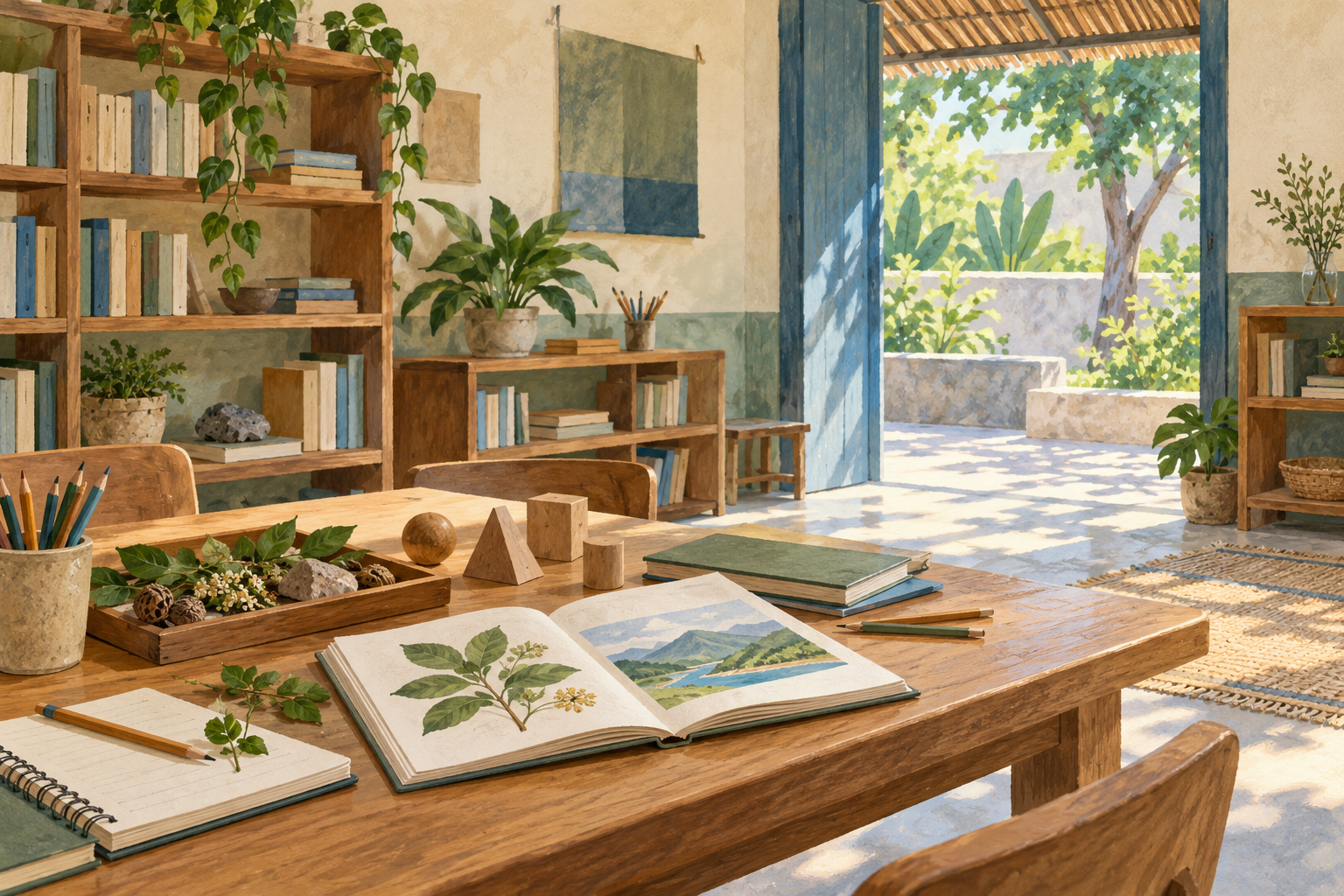
These facts are supported by Australia’s country brief, ASEAN’s accession record, Timor-Leste’s Education Ministry and UNESCO’s country register. The cover is an existing conceptual illustration of an imagined learning space, not a real Timorese classroom.
Choose your reading path
Place, history and communities
- 1. Geography: Island, Mountains and Sea
- 2. Early Communities and Maritime Networks
- 3. Colonial Rule, Occupation and Independence
- 4. Constitution, President and Parliament
- 5. Municipalities and Everyday Governance
Education, economy and everyday life
- 6. People, Tetum, Portuguese and Local Languages
- 7. Education: Nine-Year Basic School and Senior Routes
- 8. Economy: Petroleum Fund and the Post-Oil Challenge
- 9. Coffee, Food Systems and Rural Work
- 10. Dili, Housing and Everyday Communities
Services and cultural expression
- 11. Transport and Critical Infrastructure
- 12. Health and Community Care
- 13. Food and Daily Cooking
- 14. Weaving, Art and Design
- 15. Music, Stories and Living Culture
Ecology, resilience and world connections
- 16. Heritage, Historical Memory and Conservation
- 17. Coral Reefs and Terrestrial Biodiversity
- 18. Climate, Water and Energy Security
- 19. Sport, Recreation and Youth
- 20. Timor-Leste, Singapore and ASEAN
1. Geography: Island, Mountains and Sea
Where Timor-Leste is, and what maps conceal
Timor-Leste occupies the eastern part of Timor island, with the Oecusse enclave in the western part of the island, and includes Atauro and other smaller islands. It lies in Southeast Asia north of Australia, with land borders shared with Indonesia and coasts on the Timor and Banda seas. Dili is the capital. The interior rises into steep mountains, so a road journey is not necessarily short just because two towns look close on a flat map. Rivers may flow rapidly during rain and recede during drier periods. A family in a coastal neighbourhood, a coffee-growing mountain community and a household in Oecusse can have different transport and school-access conditions. I begin a country enquiry by locating a named place and asking which part of the road, power or water network links it to the next town. That is far more revealing than describing the entire country as one tropical beach. (Australian DFAT — Timor-Leste country profile; World Bank — October 2026 Timor-Leste economic outlook)
Atauro, Oecusse and the geography of connection
An island state or island territory has to manage more than its coastline. Atauro has marine ecosystems and ferry or boat connections with Dili, while Oecusse’s separated geography means people and freight may need to cross Indonesian territory or use maritime or air options. For a small clinic, an equipment shortage can turn into a complicated logistics task. Steep terrain and seasonal weather also affect bridges, landslides and the final distance from a road to a household. The lesson is not that geography makes development impossible; it shapes what designs cost, how maintenance is arranged and who is served first. When I compare two districts, I record the realistic journey from home to school, clinic, market or administrative office rather than using straight-line distance as a substitute for access. Clear examples help learners understand why the same national policy may have quite different practical consequences. (Australian DFAT — Timor-Leste country profile; World Bank — October 2026 Timor-Leste economic outlook)
What I would investigate
A coastal school orders laboratory equipment. Trace the complete route to Atauro, then compare it with a delivery to a mountain village. Identify who must coordinate shipping, loading, repairs and communication, and which facts require current local verification. Return to all chapters ↑
2. Early Communities and Maritime Networks
History begins long before independence
Timor-Leste’s human history precedes the arrival of Portuguese officials by many centuries. Archaeological finds, local stories and language relationships help researchers examine ancient settlement, food gathering and exchange. The region’s position between island Southeast Asia and Australia is relevant to wider questions of human movement, but a single discovery cannot explain every later community. Rock shelters and material remains must be dated by suitable scientific methods, and oral accounts may answer questions about identity or social relationships that artefacts cannot. A useful student method is to list what is physically observed, the date proposed by researchers and the interpretation connecting the two. I would never call a modern family simply the direct representative of one prehistoric artefact or presume that all communities have the same origins. People and cultures change through generations, contact and local choices. (Australian DFAT — Timor-Leste country profile; UNESCO — Timor-Leste World Heritage register)
Ocean travel and the formation of communities
Seafaring, farming and exchange linked villages across Timor and nearby islands before colonial borders were drawn. Languages, textiles and ceremonies reflect histories that are varied rather than one uniform national tradition. A maritime network can carry tools, food, stories and marriages as well as commercial goods; it can also expose communities to changing political influence. Studying a woven item, for example, might reveal fibres, motifs and the knowledge of a particular maker, but its appearance alone cannot disclose what every family believes. Modern borders and international trade routes add another layer without making older relationships disappear. I ask learners to distinguish a place’s historical exchange network from the present-day shipping and customs arrangements that operate through ports. Both connect people, but they use different institutions, technologies and rules. This makes history part of everyday geography rather than an isolated chronology. (Australian DFAT — Timor-Leste country profile; Timor-Leste economic affairs ministry — ASEAN and WTO milestones)
What I would investigate
Choose a material object such as a weaving tool or fishing implement. Record what it is made from and who explains its use, then distinguish observation, oral memory and an archaeologist’s interpretation. Return to all chapters ↑
3. Colonial Rule, Occupation and Independence
Portugal, 1975 and the importance of dates
Timor-Leste’s recent political story includes centuries of Portuguese colonial rule, upheaval after Portugal’s 1974 revolution, a declaration of independence on 28 November 1975 and Indonesia’s invasion on 7 December 1975. The subsequent occupation and resistance caused immense suffering and disrupted the lives of many families. A chronology should not treat the 1975 declaration as identical to the internationally recognised restoration of independence in 2002. The country’s communities made different sacrifices and retained cultural practices through changing circumstances. Archival documents establish some official decisions, while personal testimony and scholarship are essential for understanding displacement, repression and resistance. A responsible classroom discussion describes abuses accurately without using distressing experiences as spectacle. I would begin by making the timeline explicit, then explore which institutions were involved and how civilians experienced consequences. (Australian DFAT — Timor-Leste country profile; Timor-Leste presidency — ASEAN accession)
The 1999 consultation and restoration in 2002
A UN-supervised popular consultation in August 1999 rejected autonomy within Indonesia; violence followed, and an international security response and UN administration supported the transition. Timor-Leste restored its independence on 20 May 2002. José Ramos-Horta and Xanana Gusmão are among the prominent leaders associated with the country’s struggle and later political life, but no individual can stand for everyone’s experience. Building a sovereign state then required public institutions, laws, schools, infrastructure and long-term reconciliation. To understand the aftermath, separate the establishment of a ministry from the practical question of whether it could staff and serve rural communities. This distinction is as important in 2026 as it was after independence: a constitution creates a legal framework, while everyday improvement requires funding, capability and public trust. (Australian DFAT — Timor-Leste country profile; Timor-Leste presidency — ASEAN accession)
What I would investigate
Write a four-date timeline for 1975, 1999 and 2002, then explain what each event changed legally or politically. Do not replace the experience of civilians with only the names of national leaders. Return to all chapters ↑
4. Constitution, President and Parliament
José Ramos-Horta and Xanana Gusmão have different roles
Timor-Leste is a democratic republic with a directly elected president, a prime minister and a single-chamber National Parliament. As of October 2026, José Ramos-Horta is President and Xanana Gusmão is Prime Minister. These titles have distinct constitutional functions: the President is head of state, while the Prime Minister heads government and the Council of Ministers. National institutions include the judiciary and other bodies with different responsibilities. A media photograph of two leaders at an ASEAN summit cannot tell a reader which institution actually signs a budget or administers a school. For an accurate civic lesson, I ask who has the authority to propose, legislate, implement and review a decision. The constitutional text establishes the intended division of power, while reported practice shows how it works in real circumstances. That distinction makes civic education more useful than memorising officeholders alone. (Timor-Leste presidency — ASEAN accession; ASEAN — Timor-Leste becomes 11th member, 26 October 2025)
Elections, public accountability and small-state institutions
National elections, parliamentary scrutiny, courts and public administration all contribute to political accountability. But electoral participation is only one step; people also need understandable information, accessible procedures and mechanisms to challenge an error. Timor-Leste’s ASEAN participation creates additional negotiations and legal obligations, which involve specialists and local agencies rather than one symbolic ceremony. The economic ministry’s 2026 roadmap material explains that trade integration and customs harmonisation require ongoing work. I would teach an official announcement by separating commitment, government allocation, operating institution and verified outcome. A regulation about a port, for example, might alter documents and costs before it changes what a consumer pays. Understanding each stage prevents students from confusing a formal accession with instant economic transformation. (Timor-Leste economic affairs ministry — ASEAN and WTO milestones; ASEAN — Timor-Leste becomes 11th member, 26 October 2025)
What I would investigate
Follow a proposed school improvement from Cabinet announcement to parliamentary funding, school purchase and evidence of classroom use. Identify records needed at each stage; this distinguishes political authority from verified delivery. Return to all chapters ↑
5. Municipalities and Everyday Governance
Dili is not every municipality
Timor-Leste’s municipalities differ in geography, population, roads, access to power and economic activities. Dili houses national institutions, but its schools and hospitals cannot be treated as a description of every rural community. Local administration works alongside national ministries, schools, health facilities and traditional or community organisations. A household may need one authority to obtain a document and another to fix a broken road. Studying these relationships requires asking which institution is legally responsible and which actually delivers a service. It is easy to speak about government as if it were a single office; following the route of a child’s journey to school gives a clearer picture. Terrain, cost, language, household work and disability access can all influence the result. Real civic knowledge begins with the resident and traces outward to responsibility. (Australian DFAT — Timor-Leste country profile; Timor-Leste Ministry of Education — Basic School)
Planning and finance from the national centre to villages
Budgeting a service requires a national policy, a financing decision, procurement, staff and continued maintenance. Timor-Leste’s petroleum revenues have long supported national spending, but a large fund cannot automatically repair every remote water system. The World Bank’s October 2026 economic update warns about reliance on public spending and the need for productivity and sustainable investment. Public accountability means more than measuring how much was allocated; it asks whether the project operates reliably and whom it reaches. I would compare a proposed village road with evidence about its condition after two rainy seasons, not simply the day it was opened. This is a general method students can apply to any country, and it keeps people and outcomes visible when institutional diagrams become complicated. (World Bank — October 2026 Timor-Leste economic outlook; Timor-Leste economic affairs ministry — ASEAN and WTO milestones)
What I would investigate
Draw the service chain for one municipal water point: funding, construction, testing, collection, repairs and user feedback. Which authority could a family contact when it fails, and how would you verify a response? Return to all chapters ↑
6. People, Tetum, Portuguese and Local Languages
The everyday work of multilingual education
Tetum and Portuguese are Timor-Leste’s official languages, while other local languages and Indonesian or English may also be encountered. The choice of language matters when a young child learns to read or when a family receives information about health and government services. A classroom might use Tetum to build literacy while introducing Portuguese progressively; national policy has to be implemented through trained teachers and suitable materials. Timor-Leste’s Education Ministry explicitly describes this bilingual approach in basic education. Language diversity is a source of knowledge, not evidence of confusion or deficiency. I would ask learners to explain a science idea in words they understand, then help them use the formal terms needed in tests. A good guide also avoids assuming every person in one municipality speaks the same languages or has identical access to translation. (Timor-Leste Ministry of Education — Basic School; Timor-Leste Ministry of Education — National Curriculum)
Identity, faith and family networks
Catholicism is prominent in national life, while families and communities also draw on local traditions and different individual beliefs. Ceremonies, kinship responsibilities, ancestral relationships and cultural knowledge vary across groups and generations. Diaspora families may maintain relationships through visits, digital communication and remittances, and memories of conflict can shape identities without defining every individual. A respectful account identifies a particular practice’s community, purpose and context rather than using it as a fixed stereotype for everyone in Timor-Leste. Textile design, performance and oral storytelling can change while retaining meaning for practitioners. Students should ask permission before recording or reproducing cultural material and recognise that outsiders may not have the right to describe every ceremonial detail. This approach connects humanities learning with everyday courtesy and media literacy. (Australian DFAT — Timor-Leste country profile; Timor-Leste presidency — ASEAN accession)
What I would investigate
Ask a bilingual learner to explain a locally relevant concept in two languages. Which terms translate easily, and which need explanation? Avoid treating one language or accent as a measure of intelligence. Return to all chapters ↑
7. Education: Nine-Year Basic School and Senior Routes
The nine-year compulsory basic education structure
Timor-Leste’s 2008 Education System Framework Law provides for nine years of free compulsory basic education. The Ministry groups these into Grades 1–4, 5–6 and 7–9, followed by general secondary or technical-vocational secondary pathways in Grades 10–12. Completion and national assessment rules matter to admission, so parents should consult current ministry information for their child’s cohort instead of copying a dated examination diagram. Early reading, mathematics and language development are foundational because later science and vocational subjects build on them. The Ministry also describes Merenda Eskolár school meals and monitoring through early literacy and numeracy assessments. These programmes are important, but their existence is not evidence that all learners receive the same level of support. A child in a remote community may need transport, special-needs provision and teacher continuity to benefit. (Timor-Leste Ministry of Education — Basic School; Timor-Leste Ministry of Education — National Curriculum)
The July 2026 Grades 7–9 curriculum reform
UNICEF’s July 2026 account describes a new basic-education curriculum for Grades 7–9 that aims to make learning more practical, inquiry-based and connected to climate action and digital skills. This is useful for students who think progress means only memorising notes. In a science lesson, I would ask a learner to design an observation, collect a small set of measurements and explain uncertainty rather than recite a paragraph without understanding. However, classroom practice depends on teacher preparation, resources and the time available to apply the reform. A report profiling innovative teachers is evidence of what they are doing, not confirmation that every school has fully adopted the same methods. Families can check school equipment, assessment expectations, language support and the next qualification before choosing a route. Honest advice is tailored to the learner’s situation. (UNICEF — Timor-Leste’s new Grades 7–9 curriculum, July 2026; Timor-Leste Ministry of Education — Basic School)
What I would investigate
Compare a traditional recall exercise with an investigation of rainfall or soil quality. Which skills are assessed in each? Explain why both basic knowledge and the ability to test claims matter for later study. Return to all chapters ↑
8. Economy: Petroleum Fund and the Post-Oil Challenge
Why a sovereign fund is not an inexhaustible income stream
Timor-Leste created a Petroleum Fund to manage hydrocarbon wealth for public spending and future generations. Petroleum income supported government budgets, but a fund’s investment value should not be confused with annual tax revenue or money received by a specific household. The World Bank’s October 2026 macroeconomic assessment records that oil and gas production from Bayu-Undan ended in 2025. The country is therefore grappling with a difficult fiscal transition, higher spending demands and the need to create activity beyond the petroleum sector. Possible future field developments are plans subject to investment and regulatory choices, not proof that a new stream of revenue is already flowing. A practical economics lesson separates fund valuation, withdrawals, annual expenditure and jobs actually created. Without those distinctions, apparent national wealth can conceal long-term sustainability risks. (World Bank — October 2026 Timor-Leste economic outlook; Timor-Leste economic affairs ministry — ASEAN and WTO milestones)
Agriculture, trade, tourism and business opportunities
Coffee, agriculture, fisheries, tourism, construction and services provide livelihoods, but each has different productivity constraints and market access. ASEAN membership and WTO membership can create opportunities for trade rules and business cooperation, yet neither automatically improves every road or guarantees higher wages. The government’s 2026 economic information describes the need to implement customs, legal and investment reforms. A small enterprise may depend on affordable credit, reliable electricity, workers with skills and predictable shipments. I would trace the product from producer to consumer before declaring an export strategy successful. Counting companies registered is different from measuring profitable firms and secure employment. This approach also brings economic analysis into family decisions, because the price of imported goods and the availability of local work influence how young people plan qualifications. (Timor-Leste economic affairs ministry — ASEAN and WTO milestones; World Bank — October 2026 Timor-Leste economic outlook)
What I would investigate
Draw four different figures: national fund assets, annual fiscal withdrawals, local business revenue and household income. Explain why a rise in one does not automatically mean the other three increased. Return to all chapters ↑
9. Coffee, Food Systems and Rural Work
Coffee as a crop and livelihood
Coffee is associated with Timor-Leste’s uplands and has economic and cultural value to many farming communities. Harvest quality depends on plant health, picking, processing, storage, transport and relationships with buyers. A claim that coffee is internationally sought after is not enough to say that every farmer receives a high or stable price. Some farms sell through cooperatives or intermediaries, and weather or changing market demand can affect earnings. Students can investigate the value chain through a specific bag of coffee: grower, pulping, drying, grading, export and roasting. At each step another task adds cost or value. This is why agriculture education should combine biology, measurement, economics and communication. I would ask whether a programme reports the number of farmers trained, the amount exported or actual changes in farm incomes before treating it as a measured success. (Australian DFAT — Timor-Leste country profile; World Bank — October 2026 Timor-Leste economic outlook)
Household food security is more than the harvest
Rice, maize, vegetables, fish, root crops and other foods contribute to diets with differences across places and households. Drought, heavy rainfall, poor roads, limited cold storage and prices can all make affordable food harder to obtain. A large national crop figure is not a measure of the nutritional quality of every child’s meal. Local gardens, public health services and reliable market connections may interact. Timor-Leste’s Education Ministry describes school meals intended to support attendance and nutrition while using locally sourced produce; such programmes join agriculture to education. Their real effects should be evaluated through school participation, nutritional outcomes, procurement and continuity. A student can map a meal from field or boat to kitchen, noting what depends on weather and what depends on transport and household budgets. That method reveals why food security is a system. (Timor-Leste Ministry of Education — Basic School; World Bank — October 2026 Timor-Leste economic outlook)
What I would investigate
Trace a coffee bean and a household meal through their supply chains. Mark the costs, risks and people involved, and distinguish the farmer’s received price from the final customer price. Return to all chapters ↑
10. Dili, Housing and Everyday Communities
Capital city opportunities and unequal access
Dili is the capital and an economic hub, but it contains neighbourhoods with different housing, drainage, transport and services. A capital skyline does not reveal whether an individual household has reliable water or whether a young person can travel safely to class. The city connects national institutions, markets, universities and port facilities, and that concentration influences where people seek work and education. Rural and island communities have different opportunities and challenges, so one urban household cannot be used to represent the country. I would compare how two fictional students reach a school, one in Dili and one in a mountain municipality, specifying the assumptions made and what requires real evidence. A useful city study focuses on routes, costs, sanitation and accessible public space rather than just photographs of buildings or traffic. (Australian DFAT — Timor-Leste country profile; Timor-Leste Ministry of Education — Basic School)
Community work and public maintenance
People rely on households, neighbourhood organisations, markets, local health workers, schools and government services. A water system needs operators, repairs and community trust; a school needs teaching staff and safe toilets as much as classrooms. Timor-Leste’s public-finance challenge affects how authorities can maintain assets beyond their opening date. The World Bank’s 2026 assessment of dependence on public spending provides context, but a national analysis cannot establish whether one village project is functioning. That requires local records and user accounts. Students can assess a proposed bridge or clinic by following the design, budget, implementation, staffing and ongoing maintenance. A project should be considered useful because it helps residents reliably, not merely because construction was completed. This keeps the work of ordinary people central to a serious country overview. (World Bank — October 2026 Timor-Leste economic outlook; Timor-Leste economic affairs ministry — ASEAN and WTO milestones)
What I would investigate
Imagine a neighbourhood water point that breaks two months after opening. List all people and institutions involved in restoring it, then explain which evidence distinguishes an announcement from an actual repair. Return to all chapters ↑
11. Roads, Ships and Public Infrastructure
Understanding the systems
Dili’s coastal gateways connect imported goods with businesses, schools and clinics; transport inland crosses mountains with seasonal road and drainage challenges. An apparently short journey can take much longer when bridges, vehicles or weather fail. I would not infer access from the length of a paved road without evidence of its condition and continued maintenance. A science textbook reaching a remote school needs warehousing, transport, staff and local distribution rather than only arrival at a container terminal. (Australia DFAT — Timor-Leste Country Brief; World Bank — Timor-Leste October 2026 Outlook)
What the evidence can and cannot show
Essential services rely on one another. A clinic needs electricity to store certain medicines and communications to arrange specialist referrals. An island or enclave may also require maritime or cross-border arrangements. Spending on construction is not identical to providing a dependable service years later. The October 2026 economic review describes the importance of effective public spending amid Timor-Leste’s fiscal transition. Students can trace how one asset is procured, installed, maintained and actually used. (Australia DFAT — Timor-Leste Country Brief; World Bank — Timor-Leste October 2026 Outlook)
Try this practical enquiry
Draw the route of a school equipment shipment from international port to mountain classroom; mark costs, possible interruptions and information you still need to verify. Back to the reading directory ↑
12. Health, Nutrition and Community Care
Understanding the systems
A national health service operates through community workers, clinics, hospitals and referrals. People in rural or mountainous locations may have difficulty reaching specialist care even when that care is formally available. A referral can depend on safe travel, staff, records, medicine and a receiving facility. A national count of hospitals cannot tell us whether a particular family receives timely care. I would compare actual service continuity and accessibility in named locations rather than infer it from a policy statement. (Timor-Leste Ministry of Education — Basic School; World Bank — Timor-Leste October 2026 Outlook)
What the evidence can and cannot show
Children’s wellbeing also depends on household nutrition, safe water, sanitation and education. The Ministry’s school-meal programme links locally sourced food with school participation, but the existence of a programme is not proof that every pupil receives identical meals. Researchers should distinguish people eligible, people served and changes in outcomes over time. A school investigating hygiene can practise safe observation and record general facilities without collecting private medical data. (Timor-Leste Ministry of Education — Basic School; World Bank — Timor-Leste October 2026 Outlook)
Try this practical enquiry
Trace a fictional child’s day through breakfast, school sanitation and a possible clinic visit; identify the separate institutions needed for reliable support. Back to the reading directory ↑
13. Food, Cooking and Food Security
Understanding the systems
Timorese meals may involve rice, maize, vegetables, fish, tubers and regionally available ingredients, but there is no single national menu shared by every family. A coastal fisher and a mountain farmer may obtain their food through very different routes. Recipes also change through generations, imports and household preferences. A respectful cultural explanation should identify the cook and locality instead of claiming that one preparation defines the entire population. (Australia DFAT — Timor-Leste Country Brief; World Bank — Timor-Leste October 2026 Outlook)
What the evidence can and cannot show
Food security involves price, nutrition, safe storage and dependable access as well as total harvest volume. Local rice passes through farming, milling and roads; imports require freight, customs and retail distribution. The country’s need for economic diversification also affects how families earn money to buy food. An investigation should mark each supplier, its costs and the information that remains unknown rather than invent prices. This connects food, maths, biology and livelihoods. (Australia DFAT — Timor-Leste Country Brief; World Bank — Timor-Leste October 2026 Outlook)
Try this practical enquiry
Choose a meal and trace three ingredients to farm, coast or importer; distinguish the family’s account from a verifiable trade statistic. Back to the reading directory ↑
14. Tais Weaving and Visual Design
Understanding the systems
Tais textile weaving is associated with Timorese communities and demonstrates skilled knowledge of threads, dyes, tension and patterns. Motifs, purposes and techniques depend on the specific maker and cultural context. A single textile should not be described as the practice of every household. Students can ask about the artisan, material, time involved and permission to share photographs or descriptions. New markets may change designs without stripping makers of the authority to interpret their own work. (Australia DFAT — Timor-Leste Country Brief; UNESCO Timor-Leste World Heritage Register)
What the evidence can and cannot show
Contemporary art includes illustration, murals, photography, architecture and digital expression as well as inherited forms. An artistic image is not a neutral record of current conditions. The existing illustrated cover of this guide is a conceptual educational scene rather than a photograph of a named school. Readers can appreciate an image while asking which statements it can support, who owns it and what separate evidence is needed to verify historical claims. (Australia DFAT — Timor-Leste Country Brief; UNESCO Timor-Leste World Heritage Register)
Try this practical enquiry
Describe two objects, one woven and one contemporary: who made them, how do their materials work, and which meanings require the practitioner’s explanation? Back to the reading directory ↑
15. Music, Language and Storytelling
Understanding the systems
Narratives and performances are shared in Tetum, Portuguese and other community languages. Words may carry local histories that cannot be transferred into another language without explanation. Oral memories can illuminate events and family relationships missing from official archives, although one account does not represent every community. Students should seek permission before recording a personal story and identify the narrator, date and context. They should compare testimony with documented chronology respectfully, especially where memories concern difficult periods of conflict. (Australia DFAT — Timor-Leste Country Brief; Timor-Leste Ministry of Education — Basic School)
What the evidence can and cannot show
Music and dance also vary by region, generation and occasion. Contemporary performers can adapt inherited forms using new instruments or platforms while preserving meaning for their communities. A video posted online may be genuine but carry an incorrect date or location. I would verify its origin and distinguish observable performance details from the interpretation offered by a commentator. This builds cultural understanding and digital-media literacy together. (Australia DFAT — Timor-Leste Country Brief; Timor-Leste Ministry of Education — Basic School)
Try this practical enquiry
Choose one story or performance with permission. Identify its date, participants and language, then note what additional context you would need before generalising. Back to the reading directory ↑
16. Heritage, Memorials and Historical Records
Understanding the systems
UNESCO lists zero inscribed World Heritage properties in Timor-Leste as of October 2026. This technical designation must not be interpreted as a claim that the country lacks heritage. Historic buildings, archaeological locations, ceremonial places and sites connected to independence may matter deeply to local communities without international inscription. World Heritage involves separate nomination and conservation criteria; community significance is wider than that process. Learners should distinguish a protected national site, a proposed nomination and an already inscribed UNESCO property. (UNESCO Timor-Leste World Heritage Register; Australia DFAT — Timor-Leste Country Brief)
What the evidence can and cannot show
Remembering the occupation and restoration of independence requires care with witnesses’ dignity, the use of archives and the distinction between chronology and interpretation. A commemorative site tells a particular story, but additional perspectives may be important. Heritage conservation involves preserving records, providing access, translating materials and consulting communities. I would not use images of suffering simply to make a page more dramatic; education needs accurate and respectful context. (UNESCO Timor-Leste World Heritage Register; Australia DFAT — Timor-Leste Country Brief)
Try this practical enquiry
Pick a historically important local place and make an evidence register: physical features, dated records, community descriptions, conservation duties and UNESCO status. Back to the reading directory ↑
17. Coral Reefs, Forests and Biodiversity
Understanding the systems
Reefs, seagrass and open waters around Timor-Leste support marine ecosystems and fishing livelihoods. Atauro is widely associated with marine biodiversity, but claims of exceptional richness depend on where, when and how species were counted. A beautiful reef photograph cannot establish a long-term ecological trend. Conservation should consider fisheries, habitats, scientific monitoring and the practical rights of nearby communities. A survey of one location should not be automatically generalised to every island or coast. (Australia DFAT — Timor-Leste Country Brief; UNESCO Timor-Leste World Heritage Register)
What the evidence can and cannot show
Mountain slopes, forests and watersheds support different organisms and land uses. Farming, roads, fires and severe rain may change erosion and habitat condition. A project planting trees may be useful without proving mature forest recovery; follow-up monitoring and community participation are essential. Students can compare the ecological functions of a reef and watershed using species observations, water quality or vegetation measurements over time. (Australia DFAT — Timor-Leste Country Brief; UNESCO Timor-Leste World Heritage Register)
Try this practical enquiry
Choose one reef and one watershed measure. Explain the baseline, sampling method, human pressures and how a future survey could show improvement. Back to the reading directory ↑
18. Climate, Water and Electricity Resilience
Understanding the systems
Rainfall, drought, storms and steep terrain create differing environmental risks across the country. Water may be physically nearby yet unsafe or unreliable without testing, treatment, storage and repairs. A school should not treat an extreme weather event as proof of a long-term climate trend unless supported by relevant data. Drainage, land management and warnings also influence the outcome when heavy rain arrives. I would draw the full route from a catchment to a household tap before declaring that access has improved. (World Bank — Timor-Leste October 2026 Outlook; Australia DFAT — Timor-Leste Country Brief)
What the evidence can and cannot show
Electricity supports evening study, clinics, businesses and communication. Installed generation capacity, household connections and hours of dependable supply are different metrics. Timor-Leste’s tighter fiscal outlook makes maintenance and effective investment important. Solar and other technologies can help under suitable conditions, but equipment needs safe wiring, spare parts and skilled operators. Students can use this example to practise energy units and the relationship between engineering claims and actual public services. (World Bank — Timor-Leste October 2026 Outlook; Australia DFAT — Timor-Leste Country Brief)
Try this practical enquiry
Model a school during a water or electricity interruption. Which services are essential, who repairs them and what evidence demonstrates reliable restoration? Back to the reading directory ↑
19. Sport, Skills and Youth Opportunities
Understanding the systems
Football and other recreational activities can help people learn cooperation, enjoy physical exercise and connect across communities. Elite sporting achievements do not establish that every child has access to a safe field or appropriate coaching. Transport, equipment, inclusion and family circumstances influence participation. Young athletes benefit from safeguarding and age-appropriate expectations rather than promises of professional careers. A practical evaluation would measure who can participate and whether a programme supports wellbeing. (World Bank — Timor-Leste October 2026 Outlook; ASEAN 11th Member Accession 26 October 2025)
What the evidence can and cannot show
Youth career prospects also depend on education, recognised training and a growing range of productive work. The World Bank’s October 2026 outlook identifies limited job creation and the need for diversification. A training course’s enrolment number is not proof that everyone obtained secure work. ASEAN integration may offer opportunities but domestic preparation still matters. I would encourage a student to investigate real qualification requirements, employers, costs and work conditions before choosing a career path. (World Bank — Timor-Leste October 2026 Outlook; ASEAN 11th Member Accession 26 October 2025)
Try this practical enquiry
Select a career in teaching, agriculture, logistics or media. List real skills and qualifications and distinguish an announced programme from verified employment. Back to the reading directory ↑
20. ASEAN Accession and Singapore Connections
Understanding the systems
Timor-Leste was admitted as ASEAN’s eleventh member on 26 October 2025, following an application in 2011 and several preparatory stages. Full membership is a completed diplomatic milestone, while integration of specific treaties and customs systems continues after the ceremony. It should not be described in October 2026 as still merely an observer state. Nor does membership by itself guarantee higher household income; actual opportunities depend on skills, logistics, investment and legal implementation. (ASEAN 11th Member Accession 26 October 2025; Singapore MFA — Lawrence Wong July 2026 Visit; Timor-Leste Economic Ministry — ASEAN Integration)
What the evidence can and cannot show
Singapore Prime Minister Lawrence Wong visited Timor-Leste on 2–3 July 2026, meeting President José Ramos-Horta and Prime Minister Xanana Gusmão. Singapore documented a bilateral-consultations MOU and further training support. A specified Work Permit source-country arrangement was announced to begin in the second half of 2027, not immediately in 2026. A careful account distinguishes a meeting, signed instrument, start date and verified later benefits. These two small states offer valuable but geographically different examples of international cooperation. (ASEAN 11th Member Accession 26 October 2025; Singapore MFA — Lawrence Wong July 2026 Visit; Timor-Leste Economic Ministry — ASEAN Integration)
Try this practical enquiry
Build a timeline of 2011 application, 2025 admission, 2026 Singapore visit and the planned 2027 work-permit measure, distinguishing completed and future steps. Back to the reading directory ↑
Frequently asked questions about Timor-Leste
Where is Timor-Leste?
In Southeast Asia, on the eastern part of Timor island and surrounding areas, with Dili as capital.
When did Timor-Leste become independent?
It declared independence in 1975 and restored internationally recognised independence on 20 May 2002.
What currency does it use?
The United States dollar, as well as locally issued centavo coins.
Which languages are official?
Tetum and Portuguese, alongside other local languages used in daily life.
Who are the leaders in 2026?
President José Ramos-Horta and Prime Minister Xanana Gusmão.
Did it join ASEAN?
Yes, it became the eleventh ASEAN member on 26 October 2025.
Is Timor-Leste a WTO member?
Yes, since August 2024.
What is basic education?
Nine years of compulsory schooling arranged as Grades 1–4, 5–6 and 7–9.
What changed in the 2026 school curriculum?
UNICEF described a more practical Grades 7–9 curriculum involving critical thinking, digital skills and climate learning.
What is the Petroleum Fund?
A financial fund managing petroleum wealth for public spending and future generations.
Did Bayu-Undan production end?
The World Bank’s 2026 outlook reports production ended in 2025.
What is tais?
A Timorese woven textile tradition with diverse community forms and meanings.
Does it have UNESCO World Heritage properties?
No inscribed properties as of October 2026.
What is the Singapore link?
The July 2026 visit by Lawrence Wong led to bilateral-consultations cooperation and other announced support.
Is the announced Singapore Work Permit extension active in October 2026?
No. It was announced to begin from the second half of 2027 in specified sectors.
Four evidence-led activities
1. Compare two educational journeys
Map a hypothetical school journey in Dili and another from a mountain village. Check what is known about transport, time, cost and accessible facilities. Make the assumptions explicit instead of inventing conditions at a particular school.
2. Follow a food supply chain
Compare the route of locally grown rice with an imported staple, including milling, freight, storage and the family’s purchasing power. Identify what needs a real market survey before quoting prices.
3. Build an accession timeline
Separate the 2011 ASEAN application, 2025 admission, 2026 Singapore visit and a programme scheduled for 2027. Mark which events are completed and which need later implementation.
4. Compare with Singapore
Choose one service—safe water, secondary education or freight delivery—define a comparable outcome, identify the effect of geography and state what data would be needed to evaluate the result.
Continue reading in the eduKateSG library
- How Timor-Leste Works | Government, Petroleum Fund, ASEAN and Coffee
- Understanding the Education System of Timor-Leste
- Top 100 Coffee Cultivation Vocabulary Words | Timor-Leste
- How Countries Work | A–Z Directory
- Everything About Countries Archive
How to interpret dates, claims and changing programmes
In a 2026 article, the end of petroleum production in 2025, ASEAN admission in 2025 and a Singapore employment arrangement intended to begin in 2027 must be described differently. A public commitment is not identical to a service already working. A school curriculum describes intended learning; a survey or classroom observation tells us how it is experienced. For factual comparisons, check the responsible institution, the time period, what was measured and which places were covered.
A research paper, household interview, official statement, photograph and conceptual illustration answer different kinds of questions. One school or reef observation cannot automatically describe an entire country. Respect community knowledge while acknowledging the limits of the evidence, and prefer a small supported conclusion to a confident generalisation.
Sources and further evidence
- Australia DFAT — Timor-Leste Country Brief
- World Bank — Timor-Leste October 2026 Outlook
- UNESCO Timor-Leste World Heritage Register
- Timor-Leste Ministry of Education — Basic School
- ASEAN 11th Member Accession 26 October 2025
- Singapore MFA — Lawrence Wong July 2026 Visit
- Timor-Leste Economic Ministry — ASEAN Integration