
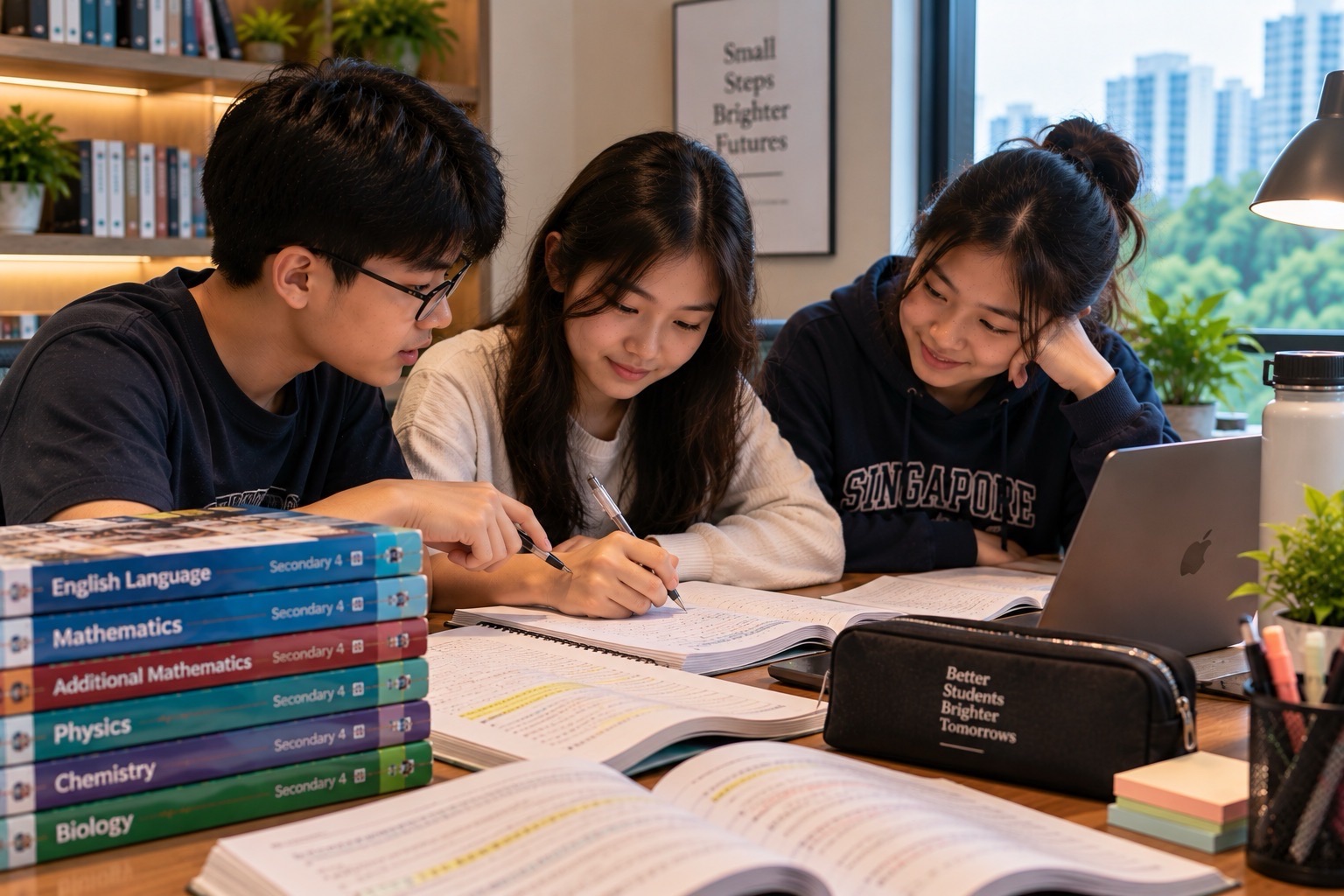
G1 Mathematics Tutorials | Bukit Pasoh Road helps secondary-school families from Bukit Pasoh, Chinatown and Tanjong Pagar find patient, structured Mathematics support. eduKateSG provides premium three-student tutorials at 8 Fourth Avenue near Sixth Avenue MRT, working on ratios, fractions, percentages, measurement, data and early algebra.
G1 Mathematics tuition should give a student confidence about what a number represents before choosing an operation. A ratio difference is not the total, a fraction of what remains uses a new reference whole, and the discount saving is not the amount paid. Our Bukit Pasoh Road tutorials connect those distinctions to original worked examples and new independent questions.
Bukit Pasoh Road describes the family’s locality or after-school meeting context, not an eduKateSG branch. Lessons are at Sixth Avenue. Families comparing tuition should consider the whole evening: school dismissal, the journey, a meal, the lesson and the return home. A worthwhile class should repay that commitment through clearer thinking rather than simply send the child home with more unfinished work.
Our established three-student tutorial format uses 1.5-hour weekly lessons, learning materials, guided corrections and focused continuation work. Suitable placement and current availability are confirmed directly. We begin with a parent–student consultation and genuine schoolwork, so the first plan responds to the learner rather than a broad label such as “weak at Maths”.
Arrange a parent–student consultation · Ask about G1 Mathematics on WhatsApp · eduKateSG on Facebook
G1 Is a Mathematics Level, Not a School Year
G1 identifies a subject level, while Secondary 1 identifies a school year. A suitable tutorial needs both pieces of information. A student beginning secondary school may need help with the transition into symbolic work; a graduating learner may need broader consolidation. The same subject-level label does not mean their current lessons should be identical.
SEAB’s 2027 school-candidate listing identifies G1 Mathematics as K110. Under the Singapore-Cambridge Secondary Education Certificate framework, students take subjects at their respective G1, G2 or G3 levels from 2027. SEC is not a fourth Mathematics level. The school’s programme and applicable syllabus remain the academic references.
We use that distinction to choose appropriate questions, not to limit expectations. A G1 learner can explain why a method works, compare two representations and notice an unreasonable answer. Difficulty can increase through unfamiliar wording or reduced assistance before it increases through more demanding content. The goal is understanding that belongs to the student, not successful imitation of someone else’s working.
The examples in this article are original teaching illustrations, not official examination questions or a complete syllabus inventory. They are selected according to the student’s school year, current coverage and readiness. Where a question introduces an additional step, the tutor first checks that the simpler relationship is secure enough to support it.
The Small Decision That Often Causes the Large Error
Some students solve an exercise easily when its chapter title supplies the method, then hesitate at an unfamiliar word problem. We identify the first uncertainty: the reference whole, the requested quantity, the role of a unit or a relationship the pupil cannot yet represent.
Bukit Pasoh Road has a documented community history. URA locates Ee Hoe Hean Club at 43 Bukit Pasoh Road and the Gan Clan Association at 18–20. These landmarks support a sense of place; imaginary prices, group sizes and measurements used for learning are not actual records of the institutions.
An equal-part bar may clarify whether the question supplies the total or only the extra ratio parts. A running table shows how a fraction of the remainder uses a different whole from the starting amount. A unit label identifies whether a number describes capacity, area or length.
In a premium three-student lesson, the tutor inspects each child’s first mathematical decision. One learner may need a prerequisite rebuilt, another a more dependable check, and another a changed question solved without the original scaffold.
We then return to the same principle after a delay and change how the question is presented. A new problem started independently gives parents better evidence than another answer completed while a model remained visible.
What Three Students Allow the Tutor to Notice
In a three-student lesson, the tutor can inspect the route to an answer while it is being constructed. One pupil may read a question correctly but lose a negative sign. Another may draw a useful bar but misidentify the whole. A third may reach the correct number through a method they cannot explain. Those attempts should not receive identical feedback.
The tutor can ask each learner to explain the first decision, give a suitable prompt and then step back. A pupil who needs the total labelled receives that support initially. A pupil who already understands the relationship can attempt a changed question without a diagram. The shared topic remains coherent while the next step is adjusted to the individual.
Peer discussion is useful when students compare explanations rather than merely exchange answers. One learner might notice that a unit conversion is easier before calculating volume; another may show a number-line check for a signed-number result. Each then needs an independent attempt. Understanding a classmate’s explanation is not yet evidence of being able to select the method alone.
Parents should be able to ask what this attention changed. A useful answer names the misunderstanding, the explanation and the follow-up check. “The student now identifies which amount the second fraction refers to” describes a testable skill. “We completed more fractions” describes activity, but does not tell the family whether the original difficulty has been repaired.
The Foundations We Keep Connected
What signed numbers describe
A temperature starting below zero and then rising describes a position followed by a change. Students can show this on a number line before simplifying a signed-number expression.
When a question asks for the final value, a positive net change is not necessarily the final positive position. Distinguishing these objects prepares students for algebra and coordinates.
Which whole a fraction belongs to
A fraction can refer to the original amount or to what remains after an earlier step. We use a short running record so each calculation has a named reference quantity.
The child must eventually identify the whole without a tutor circling it first. A changed question can test whether the relationship is understood.
When to add or subtract ratio parts
A given total corresponds to the sum of the ratio parts; a given difference corresponds to their difference. The student labels the actual quantity before dividing.
After the initial model, we swap the supplied total for a supplied difference. Choosing a new opening operation is meaningful evidence of understanding.
A discount amount is not a discounted price
The percentage removed and the percentage still payable both describe the original price. A final answer must identify which one the question requested.
A bar model or a complementary percentage can provide a different check. The aim is accurate interpretation rather than exclusive reliance on one shortcut.
Measurement units tell a mathematical story
Centimetres measure lengths, square centimetres areas and cubic centimetres volumes. Conversions should be completed where necessary before combining quantities.
A correctly calculated number with the wrong unit may reveal that the student has measured the wrong object. We use units as an active check.
Data summaries are not the original observations
A mean can be fractional even when each observed daily count is a whole number. It summarises a set rather than describing a single observed day.
We contrast total, average and range so students choose the summary requested instead of applying a formula simply because it was used in the last question.
Bukit Pasoh Road G1 Mathematics Casebook: 12 Original Worked Cases
These cases distinguish verified community history from invented learning values. Unless explicitly linked to an official source, costs, group counts, rectangular dimensions, dates and travel allowances are fictitious Mathematics teaching models rather than measured Bukit Pasoh Road facts or SEC examination questions.
1. Two real institutional dates used carefully
URA documents Ee Hoe Hean Club’s founding in 1895 and the establishment of the Gan Heritage Centre in 2013. The years differ by 2013 − 1895 = 118.
These are separate events belonging to different institutions. The year difference does not imply one institution operated the centre for 118 years, and subtraction does not establish how long a building was under construction.
A separate fictional date exercise uses 1954 and 1970 and asks for a sixteen-year interval. This is arithmetic using invented dates and is clearly distinguished from the two historical records.
An accurate Mathematics answer should preserve the meaning of the quantities, not invent a connection because the dates are on the same street.
2. A fictional total shared in ratio five to seven
An invented classroom collection has 144 tokens shared in ratio 5:7. Twelve equal ratio parts make the whole, so one part is twelve, producing shares of 60 and 84.
Dividing by seven alone would mistake one share’s ratio number for the whole. We draw five equal sections beside seven and label the combined twelve.
Check that 60 + 84 = 144 and 60:84 simplifies to 5:7. A changed task supplies the difference of 24 and asks for the two shares using the two extra parts.
No count here describes the actual membership of any Bukit Pasoh club.
3. A ratio gap rather than combined shares
Two hypothetical groups contain resources in the ratio 3:7, with the second group holding 32 more items. Four extra ratio parts represent 32, so each part is eight.
The groups contain 24 and 56. Check the difference 56 − 24 = 32 and ratio 24:56 = 3:7. The overall total is eighty, but it was not the number originally given.
The independent variation supplies that total of eighty instead; ten combined parts are now the appropriate opening model.
A ratio problem cannot be solved reliably by blindly adding or subtracting its numbers without reading what the given amount represents.
4. One quarter, then two fifths of what remains
A fictional school activity begins with 360 cards. One quarter, or ninety, are used first, leaving 270. Two fifths of the remaining cards are 108, leaving 162.
Using two fifths of the original 360 would ignore the changing whole. A short stock table shows the amount present immediately before each fraction.
Check 90 + 108 + 162 = 360. A new version refers the second two-fifths to the original amount and requires different working.
The numbers are teaching figures, not historic Gan Heritage Centre stationery supplies.
5. Discount saving, reduced price and a separate fee
An invented learning kit costs $96 and receives a 12.5% discount. The saving is $12 and the reduced price is $84. A fixed $6 delivery fee gives final payment of $90.
Calculating the saving is not the same as answering how much the customer pays. We label each intermediate amount before deciding which value the question requests.
Check backwards: $90 − $6 = $84, then $84 + $12 = $96. A changed task gives the payment and asks for the starting amount.
These are fictional prices, not current commercial quotations for Bukit Pasoh Road.
6. Volume in litres converted to smaller containers
An imaginary water supply holds eighteen litres, equivalent to 18,000 mL. Each fictional small container holds 450 mL, so the amount fills forty containers exactly.
Dividing eighteen by 450 without converting units would produce a meaningless result because litres and millilitres differ by a factor of a thousand.
Check 40 × 450 mL = 18,000 mL. A new problem uses a different cup size and asks for the greatest complete count when a remainder occurs.
No historic well or local building capacity is being measured.
7. Area from a scaled fictional drawing
A hypothetical plan of a rectangle measures 3.4 cm by 2.5 cm at scale 1:300. The lengths represented are 1,020 cm and 750 cm, or 10.2 m and 7.5 m.
The area represented is 76.5 m². The student must apply the linear scale to both side lengths and keep centimetres separate from metres.
A changed question gives the real width and asks for the drawing width, testing the same relationship in reverse.
This plan is invented, not a floor plan of the institutions at 18 or 43 Bukit Pasoh Road.
8. A border reduces both dimensions
An imaginary board measures 3.2 m by 2.4 m. A border 0.2 m wide on every inside edge leaves dimensions 2.8 m by 2.0 m.
The outside area is 7.68 m² and inner area is 5.6 m², so the border covers 2.08 m². We must remove the border at both ends of each dimension.
Shading the border explains why this is an area task rather than a perimeter task. The variation places the frame outside, so dimensions increase.
These are classroom lengths, not surveyed features of the conserved street.
9. A mean after an unusually high value arrives
Five fictional observations are 8, 12, 16, 20 and 24. Their total is eighty and mean sixteen. Adding a sixth value of 28 raises total to 108 and the mean to eighteen.
The new observation is above the old mean, so the mean should rise. This prediction offers a reasonableness check independent of the division.
A reverse question gives the six-observation mean and first five counts and asks for the sixth.
These figures are invented, not visitors to Ee Hoe Hean Club or the Gan Heritage Centre.
10. A fixed charge plus a whole-item count
An imaginary project has a fixed $10 charge and $7 for each item. With a total of $80, the equation 10+7n=80 gives ten complete items.
If the maximum budget were $79, only nine complete items would be affordable, costing $73; ten would exceed the budget.
An item count is a non-negative whole number. A pupil should explain the meaning of n and check the result in the original cost rule.
The fees are inventions for teaching and are not paid at any Bukit Pasoh institution.
11. Plan a fictional departure across the hour
An imaginary meeting begins at 6:07 pm. With a hypothetical 54-minute allowance for travel and preparation, the departure time is 5:13 pm.
Work backwards seven minutes to reach 6:00, then forty-seven minutes to reach 5:13. Adding 54 minutes forward checks the answer.
Clock arithmetic uses sixty-minute hours, not ordinary decimal subtraction. A labelled timeline helps prevent errors.
This is not an actual door-to-door estimate from Bukit Pasoh Road to the teaching centre.
12. Signed movement and a final position
A fictional instrument starts at −6, rises fourteen and falls nine units. It passes through +8 and finishes at −1, despite having a net change of +5.
The net movement and the final position answer different questions. A number line makes the starting value visible.
Reverse the movements to check, then alter the given to the final position and ask for the original.
No actual environmental or height measurement at Bukit Pasoh Road is claimed.
Our First-Principles Teaching Sequence
Diagnose before assigning more practice
We inspect a short attempt and ask the student to explain it. The first wrong decision matters more than a broad topic label. “Applied the second fraction to the original amount” gives the tutor a clear target. “Needs more fraction practice” is too general to determine whether the next question should teach interpretation, calculation or checking.
Make the relationship visible
A number line, bar, running-total record or diagram is chosen because it clarifies the specific difficulty. We do not insist on one representation for every question. The learner should be able to say what each part of the representation means and connect it to the calculation. A drawing copied without that connection can become another procedure to memorise.
Fence one new difficulty at a time
Our Fencing Method controls what changes. A ratio task might first give the total, then one share, then the difference. A measurement problem might first use one unit throughout, then require a conversion. The sequence exposes the boundary of understanding. If numbers, wording, units and relationships all change together, a failed attempt is harder to diagnose usefully.
Reduce prompts deliberately
The tutor may model the first solution, guide the next with questions and observe a third without interruption. A student is allowed a genuine thinking interval. We intervene when the learner cannot identify the relationship or repeats an invalid approach, not merely to avoid a pause. Independence needs an opportunity to appear without the adult pre-empting every decision.
Return after the model is no longer fresh
A later question checks whether the idea remains available without the worked page open. The task is short and relevant. The learner attempts it first, then compares the reasoning with the earlier explanation. We record how much help was needed, so a correct supported answer is not silently treated as independent mastery.
Mix methods rather than announce every chapter
A mixed set might contain a time interval, a fraction of a remainder and a perimeter question. The student must choose a relationship rather than repeat the previous operation. The questions need not be unusually difficult. Their value comes from removing the chapter cue and showing whether the learner can recognise what kind of mathematical decision is required.
Finish with a correction that can travel
The correction states the mistaken assumption, the repaired idea and a cue for the next problem. “Identify what the given ratio quantity represents” applies beyond one set of tokens. A later changed question tests that cue. The notebook should preserve usable thinking, not just a collection of attractive solutions that the student could not start alone.
What a Ninety-Minute G1 Tutorial Can Look Like
A possible lesson begins with ten minutes of earlier-topic retrieval and fifteen minutes of concept explanation. Twenty-five minutes of guided practice then introduce controlled variations. The tutor uses each attempt to decide whether to retain a representation, reduce a prompt or pause for a prerequisite repair. These are illustrative allocations, not a fixed timetable applied to every learner.
Twenty minutes can be used for independent application, followed by ten minutes of correction and ten minutes to review the learning and set continuation work. Those segments total ninety minutes. The balance changes when a student needs a slower explanation or is ready for more unfamiliar work. The structure serves the learning; the learner is not forced to fit the clock.
The session should leave a small but meaningful record: the relationship taught, the error repaired, a question attempted independently and the next task. Parents can ask the student to explain one example rather than describe the entire lesson. The tutor should also be able to identify what has not yet been established, rather than imply that every completed page proves lasting understanding.
Repair, Stabilise or Extend
The repair route is for a missing idea. A child who cannot explain the whole in a fraction question needs reconstruction with manageable values. The stabilisation route is for an understood idea applied inconsistently, perhaps because the reference quantity changes or a unit is omitted. The extension route is for stronger independence, new contexts and comparison of methods when the foundation is already reliable.
These routes describe tasks, not permanent categories of children. The same learner might need repair in signed numbers, stabilisation in measurement and extension in data interpretation. A good programme can hold those differences together. It does not make every topic equally easy or equally difficult merely because the student’s overall school mark falls within a particular range.
A useful extension asks why an apparently reasonable answer is wrong. For instance, why is the overall temperature change not the final temperature? Why does a correct volume calculation still require a unit conversion? Explaining these distinctions can deepen a G1 learner’s reasoning without prematurely moving into another syllabus or using complexity simply to make the lesson look advanced.
An Illustrative Twelve-Week Learning Arc
A twelve-week plan is a framework for reviewing evidence, not a promise of a particular grade or a requirement that every child finish the same topics. School coverage, attendance, existing gaps and upcoming assessments change the sequence. The important feature is that each phase has a teaching purpose and an independent check.
Weeks 1–3: locate the first missing connection
We review schoolwork, confirm the year and level, and sample a few relevant prerequisites. A student might understand fraction operations but misread the reference quantity. Another might label quantities accurately but calculate with decimals unreliably. The first phase selects a consequential repair and records an honest starting attempt. It should not produce a long weakness list without a practical next lesson.
Weeks 4–6: connect repair to current schoolwork
The school’s current topic becomes the main application. A unit conversion may support volume; a better understanding of equal parts may support ratio; a clearer distinction between change and final value may support a graph. Earlier repairs return briefly. The student should see why revisiting a foundation helps the work happening in school now.
Weeks 7–9: remove familiar clues
We vary the wording and mix suitable questions. Students practise identifying whether a number is the total, a remainder or a difference, and whether a calculation has found the requested answer. The tutor reduces help and records which choices remain independent. The purpose is not to make every task long, but to test whether a method can be selected without its usual heading.
Weeks 10–12: inspect what has become dependable
A fresh question checks the original priority under comparable conditions. We look at accuracy, explanation, independence and checking. Short timing controls are introduced only where the underlying method is sufficiently secure. The next cycle follows the evidence. A calendar date does not justify moving on from a concept that the student still cannot explain or use without substantial assistance.
A Short Independent Check Parents Can Use
Try these four prompts separately from the worked examples. A quantity starts at −6 and increases by nine: what is the final value? A bag contains 120 counters and one quarter is removed: how many remain? Two shares are in the ratio 2:5 and total 63: what are the shares? A rectangle is 8 cm by 5 cm: what is its perimeter?
The answers are 3, 90 counters, 18 and 45 counters, and 26 cm respectively. The useful evidence is not the number alone. Ask which quantity was being found and how the answer could be checked. The ratio shares should add to 63; the perimeter should include two lengths and two widths; the final signed value should be distinguished from the change of nine.
This is not a placement test, an official assessment or a prediction of a grade. It is a conversation starter. If the student needs help, note what kind: reading the question, identifying the relationship, calculating or interpreting the result. That information gives the tutor a better starting point than simply reporting that two answers were wrong.
School Alignment Without Repeating Every Worksheet
We ask for current topics and upcoming assessment scope so the lesson remains relevant. A student studying data may need help reading a scale, while one studying measurement may need a short decimal repair. Returning to a prerequisite can be school alignment when the connection is clear. The tutor should explain that connection rather than leave the family wondering why an earlier topic reappeared.
Schoolwork is also diagnostic material. We use a question to identify the failed decision and then create a suitable variation. A child who can only reproduce the original worksheet may still struggle when the assessment changes its presentation. The tutorial therefore respects the school sequence without making exact repetition its entire purpose.
Pre-teaching can be appropriate when foundations are ready. The aim is a calm first encounter, not an impressive claim about early coverage. If a learner does not understand the current relationship, another layer of unfamiliar symbols is unlikely to make that relationship clearer. Secure understanding determines the next step more usefully than speed through a chapter list.
Home Practice with a Clear Purpose
A suggested between-lesson routine is one earlier question, one current application and one correction to explain. The amount is adjusted to the child’s school demands. The first attempt should be genuine: ask what is known and required, but avoid immediately supplying the operation. A short period of productive thinking gives the learner a chance to develop an independent starting habit.
When help is needed, record it. A fully assisted correct page is useful practice but not proof of independent control. Preserve the unsuccessful attempt and note the exact obstacle. “I did not know whether the fraction referred to the original amount” tells the tutor something teachable. An erased page replaced by a copied solution hides that information.
Parents do not need to become a second tutor. Their helpful role is to protect a manageable study window, invite an explanation and keep the conversation specific. The task should finish with a clear account of what was attempted and what remains uncertain, not with an argument about why a tired child has not completed another large set.
Reading Progress Beyond One Test Score
Look for actions that can be observed again: the student labels the reference quantity, starts a ratio question without a hint, converts units before calculation or checks whether an answer is reasonable. These are useful signs even before a school assessment samples the repaired topic. The tutor should be able to show them in work, not only describe the child as more confident.
Compare similar demands under comparable conditions. Two papers may contain different chapters, so their total percentages do not isolate a particular skill. A fresh question using the same relationship gives a more focused check. Note whether the child used notes or prompts. Responsible tuition does not promise a fixed grade after a predetermined number of lessons; it makes the next learning decision clearer.
For examination-specific work, the existing SEC Examination Mathematics Tuition | Duxton guide discusses assessment preparation. This article focuses on the continuing G1 tutorial that builds the understanding on which useful paper practice depends.
Travelling from Bukit Pasoh Road to Sixth Avenue
The teaching centre is eduKateSG, 8 Fourth Avenue, Singapore 268674, near Sixth Avenue MRT (DT7). Bukit Pasoh Road names a family’s locality near Chinatown; it does not indicate a branch in any conserved shophouse or clan association.
Bukit Pasoh Road is known for conserved association buildings, including Ee Hoe Hean Club at 43 Bukit Pasoh Road and the Gan Clan Association at Nos. 18–20, as documented by URA. These are heritage landmarks, not Mathematics classrooms.
Depending on the precise starting address, families may find Outram Park MRT or Chinatown MRT convenient. From Chinatown MRT (DT19), the Downtown Line travels towards Bukit Panjang to Sixth Avenue (DT7) without changing train lines. Journeys originating from a school or near Outram Park may favour a different route.
Refer to LTA’s Downtown Line information and a current route planner from the actual starting point. We do not invent one door-to-door travel time, service availability or fare.
A good weekly schedule accounts for travel, meals, the ninety-minute tutorial, ordinary school assignments and returning home. The value to assess is stronger independent Mathematics thinking.
Class Details and Consultation Materials
Format: premium 3-pax small-group tutorials. Subject: G1 Mathematics, matched to school year and current programme. Duration: 1.5 hours weekly. Location: 8 Fourth Avenue near Sixth Avenue MRT. Attendance: by appointment, subject to suitable placement. Confirm current fees, available times and any trial arrangements directly rather than treating this guide as a guarantee of a vacancy.
Bring a recent marked paper, ordinary homework, the current topic list and teacher comments. Include an example the student solved successfully as well as one that caused difficulty. Leave original working visible and note where help was used. The consultation should produce a specific next priority and an independent way to check it, not a dramatic label based on one score.
Frequently Asked Questions
Does every G1 student need tuition?
No. A child who understands school lessons, completes work independently and receives sufficient feedback may not need another class. Support is worth considering when a specific gap, repeated inconsistency or appropriate extension goal has been identified. The consultation should help the family judge whether the proposed support has a clear purpose and fits the student’s week.
Will you repeat the whole primary syllabus?
Not automatically. We return to the prerequisite affecting current work. A fraction misunderstanding may need a focused repair before a secondary application becomes manageable. That does not mean every primary topic should be restarted. The tutor should explain which earlier connection is being rebuilt and how a later question will show whether the repair is usable.
What happens when my child understands an example but cannot begin homework?
We distinguish following a model from selecting a method. Prompts are reduced gradually, and a changed question is attempted independently. The tutor checks whether the barrier is reading, representing the relationship, recalling the method or executing it. Repeating the explanation may help, but it is not automatically the right response to every difficulty starting alone.
Can a confident G1 learner be challenged?
Yes. Challenge can involve a changed known quantity, an extra condition, a comparison of methods or a more independent explanation. It need not begin with premature material from another subject level. Any proposed school subject-level change should be discussed with the school; enrolling in tuition does not independently authorise or guarantee such a change.
How do you handle mistakes usually called careless?
We identify the action that failed. A lost sign, a wrong reference quantity, a missed unit conversion and an incomplete final interpretation need different checks. The correction records a useful cue for a future problem. The next changed attempt shows whether the student can use that cue rather than merely agree that the earlier answer was wrong.
Should we practise with a timer every evening?
Not when the relationship is still unclear. A missing concept needs explanation and a fair independent attempt before speed becomes the main demand. Short timed tasks can be useful when the method is secure enough to test under pressure. The tutor should explain what the timing is intended to reveal rather than use a clock as a universal solution.
Are lessons physically on Bukit Pasoh Road?
The tutorials described here are at 8 Fourth Avenue near Sixth Avenue MRT. Bukit Pasoh Road identifies the family’s locality or travel context. Confirm the class, venue and appointment before attending. The article title should not be read as an advertisement for a separate Bukit Pasoh Road classroom.
What should parents ask after the first month?
Ask which question the student can now begin without hints, which recurring error has reduced and which relationship remains uncertain after a delay. Request an example of independent work rather than only a list of completed chapters. The answer should help determine the next step and acknowledge where more evidence is still needed.
Bukit Pasoh Road G1 Mathematics: Independent Transfer and Retention
Begin with two ratios, one giving the total and one giving only a difference. Ask the student why the first division changes.
Next, show a fraction problem where the whole changes after a first action. Use a running stock record only as long as it clarifies the reference amount.
A unit-conversion question tests whether the child selects compatible litres, millilitres, metres or square metres before calculating.
After explanation, change one known quantity or required output and remove the worked model. Record whether the student can choose the first step without a hint.
Some G1 pupils need a prerequisite rebuilt, while others have sufficient concept understanding but require careful execution. Three-student feedback allows those next tasks to differ.
Home practice can include one familiar question, one changed question and a short explanation of how the answer was checked.
The repaired principle returns after a delay in a mixed set. Retrieval under unfamiliar wording is better evidence than copying yesterday’s solution.
Parents can ask what the question wanted and whether the result is reasonable while leaving the child to produce the actual arithmetic.
A Student Who Can Explain, Check and Begin Again
Our goal is not a child who never makes a first-attempt mistake. It is a learner who knows what is being found, chooses a relationship, calculates carefully and can inspect the result. When an approach fails, the student has somewhere useful to return: the quantities, the diagram, the units or the original question.
For Bukit Pasoh Road families, a G1 Mathematics tutorial should make that independence more visible over time. We rebuild what is missing, stabilise what is inconsistent and extend what is ready. The value of the lesson is the clearer thinking that the learner can carry into the next question when the tutor is no longer beside them.
Questions Bukit Pasoh Road Parents Ask About G1 Mathematics
Does G1 Mathematics mean Secondary 1?
No. G1 is a subject level and Secondary 1 is a school year. We confirm both.
Why does my child know calculations but struggle with word problems?
The correct reference whole, quantity requested or unit may not be recognised.
What matters in a ratio-difference problem?
The difference corresponds to the extra ratio parts, not all the parts combined.
Are the numbers about Ee Hoe Hean and Gan Heritage Centre factual?
Only explicitly attributed dates and place details are factual. Group sizes, prices and building dimensions are invented.
Is large amounts of homework always necessary?
No. A single unfamiliar problem begun independently can show more than repeated copies.
Can a confident G1 learner be extended?
Yes, with changed known quantities, method choice, transfer and clear checks.
Are tutorials located at Bukit Pasoh Road?
No. eduKateSG teaches at 8 Fourth Avenue near Sixth Avenue MRT.
What change should parents notice?
The child can begin a new problem with less prompting and explain a check that makes sense.
Bukit Pasoh Road G1 Mathematics: Local Institutions and Accurate Models
URA documents Ee Hoe Hean Club at 43 Bukit Pasoh Road, including its role as a significant Chinese community institution. The club dates to 1895. This history does not mean that a fictional Mathematics group size reflects the club’s membership.
The URA entry for 18 Bukit Pasoh Road explains the Gan Clan Association, formally founded in 1966, its home at 18 and 20 Bukit Pasoh Road, and the Gan Heritage Centre established in 2013. These details are specific sourced history.
The Bukit Pasoh neighbourhood guide introduces the institutions and the adjacent Keong Saik and Duxton streets. Check actual visitation arrangements before seeking entry to association premises; neither site is an eduKateSG classroom.
Mathematical models can use invented counters, prices, rectangular layouts or travel intervals. Those are useful only when we distinguish them from actual building measurements, community membership statistics and official historical dates.
Bukit Pasoh Road G1 Mathematics: Verified Learning and Heritage Links
The four Bukit Pasoh Road tutorials distinguish core G1, G2 and G3 Mathematics and the common SEC qualification. The separate SEC Examination Mathematics Tuition | Bukit Pasoh guide focuses on paper-related execution and timing rather than replacing continuing tutorials.
- Things to do in Singapore | Bukit Pasoh
- Things to do in Singapore | Keong Saik
- Surviving Tuition | Tanjong Pagar
- SEC Examination Mathematics Tuition | Bukit Pasoh
- URA: Ee Hoe Hean Club at 43 Bukit Pasoh Road
- URA: Gan Clan Association at 18 Bukit Pasoh Road
- NHB: Chinatown Clans and Associations Trail
- Mathematics Learning Hub
- Singapore Mathematics Tuition by Area Index
- The eduKate Mathematics Learning System
- G1 Mathematics Tutorials | Bukit Pasoh Road
- G2 Mathematics Tutorials | Bukit Pasoh Road
- G3 Mathematics Tutorials | Bukit Pasoh Road
- SEC Mathematics Tutorials | Bukit Pasoh Road
- SEAB 2027 G1 school-candidate syllabuses
The actual tutorial venue is 8 Fourth Avenue near Sixth Avenue MRT, with three-student groups subject to suitable placement and appointment. The Bukit Pasoh title describes a family locality, not a branch.
Bukit Pasoh Road Parent Questions: Mathematics and the Learning Routine
Does G1 mean Secondary 1?
No. G1 is the level at which Mathematics is studied; Secondary 1 is a school year. Both affect lesson selection.
Should every G1 learner work at the same pace?
No. One may need a fraction concept reconstructed, while another needs more unfamiliar word problems and reduced prompts.
Why does my child calculate correctly but miss marks?
The answer may describe the wrong quantity, lack a unit or use an incorrect reference whole. We identify the first wrong decision.
Do you teach only the current school chapter?
We follow school priorities while revisiting prerequisites when they block current work, and keep old skills active through short retrieval.
Can a G1 learner be stretched?
Yes, through stronger reasoning, new contexts and independent checks rather than automatically importing another subject level.
When is timed work suitable?
When the student understands the method. Timing does not repair a missing relationship.
Does G1 Mathematics have an SEC code?
The 2027 SEAB school-candidate listing identifies G1 Mathematics as K110.
Where is the teaching centre?
At 8 Fourth Avenue near Sixth Avenue MRT, not on Bukit Pasoh Road.
What evidence should parents request?
A fresh problem solved independently, an error reduced and a specific next teaching priority.
Arrange a Parent–Student Consultation
Tell us the student’s school year, G1 Mathematics programme, current topics and the questions that repeatedly cause difficulty. Bring a few genuine work samples and a realistic weekly schedule. The first plan should begin with a teachable next step.
Contact eduKate Singapore · Chat on WhatsApp
eduKateSG
8 Fourth Avenue
Singapore 268674
Near Sixth Avenue MRT
Premium 3-pax small-group tutorials
By appointment
Properly taught kids shine a bright light into the future.