
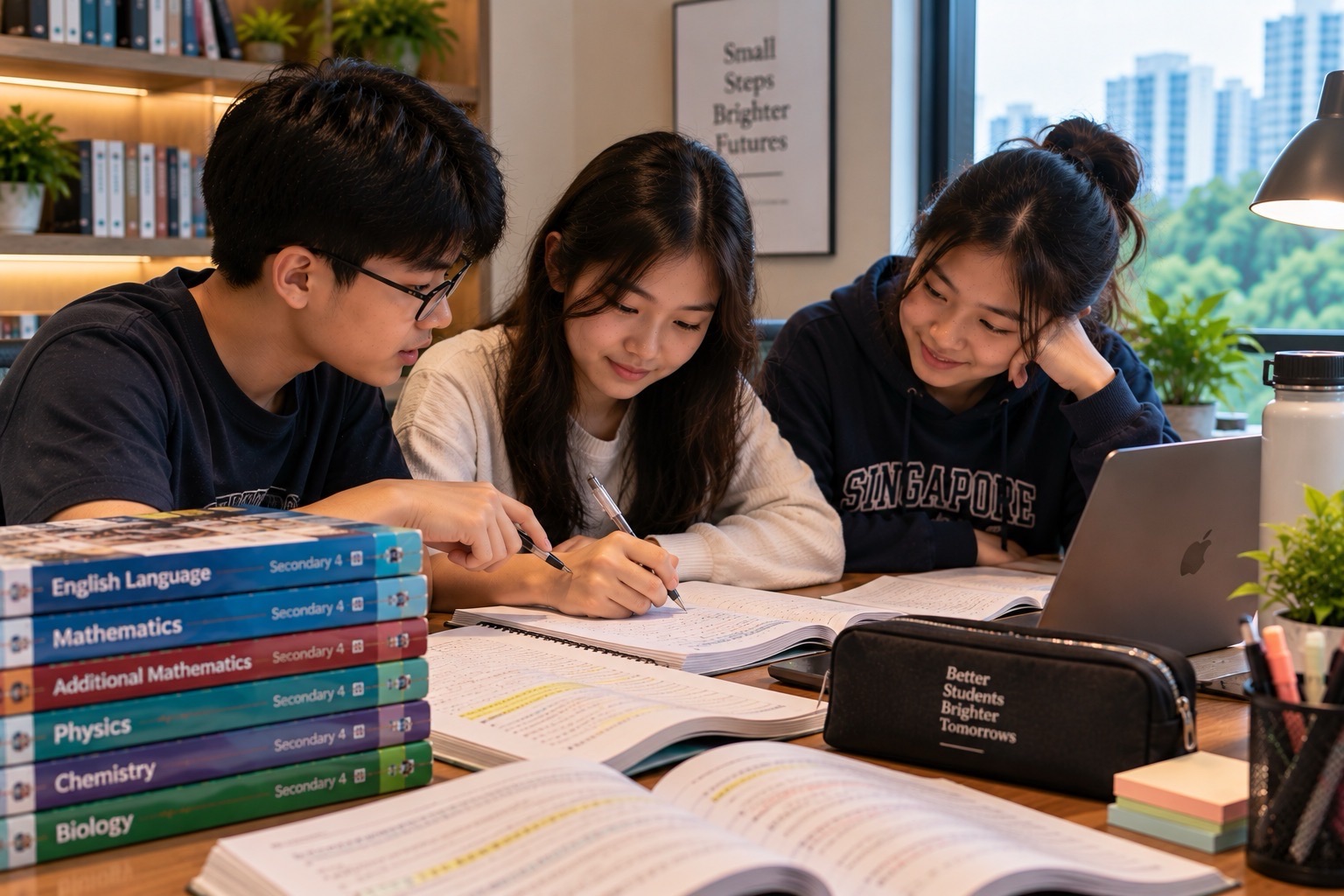
G1 Mathematics Tutorials | Keong Saik Road helps secondary-school families from Keong Saik Road, Bukit Pasoh, Chinatown and Tanjong Pagar find patient, precise Mathematics teaching at eduKateSG. Our premium three-student tutorials take place at 8 Fourth Avenue near Sixth Avenue MRT, with first-principles work on fractions, ratio, percentages, measurement, data and early algebra.
G1 Mathematics tuition becomes more useful when a child can name the quantity required before selecting an operation. A ratio gap differs from a total, a fraction of a remainder uses a new whole, and a percentage saving is not the price paid. Our Keong Saik Road tutorials use original worked examples, changing conditions and independent checks so students can apply the relationship in unfamiliar school problems.
Keong Saik Road describes the family’s locality or after-school meeting context, not an eduKateSG branch. Lessons are at Sixth Avenue. Families comparing tuition should consider the whole evening: school dismissal, the journey, a meal, the lesson and the return home. A worthwhile class should repay that commitment through clearer thinking rather than simply send the child home with more unfinished work.
Our established three-student tutorial format uses 1.5-hour weekly lessons, learning materials, guided corrections and focused continuation work. Suitable placement and current availability are confirmed directly. We begin with a parent–student consultation and genuine schoolwork, so the first plan responds to the learner rather than a broad label such as “weak at Maths”.
Arrange a parent–student consultation · Ask about G1 Mathematics on WhatsApp · eduKateSG on Facebook
G1 Is a Mathematics Level, Not a School Year
G1 identifies a subject level, while Secondary 1 identifies a school year. A suitable tutorial needs both pieces of information. A student beginning secondary school may need help with the transition into symbolic work; a graduating learner may need broader consolidation. The same subject-level label does not mean their current lessons should be identical.
SEAB’s 2027 school-candidate listing identifies G1 Mathematics as K110. Under the Singapore-Cambridge Secondary Education Certificate framework, students take subjects at their respective G1, G2 or G3 levels from 2027. SEC is not a fourth Mathematics level. The school’s programme and applicable syllabus remain the academic references.
We use that distinction to choose appropriate questions, not to limit expectations. A G1 learner can explain why a method works, compare two representations and notice an unreasonable answer. Difficulty can increase through unfamiliar wording or reduced assistance before it increases through more demanding content. The goal is understanding that belongs to the student, not successful imitation of someone else’s working.
The examples in this article are original teaching illustrations, not official examination questions or a complete syllabus inventory. They are selected according to the student’s school year, current coverage and readiness. Where a question introduces an additional step, the tutor first checks that the simpler relationship is secure enough to support it.
The Small Decision That Often Causes the Large Error
A pupil may correctly finish a textbook page but become uncertain when a new question does not announce its method. The first difficulty may be reading the given number: is it a total, a part, a difference, an amount remaining or a measurement in the wrong unit?
Keong Saik Road is part of the conserved Bukit Pasoh district. URA documents shophouses at Nos. 1, 50 and 69, with architectural features and changing historical uses. Those are real place facts, not the measured building dimensions or prices used in our teaching examples.
We ask the child to state what the question wants in a short phrase before calculating. A ratio bar shows which parts are additional, a running table identifies the current stock before a second fraction, and a shaded sketch distinguishes area from perimeter.
In a three-student session, one learner may need that concept rebuilt, another may need consistent arithmetic and unit checking, and a third may be ready to attempt a changed problem without visual hints.
After a guided example, we change one important condition. The principle later returns without the topic heading, allowing the tutor to see whether the first decision has become independently available rather than only copied.
What Three Students Allow the Tutor to Notice
In a three-student lesson, the tutor can inspect the route to an answer while it is being constructed. One pupil may read a question correctly but lose a negative sign. Another may draw a useful bar but misidentify the whole. A third may reach the correct number through a method they cannot explain. Those attempts should not receive identical feedback.
The tutor can ask each learner to explain the first decision, give a suitable prompt and then step back. A pupil who needs the total labelled receives that support initially. A pupil who already understands the relationship can attempt a changed question without a diagram. The shared topic remains coherent while the next step is adjusted to the individual.
Peer discussion is useful when students compare explanations rather than merely exchange answers. One learner might notice that a unit conversion is easier before calculating volume; another may show a number-line check for a signed-number result. Each then needs an independent attempt. Understanding a classmate’s explanation is not yet evidence of being able to select the method alone.
Parents should be able to ask what this attention changed. A useful answer names the misunderstanding, the explanation and the follow-up check. “The student now identifies which amount the second fraction refers to” describes a testable skill. “We completed more fractions” describes activity, but does not tell the family whether the original difficulty has been repaired.
The Foundations We Keep Connected
What signed numbers describe
A temperature starting below zero and then rising describes a position followed by a change. Students can show this on a number line before simplifying a signed-number expression.
When a question asks for the final value, a positive net change is not necessarily the final positive position. Distinguishing these objects prepares students for algebra and coordinates.
Which whole a fraction belongs to
A fraction can refer to the original amount or to what remains after an earlier step. We use a short running record so each calculation has a named reference quantity.
The child must eventually identify the whole without a tutor circling it first. A changed question can test whether the relationship is understood.
When to add or subtract ratio parts
A given total corresponds to the sum of the ratio parts; a given difference corresponds to their difference. The student labels the actual quantity before dividing.
After the initial model, we swap the supplied total for a supplied difference. Choosing a new opening operation is meaningful evidence of understanding.
A discount amount is not a discounted price
The percentage removed and the percentage still payable both describe the original price. A final answer must identify which one the question requested.
A bar model or a complementary percentage can provide a different check. The aim is accurate interpretation rather than exclusive reliance on one shortcut.
Measurement units tell a mathematical story
Centimetres measure lengths, square centimetres areas and cubic centimetres volumes. Conversions should be completed where necessary before combining quantities.
A correctly calculated number with the wrong unit may reveal that the student has measured the wrong object. We use units as an active check.
Data summaries are not the original observations
A mean can be fractional even when each observed daily count is a whole number. It summarises a set rather than describing a single observed day.
We contrast total, average and range so students choose the summary requested instead of applying a formula simply because it was used in the last question.
Keong Saik Road G1 Mathematics Casebook: 12 Original Worked Examples
The following 12 original worked cases separate verified Keong Saik Road heritage chronology from invented classroom figures. Hypothetical prices, counts, dimensions and rates are not current local facts or official SEC examination questions; every exercise is intended to teach a relationship and a check.
1. A verified building year and a difference between years
URA’s 50 Keong Saik Road record identifies a 1929 inscription on a shophouse group’s pediment. It also explains that this was three years after the road was named, corresponding to 1926.
Subtracting 1926 from 1929 gives a three-calendar-year difference. That subtraction does not prove a construction project lasted three years; it simply compares two documented events.
A changed *fictional* timeline places events in 1935 and 1942, giving seven years between them. The child should identify the earlier event and the interval before subtracting.
The real dates are sourced from URA, while the new timeline is labelled as invented. Both can teach time arithmetic without mixing fact with a story.
2. A ratio difference is not the combined total
Two fictional groups have shares in the ratio 4:7, with the larger group containing 45 more counters. Three extra parts therefore represent 45, so each part is fifteen.
The counts are sixty and 105. Check 105 − 60 = 45 and simplify 60:105 to 4:7. Adding all eleven parts before dividing the difference would start from the wrong mathematical model.
A changed question provides a combined total of 165. Now the eleven parts form the whole and each part is fifteen, but the reason for division has changed.
These are imaginary counters, not actual hotel guests, association members or businesses at Keong Saik Road.
3. One total in the ratio five to eight
A fictional learning workshop shares 312 cards in the ratio 5:8. Thirteen equal parts represent the whole, so each part is twenty-four. The groups receive 120 and 192.
The check is 120 + 192 = 312 and 120:192 simplifies to 5:8. A child dividing only by eight would confuse one share’s ratio number with the whole.
A new problem gives the difference of seventy-two instead of the total. Its three extra parts become the relevant reference for the opening calculation.
The method should transfer when the known amount changes, not only when the ratio values change.
4. Successive fractions must use successive wholes
An imagined school activity starts with 320 labels. It uses one quarter, or eighty, leaving 240. Two fifths of the remaining 240 are ninety-six, leaving 144.
Computing two fifths of the original 320 instead would ignore the changed reference quantity. A short stock table records the whole before each fraction.
Check 80 + 96 + 144 = 320. The changed question explicitly uses two fifths of the original, requiring a different second quantity.
The figures do not describe real Keong Saik businesses or conservation projects.
5. Discount saving, reduced price and fixed charge
An invented resource kit costs $160. A 12.5% discount saves $20, leaving $140. A fixed $9 service charge produces a final payment of $149.
The saving, discounted amount and final payment are separate quantities. Calculating $20 correctly would not answer a question asking how much is paid.
Reverse to check: $149 − $9 = $140 and $140 + $20 = $160. A changed example provides the final payment first.
These amounts are fictional, not a price list from Keong Saik Road restaurants, cafes or hotels.
6. Both lengths change on a scale drawing
A hypothetical display measures 3.6 cm by 2.4 cm on a scale plan of 1:250. The actual lengths represented would be 900 cm and 600 cm, or 9 m by 6 m.
The area is 54 m². Scaling the drawing’s area directly by a length factor of 250 only once would omit the second dimension.
Check each side conversion and state the area unit. A reverse task gives an actual dimension and asks for the corresponding drawn length.
The rectangle is fictional and is not a measurement of 1, 50 or 69 Keong Saik Road.
7. An outside frame expands two dimensions
A fictitious board measures 2.5 m by 1.5 m and receives an outside frame 0.1 m wide along every edge. The new external dimensions are 2.7 m by 1.7 m.
The board area is 3.75 m² and the complete framed area is 4.59 m², so the frame covers 0.84 m². We add border width at both ends of each dimension.
A changed task puts the frame inside and requires the learner to predict shrinking rather than expanding dimensions.
Nothing here is a measured heritage façade or window frame.
8. A fifth observation changes the mean
Four invented counts are 12, 16, 20 and 24. Their total is 72 and mean eighteen. Adding a fifth count of 33 raises the total to 105 and mean to twenty-one.
The learner can predict the mean should rise because 33 exceeds the old mean. The final mean should remain below the added value.
An inverse question supplies the new mean and the original four observations, asking the student to reconstruct the fifth.
The numbers are not actual pedestrian counts or historic shop transactions.
9. A departure time found by working backwards
An imaginary meeting begins at 6:05 pm and a fictional travel and preparation allowance totals 48 minutes. Planned departure is therefore 5:17 pm.
Subtract five minutes to reach 6:00 and another forty-three to reach 5:17. Adding the full 48 minutes forward checks the result.
Clock minutes follow a base-sixty system, not ordinary decimal subtraction. A short time line can help until the hour boundary becomes familiar.
These are teaching figures, not a verified commute from Keong Saik Road to Sixth Avenue.
10. Fixed fee and repeated items
An invented project costs $12 to set up and $6 per item. With a total of $90, the relation 12 + 6n = 90 yields n = 13.
The $12 is paid once while the $6 charge repeats. A table at zero, one and two items gives totals of $12, $18 and $24.
For a budget of $89 only twelve full items fit, costing $84. A thirteenth would exceed the limit, so rounding upwards is not valid.
The pupil should explain why n is a non-negative whole count rather than merely report the algebraic result.
11. Capacity expressed in compatible units
Three imaginary containers each hold 2.4 litres, for a total of 7.2 litres or 7,200 millilitres. At 300 millilitres per cup, this fills twenty-four full cups.
Converting to millilitres before division ensures the numerator and denominator describe the same volume unit.
Multiplying 24 by 300 mL checks the total. A new cup size may leave a remainder, which cannot be rounded into another completely filled cup.
These are classroom capacities, not actual Keong Saik Road services or infrastructure.
12. Area is not the same as outer perimeter
An imaginary rectangular display measures 7 m by 4 m. Its area is 28 m² while the outside perimeter is 2(7 + 4) = 22 m.
A one-metre inside border on every edge leaves a 5 m by 2 m central region of area 10 m², so the border covers 18 m².
Shading the border and tracing the outside edge reveal why area and perimeter need different units and procedures.
The display is invented, not an actual installation in the Bukit Pasoh conservation area.
Our First-Principles Teaching Sequence
Diagnose before assigning more practice
We inspect a short attempt and ask the student to explain it. The first wrong decision matters more than a broad topic label. “Applied the second fraction to the original amount” gives the tutor a clear target. “Needs more fraction practice” is too general to determine whether the next question should teach interpretation, calculation or checking.
Make the relationship visible
A number line, bar, running-total record or diagram is chosen because it clarifies the specific difficulty. We do not insist on one representation for every question. The learner should be able to say what each part of the representation means and connect it to the calculation. A drawing copied without that connection can become another procedure to memorise.
Fence one new difficulty at a time
Our Fencing Method controls what changes. A ratio task might first give the total, then one share, then the difference. A measurement problem might first use one unit throughout, then require a conversion. The sequence exposes the boundary of understanding. If numbers, wording, units and relationships all change together, a failed attempt is harder to diagnose usefully.
Reduce prompts deliberately
The tutor may model the first solution, guide the next with questions and observe a third without interruption. A student is allowed a genuine thinking interval. We intervene when the learner cannot identify the relationship or repeats an invalid approach, not merely to avoid a pause. Independence needs an opportunity to appear without the adult pre-empting every decision.
Return after the model is no longer fresh
A later question checks whether the idea remains available without the worked page open. The task is short and relevant. The learner attempts it first, then compares the reasoning with the earlier explanation. We record how much help was needed, so a correct supported answer is not silently treated as independent mastery.
Mix methods rather than announce every chapter
A mixed set might contain a time interval, a fraction of a remainder and a perimeter question. The student must choose a relationship rather than repeat the previous operation. The questions need not be unusually difficult. Their value comes from removing the chapter cue and showing whether the learner can recognise what kind of mathematical decision is required.
Finish with a correction that can travel
The correction states the mistaken assumption, the repaired idea and a cue for the next problem. “Identify what the given ratio quantity represents” applies beyond one set of tokens. A later changed question tests that cue. The notebook should preserve usable thinking, not just a collection of attractive solutions that the student could not start alone.
What a Ninety-Minute G1 Tutorial Can Look Like
A possible lesson begins with ten minutes of earlier-topic retrieval and fifteen minutes of concept explanation. Twenty-five minutes of guided practice then introduce controlled variations. The tutor uses each attempt to decide whether to retain a representation, reduce a prompt or pause for a prerequisite repair. These are illustrative allocations, not a fixed timetable applied to every learner.
Twenty minutes can be used for independent application, followed by ten minutes of correction and ten minutes to review the learning and set continuation work. Those segments total ninety minutes. The balance changes when a student needs a slower explanation or is ready for more unfamiliar work. The structure serves the learning; the learner is not forced to fit the clock.
The session should leave a small but meaningful record: the relationship taught, the error repaired, a question attempted independently and the next task. Parents can ask the student to explain one example rather than describe the entire lesson. The tutor should also be able to identify what has not yet been established, rather than imply that every completed page proves lasting understanding.
Repair, Stabilise or Extend
The repair route is for a missing idea. A child who cannot explain the whole in a fraction question needs reconstruction with manageable values. The stabilisation route is for an understood idea applied inconsistently, perhaps because the reference quantity changes or a unit is omitted. The extension route is for stronger independence, new contexts and comparison of methods when the foundation is already reliable.
These routes describe tasks, not permanent categories of children. The same learner might need repair in signed numbers, stabilisation in measurement and extension in data interpretation. A good programme can hold those differences together. It does not make every topic equally easy or equally difficult merely because the student’s overall school mark falls within a particular range.
A useful extension asks why an apparently reasonable answer is wrong. For instance, why is the overall temperature change not the final temperature? Why does a correct volume calculation still require a unit conversion? Explaining these distinctions can deepen a G1 learner’s reasoning without prematurely moving into another syllabus or using complexity simply to make the lesson look advanced.
An Illustrative Twelve-Week Learning Arc
A twelve-week plan is a framework for reviewing evidence, not a promise of a particular grade or a requirement that every child finish the same topics. School coverage, attendance, existing gaps and upcoming assessments change the sequence. The important feature is that each phase has a teaching purpose and an independent check.
Weeks 1–3: locate the first missing connection
We review schoolwork, confirm the year and level, and sample a few relevant prerequisites. A student might understand fraction operations but misread the reference quantity. Another might label quantities accurately but calculate with decimals unreliably. The first phase selects a consequential repair and records an honest starting attempt. It should not produce a long weakness list without a practical next lesson.
Weeks 4–6: connect repair to current schoolwork
The school’s current topic becomes the main application. A unit conversion may support volume; a better understanding of equal parts may support ratio; a clearer distinction between change and final value may support a graph. Earlier repairs return briefly. The student should see why revisiting a foundation helps the work happening in school now.
Weeks 7–9: remove familiar clues
We vary the wording and mix suitable questions. Students practise identifying whether a number is the total, a remainder or a difference, and whether a calculation has found the requested answer. The tutor reduces help and records which choices remain independent. The purpose is not to make every task long, but to test whether a method can be selected without its usual heading.
Weeks 10–12: inspect what has become dependable
A fresh question checks the original priority under comparable conditions. We look at accuracy, explanation, independence and checking. Short timing controls are introduced only where the underlying method is sufficiently secure. The next cycle follows the evidence. A calendar date does not justify moving on from a concept that the student still cannot explain or use without substantial assistance.
A Short Independent Check Parents Can Use
Try these four prompts separately from the worked examples. A quantity starts at −6 and increases by nine: what is the final value? A bag contains 120 counters and one quarter is removed: how many remain? Two shares are in the ratio 2:5 and total 63: what are the shares? A rectangle is 8 cm by 5 cm: what is its perimeter?
The answers are 3, 90 counters, 18 and 45 counters, and 26 cm respectively. The useful evidence is not the number alone. Ask which quantity was being found and how the answer could be checked. The ratio shares should add to 63; the perimeter should include two lengths and two widths; the final signed value should be distinguished from the change of nine.
This is not a placement test, an official assessment or a prediction of a grade. It is a conversation starter. If the student needs help, note what kind: reading the question, identifying the relationship, calculating or interpreting the result. That information gives the tutor a better starting point than simply reporting that two answers were wrong.
School Alignment Without Repeating Every Worksheet
We ask for current topics and upcoming assessment scope so the lesson remains relevant. A student studying data may need help reading a scale, while one studying measurement may need a short decimal repair. Returning to a prerequisite can be school alignment when the connection is clear. The tutor should explain that connection rather than leave the family wondering why an earlier topic reappeared.
Schoolwork is also diagnostic material. We use a question to identify the failed decision and then create a suitable variation. A child who can only reproduce the original worksheet may still struggle when the assessment changes its presentation. The tutorial therefore respects the school sequence without making exact repetition its entire purpose.
Pre-teaching can be appropriate when foundations are ready. The aim is a calm first encounter, not an impressive claim about early coverage. If a learner does not understand the current relationship, another layer of unfamiliar symbols is unlikely to make that relationship clearer. Secure understanding determines the next step more usefully than speed through a chapter list.
Home Practice with a Clear Purpose
A suggested between-lesson routine is one earlier question, one current application and one correction to explain. The amount is adjusted to the child’s school demands. The first attempt should be genuine: ask what is known and required, but avoid immediately supplying the operation. A short period of productive thinking gives the learner a chance to develop an independent starting habit.
When help is needed, record it. A fully assisted correct page is useful practice but not proof of independent control. Preserve the unsuccessful attempt and note the exact obstacle. “I did not know whether the fraction referred to the original amount” tells the tutor something teachable. An erased page replaced by a copied solution hides that information.
Parents do not need to become a second tutor. Their helpful role is to protect a manageable study window, invite an explanation and keep the conversation specific. The task should finish with a clear account of what was attempted and what remains uncertain, not with an argument about why a tired child has not completed another large set.
Reading Progress Beyond One Test Score
Look for actions that can be observed again: the student labels the reference quantity, starts a ratio question without a hint, converts units before calculation or checks whether an answer is reasonable. These are useful signs even before a school assessment samples the repaired topic. The tutor should be able to show them in work, not only describe the child as more confident.
Compare similar demands under comparable conditions. Two papers may contain different chapters, so their total percentages do not isolate a particular skill. A fresh question using the same relationship gives a more focused check. Note whether the child used notes or prompts. Responsible tuition does not promise a fixed grade after a predetermined number of lessons; it makes the next learning decision clearer.
For examination-specific work, the existing SEC Examination Mathematics Tuition | Duxton guide discusses assessment preparation. This article focuses on the continuing G1 tutorial that builds the understanding on which useful paper practice depends.
Travelling from Keong Saik Road to Sixth Avenue
All Mathematics tutorials are at eduKateSG, 8 Fourth Avenue, Singapore 268674, near Sixth Avenue MRT (DT7). Keong Saik Road describes a family’s locality around the Bukit Pasoh conservation district, not a separate eduKateSG branch.
Keong Saik Road has conserved shophouses, including those documented by URA at 1, 50 and 69 Keong Saik Road. The street’s cafes and hotels may have changed over time; these are neighbourhood landmarks, not education-centre premises.
Families may begin near Chinatown MRT, Outram Park or Maxwell, depending on the exact address and school route. Chinatown MRT (DT19) is on the Downtown Line, connecting directly towards Bukit Panjang to Sixth Avenue (DT7) without an interchange. An Outram Park or Maxwell starting point may call for a different line or route.
Plan from the exact point of departure using LTA’s Downtown Line information. We do not offer one door-to-door duration or transport fare for the whole road.
A realistic plan includes travel, a meal, the ninety-minute small-group tutorial, schoolwork and returning home. The benefit should be stronger independent Mathematics, not a longer evening for its own sake.
Class Details and Consultation Materials
Format: premium 3-pax small-group tutorials. Subject: G1 Mathematics, matched to school year and current programme. Duration: 1.5 hours weekly. Location: 8 Fourth Avenue near Sixth Avenue MRT. Attendance: by appointment, subject to suitable placement. Confirm current fees, available times and any trial arrangements directly rather than treating this guide as a guarantee of a vacancy.
Bring a recent marked paper, ordinary homework, the current topic list and teacher comments. Include an example the student solved successfully as well as one that caused difficulty. Leave original working visible and note where help was used. The consultation should produce a specific next priority and an independent way to check it, not a dramatic label based on one score.
Frequently Asked Questions
Does every G1 student need tuition?
No. A child who understands school lessons, completes work independently and receives sufficient feedback may not need another class. Support is worth considering when a specific gap, repeated inconsistency or appropriate extension goal has been identified. The consultation should help the family judge whether the proposed support has a clear purpose and fits the student’s week.
Will you repeat the whole primary syllabus?
Not automatically. We return to the prerequisite affecting current work. A fraction misunderstanding may need a focused repair before a secondary application becomes manageable. That does not mean every primary topic should be restarted. The tutor should explain which earlier connection is being rebuilt and how a later question will show whether the repair is usable.
What happens when my child understands an example but cannot begin homework?
We distinguish following a model from selecting a method. Prompts are reduced gradually, and a changed question is attempted independently. The tutor checks whether the barrier is reading, representing the relationship, recalling the method or executing it. Repeating the explanation may help, but it is not automatically the right response to every difficulty starting alone.
Can a confident G1 learner be challenged?
Yes. Challenge can involve a changed known quantity, an extra condition, a comparison of methods or a more independent explanation. It need not begin with premature material from another subject level. Any proposed school subject-level change should be discussed with the school; enrolling in tuition does not independently authorise or guarantee such a change.
How do you handle mistakes usually called careless?
We identify the action that failed. A lost sign, a wrong reference quantity, a missed unit conversion and an incomplete final interpretation need different checks. The correction records a useful cue for a future problem. The next changed attempt shows whether the student can use that cue rather than merely agree that the earlier answer was wrong.
Should we practise with a timer every evening?
Not when the relationship is still unclear. A missing concept needs explanation and a fair independent attempt before speed becomes the main demand. Short timed tasks can be useful when the method is secure enough to test under pressure. The tutor should explain what the timing is intended to reveal rather than use a clock as a universal solution.
Are lessons physically on Keong Saik Road?
The tutorials described here are at 8 Fourth Avenue near Sixth Avenue MRT. Keong Saik Road identifies the family’s locality or travel context. Confirm the class, venue and appointment before attending. The article title should not be read as an advertisement for a separate Keong Saik Road classroom.
What should parents ask after the first month?
Ask which question the student can now begin without hints, which recurring error has reduced and which relationship remains uncertain after a delay. Request an example of independent work rather than only a list of completed chapters. The answer should help determine the next step and acknowledge where more evidence is still needed.
Keong Saik Road G1 Mathematics: A Parent-Friendly Transfer Clinic
Start with a ratio total and a ratio difference to see whether the learner recognises which parts of the bar correspond to the given amount.
Follow with a changing-stock question. Ask the pupil to state which whole is present before taking the second fraction rather than blindly calculating.
Use a simple conversion question with clear units, then change the requested output from capacity to number of full smaller containers.
Model only the concept that was missing. A diagram should illuminate why an operation fits, not become another picture the child feels compelled to copy.
Change one feature and ask the student to start without hints, recording whether the correct first operation was selected.
Homework can be modest: one familiar question, one changed example and a brief check expressed in words or units.
A later mixed question returns to the principle after a delay, without a chapter heading to tell the child what technique to use.
Parents can ask what the problem wanted and why the answer is sensible while allowing the pupil to carry out the reasoning.
A Student Who Can Explain, Check and Begin Again
Our goal is not a child who never makes a first-attempt mistake. It is a learner who knows what is being found, chooses a relationship, calculates carefully and can inspect the result. When an approach fails, the student has somewhere useful to return: the quantities, the diagram, the units or the original question.
For Keong Saik Road families, a G1 Mathematics tutorial should make that independence more visible over time. We rebuild what is missing, stabilise what is inconsistent and extend what is ready. The value of the lesson is the clearer thinking that the learner can carry into the next question when the tutor is no longer beside them.
Questions Keong Saik Road Parents Ask About G1 Mathematics
Is G1 the same as Secondary 1?
No. G1 is a Mathematics subject level; Secondary 1 is a school year. We confirm both.
Why does my child know arithmetic but struggle with a new word problem?
The required quantity or reference whole may not be recognised until the tutor names the method.
What is important in a ratio difference question?
Use the extra ratio parts to interpret the difference rather than dividing by all parts blindly.
Are the historical dates genuine?
The 1929 inscription and preceding road-naming interval are sourced to URA; other classroom figures are invented.
Should every lesson create a large homework load?
No. A changed independent task with a reasoned check may give stronger evidence of understanding.
Can a confident G1 learner receive extension?
Yes, through unfamiliar conditions, varied representations and independent explanation.
Are classes held inside Keong Saik shophouses?
No. The tuition venue is at 8 Fourth Avenue near Sixth Avenue MRT.
What should parents look for after several lessons?
A fresh question the child can begin unaided and a previously repeated error that is reducing.
Keong Saik Road G1 Mathematics: Verified Heritage, Honest Models
URA places Keong Saik Road within the Chinatown–Bukit Pasoh Conservation Area. Its record of 1 Keong Saik Road describes conservation guidelines, including preservation of historic residential-front features.
The URA record of 50 Keong Saik Road explains a 1929 inscription on a group of shophouses and names the road’s connection to Tan Keong Saik. These are historical facts, not numbers supplied by a fictional word problem.
At 69 Keong Saik Road, URA documents how a building was reconstructed to preserve the overall appearance of an older three-shophouse grouping at Nos. 67, 69 and 71. We use this as an example of real conservation context, not as a measured geometry task.
Read Things to do in Singapore | Keong Saik for the neighbourhood narrative. Our classroom prices, area figures, times and group counts are original invented quantities, explicitly distinct from these records.
Keong Saik Road G1 Mathematics: Verified Related Learning Routes
G1, G2 and G3 Mathematics are subject levels, and SEC is their common qualification pathway rather than a fourth Mathematics level. The linked SEC Examination Mathematics Tuition | Tanjong Pagar guide covers the separate intention of paper-focused execution.
- Things to do in Singapore | Keong Saik
- Things to do in Singapore | Craig Road
- Surviving Tuition | Tanjong Pagar
- SEC Examination Mathematics Tuition | Tanjong Pagar
- URA | 1 Keong Saik Road
- URA | 50 Keong Saik Road
- URA | 69 Keong Saik Road
- Mathematics Learning Hub
- Singapore Mathematics Tuition by Area Index
- The eduKate Mathematics Learning System
- The immutable small-group Mathematics reference
- G1 Mathematics Tutorials | Keong Saik Road
- G2 Mathematics Tutorials | Keong Saik Road
- G3 Mathematics Tutorials | Keong Saik Road
- SEC Mathematics Tutorials | Keong Saik Road
- SEAB 2027 G1 subject syllabuses
Lessons are at eduKateSG, 8 Fourth Avenue near Sixth Avenue MRT. Confirm the student’s school year, subject level, suitable three-student group and appointment; a Keong Saik Road title does not indicate a separate branch.
Keong Saik Road Parent Questions: Mathematics and the Learning Routine
Does G1 mean Secondary 1?
No. G1 is the level at which Mathematics is studied; Secondary 1 is a school year. Both affect lesson selection.
Should every G1 learner work at the same pace?
No. One may need a fraction concept reconstructed, while another needs more unfamiliar word problems and reduced prompts.
Why does my child calculate correctly but miss marks?
The answer may describe the wrong quantity, lack a unit or use an incorrect reference whole. We identify the first wrong decision.
Do you teach only the current school chapter?
We follow school priorities while revisiting prerequisites when they block current work, and keep old skills active through short retrieval.
Can a G1 learner be stretched?
Yes, through stronger reasoning, new contexts and independent checks rather than automatically importing another subject level.
When is timed work suitable?
When the student understands the method. Timing does not repair a missing relationship.
Does G1 Mathematics have an SEC code?
The 2027 SEAB school-candidate listing identifies G1 Mathematics as K110.
Where is the teaching centre?
At 8 Fourth Avenue near Sixth Avenue MRT, not on Keong Saik Road.
What evidence should parents request?
A fresh problem solved independently, an error reduced and a specific next teaching priority.
Arrange a Parent–Student Consultation
Tell us the student’s school year, G1 Mathematics programme, current topics and the questions that repeatedly cause difficulty. Bring a few genuine work samples and a realistic weekly schedule. The first plan should begin with a teachable next step.
Contact eduKate Singapore · Chat on WhatsApp
eduKateSG
8 Fourth Avenue
Singapore 268674
Near Sixth Avenue MRT
Premium 3-pax small-group tutorials
By appointment
Properly taught kids shine a bright light into the future.