
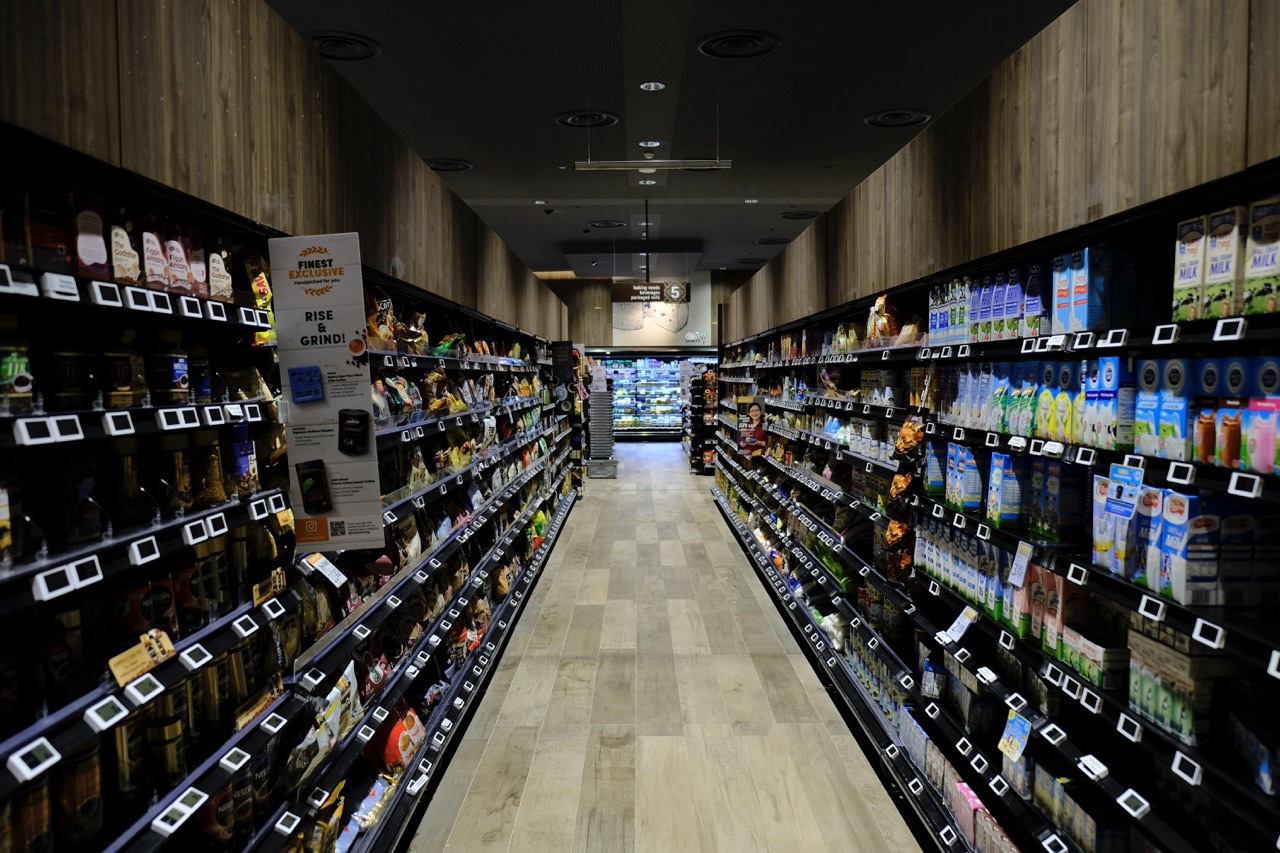
Did you know? A G1 Retail Operations student might accurately count stock, describe a customer preference and explain how an online order is fulfilled. Those are real and useful skills. But a G3 Economics student asks a different set of questions: why might prices rise, what makes shoppers change their choices, how are scarce resources allocated, and what happens when economic policies create competing effects? For the 2027 Singapore-Cambridge Secondary Education Certificate (SEC), G1 Retail Operations K132 and G3 Economics K343 are not levels of the same subject.
The first step in a useful bridge is not memorising an economics essay. It is turning practical retail observations into clearer questions about scarcity, demand, supply, costs, consumer decisions and the limits of evidence. A child can begin that reasoning with a fictional shelf of snacks and a few transparent numbers, without operating a real business.
This article is part of the eduKateSG Full Subject-Based Banding (Full SBB) parent series, but a cross-subject learning bridge does not confer an examination entry. Retail Operations K132 is a joint MOE–ITE Applied Subject Certification, separate from SEC academic certification. G3 Economics K343 is available only to candidates from approved schools. The school decides whether the relevant programmes, prerequisites and subject combinations are available to the individual pupil.
Understand the two qualifications before planning a transfer
| 2027 fact | G1 Retail Operations K132 | G3 Economics K343 |
|---|---|---|
| Credential | Joint MOE–ITE Applied Subject Certification; not an SEC grade | Singapore-Cambridge SEC G3 Economics subject |
| Paper 1 | One-hour written paper; 30 marks; 30% | One-hour MCQ paper; 40 marks; 30% |
| Other assessment | Handling Retail Processes practical; 30 minutes; 30% | Two-hour structured Economics paper; 80 marks; 70% |
| Third component | Selling Skills; 40%, including supervised preparation and a short practical | No retail selling practical; Paper 2 requires data and economic analysis |
| Coursework or application | Customer service, retail stock/order processes and digital sales pitch | Economic graphs, allocation, market behaviour, government policy and global trade |
| Availability | Approved schools only; 2027 is the final listed MOE–ITE applied-subject examination year | Approved schools only for K343 |
These entries are grounded in SEAB’s official 2027 Retail Operations K132 syllabus, the 2027 G3 Economics K343 syllabus and SEAB’s G1 school-candidate directory. A crucial warning for families is that the 2027 SEAB directory identifies this as the final examination year of the listed MOE–ITE Applied Subjects. Do not assume a child in a later graduating cohort can register for an unchanged K132 examination.
Which retail skills transfer to Economics?
| Retail activity | Useful Economics skill | A question to develop |
|---|---|---|
| Customer enquiry | Recognise customer preferences | What might change consumers’ willingness and ability to buy? |
| Price display | Read price data accurately | Is a price change causing a movement along a demand curve? |
| Restocking | Recognise supply and production constraints | What happens when delivery costs or supplier availability change? |
| Promotions | Evaluate evidence rather than promises | Does a rise in one shop’s sales prove a change in whole-market demand? |
| Stock shortage | Observe scarcity and trade-offs | Which customers or products are prioritised when resources are limited? |
| Online fulfilment | Recognise technological change | How can a new distribution method affect costs, incentives and access? |
The transferable value is precision. Retail employees cannot fulfil an order using a vague statement that stock is probably available; similarly, an Economics student should not say prices always rise when demand rises without specifying the market and assumptions. Both disciplines benefit from accurate observations and careful reasoning.
Worked example: a missing product does not prove demand has increased
A hypothetical school-store shelf usually holds 40 notebooks, but only 10 remain at the end of a day. There are at least several possible explanations: many were sold, fewer were delivered than expected, some were moved to storage, or the stock record is inaccurate. The change in visible stock alone does not prove a rise in market demand. The student should first ask what the inventory and sales records show.
An Economics explanation may then consider an actual change in the determinants of demand or supply. If delivery costs rise and sellers are willing to offer fewer notebooks at each price, the simplified supply model may shift left. If a price promotion leads customers to buy more notebooks at a lower price, that could represent a movement along the existing demand curve, depending on what else changed.
The parent can ask the child to write one observation, two plausible explanations and one additional piece of evidence needed to choose between them. This is a better starting point for economic thinking than claiming that a particular trend has a single cause.
Worked example: price, quantity and the correct graph
Suppose a fictional item costs $4 and 100 units are demanded in a simple classroom model. When its price rises to $5, 80 units are demanded, with all other determinants held constant. The example represents a movement along the demand curve. Price belongs on the vertical axis and quantity on the horizontal axis in a standard demand diagram.
Now imagine that at every price, consumers become more willing to buy because their preferences change. That might shift demand to the right. A student should not move the curve merely because the new outcome has a different price. The reason the outcome changed determines which diagrammatic analysis is appropriate.
Do not use these fictional figures as a claim about actual Singapore retail behaviour. Real markets are more complex; the diagram teaches a particular model and its assumptions.
Opportunity cost: the shelf-space question
A shop has one display table and can use it either for reusable bottles or for school stationery. Assume both options are feasible, and the shop chooses stationery. The opportunity cost includes the value of the best alternative forgone: the bottle display. It is not necessarily equal to the amount paid for the table.
The student can then ask whether the choice affects earnings, customer access, waste or stock turnover. An Economics answer distinguishes the scarce resource, alternatives and forgone benefit. The decision can be reasonable even when it sacrifices something valuable; the important point is recognising that the sacrifice exists.
The wider G3 Economics syllabus is not just retail prices
- The basic economic problem: scarcity, opportunity cost and factors of production.
- Allocation of resources: demand, supply, price, elasticity and market imperfections.
- Microeconomic decision-makers: households, workers, firms and their choices.
- Government and the macroeconomy: economic growth, inflation, unemployment and policy.
- Economic development: living standards, indicators and differences between societies.
- International trade and globalisation: specialisation, trade policy, exchange rates and external relationships.
A Retail Operations student may have strong experience with one firm but little formal teaching about national inflation or international trade. That is a curriculum gap to be addressed through school instruction, not proof that retail experience lacks value.
A four-week preparation routine
Week 1: Observe retail decisions without guessing causes
Create a fictional merchandise table showing stock received, units sold, units returned and stock remaining. Verify the arithmetic and distinguish quantity from revenue. Ask what the observed figures prove and what further data would be needed to discuss customer demand. Introduce scarcity and opportunity cost using shelf space, staffing or delivery capacity.
Do not use real customer names, order numbers or confidential workplace records. Synthetic data are sufficient to teach the structure of the reasoning.
Week 2: Teach supply and demand with explicit assumptions
Use two small price-and-quantity tables and sketch appropriately labelled curves. Explain a movement along demand and a shift caused by a different determinant. Repeat with a supply scenario involving delivery costs. Ask the pupil to explain their diagram aloud and check whether the arrows correspond to the written facts.
A correct sketch with the wrong economic story is not a fully correct explanation. The parent should ask, ‘What changed besides price?’ before approving the answer.
Week 3: Extend from one shop to wider economic effects
Discuss a hypothetical rise in transport costs for several firms. Ask how producers, consumers and workers might be affected, then explain which claims are assumptions and which require real evidence. Introduce inflation as a broad price-level concept rather than assuming one expensive item establishes the national inflation rate.
Use official or teacher-approved sources when referring to genuine Singapore policy or statistics. This exercise is not a claim that one policy would certainly produce a particular outcome.
Week 4: Write a data-response judgement
Offer a fictional case involving a retailer, two short tables and a possible policy or business response. Ask for a numerical interpretation, a labelled economic diagram, one explanation and a reasoned conclusion with an important limitation. Compare the student’s independence and clarity with Week 1, not simply the number of definitions memorised.
Four weeks is a suggested skills sequence, not an MOE-approved transfer period or a promise of K343 admission. The school’s teacher must decide what additional learning would be needed for an actual Economics enrolment.
How to prepare for the written Economics papers
The 2027 K343 written scheme includes a 40-question, one-hour multiple-choice Paper 1 worth 30%, and a two-hour Paper 2 worth 70%. Paper 2 contains a compulsory 20-mark data-response question based on an economic situation and three selected structured questions. The learner must understand concepts, read data, construct appropriate analysis and evaluate where required.
A student who enjoys practical retail assessment may need specific writing practice. The key is not producing very long answers but building a causal explanation, choosing relevant evidence and making a defensible judgement. The written requirements make a genuine difference to the student’s weekly workload.
A note about school approvals and the 2027 cutoff
K132 belongs to the G1 MOE–ITE Applied Subject group, and 2027 is listed as the final examination year of that group. K343 Economics is a G3 Cambridge subject restricted to approved schools. Neither fact creates an automatic path from one credential to the other. Check the student’s year group, registered subjects and the current school’s subject options before making plans.
Post-secondary entry depends on the institution’s actual eligibility and admission rules for the relevant year. An external course, an applied-subject certificate and an SEC academic grade should not be represented as interchangeable credentials.
Do you know? Parent questions
Can a child move from G1 Retail Operations directly to G3 Economics?
There is no automatic progression. They are different subjects and credentials, and the receiving school must approve any available upper-secondary combination. The student can learn Economics concepts privately, but that alone does not grant official enrolment.
Does K132 count as a G1 SEC academic result?
No. The K132 syllabus specifies Joint MOE–ITE Applied Subject Certification rather than Singapore-Cambridge SEC certification. Ask the school how it is recorded for the student’s specific future pathway.
Can retail sales data prove an economic theory?
Small, accurate datasets can illustrate a model, but one shop’s sales cannot establish a whole-market causal claim. Sampling, timing, customer mix and other factors matter.
Is G3 Economics only about retail and business?
No. It includes macroeconomics, development, government policy and international trade as well as market models and the decisions of firms and households.
Does every school teach G3 Economics?
No. The 2027 school-candidate directory specifically limits K343 to schools approved to offer it.
Learn the reasoning, not merely the label
The immutable eduKateSG Secondary 1 Mathematics Tutor Clementi small-group tutorial reference illustrates how close observation of working can identify a precise misconception and test an independent correction. The same educational principle applies here: spot when a pupil confuses a stock shortage with a demand increase and ask them to justify a revised answer using evidence. That Mathematics page remains unchanged.
Related learning paths include G1 Retail Operations to G3 Business and G2 Geography to G3 Economics. Consult the official K132 syllabus and the official K343 syllabus for the examined course in 2027. A sound bridge helps a learner describe retail evidence precisely, build a valid economic explanation and respect the limits of both qualifications.