
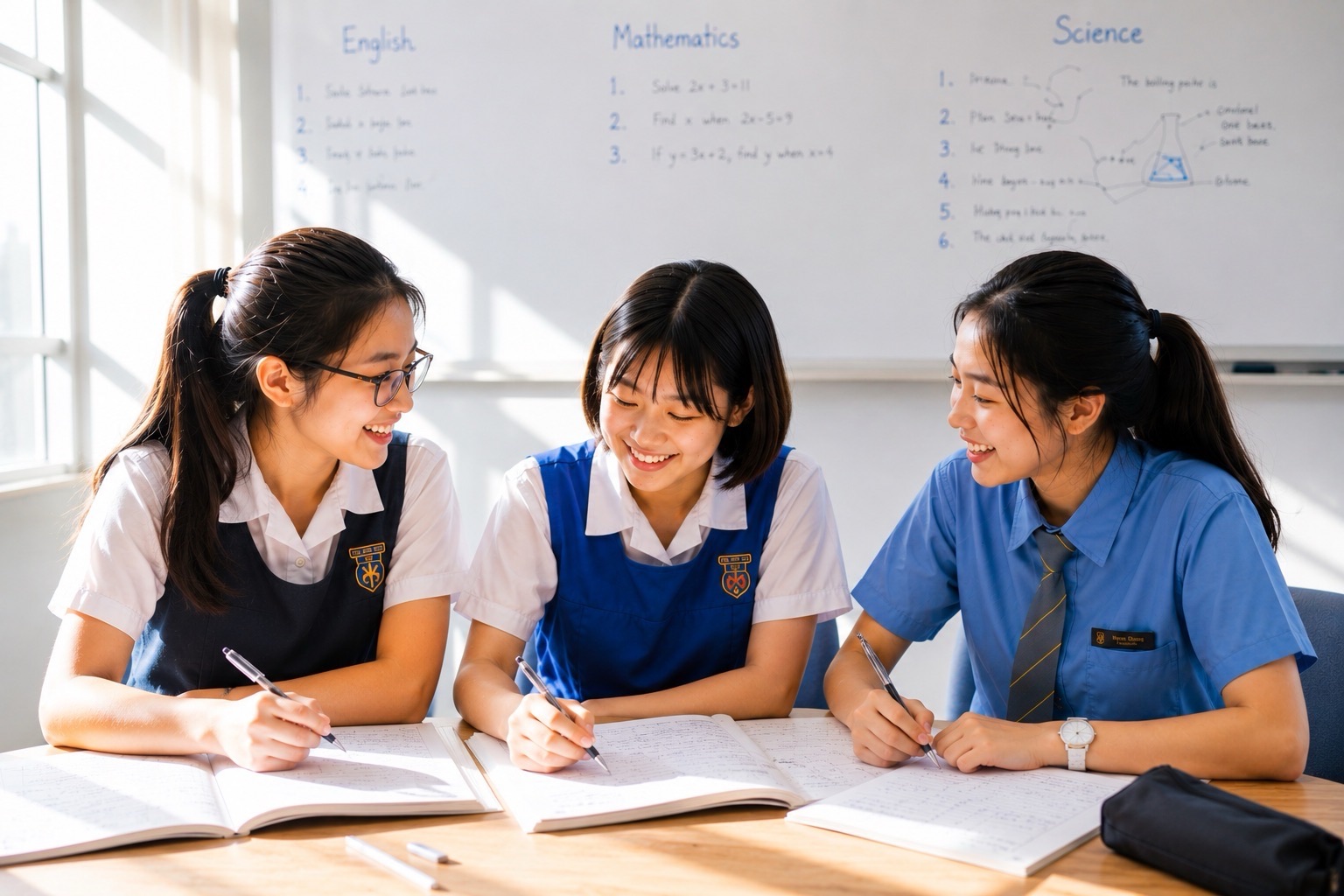
G1 Science tutorials for Boon Keng families can turn an uncertain Science lesson into a sequence a student understands: notice the evidence, measure what matters, explain the relationship and try an unfamiliar example independently. eduKateSG uses a three-student small-group teaching model so a tutor can see each learner’s diagram, data choice and reasoning, not simply whether a final answer happens to be correct.
Parents searching for G1 Science tuition near Boon Keng, Secondary Science tutorials in Singapore, or preparation for the Singapore-Cambridge Secondary Education Certificate often want the same practical outcome: a child who can explain Science without memorising a paragraph that stops making sense when a question changes. The goal here is to show exactly how diagnosis, first-principles teaching and carefully chosen practice can build that independence.
This guide serves families based in Boon Keng, not an eduKateSG branch operating in the neighbourhood. Classes and consultations are arranged at eduKateSG’s teaching location at 8 Fourth Avenue, Singapore 268674, near Sixth Avenue MRT. We check the student’s school year and actual G1 Science subject level before discussing any placement; G1 is not a synonym for Secondary 1.
For suitability, send a G1 Science enquiry or arrange a parent–student consultation. This article also works as a practical guide even for a family not considering tuition: the exercises below can be adapted to home revision with a notebook, simple diagrams and safe, supplied data.
Science Learning Lens: Boon Keng as a Starting Point, Not an Answer Sheet
Boon Keng belongs to the wider Kallang–Whampoa urban setting. NParks describes Kallang Park Connector as running through Upper Boon Keng and other districts along the Kallang River. That landscape gives us good questions about water, organisms, human activity and measurement. The facts of a Science exercise, however, must come from an explicitly provided dataset. We never claim that a fictional water reading is an actual reading of the Kallang River.
A familiar neighbourhood can make unfamiliar Science less intimidating
Imagine a learner recognising a riverside pathway from a family outing. We ask a simple question: What can a photograph of a pathway tell you, and what would require a measurement? The child may describe shade, plants or an apparently wet surface, but cannot infer a surface temperature, water quality or movement rate from appearance alone. This single distinction between noticing and proving is a useful beginning for G1 scientific literacy.
A tutor then supplies two fictional temperature readings, 31 °C and 35 °C, with a stated time interval and the same measurement method. The student can calculate a 4 °C increase, identify which surface is warmer and explain the limitation: two readings alone do not establish why the difference occurred. We praise the sensible observation while teaching the learner to separate what the numbers show from what still needs testing.
Water and flow: identify the system before calculating
A paper diagram may show water entering a container at 300 millilitres per minute and leaving at 180 millilitres per minute. If those rates remain constant, the net increase is 120 millilitres per minute. After three minutes the increase is 360 millilitres, not 900 millilitres; the outgoing flow matters. We use an imagined container, not a real waterway, to teach how inputs and outputs make a system.
When a learner gets 900 millilitres, we do not label the work careless. We ask the learner to draw arrows, label each rate and state what the calculation represents. A new case changes the outgoing rate rather than merely changing the numbers. If the student corrects the reasoning in the new case without prompting, that is evidence of understanding.
Nature observations: description is not a mechanism
Greenery along the wider river corridor is a pleasant context for thinking about plants, animals and habitats. A student may see a bird near water and infer that it eats fish. Yet location does not establish diet. We provide a fictional observation log with times, counts and relevant behaviours, then teach the child to report the recorded pattern before suggesting an explanation. A claim is stronger when the evidence supports it and weaker when an unstated assumption carries most of the argument.
In a classroom worksheet, students compare two drawings of leaves collected from imaginary study sites. They can record shape and visible structures, but should not assign a species or a function merely because the setting sounds plausible. The habit travels into tests, where a familiar picture often contains distractors that cannot support the answer.
Sheltered and unsheltered surfaces: build a fair comparison
Busy streets and covered walkways invite questions about light, shade and heat. If a student compares the temperature of a metal surface at noon with a wooden surface late in the afternoon, we ask whether time and material have both changed. They have; a conclusion about material alone would be premature. The child redesigns the comparison so the time, thermometer, exposure duration and relevant conditions are controlled.
This is not about treating everyday observations as meaningless. It is about making a claim small enough to defend. Students learn to say, ‘Under these stated conditions, this sample had a higher reading,’ before jumping to ‘this material is always hotter.’ The precision is useful far beyond Science.
Transport and journey times: connect a table to a graph
We might invent four travel segments for a fictional family journey: 100 metres in 50 seconds, 120 metres in 60 seconds, a 30-second pause and 180 metres in 90 seconds. The learner first calculates each moving segment’s average speed. Next, the learner asks whether a pause changes overall average speed even though the distance did not change during that interval.
The teaching challenge is not merely to perform division. A child must choose total distance and total elapsed time, include the pause and label units correctly. The resulting speed–time or distance–time representation provides another way to check whether the student owns the relationship.
When the Boon Keng context disappears
A Science question in an assessment is unlikely to mention Boon Keng. After a familiar example, we change the setting to a farm, a mountain research station or a laboratory apparatus, retaining the same scientific relationship. If the child can explain what stayed the same and what changed, the local analogy has served its purpose. Otherwise, we have helped the student remember a story rather than understand Science.
The Hidden Problem: Recognising a Keyword Is Not Understanding It
A child can circle the word evaporation and still misunderstand which process is being described. Another child can state that a circuit needs to be complete but cannot trace the pathway through a diagram containing a switch. A third can identify a plant structure accurately yet give a function that belongs to something else. All three may look like weak revision on a report, but their next lessons should be different.
The first student needs a distinction between a process and the evidence for it. The second needs spatial tracing and checking of connections. The third needs to connect structure to function. Merely assigning the same stack of worksheets treats separate obstacles as though they were one.
Our initial diagnostic conversations use short questions that uncover the decision process. We invite the learner to describe what the question is asking, underline the evidence and show how an answer was chosen. Saying ‘I guessed because this word appeared in the notes’ is not a failure of character; it is useful information about the point at which instruction should resume.
For example, a pupil writes that a wet towel becomes dry because water disappears. The phrase is a workable observation but not a scientific explanation. We can ask what happens to the water and how the process might be influenced by temperature, exposed area or moving air. The child then needs to distinguish an observed change from an explanatory model.
The best response is not always a longer sentence. It may be a precise diagram with arrows, a correct comparison of rates or one causal statement. We teach students to make each sentence carry an idea supported by the task.
Where G1 Fits in Singapore Secondary Science
Full Subject-Based Banding allows subjects to be taken at different subject levels; students in the same secondary year need not study every subject at the same level. MOE’s Full Subject-Based Banding information explains that broader framework. ‘G1 Science’ describes a subject level, not an age, year or school stream.
From 2027, students sitting national examinations do so under the Singapore-Cambridge SEC framework, which records G1, G2 and G3 subjects. The 2027 G1 Science syllabus listing identifies Science under code K123. For an individual pupil, the actual school work, examination year and subject code are the planning documents, rather than a generic internet checklist.
Families occasionally ask whether early secondary students should start using final-examination papers immediately. Our answer depends on what a paper is meant to reveal. An unseen exam-level question can be an excellent small diagnostic; many timed full papers can be discouraging when a learner is still struggling to read apparatus diagrams. We build accurate reading and explanations first, then extend to mixed and timed work when that will measure genuine progress.
For lower-secondary students, topic sequence and internal assessments are guided by the school and the relevant programme. The end-of-secondary SEC route matters as a destination, not as a reason to rush past foundational Science. Where a question uses terminology from a different subject level, we treat it as extension, not as proof that the pupil should already know it.
Eight G1 Science Skills We Build Explicitly
1. Read what a measurement actually says
Consider a thermometer marked at 2-degree intervals. The number to record depends on where the indicator sits relative to the marks and on the question’s expected precision. A learner who counts printed lines rather than spaces may be wrong by a consistent amount. Instead of writing the correct answer beside the question, we ask the learner to explain the scale, the unit and the reading method.
We use pictures of rulers, clocks, scales and measuring cylinders, with some cases containing an unusual starting value. Once a child can read a clean diagram, we add extra labels and ask which matter. This builds a transferable approach to practical-data questions.
2. Tell a value, a change and a rate apart
The temperature is 28 °C; it has risen by 5 °C; it rose by 5 °C in 10 minutes. Those statements answer different questions. We teach them through side-by-side tables and number sentences, because students often give a correct difference when the question asks for a final value, or a total when it asks for a rate.
After a worked example, we ask the pupil to create three questions from the same data: one about a reading, one about the difference and one about change per unit time. Making a question is a revealing test of understanding.
3. Turn a table into a scientific statement
A table must contain labels, units and enough context that another reader knows what was measured. If a student writes only ‘time’ and ‘height’, we ask ‘time since what event?’ and ‘height measured in which unit?’ Their revised table might specify minutes after watering and plant height in centimetres. We do not pretend imaginary readings are real experimental findings.
The student then writes one true statement directly from the entries and one plausible explanation requiring a further investigation. Learning the difference reduces unsupported answers in structured questions.
4. Use diagrams to trace systems
Food chains, simple circuits, transport routes and energy-transfer diagrams can all be read as relationships. We ask where something enters, what happens in the middle, what leaves and which arrows are evidence for the conclusion. Some students remember diagram labels but cannot follow the process, so they must redraw the diagram with fewer labels and explain it aloud.
A strong diagram is not decorated with every word from a chapter. It communicates enough structure to make a question answerable. Students practise annotating only the features necessary for the explanation.
5. Choose a property that fits a purpose
When selecting a material for an object, naming many properties is less useful than choosing the property relevant to the scenario. A water container needs a property that addresses leakage; a window raises different questions about light transmission and strength. We supply property data when a judgement needs it, and we encourage a comparison rather than an unsupported guess.
Learners explain ‘Material A is more suitable here because…’ and finish with the evidence from the table. They also learn that a property can be useful in one application and undesirable in another.
6. Distinguish a physical observation from a causal explanation
A cube of ice becomes smaller. The observation alone does not specify whether heat transfer, the surrounding conditions or the setup explains its rate of melting. We ask learners to report the visible change and then name the process that accounts for it, within the limits of the question. This prevents the common habit of treating an outcome and a mechanism as interchangeable.
We sometimes provide two student answers and ask which is an observation, which is an inference and which is an explanation. The learner justifies the classification instead of memorising a rigid sentence pattern.
7. Recognise controls in simple investigations
Imagine two seedlings grown under different light conditions but also watered at different frequencies. If the experiment seeks to compare light, watering is an uncontrolled difference. A fair comparison means deciding which variable changes, which outcome is measured and which other conditions remain comparable. It does not mean that every real-world factor can be controlled perfectly.
We practise turning weak experiments into stronger paper designs. The pupil should be able to name one improvement and explain why it changes the evidence, rather than write ‘make it fair’ as an empty phrase.
8. Explain and check an unfamiliar question
Many students do well after a teacher demonstrates a topic but struggle when the next exercise looks unfamiliar. We use the sequence: identify the goal, extract the data, choose a relationship, work, state units and check reasonableness. The learner eventually performs this without seeing the tutor’s method first.
A check may be a rough estimate, reverse calculation, boundary case or comparison with the diagram. This is how we reduce avoidable errors without telling children to ‘be more careful’ and hoping the instruction somehow works.
Why a Three-Student Tutorial Needs Three Independent Answers
The advantage of a three-student class is not that three is a magical number. It is that a tutor can ask everyone to answer before anyone copies a confident classmate. We often begin with silent individual work, followed by a short comparison of reasons. One pupil’s unusual method may be efficient; another’s familiar method may hide a misconception.
Imagine an apparatus question asking which of three containers has the fastest change in water level. One learner uses the highest final reading, one uses the largest difference and one correctly compares change over time. The class provides three valuable reasoning paths. The tutor can explain which question each method actually answers, then give a new case with unequal time intervals.
The same principle applies when a student answers correctly. We ask for the reasoning only when it adds diagnostic value: what evidence was used, what alternative was rejected and whether the method works with new numbers. Constant interrogation can reduce confidence; timely explanation builds it. A good tutor chooses the moment carefully.
Because every child has a turn to think, silence is not treated as an absence of ability. We can reduce the first task to one label or one comparison until the learner has something truthful to say. Confidence grows from doing a step independently, not from being told repeatedly that the question is easy.
What a Focused G1 Science Session Can Look Like
Opening retrieval: find out what remained from last week
We start with three short, different checks rather than a long recap of definitions. One may involve a simple unit conversion, one a labelled diagram and one a verbal explanation. The purpose is to distinguish knowledge that can be retrieved without support from content recognised only when the notes are open.
Diagnose the first unstable move
If an answer is wrong, the tutor looks at the earliest decision that made the rest of the work unreliable. Perhaps the student selected the wrong graph axis or misread a scale. Fixing that first move is usually more productive than rewriting the whole model answer.
Teach one relationship in a clear form
The tutor chooses a representation the pupil can follow: real objects where safe, sketches, tables, number lines or diagrams. We explain only the amount needed to make the next decision possible. Science is learned through connected meaning, not through a performance of complicated vocabulary.
Move to a new representation
A child who can answer from a diagram next tries a table; a student who follows a table next explains in words. Changing representation prevents an accidental success based on the layout of a single worksheet.
Create a small productive contrast
We place two almost-similar questions beside each other. For example, ‘Which container has more water?’ and ‘Which container gained more water?’ The small difference in wording matters. Students learn to read the command and quantity before calculating.
Independent transfer and short mixed work
Once the method is stable, we introduce an unseen question without the cue words from the demonstration. The tutor observes what happens before providing support. A few correctly chosen questions can give clearer feedback than a thick stack assigned without diagnosis.
Close with a genuine next step
Each learner finishes by naming one idea now understood, one error to watch for and a short piece of practice appropriate for home. We prefer a precise task such as ‘read five unusual scales and state the unit’ to ‘revise the whole chapter.’ Parents can then see what progress is meant to look like.
Three Learning Routes for Three Different Students
Route A: rebuild missing foundations
A pupil arriving from primary Science may recognise many topics while struggling with quantitative data and explanations. We begin with an accessible observable example and build the technical representation gradually. When comparing rates, the first lessons may involve total changes and time intervals, not an immediate timed multi-part question.
The success marker is the student’s ability to explain the relationship with different values and without borrowing the tutor’s wording. We then link it to a school topic and space the recall over subsequent lessons. Moving slowly at the beginning can avoid repeating the same confusion for a whole term.
Route B: stabilise inconsistent performance
Another pupil can solve topic exercises accurately but misses marks in mixed tests. Here the issue may be reading precision, attention to units or choosing a method when several are plausible. We interleave short questions and annotate the exact decision errors. The learner practises sorting the question before working it.
We compare results across two or three unfamiliar exercises rather than relying on one better score. A student who can now explain why a previously tempting distractor is wrong has gained a useful independent skill.
Route C: extend a secure learner
A student with strong fundamentals does not need more of the same exercise with larger numbers. We introduce unfamiliar contexts, require comparison of alternative explanations and ask what the evidence cannot prove. A high-performing learner may design a better investigation or critique a flawed graph.
Extension must remain aligned with the student’s actual G1 programme. The aim is stronger reasoning and intellectual curiosity, not racing into the vocabulary of another examination level for appearance’s sake. The ability to transfer a clear concept is a meaningful form of challenge.
Worked Example: A Rainfall Table With a Misleading Conclusion
The following is a wholly invented teaching dataset. A container on an imaginary bench receives 120 millilitres of water in the first 10 minutes, 90 millilitres in the next 10 and 60 millilitres in the next 10. A student claims that the container was emptied more quickly over time. Is that supported? No. The data gives incoming volumes for intervals; it says nothing about water being emptied.
First, the learner labels each interval, records the incoming volume and calculates the total incoming volume of 270 millilitres. Second, the learner notes that the amount arriving per ten minutes decreased. Third, we ask what further data would be needed to speak about outgoing water or total volume in the container. There is a real scientific limit to the conclusion.
A weaker answer may calculate 120 − 90 = 30 and stop. That difference is mathematically correct but does not answer the stated question. We teach the child to reconnect the calculation with the meaning of the values. A new version introduces an outflow and asks for a net change, explicitly listing the additional information needed.
Parents can try this at home by asking, ‘Which words in the question does your number answer?’ This is a more helpful check than asking only whether the calculator shows the same result.
Worked Example: Two Surfaces and One Unfair Test
In another fictional exercise, Sample A is measured under a lamp for five minutes while Sample B is measured for eight. The recorded final temperatures are 34 °C and 38 °C. A learner concludes Sample B absorbs more energy simply because its final reading is higher. The conclusion is not justified by those readings alone.
We ask what the student is trying to compare. If the purpose is the response of two materials under similar conditions, exposure time is one variable to control. Initial temperature, measurement position and the light conditions also matter. The child then rewrites the method, not just the answer.
Once the procedure is improved, we supply fresh data and ask what can reasonably be concluded. Sometimes the correct response is that the evidence remains insufficient. We deliberately teach that answer as a sign of disciplined thinking, not a failure to give the examiner the conclusion they supposedly want.
A final variation removes the familiar lamp story and instead uses insulated containers. The student should identify the same principle of comparability in a different setting.
Worked Example: The Circuit That Looks Complete
Consider a diagram with a battery, bulb, connecting wires and a switch drawn open. A learner sees wires surrounding the bulb and writes that it will light. Rather than telling the pupil to memorise the word ‘closed’, we ask them to trace an unbroken conducting path around the circuit. They encounter the open switch and must explain why the path is interrupted.
We then introduce two bulbs, move the switch and ask the student to predict which paths remain complete. The learner draws arrows to explain a functional path and checks each relevant junction. We are not asking for unsafe electrical work at home; paper diagrams and low-risk classroom teaching resources are sufficient for the reasoning.
The transfer test presents a different circuit drawing orientation. If the student relies on whether the picture looks circular, the new arrangement may mislead them. If the student is following connectivity, the skill transfers.
A Small Weekly Home Routine That Parents Can Actually Use
An effective routine does not need to turn the dining table into a tuition centre. Ten or fifteen focused minutes can be enough for a short retrieval check, one explanation and one corrected error, although the appropriate duration depends on the learner. The guiding question is whether the child has produced an answer independently.
- Monday: ask the learner to redraw and explain one diagram from memory, then check it against the school material.
- Midweek: use a different representation such as a table or graph; ask the child to state what the numbers prove.
- Weekend: revisit an earlier wrong question, solve an unfamiliar counterpart and write the earliest mistake that used to occur.
If a child cannot answer, parents can ask a smaller question rather than provide the final phrase. ‘What do the axes represent?’ or ‘Which number is the starting reading?’ gives a foothold. Once the learner responds, parents can step back and let the child complete the rest.
A home error log should be short enough to be read. Record the task, the wrong decision, the corrected idea and a date for another check. Avoid writing labels such as lazy, weak or careless in the log. Those words do not explain a scientific misconception and rarely tell anyone what to practise.
Where school guidance differs from a generic online resource, use the school’s current assignment and teacher feedback as the immediate reference. We treat national syllabus links as a framework for planning, not permission to override a child’s actual teaching programme.
Assessment Preparation Without Turning Every Lesson Into a Test
Familiarity is not the same as recall. When a learner reads an answer beside the question and says it makes sense, that is useful but incomplete evidence. We close the notes and ask for a short explanation in the student’s own words. A second check days later reveals whether the idea remains available.
Timed work becomes useful after the basic method is sufficiently secure to make the clock informative. Otherwise, the learner may repeatedly practise panic rather than Science. When timing is introduced, we distinguish slow reading, difficulty selecting a method and unnecessary rewriting of the same point.
An accurate improvement plan gives each type of difficulty a different response. Slow graph reading suggests practice with scale and axes. Repeated missing units suggests a finishing check. A confused mechanism requires concept repair, even if the child is completing papers quickly.
No one can guarantee a grade from a few practice scores. We prefer observable milestones: fewer unsupported claims, better graph interpretation, correct transfer to new questions and growing ability to correct an error without being shown the answer.
Access, Consultation and Class Suitability for Boon Keng Families
The tuition enquiry starts with the pupil, not with a neighbourhood label. We ask which secondary year they are in, which Science subject level they currently study, what kind of task is difficult and what their most recent school work shows. We also ask whether the family can travel to Sixth Avenue for suitable small-group arrangements.
Our teaching location is 8 Fourth Avenue, Singapore 268674, near Sixth Avenue MRT. Boon Keng is an area served by this article, not a second teaching address. Families should check their actual public-transport route and travel needs directly before planning a visit; no commute duration or local branch is implied here.
It helps to bring one paper where the child did well, one where they struggled and a piece of ordinary classwork. Contrasting examples reveal whether the issue is knowledge, interpretation, examination conditions or inconsistent execution. We never reduce a learner to a single result.
Class suitability also depends on compatibility with the group, school programme and current learning needs. A three-student setting is intended to make individual thinking visible. It should not be used to promise fixed improvements, exam predictions or a timetable that has not been confirmed.
Questions Parents Ask About G1 Science
Does G1 mean Secondary 1?
No. G1 refers to a subject level under Full Subject-Based Banding. A student can be in a particular secondary year and take different subjects at different levels. Confirm both the year and Science level before choosing materials.
Is this a Boon Keng tuition centre?
No. The article is for families from Boon Keng. eduKateSG’s stated teaching location for consultations and suitable tutorials is at 8 Fourth Avenue near Sixth Avenue MRT.
Do G1 students need to complete many papers?
Not necessarily. A focused mix of explanation, topic work, retrieval, unfamiliar application and later timed practice is usually more informative than assigning full papers before the student can read the question accurately.
Can the tutor prepare my child for the SEC?
Preparation is aligned with the student’s actual examination year and subject level. For 2027, the G1 Science syllabus is listed by SEAB under K123; confirm the learner’s registration and school guidance.
What if my child knows the notes but struggles in tests?
We examine what changes during a test: the reading demand, representation, memory retrieval, method choice or time pressure. Each has a different remedy. We do not assume the student simply needs to study harder.
What should parents do when an explanation is incomplete?
Ask which observation or piece of data supports it. Then invite the child to explain the relationship in one clear sentence. If the idea is still missing, note the gap for targeted teaching instead of supplying a speech to memorise.
Connected Reading for Boon Keng Families
For subject pathways, read G2 Science Tutorials | Boon Keng, G3 Science Tutorials | Boon Keng and SEC Science Tutorials | Boon Keng. Each serves a distinct level or examination-planning intention; they are not four names for the same class.
For younger pupils, use PSLE Science Tuition | Boon Keng or Primary 3 Science Tuition | Boon Keng. For locality context, explore Education and Tuition | Boon Keng and Why Singaporeans Love Boon Keng. These links distinguish primary-school support, neighbourhood reading and secondary Science.
To explore beyond one neighbourhood, start with the Singapore Science Tuition by Area Index or the Singapore Area Learning and Tuition Hub. The nearby G1 Science Tutorials | Bendemeer article provides a different place-based example of the same level.
A Good G1 Science Lesson Ends With a Student’s Own Explanation
When a child can name the relevant quantity, read the evidence, explain the scientific relationship and attempt a new question without a prompt, revision becomes less mysterious. There may still be errors; the difference is that they are easier to find and repair. We want students to understand why an answer works, rather than depend on remembering the exact worksheet where they first saw it.
For a Boon Keng family planning next steps, ask about G1 Science tutorial suitability and share the student’s current Science level, school year and one representative question. The discussion should begin with what that learner needs, not a promise that one tuition formula suits everybody.
Continue reading: explore the Science Learning Hub for related guides and reading routes.