
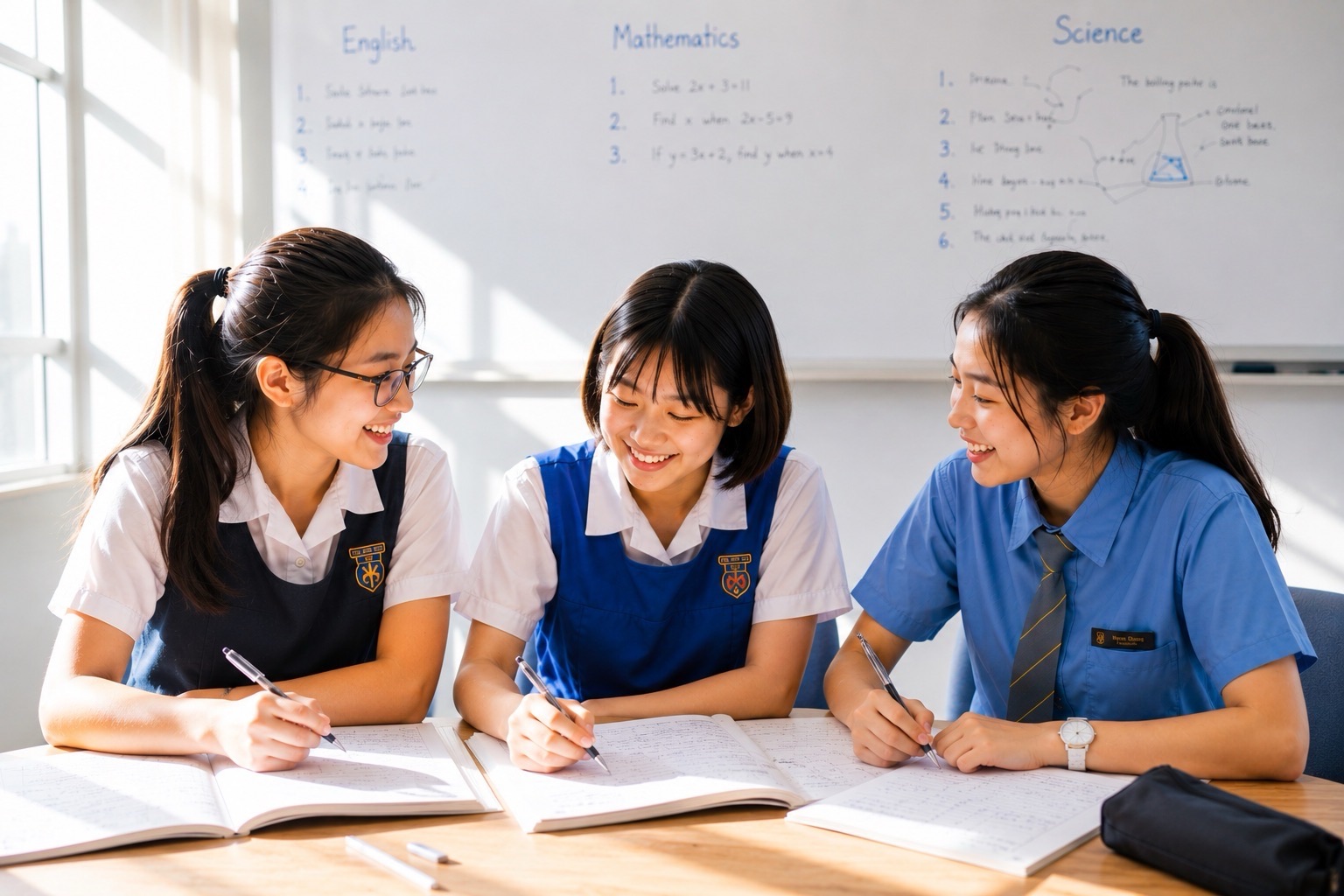
G1 Science tutorials for Circuit Road families should help a student look at an unfamiliar Science question and know where to begin. At eduKateSG, our three-student small-group teaching makes space for every learner to read the evidence, explain a choice and test the idea on a different example. We want children to understand what the question measures, why a relationship is useful and how to spot a conclusion that goes beyond the information provided.
Parents comparing G1 Science tuition near Circuit Road, secondary Science tutors in Singapore and Singapore-Cambridge SEC Science preparation frequently ask why a child remembers definitions but struggles in application questions. A pupil may correctly name power but compare total energy incorrectly, or describe a body part without explaining its function. We diagnose the first uncertain decision rather than assign an identical pile of worksheets to everyone.
Circuit Road is the neighbourhood served by this educational guide. It does not announce an eduKateSG classroom or a school partnership in the estate. Suitable lessons and consultations are arranged at 8 Fourth Avenue, Singapore 268674, near Sixth Avenue MRT. We confirm the student’s current secondary year and actual G1 Science subject level before recommending lesson content, because these are not the same thing.
For a purposeful first conversation, enquire about G1 Science tutorial suitability with a recent marked question. All distances, temperatures, apparatus designs and pupil examples below are original teaching illustrations, not real measurements from Circuit Road, Pelton Canal or any nearby park connector.
The Hidden G1 Science Problem: Familiar Words, Unfamiliar Relationships
A student may know the word energy while overlooking the time interval needed to compare power. Another may read the final temperature accurately but give it when asked for the temperature decrease. Sometimes the learner understands part of the topic and loses the connection between that part and the exact question.
We use one short diagnostic item to find that missing connection. Instead of saying the child is weak at a chapter, we ask which quantity the answer represents. A correct reading but incorrect subtraction needs different teaching from a pupil who misreads the scale in the first place.
Once the difficulty is known, the tutor preserves what was already correct and repairs the first faulty step. We then change the values or diagram. The child should learn the relationship instead of memorising the solution to one familiar worksheet.
Parents can recognise progress when their child starts asking better questions: does this figure mean per second or total, which interval is included, and what observation actually supports the claim? These choices make unfamiliar Science more manageable without encouraging blind guessing.
A useful explanation does not have to be long. One accurate statement connecting evidence and the relevant scientific relationship is more valuable than a paragraph full of unrelated terminology. We practise saying exactly enough to answer the question.
Circuit Road’s Everyday Science: A Park Connector and a Rain Garden
NParks describes Balam Park Connector as starting near Merpati Road and Circuit Road and winding through housing estates along Pelton Canal. It also identifies a rain garden near the park connector and the Circuit Road Food Centre at Block 79. Pelton Canal Park Connector connects towards other neighbourhoods. These real features can inspire safe Science questions, without pretending that a photograph provides measured water quality, temperatures or real travelling speed.
A rain garden is a question starter, not a laboratory report
We ask a child what might be worth investigating when rainwater meets different surface materials. One learner suggests measuring how much water passes through a model surface over a fixed time. Another proposes comparing how much the surface retains. Both ideas can become scientific questions when the measured outcome is clearly defined.
A fictional worksheet then supplies equal model containers, equal starting volumes and invented readings. Pupils work from that supplied data rather than enter a canal, collect unknown water or claim that the real rain garden has particular filtration performance. The local reference is a doorway to inquiry, not permission to invent findings.
A Circuit Road walk can explain whole-journey speed
Imagine a fictional route of 240 metres covered in three minutes, followed by a one-minute pause and another 160 metres in two minutes. Total distance is 400 metres over six minutes, giving a whole-interval average of about 66.7 metres per minute. The moving-only average would be 80 metres per minute, because the pause is excluded.
The tutor asks which average the question actually requests. We draw a timeline and make the difference visible. The next task changes the story to a toy moving along a table, and the pupil should still know which elapsed time belongs in the denominator.
Food-centre labels offer a ratio exercise
A fictional food label gives a nutrient amount per 100 grams and a different amount per stated serving. We practise converting the two bases, but make no recommendation about what a real child should eat or any actual food item sold at the Circuit Road Food Centre.
The student learns that two correct comparisons can use different denominators. A per-100-gram number cannot simply be compared with a whole serving number as though they describe equal quantities. That same care with units becomes useful in electricity, speed and body-system questions.
Remove the local story before judging transfer
After the student understands a park-connector journey, we replace it with a laboratory cart. A nutrition table becomes a material-composition table. If the learner can still explain the relationship, the contextual introduction has worked. If not, we return to the model rather than add more neighbourhood stories.
G1 Is a Subject Level, Not Secondary 1
MOE’s Full Subject-Based Banding guidance distinguishes a pupil’s school year from the subject level taken. G1 stands for General 1. It does not automatically mean that the child is in Secondary 1.
SEAB’s 2027 G1 subject directory lists Science K123. The Singapore-Cambridge SEC framework begins in 2027; SEC is the certificate name, not a fourth Science level above G3.
Upper-secondary G1 Science includes applications involving machines, food, and the body and health. We select examples that match the child’s actual school course. A demanding question from another subject level is not automatically an appropriate way to challenge a G1 learner.
For an earlier-secondary student, current school content and missing prerequisites come first. An examination-year student may need more integration of paper-specific demands. We distinguish untaught content from a concept that was taught but remains unclear.
During consultation we check the current year, school Science course, marked work and actual timetable. The official syllabus identifies what belongs; the student’s work identifies where teaching should begin.
Machines: Understanding Power, Energy and Time
A numerical answer needs physical meaning
An invented device transfers 1,800 joules in 30 seconds. Its average power is 60 watts. We ask what the value means in words: 60 joules transferred during each second on average in the model. A child who understands that statement can predict how the value changes when time changes.
If another device transfers the same energy in 60 seconds, its average power is 30 watts. It takes twice the time for the same total, so the rate is half as large. This verbal prediction should come before the calculator.
A new question gives an 80-watt model running at constant power for 45 seconds. The total transferred energy is 3,600 joules. The unknown changed, so the operation changed. We use units to explain why a rate multiplied by time gives a total.
The next pair of devices has different operating times. A higher-power device used briefly may transfer less energy overall than a lower-power device used longer. The pupil compares the full products rather than simply choose the largest rating.
What an appliance label cannot tell us
Power and operating time may be sufficient to model energy transferred under stated conditions, but they are not automatically enough to establish useful efficiency, material safety or running cost without additional information. We ask the child which question can be answered and which requires more data.
All device ratings in this article are fictional. Real household appliance work, mains wiring and unsupervised electrical testing are not part of this home revision activity.
A circuit is a network, not a familiar shape
A simple paper circuit contains a cell, lamp, switch and connecting wires. With an open switch in the only conducting route, the model predicts no current around that route. Students trace the path rather than merely count symbols.
We rotate the diagram and reposition the components without changing their connections. The outcome should remain consistent. Another version introduces a branch, and the learner traces each available path to decide what can still operate.
We ask pupils to explain why the drawing’s spatial arrangement does not determine series or parallel connections. This habit will remain useful when circuit diagrams become more complex at later levels.
Motion: Distance, Time and the Meaning of an Average
A pupil may know speed equals distance divided by time and still choose the wrong interval. The first task is to draw or annotate the timeline and decide whether pauses belong in the total. The wording of the question, not a memorised answer, determines the denominator.
Consider an imaginary traveller completing 150 metres in two minutes, pausing for one minute and then covering another 90 metres in one minute. Total distance is 240 metres and whole-trip elapsed time is four minutes. Average speed over that complete interval is 60 metres per minute.
If the question instead asks for speed while moving, the denominator is three minutes, giving 80 metres per minute. Both calculations can be valid in their own contexts. We ask the learner to say which one answers the stated prompt.
A changed example uses a distance–time graph. The horizontal segment represents an interval during which the recorded distance remains unchanged. Students should read the time scale accurately rather than assume every horizontal line means zero of every physical quantity.
We then replace distance–time with a different graph, such as recorded temperature against time. A horizontal segment now describes unchanged temperature, not lack of motion. The axes give the graph its meaning.
Food: Compare Labels on the Same Basis
A serving size changes the total
Product A is fictional and provides 6 grams of a nutrient per 100 grams of food. A 150-gram portion contains 9 grams. Product B gives 8 grams per 100 grams but its stated portion is 100 grams, containing 8 grams. A has less per 100 grams while its stated portion has more overall.
A child who wants to choose one universal winner may overlook what the question asks. We practise writing ‘per equal mass’ and ‘per stated portion’ explicitly. The number and its basis belong together.
The exercise is about proportions and scientific reading, not personal diet advice or a claim about actual Circuit Road food outlets. A single nutrient number is insufficient to assess an entire diet or a person’s health.
Separating mixtures means identifying the required product
A fictional mixture contains insoluble sand, dissolved salt and water. Filtration retains the insoluble sand in an appropriate apparatus but does not ordinarily remove dissolved salt from the water. We ask students to label where each material goes.
The next question changes the desired output. Collecting the sand and recovering dissolved salt require different reasoning about separation techniques. We select from methods already taught at the student’s appropriate level, not from every advanced laboratory procedure online.
A clear liquid after filtration is not automatically safe to drink. Appearance alone does not establish all dissolved substances or hazards. This paper exercise is not a procedure for treating canal or rain-garden water.
The Body and Health: Processes Instead of Lists
A student may label digestive organs perfectly and still be uncertain about where digestion differs from absorption. We trace a meaningful route and ask which process changes food into smaller substances and which moves useful substances across an appropriate boundary.
The tutor may remove one arrow or present a diagram in a new orientation. The child has to explain the connection without depending on the first textbook layout. This is a stronger check than writing the organ names repeatedly.
A similar approach helps with breathing, gas exchange and transport. The learner names what moves, where a relevant process occurs and how that step connects with the next. We keep the depth appropriate to the student’s current course.
An invented exercise counts 75 beats in 50 seconds and asks for a rate per minute. Under a constant average model it is 90 per minute. This is a mathematical rate question, not a medical assessment of a real student.
We avoid requests for personal medical data. Curriculum Science helps children reason with fictional measurements; individual medical questions belong with qualified health professionals.
The Fencing Method: A Reliable Start Without Guessing
Fence the given information
We teach pupils to distinguish readings, observations and irrelevant details. A model number on an appliance label may not be a quantity to calculate with, while a time in seconds might be essential. The learner underlines the measured quantity and unit.
Fence the requested answer
A question asks for an increase, not the final reading. Another asks for average speed over a whole journey, not during movement only. The child restates the unknown in a few words before calculating.
Fence what changes between cases
Two invented devices have equal total energy but different durations. A pupil predicts which power value should differ. Another pair has equal operating time and different rates. We change one meaningful condition so the learner understands why the answer changes.
Fence what remains comparable
An imagined cooling investigation uses different containers, quantities of liquid and exposure periods. We ask which of those differences would obstruct a fair comparison of a particular covering. The pupil specifies a suitable control instead of only writing ‘make it fair’.
Fence the conclusion to the evidence
A table may support a difference between readings but not an unlimited claim about what always causes that difference. We ask what additional measurement would strengthen the proposed explanation. A scientifically accurate answer should sometimes recognise missing information.
Worked Investigation: Final Temperature Is Not Temperature Change
Two imaginary cups start at 60 °C. After six minutes under stipulated comparable conditions, A reads 51 °C and B 46 °C. Their temperature decreases are 9 °C and 14 °C respectively. Students report the final values separately from the decreases.
A pupil who writes that B ‘lost 46 degrees’ has confused the final reading with the amount of decrease. We show how subtracting the final from the initial in this cooling example gives the change. The student then explains its unit.
The tutor changes B’s starting temperature to 70 °C while its final reading remains 46 °C. Now its decrease is 24 °C. A correct pupil must reconsider the starting value rather than simply point to the lowest final temperature.
The question then asks which material caused the difference. Even correctly calculated temperature changes do not uniquely isolate covering material unless other relevant conditions are specified. We practise distinguishing a descriptive result from a causal inference.
A final unseen question gives the measurements as a cooling graph rather than a two-column table. The learner identifies the interval and calculates without the tutor naming the method.
Worked Investigation: A Ruler Doesn’t Always Begin at Zero
An imagined object begins at the 4-centimetre mark on a ruler and ends at the 13-centimetre mark. Its length is 9 centimetres, not 13. A learner who chooses the endpoint may have read the printed number accurately but has not yet used the relationship between two positions.
The next object begins at 7 and ends at 18 centimetres, giving a length of 11 centimetres. The child writes the relevant subtraction in words and checks that the result describes distance between points.
Then the ruler is pictured vertically and its scale divisions become less familiar. The child must still find the two readings before calculating. A changed visual orientation should not change the underlying relationship.
We transfer the same concept into a graph asking for change across an interval. The scale is different, but the scientific question remains a comparison between two measured positions or values.
This is the kind of small prerequisite repair that can make Science work feel substantially more manageable without assuming the pupil needs to restart every earlier Mathematics topic.
Three Students, Three Different Corrective Tasks
Imagine three fictional learners answering the same speed question. One selects the wrong interval, another handles the interval but converts minutes incorrectly, and a third reaches the correct number without understanding its unit. A single model answer could hide these different needs.
Each pupil makes an independent first attempt. The tutor identifies which part of the process is uncertain and assigns a short targeted contrast. One student labels a timeline, another converts units, and the third explains speed as distance per time.
The group then attempts an unfamiliar common question. We observe whether the targeted skill appears without a reminder. A pupil who succeeds only after hearing a classmate’s method is learning, but the teacher must still check independent understanding.
Quiet learners need time to form a response; quicker learners can evaluate assumptions rather than simply race through extra calculations. A three-student class supports those choices when the group is appropriately matched.
Small class size alone does not guarantee improvement. We discuss subject level, pace, needs and actual availability before any arrangement.
An Example Session That Moves From Understanding to Transfer
An illustrative lesson starts with a few no-notes retrieval questions from recently taught topics. The tutor examines the first attempts before explaining. A short question can often reveal whether the learner confuses rate and total or misses a scale interval.
Guided teaching then makes one relationship visible using a clear diagram and friendly values. We ask the student to explain why the operation fits the quantity rather than copy the formula mechanically.
Next comes a contrast. A pause is added, a serving size changes or a circuit branch moves. Students predict which part of the answer must be reconsidered. This exposes the method’s conditions.
A fresh problem arrives without the original picture or annotations. Every pupil attempts independently. We record which choices no longer need hints and which still deserve focused practice.
The session ends with a precise correction and a later retrieval check. Actual lesson length and class arrangements are confirmed separately; the description illustrates a teaching sequence, not an offer of a particular slot.
Three G1 Pathways: Repair, Stabilise and Extend
Repair the first missing relationship
A learner who struggles to choose a denominator in speed may need a short ratio lesson inside the current Science topic. Another who misreads scales needs measurement practice. We repair what schoolwork reveals, then return to the original scientific task.
The first milestone is an independently correct step. A new question then checks whether that skill survives a changed context. Repair is a present teaching decision, not a permanent judgement of ability.
Stabilise concepts in mixed questions
A student may succeed on topic-labelled pages yet become uncertain in a mixed set. We remove headings, vary diagrams and ask pupils to identify the requested quantity. Delayed retrieval helps reveal whether understanding lasts beyond the last demonstration.
A useful checking habit is explaining why a tempting alternative answers a different question. The child gradually learns to correct an error before the tutor intervenes.
Extend the secure learner through evaluation
A confident G1 learner can propose additional measurements, challenge an unsupported comparison or design a fairer investigation. This can be demanding without importing another subject level’s entire syllabus.
We might ask for a counterexample to the claim that a higher-power device always transfers more energy. Constructing a valid comparison requires understanding the relationship and operating time.
A Manageable Home Revision Routine
Families can help without recreating an additional school day. A short retrieval task, one changed representation and a later revisit to an old error can create useful evidence of learning alongside normal school commitments.
- Early in the week, explain one known relationship without notes and name its quantities.
- Later, apply the idea to a different graph, table or everyday model.
- Revisit one mistake after a delay and identify the first decision that should now change.
- Only when the concept is secure, mix it with another topic so the child must choose a model.
A parent can ask ‘What does that number measure?’ or ‘What fact in the question supports your explanation?’ without supplying the entire solution. We want the child to think, not turn the adult into a permanent source of the first step.
An error note such as ‘used moving time instead of whole journey time’ is more useful than ‘be more careful’. The record should be short enough the pupil will actually return to it.
All place-inspired work in this article can be done with fictional datasets and printed diagrams. We do not recommend collecting unknown canal water, entering an industrial site or doing unsupervised electrical or chemical experiments.
Rest and attention matter. An exhausted learner copying twenty solutions may produce less evidence of independent reasoning than one thoughtful unfamiliar question.
Preparing for the G1 Written and Computer-Based Demands
The 2027 G1 Science K123 assessment scheme includes a computer-based Paper 1 and a written Paper 2, each weighted 50%. A pupil needs to interpret stimuli and construct responses, not only recognise the correct option in a familiar list.
We ask a learner who selects an answer to explain why a plausible alternative is unsuitable. Later, a written question with no choices checks whether the same scientific idea can be expressed independently.
School-provided familiarisation remains important for the actual examination interface. An ordinary worksheet or online quiz does not automatically reproduce official digital features.
Timed preparation becomes useful when foundational interpretation and concept selection are sufficiently stable. We examine whether time is spent reading, choosing, calculating, writing or checking. Those difficulties have different remedies.
Full papers are valuable for integrated readiness; short targeted tasks may be better when one core relationship needs repair. We choose practice by what it can teach and reveal, not simply how many pages it fills.
What Parents Should Notice Improving
One sign of progress is that a child begins a question by identifying its requested quantity rather than looking for any formula that uses the numbers on the page. Another is correct unit use and explanation of what a calculation represents.
Students may start recognising which conditions a conclusion needs. A pupil who notices that a temperature comparison changes starting values has gained a useful scientific checking habit.
We compare performance on new tasks and record whether hints were needed. A familiar worksheet completed after a guided solution and an unseen task completed independently do not provide the same evidence.
No tutor can responsibly guarantee a particular examination grade. Starting knowledge, school learning, independent practice and assessment demands all matter. Transparent skills and thoughtful checks are more meaningful than promises.
Additional tuition is not automatically necessary for every child. Where school learning is already effective, families may decide that present support is enough.
Getting From Circuit Road to the Actual Class Venue
eduKateSG’s stated teaching location is 8 Fourth Avenue, Singapore 268674, near Sixth Avenue MRT. The Circuit Road title serves a local audience; it is not a branch address.
Circuit Road has different starting points, and travelling from home or school can involve walking, buses or rail. Families should check the actual door-to-door journey rather than rely on a fixed time invented for the entire neighbourhood.
Bring the student’s current school year, G1 Science level and representative marked work. One successful response alongside a difficult one can reveal how changed conditions or diagrams affect understanding.
We consider whether a group of three is suitable for the child’s pace and learning needs. Timetable, availability, teaching materials and actual lesson arrangements must be confirmed directly.
Frequently Asked Questions for Circuit Road Parents
Does G1 mean Secondary 1?
No. G1 is a subject level under Full Subject-Based Banding. The pupil’s school year is a separate detail, and both matter for choosing suitable work.
Are lessons held at a Circuit Road centre?
This is an educational guide for Circuit Road families. The stated eduKateSG teaching and consultation location is Fourth Avenue near Sixth Avenue MRT.
Why does my child memorise definitions but lose application marks?
The learner may not yet connect concepts with the data and conditions in a new problem. We teach that link and test it in a changed context without hints.
Should G1 pupils attempt G3 Science questions for extension?
Not automatically. Extension can deepen evaluation and reasoning within the registered G1 course. Unrelated advanced material may not serve the current learning target.
Can a correct multiple-choice answer establish mastery?
It is useful evidence but does not automatically show the pupil can construct an accurate explanation. We check written transfer as well.
Are park-connector investigations part of tuition?
Our Circuit Road examples use published local context and fictional data. They do not ask pupils to sample waterways or perform unsafe fieldwork.
How much home practice should we expect?
The amount depends on the learner’s needs and school commitments. A few independent tasks with focused feedback may be more useful than many copied answers.
Can a tutor guarantee a grade improvement?
No fixed result can be guaranteed. We track specific independent learning decisions and check how reliably they transfer.
Connected Science Learning for Circuit Road
Choose G2 Science Tutorials | Circuit Road, G3 Science Tutorials | Circuit Road or SEC Science Tutorials | Circuit Road when the subject level or examination horizon differs. SEC describes the examination framework rather than another subject level.
Earlier-stage reading includes PSLE Science Tuition | Circuit Road and Primary 5 Science Tuition | Circuit Road. Local guidance also appears in Tutors | Circuit Road and How to Improve With Tuition | Circuit Road.
For other areas use the Singapore Science Tuition by Area Index. Official course guidance is available from MOE Full Subject-Based Banding and SEAB’s 2027 G1 syllabuses.
The Aim Is a Student Who Understands the Next Question
A child becomes more independent when a new question feels like something that can be investigated: read the quantities, identify the right comparison, choose a relevant scientific relationship and explain why the evidence supports the result.
Circuit Road’s park connector, rain garden and food-centre setting can spark curiosity, but understanding is demonstrated after those familiar images disappear. The learner should still know what the scientific variables and conditions mean.
Enquire about G1 Science tutorial suitability for a Circuit Road student with the current school year, Science level and one representative question. A precise teaching target is a stronger start than a vague promise that more worksheets will make every difficulty disappear.