
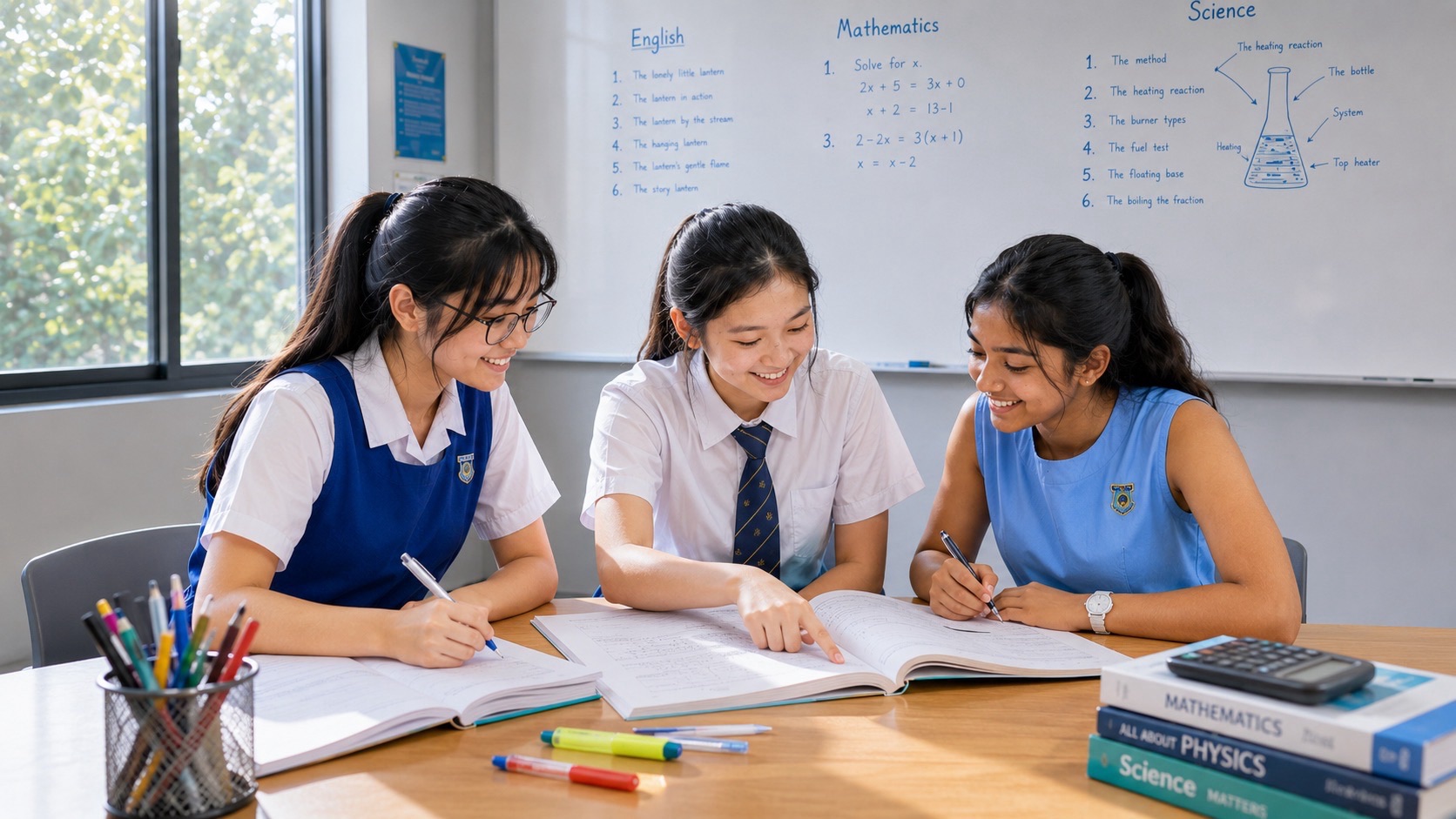
G2 English Tutorials | Potong Pasir. Premium 3-pax English lessons for Potong Pasir students travelling to eduKateSG near Sixth Avenue MRT, with teaching aligned to evidence-based comprehension, inference, purposeful writing, vocabulary precision, grammar control and responsive communication.
Potong Pasir MRT and Sixth Avenue MRT are both on the Downtown Line, so families starting near Potong Pasir station can make the rail journey with a change at Little India. The educational reason to travel remains the same: a small class where the tutor can inspect how each learner reads, writes, speaks and responds to correction.
Under Full Subject-Based Banding, G2 is one of the three secondary subject levels. From 2027, students receive the Singapore-Cambridge Secondary Education Certificate, and SEAB lists G2 English Language as K200.
The common G2 difficulty is relevance. A student may write grammatically correct English yet lose marks because the response does not perform the operation the question requires.
The purpose is not to create dependence on a tutor or to measure effort by the number of worksheets completed. The purpose is to build a method the student can retrieve during schoolwork and assessment.
Our tutorials are suitable for students who need to:
- improve inference and evidence use;
- write with stronger task fulfilment;
- develop paragraphs more purposefully;
- expand vocabulary without losing precision;
- reduce repeated grammar errors;
- strengthen listening and oral communication;
- prepare for school assessments;
- transfer feedback into new tasks.
Explore eduKateSG English services · Arrange a parent–student consultation
What We Teach and Why It Works
How We Diagnose Before We Teach
A strong G2 English programme begins with evidence rather than assumptions. We read recent school scripts, teacher annotations, unfinished work and the student’s own explanation of what feels difficult. The purpose is to identify whether lost marks come from understanding, evidence selection, organisation, language, timing or checking.
Several pieces of work are compared because repeated patterns matter more than one isolated error. The diagnosis becomes a short priority list that the student can understand. For Potong Pasir families, this keeps the weekly journey purposeful: every lesson should solve a defined learning problem rather than simply increase workload.
The Learning Ladder: Model, Guide, Release
Students first see a method modelled clearly, then practise it with prompts, then repeat the same kind of decision independently. The final test is transfer: can the learner use the method when the passage, topic or wording changes?
When transfer fails, we do not automatically assign more questions. We return to the first unstable step and reduce complexity until the learner can execute it accurately. Over time, tutor support is deliberately withdrawn so the student owns the method.
Reading as Evidence Management
Strong readers build a mental map of a passage: central idea, sequence, people, changes, relationships, examples and tone. They do not treat every sentence as equally important.
Before answering, students classify the task and then fence the relevant evidence. This helps them distinguish a useful clue from a nearby sentence that merely contains familiar words. The discipline of evidence remains important at every subject level.
How to Approach an Unfamiliar Passage
An unfamiliar topic should not feel like an entirely new problem. Students begin by locating the situation, main movement and relationships in the text before worrying about every difficult word.
Questions then become instructions for reading. The learner returns to the relevant area of the passage with a clear purpose. This routine reduces anxiety because a method is available even when prior knowledge of the topic is limited.
Writing Architecture: Purpose Before Decoration
Before drafting, students identify audience, purpose, required content and the central direction of the response. A useful plan is a decision map, not a second essay.
Every paragraph is given a job. Development comes from reason, example, consequence, contrast or reflection rather than repetition. Vocabulary and sentence variety are added only when they improve meaning.
How to Develop a Point
Development means adding meaning rather than adding length. Students learn to explain why an idea matters, give an appropriate example, show a consequence or introduce a meaningful contrast.
We compare paragraphs that repeat the same point in different words with paragraphs that genuinely advance the response. This helps learners see why some long answers remain weak while shorter ones can be precise and effective.
Vocabulary as a Working System
Vocabulary is learned with meaning, word form, collocation, register and example contexts. Students then use new words in fresh sentences so the vocabulary becomes available for writing and oral communication.
Spaced retrieval matters because recognition is not the same as production. Words are revisited after time has passed and reappear in later reading and writing tasks.
Inferring Word Meaning from Context
When students meet an unfamiliar word, they learn to use grammatical position, surrounding examples, contrast markers, tone and word families to estimate meaning.
The goal is not perfect dictionary accuracy every time. It is enough understanding to keep reading intelligently and then refine the meaning when necessary.
Grammar as Meaning Control
Grammar is taught through meaning. Tense locates events in time, pronouns control reference, conjunctions show relationships and punctuation groups ideas for the reader.
The student’s own sentences provide high-value material because they reveal what happens when attention is divided across a full task. Focused drills are used when necessary, but every repaired pattern must return to authentic writing.
The Personal Error Ledger
We classify recurring errors instead of writing ‘careless’ beside everything. Categories can include task misunderstanding, unsupported inference, tense, agreement, sentence boundaries, spelling, vocabulary fit, paragraph drift and timing.
As weeks pass, the student can see which categories are shrinking and which still require attention. Eventually, learners should be able to predict their own danger zones before submitting work.
Listening with Recovery
Listening is active. Students predict what kind of information may matter, track sequence and contrast, and continue listening after a missed detail instead of mentally replaying the uncertainty.
After a task, wrong answers are classified: missed detail, misunderstood wording, concentration lapse or incorrect inference. The next practice targets the real cause.
Oral Communication as Live Thinking
Oral work begins with listening to the exact prompt, taking a brief thinking pause and giving a direct first response. Students then develop through explanation, example, comparison or qualification.
Unfamiliar prompts are used deliberately so students learn flexible communication rather than dependence on memorised speeches. A three-student class creates frequent speaking turns while preserving individual feedback.
The Fencing Method
The Fencing Method makes task boundaries visible. Students identify what must be included, what evidence is relevant and what lies outside the response.
In comprehension, the fence protects the evidence zone. In writing, it protects purpose, audience and required content. In summary, it protects scope. With practice, these boundaries become mental and faster to apply.
How to Learn from a Model Answer
A model answer is studied for decisions: how the task was interpreted, how evidence was selected, how paragraphs were ordered and how language was controlled.
Students then transfer one principle to a new task instead of reproducing the whole model. The aim is adaptable craft, not dependence on memorised text.
How to Learn from a Weak Answer
Weak answers are useful because they make failure modes visible. Students can identify irrelevance, unsupported claims, repetition, vague wording and language that changes the intended meaning.
Repairing a weak answer before writing a fresh response sharpens judgement. Being able to explain why something is weak is an important step towards self-editing.
A Sustainable Weekly Practice System
A strong week does not require maximum homework volume. It requires retrieval, independent application and feedback that changes the next attempt.
A weekly routine might combine vocabulary retrieval, one focused reading task, one writing micro-task and review of a recurring error. Regular reading outside tuition also builds syntax awareness, ideas and vocabulary exposure.
Using School Materials Properly
School materials anchor tuition to the student’s real environment. We examine current topics, marked scripts, teacher feedback and assessment schedules.
We do not simply redo school worksheets. Instead, we identify the method or language skill the school task exposes, repair it where necessary and return the learner to current work with better control.
Assessment Preparation with Purpose
Full papers are useful for integration, stamina and pacing, but they are not always the best repair tool. Focused practice comes first when one component is unstable.
Timed work is introduced progressively. Students learn how long to persist, when to move on and how to reserve time for checking without rushing through the entire paper.
How to Edit Under Time Pressure
Students cannot check every possible grammar rule in the final minutes. We build a short editing order based on the learner’s actual error patterns.
Task completion comes first, followed by the two or three language patterns most likely to cost marks. Repetition turns this into a realistic examination routine.
Parent Support Without Over-Editing
Parents can support consistency without becoming the student’s editor. A calm routine, access to reading material and interest in the learner’s explanation are often more useful than rewriting sentences.
After a marked script, parents can ask what kind of mistake occurred and what the student will do differently next time. Concrete school information also helps the tutor keep the plan aligned.
Confidence Built from Capability
Confidence is strongest when it is based on evidence that a method works. Students become calmer when they know what to do first and can see that their decisions are improving.
We keep standards clear while adjusting scaffolding. Support may be increased temporarily, but the quality target remains visible and support is withdrawn as competence grows.
English in the Post-AI Era
AI increases the importance of language judgement. Students need to decide whether fluent text is accurate, relevant, supported and appropriate rather than treating polished wording as proof.
Writing remains important because composing an answer forces the student to organise thought. Technology may support reference or drafting, but planning, interpretation and checking remain the learner’s responsibility.
How to Read Progress Beyond the Score
Scores matter, but they should be read alongside the pattern of errors. Stronger relevance, better sentence control, clearer writing structure, more stable timing and improved self-correction may appear before a dramatic mark increase.
Behavioural indicators also matter: less hesitation, better explanation of corrections, more independent planning and stronger recovery after unfamiliar questions.
Term Planning and Retrieval
A coherent programme maintains a term map rather than moving randomly from worksheet to worksheet. Lessons consider school sequencing, upcoming assessments, recurring weaknesses and independent practice capacity.
Earlier skills are retrieved inside later lessons so they remain available after the original topic has passed. Before assessments, the balance shifts towards integration and timed execution.
Different Student Profiles Need Different Responses
The quiet learner may need structured speaking turns. The fluent but imprecise learner may need tighter evidence and editing. The diligent learner doing too much undirected work may need better diagnosis rather than more volume.
The capable but inconsistent learner needs routines that survive time pressure and unfamiliarity. The secure learner needs greater independence and precision rather than difficulty for its own sake.
How We Repair Students Who Are Behind
Repair begins at the first unstable point that affects current work. We do not automatically restart the entire primary syllabus.
A learner may need sentence boundaries, reference tracking, literal comprehension or core vocabulary before longer tasks become productive. The repair remains connected to current secondary work so its purpose is visible.
How We Extend Strong Students
Extension at G2 means stronger inference, more efficient development, more precise vocabulary and better transfer across unfamiliar texts.
Strong learners are challenged through deeper reading, tighter explanation, more independent writing and stricter checking. Extension should increase judgement and transfer, not simply add more homework.
Why Error Classification Matters
Calling every wrong answer a careless mistake hides useful information. Reading, inference, grammar, copying, task fulfilment and timing errors require different responses.
Once patterns are classified, practice becomes more efficient. Students can eventually classify their own mistakes and choose the correct repair strategy.
The Standard We Want at the End
The final objective is not a student who can reproduce the tutor’s preferred answer. We want a learner who can understand a new task, select a sensible method and produce a response that is clear, relevant and appropriately developed.
For Potong Pasir students, the North East Line journey with a change to the Downtown Line at Little India to Sixth Avenue should build a stronger learning system—not merely produce another completed worksheet.
G2 English: Precision Becomes Central
G2 students often have enough English to produce an answer, but the answer may be too broad, too vague or only partly relevant.
We therefore make precision visible: what exactly is the question asking, what evidence supports the response and how much explanation is necessary?
G2 Inference as Evidence Plus Reasoning
Inference is taught as a disciplined movement from clue to conclusion. Students identify what the text provides and what they are reasonably allowed to infer.
This reduces both copying and over-interpretation, two common sources of lost marks.
G2 Writing: Purpose and Audience
Students learn to adapt tone and content to the actual situation rather than relying on generic openings or memorised phrases.
A response is considered complete only when the required points are present and organised for the intended reader.
G2 Paragraph Development
Paragraphs are developed through reason, example, consequence, contrast or reflection. Students learn to distinguish genuine development from repeating the same claim in different words.
This improves both efficiency and clarity in longer responses.
G2 Oral and Listening Precision
Listening practice emphasises main ideas, details, sequence and contrast. Oral work emphasises direct response and supported development.
Students practise unfamiliar prompts so performance remains flexible rather than rehearsed.
Our First-Principles Teaching Method
1. Diagnose the exact weakness
We begin with evidence and identify the first unstable decision rather than using a generic worksheet sequence.
2. Rebuild from the first unstable point
The repair begins where the current task is actually breaking, not necessarily at the beginning of an old syllabus.
3. Use the Fencing Method
Students establish boundaries around evidence, content, purpose and scope so relevance is protected.
4. Make task structure visible
The learner sees the sequence behind successful performance: understand, classify, select, organise, express and verify.
5. Explain the correction
Students state why the stronger version works so feedback becomes reusable knowledge.
6. Retrieve and interleave
Earlier vocabulary, grammar and task routines reappear inside later work.
7. Build assessment discipline
Pacing, recovery and checking are rehearsed before major assessment periods rather than invented under pressure.
What Happens During a 90-Minute Lesson
Warm-up retrieval
A short opening task reveals what the student can retrieve from earlier lessons without prompting.
Concept instruction
One high-value idea is taught clearly with examples and counter-examples.
Guided practice
Support is gradually reduced while the tutor watches for the point where the method becomes unstable.
Independent application
A fresh task tests whether the skill transfers beyond the example used in teaching.
Mixed or timed practice
Skills are combined or placed under time pressure when the learner is ready.
Error review
Important errors are classified by cause rather than simply marked wrong.
Focused continuation work
Independent practice repeats the highest-value correction and gives the next lesson new evidence.
Three G2 Student Pathways
The repair pathway
Students with substantial gaps rebuild the missing language or task foundations while remaining connected to current school demands.
The stabilisation pathway
Students who understand most lessons but perform unevenly practise the same method across varied material until it becomes dependable.
The extension pathway
Extension at G2 means stronger inference, more efficient development, more precise vocabulary and better transfer across unfamiliar texts.
Potong Pasir to Sixth Avenue: Via Little India to the Downtown Line
eduKateSG is located at 8 Fourth Avenue, Singapore 268674, near Sixth Avenue MRT. It is not a Potong Pasir branch.
Potong Pasir MRT is on the North East Line. Families can travel to Little India, change to the Downtown Line, and continue towards Sixth Avenue, subject to normal service conditions.
The weekly routine should remain sustainable. Tuition should leave enough time for schoolwork, reading, CCA, rest and independent practice. A convenient route is useful only when the teaching fit is also right.
Class Details
Class size: three students.
Lesson duration: 1.5 hours weekly.
Focus: G2 English, including reading, writing, vocabulary, grammar, listening, oral communication and school assessment preparation.
Materials: curated notes, school-script correction, retrieval tasks, targeted practice, mixed work and assessment-style questions.
Placement: by consultation and subject to a suitable three-student class.
What Parents Can Bring to the Consultation
- recent English tests or examination scripts;
- marked writing and comprehension work;
- teacher comments or rubrics;
- oral or listening feedback if available;
- the student’s current textbook or learning package;
- upcoming assessment dates;
- examples of tasks that repeatedly cause difficulty.
We use these materials to distinguish capability from execution. Two students with the same score may need completely different plans.
Frequently Asked Questions
What is G2 English under Full Subject-Based Banding?
It is the student’s English subject level under the current secondary framework.
Is SEC a fourth English level?
No. SEC is the common certificate from 2027.
What is the 2027 G2 English code?
SEAB lists G2 English Language as K200 for the 2027 SEC.
Should students memorise model essays or answers?
No. Models are studied for structure, evidence and language decisions, then transferred to fresh tasks.
Do you teach vocabulary lists?
Yes, selectively, but vocabulary is learned through context, retrieval and use.
Do you teach grammar separately?
Yes when a pattern needs focused repair, and we also apply grammar inside the student’s own writing.
Should my child do full papers every week?
Not automatically. Full papers test integration; focused tasks often repair weaknesses more efficiently.
Can students move between subject levels?
Movement depends on school policy, readiness and performance. Tuition focuses on building the capability the student can demonstrate.
Can students join mid-year?
Yes, subject to a suitable placement.
How should Potong Pasir families compare this with a nearer class?
Potong Pasir and Sixth Avenue are directly connected on the Downtown Line, but the deciding factor should still be the student’s need and the quality of the teaching fit.
Helpful Reading for Potong Pasir Parents
G1 English Tutorials | Potong Pasir · G3 English Tutorials | Potong Pasir · SEC English Tutorials | Potong Pasir · SEAB Secondary Education Certificate · 2027 syllabus information
G2 English Tutorials for Potong Pasir Families
English becomes more reliable when the learner can see what the task requires and has a method precise enough to repeat.
At eduKateSG, our three-student tutorials provide room to repair weak foundations, stabilise inconsistent performance and extend students who are ready for greater independence.
The objective is a learner who can meet unfamiliar work, make a sensible decision, use feedback and carry a correction into the next task without waiting for the tutor to supply every step.
Arrange a Parent–Student Consultation
Share the student’s school year, current English subject level, recent scripts and upcoming assessments. These details help us discuss a suitable next step.
Contact eduKate Singapore · Arrange a consultation on WhatsApp
eduKateSG
8 Fourth Avenue, Singapore 268674
Near Sixth Avenue MRT
Premium 3-pax small-group tuition
By appointment
Properly taught kids shine a bright light into the future.
How We Read the Question Before the Passage
Many students begin searching a passage before they understand what the question requires. We reverse that sequence. The learner identifies the command word, scope and likely answer type before returning to the text.
This makes reading more efficient because attention is directed towards the right evidence. For G2 English, the complexity of the required operation changes, but the habit of reading with purpose remains essential.
Reference Tracking and Pronoun Control
A surprising number of comprehension errors begin with unclear reference. Students learn to trace who or what a pronoun refers to across the sentence and surrounding paragraph.
This small skill protects later inference. If the learner attaches an action or attitude to the wrong person, even an otherwise sophisticated explanation will remain incorrect.
Cause, Effect, Contrast and Condition
Students learn to recognise the logical relationships signalled by words such as because, therefore, although, however, unless and despite.
These relationships matter in both reading and writing. Understanding them helps the learner interpret the passage accurately and also build more coherent sentences of their own.
How to Build a Strong Introduction
An introduction should establish direction without consuming unnecessary time. Students learn to enter the response clearly and show the reader what the piece will be about.
The exact form varies by task and subject level, but the principle stays constant: the introduction serves the response rather than becoming a performance disconnected from the question.
How to Build a Strong Conclusion
A conclusion completes the movement of the response. It may resolve, synthesise, reflect or reinforce, depending on the type of writing.
Students avoid merely repeating the introduction or adding a completely new major point at the end. Planning the destination early often improves coherence throughout the piece.
Tone and Register
Tone grows from the relationship between writer, audience and purpose. Students compare how the same idea would sound when written to a friend, a teacher, a formal organisation or a public audience.
This helps them understand register as a system of choices rather than a list of isolated ‘formal words’.
Using Evidence in Expository Writing
Evidence is not only a comprehension skill. In expository and argumentative responses, examples, observations and relevant facts make reasoning visible.
Students learn to explain the connection between evidence and claim instead of placing an example beside a point and assuming the reader will understand why it matters.
Paragraph Coherence
A strong response has continuity across paragraphs. Students learn to see how one paragraph creates the need for the next and how the central direction should remain visible throughout.
Transitions are therefore taught as logical relationships—addition, contrast, cause, progression or qualification—not as memorised phrases inserted mechanically.
Multimodal Reading
English tasks increasingly combine words with images, layout, captions, charts or other visual information. Students learn to ask what the visual contributes and how it changes interpretation.
The learner practises integrating information across modes rather than treating the visual as decoration. This supports flexible reading in both school and digital environments.
Metacognition: Knowing How You Learn
Students improve faster when they can describe their own patterns. We ask them which task types feel secure, which errors recur and which strategies help them recover.
This language of self-observation makes revision more efficient because the learner can choose practice based on evidence rather than mood.
Retrieval Before Rereading
Revision begins with retrieval. Students close the notes and try to recall vocabulary, grammar rules, task structures and checking routines before looking back.
The gap between what feels familiar and what can actually be produced becomes visible immediately, directing revision time towards what has genuinely been forgotten.
A Personal English Reference Book
A compact personal reference book can collect recurring grammar rules, useful vocabulary, task structures, strong examples and personal error patterns.
The emphasis is curation. The book stays small enough to review and personalised enough to remain useful instead of becoming another archive of copied notes.
Managing Difficult Questions
When a question feels difficult, students practise a recovery sequence: restate the task, identify what is known, locate relevant evidence or content, and choose the next valid step.
If the item remains difficult, the learner makes a sensible time decision rather than allowing one question to consume the entire assessment.
Balancing Accuracy and Speed
Speed should emerge from a well-practised method. Rushing before understanding often creates habits that are difficult to repair later.
We stabilise the decision first, then shorten the time gradually. The target is efficient control: enough speed to complete the task without sacrificing the precision on which marks depend.
Preparing for Upper-Secondary Demands
Even when the student is earlier in secondary school, the programme builds habits that remain useful later: evidence-based reading, organised writing, vocabulary retrieval and independent checking.
Students do not need premature drilling of a future paper. They need foundations that make later complexity easier to absorb.
What to Do After Teacher Feedback
Broad comments are translated into specific actions. A note such as ‘develop your point’ may become: add a reason, provide an example, explain the consequence, or connect the evidence back to the question.
This turns school feedback into something the student can practise immediately and helps tuition reinforce rather than compete with classroom learning.
The Week Before an Assessment
The final week should not become an attempt to relearn everything. Students review high-value routines, recurring errors and representative tasks.
Short retrieval, one or two timed components and focused vocabulary review are often more useful than exhausting volume. Sleep and workload are treated as part of performance.
The Week After an Assessment
When the script returns, we classify errors and compare them with earlier patterns. We recognise weaknesses that have disappeared as well as new issues that need attention.
The review closes the learning cycle and determines the next teaching priority instead of allowing the paper to become a score that is discussed once and forgotten.
How We Know Tuition Is Working
Tuition is working when the student becomes more independent: recognising task types, explaining corrections, planning more clearly and using checking routines without prompts.
Behavioural evidence often appears before a dramatic score change. Less hesitation, better self-correction and stronger recovery are signs that the underlying learning system is improving.
The Link Between English and Other Subjects
English is the medium through which students interpret instructions, explain reasoning and evaluate information in many other subjects.
The habits built here—precision, evidence, structure and careful reading—therefore support wider academic learning even though this tutorial remains focused on English.
The Link Between English and AI Literacy
Students increasingly encounter fluent machine-generated text. They need to evaluate whether that text is relevant, supported and accurate rather than assuming that confidence equals correctness.
This makes evidence, source awareness and language judgement central 21st-century English skills. The student must remain the thinker even when technology assists the workflow.
The Final Independence Standard
The final measure is not whether the learner can complete a familiar worksheet. It is whether they can face a new task, identify what it requires, choose a method and produce a controlled response without waiting for the tutor to supply every step.
For Potong Pasir students, this is what makes the North East Line journey with a change to the Downtown Line at Little India worthwhile: the lesson should leave behind a stronger, more independent learning system.
A Stronger Bridge from Feedback to the Next Attempt
Feedback becomes useful only when it changes behaviour. In G2 English, we ask the student to name the error, identify the decision that produced it and state what will be done differently on the next task.
The follow-up task is deliberately chosen to recreate the same decision in a fresh context. This makes correction active rather than passive and gives the learner evidence that the new method can transfer.
Over time, this loop—attempt, diagnose, repair, retry, retrieve—becomes one of the most important habits in independent English learning.
Building Better Self-Checking
Self-checking is taught as a sequence of questions rather than a vague instruction to ‘check your work’. Students confirm task completion, relevance, evidence, sentence completeness and recurring personal language errors.
The sequence is practised often enough that it becomes faster. A student who knows exactly what to look for can use the final minutes of an assessment far more effectively than one who simply rereads the page.
This habit protects marks the learner already has the knowledge to earn and reduces dependence on external correction.
From Local Tuition Page to Complete Parent Guide
This Potong Pasir guide is designed to do more than match a local search phrase. It explains what the student is learning, why the methods are sequenced in this way, how a three-student lesson operates and what parents should look for when judging progress.
The local context remains specific: Potong Pasir and Sixth Avenue are directly connected by the Downtown Line, while the centre itself remains at 8 Fourth Avenue. The educational content remains specific to G2 English so each page owns a clear intent.
That combination of local usefulness and educational depth is the standard we want across the wider eduKateSG branch.
The Final Standard for Potong Pasir Students
The end-state is a learner who can approach unfamiliar work without waiting for the tutor to supply the first move. The student understands the task, selects relevant evidence or content, organises a coherent response and checks the most likely errors independently.
At G2, the sophistication and assessment demands differ, but the destination remains the same: clearer judgement, stronger language control and greater independence.
A high-standard tutorial should make the student more capable outside the tutorial. That is the benchmark we keep as the branch continues.
Reading, Writing and Speaking as One English System
The final layer in G2 English is integration. Reading develops evidence and vocabulary; writing develops organisation and precision; speaking tests whether language can be generated in real time. These components should reinforce one another rather than being taught as isolated subjects inside the subject.
A word first encountered in reading should eventually appear in discussion or writing. A reasoning pattern used in comprehension should strengthen the student’s ability to support a claim. A sentence corrected in writing should improve oral clarity when a similar structure appears in conversation.
This integration is one reason the programme returns to earlier learning repeatedly. Strong English is a connected system, and durable progress comes when the student can move knowledge between contexts.
What Parents Should Expect to See Over a Term
Over a term, parents should expect changes in both work and behaviour: clearer answers, more complete writing, fewer repeated errors, better explanation of corrections, more deliberate vocabulary and less panic when the task is unfamiliar.
Not every component will improve at the same pace. A student may stabilise sentence control before comprehension marks move, or improve reading accuracy before writing becomes more developed. We use the work itself to decide whether the underlying system is strengthening.
The strongest sign is growing independence. The learner begins to start tasks with less prompting, recognise familiar error patterns and explain what they are trying to improve.
Why We Keep the Standard Above a Thin Local Page
A local tutorial page should still be an educational resource. Families searching from Potong Pasir deserve more than a location label attached to generic copy. They should be able to understand the programme, the subject level, the teaching method, the role of assessment and the signs of genuine progress.
That is why this G2 English page is deliberately substantial. It belongs inside a larger eduKateSG architecture, but it also needs to stand alone as a complete guide for a family deciding whether the three-student Sixth Avenue programme matches the learner’s needs.
The standard remains simple: useful enough to read, specific enough to trust, and deep enough to support both the student and the wider education ecosystem.
Potong Pasir: Building English Through Repeatable Movement
Potong Pasir is a useful place from which to think about learning routines. The weekly journey itself involves a simple sequence: begin on the North East Line, change at Little India, then continue on the Downtown Line towards Sixth Avenue. Strong English learning works in a similar way: each task becomes easier when the student knows the sequence of decisions instead of treating the whole problem as one large unknown.
For G2 English, we therefore teach transitions explicitly. Reading moves from task word to evidence. Writing moves from purpose to plan to paragraph. Feedback moves from error to explanation to a fresh independent attempt. When these transitions become familiar, students spend less energy wondering what to do next.
Why Route Fit Matters for a Weekly Tutorial
eduKateSG is not located in Potong Pasir. Families should consider the entire weekly routine: travel, school dismissal time, CCA, homework, meals and rest. A strong teaching fit is useful only when the student can reach the lesson with enough attention left to learn.
A practical MRT route is from Potong Pasir on the North East Line to Little India, then a change to the Downtown Line for Sixth Avenue. Exact journey times vary with service conditions and the student’s precise starting point, so families should plan the routine rather than relying on one idealised travel estimate.
Potong Pasir Students: Use the Journey as Retrieval Time
Travel time can be used lightly rather than turned into another heavy study session. A student might retrieve five vocabulary items, explain one grammar rule aloud, recall a comprehension checklist or mentally plan a paragraph. These short retrieval moments reinforce learning without requiring a desk.
The purpose is not to fill every minute. It is to show students that English can be practised in small, repeatable forms. A few minutes of active recall can be more useful than passively rereading a long page of notes.
The Standard for This Local Page
This Potong Pasir page is designed to be a complete parent guide, not a location-swapped landing page. It preserves the high-depth tutorial architecture while giving Potong Pasir families accurate travel context, level-specific English guidance and a clear place inside the wider eduKateSG G1/G2/G3/SEC cluster.
The title, slug and search intent are deliberately separated from neighbouring areas so each page has one clear owner. Internal links connect the four Potong Pasir levels, while the educational content remains specific to the level the student is actually taking.
Potong Pasir: A Practical North East Line Route to Sixth Avenue
Potong Pasir MRT is on the North East Line. A practical route to eduKateSG is to travel to Little India, change to the Downtown Line, and continue to Sixth Avenue. The route includes one interchange, so families should judge the complete weekly routine rather than looking only at distance.
The reason to make that journey should be educational. For G2 English, the programme uses a three-student class, close script diagnosis, explicit teaching of the missing method and repeated checks that the correction transfers into unfamiliar work.
Potong Pasir Students: Build a Reliable English Routine
Potong Pasir sits within a dense residential and city-fringe environment where students move between school, transport, neighbourhood services and home. English is part of that everyday interface: instructions, notices, explanations, digital messages and schoolwork all depend on clear meaning.
We use that perspective to keep English practical. A student is not simply collecting marks; the learner is building the ability to understand what another person means and to make their own meaning visible with enough precision for the reader or listener.
Using the Journey for Light Retrieval
The trip to Sixth Avenue can be used lightly for retrieval without turning the commute into another heavy study block. A student might recall five vocabulary items, rehearse one oral response structure, explain one grammar rule or mentally list the steps of a comprehension method.
These small retrieval moments work because the learner has to produce knowledge without looking at notes. The aim is not continuous study. It is to show that strong language habits can be maintained through short, deliberate practice.
Why This Potong Pasir Page Has a Clear Owner
This Potong Pasir page is designed as a complete parent guide rather than a location-swapped landing page. It combines local travel context with level-specific English teaching, lesson architecture, school-script diagnosis, assessment strategy, parent guidance and SEC alignment.
Within the wider eduKateSG English ecosystem, this page owns the G2 English Tutorials | Potong Pasir intent. The sibling G1, G2, G3 and SEC pages cross-link to help families move between subject levels without competing for the same primary query.
The Standard for Potong Pasir Families
The standard is a coherent learning system: diagnose the real weakness, teach the smallest useful method, practise deliberately, test transfer on unfamiliar material, and make the learner increasingly responsible for planning, checking and correction.
For G2 English, progress should become visible in both school results and student behaviour: clearer reading, more purposeful writing, more accurate language, stronger pacing, more responsive speaking and less dependence on immediate prompting.
Potong Pasir: A Practical North East Line Route to Sixth Avenue
Potong Pasir MRT is on the North East Line. A practical route to eduKateSG is to travel to Little India, change to the Downtown Line, and continue to Sixth Avenue. The journey includes one interchange, so families should consider the full weekly routine alongside school, CCA, homework and rest.
The educational reason to make that journey is the small-group learning fit. For G2 English, the programme uses three-student classes, close diagnosis of school scripts, explicit teaching of the missing method and repeated checks that the correction transfers into unfamiliar work.
Potong Pasir Students: Build Calm, Repeatable English Habits
Potong Pasir is a well-established residential area where many students balance school demands with commuting and family routines. That makes consistency especially important. English should not depend on dramatic bursts of revision; it should be strengthened through small, repeatable habits that survive busy weeks.
A learner who retrieves vocabulary regularly, revisits personal error patterns, reads with evidence in mind and plans before writing is building a system. The system matters because it continues working when the passage, topic or assessment changes.
Using the Journey for Light Retrieval
The trip towards Sixth Avenue can be used lightly for retrieval without turning the commute into another demanding study session. A student might recall five vocabulary items, mentally rehearse a comprehension sequence, explain one grammar rule or plan the first two points of an oral response.
These brief retrieval moments strengthen memory because the learner has to produce knowledge without looking at notes. The aim is not continuous study; it is to make English practice portable and sustainable.
Why This Potong Pasir Page Has a Clear Owner
This Potong Pasir page is designed as a complete parent guide rather than a location-swapped landing page. It combines local travel context with level-specific English teaching, lesson architecture, school-script diagnosis, assessment strategy, parent guidance and SEC alignment.
Within the wider eduKateSG English ecosystem, this page owns the G2 English Tutorials | Potong Pasir intent. The sibling G1, G2, G3 and SEC pages cross-link to help families navigate by actual subject level without competing for the same primary query.
The Standard for Potong Pasir Families
The standard is a coherent learning system: diagnose the real weakness, teach the smallest useful method, practise deliberately, test transfer on unfamiliar material, and make the learner increasingly responsible for planning, checking and correction.
For G2 English, progress should become visible in both school results and student behaviour: clearer reading, more purposeful writing, more accurate language, stronger pacing, more responsive speaking and less dependence on immediate prompting.