
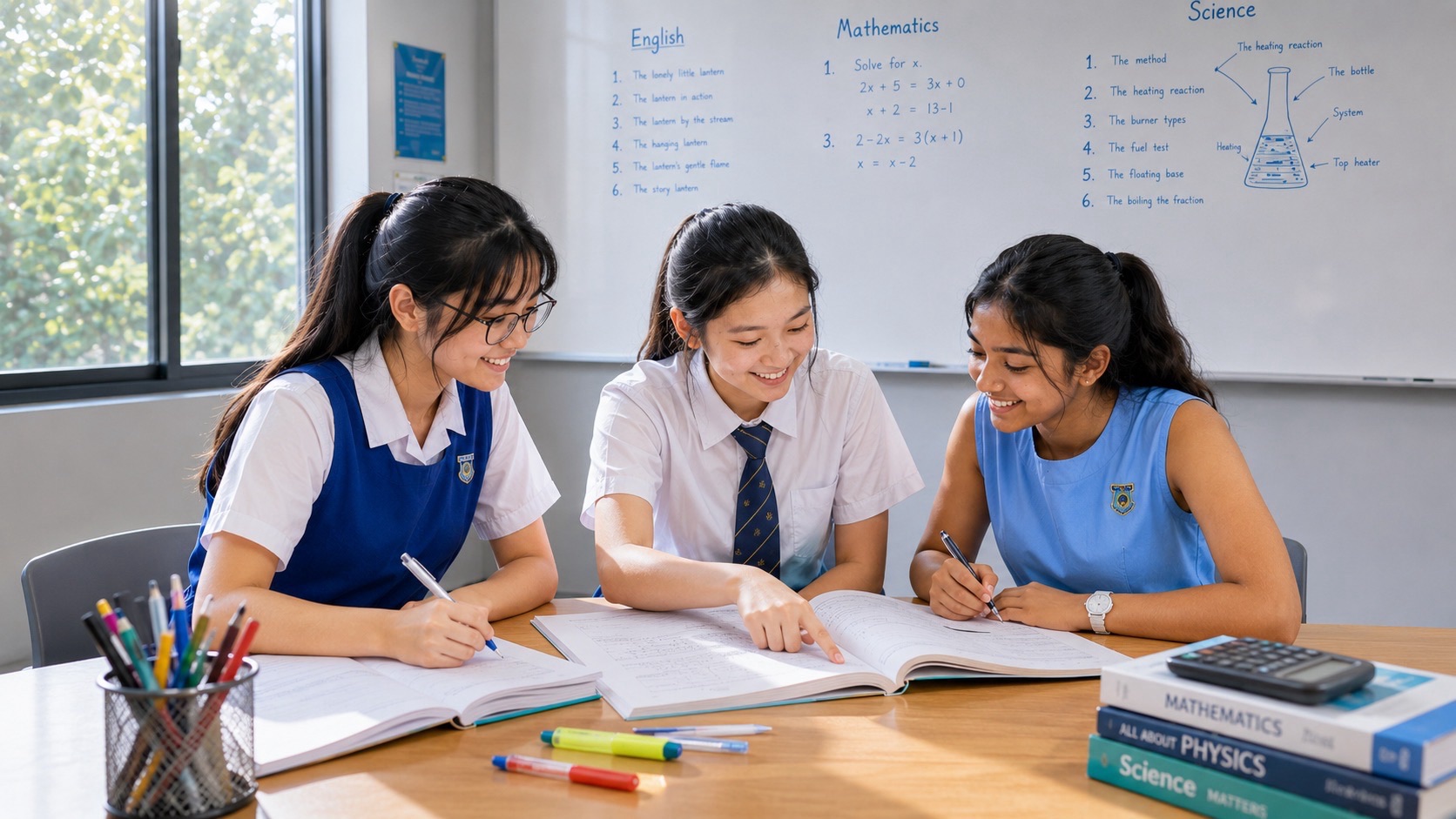
Does your child quote the right line but still lose marks because the explanation never quite arrives? G2 English Tutorials | Punggol Central concentrate on that missing bridge. eduKateSG provides premium three-student, 90-minute weekly G2 English tuition near Sixth Avenue MRT, giving families around Punggol Central clear teaching in inference, language effect, summary, situational writing, composition, listening and responsive oral discussion.
Parents choosing a G2 English tutor or English tutorials in Punggol Central deserve more than repeated instructions to use evidence. The student needs to decide which clue is relevant, what it proves, where the reasoning should stop and how to paraphrase without changing the source’s time or conditions. We use an original task, a carefully contrasted correction and a fresh application. This makes an apparently vague English weakness into a specific choice that can be taught.
Waterway Point at 83 Punggol Central and Punggol Regional Library at One Punggol offer familiar reference points for real-world reading. But eduKateSG lessons are at 8 Fourth Avenue, Singapore 268674, near Sixth Avenue MRT; this is not an advertisement for a Punggol Central branch. An initial consultation examines recent marked comprehension, an unaided writing piece and any school feedback to identify the most useful first repair.
A useful consultation begins with the learner’s current schoolwork, not a promise based on a generic grade label. Read about eduKateSG’s small-group tuition services and contact eduKate Singapore to discuss the learner’s next step. Placement, timetables and fees are confirmed directly.
The Transition from Recognition to Choice
A pupil who understands a model answer after hearing an explanation may still have difficulty beginning a new task. Recognition, imitation, delayed recall and independent selection are separate achievements. For G2 English, the tutor has to observe which decision becomes uncertain without a hint. More pages completed with constant direction can make progress look greater than it is.
We ask the child what the instruction requires, which source detail is relevant and why the chosen wording is accurate. The goal is complete the evidence-to-inference connection, explain particular word choices and preserve source conditions when selecting and compressing information. A short independent check on a new passage makes that claim testable. Parents should see the difference between a corrected original answer and a fresh one completed without being shown the method.
The Mark Does Not Explain the Error
An answer can lose marks because the question was misread, the wrong clue was selected, the inference was too broad, or the student’s sentence did not say what they intended. These problems need different teaching. One G2 concern worth investigating is a correct quotation followed by ‘this makes the reader interested’, or a summary in which ‘available to registered visitors’ becomes ‘available to everyone’. We treat it as a diagnostic possibility, not a permanent description of the child.
A tutor traces the process backwards from the written response to the student’s first reading of the task. Spoken explanation can reveal understanding not visible in writing, while an unaided paragraph can expose problems hidden by memorised responses. The next exercise targets the earliest unstable operation, and the follow-up checks whether the learner recognises that operation on changed material.
Why a Three-Student Group Must Preserve Independent Thinking
A small group provides time to hear each learner’s reasoning. Three students can select the same incorrect answer for different reasons, so the tutor asks for individual first attempts before shared discussion. One child may need sentence repair, another evidence selection and another a more careful reading of the question. The class should not mistake agreement after a peer explains the answer for independent competence.
We model a useful contrast, let learners explain alternatives, reduce prompts and then give different continuation work where needed. The value comes from diagnosis and feedback rather than the number three alone. Parents can ask which decision their child could make independently this week that required help in an earlier attempt.
The Correct 2027 SEC Route Is Essential
Under Singapore’s Full Subject-Based Banding, G1, G2 and G3 refer to subject levels. From 2027, the SEC records subjects examined at their actual levels; SEC itself is not a fourth English difficulty. The published English Language codes are K100, K200 and K300 respectively. A student can have different General levels across subjects under school arrangements.
SEAB lists G2 English Language as K200 for 2027 SEC school candidates. Its syllabus includes situational and continuous writing, comprehension with summary, language-effect analysis, listening and oral planned response and spoken interaction. An accurate method can be learnt on short extracts before it is integrated into the appropriate full-length task. Families should consult the SEAB SEC overview, the G1 school-candidate listing, G2 listing and G3 listing. The school confirms which English level is offered. We may use a short text from another source to teach a skill, but do not represent a mismatched complete paper as the candidate’s official assessment.
What Punggol Central Actually Refers To
Waterway Point’s official visitor information lists its location at 83 Punggol Central, Singapore 828761, and describes direct connectivity with Punggol MRT/LRT (NE17/PTC) and the bus interchange. Punggol Central is a named road and town-centre corridor. It should not be confused with every home in the wider Punggol area or with the separate Punggol Downtown locality articles in this series.
Punggol Regional Library is located at One Punggol, 1 Punggol Drive, Singapore 828629, according to National Library Board venue details. These two real addresses are useful for teaching precise source reading. They do not establish that a tutorial is held in either facility. The teaching address remains 8 Fourth Avenue, Singapore 268674, near Sixth Avenue MRT.
A Library and a Mall Provide Different Reading Tasks
A mall’s operator provides venue information useful for finding its premises or checking transport connections. NLB provides library programmes, reading resources and heritage interpretation. Both can be authoritative for their own published material, but they are not identical organisations and do not guarantee each other’s arrangements. Students should first ask what each source is trying to help the reader do.
NLB’s Punggol Stories exhibition information explains a public display exploring Punggol’s changing history through literature and community memory. That is a useful source for a reading or interpretation activity, not a reason to invent details about a student’s own family history or predict an examination topic. As task complexity increases, learners can compare document purpose, evidence and the limits of inference.
Reading the Question Changes the Answer
Identify, explain, infer, compare and evaluate ask for different work. A student may understand the source but select the wrong kind of response because the operative word was ignored. We teach the learner to say what the question requires before collecting information. This habit can be practised through two questions on the same short passage.
For G2, the objective is complete the evidence-to-inference connection, explain particular word choices and preserve source conditions when selecting and compressing information. The learner should be able to explain why a particular detail answers the instruction and why a tempting nearby sentence does not. We then change the text without naming the operation. That cold-start item distinguishes genuine recognition of the task from memory of where the tutor pointed in the original example.
Literal Fact, Supported Inference and Invented Story
An official address on a venue website is a directly stated fact about that place. An imagined character who checks a map twice may be concerned about choosing the right route, but the story does not prove a specific hidden fear. A new explanation needs evidence and a degree of certainty that matches it. Familiar local names do not make unsupported inferences correct.
We identify the smallest useful clue, explain the claim it can reasonably support and check surrounding information for contradictions. Overcautious writing is not the goal: a documented fact should be stated clearly. A possible feeling should be qualified. Students learn to make those choices when a new passage presents a different situation.
Grammar and Vocabulary Are Meaning Decisions
Grammar marks more than surface neatness. A tense changes when an action happened; a pronoun changes who performed it; a conjunction can invent a cause that was not present. Likewise, planned, expected, confirmed and cancelled are not interchangeable. An impressive synonym can make a sentence less accurate if it changes the original claim.
We choose recurring patterns in actual schoolwork, use short contrasts and ask the learner what a change means for the reader. A later example tests whether the rule can be used without seeing the first model. For G2, precision in ordinary language matters more than rare words inserted for display.
Writing Begins with Reader and Purpose
G2 writing requires a reason why a chosen feature matters to the reader. A situational recommendation should use the recipient’s actual constraints; a discursive paragraph should develop a mechanism and example rather than rephrase the same claim. We model how to select a point and withdraw the plan when students can do this for themselves. The learner asks what the recipient needs to know, believe or do, then decides which details belong and in what order. Organisation is not a compulsory arrangement of labels; it is a way to keep the intended meaning available to the reader.
Revision begins with relevance and completion. Does the piece actually answer the prompt? Has a required point been omitted? Are examples connected to reasons? Grammar and style follow, with the most consequential patterns taught first. When the student understands the purpose behind the structure, the tutor removes visible planning prompts so a new response can be developed independently.
Listening: The First Detail May Not Be Final
A spoken announcement can introduce a suggestion, revise it and state the agreed plan. If a learner writes the first plausible time or location and stops listening, the answer may be incorrect even though the words were heard accurately. We teach attention to markers such as instead, revised and finally.
After the first correction, a different recording places the revision elsewhere so the student cannot succeed by memorising the original answer. The aim is to track what information the speaker is actually communicating. The same habit helps with school instructions and everyday conversations in which plans change.
Oral Communication Is Responsive Thinking
G2 oral preparation combines a planned response with spoken interaction, so pupils practise a brief view, a developed reason and a new follow-up that requires adaptation. Listening similarly trains attention to tentative suggestions and later confirmation. Longer speeches are not automatically more responsive. Preparation can support a coherent starting point, but no memorised paragraph can predict every follow-up. A student should be able to listen to the current question, explain one relevant reason and adjust when a new condition changes the discussion.
We provide specific feedback on relevance, support, intelligibility and response to another speaker. A quiet student can still be thoughtful and clear; a fluent speaker may still be missing the question. The tutorial uses fresh prompts so the learner can demonstrate personal judgement rather than the performance of a rehearsed text.
The Fencing Method Protects the Base
eduKateSG’s Fencing Method starts with a secure operation and adds difficulty deliberately. A complete answer gains a reason; a reason gains evidence; a paragraph gains a new audience or a limitation. If the next layer causes meaning to collapse, we identify that step rather than simply assign more work or praise greater length.
The fence is temporary, not a permanent cap on the student’s ambition. For G2, we want complete the evidence-to-inference connection, explain particular word choices and preserve source conditions when selecting and compressing information. The child should explain why an extension makes an answer better. A longer response that invents unsupported facts or loses the task is not automatically an improvement.
What a Ninety-Minute Tutorial Can Show
A typical session begins with a brief cold-start or retrieval check, followed by a school example that exposes the main weakness. The tutor models a contrast and asks the learner to explain why one choice works. Guided practice then gives way to changed material attempted with less prompting. The three students may share a passage but require distinct feedback and next tasks.
Listening or oral work can apply the same principle in a different form. The close of the lesson records one practical checkpoint and a manageable continuation exercise. The exact minutes devoted to each English component vary according to needs; the meaningful outcome is what the student could do independently and what will be checked next time.
Four Learning Contacts During a Sustainable Week
The tutorial supplies the first contact with the method. A second short contact retrieves it after a delay; a third places it into an unfamiliar sentence, passage or writing prompt; and a fourth is an unaided attempt before the next lesson. These are learning moments, not four additional appointments.
Parents can protect time and ask about the question without rewriting the child’s response. A brief genuine attempt often gives better diagnostic evidence than a long polished answer produced with continuous help. Tuition should leave room for school obligations, CCA, family life, reading for pleasure and rest.
The Error Ledger Must Tell the Learner What to Do
An error record can include the original attempt, the reason it failed and one short checkpoint for the next task. ‘Be careful’ is too vague. A useful instruction might be ‘keep the source’s condition’, ‘match the question verb with evidence’ or ‘check who the pronoun refers to’. We select high-impact patterns instead of preserving every small mark forever.
The learner uses that checkpoint on an unrelated passage after a delay. If the error returns, the tutor changes the explanation or revisits a prerequisite. If it becomes less frequent across unfamiliar contexts, practice can move towards extension. The ledger is a guide to better future decisions, not a record of failures.
Repair, Stabilisation and Extension
Repair addresses a missing prerequisite that prevents ordinary work from being done independently. Stabilisation addresses a method that appears in familiar examples but disappears when the wording or topic changes. Extension is appropriate when the foundation is secure and the learner needs greater ambiguity, a new audience or more nuanced judgement.
These paths can differ within one student. A fluent speaker may need written grammar repair and oral extension, while a strong writer may need more careful evidence selection. We should not assume one label describes the whole learner. The choice is made from work, explained to parents and checked on changed material.
Digital Writing Tools Must Not Conceal Authorship
A suggested rewrite may improve a sentence yet also add a fact, strengthen a possibility into a guarantee or erase a meaningful condition. Such examples can be analysed critically, but the tutor needs at least one sample showing the student’s own decisions without extensive adult or automated rewriting. A polished assisted answer is not the same evidence as independent work.
Where the applicable assessment uses digital delivery, the student’s school and syllabus should guide the working environment. The purpose remains personal capability: read, plan, compose and check meaning without a tool making those decisions. Parents can label substantial help so the starting point is honest.
Getting from Punggol Central to Sixth Avenue
Waterway Point’s official visitor page identifies Punggol MRT/LRT (NE17/PTC) as a connected transport node for the mall. Families with different home addresses may reach the interchange by walking, local transport or another route. From Punggol MRT, one train option uses the North East Line to Little India and transfers to the Downtown Line for Sixth Avenue.
The lessons in this guide take place at 8 Fourth Avenue, Singapore 268674, near Sixth Avenue MRT. We do not claim a local Punggol Central teaching branch, a direct single-line ride or a guaranteed journey time. The SBS Transit system map can assist with checking current connections, while parents should account for walking, waiting, school dismissal and the journey home.
An Honest Progress Review
A progress review compares early unaided work with later unfamiliar tasks at appropriate difficulty. A score has value, but it does not on its own show whether the student understood the instruction, selected the right evidence or required hidden prompting. We note the method used, the error pattern and the independence of each sample.
For G2, one useful indicator is a fresh comprehension passage yielding supported inference, a specific explanation of language effect and a concise summary whose qualifications remain intact. If it remains uncertain, we revise the teaching sequence rather than promise a grade after a set number of weeks. Parents should know what improved, which weakness persists and why the next exercise will provide better information about the student’s learning.
Eight G2 English Workshops with a Purpose
The inference bridge is not an optional sentence
An imagined library visitor rereads the directions, asks a staff member and checks the sign once more. A pupil may quote these actions correctly, then conclude that the visitor hates the library. That emotion is not established by the source. The evidence better supports uncertainty about the route or a wish for reassurance.
We separate action, plausible inference and invented history. A new fictional scene concerns someone pausing before joining a group. Without the old answer, the learner selects a clue and writes a proportionate conclusion.
The specific effect of one chosen verb
Consider an original line: ‘The news slipped through the queue’. Saying metaphor makes it interesting could fit hundreds of phrases. Slipped suggests movement that is quiet, unobtrusive or gradual; the wider passage decides which implication is persuasive.
We compare slipped with thundered and drifted, discussing speed, attention and mood. A fresh extract then asks about another word. The purpose is to connect actual language to a precise effect, not repeat the name of a literary device.
Summary selection before compression
A fictional report discusses registration difficulties, accessibility changes and a historical introduction. If the question asks for problems and remedies, the interesting history does not belong in the summary. The student must choose by task rather than select every memorable fact.
We group each problem with a relevant response, then write concisely while retaining restrictions such as only on selected days. The next text uses a different focus so that the learner cannot copy the old point list.
Compare two trustworthy but different sources
Waterway Point’s official visitor page confirms a mall address and transport links. NLB’s library information describes a public library, events and heritage interpretation. They have different organisations, readers and purposes. Both can be credible for the particular information they publish without being interchangeable sources.
In a paired-text workshop, the learner compares what each is designed to help a visitor do. A fresh pair about school notices tests whether the student still uses a common comparison criterion, not two disconnected summaries.
Situational writing is a decision for someone else
An imagined school committee must choose an activity suitable for first-time readers with limited equipment. A visually impressive advanced seminar may be less appropriate than a small guided reading task. The student’s personal favourite is not the only criterion.
We identify who will receive the recommendation, which conditions matter and why the chosen feature helps. A follow-up changes the audience to experienced volunteers, forcing the writer to rethink relevance rather than repeat a memorised recommendation.
A concession must address something real
An essay about replacing print information with screens may say everyone owns a suitable device. That absolute claim ignores readers with different access needs. We teach the student to consider a genuine limitation while keeping a clear supported position.
A fair concession is not a second essay pasted into the paragraph. It clarifies the conditions under which the original claim remains sensible. The tutor then changes the topic and asks the learner to locate a new, relevant limitation.
Listening to how speakers settle a plan
A recorded fictional discussion names three possible times. The first is a suggestion, the second is rejected and the third is accepted. A listener who writes the first number has heard something but not the required final decision.
We mark proposal, objection and agreement, then test new audio where the decision is restated earlier. This prevents the mechanical habit of always choosing the last detail instead of listening for status and meaning.
A paragraph needs a mechanism, not praise
A student writes: ‘Access to a library is beneficial because it is useful’. This repeats the judgement but never explains how anyone benefits. A mechanism might be that readers can compare sources, borrow material or encounter perspectives different from their own.
We select a claim suitable for the question, add a clear why and choose an example that actually demonstrates it. Then the student develops a point on an unrelated topic without reusing the library explanation.
Eighteen Original G2 English Teaching Cases for Punggol Central
The cases below are original teaching illustrations, not official SEC questions, announcements of actual events or predictions about examination passages. We use verified local references only when making factual claims. A tutor can change the names and surface details while preserving the operation, so the learner must apply a method rather than remember an answer.
1. Two different audiences
The independent attempt. One invented notice addresses mall visitors and another addresses volunteer guides. The tutor asks the learner to identify what the task wants before presenting a model answer. The first response helps distinguish recognising a fact from choosing an appropriate explanation or sentence independently.
Why the answer can fail. The learner calls both formal without explaining audience needs. We identify the actual decision rather than describe the whole child as careless. A selection problem, an unsupported inference and a sentence that changes source meaning should not all receive identical correction work.
Repair and fresh test. Compare assumed knowledge, requested actions and tone using a shared criterion. We give a changed example after the guided correction and record whether the learner selected the method unaided. A useful checkpoint can be explained in everyday language and recognised again after a delay.
2. A supported inference
The independent attempt. A fictional character checks a route map twice. The tutor asks the learner to identify what the task wants before presenting a model answer. The first response helps distinguish recognising a fact from choosing an appropriate explanation or sentence independently.
Why the answer can fail. The answer invents a personal fear with no textual support. We identify the actual decision rather than describe the whole child as careless. A selection problem, an unsupported inference and a sentence that changes source meaning should not all receive identical correction work.
Repair and fresh test. State a possible desire for certainty, supported by the repeated check. We give a changed example after the guided correction and record whether the learner selected the method unaided. A useful checkpoint can be explained in everyday language and recognised again after a delay.
3. Specific figurative effect
The independent attempt. The original phrase says ‘Her words snagged on the unfamiliar names’. The tutor asks the learner to identify what the task wants before presenting a model answer. The first response helps distinguish recognising a fact from choosing an appropriate explanation or sentence independently.
Why the answer can fail. The response identifies metaphor but no effect. We identify the actual decision rather than describe the whole child as careless. A selection problem, an unsupported inference and a sentence that changes source meaning should not all receive identical correction work.
Repair and fresh test. Explain the implication of hesitation or difficulty and test a changed phrase. We give a changed example after the guided correction and record whether the learner selected the method unaided. A useful checkpoint can be explained in everyday language and recognised again after a delay.
4. Preserve access conditions
The independent attempt. An imagined event is open only to registered participants. The tutor asks the learner to identify what the task wants before presenting a model answer. The first response helps distinguish recognising a fact from choosing an appropriate explanation or sentence independently.
Why the answer can fail. The summary says everyone can join. We identify the actual decision rather than describe the whole child as careless. A selection problem, an unsupported inference and a sentence that changes source meaning should not all receive identical correction work.
Repair and fresh test. Keep the registration limit while removing unnecessary detail. We give a changed example after the guided correction and record whether the learner selected the method unaided. A useful checkpoint can be explained in everyday language and recognised again after a delay.
5. Language of uncertainty
The independent attempt. A notice says an event is expected to run on Friday. The tutor asks the learner to identify what the task wants before presenting a model answer. The first response helps distinguish recognising a fact from choosing an appropriate explanation or sentence independently.
Why the answer can fail. The learner paraphrases it as guaranteed on Friday. We identify the actual decision rather than describe the whole child as careless. A selection problem, an unsupported inference and a sentence that changes source meaning should not all receive identical correction work.
Repair and fresh test. Retain the expectation rather than assert certainty. We give a changed example after the guided correction and record whether the learner selected the method unaided. A useful checkpoint can be explained in everyday language and recognised again after a delay.
6. Summary focus
The independent attempt. The passage gives transport advice and a colourful history of the site. The tutor asks the learner to identify what the task wants before presenting a model answer. The first response helps distinguish recognising a fact from choosing an appropriate explanation or sentence independently.
Why the answer can fail. The summary question asks only for transport limitations. We identify the actual decision rather than describe the whole child as careless. A selection problem, an unsupported inference and a sentence that changes source meaning should not all receive identical correction work.
Repair and fresh test. Choose details matching the named focus and exclude unrelated history. We give a changed example after the guided correction and record whether the learner selected the method unaided. A useful checkpoint can be explained in everyday language and recognised again after a delay.
7. An actual comparison
The independent attempt. Two fictional readers prefer the same venue for different reasons. The tutor asks the learner to identify what the task wants before presenting a model answer. The first response helps distinguish recognising a fact from choosing an appropriate explanation or sentence independently.
Why the answer can fail. The answer describes each one without a shared basis. We identify the actual decision rather than describe the whole child as careless. A selection problem, an unsupported inference and a sentence that changes source meaning should not all receive identical correction work.
Repair and fresh test. Contrast their reasons and cite relevant details from both. We give a changed example after the guided correction and record whether the learner selected the method unaided. A useful checkpoint can be explained in everyday language and recognised again after a delay.
8. Word intensity
The independent attempt. An author writes whispered in one line and announced in another. The tutor asks the learner to identify what the task wants before presenting a model answer. The first response helps distinguish recognising a fact from choosing an appropriate explanation or sentence independently.
Why the answer can fail. The learner says both are examples of speech. We identify the actual decision rather than describe the whole child as careless. A selection problem, an unsupported inference and a sentence that changes source meaning should not all receive identical correction work.
Repair and fresh test. Explain volume and the possible social effect of each. We give a changed example after the guided correction and record whether the learner selected the method unaided. A useful checkpoint can be explained in everyday language and recognised again after a delay.
9. Chronology compressed
The independent attempt. A service is first proposed, then piloted and later expanded. The tutor asks the learner to identify what the task wants before presenting a model answer. The first response helps distinguish recognising a fact from choosing an appropriate explanation or sentence independently.
Why the answer can fail. The pupil writes that full service began immediately. We identify the actual decision rather than describe the whole child as careless. A selection problem, an unsupported inference and a sentence that changes source meaning should not all receive identical correction work.
Repair and fresh test. Preserve each stage and its status in the brief summary. We give a changed example after the guided correction and record whether the learner selected the method unaided. A useful checkpoint can be explained in everyday language and recognised again after a delay.
10. Audience fit
The independent attempt. A school asks for a programme for young first-time readers. The tutor asks the learner to identify what the task wants before presenting a model answer. The first response helps distinguish recognising a fact from choosing an appropriate explanation or sentence independently.
Why the answer can fail. The recommendation proposes a long advanced literary seminar. We identify the actual decision rather than describe the whole child as careless. A selection problem, an unsupported inference and a sentence that changes source meaning should not all receive identical correction work.
Repair and fresh test. Connect the alternative to beginners’ needs rather than personal prestige. We give a changed example after the guided correction and record whether the learner selected the method unaided. A useful checkpoint can be explained in everyday language and recognised again after a delay.
11. A real concession
The independent attempt. The question asks whether public information should be online only. The tutor asks the learner to identify what the task wants before presenting a model answer. The first response helps distinguish recognising a fact from choosing an appropriate explanation or sentence independently.
Why the answer can fail. The draft ignores people with limited digital access. We identify the actual decision rather than describe the whole child as careless. A selection problem, an unsupported inference and a sentence that changes source meaning should not all receive identical correction work.
Repair and fresh test. Acknowledge the access concern and refine the proposal. We give a changed example after the guided correction and record whether the learner selected the method unaided. A useful checkpoint can be explained in everyday language and recognised again after a delay.
12. Connector logic
The independent attempt. A paragraph joins contrasting results with therefore. The tutor asks the learner to identify what the task wants before presenting a model answer. The first response helps distinguish recognising a fact from choosing an appropriate explanation or sentence independently.
Why the answer can fail. The causal link is not established. We identify the actual decision rather than describe the whole child as careless. A selection problem, an unsupported inference and a sentence that changes source meaning should not all receive identical correction work.
Repair and fresh test. Name the relationship before choosing although or but. We give a changed example after the guided correction and record whether the learner selected the method unaided. A useful checkpoint can be explained in everyday language and recognised again after a delay.
13. Listening status
The independent attempt. A dialogue suggests one meeting point then confirms another. The tutor asks the learner to identify what the task wants before presenting a model answer. The first response helps distinguish recognising a fact from choosing an appropriate explanation or sentence independently.
Why the answer can fail. The first mentioned place is recorded as final. We identify the actual decision rather than describe the whole child as careless. A selection problem, an unsupported inference and a sentence that changes source meaning should not all receive identical correction work.
Repair and fresh test. Listen for decision markers and identify the agreed location. We give a changed example after the guided correction and record whether the learner selected the method unaided. A useful checkpoint can be explained in everyday language and recognised again after a delay.
14. Oral follow-up
The independent attempt. The prompt concerns convenient transport, then the examiner asks about people who prefer walking. The tutor asks the learner to identify what the task wants before presenting a model answer. The first response helps distinguish recognising a fact from choosing an appropriate explanation or sentence independently.
Why the answer can fail. The student repeats the same speech without adaptation. We identify the actual decision rather than describe the whole child as careless. A selection problem, an unsupported inference and a sentence that changes source meaning should not all receive identical correction work.
Repair and fresh test. Address the changed priority while retaining a defensible view. We give a changed example after the guided correction and record whether the learner selected the method unaided. A useful checkpoint can be explained in everyday language and recognised again after a delay.
15. A repeated assertion
The independent attempt. The paragraph says ‘clear instructions are good because they help’. The tutor asks the learner to identify what the task wants before presenting a model answer. The first response helps distinguish recognising a fact from choosing an appropriate explanation or sentence independently.
Why the answer can fail. No mechanism is explained. We identify the actual decision rather than describe the whole child as careless. A selection problem, an unsupported inference and a sentence that changes source meaning should not all receive identical correction work.
Repair and fresh test. Describe how instructions let a newcomer choose the right action. We give a changed example after the guided correction and record whether the learner selected the method unaided. A useful checkpoint can be explained in everyday language and recognised again after a delay.
16. Some is not all
The independent attempt. A report says some visitors used one route. The tutor asks the learner to identify what the task wants before presenting a model answer. The first response helps distinguish recognising a fact from choosing an appropriate explanation or sentence independently.
Why the answer can fail. The essay claims the route was used by everyone. We identify the actual decision rather than describe the whole child as careless. A selection problem, an unsupported inference and a sentence that changes source meaning should not all receive identical correction work.
Repair and fresh test. Respect the quantifier and avoid universalising a local sample. We give a changed example after the guided correction and record whether the learner selected the method unaided. A useful checkpoint can be explained in everyday language and recognised again after a delay.
17. A cause changed
The independent attempt. Organisers postpone an activity due to repairs. The tutor asks the learner to identify what the task wants before presenting a model answer. The first response helps distinguish recognising a fact from choosing an appropriate explanation or sentence independently.
Why the answer can fail. The paraphrase calls it a cancellation caused by low demand. We identify the actual decision rather than describe the whole child as careless. A selection problem, an unsupported inference and a sentence that changes source meaning should not all receive identical correction work.
Repair and fresh test. Preserve both the timing and the stated reason. We give a changed example after the guided correction and record whether the learner selected the method unaided. A useful checkpoint can be explained in everyday language and recognised again after a delay.
18. Use two sources properly
The independent attempt. The student combines a mall address from an operator and a library event title from NLB. The tutor asks the learner to identify what the task wants before presenting a model answer. The first response helps distinguish recognising a fact from choosing an appropriate explanation or sentence independently.
Why the answer can fail. The response treats the address and activity as one institution. We identify the actual decision rather than describe the whole child as careless. A selection problem, an unsupported inference and a sentence that changes source meaning should not all receive identical correction work.
Repair and fresh test. Keep source ownership and location distinct. We give a changed example after the guided correction and record whether the learner selected the method unaided. A useful checkpoint can be explained in everyday language and recognised again after a delay.
A Six-Week G2 English Learning Review
Week one — record the first independent decision
Bring the original school tasks and unaided samples. The tutor notes how the learner understood the question, what evidence was selected and how the answer was expressed. For G2, one working hypothesis is a correct quotation followed by ‘this makes the reader interested’, or a summary in which ‘available to registered visitors’ becomes ‘available to everyone’. A diagnostic tests this rather than immediately assume it explains every weak mark.
The starting sample is preserved so later work can be compared fairly. A polished correction supplied during the first meeting is helpful feedback, but it should not replace evidence of the student’s personal starting capability.
Week two — teach the smallest useful contrast
We place two possible responses side by side and ask why one preserves the source and the other fails. The learner explains the difference before attempting a revised answer. We aim for one clear operation, not a long page of unrelated rules.
The tutor then withdraws the model and asks for a fresh short response. If the student still requires the first few words to be supplied, we examine whether an earlier prerequisite has been missed.
Week three — retrieve without the original example
A delayed exercise presents the operation through a different topic or sentence. The learner is not told which technique it is meant to test. This distinguishes recognition after a reminder from the ability to select a method independently.
If the concept can be explained but its cue is missed, we use more varied examples. If the explanation cannot be recalled, we make the contrast clearer. These are different instructional problems.
Week four — add one meaningful demand
A correct G1 reason may need a further detail; a G2 inference may require a more difficult source; a G3 argument may need a serious concession; SEC planning may combine skills under the right paper demands. The Fencing Method keeps the new layer visible.
We do not increase difficulty if the earlier accuracy disappears immediately. The learner explains why the new element makes the answer more responsive or reliable, not merely longer.
Week five — practise execution at the right scale
Once the method is reasonably stable, appropriately timed material can reveal slow starts, overlong introductions, overlooked requirements or difficulty reviewing. A full paper may be suitable for an exam-stage learner, while a shorter task may be more informative for an earlier stage.
Feedback should identify the specific decision made under time pressure. Repeating another long paper without addressing the cause can reproduce the same mistake while consuming more of the learner’s week.
Week six — compare genuinely unfamiliar work
We use a changed, suitably levelled task and record whether prompts were needed. For G2, the useful evidence is a fresh comprehension passage yielding supported inference, a specific explanation of language effect and a concise summary whose qualifications remain intact. Parents can see both what has improved and what is still fragile.
This is an illustrative review cycle, not a guaranteed six-week transformation or fixed programme. A responsible tutor may return to repair, spend longer stabilising a method or choose a new extension according to actual evidence.
Frequently Asked Questions
Is eduKateSG at Waterway Point or inside Punggol Central?
No. The English tutorials described here are at 8 Fourth Avenue, Singapore 268674, near Sixth Avenue MRT. This guide serves Punggol Central families without claiming a teaching outlet in the mall or town centre.
How do you decide the first G2 English target?
The tutor examines the original question and an unaided response. One concern might be a correct quotation followed by ‘this makes the reader interested’, or a summary in which ‘available to registered visitors’ becomes ‘available to everyone’, but the diagnosis needs to distinguish other possible causes before practice is chosen.
Is there a new SEC English subject above G3?
No. SEC is the common certificate from 2027. English Language remains at G1 K100, G2 K200 or G3 K300 as offered by the school.
How many students join the tutorial?
The arrangement in this series is premium three-student English tuition for 90 minutes weekly, by arrangement. Each learner should receive individual diagnosis and an independent next check.
Does the tutor assign an entire paper every week?
Not necessarily. Short exercises are appropriate for repairing one unstable operation; properly levelled timed papers test integration and execution when needed.
Can model answers be used without encouraging memorisation?
Yes. We explain why an answer works, contrast it with a flawed choice and then change the task. The learner should eventually choose the structure without the model visible.
What about a student who is strong in speaking but weak in writing?
Oral fluency and written control are not identical. We compare spoken explanation with unaided writing and repair sentence structure, relevance or organisation as indicated.
Can tutoring change an official subject level?
No. Official subject-level arrangements and progression are matters for the school under MOE policy. A tutor can develop skills and explain performance, not independently assign a formal level.
Can Punggol Central families use the library for reading practice?
Families can consult NLB’s public information on Punggol Regional Library and its activities. The teaching examples do not require joining an event or entering any restricted space.
Should parents rewrite the child’s answers before showing a tutor?
No. Keep an unaided sample and label substantial adult or digital help used elsewhere. The original response helps identify the method the child actually needs.
Which transport connection is relevant?
Waterway Point identifies Punggol MRT/LRT as a directly connected transport node. The best initial connection depends on the family’s address. Check current rail information and allow for transfers.
Is more difficult vocabulary always better?
No. Meaning and audience come first. An uncommon synonym is harmful if it changes the source’s condition, cause or tone.
Does a high practice score prove examination readiness?
A familiar or guided exercise may show recognition. Use additional unseen, appropriately levelled tasks and record assistance and timing before reaching a broader judgement.
What should we notice after several G2 tutorials?
Look for a fresh comprehension passage yielding supported inference, a specific explanation of language effect and a concise summary whose qualifications remain intact, using comparisons of unfamiliar independent work and a clear next target. No specific grade is guaranteed.
What should be brought to the first consultation?
Bring school-confirmed English subject level if available, original question papers, marked work, an unaided writing sample and any relevant teacher feedback. Confirm placement and fees directly.
G2 English Related Learning Guides and Official Reading
Singapore English Tuition by Area Index · English Learning Hub · SEAB SEC overview · G1 English 2027 · G2 English 2027 · G3 English 2027. The student’s school and the matching official syllabus determine actual examination arrangements.
Waterway Point visitor information · Punggol Regional Library · NLB Punggol Stories · HDB Punggol town overview · A Student’s Life | Punggol Field. These links support local context and source literacy; they do not imply institutional endorsement of tuition.
G1 English Tutorials | Punggol Central · G2 English Tutorials | Punggol Central · G3 English Tutorials | Punggol Central · SEC English Tutorials | Punggol Central. Select the subject-level guide or qualification-planning guide that matches the student’s real question.
The preceding locality in this series is G2 English Tutorials | Punggol Field West. Punggol Central, Punggol Field West and the earlier Punggol Downtown locality are distinct search intents; none of their titles establishes a teaching branch in that neighbourhood.
Arrange a G2 English Parent–Student Consultation
The next useful improvement for G2 English is complete the evidence-to-inference connection, explain particular word choices and preserve source conditions when selecting and compressing information. A consultation begins with authentic schoolwork and identifies one specific repair, a suitable practice sequence and an unfamiliar independent check. eduKateSG teaches premium three-student, 90-minute weekly lessons at 8 Fourth Avenue, Singapore 268674, near Sixth Avenue MRT, subject to direct arrangements.
Contact eduKate Singapore or request a G2 English consultation on WhatsApp. Confirm class time, placement and fees directly. Properly taught kids shine a bright light into the future.