
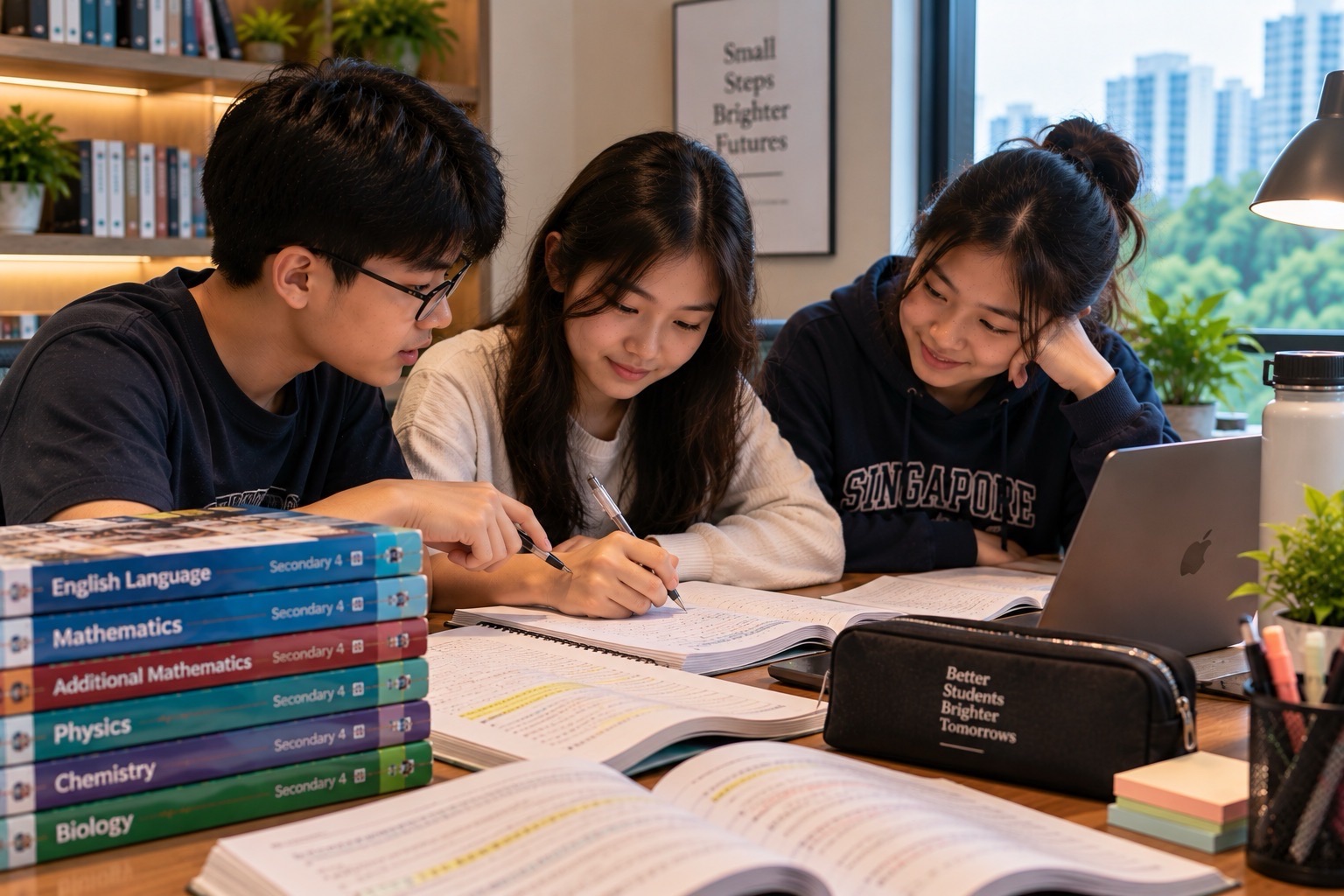
G2 Mathematics Tutorials | McCallum Street helps secondary students in Singapore’s Telok Ayer and southern CBD area connect algebra, number relationships, graphs and practical geometry. At eduKateSG near Sixth Avenue MRT, premium three-student lessons use carefully sequenced explanations, original problems and close review of the student’s independent working.
G2 Mathematics tuition should teach more than solving an equation already printed on a page. Students need to form equations from words, explain a graph’s gradient, recognise which dimensions a border changes and interpret a mathematical answer as a real quantity. Our McCallum Street tutorials build those links while matching Singapore’s G2 syllabus and the current school chapter.
McCallum Street is the family’s locality or after-school meeting context, not a separate eduKateSG teaching branch. The lesson venue is near Sixth Avenue MRT. A realistic tuition plan therefore considers the journey as well as the class: when the student leaves school, where the family meets, when the child eats and how much evening work remains.
Our established premium 3-pax format uses 1.5-hour weekly lessons with materials, guided corrections and focused continuation work. Current class availability and suitable placement are confirmed through a consultation. The aim is not simply to finish another chapter, but to make the student less dependent on being shown how every question begins.
Arrange a parent–student consultation · Ask about G2 Mathematics on WhatsApp · eduKateSG on Facebook
G2 Mathematics Needs the Right Year, Level and Syllabus
G2 identifies a subject level, not Secondary 2. The tutor needs to know both the school year and the Mathematics programme. A younger learner may be building the language of equations, while a graduating candidate may be consolidating several connected topics. The same G-level does not make their immediate lesson needs identical.
SEAB’s 2027 school-candidate listing identifies Mathematics as K210 and Additional Mathematics separately as K232. Under the SEC framework, the certificate records subjects at their respective levels. This article concerns the ongoing G2 Mathematics tutorial, not an interchangeable course for every subject carrying “Mathematics” in its name.
The distinction shapes teaching. A learner who cannot form an equation from a situation may need a clearer representation rather than a more advanced technique. A student who already understands the relationship may need more independent variation rather than repeated introductory explanation. We begin with evidence in the child’s actual work and check it against the current school sequence.
The worked situations below illustrate teaching across different stages of readiness. They are not official examination questions, a full syllabus list or a claim that every example belongs in one school term. The tutor selects and adapts them according to what the learner has been taught and which prerequisites are secure.
The Hidden G2 Problem: A Relationship Changes Its Appearance
A student can perform algebra accurately once somebody has supplied the equation yet fail to write it from a situation. That is often a modelling gap, not proof the pupil needs more repetition of the same manipulation. The variables and relationships must be understood first.
We ask which quantity is fixed, which changes and what the question requests. An equation, table, graph or labelled diagram is chosen to represent the same relationship. The student should be able to move among these forms and explain what remains unchanged.
Another pupil might model a problem correctly but lose an algebraic sign, expand only part of a bracket or attach square units to a length. Those are execution or interpretation mistakes. In a three-student class, the tutor can identify a different correction for each student.
McCallum Street’s conservation-edge setting invites hypothetical comparisons of dimensions, areas, scale and survey data. These are original classroom scenarios, not actual measurements of buildings or claims about businesses located there.
The tutor gradually removes prompts, then returns to the repaired principle after a delay inside a mixed set. Independence is demonstrated when the child chooses the starting relationship without relying on the chapter heading or a copied example.
Why Three Students Can Receive Different Next Steps
A shared topic does not require identical follow-up work. One pupil may need a table left visible while learning a linear relationship. Another can form the equation but needs more accurate transformations. A third can solve reliably and is ready to interpret a restriction on the variable. The tutor should be able to recognise those differences while the students are working.
In our three-student format, each learner has frequent opportunities to explain an opening decision. The tutor can inspect written steps, ask why an operation is valid and choose an appropriate variation. The setting is small enough to notice a recurring error before it fills another page, while still allowing students to hear an alternative explanation from a peer.
Discussion is followed by individual evidence. A learner may agree with an explanation about a graph but still be unable to interpret a new graph independently. We therefore remove prompts deliberately and record how much help the changed question required. A correct answer produced after several hints is useful practice, but it should not be mistaken for fully independent performance.
McCallum Street parents can ask what the tutor learned from the small-group setting. A precise answer might be that the student recognises a fixed charge but still confuses the dependent variable. That observation can guide the next lesson. The number of worksheets completed says less about whether the important connection has become usable.
The G2 Skills We Build as a Connected System
Variables describe quantities
Define each unknown in words and keep that definition stable through the working. In a cost model, an item count is not a price and should not silently change meaning.
The final numerical solution must return to the original quantity. The student should be able to explain what the value represents and why its unit or domain is sensible.
A linear rule connects table, equation and graph
A constant increase per unit appears in a table as repeated differences and in a graph as gradient. The fixed starting amount appears as a vertical intercept.
We ask students to predict how a change in the starting amount affects the graph without immediately replotting every point.
Algebraic equalities need valid operations
Expansion, simplifying and eliminating unknowns all require coherent transformations. A bracket multiplier must apply to every term, and both sides of an equation must be treated consistently.
Substitution into the original relationship is an independent check. A student who cannot explain why a step preserves equality needs the principle rather than another unexplained shortcut.
Percentages have a base that can change
A discount and later increase are applied to different values in sequence. The combined multiplier preserves that order; adding the percentage figures can give the wrong result.
We identify the amount before each stage and check the direction of change before exact arithmetic.
An area factor is not a length factor
When both dimensions of a rectangle scale, the area changes through both multipliers. An inner border is a difference of regions rather than a change in boundary length.
A sketch marks which sides receive an added or removed border and what the question measures.
A combined mean depends on both group sizes
The group total equals the group mean multiplied by the observation count. Combining groups requires combining totals and counts, not simply taking the average of two means.
We ask whether the combined result should lie nearer the larger group’s mean as a quick reasonableness check.
McCallum Street G2 Mathematics Casebook: 9 New Worked Examples
These 9 examples use original invented quantities and settings. They are not reports of McCallum Street business prices, measured heritage-building dimensions, live transport times, official examination questions or outcomes of actual students. Each mathematical result is paired with an explanation of its meaning and a changed task for independent practice.
1. Two fictional pricing rules and where they agree
Plan A for a school exhibition charges a fixed $18 plus $1.80 per printed item. Plan B charges $6 plus $3 per item. With n items, their total costs are A = 18 + 1.8n and B = 6 + 3n. These are invented amounts, not local quotations.
Set the totals equal: 18 + 1.8n = 6 + 3n, so 12 = 1.2n and n = 10. Both plans cost $36 at that point. The equality has a graphical meaning: the two lines meet at (10, 36).
At five items, A costs $27 and B costs $21, making B cheaper. At fifteen items, A costs $45 and B costs $51, making A cheaper. The lower variable charge begins to outweigh A’s greater fixed cost as the order grows.
A student should explain the change in preference rather than memorise the instruction to solve simultaneous rules. A changed fixed fee shifts the crossing point, and a table can verify which side of the crossing favours each plan.
2. A distance–time graph that includes a stop
A hypothetical person travels 500 metres in ten minutes, waits five minutes, then travels another 300 metres in six minutes. The total recorded distance is 800 metres over 21 minutes.
The overall average speed including the stop is 800/21, approximately 38.1 metres per minute. While moving, the person covers 800 metres in sixteen minutes, an average of 50 metres per minute.
On the cumulative distance–time graph, the waiting period is horizontal between minutes ten and fifteen at 500 metres. A student who excludes the stop without checking the question has answered a different speed question.
These are made-up graph values, not an estimate of a route near McCallum Street. A variation changes the waiting interval and asks whether the overall average rises or falls while the moving rate stays constant.
3. Reverse a percentage from the price after discount
A fictional item costs $102 after a 15% discount. The discounted amount is 85% of the original price p, so 0.85p = 102 and p = $120.
The check finds a 15% saving of $18 from $120 and recovers the $102 payment. Adding 15% of $102 would use the new price as the wrong base.
A ten-part bar can visualise the original and reduced amount, but the algebraic multiplier provides a compact solution. We compare both and ask what remains the same when the percentage changes.
The next task might state that a quantity increases to 120% of its original value. The pupil identifies the factor before solving instead of applying an isolated discount rule to every question.
4. Two ticket types with two conditions
A fictional school event sells ordinary tickets for a dollars and student tickets for c dollars. Two ordinary and three student tickets cost $41, while three ordinary and two student tickets cost $44.
The conditions are 2a + 3c = 41 and 3a + 2c = 44. Multiplying the first by three and the second by two gives 6a + 9c = 123 and 6a + 4c = 88, so 5c = 35. Therefore c = $7 and a = $10.
Both original purchases check: 2(10) + 3(7) = 41 and 3(10) + 2(7) = 44. A pupil who checks only one condition cannot be confident that the simultaneous model was copied correctly.
The technique is taught where appropriate to the school sequence. Before this topic, a single-variable price problem can establish the meaning of fixed conditions without premature algebra.
5. A border inside a rectangular exhibition board
An invented display board has outer dimensions 3.2 m by 1.8 m with an inside border 0.1 m wide. The inner dimensions are 3.0 m by 1.6 m.
The outer area is 5.76 m² and the inner area is 4.80 m², so the border area is 0.96 m². Both opposing edges remove border width from the dimension.
A student who subtracts the border only once needs a diagram; another who reports a perimeter needs a clear distinction between a region and its boundary.
An independent problem adds a frame outside a picture. The learner predicts that the dimensions should now increase, then uses the same region-difference structure accurately.
6. A changing ratio of two groups
Two fictional activity groups initially have members in the ratio 3:5. Eight new people join the smaller group, after which the ratio becomes 4:5.
Let initial group sizes be 3k and 5k. The new condition is (3k + 8)/(5k) = 4/5, giving 15k + 40 = 20k and k = 8. The original sizes are 24 and 40; afterwards they are 32 and 40.
Check that 24:40 simplifies to 3:5 and 32:40 simplifies to 4:5. The learner should understand that ratio parts are not necessarily actual numbers of people until k is determined.
A variant adds the people to the larger group instead. The equation and the direction of ratio change must be reconsidered instead of copied from the previous question.
7. Combining averages from differently sized groups
Five fictional observations have mean twelve, giving a total of 60. Another fifteen have mean sixteen, giving total 240. The combined twenty observations sum to 300 and have mean fifteen.
Simply averaging twelve and sixteen would give fourteen, but that would assign equal weight to groups of very different sizes. The second group contributes three times as many observations.
The mean of fifteen lies between the group means and closer to sixteen, as expected. A changed task gives the overall mean and one group mean and asks for the missing group mean.
The skill is reconstructing the underlying totals before choosing algebra or division, not memorising one version of a weighted-average formula.
8. An arithmetic sequence becomes a rule
A fictional display increases the number of markers in a row by four each time. The first row has three markers, the second seven and the third eleven. The nth term is 3 + 4(n − 1) = 4n − 1.
The tenth row would contain 4(10) − 1 = 39 markers. A student writing 4n might recognise the step size but forget the starting offset.
A table can verify rows one, two and three before the symbolic rule is accepted. A changed task gives the number of markers and asks for the corresponding row number.
The model depends on a constant increase. A different pattern that doubles each row would not obey the same linear rule simply because the early values look familiar.
9. A budget is an inequality, not only a boundary
A fictional project costs $14 initially and $3 for each item. A budget of at most $65 gives the inequality 14 + 3n ≤ 65.
Solving gives n ≤ 17. With n a non-negative whole-number count, seventeen items cost exactly $65, while eighteen cost $68 and exceed the budget.
A student who writes only n = 17 has identified the maximum but may not understand that every smaller non-negative whole number is also affordable.
The tutor contrasts ‘at most’ and ‘at least’ with changed examples, asking which sign represents each condition before any solving begins.
Our First-Principles Method
Find the earliest invalid or uncertain step
The tutor observes an attempt and asks what the learner intended. If the cost equation is wrong, the representation needs work. If it is right but a bracket is mishandled, the operation needs attention. This distinction prevents a general topic label from concealing a precise barrier that could be repaired with a shorter, better-chosen task.
Choose a representation for a reason
A table can expose a fixed charge; an annotated rectangle can expose both border widths; a timeline can expose a waiting interval. We choose the representation that clarifies the difficulty. The student should be able to connect it back to the original wording and forward to the calculation, rather than treat the drawing as a separate item to complete.
Make every important symbol readable
Variables have definitions, coefficients have roles and equal signs state relationships. We ask pupils to explain those roles before longer manipulation. This does not require a paragraph of prose beside every line. A clear opening definition and a brief explanation can be enough to keep the symbolic work connected to the quantities the problem actually describes.
Control the next source of difficulty
Our Fencing Method changes one important feature at a time. A student might first solve a cost equation with whole numbers, then decimals, then a whole-number restriction. The progression makes it easier to identify what caused a failure. Introducing every complication at once can create confusion without producing useful information about the learner’s understanding.
Give independent thinking an actual opportunity
Prompts are reduced deliberately. The student eventually receives a question without a ready-made equation or a fully labelled diagram. We allow a productive pause rather than immediately rescue the first hesitation. The tutor intervenes when the method is invalid or a prerequisite is missing, while recording whether the next decision was supplied or made independently.
Return to the idea after a delay
A brief later question checks whether the method is still available when the original explanation is no longer fresh. Mixing it with another topic checks selection as well as recall. We record the conditions of the attempt, including notes and prompts, so the parent can distinguish supported success from more dependable independent use.
Turn the mistake into a useful future check
A correction names the vulnerable decision: identify the percentage base, include both border widths or check both ticket conditions. The note should apply beyond one numerical example. A changed task later tests whether the student can use it. Copying the corrected solution is documentation; independently selecting the repaired method is the stronger evidence of progress.
A Possible Ninety-Minute G2 Tutorial
A session might start with ten minutes of mixed retrieval and fifteen minutes of focused explanation. Twenty-five minutes of guided practice then introduce variations while the tutor inspects each learner’s working. The questions are chosen to expose a relationship or decision, not simply to occupy time. These timings are illustrative rather than a rigid script for every class.
Twenty minutes can be used for independent application, followed by ten minutes of correction and ten minutes of review and continuation planning. Together the segments total ninety minutes. A student rebuilding a concept may need a different balance from one ready for unfamiliar work. The useful constant is the movement from explanation towards independent evidence.
The lesson should leave a clear record of what the student did alone. That might be constructing a rule from a table, identifying the correct percentage base or checking both original conditions of a problem. If help is still needed, the record says so. A fully corrected worksheet should not create a misleading impression that every part of the method is already secure.
Three Learning Routes Within the Same Subject Level
The repair route rebuilds a missing relationship. A pupil who cannot distinguish a fixed amount from a repeated amount may begin with a small table and verbal explanation. The stabilisation route strengthens a method that works inconsistently, perhaps because of signs, unit conversion or incomplete interpretation. The extension route increases independence, contrasts methods and adds suitable conditions when the foundation is already reliable.
One learner can occupy all three routes across different topics. Strong graph reading does not guarantee secure algebraic manipulation, and a weaker test score does not mean every chapter needs restarting. The tutor should be able to preserve the student’s strengths while repairing the specific barrier. This makes the programme more responsive than assigning the same difficulty to everything.
For a confident G2 student, extension might ask whether a model’s assumptions are reasonable, whether another representation is more efficient or why a decimal answer must be interpreted as a whole number. Those tasks deepen the current Mathematics. They do not rely on silently replacing it with a different subject or promising a school subject-level change.
An Illustrative Twelve-Week Progression
This framework describes learning purposes, not a guarantee of identical outcomes after twelve weeks. The school’s sequence, the student’s starting point and assessment dates can change the plan. The important feature is that each phase produces evidence useful for deciding what to teach next.
Weeks 1–3: separate representation from calculation
Review ordinary work and short diagnostic attempts. Can the learner form an equation from words? Can the learner solve an equation already given? Can the result be interpreted? Those questions separate different difficulties that might otherwise receive the same label. Select one or two consequential priorities and record a genuine starting attempt before explaining the repair.
Weeks 4–6: connect the representations
Where relevant to current schoolwork, move between tables, graphs, diagrams and equations. Ask what stays unchanged across the forms. Earlier repairs return briefly so they do not disappear as a new chapter becomes active. The learner should be able to explain how a coefficient, a table increase and a graphical rate can describe the same relationship.
Weeks 7–9: contrast similar-looking questions
Compare an original amount with a changed amount, total elapsed time with moving time, and a boundary with an area. The student names the feature that changes the method. Mixed tasks then remove the chapter cue. We watch whether correct choices survive without the previous example announcing what to do, and reduce assistance only as the evidence supports it.
Weeks 10–12: review independent control
A fresh sample revisits the original priorities under comparable conditions. Record accuracy, clarity, checking and the help required. Short timed sets can be used when the underlying methods are secure. The next cycle follows the result rather than automatically moving forward. A learner can extend in one topic while continuing a targeted repair in another.
A Compact Independent Practice Check
Here are four separate prompts. Solve 2(3x − 4) = 22. An item costs $72 after a 20% reduction: find the original price. A rectangle has outer dimensions 2 m by 1.5 m and an inside border 0.1 m wide: find the inner area. Five observations have mean twelve, and four sum to forty-three: find the missing value.
The solutions are x = 5, an original price of $90, an inner area of 1.8 × 1.3 = 2.34 m², and a missing value of seventeen. The checks are substitution, applying the stated reduction to $90, accounting for the border on both ends of each dimension, and reconstructing the five-observation total of sixty.
This is not an official assessment or a basis for predicting a grade. Its purpose is to reveal which decision needs support. Record whether the learner struggled to set up the relationship, carry out the operation or interpret the result. The tutor can then choose a more precise next question than a general instruction to revise everything.
School Alignment and Pre-Teaching
The current school chapter and assessment scope give the tutorial a practical direction. We ask for worksheets, textbook sections and teacher comments. If measurement is the current focus, an algebra repair should be connected explicitly to the measurement questions. The student should understand why an earlier skill is being revisited rather than experience it as an unrelated detour.
Following school does not mean copying every worksheet. A familiar question can expose an error; a changed question can test the repaired principle. This keeps the lesson relevant while protecting the learner from dependence on having seen the exact format beforehand. The goal is a method that remains usable when the question looks different.
Pre-teaching is considered when prerequisites are ready. A calm first encounter with a new representation may be useful, but early coverage is not the same as mastery. We do not keep adding chapters when the current relationship remains unclear. The next step should be justified by what the student can explain and use, not by how quickly a list can be ticked.
Home Practice That Gives the Tutor Useful Evidence
A suggested short routine contains one earlier skill, one current application and one correction to explain. The amount is adjusted to school workload. Parents can ask what is known and what is required, but should avoid supplying the whole equation immediately. A genuine first attempt helps reveal whether the learner can choose a representation without being directed.
Keep the original working and note substantial assistance. A correct answer completed after a parent names the method is not equivalent to an independent solution. It can still be useful learning, provided the record is honest. When a question stalls, preserve the exact point of uncertainty so the next lesson can begin with the real barrier.
A correction notebook should contain the mistaken assumption, the repaired relationship and a new example. “The second percentage used a different base” is more useful than “be careful”. The next changed task checks whether that note helps. The purpose is not to produce a beautifully copied notebook whose owner still cannot begin an unfamiliar question.
What Parents Should Look for in Progress
Useful signs include more accurate variable definitions, clearer equations, fewer repeated sign errors and stronger final interpretation. Ask for one example of what the learner can now do without help. “Can recover a linear rule from a table” describes an observable skill; “seems more confident” needs evidence before it becomes a useful account of progress.
Compare similar demands under comparable conditions. Two school papers may cover different topics, so their overall marks do not isolate a particular repair. A fresh problem using the same relationship offers a more focused check. No fixed grade outcome is promised. The tutor’s responsibility is to show what has changed, what remains uncertain and which next step follows from that evidence.
For the separate task of marked-paper analysis and examination execution, read SEC Examination Mathematics Tuition | Telok Ayer. This guide explains the sustained G2 tutorial that builds the knowledge and independence needed before intensive paper practice becomes the main priority.
Travelling from McCallum Street to Sixth Avenue
eduKateSG holds these tutorials at 8 Fourth Avenue, Singapore 268674, near Sixth Avenue MRT (DT7). McCallum Street describes the family’s locality at the southern edge of the Telok Ayer conservation precinct, not a teaching branch.
For a family starting within walking reach of Telok Ayer MRT (DT18), the Downtown Line provides a route in the direction of Bukit Panjang to Sixth Avenue without changing train lines. Starting closer to other CBD stations or coming from school can change the best journey.
McCallum Street connects conserved shophouses with the modern office district. The street’s location and the conserved buildings around Nos. 2 and 3 are described in the existing McCallum Street locality guide and URA’s Historic Districts reference. They are context for the neighbourhood, not a promise of lessons in those buildings.
Check current train access and directions against the family’s actual starting point, using the LTA Downtown Line information. Walking distances and interchange choices differ across addresses, so we do not give a universal door-to-door travel time.
A useful weekly plan leaves time for the journey, food, school assignments and the return home. The real reason to attend should be precise Mathematics teaching and growing independent problem solving rather than another class fitted into a tired student’s timetable.
Class Details and the First Consultation
Format: premium 3-pax small-group tutorials. Subject: G2 Mathematics, matched to school year and current programme. Duration: 1.5 hours weekly. Venue: 8 Fourth Avenue near Sixth Avenue MRT. Attendance: by appointment, subject to suitable placement. Current fees, available timings and any trial arrangements should be checked directly.
Bring a marked assessment, ordinary homework, the school topic sequence and teacher comments. Include a successful example beside one that caused difficulty, with original working intact. Note where help was used. The consultation should identify a manageable next priority and an independent check, rather than reduce the student to one percentage or promise that every difficulty will disappear after a fixed number of lessons.
Frequently Asked Questions
Does G2 mean Secondary 2?
No. G2 is the Mathematics subject level; Secondary 2 is a school year. A suitable lesson considers both, along with current school coverage and the applicable syllabus. The needs of a lower-secondary learner should not be assumed to match those of a graduating candidate simply because both study G2 Mathematics.
What changes when my child can calculate but cannot set up a word problem?
We focus on representation: defining the unknown, identifying fixed and changing quantities and preserving the relationship in a diagram or equation. Another page of calculations may not repair that step. The check is a new situation that the student can represent without being supplied the opening equation by the tutor.
Will you automatically use G3 questions to stretch a G2 learner?
No. Appropriate stretch can involve unfamiliar wording, alternative methods, interpretation and additional conditions within suitable work. The first priority is secure understanding at the learner’s actual level. Any proposed school subject-level change belongs in a discussion with the school; tuition does not independently authorise or guarantee that change.
Is this also an Additional Mathematics programme?
This guide concerns Mathematics. Additional Mathematics is separately identified in SEAB’s subject listing, and a student taking it needs subject-specific planning. State the exact subject when enquiring so resources and class placement are not based on an ambiguous reference to Maths or an assumption that the two syllabuses are interchangeable.
Do students need to show every tiny calculation?
Working should be clear enough to justify the method and locate errors, without becoming unnecessarily long. While a technique is unstable, one logical transformation per line can help. As control improves, the solution can become more concise. The student should still be able to explain the important steps and verify the result in the original conditions.
What happens when the school moves ahead of the student?
We identify the prerequisite blocking current work and connect its repair to the school topic. The answer is not automatically to restart everything or to race ahead without understanding. The tutor should explain why the chosen repair matters and use a school-relevant changed question to check whether it has helped.
Are tutorials physically on McCallum Street?
The programme described here is taught at 8 Fourth Avenue near Sixth Avenue MRT. McCallum Street is the family’s locality or travel context. Confirm the venue, class and appointment before attending. The locality in the title should not be interpreted as evidence of a separate McCallum Street branch.
What should we review after several lessons?
Ask which representation the student can now construct independently, which repeated error has reduced and whether the corrected method survives a delayed question. A useful review shows work and names the next priority. Attendance and completed chapters matter, but they do not replace evidence that the intended learning has become usable.
McCallum Street Mathematics Tutorial Directory
For the correct subject level, use the dedicated G1, G2, G3 or SEC Mathematics guide rather than treating SEC as a new fourth syllabus. The mathematics hub explains broader concepts; the nearby McCallum Street examination guide covers a distinct marked-paper and timing intent.
G1 Mathematics Tutorials | McCallum Street · G2 Mathematics Tutorials | McCallum Street · G3 Mathematics Tutorials | McCallum Street · SEC Mathematics Tutorials | McCallum Street
Mathematics Learning Hub · Mathematics Tuition by Area Index · SEC Examination Mathematics Tuition | Telok Ayer · Surviving Tuition | Telok Ayer (nearby parent guide).
Further Reading for McCallum Street Families
The Mathematics Learning Hub, the eduKate Mathematics Learning System and the Singapore Mathematics Tuition by Area Index provide wider subject and locality guidance. Use them to understand the learning approach and find the route appropriate to the student’s actual level.
The related local guides cover G1 Mathematics Tutorials | McCallum Street, G3 Mathematics Tutorials | McCallum Street and SEC Mathematics Tutorials | McCallum Street. For neighbourhood reading beyond lessons, see Things to do in Singapore | McCallum Street.
McCallum Street G2 Mathematics: Independence and Transfer
Our G2 Mathematics tutorials distinguish an answer that was reached with a model from one the student can produce independently. We ask what information the learner can identify, which method they choose and what reasonableness check is possible before the next question.
We change the known quantity, wording or condition in one step at a time. A student who can recognise the same structure in a new context is making progress that can carry into schoolwork and examinations. If the variation fails, we identify the missing connection rather than assign indiscriminate repetition.
A decision notebook should preserve the mistaken assumption and the correct principle, not merely a flawless copy of the model answer. After a short delay, the tutor revisits the principle in a mixed set where the chapter name is not supplied.
McCallum Street’s boundary between the conservation precinct and larger modern buildings offers a memorable example of how conditions matter. Our diagrams and quantities remain educational inventions; real land-use and conservation facts belong with URA, not with the numerical values in a worksheet.
The parents’ useful question after several lessons is whether the child can start a different question, explain the chosen method and notice a result that does not fit. Those signs make the weekly commitment more meaningful than collecting pages of corrected work.
McCallum Street G2 Mathematics: Clear Learning Routes
This G2 tutorial guide describes ongoing Mathematics learning at Sixth Avenue. Nearby examination guides focus on marked papers and timed execution, while subject hubs cover broader mathematical concepts and the locality guide explains the actual McCallum Street neighbourhood. These are different reader needs and should not be conflated.
- Things to do in Singapore | McCallum Street — verified locality context
- Surviving Tuition | Telok Ayer — nearby parent timetable and energy decisions
- SEC Examination Mathematics Tuition | Telok Ayer — nearby paper-readiness guide
- Mathematics Learning Hub — concept and study-system resources
- Mathematics Tuition by Area Index — geographical navigation
- G1 Mathematics Tutorials | McCallum Street — different subject-level route
- G2 Mathematics Tutorials | McCallum Street — this tutorial
- G3 Mathematics Tutorials | McCallum Street — different subject-level route
- SEC Mathematics Tutorials | McCallum Street — different subject-level route
- Official SEAB 2027 G2 syllabuses — examination authority
The education centre is not located on McCallum Street. The current school Mathematics level, year and learning needs determine the class enquiry; published links do not guarantee a particular timetable or vacant place.
G2 Mathematics That Still Makes Sense in a New Question
The learner we are developing can define a quantity, choose a representation, preserve a relationship through valid working and explain what the result means. That is more than being familiar with a worksheet. It is the ability to use Mathematics when the story, numbers or presentation have changed.
For McCallum Street families, our three-student G2 Mathematics tutorials provide a structured setting for those connections. We repair the missing relationship, stabilise the vulnerable step and extend independent choice. The best evidence is what the student can carry into the next school question without waiting for someone else to write its first equation.
Questions McCallum Street Parents Ask About G2 Mathematics
Is G2 the same as Secondary 2?
No. G2 is a subject level, and the school year must be identified separately.
Why does my child solve equations but fail word problems?
The difficulty may be representing the relationship, defining variables or choosing the correct model before manipulation.
What does gradient represent?
The change in the dependent quantity for one unit of the independent quantity, interpreted using the graph’s labels and units.
Is G2 Additional Mathematics identical to core Mathematics?
No. The 2027 SEAB listing identifies G2 Mathematics K210 separately from Additional Mathematics K232.
Can a stronger learner be extended without changing level?
Yes. More unfamiliar contexts, simultaneous conditions, model interpretation and independent checks add appropriate depth.
Do you always teach the next school chapter early?
Only when the necessary foundation is ready and early exposure serves a clear purpose.
Are lessons held on McCallum Street?
No. The tutorials are at 8 Fourth Avenue near Sixth Avenue MRT.
How do we check whether modelling has improved?
Ask the student to create a correct equation from unfamiliar wording without the tutor giving the first line.
McCallum Street: From a Familiar Neighbourhood to Better Mathematical Models
McCallum Street provides a useful geographical analogy for G2 representation. Its conservation-edge shophouses and nearby towers share the same physical street, but the two building types differ in scale, function and planning constraints. In Mathematics, a table and an equation can describe the same structure while showing different information.
A student can begin with an invented scale plan of a row of buildings and work through lengths and area ratios. These are teaching figures, not measurements of heritage structures. The tutor keeps the model’s assumptions explicit.
Another useful transfer task gives two fictional resource-allocation plans and asks what changes when a fixed amount increases but the per-unit rate remains constant. The learner predicts the change in graph position before calculating the new intersection.
The URA conservation reference and McCallum Street guide explain the actual neighbourhood; the invented algebraic examples remain separate.
G2 progress becomes visible when the pupil can identify the quantity, choose a representation, form a valid equation and explain its solution in words, rather than wait for the same worksheet pattern.
McCallum Street G2 Mathematics: Official and Local Reading
This is a continuing G2 tutorial guide, and the location in its title describes the family’s neighbourhood rather than an eduKateSG branch. The published Telok Ayer SEC Examination Mathematics Tuition article has a different role: marked-paper review and examination execution. Official SEAB materials determine subject requirements.
- Things to do in Singapore | McCallum Street
- Surviving Tuition | Telok Ayer
- SEC Examination Mathematics Tuition | Telok Ayer
- Mathematics Learning Hub
- Mathematics Tuition by Area Index
- The eduKate Mathematics Learning System
- URA Historic Districts
- SEAB SEC Overview
- G1 Mathematics Tutorials | McCallum Street
- G2 Mathematics Tutorials | McCallum Street
- G3 Mathematics Tutorials | McCallum Street
- SEC Mathematics Tutorials | McCallum Street
- Official G2 2027 school-candidate Mathematics guidance
Actual lessons remain near Sixth Avenue MRT, by appointment, and are aligned to the student’s school year and Mathematics level. The linked McCallum Street locality page is a guide to the area, not a classroom address.
McCallum Street Parent Questions: Mathematics and the Learning Routine
Does G2 mean Secondary 2?
No. G2 is a Mathematics subject level and may apply across school years. Confirm both.
What if my child solves equations but not word problems?
We rebuild the translation from words to variables, tables and equations, then test a changed question independently.
Is G2 Mathematics the same as Additional Mathematics?
No. In 2027 SEAB lists Mathematics K210 separately from G2 Additional Mathematics K232.
Should a strong student use G3 worksheets immediately?
Not automatically. Greater independence and unfamiliarity within a suitable level can be better extension.
Why are graph questions difficult?
Students may read the points accurately but miss what the axes, gradient or starting value mean.
Will lessons follow the school topic order?
School coverage guides the focus, with targeted prerequisites repaired when they block current work.
Is every tutorial timed?
No. Timing is used when the method is secure enough to rehearse under pressure.
Where are lessons held?
At eduKateSG, 8 Fourth Avenue near Sixth Avenue MRT, not a McCallum Street branch.
What is the first sign of progress?
Being able to define a variable, construct a relationship and interpret a new answer without hints.
Arrange a Parent–Student Consultation
Share the school year, G2 Mathematics level, current topics and recurring difficulties. Bring a few genuine work samples and a realistic weekly schedule so the first plan can begin with the student’s actual next step.
Contact eduKate Singapore · Chat on WhatsApp
eduKateSG
8 Fourth Avenue
Singapore 268674
Near Sixth Avenue MRT
Premium 3-pax small-group tutorials
By appointment
Properly taught kids shine a bright light into the future.