
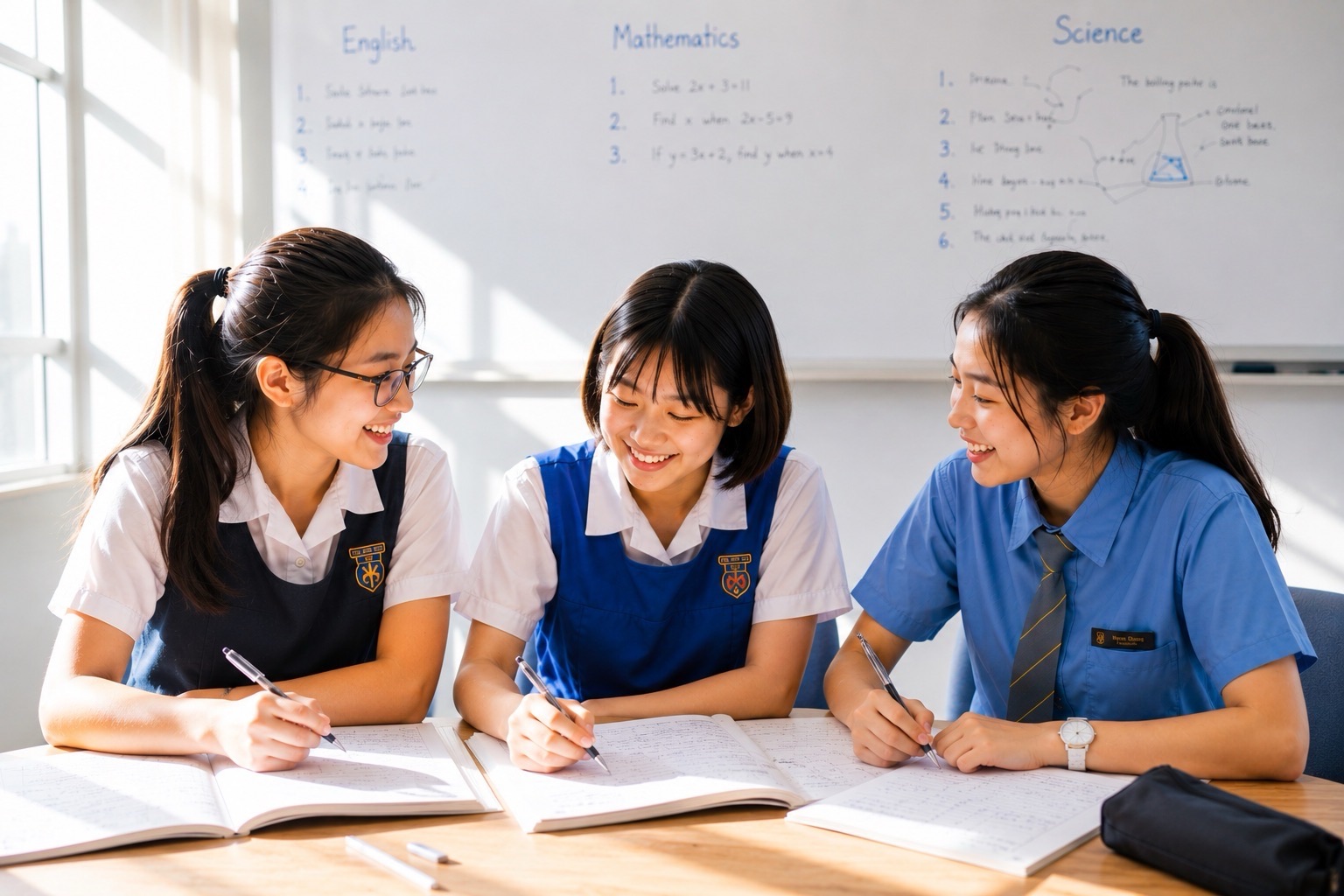
G2 Science tutorials for Aljunied learners should turn a correct scientific fact into the right decision for an unfamiliar question. At eduKateSG, our three-student small-group model focuses on identifying quantities, choosing a relevant mechanism, reading graphs and explaining the evidence before speeding up. The student should be able to justify a new answer, not simply recognise the layout of the teacher’s worked example.
Parents comparing G2 Science tuition in Aljunied, Physics and Chemistry support, Physics and Biology tutorials, or Singapore-Cambridge SEC Science preparation often report that their child performs well in topic work but hesitates in mixed tests. The missing step may be selecting a concept without a chapter heading, translating a diagram into words or using units consistently. We diagnose that decision and teach it through clear contrasts and independent follow-up tasks.
This guide is for families based in Aljunied, not an announcement of a tuition branch there or an affiliation with a local school. Suitable tutorials and consultations are arranged at eduKateSG’s teaching location, 8 Fourth Avenue, Singapore 268674, near Sixth Avenue MRT. The student’s year, exact G2 Science pairing and examination cohort must be checked before selecting practice.
Enquire about G2 Science tutorial suitability or arrange a parent–student consultation. The numerical examples, measurements and pupil scenarios below are fictional teaching exercises and should not be mistaken for observations made at Aljunied MRT, Geylang East Park or a particular school.
A More Important Transition Than It First Appears
Recognising a chapter is easier than selecting a scientific idea when the chapter title is absent. During revision, the heading Pressure may tell a student what to calculate before the question is read. In mixed work, the learner has to decide whether the information concerns pressure, density, force or a rate. This independent selection deserves its own teaching.
We begin by separating the requested quantity from the available numbers. A question can provide a mass, time, length and area without requiring every value in one calculation. Students identify what each quantity describes and which relationship could answer the prompt. The aim is a deliberate choice, not formula hunting.
The same transition occurs in explanations. A student who knows that particles move may still be uncertain about whether the question concerns diffusion, thermal expansion or a change of state. We ask what changes in the supplied situation and which features of the model explain that change. A familiar noun alone is not yet an answer.
Once a concept is introduced, we vary the representation. A table becomes a graph; a verbal account becomes an apparatus diagram; a calculation is explained in words. Successful movement between those forms gives the tutor better evidence than another immediately repeated example with the same layout and different numbers.
The Hidden Problem: Comparing Different Things as Though They Were the Same
Many apparently careless answers are really comparisons without a clear basis. A heavier object is assumed to have greater density, even when its volume is also larger. A larger force is assumed to create greater pressure, even when its contact area changes. A greater final reading is treated as a greater increase, even when starting values differ.
We use pairs of questions to uncover these errors. The pupil first answers which object has greater mass, then which has greater density. The correct choices may differ. We ask the learner to explain why a statement can be true for one quantity but false for another. The distinction is the lesson, not an unnecessary complication.
A useful diagnostic keeps arithmetic simple. If a student fails because the numbers are unwieldy, it is harder to see whether the model itself is understood. We begin with accessible values, make the comparison explicit and then increase the numerical demand when that relationship is stable.
The tutor also asks what evidence would be missing from an incomplete comparison. If only force is supplied, the pupil cannot calculate pressure without area. Recognising that limitation is a correct scientific decision. We do not reward filling every blank with an invented assumption merely to produce an answer.
Why a Three-Student Group Needs Individual Working
Each learner begins a diagnostic task before hearing another student’s response. The tutor can then see whether the first difficulty was reading, selecting, calculating or explaining. A group that only follows one confident answer may finish quickly while leaving two students’ misconceptions untouched.
Imagine three fictional pupils comparing pressures. Salma chooses the correct force but uses a side length instead of contact area. Ben uses the area correctly but reverses the division. Jae calculates accurately and then says the larger pressure proves that the material is stronger. Each answer needs a different correction.
Salma can identify the relevant face and calculate its area, Ben can explain force per unit area, and Jae can distinguish the calculated quantity from an unsupported material claim. They then attempt another shared question. The teaching remains coherent while the follow-up reflects each learner’s actual need.
Class size alone does not create this benefit. We need suitable grouping, purposeful discussion and time for new independent attempts. Faster pupils should justify and evaluate, not merely complete more routine items. Quieter pupils should have time to form a response without being treated as though silence proves an absence of understanding.
G2 Science Under Full Subject-Based Banding
G2 is a subject level, not Secondary 2. MOE’s Full Subject-Based Banding guidance explains the wider framework. The pupil’s year and Science level must both be known before an appropriate weekly programme can be selected.
The 2027 SEAB directory lists Physics/Chemistry K223, Physics/Biology K224 and Chemistry/Biology K225. We check the actual pairing rather than assume that every G2 learner studies all three disciplines or should receive the same revision materials.
The G2 Chemistry learning outcomes include mass, molar mass and amount in moles but do not require stoichiometric reacting-mass or gas-volume calculations. Appropriate challenge respects that boundary. A more demanding worksheet is not automatically a better use of a G2 student’s revision time.
For lower-secondary pupils, current school topics remain the immediate reference. We use the eventual examination route as a destination while distinguishing untaught material from genuine gaps. A child’s unfamiliarity with a future topic should not be presented as evidence that they are already behind.
An Aljunied Science Learning Lens: Evidence in an Everyday District
Geylang East Park along Aljunied Avenue 1 and Aljunied Park on Aljunied Road provide recognizable contexts for questions about plants, shade, surfaces, measurement and changing conditions. Those parks are real. Any data values in our worksheets, however, are explicitly invented and cannot be used to infer actual environmental conditions in either place.
Aljunied’s elevated East–West Line station also offers an intuitive opening to motion, energy and systems questions. We may describe a fictional journey and supply its distances and times, but we do not imply that the imaginary speeds are measurements of an SMRT train. An engaging setting helps a child ask a question; scientific evidence must be supplied by the exercise.
The local reference deliberately disappears when we test transfer. A park temperature table becomes a laboratory cooling curve, while a rail-journey diagram becomes a movement graph for a trolley. A pupil who relies on the original place name has not yet demonstrated the same strength as one who chooses the relationship without that cue.
When the station story changes the requested rate
In a hypothetical movement problem, a vehicle travels 400 metres in 200 seconds, pauses for 100 seconds and continues another 200 metres in 100 seconds. Its moving-section average speeds are both 2 metres per second. Yet total distance over the whole 400-second period is 600 metres, so the complete-interval average is 1.5 metres per second.
A learner who announces 2 metres per second for every part may have done correct calculations on selected intervals without reading the question’s scope. We ask which quantities belong to the complete period and whether the pause was included in its elapsed time. The diagnostic concerns the definition of the average.
The next task is presented as a graph without a train or station. Its flat distance–time interval represents a period with no change in distance. The pupil uses the axis labels to choose whether the entire interval or only part is relevant. The mathematics becomes transferable when the place name is no longer present.
Vegetation gives a useful question about controlled comparisons
A fictitious park-study worksheet records average heights for two sets of seedlings in different stated conditions. If water amount and light exposure both vary, the pupil cannot isolate one of them as the cause. We ask which variable the investigator intended to study and how to make the comparison more informative.
The first improved design controls the unrelated stated factors and chooses one measurable outcome. Students explain why a fairer method helps interpret the result. We do not teach ‘repeat three times’ as a substitute for controlling two simultaneous changes.
A final unfamiliar plant study gives no local scene at all. It uses an apparatus diagram with labelled conditions. The learner should still identify the independent variable, dependent variable, controls and the evidence needed for a causal claim.
Built surfaces illustrate property–purpose reasoning
Imagine a fictional housing-design brief presenting three samples with labelled thermal conductivity, opacity and water resistance. The learner selects a material for a particular role and explains why one property matters more than the others. A technically true description is not a good answer unless it addresses the specified purpose.
Next, the objective changes from admitting daylight to reducing heat transfer. The original ‘best’ sample may no longer be suitable. The child learns that a choice is conditional on the intended function, not a property that belongs to an object for every possible task.
We explicitly avoid assigning these invented specifications to actual Aljunied buildings. The town provides an accessible scene; the question provides the properties that must support the calculation or explanation.
Environmental data: identify what was actually measured
A simulated temperature sensor records 29 °C, 31 °C and 30 °C at three stated times. The student can describe an initial increase followed by a decrease. The readings alone do not prove why the changes occurred. A proposed link to shade, rain or wind would need additional conditions or evidence.
We then give two sensors with repeated readings and ask which comparison is appropriate. If one sensor’s readings are consistently offset under the scenario, repeating the same method may not remove that offset. The pupil learns that evidence quality depends on measurement design, not merely the number of data points.
What We Work On: Seven Connections in G2 Science
Quantity, unit and scale
A number becomes scientifically useful when the learner can say what it measures. Students attach units to given values and check whether those units are compatible before substituting into an equation. We use small conversions to reveal whether the relationship is understood or whether the pupil is copying numbers without their meanings.
An original density example gives a mass of 540 grams and a volume of 200 cubic centimetres. The density is 2.7 grams per cubic centimetre. The tutor then asks for another mass and volume pair that has the same density. Constructing a valid example is a stronger check than repeating the first division.
We next give a larger sample with proportionately larger volume. The pupil should not describe its density as larger merely because it contains more material. This short contrast connects quantitative reasoning with the physical meaning of the property rather than making density a formula to remember in isolation.
Forces and the particular object being studied
Before combining forces, the learner identifies the object on which they act. A diagram should not mix a force on a trolley with the reaction force on the person pulling it and then call the result zero. We start with a clearly defined one-dimensional system and label each relevant force.
A fictional 5-kilogram trolley has a forward force of 14 newtons and an opposing force of 4 newtons. Its resultant is 10 newtons forward, giving an acceleration of 2 metres per second squared. The arithmetic follows the diagram; it does not determine which forces belonged in the diagram.
The follow-up makes the opposing force equal to the forward force. The learner explains that zero resultant means no acceleration in this model, not necessarily that the trolley was already at rest. The initial motion matters. This is an example of why a known equation needs a correct physical interpretation.
Particle behaviour and visible thermal changes
In thermal questions, students move between what is observed and the particle model used to explain it. We ask whether the statement concerns particle motion, particle spacing or the size of the whole sample. Saying that particles themselves become larger is not an adequate explanation for ordinary thermal expansion.
We give two particle sketches and ask which better represents the stated change. The learner explains the choice, then checks whether the number of particles has been preserved where the model requires it. A diagram can make an inconsistent explanation visible more quickly than a long paragraph.
The G2 thermal-physics outcomes provide the curriculum boundary. Our examples connect observations with the relevant model rather than treating every warm or cool object as an invitation to use the same memorised sentence.
A circuit drawing and a quantitative relationship
Students identify connections, junctions and the quantity measured by each instrument before calculating. A meter symbol is not enough; its location in the diagram matters. We ask which two points a voltage refers to and which branch a current reading describes.
A hypothetical resistor has 8 volts across it and carries 0.4 ampere. Its resistance is 20 ohms. We then change the question so resistance and current are given and voltage is required. The learner explains the relationship before rearranging, instead of assuming that the operation must always be division.
The independent diagram is arranged differently on the page. The child has to identify the same electrical connections without relying on the original picture. These tasks are paper-based; they do not require a family to handle household wiring or construct unsafe electrical experiments.
Chemical notation and conservation
We ask pupils to explain what a coefficient changes and what a subscript describes. Two molecules of a substance are not a new substance with a different formula. A particle drawing can help the learner distinguish the number of represented particles from the composition of each particle.
In an original balancing task, the teacher supplies all reactants and products and asks the student to count each atom type on both sides. The pupil should adjust coefficients, not rewrite a substance’s identity to make the count easier. Conservation becomes the reason for the operation rather than a separate definition.
A second equation looks less familiar but uses the same counting principle. The learner explains the balance without recalling a memorised reaction from a worksheet. We then return to the school topic to connect this symbolic control with the properties and observations relevant to the actual course.
Biological structure, process and direction
For students taking Biology, we use route diagrams to distinguish naming a structure from explaining its role. The learner identifies where a substance starts, what process moves or changes it and where it goes next. This is more revealing than asking for an entire memorised paragraph with no change in presentation.
A task might contrast diffusion and active transport using explicitly stated concentration conditions and energy requirements. The pupil selects the relevant mechanism and explains the direction rather than write both terms in the hope that one is accepted. We choose the depth from the school’s current Biology programme.
Another example removes one step from a transport explanation and asks the learner to repair it. The child must connect the structure to the process rather than simply insert a remembered organ name. We use this kind of task to make biological knowledge coherent and usable across diagrams.
Experimental evidence and the claim it supports
A result can be described accurately without establishing its proposed cause. We give a fictional investigation in which temperature and sample size both differ between groups. The learner identifies why the comparison cannot isolate temperature alone and proposes a change that addresses that specific limitation.
We also distinguish repeating a measurement from improving a flawed comparison. More readings under the same confounded conditions do not automatically separate the effects of the two variables. A strong evaluation names the problem, explains its consequence and proposes a relevant improvement instead of repeating a universal instruction to average.
Worked Physics Example: A Moving Trolley With Opposing Forces
An original G2 paper problem shows a trolley of mass 4 kilograms. A force of 18 newtons acts forward, with 6 newtons acting backward on the same trolley. Its resultant force is 12 newtons forward; the corresponding acceleration in the stated model is 3 metres per second squared.
We begin with a force diagram rather than a calculator. Both forces belong to the trolley, so their directions determine how they combine. A pupil who adds 18 and 6 without drawing the arrows may calculate quickly but choose the wrong physical relationship.
The next question changes the backward force to 18 newtons. The resultant becomes zero and the acceleration is zero in the model, but the trolley need not be stationary. It may be moving at constant velocity. We ask what additional information about its previous motion would be required to describe its speed.
Finally, the question provides the same numbers in a less familiar diagram orientation. We want the child to recognise force direction and system boundary, not rely on the arrow that happened to be drawn on the left in the first example.
This is a model problem with specified constant values. It is not a measurement of trains or road traffic near Aljunied. The purpose of the real neighbourhood reference is to make the ideas imaginable, while the paper setup supplies the actual evidence.
Worked Chemistry Example: Amount of Substance and a Sensible Unit
For a G2 Chemistry exercise, suppose an imaginary sample contains 12.0 grams of a pure substance with a given molar mass of 60.0 grams per mole. Amount in moles is mass divided by molar mass, so 12.0 ÷ 60.0 = 0.200 mole.
The units are informative. Grams divided by grams per mole gives moles. A pupil who multiplies the given numbers might be remembering two quantities without understanding why their ratio determines amount. We ask the student to state the quantity required before choosing the operation.
In a changed version, the problem gives 0.35 mole of the same substance and asks for mass. The answer is 0.35 × 60.0 = 21.0 grams. A student who mechanically divides again has used the earlier procedure even though the unknown changed. We compare the two questions side by side.
We then introduce a new, fully specified molar mass and ask for an estimate before the exact calculation. If the sample mass is less than one molar mass, the amount should be less than one mole. That reasonableness check can reveal a misplaced decimal without replacing the need to understand the relationship.
This sequence remains within the G2 mass–molar mass–mole relation. We do not append a reacting-mass or gas-volume stoichiometry exercise simply to make the page look harder. Where the registered course has different boundaries, the appropriate official syllabus remains the reference.
Worked Separation Example: A Mixture and Two Different Goals
An imagined laboratory mixture contains insoluble sand, dissolved salt and water. One prompt asks how to remove sand from the mixture. Filtering can retain the insoluble solid while allowing the dissolved salt solution to pass through. The student explains the physical property being used and does not claim that the filtrate is pure water.
The next prompt changes the desired product to the dissolved salt. Now the original filtration step alone cannot recover that salt. A suitable method must account for the desired solid and the liquid, within the practical methods taught in the student’s current syllabus.
A third prompt asks to collect the water rather than retain the salt. Students must reconsider the setup again. We teach pupils to identify which component is the product and which properties separate it from the others before naming apparatus.
This is intentionally a paper-based method comparison. It is not guidance for treating drinking water or handling unknown materials at home. A clear liquid is not necessarily safe, and the invented components cannot justify claims about local groundwater or drainage.
The transfer example uses a chromatography diagram with suitable reference spots and conditions. The child should still ask what must be separated or identified, how the apparatus achieves it and what evidence the resulting pattern can support.
Worked Biology Example: Equal Growth Does Not Mean Equal Percentage Change
In a fictional experiment, two plant samples gain mass under stated conditions. Sample A increases from 6.0 grams to 6.6 grams; Sample B increases from 12.0 grams to 12.6 grams. Both show an absolute increase of 0.6 gram.
The question then asks for percentage increase relative to the initial mass. A’s increase is 0.6 ÷ 6.0 × 100% = 10%, while B’s is 0.6 ÷ 12.0 × 100% = 5%. Equal absolute gains need not represent equal relative changes.
A pupil who reports 10% for both has retained the first number but forgotten what the denominator means. We ask the learner to identify the starting mass as the reference in each case. The task tests quantitative interpretation before asking for any explanation of the biological processes involved.
If the next question asks why the samples changed mass, the two measurements alone are not enough. We need the relevant experimental conditions and a model, such as water movement across a partially permeable membrane when appropriate. We distinguish the supported numerical comparison from a proposed mechanism.
The final version changes one sample to a decrease in mass. Students preserve the negative direction and explain whether the question asks for signed change or percentage decrease. The mathematics remains transferable across Biology datasets, without turning a fictional observation into a claim about all living material.
Writing Science Explanations That Actually Answer the Command
Some pupils include every definition they remember because they are uncertain which one matters. We teach them to identify the outcome, select the relevant evidence and connect it with the process the question asks them to explain. A long paragraph can still be incomplete when the causal link is missing.
We contrast a describe question with an explain question using the same table. Describe requires reporting the change correctly; explain requires a valid mechanism tied to stated conditions. An evaluation may ask whether an experimental method supports the proposed cause. The relevant content overlaps, but the answer task differs.
A tutor can give two draft answers for editing, one accurate but excessively broad and one concise with the necessary relation. Students decide which words earn their place. The final independent task uses a new scene without a sentence starter, allowing the learner to demonstrate that the structure has become understood rather than copied.
A well-formed answer also recognises missing evidence. If an experiment has not specified the relevant conditions, it can be correct to say what would need measuring. We encourage that scientific discipline rather than reward confident assumptions merely because they sound plausible.
Our First-Principles Teaching Method
Inspect the first decision, not just the final answer
We ask how the learner selected the values and method. A wrong answer can come from a sound model followed by a numerical slip, or from an unsuitable model applied accurately. Those cases need different teaching. The working reveals which kind of problem the pupil actually encountered.
Repair the relevant prerequisite
A pupil struggling with area conversion in a pressure question needs that conversion made clear, not an automatic restart of every Physics chapter. We use an accessible representation, repair the missing connection and return to the original task. The child should understand why the earlier skill was revisited.
Use contrasts to reveal meaning
We change one condition while keeping other information recognisable. The same mass occupies a different volume; the same amount of gas is represented in a different particle sketch; the same force acts over a different area. Students predict the direction of the effect before calculating or writing a formal answer.
Translate between forms
A concept is explained through a diagram, table, equation and short paragraph where appropriate. We also reverse the route by asking the learner to explain a completed calculation. This catches a pupil who can produce the number but cannot state which physical or biological quantity it represents.
Remove hints and check later
The next question arrives without its chapter heading or the tutor’s opening clue. We record how much help was needed, then revisit the idea at a later lesson with different wording. Independent transfer is the goal. Immediate agreement with a demonstration is welcome but cannot be the only basis for moving ahead.
What a Focused G2 Science Session Can Look Like
An illustrative 90-minute session can begin with short individual retrieval, followed by a diagnostic comparison and focused concept teaching. Guided practice then leads into an unsupported application. The final review identifies one precise correction and a manageable home task. Actual class duration and timetable arrangements are confirmed separately.
For a thermal lesson, students first describe what a supplied temperature record shows. The tutor then asks which part is observation and which proposed explanation would require a particle model. A contrast changes the conditions, so the learner must reconsider rather than repeat the same sentence about heat.
Within the group, one pupil may need help distinguishing particle motion from spacing, another may need to interpret the graph’s interval, and another may need to evaluate the fairness of the comparison. These different follow-ups can still support a common lesson without pretending everyone has the same difficulty.
The closing independent task should reveal the selected target clearly. A large mixed assignment is less useful when it hides whether the learner now understands one important distinction. We choose the next practice because it can answer a teaching question, not because a particular number of pages has to be completed.
Three G2 Learning Pathways
Repair: rebuild a usable relationship
A learner may remember terms while lacking a dependable way to relate them. We start with what is measured and what the question asks, then build the smallest necessary comparison. An independently correct first step gives the pupil something stable to use as the rest of the question becomes more demanding.
Repair stays connected to current schoolwork. Once the pupil understands a ratio or diagram convention, we return to the original Science context. The student should see the practical benefit of the repair rather than interpret it as a judgment about being generally weak at the subject.
Stabilisation: make knowledge available in mixed work
A student who knows the chapters but performs unevenly may need varied representations and delayed retrieval. We inspect whether the difficulty is remembering, interpreting, selecting or executing. The next question isolates that decision before the learner returns to a fuller mixed set.
We look for the pupil recognising why an earlier answer was unsuitable. A learner who can say that they compared total mass when the question asked for density has gained a useful checking habit. The correction should remain visible when the numbers and materials are changed.
Extension: evaluate and justify
A secure learner can compare two investigation designs, propose missing evidence or identify a limitation in a broad claim. We deepen reasoning within the G2 course rather than automatically assign G3-only calculations. The challenge is the quality of the decision, not merely the difficulty of the arithmetic.
Students can also construct a valid counterexample. If someone claims that the heavier sample always has greater density, the learner supplies masses and volumes that disprove it. Creating a correct case requires ownership of the relationship rather than recognition of a rehearsed answer.
Assessment Preparation Without Losing the Learning Goal
The 2027 G2 scheme pairs multiple-choice and structured papers for each selected discipline in a 75-minute session. Each discipline contributes 50% overall, through components weighted at 20% and 30%. Preparation needs both answer recognition and independently produced explanations.
We ask a pupil who selects the correct option to explain why a plausible alternative is unsuitable. Another task removes the options and asks for a written answer. These checks can reveal different needs. A strong performance in one response format should not automatically stand in for evidence about another.
Experimental reasoning is still important. A learner must be able to interpret apparatus, identify variables and evaluate data at the required level. School practical learning provides experience that paper discussion cannot replace. Our tutorial work supports the interpretation and explanation while respecting appropriate supervision for hands-on activities.
How We Reduce Repeated Errors
The error record names the first incorrect choice, not simply the chapter. Used side length instead of area gives the learner a clear correction. Careless with pressure does not. We preserve the original attempt, add a concise explanation and identify a new task that will test the same choice.
Reading, conceptual selection, calculation and presentation are tracked separately where useful. A student who knows the relationship but miscopies a unit needs a different response from one who has selected the wrong relationship. A single mark cannot make that distinction; the working and the learner’s explanation can.
The follow-up comes after an appropriate interval and uses changed wording or values. If the same mistake persists, we reconsider how the idea was represented. Repeating the same correction more loudly is not a different teaching method. The objective is a decision the pupil can now make without being reminded.
Teaching Ahead and a Useful Home Revision Rhythm
A preview of an upcoming topic can help a ready student become familiar with its vocabulary and representation. We might introduce the meaning of a mole or the axes of a new graph before the school lesson. The preview stays connected to secure prerequisites rather than concealing unresolved ratios under advanced terminology.
A manageable week can use short retrieval, one unfamiliar application and a return to an older mistake. The learner explains a relationship without notes, later uses it in a new representation and finally checks whether the earlier wrong decision has changed. The workload should fit school commitments rather than become a fixed additional quota.
Parents can ask what each number measures and which condition justifies the selected method. These prompts help the child show their thinking without turning the parent into a second full-time tutor. If the learner remains uncertain, record the precise question for the next lesson instead of supplying a polished answer to copy.
Keep a clear distinction between practice completed with support and independent attempts. Looking at a worked solution while answering a similar question is a useful learning activity, but it should not be mistaken for the same evidence as a closed-note response. The distinction helps the tutor plan the next level of challenge honestly.
What Progress Should Look Like
Progress may first appear as better questions, clearer units and more accurate comparisons. The learner can explain why a larger mass does not necessarily imply greater density, or why an observed trend does not identify its cause. These are useful changes even before another major assessment is available.
We compare the targeted skill across unfamiliar tasks and later checks. A higher score on an easier or repeatedly seen worksheet does not automatically establish independent improvement. Work conditions, question demands and the amount of prompting all matter when interpreting a result.
Some pupils already have sufficient support through school and their own study habits. Tuition is more useful when there is a persistent gap, dependence on hints or a clear need for extension. A credible programme explains what will be taught and checked without promising a particular grade after a fixed number of lessons.
An Aljunied Parent’s Guide to Class Suitability
The teaching and consultation location for suitable eduKateSG classes is 8 Fourth Avenue, Singapore 268674, near Sixth Avenue MRT. Aljunied is the neighbourhood served by this educational page, not a separate tuition centre address. Consultations are arranged by appointment.
Aljunied MRT is on the East–West Line, and families should use current public-transport information to plan any transfer and onward journey. The relevant question is whether the full home-or-school-to-class trip is practical for the pupil’s timetable, not whether one station name looks close on a map.
A useful consultation includes the student’s current year, actual G2 Science pairing, school topic sequence, and representative classwork or a marked assessment. Bring one successful explanation as well as one difficult question. The difference between the two may reveal that the pupil chooses better when the topic is named than when it is hidden.
A suitable three-student group should allow every learner to attempt questions independently and receive feedback relevant to their actual Science combination. Group fit, lesson duration, timetable and availability must be confirmed rather than assumed from a neighbourhood article.
Ask about G2 Science tutorial suitability and include the learner’s current Science subject title, examination year and one question that remains uncertain. That is enough to begin a meaningful diagnosis.
Frequently Asked Questions: G2 Science for Aljunied
Is G2 the same as Secondary 2?
No. G2 refers to a subject level within Full Subject-Based Banding. Secondary 2 is a year of schooling. Both must be known before choosing a tutorial plan.
Does G2 always mean Physics and Chemistry?
No. The 2027 G2 Science pathways include Physics/Chemistry, Physics/Biology and Chemistry/Biology. The registered combination determines which disciplines and papers are relevant.
Are difficult G3 questions automatically useful extension?
Not necessarily. Strong extension can deepen experimental reasoning or improve interpretation within the G2 syllabus. Questions requiring unrelated content from another course may consume time without serving the student’s examination route.
How do you tell whether a topic is understood?
We ask the learner to retrieve the idea without notes, explain it and solve an unfamiliar variant with changed presentation. Immediate success after a demonstration is only one part of the evidence.
Can this tuition replace practical lessons?
No. Tutorials can strengthen apparatus diagrams, investigation planning and interpretation. Hands-on experience and safety-sensitive practical work require appropriate facilities and supervision.
Are G2 Science classes located in Aljunied?
The article is for Aljunied families. The stated suitable teaching location is at Fourth Avenue near Sixth Avenue MRT, and the actual arrangements must be confirmed before travel.
Connected Reading for Aljunied Families
The subject-level companions are G1 Science Tutorials | Aljunied, G3 Science Tutorials | Aljunied and SEC Science Tutorials | Aljunied. Each serves a distinct level or examination-planning need rather than duplicating one universal Science course.
Related primary and area information includes PSLE Science Tuition | Aljunied, Tutors | Aljunied and How to Improve With Tuition | Aljunied.
For the broader series, use the Singapore Science Tuition by Area Index and Singapore Area Learning and Tuition Hub. Official science subject combinations can be checked with SEAB’s 2027 G2 directory.
G2 Science Becomes More Reliable When the Student Knows Why
The aim is to help a learner distinguish the requested quantity from a familiar but irrelevant one, choose a suitable model and write an explanation that is bounded by the evidence. Once those decisions become dependable, a changed worksheet is less likely to feel like an entirely new subject.
Aljunied provides everyday contexts that can welcome students into scientific questions, but the neighbourhood is not the answer key. We remove the local cue and look for the same reasoning in unfamiliar tables, circuits, material choices and biological data.
Discuss G2 Science tutorials for an Aljunied student with the current school year, exact Science pairing and a question that caused difficulty. A useful plan begins with evidence of what the pupil can do and what the next independent task needs to test.
Continue reading: explore the Science Learning Hub for related guides and reading routes.