
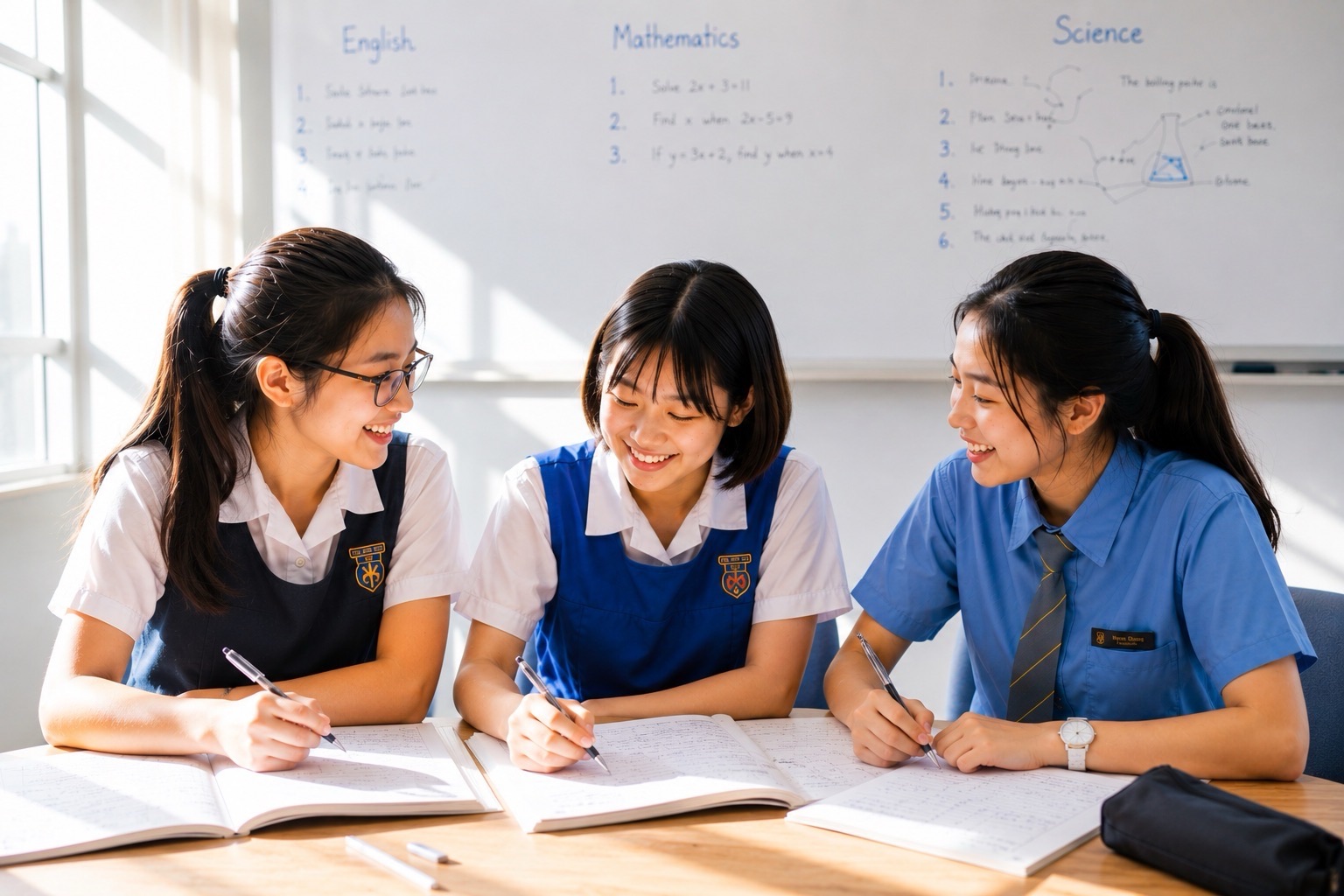
G2 Science Tutorials | Chai Chee gives families a clear route into Science learning that works beyond familiar chapter exercises. A student may remember scientific definitions yet struggle to select the relevant model in an unfamiliar question. eduKateSG’s three-student small-group approach starts with each learner’s independent attempt, diagnoses the earliest unsupported choice and checks the corrected idea in a changed context.
Parents looking for G2 Science tuition in Chai Chee, Science tutors and SEC preparation should confirm the student’s school year, registered Science level and actual subject combination. G1, G2 and G3 are subject levels, not shorthand for Secondary 1, 2 and 3. This locality guide does not claim a Chai Chee teaching branch. The stated eduKateSG venue is 8 Fourth Avenue, Singapore 268674, near Sixth Avenue MRT.
Chai Chee’s neighbourhood and the surrounding eastern estates can introduce questions about everyday measurements, travel, materials and scientific evidence. All figures here are fictional teaching datasets, not actual readings from Chai Chee businesses, roads or facilities. The learner’s task is to understand the relationship well enough to use it when the familiar setting disappears.
Density and volume: G2 Science Tutorials for Chai Chee
The first task for density and volume is identifying what is measured and what the question asks. In an invented dataset, a reading begins at 35 units and ends at 47 units after six minutes. The final value, increase of twelve units and average change of two units per minute answer different questions. These generic values do not establish a physical or biological mechanism by themselves. The learner names the quantity and its reference before selecting an operation.
The tutor introduces an appropriate density and volume model from the student’s registered syllabus and asks for an independent explanation. One learner may misread a graph, another may choose the wrong denominator, and a third may calculate correctly but infer a cause not supported by the supplied evidence. We distinguish these needs instead of describing all three as careless. Scientific terminology matters when it explains the relevant conditions, process and outcome.
A second task changes one condition such as time, measured system, experimental control or starting value. Pupils predict which part of the result should change before calculating. We then remove the chapter heading and original worked solution. An unfamiliar graph, apparatus diagram or table tests whether the learner can choose the scientific relationship independently rather than repeat the most recently demonstrated procedure.
In a three-student group, pupils discuss their approaches only after independent first attempts. The tutor gives targeted feedback and each child completes a new task alone. We record whether the corrected choice survives without hints and revisit it after a delay. A correct guided response is useful progress, but an unseen independent answer is stronger evidence of learning continuity and transfer.
At home, parents can ask what the number represents, which condition changed and what observation supports the conclusion. A precise error note for density and volume is more useful than a general judgement about effort. Practice should match the current school course, be manageable alongside rest and remain safe. Printed data and school-supervised practical work are preferable to hazardous unsupervised experiments.
Pressure and contact area: G2 Science Tutorials for Chai Chee
The first task for pressure and contact area is identifying what is measured and what the question asks. In an invented dataset, a reading begins at 36 units and ends at 48 units after six minutes. The final value, increase of twelve units and average change of two units per minute answer different questions. These generic values do not establish a physical or biological mechanism by themselves. The learner names the quantity and its reference before selecting an operation.
The tutor introduces an appropriate pressure and contact area model from the student’s registered syllabus and asks for an independent explanation. One learner may misread a graph, another may choose the wrong denominator, and a third may calculate correctly but infer a cause not supported by the supplied evidence. We distinguish these needs instead of describing all three as careless. Scientific terminology matters when it explains the relevant conditions, process and outcome.
A second task changes one condition such as time, measured system, experimental control or starting value. Pupils predict which part of the result should change before calculating. We then remove the chapter heading and original worked solution. An unfamiliar graph, apparatus diagram or table tests whether the learner can choose the scientific relationship independently rather than repeat the most recently demonstrated procedure.
In a three-student group, pupils discuss their approaches only after independent first attempts. The tutor gives targeted feedback and each child completes a new task alone. We record whether the corrected choice survives without hints and revisit it after a delay. A correct guided response is useful progress, but an unseen independent answer is stronger evidence of learning continuity and transfer.
At home, parents can ask what the number represents, which condition changed and what observation supports the conclusion. A precise error note for pressure and contact area is more useful than a general judgement about effort. Practice should match the current school course, be manageable alongside rest and remain safe. Printed data and school-supervised practical work are preferable to hazardous unsupervised experiments.
Resultant force: G2 Science Tutorials for Chai Chee
The first task for resultant force is identifying what is measured and what the question asks. In an invented dataset, a reading begins at 37 units and ends at 49 units after six minutes. The final value, increase of twelve units and average change of two units per minute answer different questions. These generic values do not establish a physical or biological mechanism by themselves. The learner names the quantity and its reference before selecting an operation.
The tutor introduces an appropriate resultant force model from the student’s registered syllabus and asks for an independent explanation. One learner may misread a graph, another may choose the wrong denominator, and a third may calculate correctly but infer a cause not supported by the supplied evidence. We distinguish these needs instead of describing all three as careless. Scientific terminology matters when it explains the relevant conditions, process and outcome.
A second task changes one condition such as time, measured system, experimental control or starting value. Pupils predict which part of the result should change before calculating. We then remove the chapter heading and original worked solution. An unfamiliar graph, apparatus diagram or table tests whether the learner can choose the scientific relationship independently rather than repeat the most recently demonstrated procedure.
In a three-student group, pupils discuss their approaches only after independent first attempts. The tutor gives targeted feedback and each child completes a new task alone. We record whether the corrected choice survives without hints and revisit it after a delay. A correct guided response is useful progress, but an unseen independent answer is stronger evidence of learning continuity and transfer.
At home, parents can ask what the number represents, which condition changed and what observation supports the conclusion. A precise error note for resultant force is more useful than a general judgement about effort. Practice should match the current school course, be manageable alongside rest and remain safe. Printed data and school-supervised practical work are preferable to hazardous unsupervised experiments.
Distance-time graphs: G2 Science Tutorials for Chai Chee
The first task for distance-time graphs is identifying what is measured and what the question asks. In an invented dataset, a reading begins at 38 units and ends at 50 units after six minutes. The final value, increase of twelve units and average change of two units per minute answer different questions. These generic values do not establish a physical or biological mechanism by themselves. The learner names the quantity and its reference before selecting an operation.
The tutor introduces an appropriate distance-time graphs model from the student’s registered syllabus and asks for an independent explanation. One learner may misread a graph, another may choose the wrong denominator, and a third may calculate correctly but infer a cause not supported by the supplied evidence. We distinguish these needs instead of describing all three as careless. Scientific terminology matters when it explains the relevant conditions, process and outcome.
A second task changes one condition such as time, measured system, experimental control or starting value. Pupils predict which part of the result should change before calculating. We then remove the chapter heading and original worked solution. An unfamiliar graph, apparatus diagram or table tests whether the learner can choose the scientific relationship independently rather than repeat the most recently demonstrated procedure.
In a three-student group, pupils discuss their approaches only after independent first attempts. The tutor gives targeted feedback and each child completes a new task alone. We record whether the corrected choice survives without hints and revisit it after a delay. A correct guided response is useful progress, but an unseen independent answer is stronger evidence of learning continuity and transfer.
At home, parents can ask what the number represents, which condition changed and what observation supports the conclusion. A precise error note for distance-time graphs is more useful than a general judgement about effort. Practice should match the current school course, be manageable alongside rest and remain safe. Printed data and school-supervised practical work are preferable to hazardous unsupervised experiments.
Electrical relationships: G2 Science Tutorials for Chai Chee
The first task for electrical relationships is identifying what is measured and what the question asks. In an invented dataset, a reading begins at 39 units and ends at 51 units after six minutes. The final value, increase of twelve units and average change of two units per minute answer different questions. These generic values do not establish a physical or biological mechanism by themselves. The learner names the quantity and its reference before selecting an operation.
The tutor introduces an appropriate electrical relationships model from the student’s registered syllabus and asks for an independent explanation. One learner may misread a graph, another may choose the wrong denominator, and a third may calculate correctly but infer a cause not supported by the supplied evidence. We distinguish these needs instead of describing all three as careless. Scientific terminology matters when it explains the relevant conditions, process and outcome.
A second task changes one condition such as time, measured system, experimental control or starting value. Pupils predict which part of the result should change before calculating. We then remove the chapter heading and original worked solution. An unfamiliar graph, apparatus diagram or table tests whether the learner can choose the scientific relationship independently rather than repeat the most recently demonstrated procedure.
In a three-student group, pupils discuss their approaches only after independent first attempts. The tutor gives targeted feedback and each child completes a new task alone. We record whether the corrected choice survives without hints and revisit it after a delay. A correct guided response is useful progress, but an unseen independent answer is stronger evidence of learning continuity and transfer.
At home, parents can ask what the number represents, which condition changed and what observation supports the conclusion. A precise error note for electrical relationships is more useful than a general judgement about effort. Practice should match the current school course, be manageable alongside rest and remain safe. Printed data and school-supervised practical work are preferable to hazardous unsupervised experiments.
Thermal change: G2 Science Tutorials for Chai Chee
The first task for thermal change is identifying what is measured and what the question asks. In an invented dataset, a reading begins at 40 units and ends at 52 units after six minutes. The final value, increase of twelve units and average change of two units per minute answer different questions. These generic values do not establish a physical or biological mechanism by themselves. The learner names the quantity and its reference before selecting an operation.
The tutor introduces an appropriate thermal change model from the student’s registered syllabus and asks for an independent explanation. One learner may misread a graph, another may choose the wrong denominator, and a third may calculate correctly but infer a cause not supported by the supplied evidence. We distinguish these needs instead of describing all three as careless. Scientific terminology matters when it explains the relevant conditions, process and outcome.
A second task changes one condition such as time, measured system, experimental control or starting value. Pupils predict which part of the result should change before calculating. We then remove the chapter heading and original worked solution. An unfamiliar graph, apparatus diagram or table tests whether the learner can choose the scientific relationship independently rather than repeat the most recently demonstrated procedure.
In a three-student group, pupils discuss their approaches only after independent first attempts. The tutor gives targeted feedback and each child completes a new task alone. We record whether the corrected choice survives without hints and revisit it after a delay. A correct guided response is useful progress, but an unseen independent answer is stronger evidence of learning continuity and transfer.
At home, parents can ask what the number represents, which condition changed and what observation supports the conclusion. A precise error note for thermal change is more useful than a general judgement about effort. Practice should match the current school course, be manageable alongside rest and remain safe. Printed data and school-supervised practical work are preferable to hazardous unsupervised experiments.
Chemical formulas: G2 Science Tutorials for Chai Chee
The first task for chemical formulas is identifying what is measured and what the question asks. In an invented dataset, a reading begins at 41 units and ends at 53 units after six minutes. The final value, increase of twelve units and average change of two units per minute answer different questions. These generic values do not establish a physical or biological mechanism by themselves. The learner names the quantity and its reference before selecting an operation.
The tutor introduces an appropriate chemical formulas model from the student’s registered syllabus and asks for an independent explanation. One learner may misread a graph, another may choose the wrong denominator, and a third may calculate correctly but infer a cause not supported by the supplied evidence. We distinguish these needs instead of describing all three as careless. Scientific terminology matters when it explains the relevant conditions, process and outcome.
A second task changes one condition such as time, measured system, experimental control or starting value. Pupils predict which part of the result should change before calculating. We then remove the chapter heading and original worked solution. An unfamiliar graph, apparatus diagram or table tests whether the learner can choose the scientific relationship independently rather than repeat the most recently demonstrated procedure.
In a three-student group, pupils discuss their approaches only after independent first attempts. The tutor gives targeted feedback and each child completes a new task alone. We record whether the corrected choice survives without hints and revisit it after a delay. A correct guided response is useful progress, but an unseen independent answer is stronger evidence of learning continuity and transfer.
At home, parents can ask what the number represents, which condition changed and what observation supports the conclusion. A precise error note for chemical formulas is more useful than a general judgement about effort. Practice should match the current school course, be manageable alongside rest and remain safe. Printed data and school-supervised practical work are preferable to hazardous unsupervised experiments.
Mass and moles: G2 Science Tutorials for Chai Chee
The first task for mass and moles is identifying what is measured and what the question asks. In an invented dataset, a reading begins at 42 units and ends at 54 units after six minutes. The final value, increase of twelve units and average change of two units per minute answer different questions. These generic values do not establish a physical or biological mechanism by themselves. The learner names the quantity and its reference before selecting an operation.
The tutor introduces an appropriate mass and moles model from the student’s registered syllabus and asks for an independent explanation. One learner may misread a graph, another may choose the wrong denominator, and a third may calculate correctly but infer a cause not supported by the supplied evidence. We distinguish these needs instead of describing all three as careless. Scientific terminology matters when it explains the relevant conditions, process and outcome.
A second task changes one condition such as time, measured system, experimental control or starting value. Pupils predict which part of the result should change before calculating. We then remove the chapter heading and original worked solution. An unfamiliar graph, apparatus diagram or table tests whether the learner can choose the scientific relationship independently rather than repeat the most recently demonstrated procedure.
In a three-student group, pupils discuss their approaches only after independent first attempts. The tutor gives targeted feedback and each child completes a new task alone. We record whether the corrected choice survives without hints and revisit it after a delay. A correct guided response is useful progress, but an unseen independent answer is stronger evidence of learning continuity and transfer.
At home, parents can ask what the number represents, which condition changed and what observation supports the conclusion. A precise error note for mass and moles is more useful than a general judgement about effort. Practice should match the current school course, be manageable alongside rest and remain safe. Printed data and school-supervised practical work are preferable to hazardous unsupervised experiments.
Separation methods: G2 Science Tutorials for Chai Chee
The first task for separation methods is identifying what is measured and what the question asks. In an invented dataset, a reading begins at 43 units and ends at 55 units after six minutes. The final value, increase of twelve units and average change of two units per minute answer different questions. These generic values do not establish a physical or biological mechanism by themselves. The learner names the quantity and its reference before selecting an operation.
The tutor introduces an appropriate separation methods model from the student’s registered syllabus and asks for an independent explanation. One learner may misread a graph, another may choose the wrong denominator, and a third may calculate correctly but infer a cause not supported by the supplied evidence. We distinguish these needs instead of describing all three as careless. Scientific terminology matters when it explains the relevant conditions, process and outcome.
A second task changes one condition such as time, measured system, experimental control or starting value. Pupils predict which part of the result should change before calculating. We then remove the chapter heading and original worked solution. An unfamiliar graph, apparatus diagram or table tests whether the learner can choose the scientific relationship independently rather than repeat the most recently demonstrated procedure.
In a three-student group, pupils discuss their approaches only after independent first attempts. The tutor gives targeted feedback and each child completes a new task alone. We record whether the corrected choice survives without hints and revisit it after a delay. A correct guided response is useful progress, but an unseen independent answer is stronger evidence of learning continuity and transfer.
At home, parents can ask what the number represents, which condition changed and what observation supports the conclusion. A precise error note for separation methods is more useful than a general judgement about effort. Practice should match the current school course, be manageable alongside rest and remain safe. Printed data and school-supervised practical work are preferable to hazardous unsupervised experiments.
Chromatography: G2 Science Tutorials for Chai Chee
The first task for chromatography is identifying what is measured and what the question asks. In an invented dataset, a reading begins at 44 units and ends at 56 units after six minutes. The final value, increase of twelve units and average change of two units per minute answer different questions. These generic values do not establish a physical or biological mechanism by themselves. The learner names the quantity and its reference before selecting an operation.
The tutor introduces an appropriate chromatography model from the student’s registered syllabus and asks for an independent explanation. One learner may misread a graph, another may choose the wrong denominator, and a third may calculate correctly but infer a cause not supported by the supplied evidence. We distinguish these needs instead of describing all three as careless. Scientific terminology matters when it explains the relevant conditions, process and outcome.
A second task changes one condition such as time, measured system, experimental control or starting value. Pupils predict which part of the result should change before calculating. We then remove the chapter heading and original worked solution. An unfamiliar graph, apparatus diagram or table tests whether the learner can choose the scientific relationship independently rather than repeat the most recently demonstrated procedure.
In a three-student group, pupils discuss their approaches only after independent first attempts. The tutor gives targeted feedback and each child completes a new task alone. We record whether the corrected choice survives without hints and revisit it after a delay. A correct guided response is useful progress, but an unseen independent answer is stronger evidence of learning continuity and transfer.
At home, parents can ask what the number represents, which condition changed and what observation supports the conclusion. A precise error note for chromatography is more useful than a general judgement about effort. Practice should match the current school course, be manageable alongside rest and remain safe. Printed data and school-supervised practical work are preferable to hazardous unsupervised experiments.
Biological adaptations: G2 Science Tutorials for Chai Chee
The first task for biological adaptations is identifying what is measured and what the question asks. In an invented dataset, a reading begins at 45 units and ends at 57 units after six minutes. The final value, increase of twelve units and average change of two units per minute answer different questions. These generic values do not establish a physical or biological mechanism by themselves. The learner names the quantity and its reference before selecting an operation.
The tutor introduces an appropriate biological adaptations model from the student’s registered syllabus and asks for an independent explanation. One learner may misread a graph, another may choose the wrong denominator, and a third may calculate correctly but infer a cause not supported by the supplied evidence. We distinguish these needs instead of describing all three as careless. Scientific terminology matters when it explains the relevant conditions, process and outcome.
A second task changes one condition such as time, measured system, experimental control or starting value. Pupils predict which part of the result should change before calculating. We then remove the chapter heading and original worked solution. An unfamiliar graph, apparatus diagram or table tests whether the learner can choose the scientific relationship independently rather than repeat the most recently demonstrated procedure.
In a three-student group, pupils discuss their approaches only after independent first attempts. The tutor gives targeted feedback and each child completes a new task alone. We record whether the corrected choice survives without hints and revisit it after a delay. A correct guided response is useful progress, but an unseen independent answer is stronger evidence of learning continuity and transfer.
At home, parents can ask what the number represents, which condition changed and what observation supports the conclusion. A precise error note for biological adaptations is more useful than a general judgement about effort. Practice should match the current school course, be manageable alongside rest and remain safe. Printed data and school-supervised practical work are preferable to hazardous unsupervised experiments.
Osmosis: G2 Science Tutorials for Chai Chee
The first task for osmosis is identifying what is measured and what the question asks. In an invented dataset, a reading begins at 46 units and ends at 58 units after six minutes. The final value, increase of twelve units and average change of two units per minute answer different questions. These generic values do not establish a physical or biological mechanism by themselves. The learner names the quantity and its reference before selecting an operation.
The tutor introduces an appropriate osmosis model from the student’s registered syllabus and asks for an independent explanation. One learner may misread a graph, another may choose the wrong denominator, and a third may calculate correctly but infer a cause not supported by the supplied evidence. We distinguish these needs instead of describing all three as careless. Scientific terminology matters when it explains the relevant conditions, process and outcome.
A second task changes one condition such as time, measured system, experimental control or starting value. Pupils predict which part of the result should change before calculating. We then remove the chapter heading and original worked solution. An unfamiliar graph, apparatus diagram or table tests whether the learner can choose the scientific relationship independently rather than repeat the most recently demonstrated procedure.
In a three-student group, pupils discuss their approaches only after independent first attempts. The tutor gives targeted feedback and each child completes a new task alone. We record whether the corrected choice survives without hints and revisit it after a delay. A correct guided response is useful progress, but an unseen independent answer is stronger evidence of learning continuity and transfer.
At home, parents can ask what the number represents, which condition changed and what observation supports the conclusion. A precise error note for osmosis is more useful than a general judgement about effort. Practice should match the current school course, be manageable alongside rest and remain safe. Printed data and school-supervised practical work are preferable to hazardous unsupervised experiments.
Ecological inference: G2 Science Tutorials for Chai Chee
The first task for ecological inference is identifying what is measured and what the question asks. In an invented dataset, a reading begins at 47 units and ends at 59 units after six minutes. The final value, increase of twelve units and average change of two units per minute answer different questions. These generic values do not establish a physical or biological mechanism by themselves. The learner names the quantity and its reference before selecting an operation.
The tutor introduces an appropriate ecological inference model from the student’s registered syllabus and asks for an independent explanation. One learner may misread a graph, another may choose the wrong denominator, and a third may calculate correctly but infer a cause not supported by the supplied evidence. We distinguish these needs instead of describing all three as careless. Scientific terminology matters when it explains the relevant conditions, process and outcome.
A second task changes one condition such as time, measured system, experimental control or starting value. Pupils predict which part of the result should change before calculating. We then remove the chapter heading and original worked solution. An unfamiliar graph, apparatus diagram or table tests whether the learner can choose the scientific relationship independently rather than repeat the most recently demonstrated procedure.
In a three-student group, pupils discuss their approaches only after independent first attempts. The tutor gives targeted feedback and each child completes a new task alone. We record whether the corrected choice survives without hints and revisit it after a delay. A correct guided response is useful progress, but an unseen independent answer is stronger evidence of learning continuity and transfer.
At home, parents can ask what the number represents, which condition changed and what observation supports the conclusion. A precise error note for ecological inference is more useful than a general judgement about effort. Practice should match the current school course, be manageable alongside rest and remain safe. Printed data and school-supervised practical work are preferable to hazardous unsupervised experiments.
Experimental controls: G2 Science Tutorials for Chai Chee
The first task for experimental controls is identifying what is measured and what the question asks. In an invented dataset, a reading begins at 48 units and ends at 60 units after six minutes. The final value, increase of twelve units and average change of two units per minute answer different questions. These generic values do not establish a physical or biological mechanism by themselves. The learner names the quantity and its reference before selecting an operation.
The tutor introduces an appropriate experimental controls model from the student’s registered syllabus and asks for an independent explanation. One learner may misread a graph, another may choose the wrong denominator, and a third may calculate correctly but infer a cause not supported by the supplied evidence. We distinguish these needs instead of describing all three as careless. Scientific terminology matters when it explains the relevant conditions, process and outcome.
A second task changes one condition such as time, measured system, experimental control or starting value. Pupils predict which part of the result should change before calculating. We then remove the chapter heading and original worked solution. An unfamiliar graph, apparatus diagram or table tests whether the learner can choose the scientific relationship independently rather than repeat the most recently demonstrated procedure.
In a three-student group, pupils discuss their approaches only after independent first attempts. The tutor gives targeted feedback and each child completes a new task alone. We record whether the corrected choice survives without hints and revisit it after a delay. A correct guided response is useful progress, but an unseen independent answer is stronger evidence of learning continuity and transfer.
At home, parents can ask what the number represents, which condition changed and what observation supports the conclusion. A precise error note for experimental controls is more useful than a general judgement about effort. Practice should match the current school course, be manageable alongside rest and remain safe. Printed data and school-supervised practical work are preferable to hazardous unsupervised experiments.
Measurement precision: G2 Science Tutorials for Chai Chee
The first task for measurement precision is identifying what is measured and what the question asks. In an invented dataset, a reading begins at 49 units and ends at 61 units after six minutes. The final value, increase of twelve units and average change of two units per minute answer different questions. These generic values do not establish a physical or biological mechanism by themselves. The learner names the quantity and its reference before selecting an operation.
The tutor introduces an appropriate measurement precision model from the student’s registered syllabus and asks for an independent explanation. One learner may misread a graph, another may choose the wrong denominator, and a third may calculate correctly but infer a cause not supported by the supplied evidence. We distinguish these needs instead of describing all three as careless. Scientific terminology matters when it explains the relevant conditions, process and outcome.
A second task changes one condition such as time, measured system, experimental control or starting value. Pupils predict which part of the result should change before calculating. We then remove the chapter heading and original worked solution. An unfamiliar graph, apparatus diagram or table tests whether the learner can choose the scientific relationship independently rather than repeat the most recently demonstrated procedure.
In a three-student group, pupils discuss their approaches only after independent first attempts. The tutor gives targeted feedback and each child completes a new task alone. We record whether the corrected choice survives without hints and revisit it after a delay. A correct guided response is useful progress, but an unseen independent answer is stronger evidence of learning continuity and transfer.
At home, parents can ask what the number represents, which condition changed and what observation supports the conclusion. A precise error note for measurement precision is more useful than a general judgement about effort. Practice should match the current school course, be manageable alongside rest and remain safe. Printed data and school-supervised practical work are preferable to hazardous unsupervised experiments.
Mixed-topic questions: G2 Science Tutorials for Chai Chee
The first task for mixed-topic questions is identifying what is measured and what the question asks. In an invented dataset, a reading begins at 50 units and ends at 62 units after six minutes. The final value, increase of twelve units and average change of two units per minute answer different questions. These generic values do not establish a physical or biological mechanism by themselves. The learner names the quantity and its reference before selecting an operation.
The tutor introduces an appropriate mixed-topic questions model from the student’s registered syllabus and asks for an independent explanation. One learner may misread a graph, another may choose the wrong denominator, and a third may calculate correctly but infer a cause not supported by the supplied evidence. We distinguish these needs instead of describing all three as careless. Scientific terminology matters when it explains the relevant conditions, process and outcome.
A second task changes one condition such as time, measured system, experimental control or starting value. Pupils predict which part of the result should change before calculating. We then remove the chapter heading and original worked solution. An unfamiliar graph, apparatus diagram or table tests whether the learner can choose the scientific relationship independently rather than repeat the most recently demonstrated procedure.
In a three-student group, pupils discuss their approaches only after independent first attempts. The tutor gives targeted feedback and each child completes a new task alone. We record whether the corrected choice survives without hints and revisit it after a delay. A correct guided response is useful progress, but an unseen independent answer is stronger evidence of learning continuity and transfer.
At home, parents can ask what the number represents, which condition changed and what observation supports the conclusion. A precise error note for mixed-topic questions is more useful than a general judgement about effort. Practice should match the current school course, be manageable alongside rest and remain safe. Printed data and school-supervised practical work are preferable to hazardous unsupervised experiments.
Structured writing: G2 Science Tutorials for Chai Chee
The first task for structured writing is identifying what is measured and what the question asks. In an invented dataset, a reading begins at 51 units and ends at 63 units after six minutes. The final value, increase of twelve units and average change of two units per minute answer different questions. These generic values do not establish a physical or biological mechanism by themselves. The learner names the quantity and its reference before selecting an operation.
The tutor introduces an appropriate structured writing model from the student’s registered syllabus and asks for an independent explanation. One learner may misread a graph, another may choose the wrong denominator, and a third may calculate correctly but infer a cause not supported by the supplied evidence. We distinguish these needs instead of describing all three as careless. Scientific terminology matters when it explains the relevant conditions, process and outcome.
A second task changes one condition such as time, measured system, experimental control or starting value. Pupils predict which part of the result should change before calculating. We then remove the chapter heading and original worked solution. An unfamiliar graph, apparatus diagram or table tests whether the learner can choose the scientific relationship independently rather than repeat the most recently demonstrated procedure.
In a three-student group, pupils discuss their approaches only after independent first attempts. The tutor gives targeted feedback and each child completes a new task alone. We record whether the corrected choice survives without hints and revisit it after a delay. A correct guided response is useful progress, but an unseen independent answer is stronger evidence of learning continuity and transfer.
At home, parents can ask what the number represents, which condition changed and what observation supports the conclusion. A precise error note for structured writing is more useful than a general judgement about effort. Practice should match the current school course, be manageable alongside rest and remain safe. Printed data and school-supervised practical work are preferable to hazardous unsupervised experiments.
Subject combinations: G2 Science Tutorials for Chai Chee
The first task for subject combinations is identifying what is measured and what the question asks. In an invented dataset, a reading begins at 52 units and ends at 64 units after six minutes. The final value, increase of twelve units and average change of two units per minute answer different questions. These generic values do not establish a physical or biological mechanism by themselves. The learner names the quantity and its reference before selecting an operation.
The tutor introduces an appropriate subject combinations model from the student’s registered syllabus and asks for an independent explanation. One learner may misread a graph, another may choose the wrong denominator, and a third may calculate correctly but infer a cause not supported by the supplied evidence. We distinguish these needs instead of describing all three as careless. Scientific terminology matters when it explains the relevant conditions, process and outcome.
A second task changes one condition such as time, measured system, experimental control or starting value. Pupils predict which part of the result should change before calculating. We then remove the chapter heading and original worked solution. An unfamiliar graph, apparatus diagram or table tests whether the learner can choose the scientific relationship independently rather than repeat the most recently demonstrated procedure.
In a three-student group, pupils discuss their approaches only after independent first attempts. The tutor gives targeted feedback and each child completes a new task alone. We record whether the corrected choice survives without hints and revisit it after a delay. A correct guided response is useful progress, but an unseen independent answer is stronger evidence of learning continuity and transfer.
At home, parents can ask what the number represents, which condition changed and what observation supports the conclusion. A precise error note for subject combinations is more useful than a general judgement about effort. Practice should match the current school course, be manageable alongside rest and remain safe. Printed data and school-supervised practical work are preferable to hazardous unsupervised experiments.
Timed practice: G2 Science Tutorials for Chai Chee
The first task for timed practice is identifying what is measured and what the question asks. In an invented dataset, a reading begins at 53 units and ends at 65 units after six minutes. The final value, increase of twelve units and average change of two units per minute answer different questions. These generic values do not establish a physical or biological mechanism by themselves. The learner names the quantity and its reference before selecting an operation.
The tutor introduces an appropriate timed practice model from the student’s registered syllabus and asks for an independent explanation. One learner may misread a graph, another may choose the wrong denominator, and a third may calculate correctly but infer a cause not supported by the supplied evidence. We distinguish these needs instead of describing all three as careless. Scientific terminology matters when it explains the relevant conditions, process and outcome.
A second task changes one condition such as time, measured system, experimental control or starting value. Pupils predict which part of the result should change before calculating. We then remove the chapter heading and original worked solution. An unfamiliar graph, apparatus diagram or table tests whether the learner can choose the scientific relationship independently rather than repeat the most recently demonstrated procedure.
In a three-student group, pupils discuss their approaches only after independent first attempts. The tutor gives targeted feedback and each child completes a new task alone. We record whether the corrected choice survives without hints and revisit it after a delay. A correct guided response is useful progress, but an unseen independent answer is stronger evidence of learning continuity and transfer.
At home, parents can ask what the number represents, which condition changed and what observation supports the conclusion. A precise error note for timed practice is more useful than a general judgement about effort. Practice should match the current school course, be manageable alongside rest and remain safe. Printed data and school-supervised practical work are preferable to hazardous unsupervised experiments.
Spaced retrieval: G2 Science Tutorials for Chai Chee
The first task for spaced retrieval is identifying what is measured and what the question asks. In an invented dataset, a reading begins at 54 units and ends at 66 units after six minutes. The final value, increase of twelve units and average change of two units per minute answer different questions. These generic values do not establish a physical or biological mechanism by themselves. The learner names the quantity and its reference before selecting an operation.
The tutor introduces an appropriate spaced retrieval model from the student’s registered syllabus and asks for an independent explanation. One learner may misread a graph, another may choose the wrong denominator, and a third may calculate correctly but infer a cause not supported by the supplied evidence. We distinguish these needs instead of describing all three as careless. Scientific terminology matters when it explains the relevant conditions, process and outcome.
A second task changes one condition such as time, measured system, experimental control or starting value. Pupils predict which part of the result should change before calculating. We then remove the chapter heading and original worked solution. An unfamiliar graph, apparatus diagram or table tests whether the learner can choose the scientific relationship independently rather than repeat the most recently demonstrated procedure.
In a three-student group, pupils discuss their approaches only after independent first attempts. The tutor gives targeted feedback and each child completes a new task alone. We record whether the corrected choice survives without hints and revisit it after a delay. A correct guided response is useful progress, but an unseen independent answer is stronger evidence of learning continuity and transfer.
At home, parents can ask what the number represents, which condition changed and what observation supports the conclusion. A precise error note for spaced retrieval is more useful than a general judgement about effort. Practice should match the current school course, be manageable alongside rest and remain safe. Printed data and school-supervised practical work are preferable to hazardous unsupervised experiments.
Three-student teaching: G2 Science Tutorials for Chai Chee
The first task for three-student teaching is identifying what is measured and what the question asks. In an invented dataset, a reading begins at 55 units and ends at 67 units after six minutes. The final value, increase of twelve units and average change of two units per minute answer different questions. These generic values do not establish a physical or biological mechanism by themselves. The learner names the quantity and its reference before selecting an operation.
The tutor introduces an appropriate three-student teaching model from the student’s registered syllabus and asks for an independent explanation. One learner may misread a graph, another may choose the wrong denominator, and a third may calculate correctly but infer a cause not supported by the supplied evidence. We distinguish these needs instead of describing all three as careless. Scientific terminology matters when it explains the relevant conditions, process and outcome.
A second task changes one condition such as time, measured system, experimental control or starting value. Pupils predict which part of the result should change before calculating. We then remove the chapter heading and original worked solution. An unfamiliar graph, apparatus diagram or table tests whether the learner can choose the scientific relationship independently rather than repeat the most recently demonstrated procedure.
In a three-student group, pupils discuss their approaches only after independent first attempts. The tutor gives targeted feedback and each child completes a new task alone. We record whether the corrected choice survives without hints and revisit it after a delay. A correct guided response is useful progress, but an unseen independent answer is stronger evidence of learning continuity and transfer.
At home, parents can ask what the number represents, which condition changed and what observation supports the conclusion. A precise error note for three-student teaching is more useful than a general judgement about effort. Practice should match the current school course, be manageable alongside rest and remain safe. Printed data and school-supervised practical work are preferable to hazardous unsupervised experiments.
Independent transfer: G2 Science Tutorials for Chai Chee
The first task for independent transfer is identifying what is measured and what the question asks. In an invented dataset, a reading begins at 56 units and ends at 68 units after six minutes. The final value, increase of twelve units and average change of two units per minute answer different questions. These generic values do not establish a physical or biological mechanism by themselves. The learner names the quantity and its reference before selecting an operation.
The tutor introduces an appropriate independent transfer model from the student’s registered syllabus and asks for an independent explanation. One learner may misread a graph, another may choose the wrong denominator, and a third may calculate correctly but infer a cause not supported by the supplied evidence. We distinguish these needs instead of describing all three as careless. Scientific terminology matters when it explains the relevant conditions, process and outcome.
A second task changes one condition such as time, measured system, experimental control or starting value. Pupils predict which part of the result should change before calculating. We then remove the chapter heading and original worked solution. An unfamiliar graph, apparatus diagram or table tests whether the learner can choose the scientific relationship independently rather than repeat the most recently demonstrated procedure.
In a three-student group, pupils discuss their approaches only after independent first attempts. The tutor gives targeted feedback and each child completes a new task alone. We record whether the corrected choice survives without hints and revisit it after a delay. A correct guided response is useful progress, but an unseen independent answer is stronger evidence of learning continuity and transfer.
At home, parents can ask what the number represents, which condition changed and what observation supports the conclusion. A precise error note for independent transfer is more useful than a general judgement about effort. Practice should match the current school course, be manageable alongside rest and remain safe. Printed data and school-supervised practical work are preferable to hazardous unsupervised experiments.
Related Chai Chee Science Routes
G1 Science Tutorials | Chai Chee · G3 Science Tutorials | Chai Chee · SEC Science Tutorials | Chai Chee · Science Tuition by Area Index. Official guidance: MOE Full Subject-Based Banding and SEAB SEC.
Class Suitability and Parent Consultation
Bring the student’s current year, Science level, exact subject combination and one difficult marked question. We identify a teachable first decision and confirm whether a compatible three-student class is available at the stated Fourth Avenue venue. No Chai Chee branch, guaranteed grade or fixed travel duration is claimed.