
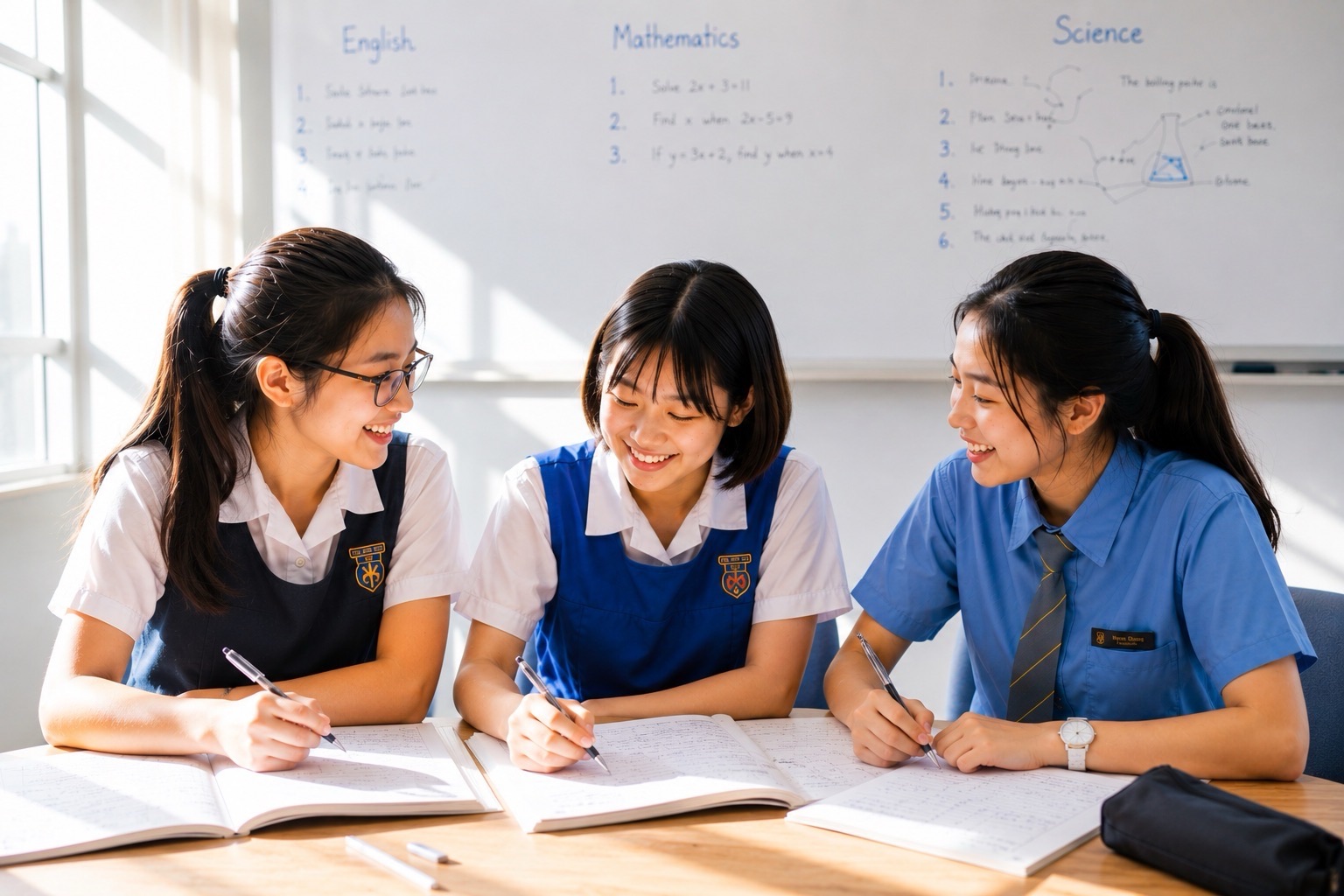
G2 Science tutorials for Chinatown students should help a learner use an idea in more than one form. A topic is not secure merely because its definition sounds familiar. The student should be able to read a diagram, select the relevant evidence, perform a suitable calculation and explain why the answer follows.
At eduKateSG, our three-student small-group approach to G2 Science tuition gives those decisions room to become visible. For families comparing a Secondary Science tutor, combined Science support or SEC preparation, we begin with the actual schoolwork rather than assume that a thicker revision file will solve the problem.
This guide serves families travelling from Chinatown. It does not represent a branch in Chinatown or an affiliation with a school bearing the Outram name. Consultations and suitable class placements are arranged at 8 Fourth Avenue, Singapore 268674, near Sixth Avenue MRT. Tell us the student’s secondary year, current Science level and subject combination so that the proposed support matches the course.
The aim is a learner who can begin without waiting for the tutor to identify the chapter. We work towards that independence through careful explanation, purposeful practice and questions that change the surface while preserving the underlying scientific relationship.
Ask about G2 Science class suitability on WhatsApp or arrange a parent–student consultation.
Science Learning Lens for Chinatown — G2
Science in a Dense Heritage District
Chinatown offers familiar prompts for scientific questions about shade, thermal conditions, food, materials, light and human movement. We do not treat the neighbourhood as a measured experiment. Instead, we convert everyday observations into stated paper scenarios where quantities, variables and evidence are clearly defined.
Shade, Heat and Surface Comparisons
A learner may notice that sheltered and unsheltered places feel different, but Science asks which quantity would be measured and what else must be controlled. In a hypothetical comparison, two surfaces are measured at the same stated time under controlled conditions. Students distinguish surface temperature from air temperature and avoid claiming more than the supplied readings support.
Food Contexts Without Turning Science Into Cooking Advice
Food gives accessible contexts for changes of state, energy transfer, dissolving, concentration and biological processes. We use safe paper-based scenarios and supplied data rather than instructing students to perform unsupervised experiments. The scientific task is to identify the process, variable or evidence that the question actually targets.
Built Materials and Property–Function Reasoning
A dense older-and-newer built environment invites questions about transparency, strength, conduction, insulation and flexibility. We provide a table of material properties and a defined design requirement, then ask students to justify a choice. The learner practises transferable property–function reasoning instead of memorising one familiar material example.
Crowd Data as a Graph-Reading Exercise
A fictional dataset may show pedestrian counts across several time intervals. Students first read axes and scale, then describe the pattern, compare intervals and identify anomalies. Only after that do they discuss possible explanations. A pattern in supplied data is not automatically proof of a cause.
From Chinatown Context Back to General Science
The local context is removed after the first successful explanation. Numbers, diagrams and wording change while the underlying concept remains. The learner must recognise the same relationship without the place name. This final transfer step keeps local context useful without making the learning locally dependent.
A More Important Transition Than It First Appears
There is a difference between recognising a scientific explanation and constructing one. During a lesson, the teacher has already chosen the concept, selected the diagram and placed the important information together. In an independent question, the student must make those choices.
That is why a learner may say, truthfully, that the lesson made sense and still be unable to answer the homework. The explanation was understandable when its route was supplied. The next task is to help the student choose that route without being shown the first step.
We address this transition directly. After a worked example, the next question changes a measurement, diagram or sentence. Later, a related question appears without its chapter heading. The student must identify the quantity or mechanism before calculating or writing. We learn more from that first independent decision than from another copied model answer.
The Hidden Science Problem: The Representation Changes
Consider an original density exercise. An object has a mass of 54 grams. When it is fully submerged in a suitable measuring cylinder, the water reading rises from 32 to 52 cubic centimetres. The object is assumed not to dissolve, absorb water or trap air.
Adrian divides 54 by 52. Jo subtracts the readings correctly but divides 20 by 54. Ben knows that density is mass divided by volume but cannot decide which number represents the object’s volume. These fictional teaching characters are not testimonials. They illustrate three different decisions hidden behind a wrong final answer.
The displaced volume is 52 − 32 = 20 cubic centimetres. Density is therefore 54 ÷ 20 = 2.7 grams per cubic centimetre. The crucial work happened before the division: identifying what changed and connecting that change to the volume of the object.
We then present the same relationship as a table, a labelled sketch and a sentence with the volume given directly. The student should recognise that these are different representations of the same calculation, not four unrelated question types requiring four memorised procedures.
Why Consider Three-Student Science Tutorials?
A class of three gives the tutor a practical opportunity to inspect individual decisions. Each student can attempt the density question before the discussion begins. The tutor sees who misunderstood displacement, who reversed the relationship and who simply made an arithmetic error.
The discussion is useful because the answers differ for identifiable reasons. One student can explain the subtraction; another can explain the division; a third can test the result against a new set of values. Everyone has a task beyond listening.
Small size is not a guarantee of learning. It matters only when the lesson uses that size to provide relevant feedback and another independent attempt. We do not regard a student’s silence during a fluent explanation as proof that the idea has been understood.
G2 Science Under Full Subject-Based Banding
G2 identifies a subject level; it does not mean Secondary 2. A student’s secondary year and Science level must both be known. MOE’s Full Subject-Based Banding guidance explains the subject-level framework.
Lower-secondary support begins with the school’s integrated Science programme and the relevant curriculum in MOE’s secondary syllabus directory. An upper-secondary examination checklist should not be imposed unchanged on a student who is still establishing foundational scientific language.
For the 2027 SEC, the G2 combinations are Science (Physics, Chemistry), K223; Science (Physics, Biology), K224; and Science (Chemistry, Biology), K225. These are two-discipline combinations, not three separate Science subjects. Check the student’s actual entry against SEAB’s G2 school-candidate list.
Our teaching therefore has two boundaries: the course the student is taking and the point the student has reached within it. A tutorial should be demanding enough to develop understanding without treating unrelated advanced content as a badge of quality.
What We Work On in G2 Science Tutorials
Physical quantities before numerical substitution
In an original exercise, a model travels 18 metres in 12 seconds. Its average speed is 1.5 metres per second. Before using that relationship, the learner should say what the distance covers and what the time measures. A time for only part of a journey cannot automatically be paired with the distance for the whole journey.
We deliberately vary the information. One question gives total distance and total time. Another includes an irrelevant waiting period and asks for speed while moving. The student must identify the requested interval rather than insert every visible number into a familiar formula.
A useful checking question is: what does this answer mean in one sentence? If the student cannot interpret the number and unit, the calculation may have been performed without a clear physical model. We return to that meaning before asking for more speed.
Graph values and rates of change
Suppose an invented temperature record falls from 70°C to 58°C in two minutes and then from 58°C to 52°C in the next two minutes. The first interval has a larger average temperature decrease per minute. It does not have the lower final temperature.
The first average decrease is 12 ÷ 2 = 6°C per minute. The second is 6 ÷ 2 = 3°C per minute. Students compare equal intervals and distinguish a rate from an ending value. The calculation is simple, but the distinction is important.
We ask two questions using the same data: when was the sample coolest, and during which interval did its temperature decrease faster on average? Answering both prevents the learner from treating lower, faster and greater change as interchangeable descriptions.
Circuit reasoning with a clearly stated model
For a paper-based example, assume an ideal 6-volt supply connected across a 3-ohm resistor. Using current = potential difference ÷ resistance gives 2 amperes. The student should identify that the given potential difference is across the same resistor whose resistance is used.
Now replace the resistor with a 6-ohm resistor while keeping the supply at 6 volts. The calculated current is 1 ampere. The comparison makes the relationship visible: under the stated constant-voltage model, greater resistance gives a smaller current.
We do not generalise from this exercise to every device. A real lamp can change resistance as it heats. Stating the model prevents a useful simple example from becoming an incorrect universal rule. These are written reasoning tasks, not instructions to work with household electrical wiring.
Energy and power as different quantities
Suppose device A transfers 900 joules in 30 seconds and device B transfers 1,200 joules in 60 seconds. A transfers less total energy in the stated run but has the greater average power: 30 watts compared with 20 watts.
Students often need this kind of paired comparison. It shows why a large total and a large rate are different claims. We ask the learner to choose which device answers a question about total transfer and which answers a question about transfer per second.
The next task removes the familiar letters and uses a graph or short description. We are checking whether the distinction survives a new presentation, not whether the student remembers that A was the answer last time.
Chemical representations that preserve identity
In a particle-diagram exercise, we define open circles as atoms of one element and shaded circles as atoms of another. A joined pair containing one of each represents a different entity from two unjoined atoms. The key tells the student what the symbols mean; the picture alone should not be interpreted by habit.
Jo may recognise the diagram yet confuse the number of particles with the number of types of atom. We ask her to count those separately. How many units are drawn? How many different atom types appear? Are those atoms joined within each unit? Each answer removes a different ambiguity.
That discipline helps when formulae appear. A subscript belongs to the identity and composition of the represented substance. A coefficient counts multiple units of it. Students should explain that distinction before trying to balance longer equations.
Mole calculations at the correct G2 scope
The 2027 G2 Chemistry syllabus includes the relationship between mass, molar mass and amount in moles. It explicitly excludes calculations of stoichiometric reacting masses and volumes of gases. See the stated boundary on page 28.
For an original in-scope exercise, a sample has mass 8.0 grams and molar mass 40 grams per mole. The amount is 8.0 ÷ 40 = 0.20 mole. The student then explains that 40 grams would correspond to one mole of that substance, so 8.0 grams corresponds to one fifth of a mole.
We reverse the task: what mass corresponds to 0.30 mole at the same molar mass? Multiplication gives 12 grams. Reversing the direction checks whether the learner understands the relationship instead of remembering that mole questions always require division.
The lesson does not need to escalate immediately into a different course’s reacting-mass problems. A strong G2 foundation means secure understanding of the required relationship and sensible application within the actual syllabus.
Separation choices from supplied properties
Imagine a written investigation involving an insoluble solid and a substance dissolved in water. A question asks which component filtration can separate. A learner who treats every solid as removable by filtration may overlook the distinction between a suspension and a solution.
We ask what is present before and after the proposed step. Which material is retained? Which substances remain in the filtrate? What additional information would be needed to choose a subsequent recovery method? The student traces the mixture rather than matching a method to a remembered picture.
Where a proposed process involves heating or chemicals, classroom safety and suitable supervision matter. Paper reasoning does not authorise an unsupervised experiment. The educational purpose is to connect a material property with a separation decision.
Biological explanations that identify what moves
In a simplified diffusion question, two regions differ in the concentration of a substance, and the relevant particles can move between them. The explanation must identify the particles and the direction of net movement, not simply say that things spread out.
Mira may write an accurate definition but name the wrong substance in the application. Ryan may identify the substance but leave the comparison unstated. We ask them to replace every vague word with the actual quantity or material in the question.
A strong answer is not necessarily longer. It may be two precise sentences rather than six general ones. We want the student to show which difference drives the process and what the process changes in the stated system.
Structure, function and the missing middle step
A student may write that an exchange surface is thin and therefore efficient. The useful next question is what the thinness changes. In an appropriate diffusion context, it reduces the distance particles must move across the surface.
We practise the connection as feature, mechanism and consequence. The feature is the structure described. The mechanism explains how it changes the process. The consequence answers why the feature is useful in that context. The sequence prevents an answer from jumping directly from a label to a conclusion.
School diagrams and the student’s textbook remain the reference for the exact structures expected. We do not treat every possible biological detail as required simply because it could make an explanation more elaborate.
Our First-Principles Teaching Method
The first step is an unprompted attempt. We want to know whether the learner can select the relevant quantity, draw the first useful diagram or explain the first causal link. Providing all those choices before the student begins would hide the difficulty we need to diagnose.
The second step is a focused reconstruction. In the density example, that may mean returning to displacement rather than reteaching division. In a biological answer, it may mean identifying the moving substance rather than rereading the entire chapter.
The third step keeps difficulty within a clear boundary. We change one feature at a time: the numbers, then the diagram, then the wording. The learner can see what remains constant in the reasoning and what needs to be reconsidered.
The fourth step removes support. A correct answer produced with the tutor supplying every decision is useful practice, but it is not independent performance. We give a related question without the guiding questions and examine what the student can now do.
The fifth step returns later. An earlier concept appears after another topic or in a subsequent lesson. The student must recognise and use it without its original setting. This check tells us whether to proceed, add practice or repair the explanation again.
What a Focused Lesson Can Look Like
The following is an illustrative 90-minute teaching sequence, not a fixed promise about every Science placement. Families should confirm the actual lesson duration and arrangements directly.
Ten minutes revisit an older distinction. Fifteen minutes develop the current concept through a worked example. Twenty minutes allow supported practice while the tutor inspects each learner’s decisions. Twenty minutes remove the prompts and change the representation.
Fifteen minutes then combine the current concept with an earlier one or introduce a short timed section. The final ten minutes review the error pattern and assign a continuation task. Each learner should leave knowing which decision improved and which one still needs attention.
For a student close to an assessment, the balance may shift towards mixed application. For a learner with a major gap, more time may be needed for explanation. The sequence is flexible, but it should always include work produced by the student rather than only work demonstrated by the tutor.
Three G2 Science Learning Pathways
Repair: We locate the earliest missing connection that is affecting current schoolwork. A learner who cannot identify volume in a displacement question needs that relationship clarified before harder density problems. Repair has a specific destination, not an indefinite return to easier worksheets.
Stabilisation: We test whether a familiar idea remains usable after the worksheet changes. Questions vary in representation and are revisited later. The aim is to make performance less dependent on seeing exactly the example used during teaching.
Extension: We ask for more controlled reasoning within the appropriate scope. A student may compare two plausible explanations, identify a missing measurement or design a clearer method. Extension should improve the quality of thinking rather than import unnecessary syllabus demands.
A Worked Correction: Repeats Do Not Repair Every Error
In an invented practical scenario, a balance reads 2 grams when empty. A student weighs the same object repeatedly and obtains closely grouped readings. The learner proposes that taking twenty more readings will remove the original problem.
The repeated values may be consistent while still reflecting the offset. Before relying on the measurements, the method needs to address the zero reading appropriately. Merely increasing the number of readings does not remove a persistent shift shared by them.
We ask two separate questions: how much do the readings vary, and is there a reason they may all be displaced from the value sought? This comparison gives meaning to consistency and measurement error instead of treating repeat more times as a universal improvement.
The transfer task changes the instrument and the context. The student must identify what the proposed improvement actually fixes. An improvement is useful only when it responds to the specific limitation in the method.
A Worked Explanation: The Highest Reading Is Not the Whole Conclusion
Suppose three invented readings under condition A are 11, 12 and 13 units, while condition B produces 10, 14 and 18. Both the spread and the average differ. A student who points only to 18 and calls B consistently better has ignored much of the evidence.
The average for A is 12 and the average for B is 14. B has the higher average in these trials, but its readings vary more. Those statements describe the supplied evidence. They do not establish that B will always produce the larger result or explain why the difference occurred.
We then ask what information is missing. Were conditions controlled? Were the measurement rules the same? Were the trials independent? The student learns to distinguish a pattern worth reporting from a causal conclusion that needs more support.
How We Reduce Repeated Mistakes
We classify a mistake before prescribing a correction. Reading the wrong value from a graph calls for a different response from choosing the wrong scientific model. An omitted unit is different from an incorrect unit conversion. A true but irrelevant explanation is different from a false explanation.
The student marks the first decision that needs to change. A short correction states the principle and applies it to a fresh question. The tutor then reduces the prompts. This gives us evidence that the repair affected the learner’s next action.
An error record should stay useful. It can contain a brief example, a named distinction and a date for a delayed check. It does not need to become a second textbook whose maintenance consumes the time needed for practice.
Teaching Ahead Without Teaching Past the Student
Pre-teaching can introduce the language and central diagram of a coming topic. It can also repair a prerequisite before that prerequisite is needed in school. Both uses are more purposeful than racing through a series of chapter titles.
For example, a learner approaching electrical calculations may first need practice distinguishing a quantity from its rate. A learner approaching chemical formulae may need the difference between a coefficient and a subscript clarified. The apparent detour has a direct connection to the next lesson.
Preparing for the Actual G2 Assessment Structure
The 2027 G2 scheme groups each discipline’s multiple-choice and structured papers into one 75-minute session. For each of the two disciplines, the multiple-choice part carries 20 marks and 20% overall, and the structured part 30 marks and 30% overall. See SEAB’s assessment scheme.
Our planning response is to practise the transition between selecting an answer and constructing one. A student may be comfortable recognising the correct option yet struggle to provide a complete written explanation. Another may write carefully but spend too long deciding between multiple-choice options.
The scheme does not list a separate practical paper; experimental skills still appear in theory assessment. See the experimental-skills objectives. That is not a reason to neglect practical understanding or school laboratory work.
We use school and official materials to match the actual examination year. A student sitting a different year or qualification should not have the 2027 structure assumed without checking. Familiarity with old questions is useful only when the syllabus fit is established.
What Progress Should Look Like
Look for changes in the work itself. The student identifies the quantity before calculating, explains a diagram without waiting for a model answer and uses the supplied data rather than making an unsupported general statement. A familiar concept remains usable when its presentation changes.
We compare attempts made under similar conditions. A heavily prompted answer should not be compared with an independent one as though they represent the same performance. A useful progress discussion states what help was available and what the learner did without it.
No universal grade improvement or timeline is promised. The starting gap, practice, attendance, school demands and assessment conditions matter. The objective is a better-informed next teaching decision and increasing independence across the actual course.
When Should an Chinatown Student Begin?
A consultation is useful when a pattern repeats: the student can follow examples but cannot start alone, one Science component is consistently weaker, diagrams are recognised but not explained, or calculations succeed only when the formula is printed beside them.
Tuition is not automatically necessary for a student who is learning independently and managing the school programme. Sometimes a focused repair is more appropriate than increasing the total workload. The proposed class should solve an identified problem.
Access From Chinatown and Class Details
The teaching location is 8 Fourth Avenue, Singapore 268674, near Sixth Avenue MRT. Consult SBS Transit’s Sixth Avenue station information for the arrival end of the journey and confirm the route from the student’s actual starting point.
For an Chinatown family, the relevant timetable is the whole afternoon: school dismissal, travel, a meal, the lesson and the return home. We do not advertise an identical door-to-door journey for every household or imply that the student’s school is necessarily near home.
Format: Three-student small-group tuition. Focus: G2 Science at the learner’s actual year and, where relevant, combined Science pairing. Materials: Worked explanations, selected practice, schoolwork review and purposeful continuation tasks. Placement: Subject to readiness, school-topic compatibility and availability. Confirm fees, duration, schedule and practical arrangements before enrolment.
What Parents Can Bring to the Consultation
Bring a marked test from each relevant Science component, one current worksheet and the school’s topic sequence where available. Include an unfinished answer or an uncorrected attempt when possible. A polished correction does not show which decisions the student originally found difficult.
We ask what the student could do before help, what feedback was provided and whether the difficulty appears elsewhere. We also discuss realistic practice time. The plan should fit the learner’s week rather than assume that every evening is available for additional Science work.
Frequently Asked Questions
Does G2 mean Secondary 2?
No. Subject level and year level are separate. Provide both when enquiring. A Secondary 1 student studying at G2 and an upper-secondary G2 Science candidate should not receive identical weekly plans. Refer to MOE’s explanation of the framework.
Can the class prioritise one weaker Science component?
The diagnostic should identify that need. The plan can give more repair time to the weaker component while retaining short checks in the stronger one. Equal time is not always the best starting allocation, and the balance should change as the work improves.
Should the student learn every advanced calculation available?
No. First establish the actual syllabus boundary and the required understanding. More difficult material can be interesting, but it should not crowd out essential work or be described as compulsory when the course does not require it.
What happens when the student gives a correct answer without understanding?
We ask for a reason, reverse the question or change one condition. A correct result is useful evidence, but a follow-up shows whether the method is dependable. The aim is not to take the success away; it is to understand how to make it repeatable.
Will tuition replace school practical work?
No. Apparatus diagrams and data questions support reasoning, but they do not reproduce every aspect of handling equipment. Families should confirm which supervised practical activities a proposed placement actually includes instead of assuming laboratory facilities from the page title.
How much home practice is appropriate?
Enough to revisit the lesson’s important decisions without producing an unmanageable backlog. We prefer a small task with a clear purpose to a large assignment that the learner completes by copying. The amount should be discussed in relation to current school demands.
Helpful Reading for Chinatown Families
PSLE Science Tuition | Chinatown · A Student’s Life | Chinatown · Education and Tuition | Chinatown · G2 Science Tutorials | Outram Park · G2 Science Tutorials | Raffles Place
G2 Science Tutorials for Chinatown Families
A useful G2 Science lesson leaves the learner with more than a corrected page. The student can identify the quantity, connect the representation to the concept, explain the relationship and test the answer against the evidence.
For students who are behind, we repair the missing connection. For students who are inconsistent, we test whether understanding survives changed wording and time. For students who are ready, we deepen the reasoning within a clearly understood course boundary.
Science Learning Blueprint for Chinatown — G2
Reading the City as a Science Text
A student travelling through Chinatown moves through changing shade, road surfaces, sheltered spaces, moving vehicles, indoor cooling and outdoor heat. We use such ordinary observations only as prompts for scientific questions: what quantity would describe the change, what could be measured, what alternative explanation must be controlled, and what evidence would justify a conclusion? The place is not treated as a laboratory result. It is a source of observable questions that can then be converted into safe paper-based models.
From Crowded Information to the Relevant Variable
Dense urban environments contain many simultaneous changes. That makes them useful metaphors for scientific selection. A question may provide five pieces of information while only two control the calculation. We teach the learner to mark the requested quantity, circle the evidence that bears on it and deliberately leave irrelevant information unused. The habit is especially valuable in data-response questions, where the difficulty often comes from selection rather than arithmetic.
Heat, Shade and Surfaces
A simple urban heat question can compare two hypothetical surfaces placed under the same stated conditions. The student first distinguishes surface temperature from air temperature, then identifies what was actually measured and whether the comparison was controlled. We avoid claiming that a particular Chinatown location has a measured temperature unless data are supplied. The teaching point is how to build a defensible comparison from stated evidence.
Movement, Time and Rate
Urban movement gives a familiar context for rates without requiring claims about actual journey times. If a model object covers 120 metres in 80 seconds, the average speed is 1.5 metres per second. A second journey may cover a greater distance yet have a lower average speed if it takes proportionally longer. Students learn to compare ratios rather than the largest raw number.
Evidence Before Explanation
We sometimes present a fictional Chinatown-style urban dataset with noise level, temperature or footfall as abstract values. The learner first describes the pattern, then identifies which additional evidence would be needed for an explanation. This trains an important scientific boundary: a correlation in supplied data is not automatically a proven cause.
Systems Thinking in a Dense District
Science becomes easier when the learner sees systems rather than isolated facts. A transport system contains inputs, constraints and flows; a biological system contains structures, materials and processes; an electrical circuit contains connected components. We use the city only as an analogy for organisation, then return immediately to the exact scientific system named in the syllabus question.
G2 Science Is About Models That Travel
At G2, the student increasingly needs a concept to survive changes in representation. A particle model should work when the question moves from words to a diagram. A rate should remain recognisable when it appears in a graph. A biological process should remain clear when the labels are removed. We deliberately switch forms so that knowledge becomes less dependent on the appearance of the original example.
Quantities Before Formulae
A calculation starts by identifying what each number represents. We ask whether values refer to the same interval, object or component and whether units are compatible. Only then is a relationship used. This habit reduces formula hunting and makes it easier to diagnose whether a wrong answer came from the model or the arithmetic.
The Runway to G2 Combined Science
For the 2027 SEC, SEAB lists Physics–Chemistry K223, Physics–Biology K224 and Chemistry–Biology K225. Lower-secondary preparation should therefore remain broad enough to strengthen models, measurement, graph interpretation, practical reasoning and scientific explanation before the actual upper-secondary pairing becomes the weekly structure.
Diagnose the First Unstable Decision
A wrong answer is the end of a chain, not the diagnosis. We ask where the chain first changed direction. Did the learner misread the graph, choose the wrong quantity, recall the wrong concept, omit a condition, reverse a relationship or explain with language that was too broad? The repair begins at that point. This prevents a student who needs one conceptual distinction from being assigned an indiscriminate stack of questions.
Arrange a Parent–Student Consultation
Tell us the student’s secondary year, current Science level, combination where relevant and one repeated difficulty. That gives the consultation a clear starting point.
Arrange a G2 Science consultation on WhatsApp
eduKateSG
8 Fourth Avenue, Singapore 268674
Near Sixth Avenue MRT
Three-student small-group tuition
By appointment