
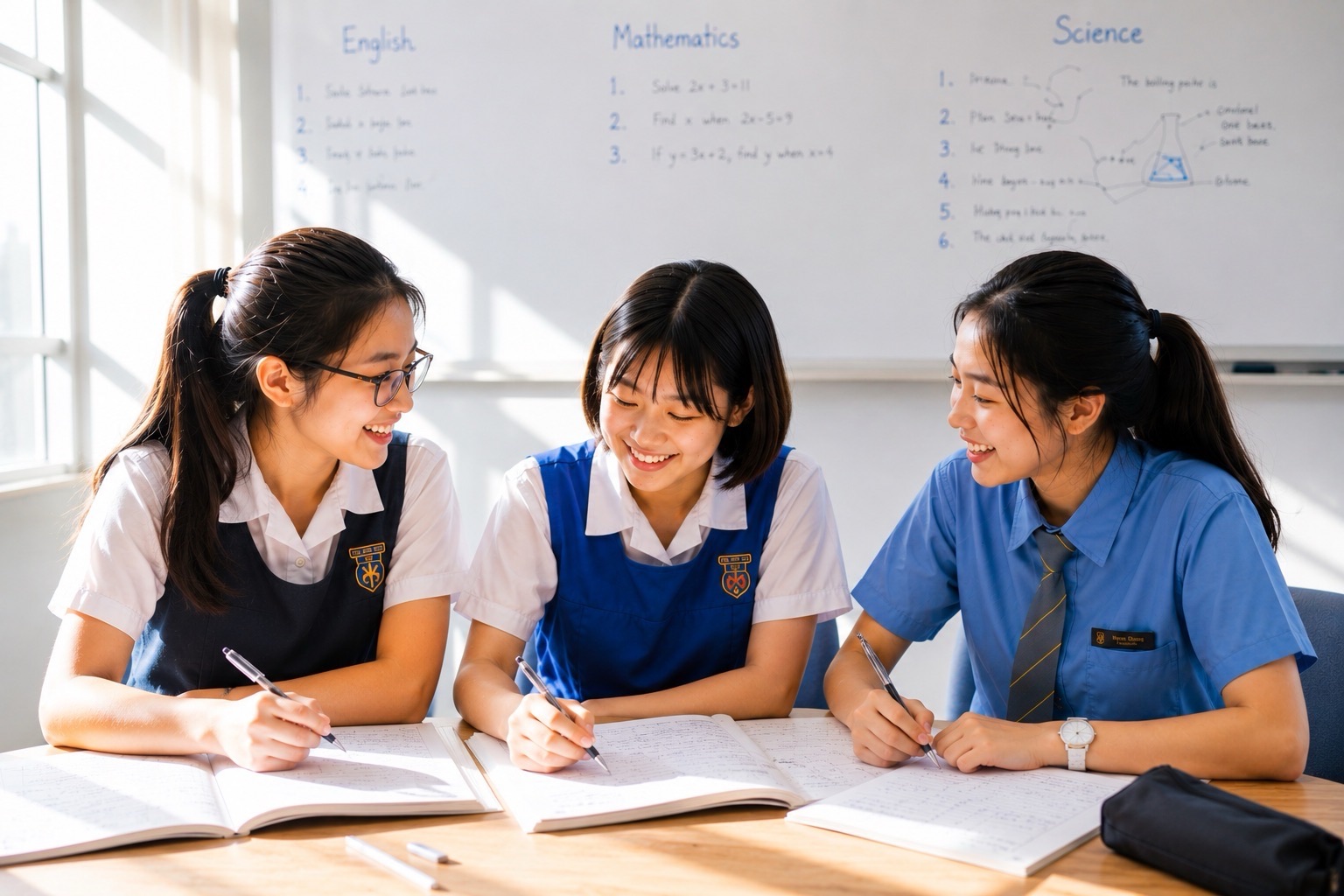
G2 Science tutorials for Eunos students should make unfamiliar questions easier to interpret before the learner starts calculating or writing. At eduKateSG, three-student small-group teaching helps pupils identify what the question measures, choose a Physics, Chemistry or Biology model, use the appropriate units and explain a conclusion supported by evidence. Our aim is a student who can work without the chapter heading or tutor supplying the first step.
Parents comparing G2 Science tuition near Eunos MRT, secondary Combined Science tutors, Physics and Chemistry revision, or Physics and Biology support often describe a pupil who finishes textbook worksheets but loses confidence on school tests. A student might apply a force formula when the task asks about pressure, misinterpret a graph’s horizontal axis, or write a biological explanation without linking it to the actual observation. We identify those as different teaching needs rather than one vague problem called careless mistakes.
Eunos is the community addressed by this guide, not a newly announced eduKateSG tuition branch or a partnership with a neighbourhood school. Suitable lessons and consultations are arranged at 8 Fourth Avenue, Singapore 268674, near Sixth Avenue MRT. We confirm the pupil’s current secondary school year and registered G2 Science combination before selecting coursework or examination practice.
For a focused conversation, enquire about G2 Science tutorial suitability with the actual subject pair and one recent marked question. All transport distances, market quantities and experimental results in this article are fictional teaching exercises rather than observations made in Eunos.
Why G2 Science Becomes Harder When the Chapter Title Disappears
On a worksheet headed Density, a pupil knows what relationship to use even before reading the question. In a mixed school assessment, the question may give mass, volume, force and area in the same paragraph. The learner has to choose which quantities matter for the requested property.
This is an important distinction between recognising and selecting knowledge. A child who knows the formulas may still need practice deciding whether the prompt concerns mass per volume, force per area, distance per time or a biological rate. We ask the student to name the unknown and expected unit first.
A student may reach the correct numerical answer by coincidence. For instance, two stages of a journey might happen to have the same speeds even if the wrong interval is used. We change one value so that a mistaken model produces a different result, revealing whether the reasoning is secure.
Scientific explanations create similar problems. A pupil may know the term diffusion but describe only a concentration difference when the question asks how net movement occurs. Another may read a graph correctly yet assert a cause never examined in the study.
We teach clear contrasts, remove hints and revisit the idea after a delay. The learner should eventually recognise the relationship from the evidence rather than rely on the tutor announcing the topic.
G2 Science Must Match the Registered Pair
MOE’s Full Subject-Based Banding guidance separates school year from subject level. G2 is a General 2 level, not another name for Secondary 2. A younger student and an examination-year learner on the same level may need different weekly work.
SEAB’s 2027 G2 directory lists Science (Physics, Chemistry) K223, Science (Physics, Biology) K224 and Science (Chemistry, Biology) K225. A student taking Physics/Biology should not spend core lesson time on Chemistry simply because a generic Science booklet includes it.
The registered pair tells us which topics and disciplines belong. The school chapter sequence tells us what has already been taught. The student’s independent work reveals which concepts are insecure. We need all three to design focused practice.
Content depth also matters. For example, the relevant 2027 G2 Chemistry route teaches relationships among mass, molar mass and amount in moles, but does not require the same reacting-mass or gas-volume stoichiometry as a more advanced course.
The Singapore-Cambridge SEC examinations begin in 2027, but SEC describes the certificate rather than a fourth subject level. We check the applicable examination year and registered course before using older resources as complete mocks.
An Eunos Market Question Should Teach Evidence, Not Invent Facts
NEA’s hawker-centre information identifies Eunos Crescent Block 4A as a market or food-centre location, and SMRT’s Eunos station information identifies a familiar local transport reference. We use imaginary measurements and models, not real performance data for food stalls, building services or commuters.
A fictional market delivery asks for a rate
An imagined supplier transports 360 packages in six minutes. The average throughput is 60 packages per minute. A second supplier transports 440 packages in eight minutes, averaging 55 per minute. The second handles more total packages while the first has a higher rate.
The child identifies which comparison the question requests before calculating. We then add a pause inside one interval and ask whether the average should include it. The correct denominator follows the wording, not whichever time was used in the preceding example.
A weighing-table question separates a whole from a part
A fictional empty delivery crate weighs 1.2 kilograms and the combined crate-plus-contents reading is 7.8 kilograms. The contents alone weigh 6.6 kilograms. The student labels the system included in each measurement.
We change the description so the task asks for the combined mass rather than the contents. A child who always subtracts because it worked once would now answer the wrong question. The scientific skill is identifying what the instrument measures.
A hypothetical cooling record teaches controlled comparisons
Two invented sample containers have different starting temperatures, different masses and different exposure times. The pupil cannot confidently attribute the difference in final temperature to container material alone because several conditions changed.
A stronger paper method holds relevant sample quantities and exposure conditions comparable while deliberately changing the property under investigation. We ask which measurement is the outcome and how the controlled conditions improve the evidence.
An everyday image does not provide every physical property
A photograph of the Eunos market building cannot reveal exact insulation performance or electrical conductivity. A scientific answer requires stated measurements. We provide a fictional properties table and ask the learner to select the relevant value for a specified application.
The local story then disappears. An unfamiliar laboratory or engineering dataset tests the same model. A pupil who succeeds without recognising the original neighbourhood image has built transferable understanding.
Physics: The Meaning of a Ratio Is More Important Than Its Shape
Density is mass per unit volume
An imagined sample has a mass of 640 grams and volume of 160 cubic centimetres, giving density 4 grams per cubic centimetre. Another sample has mass 1,280 grams and volume 320 cubic centimetres, so it is heavier but equally dense.
We ask why doubling both values leaves the ratio unchanged. The pupil then constructs another mass-volume pair that would describe the same density, demonstrating the relationship rather than repeating the original division.
The next sample has mass 640 grams and volume 320 cubic centimetres, giving 2 grams per cubic centimetre. Students predict the direction of change first: more volume for the same mass means less mass per unit volume.
We include unit changes in a later problem. A student should not compare a value expressed in grams per cubic centimetre directly against one in kilograms per cubic metre without making the units compatible.
Pressure is force per area
A fictional model block applies 180 newtons across 0.045 square metre, producing average pressure 4,000 pascals. If the area becomes 0.030 square metre while force stays fixed, pressure becomes 6,000 pascals.
We ask for a prediction before the calculation. Halving area at fixed force doubles average pressure, but changing both force and area requires comparing the actual ratios. The largest force alone may not produce the largest pressure.
One common misunderstanding is to use a side length where contact area is required. We draw the face and explain why area is measured in square units. A correction can therefore be a small geometry repair embedded in Science.
A result in pascals describes pressure, not material strength or whether a real structure is safe. A broader engineering claim needs further information about the materials and conditions.
Forces and Motion: One Object at a Time
Imagine a model trolley of mass 6 kilograms experiencing a forward driving force of 24 newtons and a resistive force of 6 newtons. Resultant is 18 newtons forward, giving acceleration 3 metres per second squared.
A pupil who substitutes 24 directly has used an individual force instead of the resultant. We require a labelled force diagram on the chosen object before calculating, then ask the learner to explain why directions matter.
In a changed example, the forces become equal. The resultant and acceleration become zero, but the trolley need not be stationary if it already had non-zero velocity. We teach the distinction between motion and change in motion explicitly.
Another drawing shows forces acting on interacting objects. Students must not add a force on one body to the resultant on a different body merely because both appear on the page.
Finally, the trolley becomes an unfamiliar laboratory cart with the same physical relationships. We check whether the child selects the relevant forces without waiting for a prompt.
Motion Graphs: Their Axes Define the Answer
A horizontal segment of a distance–time graph represents an unchanged distance reading over that interval, whereas a horizontal segment on a speed–time graph represents constant speed. They can look visually similar while requiring very different interpretations.
An invented distance–time record reads 0 metres at zero seconds, 90 metres after 45 seconds, stays at 90 metres until 75 seconds and reaches 150 metres after 105 seconds. The whole-interval average is 150 divided by 105, approximately 1.43 metres per second.
The moving-only time is 75 seconds, giving an average of 2 metres per second. A student who uses 75 seconds for the complete observation has answered a nearby but different question.
We alter the horizontal scale and hide the chapter title. The learner should first inspect labels, values and relevant interval, then calculate. Apparent steepness on a printed diagram is not a substitute for reading its scale.
A new task uses a data table and asks for a written description. The learner should state what the measured graph or table shows and avoid inventing a cause for a pause when none was supplied.
Electrical Relationships Begin With Connections
An ideal paper circuit has a resistance of 15 ohms and current of 0.4 ampere, giving a potential difference of 6 volts. We ask the pupil to explain what each value represents and why multiplying resistance by current gives potential difference under the model.
The inverse question supplies 6 volts and 0.3 ampere, asking for resistance. The answer is 20 ohms. The operation changes because the requested unknown changes, not because the scientific relationship has altered.
We then show two circuit drawings with components positioned similarly but connected differently. Students identify junctions and paths before applying series or parallel rules. The visual arrangement of symbols is less important than the connectivity.
A changed task moves a switch to another branch. A pupil who automatically predicts that every lamp turns off may have overlooked an alternative conducting route.
Printed diagrams and safe school-approved simulations are suitable for the reasoning. We do not encourage household electrical experiments or work with mains wiring.
Thermal Science: Final Temperature Is Not the Temperature Change
An imagined sample A warms from 20 °C to 28 °C, an 8 °C increase. Sample B warms from 29 °C to 34 °C, a 5 °C increase. B has the higher final reading while A has the greater increase.
The child writes both accurate claims and identifies which quantity each describes. We then change starting temperatures so a shortcut based on which final reading is larger becomes unreliable.
Temperature change alone does not determine the exact thermal energy transferred without other material and system information. We ask which quantities and conditions would be needed for a broader calculation.
A particle-model question asks the pupil to distinguish changes in motion or spacing from an inappropriate claim that all particles simply increase in size when the object is heated.
The transfer task presents a cooling graph rather than a heating table. The learner preserves the direction and units of change, even though the picture is unfamiliar.
Chemistry: Chemical Symbols Must Retain Meaning
In a familiar molecular example, 2H₂O represents two molecules of water, with four hydrogen atoms and two oxygen atoms in all. The coefficient indicates a quantity of molecules while the subscripts belong to the chemical formula.
The student draws a particle representation and checks the number of each atom type. We explain why balancing an equation can involve changing coefficients but must not casually change a formula subscript, which might represent a different substance.
A changed equation uses unfamiliar but completely supplied formulas. Students count atom types independently and explain why their proposed coefficients respect conservation.
This bridge between symbols and physical models matters because later questions may use formulas without familiar substances’ names or pictures.
Chemistry: Mass and Moles at G2 Scope
A fictional compound has molar mass 64 grams per mole and the sample mass is 16 grams. The amount is 0.25 mole. We ask the learner to identify grams, grams per mole and moles before dividing.
The next prompt gives 0.375 mole and asks for mass. Under the stated molar mass the answer is 24 grams. A pupil who divides again merely because it worked before has not understood what the ratio represents.
We give a new compound with its molar mass supplied. The learner predicts whether the requested mass should be greater or less than the mass of one mole and then verifies the result.
An additional question supplies only mass and omits chemical identity or molar mass. Identifying the missing quantity is more scientifically correct than inventing a substance and calculating a plausible number.
These tasks match the relevant amount relationship rather than automatically import advanced reacting-mass and gas-volume stoichiometry outside the core G2 scope. Challenge can come from interpretation without syllabus mismatch.
Chemistry: Separation and Chromatography Require Conditions
A fictional mixture contains insoluble particles and a dissolved substance in water. Filtration can remove the insoluble material while the dissolved substance remains in the liquid. A clear filtrate is not necessarily free of dissolved substances.
We ask which component the problem wants recovered and choose a relevant school-taught technique. When the desired output changes, the method may need to change too.
An imaginary chromatogram shows unknown spots compared with known references under matching conditions. Students can describe relative positions and carefully limited identifications within the supplied model.
A second reference comes from a differently specified solvent setup. The learner questions whether a direct match of spot heights is justified rather than recognising a familiar visual arrangement.
These tasks develop interpretation of supplied observations. Handling unknown substances or chemical reagents belongs to supervised practical work rather than an unsupervised activity near a market.
Biology: Structure Must Explain a Function
For G2 students taking Biology in their registered pair, a structure name is only the beginning. If the question identifies a surface with many extensions, pupils should connect the relevant shape with the process occurring there rather than recite a general list of adaptations.
A root-hair model may illustrate increased area for uptake in a specified context. We ask what substance moves and which feature helps. The pupil writes a short causal sentence rather than decorate the answer with unrelated facts.
A changed diagram introduces a different specialised cell. The learner cannot paste the earlier explanation automatically; they must identify the new relevant feature.
We then remove one arrow from a process flowchart. The student reconstructs the missing link independently, demonstrating understanding of a sequence rather than memorising its original layout.
Biology: The Same Mass Gain Can Mean Different Percentages
Two fictional samples begin at masses of 5.0 and 12.0 grams. Both gain 0.6 gram in an imaginary study. Their percentage gains are 12% and 5% respectively. Equal absolute gains do not mean equal changes relative to initial mass.
We ask which reference the percentage calculation uses. A learner who divides by final mass has answered a different mathematical question, even if their calculator operation is executed correctly.
Next, a sample loses mass rather than gaining it. The child preserves the direction of change and does not automatically write the word increase next to every positive absolute difference.
When an osmosis mechanism is requested, we supply relevant membrane and water-potential conditions. Mass readings alone cannot establish the unique cause of a sample’s change.
A new graph replaces the table. The pupil should still be able to distinguish observed result, percentage calculation and causal explanation.
Biology: A Pattern Does Not Automatically Name Its Cause
An invented ecological survey provides population counts for two organisms at several times. A pupil may describe one increasing while the other decreases, but cannot infer a unique causal interaction merely because the trends occur together.
We ask about sampling effort, other changing conditions and what extra evidence would distinguish potential explanations.
A follow-up dataset includes improved controls or additional observations. The child explains how those affect the strength of the inference rather than simply say every correlation proves causation.
This is a fictional Science analysis and not a report of actual wildlife, water quality or ecological change around Eunos.
Worked Clinic: A Mass Reading Can Describe More Than One Object
A fictional tray has mass 0.8 kilogram and its contents have mass 2.6 kilograms. The combined mass is 3.4 kilograms. A scale reading of 3.4 on the combined system does not mean the contents alone have that mass.
The question may ask for the combined value, in which case 3.4 is correct, or the contents alone, in which case 2.6 is correct. We teach learners to label what is inside the measurement boundary.
We then change units: the tray is 800 grams while the combined reading is 3.4 kilograms. The student converts before subtracting and explains the resulting quantity.
The next problem involves an imaginary sealed reaction vessel. The pupil traces which parts remain on a balance before drawing a conclusion about mass conservation.
This sequence moves from familiar Eunos market-inspired weighing to a less familiar laboratory representation without changing the underlying requirement to define the measured system.
Worked Clinic: Force and Pressure Can Rank Objects Differently
An imaginary object A applies a force of 120 newtons across 0.030 square metre, giving pressure 4,000 pascals. B applies 150 newtons across 0.075 square metre, giving pressure 2,000 pascals.
B applies a larger force while A produces greater average pressure. We ask the student to explain how both statements can be true and identify the relevant denominator.
We change B’s area to 0.025 square metre. Its pressure becomes 6,000 pascals and the relative ranking changes. The earlier conclusion should not be copied when the data change.
A final prompt asks whether the higher pressure guarantees damage to a particular surface. Without relevant material-strength and contact conditions, that broad prediction is not justified.
The pupil then works on an unfamiliar apparatus diagram and should identify which contact face matters without the chapter title Pressure appearing as a hint.
Worked Clinic: The Correct Chemistry Operation Can Reverse
A fictional G2 compound has molar mass 80 grams per mole. A 20-gram sample is 0.25 mole. The learner explains that mass divided by mass per mole gives an amount in moles.
Now the prompt gives 0.25 mole and asks for mass, giving 20 grams. The change in operation is not arbitrary: the unknown has moved to the opposite side of the same relationship.
The next question gives 0.60 mole and asks for mass, giving 48 grams. We ask the pupil to estimate whether the number should be smaller than 80 grams before calculating.
Another task supplies a new substance with its molar mass. Students should choose the relationship from the units rather than from recognising a familiar compound name.
We keep these examples within relevant G2 scope and do not introduce full reaction stoichiometry without a clear syllabus reason.
Worked Clinic: Improve the Right Part of an Investigation
A hypothetical investigation compares dissolving times at different water temperatures but changes stirring rates at the same time. A pupil attributes the result entirely to temperature. We ask which second variable changed.
The correction holds stirring comparable while varying temperature deliberately and specifying an appropriate measured endpoint. The student explains how the change addresses the original comparison weakness.
Repeating the flawed setup five times may provide information about variation, but cannot by itself isolate temperature from stirring. Experimental control and replication are distinct ideas.
Another instrument record produces readings clustered above a stated reference value. More readings with unchanged calibration may not remove systematic offset. We ask for a calibration-related improvement instead.
A final task switches from dissolving to ecological sampling, where repeating observations at one unrepresentative site may not answer a question about the whole region. The learner needs to connect every method correction to the stated claim.
Three Students, Different Errors, Purposeful Feedback
Imagine three fictional pupils who all obtain the wrong pressure answer. One measures side length where area is required, another reverses the fraction, and the third calculates correctly but concludes a material is stronger without data.
We preserve each independent first attempt before class discussion. The group learns the meaning of force per unit area, then each learner receives a different follow-up targeting geometry, ratio interpretation or evidential restraint.
All three later attempt a new common question without hints. We use that result to determine what has improved independently and which misconception still needs teaching.
A quieter learner is given thinking time, while a faster pupil might be asked to design a counterexample. Small-group teaching becomes useful when the three-student format supports real differentiation.
Group composition must fit subject pairing, current year and pace. Actual availability and class arrangements are checked during an enquiry rather than assumed from an area guide.
An Example G2 Lesson From Diagnosis to Unfamiliar Practice
A lesson may begin with short retrieval of a past concept and one mixed question that removes the topic title. The tutor observes the earliest uncertain choice and selects a clear representation to rebuild it.
A central idea is explained with accessible values and appropriate units. Pupils then compare two problems that differ in one condition, such as equal force with different contact areas.
Guided practice gives way to independent working on a new apparatus. Students name the unknown, make a prediction and calculate, with the tutor checking their explanation after the attempt.
A short mixed segment returns the idea beside other Physics, Chemistry or Biology concepts that the child has already studied. The learner must select rather than repeat the last method demonstrated.
The closing record names a precise error and schedules a later review. Actual lesson duration, timetable and materials are confirmed directly; the sequence is an illustration of teaching, not a promise of a class slot.
Repair, Stabilise and Extend at G2
Repair the smallest necessary prerequisite
One pupil may need area units repaired before a pressure calculation becomes possible. Another may need to understand mass per mole. We teach the missing relationship inside the Science question instead of restarting unrelated chapters.
An independently justified correct first step is a milestone. We then use changed numbers and representation to see whether the skill is stable.
Stabilise when topics are interleaved
A capable learner may understand individual chapters but depend on headings to choose methods. We remove those cues and use short contrasting mixed sets.
The corrected choice is revisited after a delay. A paper completed immediately after the model solution is not the same evidence as an unseen problem solved without assistance.
Extend through evaluation of evidence
A secure pupil can critique an investigation, suggest a missing measurement or construct a valid counterexample to an overbroad conclusion.
We deepen scientific judgement within the registered G2 course instead of assuming every harder-looking G3 calculation will be helpful.
A Sustainable Eunos Home Revision Plan
Parents can encourage Science without turning the dining table into a second classroom every evening. Short independent retrieval, one changed-context application and a later review of an old mistake can create useful learning evidence.
- Explain one relevant concept without notes and state its units or conditions.
- Apply it to an unfamiliar graph, table or diagram.
- Compare two similar-looking questions requesting different quantities.
- Revisit a corrected decision several days later.
- Use short mixed questions when individual foundations are sufficiently secure.
Parents may ask ‘What does this number represent?’ or ‘Which observation supports the conclusion?’ These questions invite reasoning without requiring an adult to solve every Physics or Biology item.
If the pupil is stuck, record the precise uncertainty for the tutor. An adult-written solution may make the homework look finished while concealing the issue needing support.
Avoid hazardous home experimentation. Printed data, school-provided apparatus descriptions and appropriately supervised practical work support the relevant scientific skills.
Workload should respect sleep and school commitments. Finishing more pages while exhausted is not necessarily better evidence of independent understanding.
G2 SEC Exam Preparation Requires Two Response Skills
The 2027 G2 Science routes include multiple-choice and structured-answer requirements for the selected disciplines. Recognition of a correct option and construction of a causal explanation are related but not identical.
We ask the learner to justify an option and explain why a plausible distractor fails. Later a question with the choices removed requires the child to produce the scientific explanation independently.
Timed practice is introduced when underlying concept selection is reliable enough to make a clock meaningful. A learner losing time to graph interpretation needs different support from one who writes irrelevant paragraphs.
Full papers can assess integrated performance when the pupil has studied enough of the course. For one recurring misconception, a short diagnostic may provide clearer evidence and allow more focused teaching.
We check the registered pair and examination cohort before treating a past-year paper as a complete matching mock. Shared concepts do not guarantee identical paper structures.
How Parents Can See Improvement Beyond Scores
A pupil making progress identifies the relevant quantity first, uses correct units and connects an explanation with the conditions supplied. An unfamiliar representation becomes something to interpret, not a signal that the whole topic is unknown.
Self-correction matters. When a student notices that they compared raw mass instead of density, they are beginning to apply a useful standard independently.
We compare new tasks and record how much prompting was needed. A familiar question answered after seeing its solution and an unseen task completed unaided offer different evidence of readiness.
No fixed grade improvement can responsibly be promised. We focus on explicit targets and repeated meaningful checks, while recognising that some pupils may already have adequate support through school.
A good progress discussion identifies what changed in the child’s reasoning, rather than simply celebrate the number of completed worksheets.
Class Suitability, Location and Consultation for Eunos
The stated eduKateSG teaching venue is 8 Fourth Avenue, Singapore 268674, near Sixth Avenue MRT. This article serves Eunos families, not a classroom within the Eunos estate.
Eunos MRT serves the East–West Line, while Sixth Avenue is on the Downtown Line. An actual journey may involve a transfer and walking, and the best route depends on where a child begins. We do not invent a universal travel duration.
Bring the learner’s secondary year, actual G2 Science pairing, current school topics, a successful response and a marked question they could not explain independently.
Group compatibility, lesson duration, timetable, materials and availability are discussed before placement. A three-student tutorial is useful only when teaching depth and pace suit the pupils.
Questions Eunos Parents Ask About G2 Science
Does G2 mean Secondary 2?
No. G2 is a subject level and the school year is separate. Both details are important for choosing the right Science work.
Does every G2 pupil study all three Sciences?
No. The official 2027 Science courses pair Physics/Chemistry, Physics/Biology or Chemistry/Biology.
Why are mixed papers harder than textbook chapters?
Chapter headings provide a method cue. We practise independent concept selection on unfamiliar problems with the cue removed.
Should G2 students practise every advanced G3 calculation?
Not automatically. Core preparation must fit G2 content, and useful extension can deepen scientific reasoning without irrelevant off-syllabus work.
Can Science tuition replace laboratory practical experience?
No. Paper investigation planning and data analysis complement safe supervised practical learning.
Are there eduKateSG classrooms in Eunos?
This is an Eunos locality guide. The stated teaching venue is Fourth Avenue near Sixth Avenue MRT, subject to confirmed arrangements.
Can a tutor guarantee the examination result?
No. We teach specific decisions and monitor independent progress, but exact marks cannot responsibly be guaranteed.
What should we bring for a learning diagnosis?
The student’s year, registered subject pair and representative work. One confusing marked question gives a useful place to begin.
Related G2 Science and Eunos Reading
Choose G1 Science Tutorials | Eunos, G3 Science Tutorials | Eunos or SEC Science Tutorials | Eunos when subject level or examination planning needs differ. SEC is the certificate framework, not a separate higher Science level.
For younger pupils, see PSLE Science Tuition | Eunos. Local education reading includes Tutors | Eunos, Education and Tuition | Eunos and the Science Tuition by Area Index.
The official references are MOE’s Full Subject-Based Banding guidance and SEAB’s 2027 G2 Science directory.
G2 Science Mastery Starts With Choosing the Right Relationship
A student becomes more secure in G2 Science when they can distinguish a rate from a total, density from mass, observation from explanation and a controlled comparison from a confounded study. These are usable skills across the actual pair of Science disciplines the child studies.
Eunos’s market and transport setting can introduce those distinctions in everyday language. But we remove the familiar story when checking transfer: a new laboratory graph or unfamiliar material table should still prompt an appropriate scientific decision.
Enquire about G2 Science tutorials for Eunos with the learner’s year, Science combination and one representative question. A precise diagnosis is a better beginning than another generic paper marathon.