
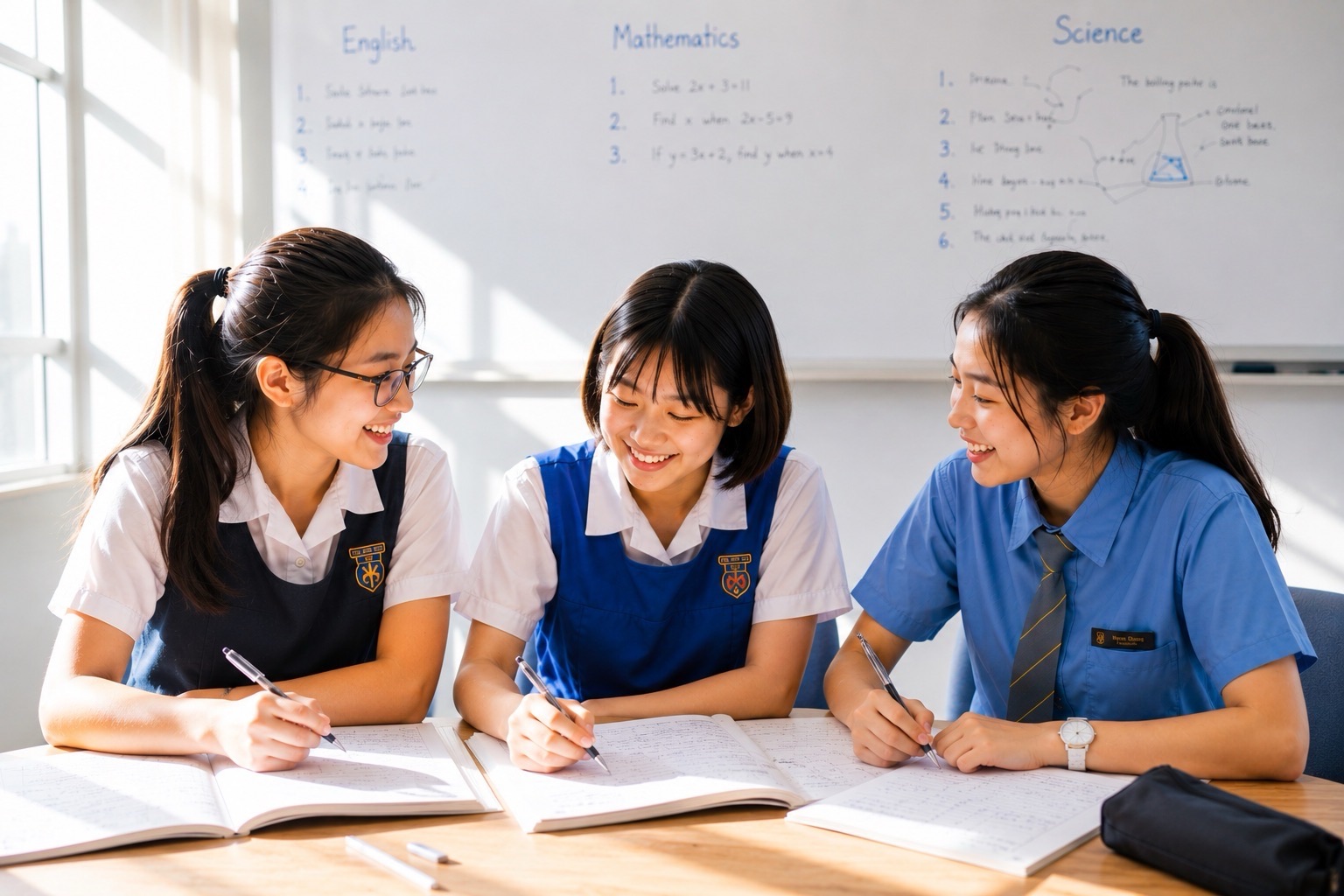
G2 Science tutorials for Geylang Serai families should help a student decide which scientific relationship fits a question when the chapter title is no longer there to provide a hint. At eduKateSG, our three-student small groups begin with individual attempts, then connect Physics, Chemistry or Biology to first principles, measurement and clear explanations. The real goal is independent selection, not an impressive pile of completed revision pages.
Parents considering G2 Science tuition in Geylang Serai, Combined Science tutors or Physics/Chemistry, Physics/Biology and Chemistry/Biology support often ask why a child can solve familiar textbook examples yet struggle with school tests. We distinguish a missing idea from an inappropriate formula, a misread quantity or an explanation that does not answer the prompt. Each needs a focused teaching response rather than generic repetition.
This guide serves families from the Geylang Serai community and is not an announcement of an eduKateSG teaching branch within the neighbourhood or a claimed school affiliation. Suitable lessons and consultations are arranged at 8 Fourth Avenue, Singapore 268674, near Sixth Avenue MRT. We confirm the student’s actual secondary year and G2 Science pairing first; G2 describes a subject level, not necessarily Secondary 2.
For a useful first discussion, enquire about G2 Science tutorial suitability with a representative marked question and the registered Science combination. All market, travel, laboratory and student data below are imaginary teaching examples; we do not claim to have measured the neighbourhood’s businesses or environment.
Why G2 Science Needs More Than Remembering the Correct Formula
A topic worksheet labelled Pressure supplies a method cue before the child even reads the problem. In a mixed assessment, force, mass, contact area and volume may all appear together. The student must decide what is being asked and why the relevant physical ratio is appropriate.
We teach the pupil to identify the quantity, unit, system and applicable relationship before substituting. This short act of interpretation can reveal whether the underlying problem is reading or knowledge. Someone who chooses the wrong denominator needs a different intervention from someone who cannot perform the division.
Scientific writing adds another level of choice. A pupil may describe a trend correctly but attribute it to a mechanism that the experiment has not controlled. An answer that sounds scientific is not necessarily supported by the evidence. We ask for a precise causal link and show where the data stops.
We also teach the student to detect which part of the question is not yet known. If a rate is required but time is missing, a guessed denominator is not a scientific solution. A correct explanation of what further information is needed can demonstrate better judgement than an unsupported number.
Changed-context questions follow each demonstration. The same relationship may appear in a graph, table or story with unfamiliar objects. The tutor checks whether the first decision survives without a chapter heading or verbal prompt.
The Science Pairing Must Be Confirmed Before Tuition Is Planned
MOE’s Full Subject-Based Banding guidance separates a student’s school year from the level at which a subject is taken. G2 is General 2 and should not be treated as another name for Secondary 2.
SEAB’s 2027 G2 syllabus directory lists Science (Physics, Chemistry) K223, Science (Physics, Biology) K224 and Science (Chemistry, Biology) K225. These are combinations of two disciplines, not a requirement to prepare for all three.
A G2 Physics/Biology student does not need Chemistry-heavy exercises merely because a generic booklet contains them. A Chemistry/Biology student may have quite different immediate needs from someone taking Physics/Chemistry. We start with the registered pair and then inspect which ideas actually cause difficulty.
Syllabus boundaries are important. The 2027 G2 Chemistry curriculum includes mass, molar mass and amount in moles, but not all advanced reacting-mass or gas-volume stoichiometric calculations. Syllabus-aligned challenges can still develop reasoning without assigning a different course under the name of extension.
The Singapore-Cambridge SEC framework begins in 2027, but the SEC certificate is not a new fourth Science subject level. We check the actual examination year and the school’s registration before treating older papers as complete mocks.
For younger secondary students, current school chapters remain central. An upper-secondary idea not yet taught should not automatically be called an existing weakness. We distinguish purposeful pre-teaching from repair of something already learned.
A Geylang Serai Market Lens for Measurement and Evidence
NEA documents the heritage of Geylang Serai Market and NHB explains the precinct’s history of commerce and community life. Markets provide approachable illustrations of measurement, materials, changing rates and preservation. We use fictional datasets and do not treat a local vendor’s activities as a measured scientific experiment.
An imaginary delivery rate tells us what a total cannot
Suppose a paper market-distribution model delivers 240 boxes in four minutes, averaging 60 boxes per minute. A second system delivers 300 boxes in six minutes, averaging 50 per minute. The second moves a greater total, while the first has a greater average rate.
The student must decide whether the question asks for the total or the rate. We then give the same figures as a cumulative-count graph and ask for the slope of the relevant interval. A rate should have a denominator that means something, not simply whichever time appears last.
Serving sizes require a common comparison basis
A fictional product lists 6 grams of a nutrient per 100 grams and a serving of 200 grams, containing 12 grams. Another product lists 8 grams per 100 grams and a 100-gram serving, containing 8 grams. One has less per equal mass but more in its stated serving.
Pupils write two precise comparisons. We then replace the food quantities with a physical mass-per-volume table, showing how a ratio method can transfer while the scientific quantity changes. This is classroom interpretation, not advice about any actual market food or individual diet.
A market building invites material questions, not material guesses
The heritage market is recognisable, but a photograph cannot reveal the exact thermal conductivity or load-bearing capacity of a panel. We provide a fictional data table with strength, water resistance and conductivity, then ask which property answers a stated design requirement.
When the requirement changes from protecting contents against water to transferring heat efficiently, the preferred property changes. The child learns that even a true material fact may be irrelevant to the actual problem.
Evidence must remain fictional where the model is fictional
A simulated temperature table does not report the temperature of Geylang Serai Market, and an invented delivery rate does not describe its traders. We make those boundaries explicit, then ask students what measurements would be required to investigate a genuine claim ethically and safely.
Physics: Density Is a Ratio, Not a Ranking by Mass
An imaginary rectangular solid has a mass of 540 grams and volume 180 cubic centimetres. Density is 3 grams per cubic centimetre. A second block of mass 1,080 grams and volume 360 cubic centimetres has exactly the same density despite being twice as massive.
We ask students to explain why doubling both mass and volume preserves the ratio. The pupil constructs a third possible mass-volume pair instead of repeating the first computation. Creating an example shows that the relationship has meaning.
A new sample has mass 540 grams and volume 270 cubic centimetres, giving density 2 grams per cubic centimetre. We ask for a qualitative prediction before division. A larger volume at the same mass means less mass per unit volume.
Now the measurements appear in kilograms and cubic metres. The learner checks compatible units and does not interpret a changed numerical representation as a changed material property unless the corresponding physical ratio differs.
The next question asks whether the denser sample must also be stronger. Without strength measurements, that conclusion is unsupported. Learning to distinguish separate material properties is a valuable scientific habit.
Physics: Force Per Area Is Not Just Force
A model block exerts 150 newtons over a contact area of 0.050 square metre. Its average pressure is 3,000 pascals. If the force stays at 150 newtons but the area becomes 0.025 square metre, the average pressure is 6,000 pascals.
We invite students to predict what happens when area halves. The physical meaning is force distributed over the stated contact area; simply memorising a formula triangle may not help when the task uses an unfamiliar surface shape.
A second question changes both force and contact area. We ask the pupil to compare the relevant ratios rather than declare that the block with the larger force must create greater pressure.
Area conversion deserves special care. A face measured in centimetres has an area in square centimetres, which must be converted appropriately into square metres if SI units are required. A common error comes from treating a square-unit conversion as though it were a length conversion.
We finish with a claim about damaging a surface. Pressure alone is not enough to determine every specific failure outcome without information about the surface material and its strength. The pupil learns what further evidence the broader conclusion requires.
Physics: Draw the Resultant on One Object
An invented 5-kilogram trolley experiences an 18-newton forward force and a 6-newton opposing force. Net force is 12 newtons forward, giving acceleration 2.4 metres per second squared under the specified simple model.
A pupil using 18 newtons directly has confused one applied force with the resultant. We make the first step a clearly labelled force diagram and require the child to explain which arrows act on the trolley.
We then increase the opposing force to 18 newtons. The resultant becomes zero, so acceleration is zero. The model does not necessarily say the trolley is stationary if it already had non-zero velocity.
Another sketch shows forces acting on a separate object that interacts with the trolley. The learner must not include those forces in the trolley’s resultant merely because both appear on the same page.
A transfer task changes the trolley to a sliding container with the diagram oriented vertically. The pupil identifies directions and the system first, showing that the scientific relationship is independent of familiar pictures.
Physics: Graphs Must Be Read Through Their Axes
An imaginary distance–time table starts at zero, reaches 80 metres after 40 seconds, remains at 80 metres for 30 seconds and reaches 140 metres after another 30 seconds. We ask pupils to describe moving, stationary and moving sections in the supplied model.
Whole-interval average speed is 140 metres over 100 seconds, or 1.4 metres per second. If the question requests moving-only time, it uses 70 seconds, giving 2 metres per second. The correct result depends on which interval is requested.
A horizontal segment on a distance–time graph means the recorded distance is unchanged; on a speed–time graph it would mean constant speed. The pupil must inspect both axis labels before importing a familiar graph description.
We change the graph scale and move the zero position. A pupil who reads only the line’s apparent angle may miss the data values. We teach interval measurement as a deliberate act.
Finally, the graph becomes an unfamiliar table. If the student can still calculate the correct quantity with units and explain the pause, understanding has transferred.
Electricity: The Circuit’s Connections Matter More Than Its Shape
A hypothetical ideal resistor has 10 volts across it and a current of 0.5 ampere, giving resistance 20 ohms. We ask the learner to explain what each quantity represents and why volts divided by amperes yields ohms in the model.
An inverse question supplies 20 ohms and current 0.30 ampere. Potential difference is 6 volts. A pupil who divides again merely because the first example used division has not yet understood the relationship.
We then show a circuit with two branches whose symbols are arranged in an unfamiliar way. Pupils trace the conducting paths and identify which elements share the same endpoints before selecting series or parallel reasoning.
A switch opening one route changes the topology but does not necessarily disconnect a separate intact branch. We teach diagrams, not assumptions about their visual symmetry.
No household electrical experimentation is required. Appropriate supervised low-voltage school work is different from modifying real wiring and should follow safety requirements.
Thermal Physics: Temperature Change Is Not Energy Alone
Two hypothetical samples have different initial temperatures. Sample A warms from 21 to 30 °C, an increase of 9 °C. Sample B warms from 27 to 33 °C, an increase of 6 °C. B has the higher final reading while A has the larger increase.
A pupil who always chooses the largest final number may have read the thermometer accurately but answered another question. We put final value and change in separate columns, then change the starting temperatures.
The recorded temperature changes do not uniquely determine the energy transferred without relevant mass, material and model information. The learner distinguishes what was measured from the quantity being inferred.
For particle explanations, we teach appropriate changes in motion or arrangement rather than assert that individual particles simply swell larger when heated.
The final question gives a cooling graph. The child preserves direction of change and reads the requested interval instead of taking every difference as a positive increase.
Chemistry: Coefficients and Subscripts Play Different Roles
In a simple molecular model, 2H₂O means two water molecules containing four hydrogen and two oxygen atoms in total. The subscript belongs to the formula; the coefficient changes how many molecules are represented.
We use particle sketches and ask the student to count each atom type. A balancing exercise should adjust appropriate coefficients rather than change the formulas of the substances to make counting easier.
A new equation uses unfamiliar but supplied chemical formulas. The learner explains conservation of atom types rather than recognise a famous classroom reaction.
This strengthens the bridge between a particle model and symbolic representation. Both matter when a later problem changes the diagram or removes chemical names from the prompt.
Chemistry: Mass, Molar Mass and Amount at the Correct Level
A fictional substance has molar mass 60 grams per mole and sample mass 15 grams. Its amount is 0.25 mole. We ask students to write the units during division and explain the resulting physical quantity.
The inverse problem gives 0.40 mole of the same substance, corresponding to 24 grams. The operation changes because the unknown changes, even though the relationship is the same.
The learner then uses another supplied molar mass and predicts whether the mass for half a mole should be greater or smaller than the mass of one mole. Estimation can detect unreasonable substitutions.
A further task omits chemical identity and molar mass while providing sample mass. We teach the pupil to name which necessary information is missing instead of inventing a numerical answer.
Core G2 Chemistry should remain matched to its published scope. We do not silently add advanced reacting-mass and gas-volume calculations just because a broader revision book includes them.
Chemistry: Separation and Chromatography Are Evidence Questions
A fictional mixture contains an insoluble solid and dissolved material in water. Filtering can remove the insoluble component, but it does not ordinarily separate a dissolved substance simply because the resulting liquid looks clear.
When the requested product changes, the learner chooses a relevant school-taught separation method and explains which physical property is used. The aim and property determine the method, not one memorised apparatus picture.
An imaginary chromatogram shows several spots from an unknown mixture and reference spots produced under matching conditions. Pupils compare the observed positions and identify what the simplified data supports.
A matching appearance under one method is not unlimited real-world proof of identity. We change the solvent conditions in a second fictional diagram and ask whether a direct comparison remains justified.
All practical descriptions are paper exercises. Actual chemical handling needs suitable supervision and facilities.
Biology: Connect a Structure With What It Actually Does
For learners taking G2 Biology, a diagram can label a structure correctly without proving the student understands its contribution. We ask what enters the structure, what changes or moves and how a relevant feature assists the particular process.
A root-hair model might illustrate surface area and uptake under suitable conditions. We ask for the causal link, not a list of unrelated facts about plants.
A new diagram presents a different specialised cell. The pupil must identify which feature is relevant to the new function rather than copy the previous answer.
We use a short flow sequence with one missing link. The learner repairs it and then reconstructs the process using a differently arranged illustration.
Biology: Relative Change Requires a Starting Reference
Two fictional tissue samples start at 5.0 and 10.0 grams and end at 5.5 and 10.5 grams. They both gain 0.5 gram, but the relative gains are 10% and 5% respectively.
We teach that an equal absolute increase does not imply an equal percentage increase. The denominator must correspond to the stated reference. A pupil who divides by the final mass may answer a different question.
The next sample loses mass. The learner describes the decrease accurately and avoids reporting a positive ‘gain’ merely because the absolute difference is positive.
Where an osmosis explanation is requested, the task must supply the appropriate membrane and relative water-potential conditions. Mass readings alone cannot uniquely identify every possible biological mechanism.
We then replace the table with an unfamiliar graph, checking whether the quantitative interpretation remains independent of format.
Biology: A Trend Does Not Automatically Prove Its Cause
A fictional ecosystem table records one population rising while another falls. The child can describe the pattern, but the two changes alone do not establish which mechanism caused either one.
We ask about sampling effort, other changing environmental factors and which additional evidence could distinguish competing explanations.
A better-controlled imagined investigation supplies a relevant intervention and repeat observations. We discuss whether the new evidence strengthens a specific inference without making a universal claim.
This is a classroom case, not a report on species living around Geylang Serai. The skill is to express what the dataset supports and what remains uncertain.
Worked Clinic: Rate or Total at the Market?
An invented distribution team moves 360 fictional crates in six minutes, including a one-minute pause. Its whole-interval throughput is 60 crates per minute. The active-time rate during five working minutes is 72 crates per minute under the model.
A student who reports 72 as the complete-interval rate has answered the wrong question despite performing a correct calculation. We draw a timeline and label the relevant denominators.
Now the pause becomes two minutes while the total period and crate count remain unchanged. Whole-interval rate remains 60, while active-time rate becomes 90 crates per minute. The pupil predicts what changes and what stays fixed.
A cumulative-count graph replaces the story. The child identifies a flat section as no increase in the recorded count over that interval and calculates an appropriate rate from the axes.
No numerical result in this section represents an actual market worker or vendor. We use imaginary values to practise selecting meaningful quantities.
Worked Clinic: A Pressure Problem With Two Changing Variables
A fictional object A applies 120 newtons across 0.040 square metre, giving 3,000 pascals. Object B applies 180 newtons across 0.090 square metre, giving 2,000 pascals. B has a greater force, while A gives higher pressure.
A learner who chooses B because 180 is larger has compared the wrong quantity. We ask what each denominator represents and why force alone is insufficient.
The tutor changes B’s area to 0.045 square metre, producing 4,000 pascals. The earlier conclusion reverses, but the governing relationship has not changed.
We then add a fictional material-strength table and ask what evidence would be required to make a valid statement about damage. A pressure calculation does not automatically settle a complex material outcome.
The student finishes with an unfamiliar diagram and no Pressure heading, identifying the relevant contact face before using the formula.
Worked Clinic: Chemistry Mass and Moles in Both Directions
A fictional compound has molar mass 75 grams per mole. A 15-gram sample contains 0.20 mole. We ask for the unit and whether the result should be less than one mole based on the mass being smaller than one molar mass.
An inverse problem gives 0.60 mole, corresponding to 45 grams of the same compound. The pupil explains why multiplication is now appropriate.
The next question uses a different molar mass and unfamiliar compound name, with all relevant data supplied. The learner should identify the required mass-per-mole relationship without a chapter title.
An additional question gives only sample mass and no chemical identity or molar mass. We ask the student to identify the missing data, not make an unsupported assumption.
These tasks intentionally stay within relevant G2 content rather than importing advanced reaction calculations from another course.
Worked Clinic: Experimental Design and an Unfair Comparison
Two imaginary containers hold equal water volumes, but one is warmer and stirred more vigorously. A pupil reports that the faster dissolving rate proves temperature was the cause. We ask what else changed.
A valid improvement holds the stirring method comparable while varying the intended temperature, and defines how the endpoint will be measured. The child explains why this change strengthens the test.
Repeating the same confounded conditions does not isolate temperature, even if the measurements are very consistent. We distinguish method validity from repeatability.
Another task gives an instrument with readings consistently above a reference. A calibration check may be more relevant than more repeats. We ask the learner to match the improvement to the actual limitation.
The final exercise removes the dissolving story and uses a biological sampling design. The same principle of comparable conditions remains, but the relevant variables and controls change.
Three Learners May Need Three Different Corrections
Imagine three fictional G2 students losing marks in a mixed paper. One misreads the graph axes, another selects an unsuitable ratio and the third computes correctly but writes a conclusion unsupported by the data. Giving all three the same generic worksheet would not treat their needs equally.
Independent first attempts expose the different decisions. The tutor teaches a central concept clearly, then provides targeted tasks for graph reading, model selection or response writing.
Group discussion helps pupils compare reasoning, but we deliberately return to independent application. A response reached after hearing the strongest classmate’s solution is a step in learning; a fresh correct choice without help is stronger evidence.
A three-student format can support attentive teaching when the group is suitably matched for course and pace. It is not a guarantee of availability or an automatic grade improvement.
An Illustrative G2 Tutorial Session
A focused session begins with short retrieval from previously taught topics and an unfamiliar diagnostic. The tutor identifies one high-impact relationship, then builds it using a clear diagram or accessible numbers.
Students explain the mechanism, work through guided examples and compare two cases that differ in one important condition. A changed denominator, sample size or measurement basis forces a new decision.
The tutor removes hints and presents an unseen task. Each pupil chooses the model and gives a reason, allowing the instructor to see which correction has become independent.
A short mixed set revisits the relationship among other familiar concepts. Timing follows only when the student can make the fundamental choice reliably.
The session closes with a precise error note and a later retrieval task. Actual duration, timetable, group composition and availability are confirmed during enquiry rather than promised by this illustrative sequence.
Repair, Stabilise and Extend: Different G2 Learning Routes
Repair the first missing foundation
An insecure ratio or area conversion may block a current Physics question. A vague understanding of grams per mole may block a Chemistry task. We repair the smallest necessary relationship and return to the present school problem.
The learner should be able to make the corrected first choice independently in a changed example before the programme moves on.
Stabilise knowledge that disappears on mixed papers
A pupil may understand separate topics but depend on chapter headings. We remove cues, vary representations and revisit corrected misconceptions after a delay.
Explaining why a tempting alternative is wrong is part of the training. The pupil learns to check the relevance of a method without waiting for external confirmation.
Extend through better interpretation
A secure learner may evaluate competing explanations, suggest a measurement needed to settle an issue or construct a counterexample to an overbroad claim.
We deepen reasoning within the actual G2 pairing rather than treat every off-syllabus advanced calculation as desirable extension.
A Sustainable Revision Routine for Geylang Serai Families
The school week already contains substantial work. A short no-notes explanation, an unfamiliar problem and a later correction check can generate meaningful evidence without creating a full second school day.
- Retrieve one Science relationship without notes and explain its relevant conditions.
- Apply it to a new graph, table or apparatus diagram.
- Compare two questions with similar words but different requested quantities.
- Return to a corrected error after a delay without the solution beside it.
- Introduce short mixed tasks when concepts are stable enough for independent selection.
Parents do not need to solve G2 Chemistry or Biology themselves. Asking which measurement supports the answer or which variable changed invites useful reasoning.
A short error record should identify the first wrong choice: used whole serving instead of per-100-gram value, confused pressure with force, or treated a trend as proof of cause.
We avoid hazardous home experiments or sampling actual market goods without consent. Printed fictional data and safe supervised school work are sufficient for the teaching aims.
Rest and attention matter. A long copying session when the child is exhausted is not necessarily more effective than a small unfamiliar task completed carefully and reviewed.
Preparing for the Correct G2 SEC Paper
The published 2027 G2 Science route includes multiple-choice and structured response tasks in each selected discipline. Recognising the correct option and constructing the same explanation without options should be practised separately.
When a student selects an answer correctly, we ask why one plausible distractor is unsuitable. Next, a written task requests the causal explanation directly. The child learns to connect a specified condition with the relevant outcome.
Full papers are useful for integrated preparation once enough concepts are secure. Earlier on, a short diagnostic may show a misconception more clearly.
Timed work can uncover whether the learner spends too long reading, choosing, calculating, writing or checking. We investigate the cause rather than issue a universal instruction to hurry.
Materials should match the registered combination and examination year. Older or differently labelled papers may contain useful shared concepts without being accurate complete mocks.
What Parents Can Recognise as Progress
A G2 learner becomes more dependable when they identify a requested quantity and its unit before calculating, read unfamiliar graphs correctly and connect written explanations with relevant conditions.
Self-correction is especially encouraging. A pupil who notices they compared raw force rather than pressure can change the method before a tutor intervenes.
We compare changed-context tasks and note whether prompts were needed. A familiar exercise completed immediately after teaching is different evidence from an unseen item answered independently.
No particular grade can be guaranteed. A programme should explain the targeted skill, teaching action and independent check so families can see what is becoming more secure.
Tuition is not automatically necessary for every child. Where present school teaching and independent learning already work well, additional classes may not be needed.
Class Venue and Consultation for Geylang Serai Families
The stated eduKateSG teaching venue is 8 Fourth Avenue, Singapore 268674, near Sixth Avenue MRT. The Geylang Serai title is a locality guide, not a centre address.
Families should calculate their own realistic journey from home or school, taking account of walking, transport stages and the return trip. We do not invent a single travel time for all readers.
Bring the pupil’s year, actual G2 Science combination, current chapters, a successful work sample and one difficult marked question. The contrast may show exactly which changed conditions caused trouble.
Three-student classes require compatible subjects and pace. Timetable, availability, duration and materials are confirmed during the first enquiry.
Geylang Serai G2 Science: Questions Parents Ask
Does G2 mean Secondary 2?
No. G2 is a subject level, while Secondary 2 describes a school year. We confirm both when planning lessons.
Does every G2 Science pupil take Physics, Chemistry and Biology?
No. The 2027 G2 Science subjects are two-discipline combinations: Physics/Chemistry, Physics/Biology and Chemistry/Biology.
Why are chapter questions easier than mixed school tests?
The heading supplies a method clue. We practise selecting the concept independently when different topics and representations are mixed.
Should students immediately begin G3 Chemistry calculations?
Not automatically. Core preparation follows the registered G2 syllabus. Extension can deepen evidence evaluation without irrelevant off-syllabus calculations.
Is there an eduKateSG classroom at Geylang Serai?
This guide serves Geylang Serai families. The stated class venue is Fourth Avenue near Sixth Avenue MRT.
Can tutorials replace laboratory practical learning?
No. Written planning and data analysis complement safe supervised practical experience where required.
Can a tutor guarantee a particular examination mark?
No fixed result can responsibly be promised. We focus on teachable decisions and repeated independent checks.
What should a family bring to a consultation?
The pupil’s current school year, exact Science pairing and representative marked work, including one question they cannot explain unaided.
Geylang Serai G2 Science Links and Learning Routes
Continue to G1 Science Tutorials | Geylang Serai, G3 Science Tutorials | Geylang Serai and SEC Science Tutorials | Geylang Serai when the registered subject level or examination horizon requires a different guide.
Primary-stage Science support is separate: PSLE Science Tuition | Geylang Serai and Primary 6 Science Tuition | Geylang Serai. The Science Tuition by Area Index connects further learning routes.
Official course references include MOE’s Full Subject-Based Banding guidance and SEAB’s 2027 G2 syllabus directory. Check the examination documents applicable to the learner’s cohort.
The G2 Goal Is a Student Who Can Choose and Explain
A stronger G2 student can distinguish a total from a rate, a mass from density, an observation from an explanation and a useful control from a generic phrase. Those habits matter because unfamiliar Science tasks often test which concept belongs rather than whether a definition can be recited.
Geylang Serai’s market and cultural surroundings make quantities and materials easy to discuss, but the final teaching check deliberately uses new contexts. Scientific understanding should not disappear when the local story or chapter title is removed.
Enquire about G2 Science tutorials for Geylang Serai with the student’s secondary year, registered Science pair and a representative difficult question. A precise, testable learning need provides a better starting point than a generic paper marathon.