
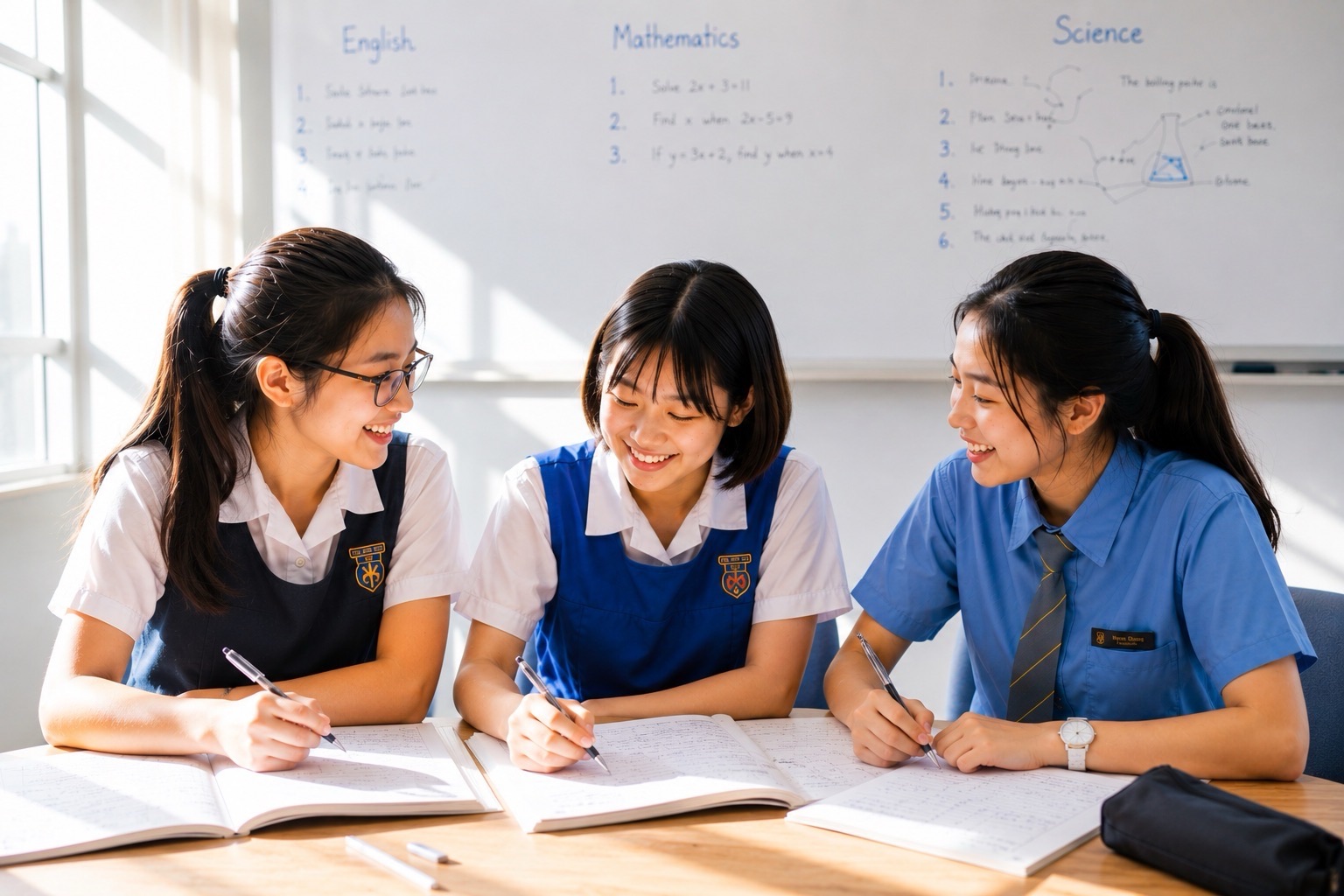
G2 Science tutorials for MacPherson students should begin with one simple promise about teaching: every calculation and explanation must mean something. In eduKateSG’s three-student small groups, we examine how a learner identifies the requested quantity, interprets evidence, selects a scientific model and checks the result. A completed exercise is useful when it develops thinking that survives the next unfamiliar question, not merely when the page is full.
Parents exploring G2 Science tuition in MacPherson, Combined Science tutors, Physics and Chemistry revision or Physics and Biology support often notice a pupil who knows the topic but struggles on mixed assessments. We ask which decision became unstable: did the child compare totals instead of rates, substitute into the wrong formula, confuse observation with cause or write an explanation without a scientific mechanism? Those problems call for different corrective tasks.
MacPherson is the community this article serves, not an additional eduKateSG teaching branch or a relationship with local schools. Suitable consultations and classes are arranged at 8 Fourth Avenue, Singapore 268674, near Sixth Avenue MRT. The learner’s school year and exact G2 Science pairing matter because G2 is a subject level, not another name for Secondary 2. Examples in this article are fictional paper exercises, not local measurements.
For a focused conversation, enquire about G2 Science class suitability or arrange a consultation. Bring the student’s present Science combination and one school question that felt confusing. We will use that evidence to identify a useful first teaching target instead of making a vague assumption that every pupil needs more examination papers.
Why G2 Science Often Feels Different From the Chapter Notes
A chapter worksheet announces the topic before a pupil reads its first question. If the heading says Density, the learner already knows which relationship to consider. In a mixed paper, that hint disappears. The student must decide whether a problem concerns density, speed, pressure, energy or an unfamiliar relationship that has to be extracted from the given data.
This is a genuine step in scientific learning. Recognising a formula is useful, but selecting it from the meaning of the quantities is more demanding. We teach children to state the unknown in words, label the data with units and check the model’s conditions before substituting. This protects against precise arithmetic attached to an unsuitable interpretation.
Scientific language adds another challenge. A pupil might answer a question about diffusion with a paragraph about particles without stating the direction of net movement. Another may report that a gas was formed without distinguishing an observation from an inference about what substance it is. We use paired explanations to show which statement responds to the evidence and which introduces unsupported material.
We also distinguish an unfamiliar task from an untaught topic. A lower-secondary student cannot reasonably be expected to know an upper-secondary concept that school has not introduced. A good diagnostic checks the student’s current course and then identifies a missing prerequisite or a transfer problem, rather than treating every unfamiliar word as a mark of weakness.
Our goal is confidence based on meaningful choices. The learner understands why a method works, when it does not and what information is missing. That is a more dependable kind of confidence than being able to answer many identical questions immediately after a demonstration.
The MacPherson Science Lens: Systems, Flows and Measured Differences
NParks describes Pelton Canal Park Connector as running through residential areas including Circuit Road, while Balam Park Connector serves the Circuit Road housing estates. These are real places that can prompt useful questions about movement, runoff, materials and living systems. We do not claim to have measured the canal or local environment. All readings in the exercises that follow are invented and labelled as such.
From a park-connector path to the correct average rate
Imagine a fictitious delivery model covering 360 metres in three minutes, pausing for two minutes and travelling another 240 metres in two minutes. Moving speed is 120 metres per minute during both moving sections, but the average speed across the whole seven-minute interval is 600 ÷ 7, about 85.7 metres per minute.
A student who averages the two moving speeds without including the pause might give a convincing but wrong answer to the whole-interval question. We ask the learner to mark the total elapsed time and explain what the word average refers to. The follow-up removes the path and uses a distance–time graph, testing the same idea through another representation.
From a waterway image to a system boundary
An imaginary reservoir receives 0.9 litre of water per minute and releases 0.6 litre per minute under constant conditions. The stored volume increases by 0.3 litre per minute. The student draws arrows showing which quantities enter and leave before calculating the net change. We then add a second outlet and ask for a revised prediction.
If only a graph of stored volume is provided, it may show the net change without revealing the individual inflow and outflow rates. The learner must distinguish what the data supports from what is still unknown. This is a foundational habit for energy accounting, chemical conservation and biological transport as well.
The rain-garden observation: controlled comparisons
NParks notes a rain garden along Balam Park Connector. It provides a meaningful place to discuss why a scientist must distinguish a visible feature from a measured effect. We make no claim about that garden’s actual temperature, absorption or water quality. Instead, an invented pair of models compares two soil mixtures under explicitly stated test conditions.
Suppose an imagined setup delivers 400 millilitres of water to each equal-sized container and measures the volume draining out after the same duration. A student can calculate the difference in recorded output and propose further measurements. But the conclusion about which mixture retains more water depends on the supplied experimental design, not on assumptions about the real local rain garden.
MacPherson’s mixed surroundings and material choices
A fictional designer chooses among materials with different electrical conductivity, density and resistance to water. The purpose of a protective cover determines which property is relevant. A strong answer cites data linked to function rather than listing every true material fact. We deliberately provide one irrelevant property to teach selective use of evidence.
The tutor later changes the purpose while retaining the same materials table. An answer that was reasonable for electrical insulation may not be suitable for a transparent observation panel. The learner must reconsider the decision instead of repeating the material named in the first model answer.
The test of place-based learning is transfer
At the end of the sequence, MacPherson disappears from the page. Flow becomes a laboratory rate table, material selection becomes unfamiliar packaging and a path becomes an abstract graph. The student should be able to recognise the same relationship when the local story no longer supplies a hint.
If the child can solve only the place-based question, we revisit the model rather than add more local colour. Familiarity is a teaching invitation; it is not evidence of conceptual independence. We use the transfer question to decide whether the lesson should be consolidated or extended.
Know Which G2 Science Pairing the Student Actually Takes
MOE’s Full Subject-Based Banding guidance explains the difference between a secondary school year and a subject level. G2 is General 2 and does not automatically mean Secondary 2. We therefore record both the current year and the actual Science course before selecting learning tasks.
SEAB’s 2027 G2 syllabus directory lists Science (Physics, Chemistry) K223, Science (Physics, Biology) K224 and Science (Chemistry, Biology) K225. These are distinct pairings. A pupil on Physics/Biology should not be assigned Chemistry-heavy revision merely because a general booklet is labelled Combined Science.
G2 Chemistry includes a relationship between mass, molar mass and amount in moles, but its stated 2027 syllabus scope excludes the more advanced stoichiometric reacting-mass and gas-volume calculations. We honour the precise content boundary. Appropriately challenging G2 practice can improve interpretation and explanation without requiring students to spend limited time on material belonging to a different course.
The SEC certificate framework begins in 2027, but SEC is not a fourth Science subject level. Exam preparation depends on the subject code and the learner’s examination year. School guidance remains essential for the current topic order and actual registered course.
Our first consultation therefore asks whether the child is an earlier-year learner building present foundations or an examination-year pupil needing integrated preparation. Both may take G2 Science, yet the weekly sequence should differ. Getting the destination right is a practical form of educational care.
Quantitative Physics: Check What Each Ratio Describes
Density is not mass alone
Suppose a fictional solid has a mass of 450 grams and a volume of 150 cubic centimetres. Its density is 3 grams per cubic centimetre. Another solid with mass 900 grams and volume 300 cubic centimetres has the same density. A heavier sample is not necessarily denser if its volume increases proportionately.
We ask students to construct a new valid mass-volume pair for the same density. This reverses the usual worksheet question and reveals whether the relationship is understood. A pupil who can only divide the originally supplied numbers may not yet appreciate what density says about mass per unit volume.
Next we change units, such as grams to kilograms, and ask how the numerical representation must change. The student labels both quantities and checks the plausibility of the result. A correct number with an incompatible unit should prompt a focused interpretation check, not simply a demand for greater care.
Pressure depends on area as well as force
An invented block exerts a perpendicular force of 120 newtons through a contact area of 0.040 square metre. Its average pressure is 3,000 pascals. With the same force distributed over 0.020 square metre, average pressure becomes 6,000 pascals. We make students predict the direction of change before using the formula.
The common error is comparing only the forces or treating area like a linear dimension without squaring the conversion. We draw the contact face, label its area and distinguish the geometric measurement from the formula. This makes the calculation a test of a clear model, not a guessing game.
A transfer question supplies two different forces and areas. The learner must calculate or reason about force per unit area rather than choose the larger force automatically. The tutor then asks whether the calculated pressure proves the strength of a material. It does not without relevant material data. The last sentence teaches what the evidence cannot say.
Force and acceleration need the right object
A fictional 4-kilogram trolley has an 18-newton forward force and a 6-newton opposing force. The resultant is 12 newtons forward and acceleration is 3 metres per second squared under the stated model. We first draw both forces acting on the same object and label their directions.
The next case makes the opposing force equal to the forward force. Zero resultant means zero acceleration in this model, not necessarily zero velocity. The child explains why motion and change of motion should not be conflated. This is an important conceptual contrast that more arithmetic alone would not guarantee.
We may introduce another sketch showing forces acting on two interacting objects. The student must not sum these as though both forces acted on one trolley. The system boundary is a meaningful piece of the Physics explanation, not an optional drawing.
Graphs, Heat and Electrical Models: Read Before Calculating
A graph’s axes define the interpretation
We teach students to inspect the axis quantities, units and interval before invoking a gradient rule. A flat segment on a distance–time graph represents an unchanged distance reading over the interval. A flat segment on a speed–time graph represents constant speed over the interval. These are not identical descriptions of motion.
A fictional distance–time table starts at 0 metres, reaches 100 metres at 50 seconds, remains at 100 at 80 seconds and reaches 160 at 110 seconds. Students describe moving, stationary and moving sections in the supplied model. They calculate average speeds for each relevant interval, then explain why the whole-interval average differs.
The tutor rotates the diagram layout and changes scale divisions, preserving the physical relationships. A learner who can now read the values without relying on a familiar graph shape has improved the relevant skill. We test the new interpretation after time has passed, not only immediately after the demonstration.
Heat and temperature are related but different
An imaginary investigation begins with two samples at different temperatures. Students record final temperatures and calculate changes, then decide whether the supplied information is enough to compare energy transferred. Temperature readings alone may be insufficient without additional quantities and model conditions. We teach pupils to avoid substituting one kind of measurement for another.
A fictional sample rises from 24 °C to 31 °C, a seven-degree increase. Another rises from 29 °C to 34 °C, a five-degree increase. The second has the higher final temperature, while the first has the greater rise. Both statements are valid. The child must match the answer to the actual question.
A separate particle-model task asks the learner to explain relevant changes in motion or arrangement rather than claim that individual particles simply grow larger. We begin with a clear drawing and ask the pupil to identify what the model includes and excludes. The depth follows the registered Physics course.
Circuit thinking begins with connections
In an ideal circuit model, a resistor has 10 volts across it and a current of 0.5 ampere. The resistance is 20 ohms. The tutor asks what each quantity represents before rearranging the relationship. A student who divides current by voltage may have remembered two numbers but lost the meaning of the equation.
We then change the requested unknown: the resistor remains 20 ohms, current becomes 0.3 ampere and the student calculates 6 volts. The operation changes because the question changes. We make the units and relationship explicit rather than teach that every electricity calculation follows the same procedure.
A later diagram introduces a branch. Pupils trace the topology before importing a rule from the original simple circuit. Written reasoning can be taught without unsafe home electrical work; any practical handling requires suitable low-voltage equipment and competent supervision.
Chemistry: Turn Particle and Formula Knowledge Into Explanations
Understand coefficients and subscripts
Students learn that a coefficient counts formula units or molecules as appropriate to the model, while a subscript is part of the substance’s formula. In the molecular expression 2H₂O, two water molecules contain four hydrogen atoms and two oxygen atoms. The pupil draws the particles and counts each kind before trying another symbolic expression.
A balanced equation expresses conservation of each type of atom in the described chemical change. We ask learners to adjust coefficients rather than change formula subscripts to make counting easy. An explanation connects the notation to the particle model instead of presenting a correct-looking equation with no interpretation.
The transfer version uses unfamiliar but fully supplied formulas. The student checks atom counts independently and explains why a proposed unbalanced expression is inadequate. This is a more reliable test than copying a familiar reaction several times.
Mass, molar mass and amount
Suppose a fictional sodium chloride sample has mass 11.7 grams and the exercise supplies molar mass 58.5 grams per mole. The amount of sodium chloride is 0.200 mole. We identify each unit before division, explaining that grams divided by grams per mole gives moles. The numerical result is not a mysterious calculator output.
The tutor then gives 0.300 mole of the same substance and asks for mass. Multiplying by 58.5 gives 17.55 grams before any specified rounding. The different unknown requires a different operation. We ask the student to predict whether the answer should be above or below one molar mass before calculating.
The next question uses another compound and supplies all atomic masses needed. We intentionally stay within the relevant G2 relationship instead of silently moving into reacting-mass and gas-volume stoichiometry outside that core scope. A learner can be challenged by unit interpretation and unfamiliar representation without being taken away from the required course.
Physical separation requires knowing the target
An imaginary mixture contains insoluble particles and a dissolved solid in water. Filtration can remove the insoluble particles but does not ordinarily remove the dissolved solid merely because the filtrate looks clear. We ask where each substance goes and what property the separation exploits.
The question then changes what must be recovered. Keeping the filtrate, isolating the insoluble solid or recovering the dissolved solid are different aims. The pupil selects a relevant school-taught method and explains its purpose rather than memorising a single fixed process for every mixture.
A paper chromatogram provides another example: two visible spots in an unknown sample can support certain comparisons with references under specified conditions, but matching appearance is not unlimited proof of identity. We keep the explanation within the syllabus and use fictional results. No unsupervised chemical testing is needed.
Biology: Ask for the Mechanism Behind a Diagram
From cell structure to transport
For G2 students taking Biology, a cell feature matters because of its contribution to a process. We ask learners to identify how a structure affects exchange or transport under the stated conditions. Naming a thin membrane or large surface area is not enough unless the child explains why that property is relevant in the actual question.
An original paper problem supplies a concentration difference across a partially permeable membrane and asks about the direction of net water movement under a specified model. Pupils trace the direction and explain it with appropriate terminology. We then reverse the concentration relationship and ask what should change in the prediction.
A learner who always says movement goes into the cell may have memorised one example without understanding its conditions. We make the change explicit and use an unfamiliar diagram to test the model again. Curriculum-appropriate terminology and depth depend on the student’s registered Science combination.
An organism count is evidence, not an automatic cause
A fictional chart shows two populations changing over several intervals. Students describe what was measured and avoid treating simultaneous change as proof that one population caused the other to change. We ask how sampling, environmental conditions and unmeasured variables might affect the interpretation.
Next we supply a clearer experimental model with controlled conditions, then ask what stronger conclusion could be considered. The child learns that more evidence may improve an inference; the lesson is not that a scientist can never discuss causes. The key is to connect the explanation with data actually supplied.
In the final transfer task, the organisms are replaced by an unfamiliar dataset with the same analysis demand. The learner can identify a pattern and a limitation without needing to recognise species names. This strengthens general scientific literacy rather than memorisation of a particular ecological story.
Follow a physiological process as a causal chain
An organ diagram can be easy to label but hard to explain. We ask what enters a particular structure, what happens there and what follows. A pupil who knows the location of absorption may still confuse absorption with digestion; a route diagram helps identify the missing connection.
We provide a partially completed flow sequence, then remove one step and ask the student to repair it. The next question changes the diagram layout and tests the same process without the original labels. The aim is a linked explanation in the learner’s own words, not a paragraph assembled from unrelated organ names.
Worked Physics Clinic: The Wrong Time Interval
An invented robot moves 100 metres in 50 seconds, pauses for 40 seconds and then moves 60 metres in 30 seconds. Its average moving speed is 2 metres per second in both moving sections, but the full observation includes the pause. Total distance is 160 metres over 120 seconds, giving about 1.33 metres per second overall.
The tutor asks which interval the words ‘entire observation’ refer to. A student who divides 160 by 80 has calculated the moving-only average instead. Rather than just show the answer, we make the pupil label the timeline and explain where 40 seconds belongs.
A follow-up doubles the pause. Total distance remains 160 metres while elapsed time becomes 160 seconds, so whole-interval average speed is 1 metre per second. Before calculating, the learner should predict that adding stationary time reduces the whole-interval average in this simplified model.
We then replace the story with a distance–time graph containing a flat segment. Students recognise that distance does not change in the pause, read the elapsed interval and choose the correct average. The test is whether an interpretation survives a new representation.
The final check asks what the graph cannot establish: for example, it may not reveal all physical reasons for the pause. A good Science answer separates measured motion from a speculative explanation for that motion.
Worked Chemistry Clinic: The Same Element Count Across a Reaction
Consider an invented paper task based on the familiar balanced equation 2Mg + O₂ → 2MgO. Students count magnesium and oxygen atoms on both sides, explaining why changing a coefficient preserves the substance’s formula while changing its represented amount.
A pupil who changes MgO into MgO₂ to make an oxygen count look convenient has altered the substance being described. We ask the learner to draw the reactant and product particles and account for every atom using coefficients rather than modifying the formula.
Next, the teacher provides an unfamiliar symbolic equation where one element is not balanced. The pupil identifies which type of atom has an unequal count and selects a coefficient that repairs the equation. We check the entire equation again because fixing one count must not invalidate another.
We deliberately keep the task focused on chemical conservation and symbolic meaning, which apply appropriately across relevant G2 Chemistry topics. Quantitative reacting-mass and gas-volume stoichiometry are not added simply to make the problem look more sophisticated.
Students finish by explaining the balanced result without copying a sentence starter. The ability to move from particles to symbols and back is stronger evidence than being able to write a famous reaction from memory.
Worked Biology Clinic: Absolute Gain Versus Percentage Gain
Two imagined biological samples start at different masses. Sample A rises from 5.0 to 5.5 grams; Sample B rises from 10.0 to 10.5 grams. Both gain 0.5 gram. But their relative increases are 10% and 5% of the respective starting masses. A numerical statement must name which kind of comparison it uses.
The child calculates absolute gain first and then identifies the correct reference mass. A pupil who divides by final mass has chosen a different denominator. We teach the basis of the percentage change before treating the operation as merely a calculator procedure.
The task then asks whether a particular biological mechanism caused the mass difference. The readings alone do not establish a unique cause. Where the question specifies appropriate membrane and solution conditions, the student can use the relevant model; otherwise the answer should recognise missing experimental evidence.
We reverse one change so a sample loses mass. The learner preserves the direction rather than always taking a positive difference. The next question uses a length measurement instead of mass to test whether relative change remains understood.
We also ask what an average recorded for a group can and cannot say about individuals. Scientific precision includes resisting unsupported statements about every sample when the task only provides a summary measurement.
Experimental Design Clinic: Why More Repeats May Not Fix the Study
A hypothetical investigation compares the time required for two identical solids to dissolve. In one trial the water is warmer and stirred more vigorously; in another it is cooler and not stirred. A pupil attributes the difference entirely to temperature. We ask which variables changed and how that prevents a clean interpretation.
A useful corrective method keeps stirring comparable while changing temperature deliberately and measuring an appropriate endpoint. The learner specifies quantities and conditions from the given setup instead of saying simply ‘make it a fair test’. We ask how the correction addresses the identified ambiguity.
Repeating the original flawed comparison five more times could describe variability but would not separate the effects of temperature and stirring. We teach this distinction explicitly. Repetition and experimental control solve different problems, and one cannot automatically stand in for the other.
A second exercise uses an instrument with a possible calibration offset. Additional consistent readings cannot on their own prove closeness to the reference. The student proposes checking calibration under relevant conditions, explaining why this is different from reducing random spread.
We then change the context to a fictional ecological sampling record. The child must decide whether repeated sampling from one unrepresentative site answers a question about a broader area. The reasoning about method validity transfers, while the appropriate specific correction changes.
Three Students, Three Different Learning Routes
Suppose three fictional learners obtain the same score on a mixed Science quiz. One selects the right quantities but writes vague explanations; another explains well but reverses several ratios; the third handles chapter questions but freezes when topics are interleaved. A generic worksheet set would not treat these needs fairly.
We use individual written attempts at the beginning so the tutor sees what each pupil actually knows before discussion. The group then compares methods and misconceptions in a way that values clarity over speed. One student may receive a paragraph-editing task, another a ratio contrast and another a topic-selection check.
The next common question is unfamiliar and completed independently. We look for whether each corrected decision holds. A learner who can now identify the right unit or scientific model without a hint is becoming less dependent on tutoring. The class should celebrate that independence rather than the number of solutions copied.
Group suitability is assessed before placement. G2 pairing, school year, current topic load and learning pace matter. We do not assume a seat or timetable is available from the existence of a locality guide. The teaching goal is an environment where each pupil can make a thoughtful attempt and receive specific corrective feedback.
What a Focused G2 Science Session Can Look Like
A lesson may begin with retrieval from a previous topic and a short unfamiliar question. The tutor notices that a learner knows a formula but cannot choose it after the chapter heading is removed. We create a contrast between two different ratios and ask the student to name what each calculates.
The central teaching then makes the conceptual difference visible through a table and diagram. Pupils perform guided calculations, but are also asked to explain their choices and units. We deliberately change a condition so the earlier answer cannot be copied. This reveals whether the rule is understood.
Next, the student receives a new problem without annotations or verbal hints. The tutor observes the first choice, intervening only when support becomes productive. A later mixed exercise places the concept beside a different topic, forcing independent selection.
The closing record names a teachable correction and schedules a later check. ‘Use total elapsed time when the entire observation period is requested’ is actionable. ‘Try harder in Science’ does not tell the child what to practise. Actual session duration and arrangements are confirmed separately.
We do not rush pupils into timed practice if concept selection remains unstable. When understanding becomes dependable, short timed segments help measure execution and answer organisation. The schedule follows readiness rather than treating time pressure as the universal cure.
A Revision Rhythm That Works With School Commitments
Families may be tempted to measure progress by how many worksheets have been completed. We prefer short independent attempts that reveal retrieval and transfer. One session can revisit a previous misconception, another can tackle an unfamiliar representation, and a later one can test a mixed selection without the topic title.
- Begin the week with a no-notes explanation of one relevant relationship.
- Use a new graph or diagram midweek to test the same idea with altered labels.
- Return to a previously corrected mistake after a delay and identify the earliest wrong choice.
- After foundations are secure, combine two or three topics so the student must select the model.
- Review progress against the registered G2 Science pairing and present school chapters.
When a pupil is exhausted after school, more volume is not always more learning. A few clear attempts with feedback may be more useful than a long copying session. We adapt the amount and timing to the learner’s commitments, recognising that sustainable practice helps preserve attention for school and life.
Parents can ask what a number represents or which part of a diagram supports the conclusion. Those questions invite reasoning without requiring a full Science lesson at home. If an answer remains uncertain, record the specific problem for the tutor. Providing a polished adult paragraph could conceal the gap that needs instruction.
Students should also learn to recognise when information is missing. If a rate question gives distance without time, or a causal question gives a trend without relevant conditions, an appropriate response may be to identify what further data is needed. This is scientific discipline, not simply a refusal to answer.
Exam Preparation for the G2 Route
G2 Science 2027 subjects combine multiple-choice and structured response demands for each of the two registered disciplines. Students therefore need both recognition and the ability to construct scientific reasoning without options. We check whether a learner can justify why a plausible distractor is wrong rather than rely only on a selected answer.
Structured responses deserve special attention because a student may know the concept but write a description when an explanation is asked for. We teach concise causal links: state the relevant condition, identify the scientific mechanism and connect it with the observed result where justified.
Appropriate timing comes after concept stability. If a learner spends too long reading a graph, we train axis interpretation; if time is lost through rewriting irrelevant material, we practise selecting essential sentences. A generic instruction to hurry would not solve these different problems.
Full papers are valuable when used to diagnose integrated performance. After marking, we identify whether lost marks came from knowledge, interpretation, method selection, calculation, writing or unanswered items. The next practice addresses those causes. We avoid repeating an already-seen paper immediately and treating a better memory score as independent mastery.
Access and Consultation for MacPherson Families
The stated eduKateSG teaching location is 8 Fourth Avenue, Singapore 268674, near Sixth Avenue MRT. This article is intended for MacPherson families and does not advertise a classroom in Circuit Road or an affiliation with any nearby school. Families should confirm the actual travel arrangement and class suitability directly.
MacPherson MRT serves both Circle and Downtown lines, while Sixth Avenue is on the Downtown Line. Station information is useful, but we do not invent a precise commute for every household. The relevant journey includes where the child starts, walking stages and the return home.
Bring the learner’s current school year, registered G2 Science pairing, recent marked work and one question that remains confusing. A successful answer is also informative because it shows what the child already understands independently. We compare both to identify a suitable first lesson target.
The intended three-student format includes independent attempts, guided correction, shared discussion and a changed-context check. Group compatibility, actual timetable, duration and availability are confirmed during the enquiry. A level-appropriate and pace-appropriate placement is more valuable than an assumed convenient slot.
Frequently Asked Questions About G2 Science in MacPherson
Does G2 mean Secondary 2?
No. G2 is a subject level under Full Subject-Based Banding. The student’s current year and actual Science course must be identified separately before selecting topics and assessment work.
Does every G2 pupil study all three sciences?
No. The 2027 SEC G2 combinations pair Physics with Chemistry, Physics with Biology, or Chemistry with Biology. Materials must match the registered pair rather than assume that every student takes the same disciplines.
Why can a child calculate correctly and still lose marks?
The formula may have been applied to the wrong interval, substance or requested quantity. We inspect the earliest decision and ask the learner to explain the unit and physical meaning, then test it on a fresh example.
Should a G2 pupil do G3 Chemistry calculations for extension?
Not automatically. Good extension deepens interpretation, experimental reasoning and syllabus-relevant applications. We keep core preparation aligned with the registered G2 course and distinguish other material explicitly.
Can tuition replace practical Science experience?
No. Tutorials can support experimental design, apparatus interpretation and data evaluation, but hands-on work requires appropriate safe supervision and facilities. The school’s practical arrangements remain important.
How does the tutor distinguish a careless error from a concept gap?
We examine the first wrong step. A copied unit, wrong model, arithmetic slip and unsupported explanation are different issues. Targeted correction and a delayed independent check show whether the cause has been addressed.
Are lessons held in MacPherson?
This is a locality guide for MacPherson families. The stated teaching location is Fourth Avenue near Sixth Avenue MRT. Please confirm the actual group arrangement and travel directly.
Can a particular grade be promised?
No. We can identify a learning need, teach from evidence and assess independent progress, but no fixed grade follows automatically from a number of lessons. We focus on transparent goals and repeated transfer.
Connected G2 Science Reading
The companion pages are G1 Science Tutorials | MacPherson, G3 Science Tutorials | MacPherson and SEC Science Tutorials | MacPherson. G2 is its own subject-level route; the SEC guide organises national examination preparation across the levels.
For local primary foundations, use PSLE Science Tuition | MacPherson or the Tutors | MacPherson area guide for broader learning context. The Singapore Science Tuition by Area Index provides wider navigation.
The authoritative references remain MOE’s Full Subject-Based Banding guidance and SEAB’s 2027 G2 syllabus directory. Families should check the syllabus for the applicable year rather than assume older specimen papers are identical.
Give Every G2 Science Answer a Reason
A pupil who knows why a rate requires both quantity and time, why a force diagram must refer to one object, and why a graph cannot prove every suggested cause has more than a set of memorised answers. Those habits help with unfamiliar Physics, Chemistry and Biology questions at the level and pairing the student actually studies.
The everyday MacPherson setting provides a friendly entry point, but the lesson’s success is judged after the setting disappears. Can the student identify the same relationship in an unfamiliar apparatus or data table and explain it without prompting? That is a question worth asking throughout the term.
MacPherson families who want a targeted first step can enquire about G2 Science tutorial suitability with the learner’s year, exact subject pairing and a representative question. One specific uncertainty is enough to begin a productive conversation about what the child can learn to do independently.