
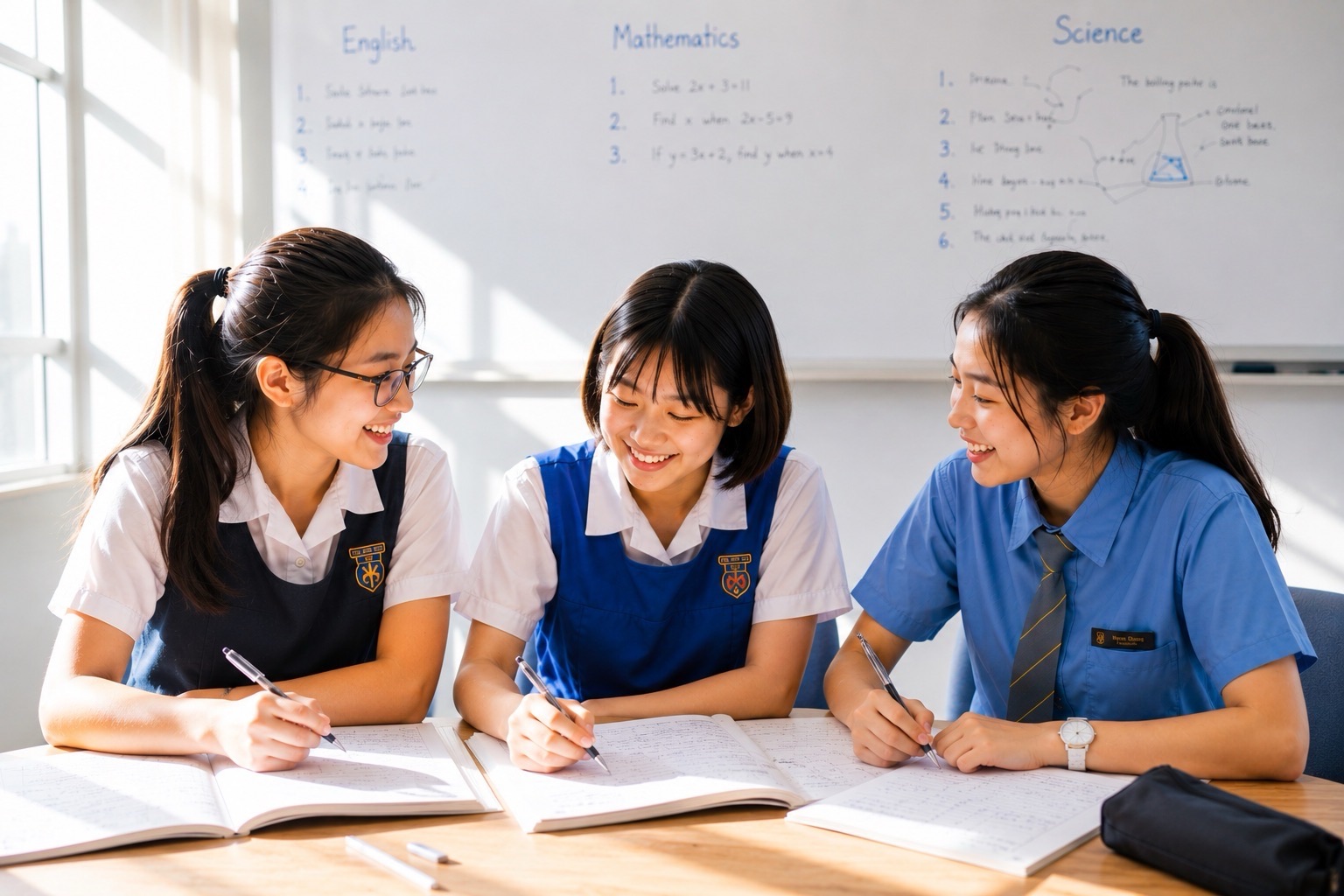
G3 Science tutorials for Geylang students should make scientific reasoning dependable when a question is unfamiliar. At eduKateSG, our three-student small-group approach develops the ability to identify a system, choose a model, calculate accurately and explain the evidence. We look for the student’s own decisions rather than a polished answer produced only after the tutor has supplied the first step.
Parents comparing G3 Science tuition in Geylang, Combined Science revision and Physics, Chemistry or Biology tutors often describe a learner who knows the formulas but still loses marks on application. The difficulty may be choosing the correct relationship, interpreting a condition or explaining what a result means. A useful programme diagnoses those different problems separately and checks whether each correction survives a changed diagram, dataset or question.
This guide serves families from Geylang; it does not announce an eduKateSG branch in the district or a partnership with a local school. Suitable classes and consultations are arranged at 8 Fourth Avenue, Singapore 268674, near Sixth Avenue MRT. The student’s secondary year, exact Science subjects and examination cohort determine the appropriate content and depth.
Ask about G3 Science class suitability or arrange a consultation. All numerical examples and learner stories below are original teaching illustrations, not actual school results, industrial measurements or observations collected in Geylang.
A More Important Transition Than It First Appears
At G3, a familiar scientific relationship can appear in a system the learner has never encountered. The question may supply enough information to reason correctly without expecting prior knowledge of the device. The student needs to distinguish the new setting from the underlying concept, rather than assume that unfamiliar wording means the entire topic is unknown.
A question about an invented machine may still be about energy transfer. A new chemical equation may still require a mole ratio. An unfamiliar organism may still be used to test a stated inheritance model. We teach the pupil to identify what the problem supplies and what established relationship can be applied to it.
The first task is therefore interpretation. Which object is being considered? What quantity is requested? Which conditions are fixed? Does a value represent an initial state, a final state or a change? These questions are not lengthy rituals to perform before every calculation. They are decisions that should become increasingly clear and efficient with practice.
We also teach a student to reject an unsuitable familiar method. Knowing when an equation does not apply is part of understanding it. A strong learner can explain why a changed condition alters the solution instead of trying to force every problem into the format of the last worked example.
The Hidden Science Problem: A True Principle Can Be Used in the Wrong Place
Consider conservation of energy. A pupil may know the principle but ignore an energy transfer out of the chosen system. Another may calculate a kinetic-energy change correctly and call it the total work done by one particular force without considering other forces. The difficulty is not a missing slogan; it is an incomplete model.
In Chemistry, a balanced equation can be interpreted with the wrong pair of coefficients. In Biology, a predicted probability can be reported as a guaranteed count in a small sample. Each answer can contain correct vocabulary while failing at the point where the general idea meets the actual information.
We ask the pupil to identify that connection. Which substance does the ratio compare? Which system does the energy statement concern? Does the probability describe an expected distribution or an exact observed outcome? The next teaching task follows the answer to these questions rather than simply adding harder numbers.
A useful correction retains the learner’s valid reasoning and repairs the first unsupported step. The student then attempts another case without seeing the original solution. This distinguishes a concept that has become usable from an answer that has merely been copied accurately into an error notebook.
Why Consider Three-Student G3 Tutorials?
A suitable group of three allows the tutor to inspect each learner’s first attempt while preserving the benefit of discussion. Students commit to a model or prediction before hearing the others. The class then compares reasons, not only final values. This makes a hidden misconception easier to locate.
Imagine three fictional pupils working on a limiting-reactant problem. Farah uses the correct equation but compares raw mole amounts without considering coefficients. Owen selects the limiting substance correctly but calculates for the wrong product. Lin obtains the correct amount yet cannot explain why the other reagent remains. Their follow-up tasks should differ.
We can use one common reaction while asking Farah to interpret ratios, Owen to label the substances in each step and Lin to account for the unused quantity. An unfamiliar final question checks whether each student now makes the relevant decision independently. The group shares a concept, not an identical diagnosis.
Small class size alone is not a promise of improved marks. The benefit depends on compatible levels, appropriate pacing and teaching that makes individual working visible. A confident learner should be challenged to justify assumptions, while a quieter learner should have enough time to form an answer before discussion supplies it.
G3 Science Under Full Subject-Based Banding
G3 is a subject level, not another name for Secondary 3. MOE’s Full Subject-Based Banding guidance explains the framework. Both the student’s current year and actual Science subjects are needed when selecting appropriate teaching.
The 2027 G3 directory distinguishes Combined Science Physics/Chemistry K326, Physics/Biology K327 and Chemistry/Biology K328 from separate Physics K323, Chemistry K324 and Biology K325. These routes have different content and assessment expectations, so they should not be treated as interchangeable labels.
For example, the 2027 Combined Science Chemistry outcomes include limiting-reactant calculations but do not require percentage-yield or percentage-purity calculations. We use the registered syllabus to decide what is core practice and what, if relevant, belongs to a different course or explicitly identified extension.
For lower-secondary pupils, the immediate school programme remains important. An examination syllabus is a future destination, not evidence that a child should already know every upper-secondary topic. We distinguish current content, missing prerequisites and purposeful pre-teaching before deciding how to use the lesson time.
What We Teach: Seven Decisions Behind a Reliable Answer
Define the system before applying a rule
A force diagram concerns forces on a particular object. An energy account concerns specified stores and transfers. A mass measurement may include the container and contents or only the sample. Students identify the system first, because changing its boundary can change the interpretation of an otherwise correct measurement.
We sometimes ask for a simple box around the chosen system and arrows showing what crosses the boundary. The drawing exposes an omitted transfer or a force acting on a different object. It is a reasoning tool, not a decorative addition after the calculation has already been completed.
Separate a measured quantity from a derived one
Students distinguish readings from calculations and assumptions. Potential difference and current may be measured; resistance may then be calculated. A claim that temperature stayed constant needs support from the stated conditions. Treating all three kinds of information as though they were equally observed can make an explanation appear stronger than it is.
A short exercise provides a table with measured columns and asks the pupil to add a derived column. The next question asks which further observation would test an assumption used in the calculation. This develops a more careful relationship between a numerical result and the physical conditions that make it meaningful.
Read a graph’s quantities before its shape
A steep line has no single scientific meaning independent of its axes. We ask what the vertical and horizontal quantities represent, which interval is relevant and whether the requested result comes from a point, a difference, a gradient or an area. The graph rule follows that interpretation.
The tutor then changes a scale or the quantity on one axis while keeping a similar visual shape. The learner must reconsider the meaning rather than recite a familiar statement about steepness or flat sections. This is especially useful when students perform well on standard graphs but struggle with altered presentation.
Interpret coefficients rather than chase numbers
In quantitative Chemistry, the pupil names the substances being compared and reads the relevant ratio from the balanced equation. A coefficient is not a universal multiplier to apply to every number. We ask the learner to write the ratio in words before using it in a multi-step calculation.
A second task reverses the unknown: instead of calculating product from reactant, it asks for the reactant needed for a stated product. The learner should preserve the same chemical relationship while changing the direction of the calculation. This is a stronger check than several repetitions of one familiar substitution pattern.
Connect biological features to processes
A list of adaptations does not automatically explain how a structure functions. We ask which feature matters for the process described and how it contributes. The pupil builds a short causal chain rather than attach the same paragraph about surface area or energy to every biological diagram.
Another task changes one feature and asks what part of the explanation would need revision. The student must understand the connection well enough to adjust it. The depth of terminology follows the registered Science route and current school learning, rather than the most elaborate description available online.
Distinguish expectation from observation
A model can predict a probability or trend without guaranteeing every small set of observations. We ask learners to distinguish what the model expects from what was actually recorded. An unusual result should invite checking the conditions and method, not automatic alteration of the data to fit a preferred answer.
This habit applies beyond inheritance. A measurement series can vary, a sample may not represent an entire population and a graph may support more than one causal explanation. Students learn to describe the evidence accurately before deciding how strongly it supports the proposed model.
Write enough reasoning, but keep it relevant
A good explanation identifies the required outcome, the relevant condition and the process connecting them. Some questions need several linked steps; others need one precise comparison. We teach students to match the response to the prompt instead of assuming that a longer answer must contain more useful Science.
We compare two answers and ask which sentence provides the mechanism rather than repeating the observation. The pupil then edits their own response. The objective is controlled scientific communication: clear enough to show the reasoning and selective enough not to hide uncertainty behind unrelated facts.
A Geylang Learning Lens: From Architecture to a Testable Model
URA describes the range of architectural styles in Geylang’s conservation area. Its shophouse guide explains features including sheltered five-foot ways. These verified details can introduce questions about materials, light and heat transfer without supplying measurements that were never taken.
For an original paper investigation, we describe identical model panels with a single specified difference in surface finish. The learner identifies what should be measured and what conditions need to remain comparable. A real photograph does not establish a thermal property or an engineering performance claim, so the worksheet supplies its own hypothetical data.
A second problem compares the work done moving two fictional loads. Masses, distances and relevant forces are stated explicitly. The learner cannot infer that the larger-looking load requires a particular force without a defined model. We use the setting to encourage a question, then make the scientific assumptions visible.
NParks describes Geylang Park Connector along Geylang River towards Tanjong Rhu. A hypothetical journey there can be represented as a speed–time graph, but its invented readings say nothing about actual travel conditions or waterway measurements. Students practise moving between the story and the graph without confusing illustration with field evidence.
Finally, the local scene is removed. The panel becomes part of an unfamiliar laboratory model, and the journey becomes motion inside a machine. The same reasoning should still apply where the stated conditions match. Local relevance is valuable when it opens the lesson, not when it becomes a cue the learner cannot work without.
Our First-Principles Teaching Method
Diagnose before demonstrating
The student attempts a carefully selected question before the tutor shows the method. We inspect the first choice that becomes unsupported: the wrong system, the wrong interval, a missing condition or an unsuitable ratio. This avoids teaching a long general explanation when the actual obstacle is a narrow decision that can be repaired directly.
Rebuild a model the learner can explain
We use a diagram, table or simple example to make the relationship visible. Formal notation is introduced or revisited as a precise way to express that relationship. A pupil should be able to explain why a term is present in an equation rather than merely identify which letters appeared on a formula sheet.
Change one condition purposefully
The next example alters a meaningful condition: a reactant becomes limiting, the mass changes, the graph uses another quantity or an experimental control disappears. The learner explains what must be reconsidered. This tests the boundary of the model instead of only the ability to repeat its first numerical application.
Remove prompts and vary the representation
An independent task follows without the original annotations or an opening hint about the topic. We observe the student’s reasoning before intervening. The pupil may be able to use the idea in a table but not a diagram; that difference becomes the next teaching target instead of being hidden by a shared worked answer.
Recheck the idea after time has passed
A later lesson uses another unfamiliar context. The tutor records whether the learner retrieved the relationship and applied its conditions independently. We then decide whether to extend, consolidate or reteach. A correct response immediately after a demonstration is useful, but it cannot be the only measure of readiness.
What a Focused G3 Science Lesson Can Look Like
An illustrative 90-minute lesson can begin with short retrieval, move into a diagnostic contrast and then develop one central relationship. Guided practice is followed by an unseen application, with time left to review the earliest error and plan continuation work. Actual duration and class arrangements are confirmed separately.
In an energy lesson, pupils first identify the relevant stores and quantities. The tutor then contrasts changing speed with changing mass. Students predict the effect on kinetic energy, calculate and explain why the two comparisons behave differently. The numerical result should confirm an understood relationship rather than arrive as a surprise.
Different pupils can receive different follow-ups within that common concept. One may need to repair squaring and units, another may need to distinguish final energy from energy change, and a third may evaluate whether a stated force accounts for all the work. Everyone then attempts a fresh shared problem.
The closing task is chosen to reveal the target clearly. A pupil who confuses energy change with final energy needs a short contrast that tests that distinction. A full paper may be useful later, but it should not replace the precise check that tells us whether the current lesson worked.
Three G3 Learning Pathways
Repair: restore the first missing connection
A learner may struggle with a multi-step calculation because a ratio, conversion or graph convention is uncertain. We repair that specific prerequisite and reconnect it with the current Science. The pupil should see a practical reason for revisiting the earlier skill rather than assume that one error means the whole subject must be restarted.
The first milestone is an independently justified step. Once that step is stable, the tutor adds the next demand. Repair is not a permanent label about ability; it is the present route through a particular problem, and it changes as the learner’s evidence changes.
Stabilisation: make knowledge dependable under variation
A capable student with inconsistent results may need mixed work, clearer answer planning or a better checking routine. We identify whether the main difficulty is interpretation, model selection, numerical execution or communication. Timed practice is used when it can reveal those decisions meaningfully rather than obscure them under pressure.
We compare the target skill across several new questions. A student who can explain why the earlier wrong answer was tempting has gained a useful way to recognise it again. The objective is a correction that travels across different values and representations.
Extension: evaluate the strength of an explanation
A secure learner can consider alternative models, identify missing evidence and evaluate whether a conclusion exceeds the data. We use fully specified unfamiliar contexts so that reasoning is challenged without relying on unannounced specialist knowledge. The difficulty should come from the decision, not from withholding essential information.
Extension remains appropriate to Combined or separate Sciences as actually studied. We do not use irrelevant content to make a worksheet look more advanced. A well-designed evaluation question can deepen understanding of a familiar principle more effectively than rushing into another course’s topic list.
Worked Physics Example: Doubling Speed Does Not Double Kinetic Energy
An original model uses a 12-kilogram object moving in a straight line. At 2 metres per second, its kinetic energy is ½ × 12 × 2² = 24 joules. At 4 metres per second, it is ½ × 12 × 4² = 96 joules. The mass stays unchanged while speed doubles.
The energy becomes four times as large because speed is squared in the relationship. We ask the learner to predict the factor before calculating. This separates a structural understanding of the equation from a sequence of calculator entries. The G3 energy outcomes provide the relevant curriculum context.
The increase in kinetic energy is 72 joules, not 96 joules. If an idealised problem states that a constant resultant force does this net work over 8 metres in the direction of motion, the resultant force is 9 newtons. We explicitly connect work to the change, rather than substitute final energy automatically.
A pupil may instead be asked about the work done by an applied force while friction also acts. The applied force’s work need not equal the net kinetic-energy increase. The question must supply enough information about the other transfer. We teach students to distinguish the system’s net change from the contribution of one force.
The transfer question doubles mass while keeping speed fixed. Kinetic energy now doubles rather than quadruples. The learner should explain why changing a different variable changes the scaling rule. Remembering that doubling means four times would be a dangerous shortcut without naming what doubled.
Worked Wave Example: Read Distance and Time as Different Information
A fictional source makes 15 complete oscillations in three seconds. Its frequency is 5 hertz. A separate spatial diagram gives wavelength as 0.40 metre under the stated conditions. Applying wave speed = frequency × wavelength gives 2.0 metres per second. Each number has a different measurement basis.
A common error treats a horizontal distance on the spatial drawing as a time interval. We ask the learner to identify the axis before reading the value. A snapshot of the wave along a length and a time record at one point are different representations, even if their curves look similar.
The next problem states that wave speed remains 2.0 metres per second while frequency becomes 10 hertz. The wavelength is then 0.20 metre. The pupil should explain that the constant-speed condition is supplied; it is not a universal assumption to make whenever a frequency changes in any possible system.
Finally, the question asks whether amplitude can be found from the frequency and wavelength alone. It cannot from the information given here. Identifying this missing measurement helps prevent the habit of using every available number to answer a question that actually requires different evidence.
Worked Chemistry Example: Let the Coefficients Decide the Limiting Amount
Consider a theoretical reaction supplied in the question: 2NaOH + H₂SO₄ → Na₂SO₄ + 2H₂O. The stated starting amounts are 0.20 mole of sodium hydroxide and 0.15 mole of sulfuric acid. The model assumes the reaction proceeds according to this equation to consume the limiting reagent. This is a paper calculation, not a practical mixing instruction.
The equation requires two moles of sodium hydroxide for each mole of sulfuric acid. Therefore 0.20 mole of sodium hydroxide can react with 0.10 mole of the acid. Sodium hydroxide is limiting, even though its raw mole amount is larger. Comparing raw amounts without the ratio would give the wrong decision.
The amount of sodium sulfate formed is 0.10 mole, and 0.05 mole of sulfuric acid remains in this idealised account. We ask the pupil to name the substances at each step so that a correct ratio is not accidentally applied to the wrong product or leftover reagent.
If the task supplies a sodium sulfate molar mass of 142 grams per mole, the theoretical product mass is 14.2 grams. The calculation follows the limiting-reactant decision; it does not replace it. We ask students to explain why using all 0.15 mole of acid would overstate the product under the stated starting conditions.
The contrast task changes the sodium hydroxide amount so the acid becomes limiting. The pupil must reconsider the comparison rather than reuse the previous label. We keep the example within the relevant Combined Science stoichiometry outcomes and check separate-science requirements independently when that is the student’s course.
Worked Biology Example: An Expected Ratio Is Not a Guaranteed Small Sample
An original plant model states that allele Y produces yellow flowers and is completely dominant over allele y for pale flowers. The cross is Yy × yy. We supply these assumptions explicitly rather than suggest that all real flower colours follow one simple pattern. Students identify the possible gametes before predicting offspring.
The first parent contributes Y or y with equal probability under the model; the second contributes y. Expected offspring genotypes are therefore Yy and yy in a 1:1 ratio. The corresponding expected flower-colour ratio is also 1:1 under the stated dominance relationship.
A small observed group need not contain exactly equal numbers of the two flower colours. The G3 inheritance outcomes explicitly distinguish expected and observed ratios. We ask learners to explain why probability is not a guarantee that every small sample reproduces the theoretical ratio exactly.
The next task changes one parent’s genotype to YY. All offspring are expected to be Yy under the same model. A student who memorised that yellow crossed with pale gives half of each has overlooked genotype. The phenotype description alone may not identify the necessary parental information.
The final question gives only the dominant parent’s appearance and asks for a unique prediction. Without knowing whether that parent is homozygous or heterozygous, the supplied information may not determine one outcome. Recognising that limitation is part of understanding the model rather than a failure to complete the diagram.
Worked Evaluation: What Should Happen to an Unexpected Reading?
A fictional investigation produces four closely grouped times and one much larger value. A pupil proposes deleting the larger reading because it does not fit the expected trend. We ask what evidence identifies a problem with that trial. Disagreement with a prediction alone is not a sufficient reason to alter the record.
The learner can inspect the stated method, consider whether a documented timing mistake occurred and propose an appropriate repeat where the task permits it. The original reading remains part of the record. A justified treatment of an anomalous result is different from silently removing an inconvenient number to make a graph look better.
The tutor then supplies a note that the timing started late for one trial. Now there is specific evidence relevant to interpreting that result. The student explains what the note changes and why. We want evaluation to respond to evidence, not become a routine instruction to discard the largest or smallest value.
A final contrast gives repeated measurements that all share a suspected instrument offset. Taking more readings may describe repeatability but does not automatically remove the offset. The corrective action should address calibration or the relevant measurement method rather than treat repetition as a universal cure.
Preparing Practical and Written Components
The 2027 G3 Combined Science assessment scheme weights multiple choice at 20%, each selected discipline’s structured/free-response paper at 32.5%, and the practical test at 15%. Separate Sciences require checking their own documents rather than assuming the same allocation.
Our teaching implication is to assess different kinds of performance. Recognising the correct option does not automatically show that a causal answer can be written independently. Explaining a procedure on paper also does not automatically establish that apparatus can be handled accurately during a supervised practical task.
Tutorials can support apparatus interpretation, table design, graph processing and evaluation of methods. Hands-on competence still requires suitable equipment and supervision through appropriate school or teaching arrangements. We do not present paper examples involving chemicals, electricity or heating as instructions for unsupervised experiments at home.
How We Reduce Repeated Errors
We distinguish a wrong model from a wrong numerical step. Using final kinetic energy instead of the change needs a conceptual comparison. Correctly finding the change but mistyping a number needs a checking routine. Both may produce the same wrong answer, but the next practice should address the actual cause.
The pupil identifies the first line they would now change and explains why. We keep that note concise: used the raw mole amounts instead of the equation ratio, or treated the expected ratio as an exact sample count. The entry should guide a new attempt rather than merely record that the old one was wrong.
A later unseen task checks the same choice. If the error returns, we reconsider the teaching representation or the amount of support being withdrawn. Repeating a solution is not the same as testing whether the student can now select it without help. The aim is a checking standard the learner owns.
We examine timing errors with similar care. A pupil may lose minutes reading a graph, trying several inappropriate equations or writing irrelevant detail after the answer is already sufficient. A blanket instruction to hurry is unlikely to address all those different patterns. We practise the specific decision that consumes time.
Teaching Ahead and a Useful Revision Rhythm
Pre-teaching can make an upcoming concept less intimidating when the prerequisite understanding is ready. We might introduce a ratio interpretation, graph convention or model assumption before the school chapter begins. The purpose is a calm first encounter, not a claim that every upper-secondary topic has been rushed through ahead of schedule.
A useful revision week contains different types of work. Retrieval asks what can be recalled without notes. Reconstruction asks the learner to rebuild a diagram or explanation. Application changes the context. Evaluation asks whether the evidence supports the claim. A long session of rereading should not be treated as proof that all four are secure.
We return to corrected mistakes after an interval and vary their appearance. Once individual ideas are secure, mixed questions require fresh method selection. Timing is added where it helps measure execution rather than obscure an unresolved concept behind pressure. The learner should understand the purpose of the assignment, not only its page range.
Parents can ask which assumption the answer uses and where the question supplies it. That is often more helpful than trying to teach every calculation themselves. A precise uncertainty gives the tutor a clear next target; an adult-written model answer can hide the very gap that needs attention.
What Progress Should Look Like
We look for a learner who starts unfamiliar work with a clearer system, preserves units, selects the appropriate ratio and keeps conclusions within the evidence. A student who notices an omitted condition before the tutor points it out is showing useful independence, even before another major school assessment arrives.
Scores need context. Familiarity, task difficulty and substantial prompting can all change a result without showing independent transfer. We compare targeted decisions across unseen questions and later checks, and use school feedback to keep the lesson sequence relevant to the actual course.
Additional tuition is not automatically necessary for every pupil. Where support is useful, the plan should explain what is being repaired or extended and how that change will be checked. A responsible tutor cannot guarantee a fixed examination grade from a particular number of lessons.
Access From Geylang and Class Details
The stated eduKateSG teaching location is 8 Fourth Avenue, Singapore 268674, near Sixth Avenue MRT. This article serves Geylang families but does not announce an additional neighbourhood classroom. Consultations are by appointment, and actual group availability should be confirmed before travelling.
Geylang includes different home and school starting points, so compare the family’s actual journey. LTA’s rail-network and journey-planning information helps with route selection. Include walking stages and the return journey rather than assume one commuting time applies to every student in the district.
The intended format is a suitably matched group of three with individual working, focused explanations and independent checks. Confirm duration, timetable, materials and assessment-period arrangements during the enquiry. Combined Science and separate-science pupils may require different depth and preparation, so compatibility should be considered before convenience alone.
What Parents Can Bring to the Consultation
Bring the student’s current year, exact Science subjects, examination cohort and representative marked work. One successful response is useful beside a difficult one, especially when the questions use related concepts. The contrast may reveal how wording, representation or time pressure changed the outcome.
We ask the learner where they became uncertain and what they tried next. A broad concern such as weak in Chemistry can often be narrowed to formula interpretation, limiting quantities or linking observations with a model. The consultation should produce a specific first teaching target and a meaningful independent check, not merely a recommendation for more papers.
Frequently Asked Questions
Is G3 the same as Secondary 3?
No. G3 is a subject level. The learner’s secondary year and exact Science subjects are separate information, both needed when deciding which content and assessment tasks are appropriate.
Are Combined and separate Sciences interchangeable?
No. Their content depth, syllabus boundaries and assessment arrangements differ. Shared reasoning skills can be practised in related contexts, but the actual programme must match the subjects and examination year the student is following.
Why does knowing the formula sometimes fail?
The pupil may select the wrong system, quantity or condition before substituting correctly. We inspect the initial decision and the meaning of each value. The repair may concern interpretation rather than memorising another equation.
Should every lesson contain a full timed paper?
Not automatically. Full papers help with integrated preparation, but a short diagnostic or targeted correction may be more useful when one concept remains unstable. Timing should reveal execution needs rather than replace teaching.
Can practical work be replaced by worksheets?
No. Paper tasks support planning, apparatus interpretation and evaluation, while hands-on skills require appropriate supervised experience. The registered syllabus and school arrangements remain important references for practical preparation.
Are the tutorials held in Geylang?
This is a guide for Geylang families. The stated teaching and consultation location is 8 Fourth Avenue near Sixth Avenue MRT. Confirm actual arrangements and class suitability directly rather than treating the locality title as a branch address.
Can an examination grade be guaranteed?
No. We track observable improvements in understanding, independent selection and execution. The student’s starting knowledge, course demands and practice matter, so a fixed outcome should not be promised from a small number of lessons.
Helpful Reading for Geylang Families
Use G1 Science Tutorials | Geylang, G2 Science Tutorials | Geylang and SEC Science Tutorials | Geylang to distinguish subject-level teaching from examination planning across routes.
For local learning context, read Tutors | Geylang and Education and Tuition | Geylang. The Singapore Science Tuition by Area Index connects the broader subject library. Nearby reading includes G3 Science Tutorials | Geylang Bahru, a separate locality guide.
Arrange a Parent–Student Consultation
The aim is a learner who can explain why a method works and recognise when another question needs a different model. Scientific confidence becomes more dependable when quantities, conditions and evidence remain connected. We build that control through precise teaching and honest checks of new work.
Discuss G3 Science support for a Geylang student, with the current year, exact subjects and one representative question. Consultations at eduKateSG’s Fourth Avenue location are arranged by appointment.
Continue reading: explore the Science Learning Hub for related guides and reading routes.