
EDUKATE SINGAPORE · GOLD STANDARD PRACTICAL CASE STUDY 225
From pH 7 to pH 6 is a tenfold activity change—not a fourteen-percent acidity reading
A fictional school sees its aquarium pH move from 7.0 to 6.0 and misreports the change as only fourteen percent. The pH scale is logarithmic: the corresponding hydrogen-ion activity increases by a factor of ten under the pH definition. Measuring and managing real water conditions still requires separate care.
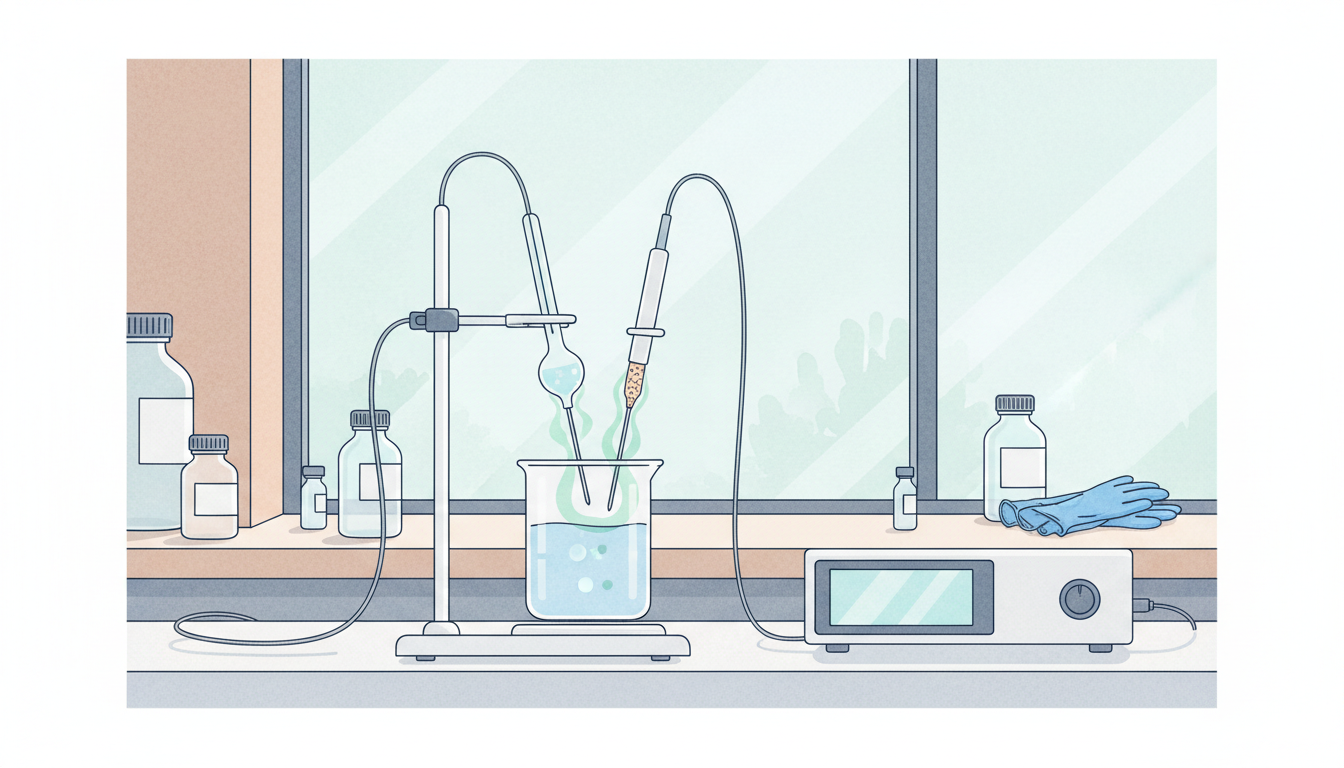
The readings are hypothetical, not animal-care instructions. The laboratory illustration is conceptual rather than documentary evidence of this aquarium.
The logarithmic calculation
- First illustrative reading: pH 7.0 corresponds to activity proportional to 10^-7.
- Second illustrative reading: pH 6.0 corresponds to activity proportional to 10^-6.
- Ratio of second to first: 10^-6 ÷ 10^-7 = 10.
- A fourteen-percent change in the displayed numeral is not the change in hydrogen-ion activity.
- A tenfold activity ratio does not specify buffering capacity, total titratable acidity or chemical treatment.
Chapter navigation
- 1. A one-point movement on the meter is not a one-percent movement in chemistry
- 2. The mathematical definition carries the meaning
- 3. Calculate the ratio correctly for pH 7 and pH 6
- 4. One more pH unit adds another factor of ten, not another fixed amount
- 5. Hydrogen-ion activity is not the same as the amount of acid needed to change pH
- 6. Temperature, dissolved gases and biological activity can affect the reading
- 7. Check the meter before making a dramatic announcement
- 8. A pH value alone is not an animal-welfare diagnosis
- 9. How to explain the difference to a parent or a younger learner
- 10. A safer school bulletin states the evidence and its limits
- 11. Worked exercise and answer check
- 12. The final management decision follows the quantity, not the label
1. A one-point movement on the meter is not a one-percent movement in chemistry
A fictional school science club measures the pH of a supervised teaching aquarium. Its digital meter first reads 7.0 and later reads 6.0. A student calculates that the pH number fell by one out of seven, or about fourteen percent, and tells the class that the water has become ‘only fourteen percent more acidic’. The arithmetic on the displayed numerals is understandable, but it does not express the chemical change correctly.
The pH scale is logarithmic. A difference of one pH unit corresponds, ideally, to a tenfold ratio in hydrogen-ion activity. The number on the screen is not a linear count of acidity. Interpreting it as if it were a measurement of centimetres or litres discards the defining mathematical relationship.
The club should not respond by immediately adding chemicals to its aquarium. First it must check the measurement, the conditions and what the observation actually means. Changes in pH can have different effects depending on water chemistry and the organisms concerned, and this fictional example does not establish harm.
The aquarium, measurement history and discussion are invented for classroom reasoning. The scientific principles follow public USGS, EPA and NOAA guidance, not a diagnosis of a real living system.
2. The mathematical definition carries the meaning
In a rigorous chemical description, pH is related to the negative base-ten logarithm of hydrogen-ion activity in water. In an introductory dilute-solution approximation, it is often introduced as pH ≈ −log10[H+], with concentration expressed relative to a standard reference. This approximation is useful when its assumptions are understood; activity and concentration are not identical in every solution.
At pH 7 the illustrative hydrogen-ion activity is about 10^-7 relative to its conventional reference, while at pH 6 it is about 10^-6. Their ratio is 10^-6 divided by 10^-7, which is 10. A pH decrease of one therefore corresponds to roughly ten times the hydrogen-ion activity.
The US Environmental Protection Agency’s pH explanation describes the base-ten logarithmic relationship and explicitly identifies a tenfold change for a one-unit difference. The US Geological Survey’s pH and water resource explains how pH describes the relative chemical condition of water.
The Gold Standard uses the relationship that defines a quantity, not merely the visual spacing of digits on its display. A one-unit change can be physically important even when the digits look close together.
3. Calculate the ratio correctly for pH 7 and pH 6
Start with the classroom approximation a(H+) proportional to 10^-pH. For the first sample, at pH 7, write 10^-7. For the second, at pH 6, write 10^-6. The ratio of second to first is 10^(-6−(-7)) = 10^1 = 10. The hydrogen-ion activity is tenfold higher in the second sample under the definition.
Expressed as a relative increase in that activity, a tenfold level means the final value is 1000% of the initial value, or a 900% increase over the initial level. Those figures refer to the specific activity comparison. They are not the same as a percent change in the displayed pH numerals, and should not casually be labelled a percent increase in the total acid content of the water.
The mistaken fourteen-percent result comes from treating seven as the starting physical quantity and six as the ending physical quantity. It is only the percentage change in the pH numeral, a transformation of activity. That percentage has no simple interpretation as the percentage of acid molecules gained.
A scientific explanation should state ‘a one-unit pH decrease corresponds to ten times the hydrogen-ion activity’ rather than compress the result into an ambiguous phrase such as ‘ten times more acid’.
4. One more pH unit adds another factor of ten, not another fixed amount
Consider fictional samples at pH 7, 6 and 5. Their hydrogen-ion activities follow relative values of about 1, 10 and 100 when the pH 7 sample is used as a reference. The move from 7 to 6 multiplies activity by ten. The move from 6 to 5 multiplies it by another ten. Across two pH units, the factor is one hundred.
This is what a logarithmic scale accomplishes: it allows enormous proportional changes in a physical quantity to be represented by a manageable range of numbers. A graph of pH values is not a direct linear plot of hydrogen-ion activity. Equal spacing of pH ticks means equal multiplicative factors in activity.
The NOAA primer on pH makes this multiplicative relationship clear in environmental-water contexts. The exact range and conventions of practical pH measurements should not be confused with the misconception that every sample is safely limited to values from zero to fourteen.
Students can transfer the mathematical habit to other logarithmic measurements, while remembering that each scale has its own physical definition. Recognising a logarithm does not by itself settle the consequences of a chemical change.
5. Hydrogen-ion activity is not the same as the amount of acid needed to change pH
A subtle mistake follows when a student concludes that because hydrogen-ion activity is ten times higher, the tank necessarily contains ten times the total acid or needs a specific fraction of chemicals to correct it. Water has buffering systems. Bicarbonate, carbon dioxide, dissolved minerals and other chemical species can react and affect how pH responds to added acid or base.
Two samples can have the same pH but quite different buffering capacities, meaning they resist future pH changes differently. Similarly, a small volume of concentrated acid and a much larger quantity of a weakly acidic, buffered solution do not behave identically just because their initial meter readings look alike.
The school’s observations do not provide a titration curve, alkalinity, carbonate chemistry or the full composition of the aquarium water. Consequently no safe dosing calculation follows from the two pH readings. The Gold Standard does not invent an intervention from an incomplete diagnosis.
The distinction matters educationally: pH addresses hydrogen-ion activity under the measurement convention. Total acid content, alkalinity and buffering capacity are related but different properties, each requiring appropriate additional evidence.
6. Temperature, dissolved gases and biological activity can affect the reading
Water chemistry changes through several processes. Photosynthesis can remove dissolved carbon dioxide in illuminated conditions, while respiration and other processes can contribute carbon dioxide. In a carbonate-containing system these changes can influence pH over a daily cycle. Temperature affects equilibria and the electrochemical response of instruments as well.
A school comparing a morning reading to an afternoon reading should not assume that all other conditions remained fixed. It needs recording time, sample location, temperature, instrument status and relevant operating conditions. A difference might reflect a genuine temporal pattern, an instrument problem or more than one influence.
The USGS water-quality discussion explains why pH is a useful indicator but must be interpreted in context. A meter provides an observation, not a complete diagnosis of ecological causes.
The fictional class can explore these dependencies on paper and with approved school-laboratory samples. Students should not deliberately stress living animals or use improvised chemical additions to generate a dramatic pH change.
7. Check the meter before making a dramatic announcement
A reported change from 7.0 to 6.0 is large enough to deserve attention, but it should first be verified. Appropriate steps may include inspection of the probe’s condition, checking calibration against suitable reference buffers, ensuring correct sample handling and recording temperature and timestamps. The exact procedure depends on the instrument and laboratory guidance.
Old or contaminated reference buffers, a damaged glass electrode, poor storage or insufficient stabilisation can affect readings. It would be misleading to attribute every discrepancy to real water chemistry without inspecting the measurement chain. Conversely, a plausible calibration does not prove every later reading is automatically correct.
The school should preserve both original readings, avoid overwriting one with a guessed correction and document any repeat measurement as a separate observation. A teacher or competent laboratory supervisor can select a safe verification method that fits the instrument and local instructions.
The Gold Standard distinguishes the instrument display, the measured chemical quantity and the inference that a particular event occurred. Each link requires its own evidence.
8. A pH value alone is not an animal-welfare diagnosis
Different aquatic species and habitats have different requirements and tolerances. A measured pH of 6.0 cannot be interpreted universally as safe, harmful or ideal without considering the actual organisms, conditions, longer-term history and professional husbandry guidance. Rapid changes may matter differently from stable conditions.
The fictional school does not know, from the two pH figures alone, whether its organisms are stressed, what caused the change or whether immediate adjustment would be appropriate. Giving children a numerical dosing rule from those limited facts could create more risk, not less.
A responsible school would keep animal care under the supervision of appropriately trained adults and follow its established welfare procedures. The article’s worked maths belongs in the lesson; real aquarium intervention requires local expert assessment and suitable monitoring.
The Gold Standard keeps a chemical observation in its correct scope. A tenfold activity ratio is a defensible mathematical interpretation, not a substitute for holistic care.
9. How to explain the difference to a parent or a younger learner
A simple explanation uses a staircase where every step is a multiplication by ten. If the indicator moves from pH 7 down to pH 6, the relevant hydrogen-ion activity moves one factor-of-ten step upward. If it moves from 7 to 5, it moves two steps, a factor of one hundred. This avoids the false idea that the display is a standard linear ruler.
An older learner can calculate with powers of ten directly. A younger learner can arrange cards marked 1, 10 and 100 beneath pH cards marked 7, 6 and 5. The labels should say ‘relative hydrogen-ion activity’, not ‘litres of acid’, so the representation remains chemically honest.
The activity may also ask why a one-point change is not a one-percent change. Pupils should recognise that a numeric scale’s meaning comes from how it was defined, not from arithmetic applied blindly to its printed numerals.
Such habits help across science education: first identify the quantity and unit, then apply the correct transformation, then decide what the measurement can support.
10. A safer school bulletin states the evidence and its limits
The fictional club’s corrected note could read: ‘Our recorded pH readings changed from 7.0 to 6.0. A one-unit decline corresponds to a tenfold increase in hydrogen-ion activity under the pH definition. We are verifying the readings and investigating the water chemistry before drawing conclusions about causes or aquarium welfare.’
This retains the genuine observation, identifies the logarithmic relationship and explains why no treatment is being inferred from one pair of readings. It neither minimises the shift as merely fourteen percent nor announces that a tenfold increase in activity means ten times as much acid was poured into the tank.
Where an earlier school worksheet contains the misleading claim, the teacher can issue a dated correction and amend the exercise while preserving the original example as a learning opportunity. The aim is to teach sound interpretation rather than publicly blame the pupil.
Clear scientific writing is useful because it tells the reader what is measured, what is calculated and what remains unknown.
11. Worked exercise and answer check
Give three hypothetical, properly measured samples with pH 7.0, 6.0 and 5.5. Ask students to calculate activity ratios relative to the first sample. They should obtain 1, 10 and approximately 31.6, since 10^(7−5.5) = 10^1.5. The last result shows that logarithmic reasoning works for fractional pH differences too.
Now ask whether sample 5.5 contains 31.6 times more total acid, whether it is 31.6 times more dangerous and how much base should be added to change it. The correct answer is that none of those conclusions follows from activity alone. Additional chemical, biological and procedural evidence would be necessary.
A final question asks learners to distinguish a pH of 6 reported with limited instrument precision from a value measured under a documented calibration. Even valid mathematics cannot rescue poor source measurements.
This exercise is for theoretical or appropriately supervised chemistry education. It does not authorise a student experiment that places aquarium organisms at risk.
12. The final management decision follows the quantity, not the label
The school can report the original 7.0 and 6.0 observations, verify the measurement method and teach the tenfold ratio in hydrogen-ion activity. It cannot equate a fourteen-percent change in the displayed numeral with the chemical change, and it cannot infer a universal animal-health impact.
An appropriate next step is to assess the actual sampling and instrument evidence, consult a trained supervisor and maintain the aquarium under established care practices. Future reporting should always distinguish pH from buffering capacity, the composition of water and the meaning of any chemical intervention.
The lesson transfers to any logarithmic quantity: the difference between display values and underlying physical ratios is not decoration. It is part of the scientific definition that makes the measurement useful.
The Gold Standard conclusion is that one pH point corresponds to a multiplicative tenfold change in hydrogen-ion activity, not a simple linear percentage of acidity.
Practical observation checklist
- Preserve the actual pH readings, sample times and temperature.
- Check calibration and sampling before treating a change as established.
- Use logarithmic ratios rather than percentages of display numerals.
- Do not confuse hydrogen-ion activity with buffering capacity or total added acid.
- Do not infer animal-welfare interventions from two isolated readings.
- Explain what is measured, calculated and still unknown.
Frequently asked questions
Why isn’t pH 6 only fourteen percent more acidic than pH 7?
Because pH is logarithmic. A one-unit fall corresponds to a tenfold rise in hydrogen-ion activity, not a linear proportional change in the displayed number.
Does tenfold activity mean ten times more total acid was added?
No. Hydrogen-ion activity is different from total acid content, buffering capacity or the amount of reagent needed to change pH.
Is pH 6 automatically dangerous for every aquarium?
No. Welfare depends on the actual organisms, conditions and history, and requires competent husbandry judgement.
Could the reading be wrong?
Yes. Instrument calibration, temperature, probe condition and sampling can affect observations. Verify before inferring a cause.
What does a one-and-a-half-unit pH difference imply?
A factor of about 31.6 in hydrogen-ion activity, based on the ratio 10^1.5.
Scientific references and connected cases
- US EPA · Understanding pH
- USGS · pH and Water
- NOAA · A Primer on pH
- The Gold Standard of Chemistry
- The Gold Standard of Scientific Instrumentation
- Gold Standard Case 214 · Printed map scale and measurement
- Gold Standard · Core Requirements and Evidence
- Gold Standard · Casebook and Decision Practice
EPA, USGS and NOAA resources explain the logarithmic pH relationship. All numerical readings and the aquarium are fictional. The Gold Standard is an educational approach to scientific interpretation, not water-quality certification or a treatment protocol.