

Singapore in 1853 can be followed through the connections that kept a port working: mail schedules, navigation lights, visiting ships, rice supplies and the circulation of commercial information. Those connections produced opportunities, but they also exposed delays, unequal returns and dependence on goods arriving from elsewhere.
The year’s local record adds school inspections, demands for judicial capacity, a surveyor’s departure and a Chinese merchants’ response to a damaging rumour. Original accounts allow us to see how people tried to make services and public information more reliable, while keeping their proposals and predictions distinct from completed results.
Choose your reading route
- Ships and communication: follow the mail, lighthouse proposals and the visiting expedition.
- Public institutions: begin with the school inspection and Thomson’s departure, then compare judicial requests.
- Rumour and evidence: read official notices beside the Chinese merchants’ address.
- Food, trade and money: compare rice supplies, different commercial returns and the annual accounts.
- A short lesson: use the timeline, worked source examples and learner routes.
Contents
A. Mails, lights and a visiting expedition
- Twice-monthly mail changes the rhythm of the port
- Lighthouses: permission, design and who should pay
- 25–29 March: Perry’s ship needs a coal arrangement
- Official visits and Whampoa’s hospitality
B. Schools, engineering and public information
- A school visit raises questions of access and location
- August: Thomson’s departure brings engineering into public view
- A damaging rumour tests the government’s public notice
- Chinese merchants answer with reasoning and a route to redress
C. Food, commerce, finance and security
Twice-monthly mail changes the rhythm of the port
From the beginning of 1853, the P&O mail service changed from a monthly to a twice-monthly arrangement. Buckley records departures from London on the eighth and twenty-fourth of each month, but the two routes did not take equal amounts of time. One continued from Galle directly towards Penang, Singapore and China. The other went through Calcutta before returning towards the Straits. Frequency at the point of departure therefore did not guarantee evenly spaced arrivals in Singapore.
The contract times were thirty-eight days for one service and forty-seven for the other. Buckley explains that the Calcutta detour caused the mails to arrive close together. For readers waiting on distant news, two departures could still produce a cluster of information followed by a longer gap. The arrangement is a reminder that a communications network must be understood through its routes and connections, not simply by counting how often a vessel leaves its first port.
Homeward mails departed Singapore on the seventeenth and twenty-eighth, one through Bombay and the other through Calcutta. The stated contract time to Marseilles was forty-four days, with the steamers continuing to Southampton. These were scheduled or contractual timings rather than a measurement of every completed passage. Delays, transfers and route choices remained part of the experience of communicating between Singapore and Europe.
Passenger travel was also shaped by the cost of running steamships. Buckley records a Singapore-to-Southampton fare of 528 dollars, subsequently raised to six hundred. The advertisement attributed the increase to coal and other costs. The figures concern the fare described in that record; they do not establish what every passenger paid or convert directly into a modern ticket price. They show fuel expenditure entering the relationship between a shipping company and its customers.
P&O also opened a Singapore office, with Henry Thomas Marshall as its first agent and John Say Sparkes as a clerk. The year’s account further records coloured flags distinguishing the closing of mails for different destinations: Calcutta, Australia, Europe and China. Ships, an office and visible signals formed connected parts of the service. The practical question for someone with a letter was both where it would travel and when it had to be handed in.
Sources: Buckley (1902), volume II, p. 568; Buckley (1902), volume II, p. 577.


Lighthouses: permission, design and who should pay
In March, the Governor-General authorised additional navigation works in the Straits. Buckley lists a screw-pile lighthouse on the Two and a Half Fathom Bank to replace the floating light, a masonry lighthouse on Coney Island and fixed beacons on the Blenheim, Pyramid and Bambek shoals. The screw-pile proposal carried a stated ceiling of 35,000 rupees. Authorisation and estimated cost identify a stage in a project; they do not by themselves establish that the new lights were already operating. The historical Coney here refers to Pulau Satumu, the site of Raffles Lighthouse, a different island from today’s Coney Island or Pulau Serangoon near Punggol.
The different structures answered different physical settings. A floating light, piles driven into a bank, a masonry tower and a fixed beacon were not interchangeable descriptions. The record shows planners considering a network of aids at particular hazards. It also makes the proposed replacement important: the screw-pile scheme was intended to change how an existing point of danger was marked, rather than introduce navigation assistance to an entirely unmarked region.
Paying for lights produced its own debate. A draft Act published in February proposed revising the earlier system of tolls associated with Horsburgh Lighthouse. The annual review reproduced by Buckley says that the draft modified the manner of collection and exempted native craft. Merchants nevertheless considered the proposed rates too high, particularly for vessels described as Straits traders. They represented a class whose repeated regional journeys could be affected differently from a longer-distance call.
Memorials asked the Governor-General in Council for changes. According to the review, the response promised to charge Straits traders half the rate applying to other liable vessels. It also pledged a later reduction if experience showed that total receipts exceeded legitimate expenditure on lighting the Straits. This was an argument over the relation between a charge and the service it financed, rather than a simple opposition to all navigational works.
The commercial response accepted the promise together with the decision to proceed with additional lights. Safer movement and the price of supporting it were being negotiated together. The annual record allows us to recover the parties’ expectations and the concession described without inventing final construction dates or revenue totals. Its central development is the attempt to turn known hazards, engineering designs and shipping charges into a workable public arrangement.
Sources: Buckley (1902), volume II, p. 569; Buckley (1902), volume II, p. 571; Buckley (1902), volume II, p. 580; Tan and Low (2022), Pulau Satumu history and etymology, pp. 2–6.


25–29 March: Perry’s ship needs a coal arrangement
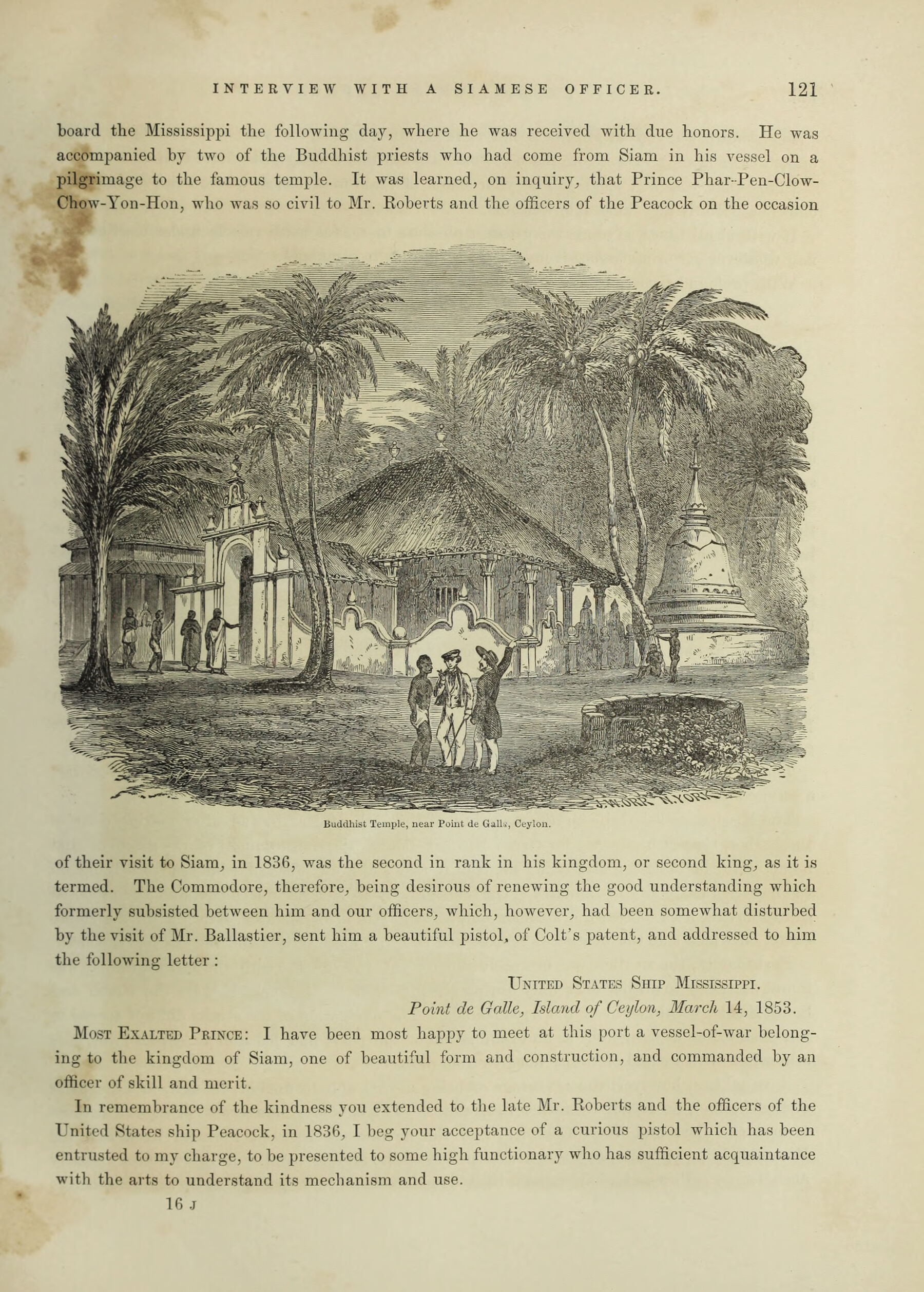
The American steamship Mississippi, carrying Commodore Matthew Perry, anchored at Singapore on 25 March 1853. The expedition’s official narrative, published in 1856 from the notes and journals of Perry and his officers, dates its departure to 29 March. This was one ship’s call within the outward voyage, not evidence that the entire eventual Japan squadron assembled in Singapore during those four days.
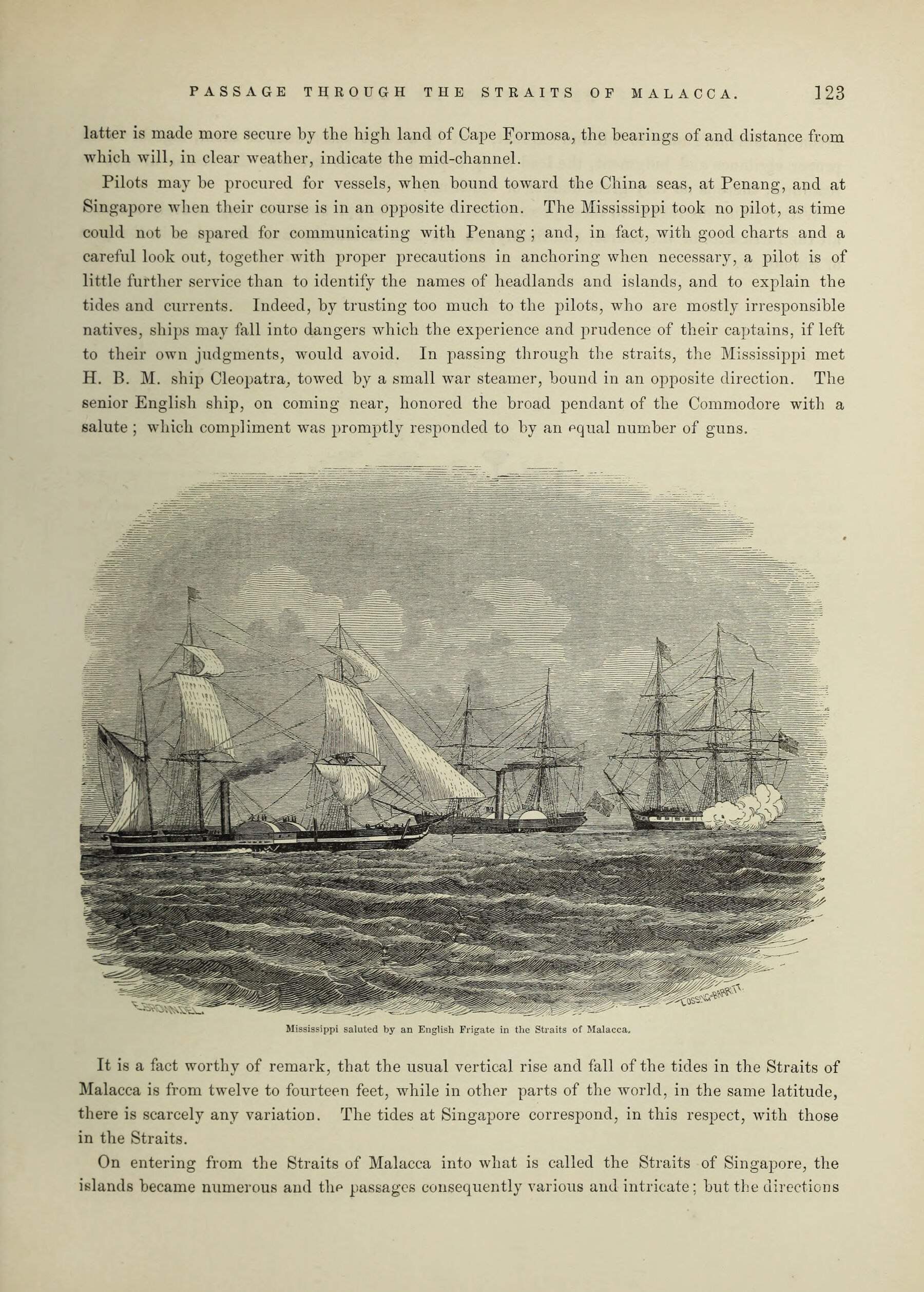
The approach already revealed the importance of navigational information. The narrative describes using charts and sailing directions, taking soundings with the lead and keeping ready to anchor. It says the vessel had not taken a pilot because time could not be spared to communicate with Penang. Its dismissive generalisations about local pilots need not be accepted to recover the concrete procedure the Americans chose for their passage.
Singapore offered the infrastructure the ship needed. The visitors described storehouses along the waterfront and a steam-navigation depot at New Harbour with wharves, coal sheds, stores and workshops. Water was obtainable from tanks under the Master Attendant’s supervision. These descriptions concern facilities present at the visit; they do not date their establishment to 1853. They show a port where maritime movement depended on organised work ashore.
Coal proved more difficult. According to the narrative, none was available for the Americans to purchase, even though a company had stocks in the port. A direct arrangement with the Labuan Company also failed because its production was already committed under a contract. Available physical material and fuel available for sale were therefore different things. Contracts could determine access as decisively as the presence of a coal shed.
A steam-navigation company’s Singapore agent resolved the difficulty by lending 230 tons, on condition that the same quantity be returned at Hong Kong. The company’s supplies there were running short, and carrying coal to that depot was itself a problem. The arrangement let the Americans continue while creating an obligation at another port. It was neither a gift nor evidence that Singapore contained no coal.
After taking aboard the fuel required, Mississippi sailed on 29 March, passing the lighthouse on Pedra Branca towards the China coast. The short call makes a larger point through an unusually specific transaction. Steam power connected distant ports, but it also tied a ship to stocks, agents, contracts and agreements about replenishment. Singapore’s usefulness lay in the ability to arrange those connections as well as in its position on the map.
Sources: Hawks, Narrative of Perry’s expedition (1856), volume I, p. 121; Hawks, Narrative of Perry’s expedition (1856), volume I, p. 123; Hawks, Narrative of Perry’s expedition (1856), volume I, p. 124; Hawks, Narrative of Perry’s expedition (1856), volume I, p. 126; Hawks, Narrative of Perry’s expedition (1856), volume I, p. 129; Hawks, Narrative of Perry’s expedition (1856), volume I, p. 132.
Official visits and Whampoa’s hospitality
The expedition’s short stay combined practical business with formal and personal visits. Its narrative says Perry exchanged calls and salutes with the acting governor and the military commander and dealt with official business at the United States consulate. It does not name those officials in the relevant passage or explain the consular business. The record nevertheless establishes the different channels through which a visiting naval commander encountered the colonial port.
The account admits that the limited time left little opportunity to meet European society. It gives fuller attention to the Chinese merchant whom it calls Whampoa. Officers were entertained at his home, and Perry dined there and stayed overnight. The exact night is not specified, so it belongs within the documented visit rather than on an invented date.
The visitors described a country residence with furnishings, pleasure grounds, plantations and collections of animals and birds. They also noticed a white Arabian riding horse. Their praise of the residence’s beauty reflects the impression of guests. The concrete details show how a merchant’s domestic surroundings could become a place of international encounter, where a naval expedition’s members were hosted beyond the offices and salutes of formal government.
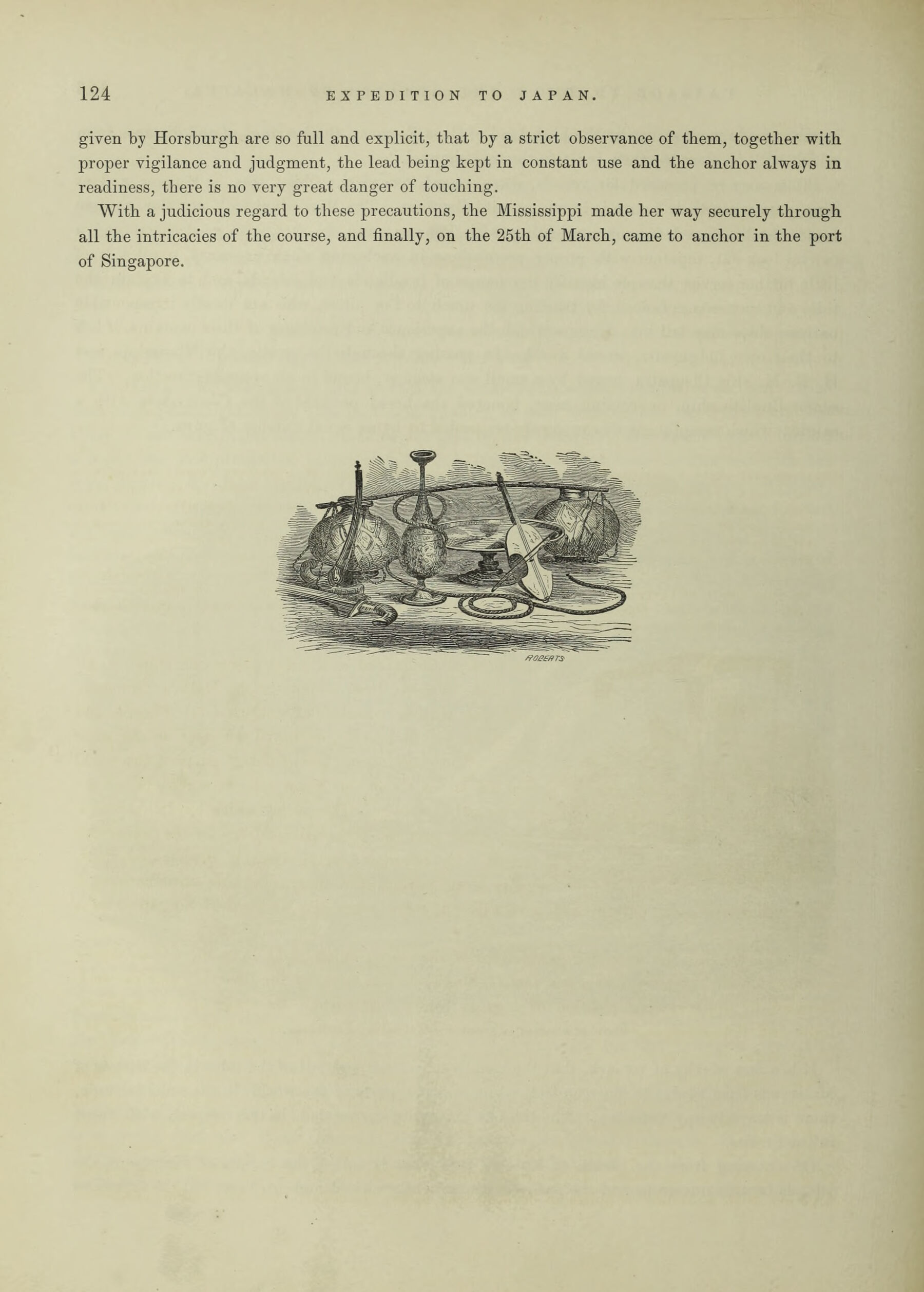
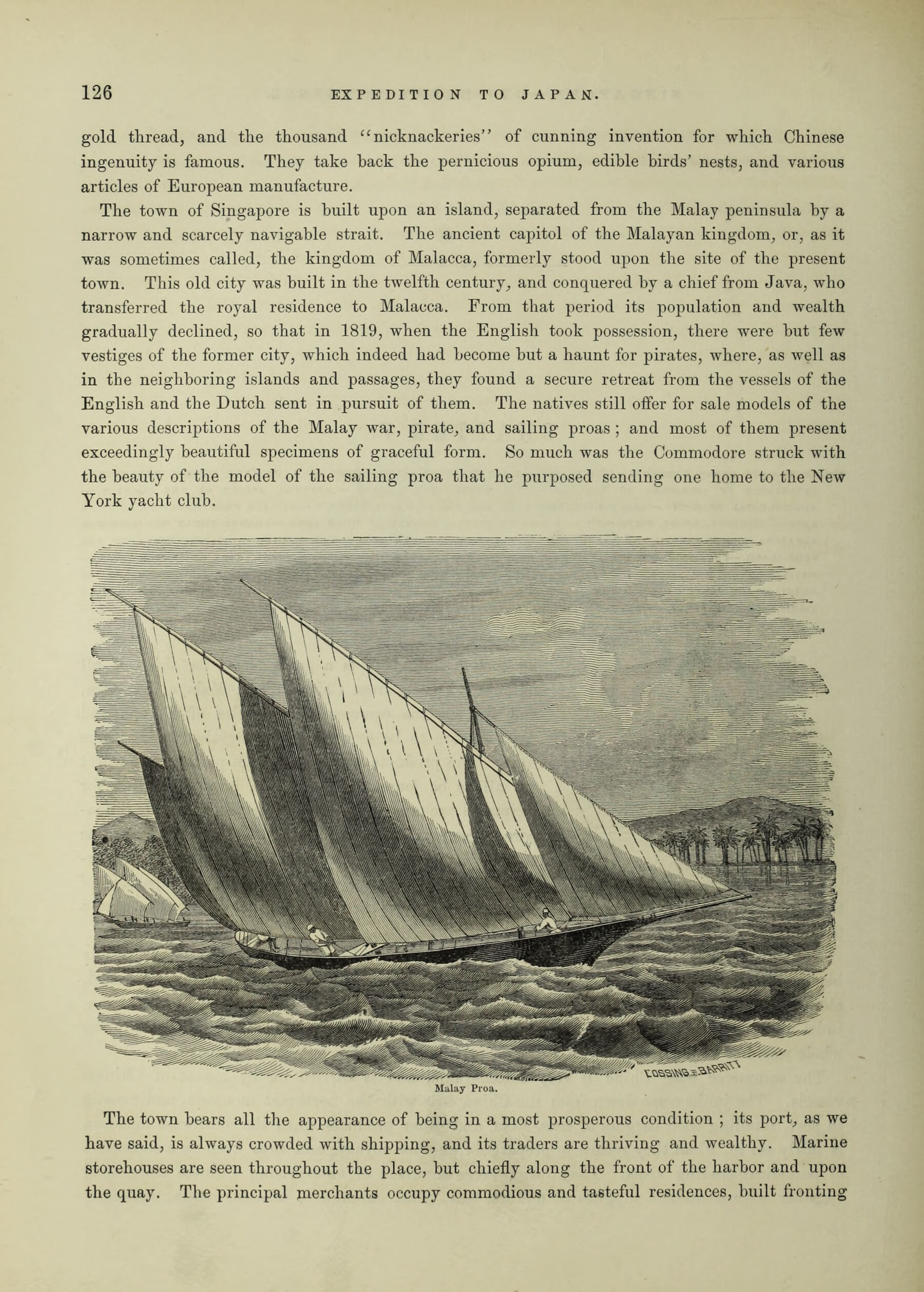
Other observations followed objects moving through the town. Models of Malay sailing vessels were offered for sale, and Perry intended to send one to the New York Yacht Club. The narrative records the intention, not confirmation that it reached that destination. Shells traded through Singapore also attracted the visitors, who acquired specimens. Ships, models and natural objects could carry knowledge and curiosity along the same routes as official dispatches and commercial goods.
These details give a social and material dimension to the coal transaction. The same visit that required negotiations over a fuel stock also involved hospitality, collecting and representations of regional craft. The narrative’s broader claims about population, religion and racial character are not needed to explain those encounters. Its specific actions are sufficient: people called on one another, offered accommodation, obtained supplies and considered what objects to carry onwards.
Sources: Hawks, Narrative of Perry’s expedition (1856), volume I, p. 126; Hawks, Narrative of Perry’s expedition (1856), volume I, p. 128; Hawks, Narrative of Perry’s expedition (1856), volume I, p. 129; Hawks, Narrative of Perry’s expedition (1856), volume I, p. 131.
A school visit raises questions of access and location
The grand jury’s August presentment included an inspection of the Institution. The jurors described its building as apparently in good repair but found that the grounds needed better drainage. They also examined the boys and considered, within the time available, whether the teaching system suited the pupils. Their report did not condemn the teaching. Instead, it connected falling attendance with other schools opening and the distance between the Institution and more densely populated parts of town.
That distinction changed the proposed remedy. If instruction itself had been the principal problem, changing teachers or lessons might have appeared the obvious answer. The jurors instead suggested leasing out the existing land and buildings and constructing a school in a more central location. They identified the green in front of the Police Office as a suitable place. This was a proposal in a presentment, not evidence that a move occurred in 1853.
The suggestion treated property as a resource that could support an educational purpose in another place. It also recognised that a building’s condition and its usefulness were different questions. A school could be structurally sound and still be inconvenient for the population it hoped to reach. The inspection therefore brought access, maintenance and finance into the same discussion.
The jurors framed education through a colonial belief that it would promote what they called civilisation and reduce crime. That judgement reflects their perspective and should not imply that Singapore’s communities lacked forms of learning outside the institution they inspected. Their own mention of other schools indicates a changing educational landscape. The report concerns their assessment of provision, not an exhaustive record of every educational practice on the island.
This episode gives the annual history an institutional process as well as a proposed building change. Visitors examined premises, looked at pupils’ work, offered an explanation for attendance and recommended action. Each step can be read separately. The source permits a precise account of what the jurors observed and argued, while leaving enrolment records, the views of families and the eventual response to be established from other evidence.
Sources: Buckley (1902), volume II, p. 570.

August: Thomson’s departure brings engineering into public view
Government Surveyor John Turnbull Thomson left Singapore on sick leave in August. A meeting of European residents at the News Room considered how to recognise his public service. The Free Press report reproduced by Buckley praised the work he had undertaken during his years in the settlement, particularly the design and construction of Horsburgh Lighthouse. The event in 1853 was his departure and the testimonial; the projects named in the tribute belonged to a longer career.
The newspaper’s list crossed several kinds of work. It credited Thomson with hospitals, a spire for St Andrew’s Church, the Ellenborough Buildings, bridges and substantial roads. Some tasks involved new construction, while others repaired, lowered or renewed existing bridges. Engineering service appeared as a mixture of design, supervision, improvement and maintenance. The tribute’s concentration on the surveyor should not make the labour of those who built the works disappear, even though the article did not identify them individually.
The account also described surveys completed with Captain Congalton and charts later engraved. It named the Straits of Singapore, Seebu Channel and New Harbour. Surveying was a way of producing information that others could use, not simply an exercise conducted for its own sake. An observation made on the water became more widely available when drawn, engraved and circulated as a chart.
The tribute carefully distinguished completed works from plans and estimates for future projects. The proposed lights at the Two and a Half Fathom Bank and Coney were among the latter. Readers hoped Thomson would return to carry them out. Treating every item in the tribute as a finished 1853 structure would erase a distinction made by the original writer.
Thomson acknowledged the testimonial, a piece of plate, from Edinburgh in November. His letter expressed regret at leaving Singapore and the hope of returning if his health recovered. Buckley could later describe the different path his career took, but that later knowledge should not replace the uncertainty in the letter. In 1853 the recognition looked backwards over twelve years of service while the people involved still spoke about an expected return and unfinished work.
Sources: Buckley (1902), volume II, p. 570; Buckley (1902), volume II, p. 571.
A damaging rumour tests the government’s public notice
Buckley reproduced a report of a rumour linking the closure of St Andrew’s Church with imagined demands from spirits. It alleged that the government had ordered convicts to obtain human heads. This was a false accusation being described and challenged in the source, not a documented government practice. The report’s ridicule of local beliefs belongs to the colonial newspaper’s voice and offers no sound basis for judging an entire population.
The important historical effects were practical. People reportedly feared going out at night, and claims about supposed victims circulated without named missing persons being produced. A building no longer used for worship had become part of an explanation that connected official action, convicts and danger in the streets. The event shows how an unexplained or poorly understood change could become attached to a threatening story.
The government issued a notice denying the reports and offered a reward of five hundred dollars for discovering who was spreading them. The denial did not simply end the matter. The newspaper says Chinese-language placards then challenged the notice and suggested retaliation against Europeans. Publication by an authority could itself become an object of distrust. The episode therefore involved competing messages, not a population merely waiting for official information to appear.
Another reported measure restricted first-class convicts who were permitted to live outside the convict lines. They were required to remain at home between eight in the evening and five in the morning. This response placed a burden on a particular group even though the allegation against the government was false. It reveals one way colonial authorities attempted to manage fear through control of movement.
The report does not provide a precise date within the year for every step, so the sequence is more secure than an invented daily chronology. Rumour, denial, hostile placards and restrictions appear in order, followed by an intervention from Chinese merchants. That intervention is especially valuable because it preserved a different strategy: asking for evidence of actual cases and addressing the harm that fear was doing to livelihoods.
Sources: Buckley (1902), volume II, p. 575; Buckley (1902), volume II, p. 576.


Chinese merchants answer with reasoning and a route to redress
A committee of Chinese merchants prepared an address to counter the rumour. Buckley’s reproduced account names Tan Beng Swee, Tan Kim Cheng, Tan Chin Seng, Seah Eu Chin and Hoo Ah Kay, with around thirty merchants signing. It says the address was intended to be lithographed and distributed. The surviving English abstract gives us their argument, although it does not establish how many copies were ultimately circulated or how every reader responded.
The address offered a specific explanation for one incident that had intensified the story. A Chinese man had been beaten during a dispute at a well. In the atmosphere created by the rumour, the encounter had been treated as confirmation of a much larger plot. The merchants argued that the same event would have been understood differently at another time. Their point concerned how a prior belief could shape the interpretation of a new report.
They also explained the church’s closure in practical terms: the building was out of repair and unsafe, so it needed attention before worship could resume. They challenged the alleged death totals by asking which streets or places had missing people whose whereabouts could not be established. This request moved the discussion from an alarming number to cases that could be identified and investigated.
Much of the address praised British government, equal law and the privileges of a free port. Those claims were part of a persuasive appeal and should not be treated as an independent audit of colonial justice or every form of taxation. The merchants were invoking institutions and benefits they expected their audience to recognise. Their political language served the immediate purpose of restoring confidence and discouraging retaliatory placards.
The statement connected fear with work. It said poorer residents could not earn their livelihoods if they were afraid to go out in the morning or evening. It also offered a route for genuine complaints: bring information about a beaten or murdered friend, and the merchants would help take the case to the authorities. The address was therefore more than a denial. It combined explanation, a demand for identifiable evidence and an offer of mediation between residents and official investigation.
Sources: Buckley (1902), volume II, p. 576; Buckley (1902), volume II, p. 577.
September: high rice prices expose dependence on supplies
A September Free Press report described alarm over the small stock of rice available for local consumption. Much of the commodity had been shipped to China or purchased for shipment there. The article put the retail price at the equivalent of one hundred dollars per koyan, compared with an ordinary level that seldom exceeded sixty and could be lower. The port’s connection to a larger market could thus draw supplies away at the same time as residents needed to buy food.
The report said additional rice had arrived and more was expected, but that the high price continued. Physical supply and price did not necessarily change together at once. It is also important to distinguish rice present in the port from rice available to local purchasers. Goods committed to an export shipment might be visible in warehouses without serving the immediate needs of households.
The newspaper offered a calculation to explain the scale of dependence. It estimated at least one hundred thousand consumers when Singapore and the Chinese settlement in Johor were considered together. At one catty per person per day, it calculated a thousand piculs daily. These were the report’s assumptions and arithmetic, not a newly verified census or a measurement of every person’s diet. They are useful because they show how the writer made a supply problem legible to readers.
At one point, available stock was said to cover no more than ten days. The report argued that Singapore depended on outside sources of rice and warned of the danger if supplies failed. Its absolute statements about local production and the absence of substitutes should remain part of that contemporary warning. The evidence establishes concern about shortage and high prices, not that a famine actually occurred during the year.
The inclusion of Johor extends the story beyond the island. Singapore functioned as a supply point for people across the strait, so its food market connected traders, shippers and consumers in several places. The September concern is a concrete example of vulnerability within commercial success: a port might handle large volumes of trade while the allocation and price of a staple created acute anxiety for the people who relied on it.
Sources: Buckley (1902), volume II, p. 579.

Commercial growth brings very different returns
The annual Free Press retrospect was optimistic about the growth of Singapore’s trade despite disturbances in China and attacks on regional trading vessels. It described a large trade with Australia and expected that connection to become an enduring part of the port’s business. The confidence was a forecast made in the review, while the reported fluctuations show that participants were already dealing with an unsettled market.
Gutta-percha supplied an especially striking example. The review compared an earlier price of ten dollars per picul with a peak of seventy-five amid intense competition, followed by a retreat to thirty or thirty-five. These figures trace a movement over time rather than one price prevailing throughout 1853. They also show why an increase in demand did not produce a stable outcome for every trader. The timing of a purchase or sale could change its result substantially.
Cargoes arriving from the east included those carried by Bugis traders and other regional vessels. The review distinguished goods chiefly suited to the Chinese market from those finding outlets in European and Indian markets. It listed trepang, agar-agar, birds’ nests, rattan and aromatic wood among the former, and commodities including coffee, rice, wax, sago and gutta-percha among the latter.
The writer reported poor returns on the first group while describing remunerative prices for the second. That contrast complicates the headline story of rising trade. A vessel could reach Singapore with a cargo that faced weak demand even while another commodity sold profitably in the same port. The relationships between source region, product and destination mattered more than a single statement that commerce was thriving.
The review therefore reveals Singapore’s intermediary role through actual commercial distinctions. Different cargoes and destination markets converged there, but they did not merge into one uniform experience. Its optimism about the aggregate can be retained alongside the losses it acknowledged. That is a more precise picture of a growing entrepôt than assuming that every merchant, shipowner or producer benefited equally from the year’s trade.
Sources: Buckley (1902), volume II, p. 579; Buckley (1902), volume II, p. 580.
Revenue, migration and a currency proposal in the annual review
The annual retrospect set commercial growth beside the government’s accounts. For the official year 1852–53, it reported revenue of 457,207 rupees and expenditure of 442,342, leaving a surplus of 14,865. It explicitly included military and convict charges in the expenditure. The accounting period matters: these are official-year figures quoted in an annual discussion, not automatically receipts and spending between 1 January and 31 December 1853.
Revenue farms supplied 340,089 rupees of the reported income. The review named opium, spirits, toddy, the market and pawnbroking among their categories. This helps explain how a free port could still generate government revenue. Freedom from ordinary import and export duties did not mean the absence of every licensed activity, monopoly payment or other fiscal arrangement. The statement needs its actual categories rather than an unrestricted claim that nobody paid taxes.
The same review gave 11,484 as the number of Chinese immigrants arriving during the official year 1852–53. It then described further arrivals towards the end of the year, including wives and families of established merchants from Amoy. A counted reporting period and a later description of arrivals should not simply be added without knowing whether they overlap. The source’s favourable prediction about the social effects of family migration was its own judgement about future change.
A proposal to make the East India Company’s rupee the sole legal tender across the Straits also appeared in the review. It says the plan was broadly opposed in Singapore and that the Governor-General in Council had declined to support it. This records a proposed monetary change and its reported reception, not an implemented replacement of all existing currency in 1853.
Taken together, these entries show several systems meeting in a commercial settlement: government accounts, licensed sources of income, migration and the money used in transactions. Their numbers and categories belong to particular records and purposes. The annual historian can explain their relationship while preserving the difference between a fiscal balance, a count of arrivals, a prediction about families and a policy proposal that did not become the described reform.
Sources: Buckley (1902), volume II, p. 580.
Courts and witnesses: demands for more effective justice
The need for a professional judge permanently present in Singapore remained a public issue during 1853. The annual review records the grand jury pressing the matter in April and the Chamber of Commerce submitting a memorial to the Governor-General in Council. The request was for continuing judicial capacity in the settlement. A petition for a resident judge is evidence of dissatisfaction and organised representation, rather than proof that the requested appointment immediately followed.
The August presentment raised a different problem: preserving evidence until serious cases could be tried. The jurors believed witnesses were being influenced or removed, particularly in cases involving secret societies, and asked for stringent measures to detain them. That proposal reveals the coercive remedy they favoured. It should not be described as a protective programme freely chosen by witnesses, or as proof that every allegation of interference was established in a specific trial.
The jurors also wanted wider executive powers in a new Police Act to deal with organisations they regarded as threatening public safety. Their language was broad and accusatory. What the document securely records is their argument for expanding authority. It does not justify assigning criminal responsibility to all people associated with a community, nor does a requested power establish that the legislature enacted it in that form.
An additional complaint concerned the unrestricted sale of arsenic and other poisons in the bazaar. This placed ordinary retail activity within the jury’s discussion of safety. The presentment does not give a complete list of sellers or demonstrate that every transaction was connected with a crime. It identifies a practice that the jurors wanted regulated and shows the range of concerns they brought before the court.
The April and August interventions addressed different stages of justice: access to an appropriate judge, the availability of testimony, police authority and control of potentially dangerous goods. Their shared form was a demand for government action. Reading the requests as requests lets us see institutional shortcomings being argued over before later legislation or appointments could make the outcome appear inevitable.
Sources: Buckley (1902), volume II, p. 569; Buckley (1902), volume II, p. 570; Buckley (1902), volume II, p. 580.
Seafarers’ welfare and the problem of security at sea
A report from the Sailors’ Home committee, reproduced in Buckley’s chapter, focused on what happened to visiting seamen after they came ashore. The committee feared that the large number of punch houses weakened its efforts to help sailors. It welcomed what it described as a gradual restriction in licences by the magistrates. The concern connected an institution offering support with the surrounding commercial trade in drink and accommodation.
The committee’s language was moralising. It portrayed sailors as vulnerable to intoxication and robbery and described some establishments on the outskirts with suspicion. Those were the committee’s assessments, not findings against every coffee house or proprietor. They nevertheless reveal what its members considered an obstacle to their work: a person reaching land after a voyage could still face insecurity in the town.
The report also shows that welfare did not depend solely on the Home’s own premises. Its committee looked to licensing decisions and official intervention beyond the building. A service intended for seafarers therefore became part of a larger argument about the places where they spent money and time. The source does not state how many people were protected from harm through these measures, so its hopes should not become invented outcomes.
At sea, the Chamber of Commerce corresponded with the authorities and the naval commander about attacks on trading vessels. Buckley particularly mentions Chinese and other regional craft. The admiral’s response promised a warship at Singapore when one became available. This was a conditional commitment, not evidence that a continuously stationed vessel immediately appeared.
The two records widen the meaning of a useful port. Ships needed access to routes and protection of trade, while the people crewing them needed arrangements on shore. Both problems prompted organisations to ask authorities to act, and both depended on resources or regulations outside those organisations’ direct control. Their place in the year’s record sits naturally beside lighthouse financing and the mail service: maritime connections had to be supported at several different points.
Sources: Buckley (1902), volume II, p. 578.

1853 in sequence
- Beginning of the year: P&O moves to twice-monthly mails and opens its Singapore office.
- February: a draft revision of lighthouse tolls prompts representations about rates and regional traders.
- March: additional lighthouse and beacon works receive authorisation.
- 25–29 March: Mississippi calls with Perry; its coal is obtained through a loan repayable at Hong Kong.
- April: the grand jury presses the case for a professional judge permanently based in Singapore.
- August: jurors inspect the Institution and suggest relocating it; Thomson leaves on sick leave and residents arrange a testimonial.
- September: the Free Press reports high rice prices and concern about stocks available for local consumption.
- November: Thomson acknowledges his testimonial in a letter from Edinburgh.
- During the year: a government denial and an address by Chinese merchants answer a damaging rumour connected with the closed church.
- Annual retrospect: the press reviews trade, revenue, migration, lighthouse tolls and the rupee proposal; its fiscal and migration totals use the official year 1852–53.
Worked source-reading examples
1. Why did two mails arrive close together?
Compare the two stated contract times on Buckley’s page 568: thirty-eight days and forty-seven days. The nine-day difference helps explain why departures spaced apart in London could produce arrivals close together in Singapore. Trace the route through Calcutta before assuming that twice monthly meant a regular fourteen-day interval at the destination.
The same page gives different homeward routes and a forty-four-day contract to Marseilles. Label departure place, destination and route for each figure; do not mix a homeward contract with an outward one.
Source: Buckley, p. 568, inspected original.
2. Reconstruct the rice report’s calculation
The September report assumes one hundred thousand consumers and one catty each per day. It then expresses that daily quantity as one thousand piculs. Under those assumptions, ten days would require ten thousand piculs. This calculation explains the newspaper’s warning; it does not verify the population estimate or establish a famine.
Compare the stated high price of one hundred dollars per koyan with sixty. The difference is forty dollars, approximately two thirds of the lower figure. Both refer to the same unit in the source; do not silently change a koyan into a picul.
Source: Buckley, p. 579, inspected original.
3. Check the official-year balance
Subtract 442,342 from 457,207. The result is 14,865 rupees, matching the surplus given in the annual review. Then identify the label 1852–53. A correct calculation still needs the correct reporting period.
Revenue farms are reported separately at 340,089 rupees. Their presence helps explain why calling Singapore a free port did not mean that the government had no revenue. Avoid assigning a modern meaning to a historical fiscal label without checking how the record used it.
Source: Buckley, p. 580, inspected original.
4. Separate persuasion from a testable claim
The Chinese merchants’ address praised government and also asked for the streets or places from which people were supposedly missing. The first is part of its persuasion; the second points to evidence that could be checked. Explain why those statements do different kinds of work.
The address offered to help bring real cases to the authorities. Identify that proposed route to investigation, and distinguish it from proof that no harm of any kind ever occurred in the settlement.
Source: Buckley, pp. 576–577, inspected originals; Continuation.
Three learner routes
Primary readers: follow a letter
Draw a letter travelling through the mail route, then mark the company office and the flag announcing a closing time. Explain why a sender needed both a ship and information about when to hand the letter in.
Secondary readers: compare growth with vulnerability
Read the commercial review beside the rice report. Identify evidence of increasing trade, then explain why that did not guarantee cheap food for local residents or profitable returns on every cargo.
Families: test a public message
Use the rumour and merchants’ address chapters to distinguish an alarming assertion, a denial and a request for identifiable evidence. Discuss what a reader could check and which claims would require further records.
Frequently asked questions
Did twice-monthly departures provide evenly spaced Singapore arrivals?
The two routes had different contract times. Buckley explains that the Calcutta detour brought arrivals close together.
Were all the March navigation works already open?
The record describes authorisation and plans. Those stages should not be treated as operating dates.
Did the Institution move to the suggested site in 1853?
The inspected presentment proposes a move. It does not document that the proposal was carried out that year.
Did the reported rice shortage become a famine?
The September article expresses alarm and warns of what interrupted supplies could cause. It does not establish that a famine occurred.
Was the rumour about official demands for human heads true?
The source records it as a false accusation that government and Chinese merchants challenged. The history concerns its circulation and effects.
Are the revenue figures for calendar 1853?
The annual review labels them as the official year 1852–53. That period must remain attached to the numbers.
Did Thomson’s departure tribute list only works completed in 1853?
No. It reviewed his earlier career and distinguished completed works from plans. The annual event was the departure and testimonial.
What makes 1853 distinct?
The year shows Singapore’s growth through the services and decisions behind movement. More frequent mail still depended on routes; additional navigation lights required both engineering and agreement over charges. A visiting expedition used the port within a larger journey, while residents worried about food available for daily life.
Local records reveal people trying to improve institutions and public understanding. Jurors inspected a school and pressed for judicial capacity, residents recognised Thomson’s work, and Chinese merchants combined a rebuttal of rumour with a way to report actual cases. These efforts had different purposes but each made a concrete claim about what the settlement needed.
The strongest reading of 1853 keeps commercial optimism beside these practical difficulties. Aggregate growth did not settle the price of rice, the return on a particular cargo or the trustworthiness of a public message. The year’s documents make those distinctions visible and give learners several ways to test a broad historical statement against a specific record.
Continue exploring Singapore
- Learning Tanjong Pagar: explore a neighbourhood route connected with port work and maritime history.
- Singapore Atlas: connect this annual account with the island’s wider chronology.
- Return to the contents or begin the full 1853 route.
Continue backward: History of Singapore | 1852