

Singapore in 1865 was a town renewing its river crossing, organising public services and considering ambitious changes to its waterfront. The year’s original Gazette gives us detailed scholarship rules, notices about building materials and postal arrangements, and proposals for a railway and a long pier. Alongside those official records, accounts of a maritime tragedy and a December concert bring named people into the story.
Some of the most revealing history lies in the difference between intention and action. Coleman Bridge was replaced, a new cemetery received burials and musicians gave a concert. The railway and pier appear as applications with routes, specifications and financing plans. Keeping those stages clear helps us see what people achieved, what they organised and what they hoped to build.
Follow the eleven chapters in order, or choose a reading route below. The worked examples use figures and dates from inspected original pages. They offer practical ways to read an examination scheme, a postal notice, a burial return and two development proposals without losing the people and purposes behind the documents.
- Education and everyday services: begin with scholarship rules, then read the cemetery return and postal arrangements.
- The changing town: follow Coleman Bridge, building materials, the railway proposal and the proposed pier.
- People around the port: explore consular connections, the Johore explosion and harbour administration.
- One evening in 1865: go to the Town Hall concert and consider how a programme was put together.
- A shorter lesson: use the timeline, a worked example and a learner route.
Contents
A. Education, a river crossing and overseas connections
- January and February: scholarships acquire clearer rules
- February: a replacement Coleman Bridge crosses the river
- February to July: consular notices show Singapore’s wider connections
B. People, public works and services
- 15 April: the Johore steamer explosion reaches across communities
- April onwards: a new cemetery and a surviving burial return
- May and June: public works require stone, cement and clear waterways
- 1 July: the post office offers a paid window service
C. Harbour ambitions, administration and music
- 4 August: promoters propose a railway to New Harbour
- 28 July: another proposal joins a long pier with reclamation
- Harbour administration reaches seamen, cargo boats and lost equipment
- 28 December: amateur musicians gather at the Town Hall
- 1865 in sequence
- Worked source-reading examples
- Three learner routes
- Frequently asked questions
- What makes 1865 distinct?
- Continue exploring Singapore
January and February: scholarships acquire clearer rules
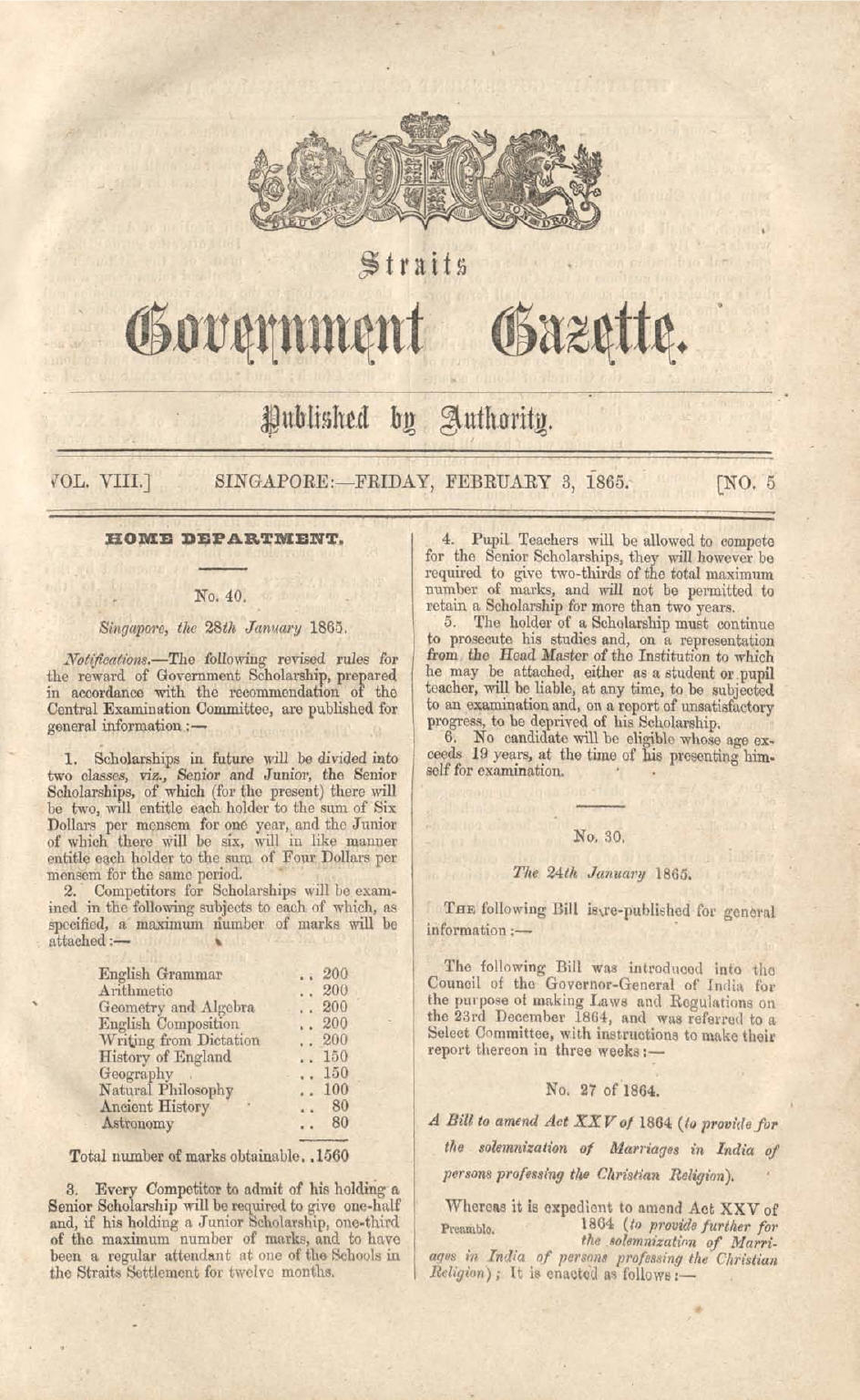
A government notification dated 28 January 1865 set out revised rules for scholarships in the Straits Settlements. Published in the Gazette on 3 February, it divided the awards into senior and junior classes. For the time being, there would be two senior scholarships, each paying six dollars a month for a year, and six junior scholarships, each paying four dollars a month for the same period. The notice therefore defined both the number of available awards and the financial support attached to each class.
The examination programme was broad. English grammar, arithmetic, geometry and algebra, composition and dictation each carried a maximum of two hundred marks. English history and geography carried one hundred and fifty each, natural philosophy one hundred, and ancient history and astronomy eighty each. The printed total was 1,560. These weights tell us which subjects contributed most to the overall result, rather than merely listing what students might have studied.
The rules combined attainment with attendance. A senior competitor needed at least half the maximum marks, while a junior competitor needed one third. Candidates also had to have attended a school in the Straits Settlements regularly for twelve months. The award was consequently tied to an ongoing connection with a school, not simply to appearing for one examination. No candidate whose age exceeded nineteen at the time of examination was eligible under the stated rule.
Pupil teachers had a separate route. They could compete for senior scholarships but were required to obtain two thirds of the total possible marks, and they could not retain a scholarship for more than two years. The distinction shows the administration treating a pupil teacher differently from an ordinary student candidate. The document does not explain every aspect of that role, but it makes the higher assessment threshold explicit.
Support came with a continuing expectation of study. On a headmaster’s representation, a scholarship holder could be examined again, and an unsatisfactory progress report could lead to loss of the award. This makes the scholarship more than a prize marking a single successful day. It was intended to support further learning while retaining a mechanism for checking progress. Whether that mechanism was often used would require later school or examination records.
The notice offers a close view of official education policy before the constitutional transfer of 1867. It describes a scheme across the settlements rather than a universal entitlement for every child in Singapore. Its value is the specificity: subjects, weights, thresholds, attendance, age and monthly support appear together. For a student reading today, it is a manageable original document showing how educational opportunity could be organised through a combination of rules and money.
Sources: Straits Government Gazette, 3 February 1865: Notification 40, dated 28 January.
February: a replacement Coleman Bridge crosses the river
A replacement Coleman Bridge was completed in 1865 at the crossing linking Hill Street and New Bridge Road. Buckley’s later annual account places completion in February and describes a wooden structure. NLB’s bridge history independently identifies it as the second Coleman Bridge. The crossing therefore belongs to a sequence of bridges at the same location, not to the first introduction of a bridge across the Singapore River.
The choice of material was part of the story. Buckley gives an approximate cost of ten thousand dollars for the wooden bridge and records concern over its construction and expected durability. His account says that government had difficulty persuading the municipality to take it over. These details connect the engineering work with a question of responsibility: completing a structure and accepting the duty to look after it were not necessarily the same decision.
The contemporary criticisms, discussed in NLB’s account, help explain why a completed bridge was not automatically regarded as a satisfactory one. For this annual, the essential point is the replacement crossing and the dispute around its quality. The later iron bridge and the modern structure should not be imagined in the 1865 scene. A familiar place name can survive through several structures with different materials, dimensions and working lives.
A bridge also connects more than two points on a map. Its approaches join streets, so its usefulness depends on the routes people take through the town. Identifying Hill Street and New Bridge Road keeps the episode grounded in an actual urban journey. It explains why an additional or replacement crossing mattered even though Singapore already had other bridges and water transport.
The episode illustrates a recurring issue in public works: the initial expenditure does not settle the question of long-term service. Durability, maintenance and which authority accepts responsibility all affect what the town receives from a project. We cannot calculate the bridge’s full lifetime cost from Buckley’s approximate construction figure alone. We can, however, recognise 1865 as a year when an established river crossing was renewed and its practical adequacy remained open to challenge.
Sources: Buckley (1902), volume II, p. 716, inspected original page; NLB, Bridging History: Passageways Across Water, Coleman Bridge section.

February to July: consular notices show Singapore’s wider connections
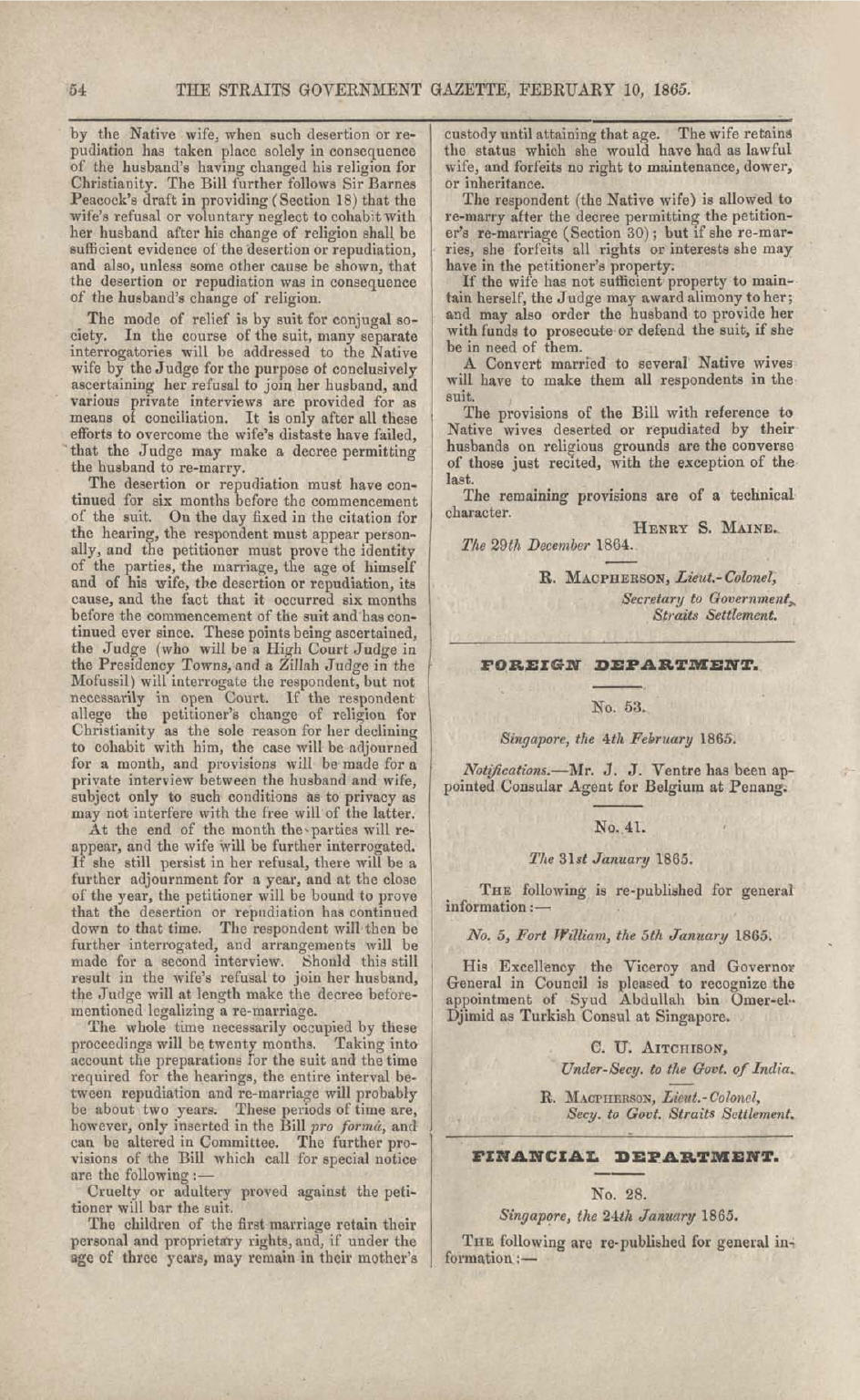
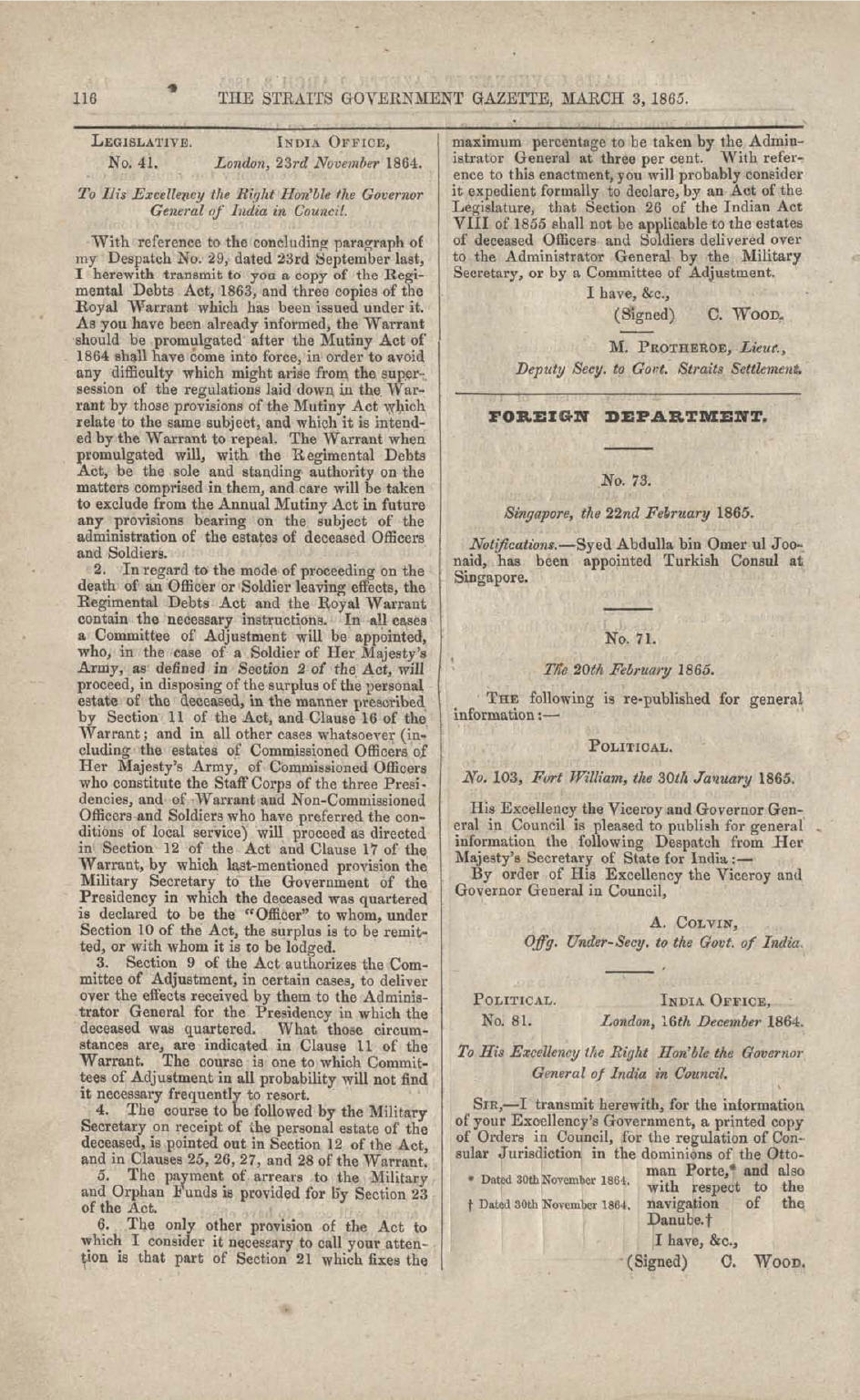
The Gazette’s foreign-department notices show another kind of connection crossing Singapore’s harbour. On 10 February, it republished a Government of India notification dated 5 January recognising Syed Abdullah bin Omar al-Junied as Turkish consul at Singapore. A further local notice dated 22 February, published on 3 March, announced his appointment. The original print uses differing English spellings of his name, a reminder that historical names can vary across documents describing the same person.
The sequence matters. Recognition by one authority, notification in Singapore and publication in a Gazette were separate actions. The February issue cannot by itself be treated as the first moment at which every part of the appointment had been arranged. The useful milestone is the public recognition and announcement preserved in the 1865 record. It shows the Ottoman connection taking a formal place in Singapore’s official information.
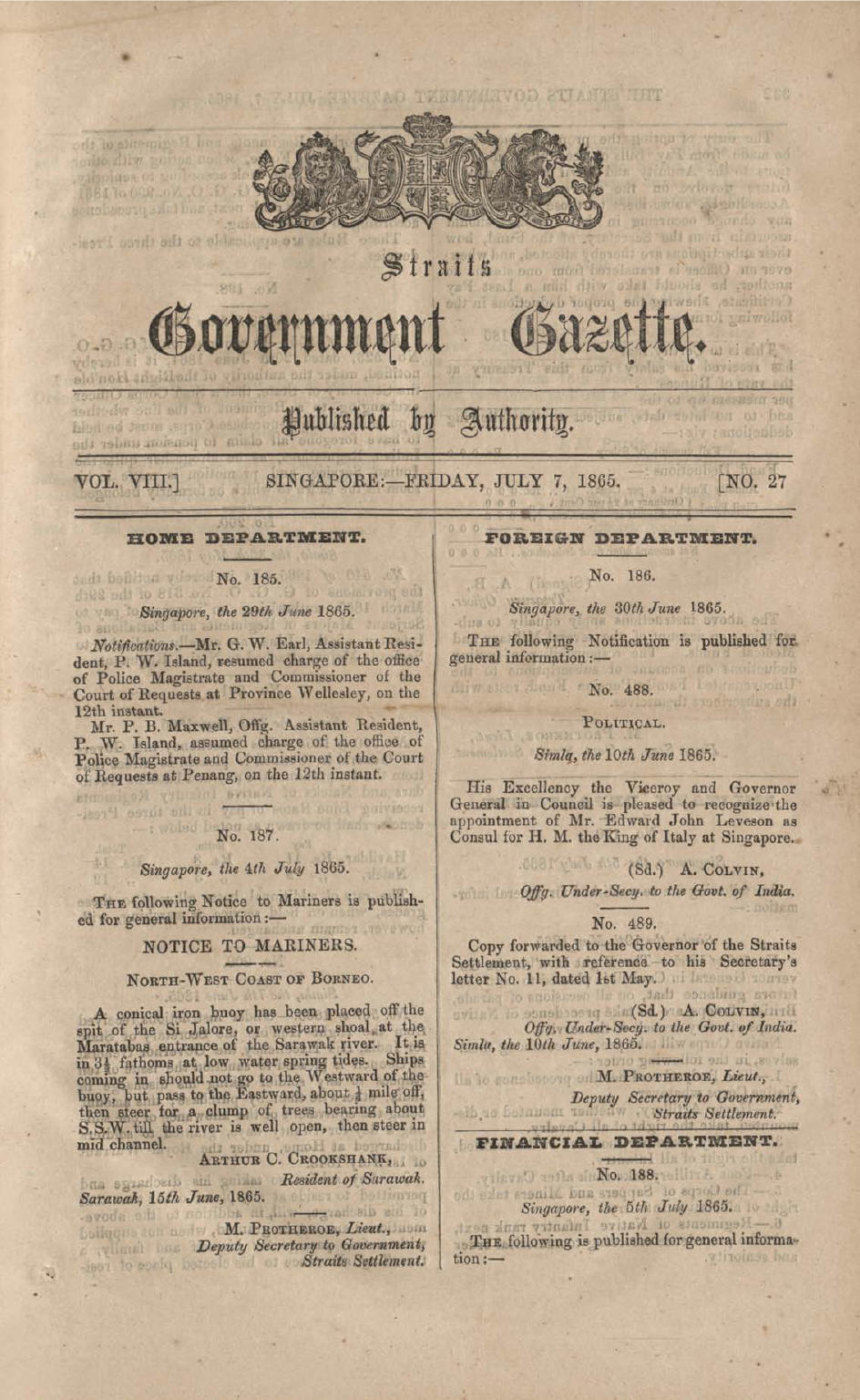
Another notice published on 7 July concerned Edward John Leveson as consul for the King of Italy at Singapore. It reproduced recognition issued at Simla on 10 June and included the forwarding instruction to the governor of the Straits Settlements. The paperwork travelled through the Indian administration because the settlements still formed part of that administrative system. The later Crown Colony arrangement had not yet begun.
These notices make Singapore’s international role concrete without requiring a claim about the daily workload of either consulate. They identify named representatives, the authorities recognising them and the place where they would serve. Consular representation was one way relationships between governments met the practical world of ports, merchants and travellers. The notices themselves do not reveal every service provided or the number of people who used it.
The same July page printed a navigation notice concerning a buoy at the Sarawak River entrance. Its location was in Borneo, not Singapore. Its presence in the Singapore Gazette shows how useful maritime information circulated through the port’s official publication. Read together, the page’s consular and navigation items reveal a town connected through both institutional representation and the circulation of information needed for regional journeys.
Sources: Gazette, 10 February 1865, p. 54: recognition notice; Gazette, 3 March 1865, p. 116: local appointment notice; Gazette, 7 July 1865: Italian consular recognition and Sarawak navigation notice.
15 April: the Johore steamer explosion reaches across communities
On 15 April 1865, the steamer Johore suffered a fatal boiler explosion at Singapore’s New Harbour. Buckley’s account places the vessel there after its arrival from England, undergoing work before a planned Easter Monday excursion. The outing was to include the Temenggong of Johor’s guests and colonial officials. The explosion happened during preparations on the preceding Saturday, before that intended pleasure trip could take place.
The account identifies a mixture of people connected with the vessel: its crew, workers from the dock company and visitors associated with Johor. This makes the casualty part of the human world of the port. A ship in harbour could bring together people doing technical work, people responsible for its operation and people visiting for social reasons. Their presence arose from different roles, even though they were caught in the same event.
Buckley describes boats and sampans going to assist after the explosion. Among the survivors he names Inche Wan Abdulrahman and Jaafar bin Haji Mohamed; among those killed was Hussein bin Abdullah, son of the writer Abdullah Munshi. The account also names several European seamen and dock workers who died. These particulars show the loss reaching across linked communities and occupations. The event should not be reduced to damage to a machine or a vessel alone.
The book was published decades later and combines reported recollections with the author’s interpretation. Its confident explanation of the technical cause and its assignment of blame are not repeated here as established engineering findings. A fuller determination of cause would require a contemporary inquiry and technical evidence. The secure annual event is the explosion, the rescue effort and its consequences for the people connected with the ship.
Several victims were buried at the new Christian cemetery in Bukit Timah Road. Buckley dates three of those burials to 16 April and two more to the following day. The deaths thus connect the harbour with another change in the town’s services: the beginning of use of a new burial ground. Keeping that connection in view gives the event a place in Singapore’s civic history as well as its maritime history, while avoiding the claim that all of the cemetery’s earliest burials resulted from the accident.
Sources: Buckley (1902), volume II, pp. 719–721: event, rescue and burials; inspected original pages; Continuation: original p. 720; Continuation: original p. 721.


April onwards: a new cemetery and a surviving burial return
The new Christian cemetery in Bukit Timah Road began receiving burials in April 1865, according to Buckley’s historical account. He places this change after the acquisition of the site in earlier years and alongside the end of use of the old Government Hill cemetery. The distinction between buying land and beginning burials matters. The administrative and physical preparation of a cemetery could precede the year in which it started serving its purpose.
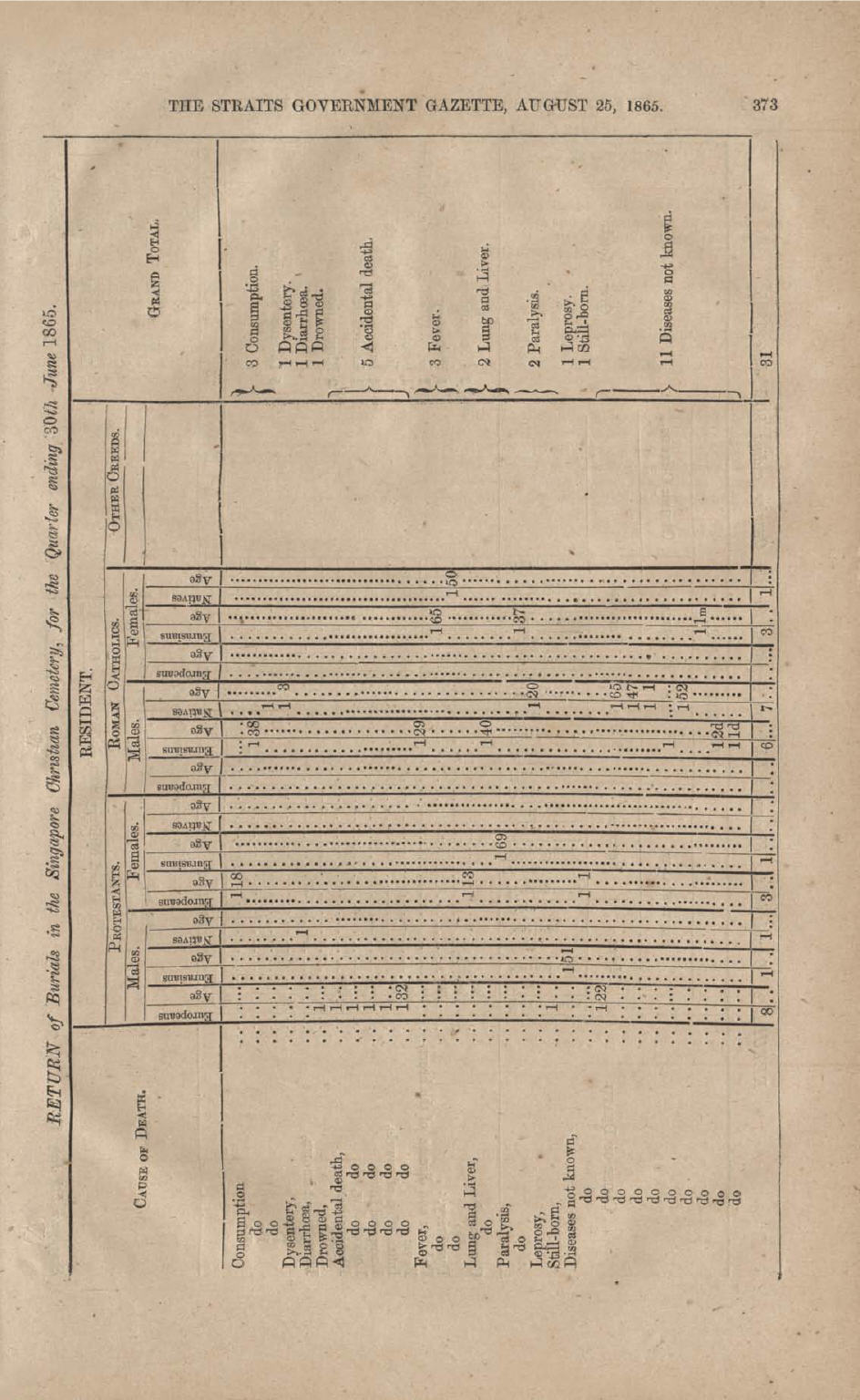
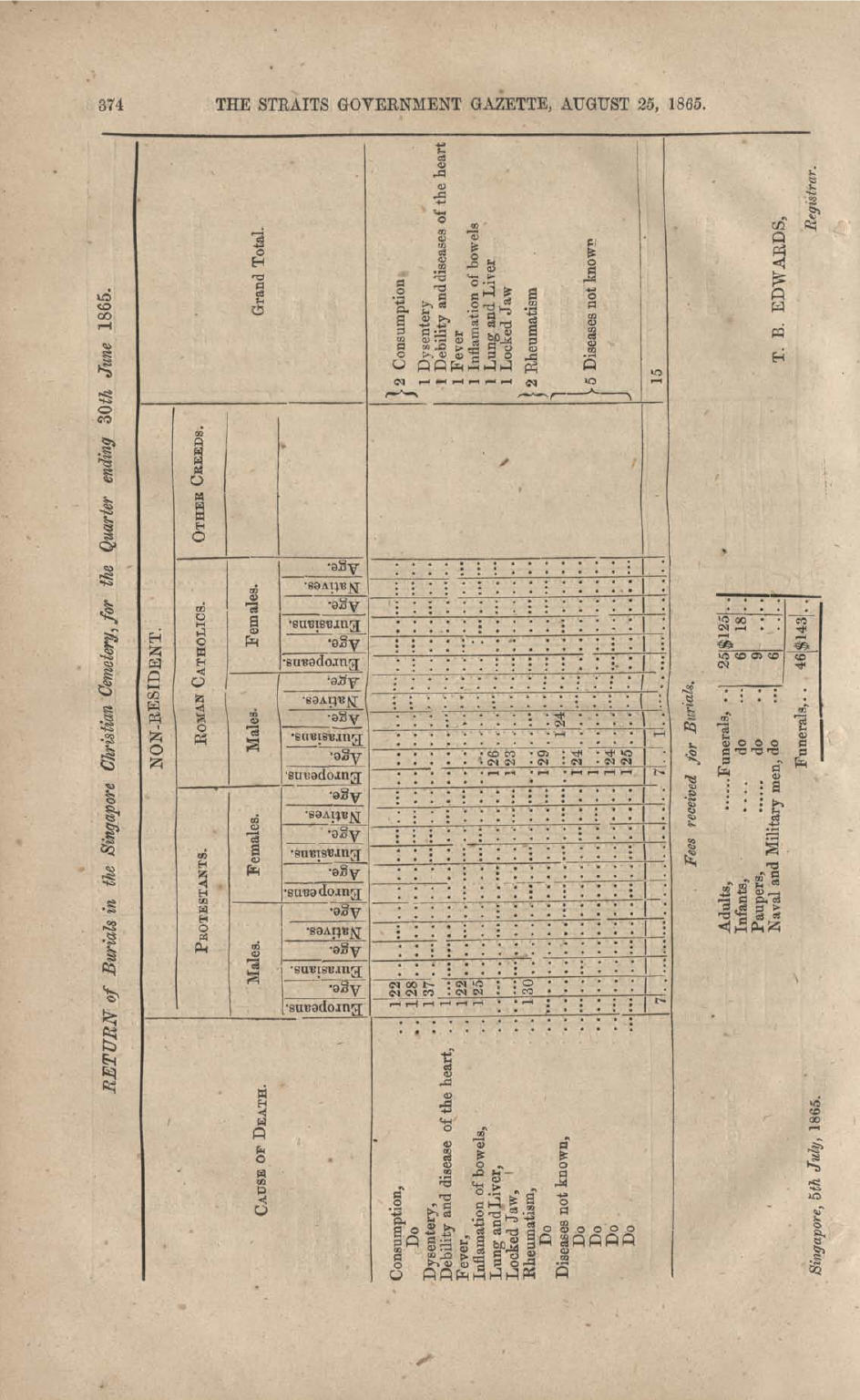
The original Gazette provides a different, closely dated kind of evidence: a return of burials for the quarter ending 30 June 1865, published on 25 August. It divides the entries into residents and non-residents and records religion, sex, the administrative population categories then used, age and stated cause of death. The return was signed by registrar T. B. Edwards on 5 July. Its coverage period, signature date and publication date are all visible and should not be collapsed into one date.
The categories show what the institution was recording. They also reveal the limits of the source. This is a return for a particular cemetery, not a count of every death on the island. People buried elsewhere are outside its stated scope. A student who uses the total as Singapore’s complete mortality figure would therefore be answering a much larger question than the document can support.
Some causes were recorded as unknown, while other entries used broad historical medical labels. Those labels are evidence of how deaths were classified in the return; they are not a secure basis for assigning a modern diagnosis to every person. The table is especially useful for studying record keeping, the population served by the cemetery and the administrative effort to turn individual burials into a quarterly account.
The return also includes burial-fee information. This connects the cemetery’s commemorative purpose with its practical operation: staff had to record burials, classify charges and account for receipts. Buckley’s account of the site adds concerns about drainage and the gradual planting and laying out of the grounds. Those improvements took place over time, so they should not all be assigned to the opening month.
A cemetery’s history therefore includes land, water, records, money and remembrance. The 1865 milestone is the new burial ground coming into use, supported by a contemporary return from its first year. The surviving documents let us discuss that service concretely while remembering that their rows and categories stand for individual lives and families.
Sources: Buckley (1902), volume II, p. 717: cemetery site and beginning of burials; Buckley, p. 719: drainage and subsequent planting; Gazette, 25 August 1865, p. 373: resident burial return; Gazette, p. 374: non-resident burial return and fees.

May and June: public works require stone, cement and clear waterways
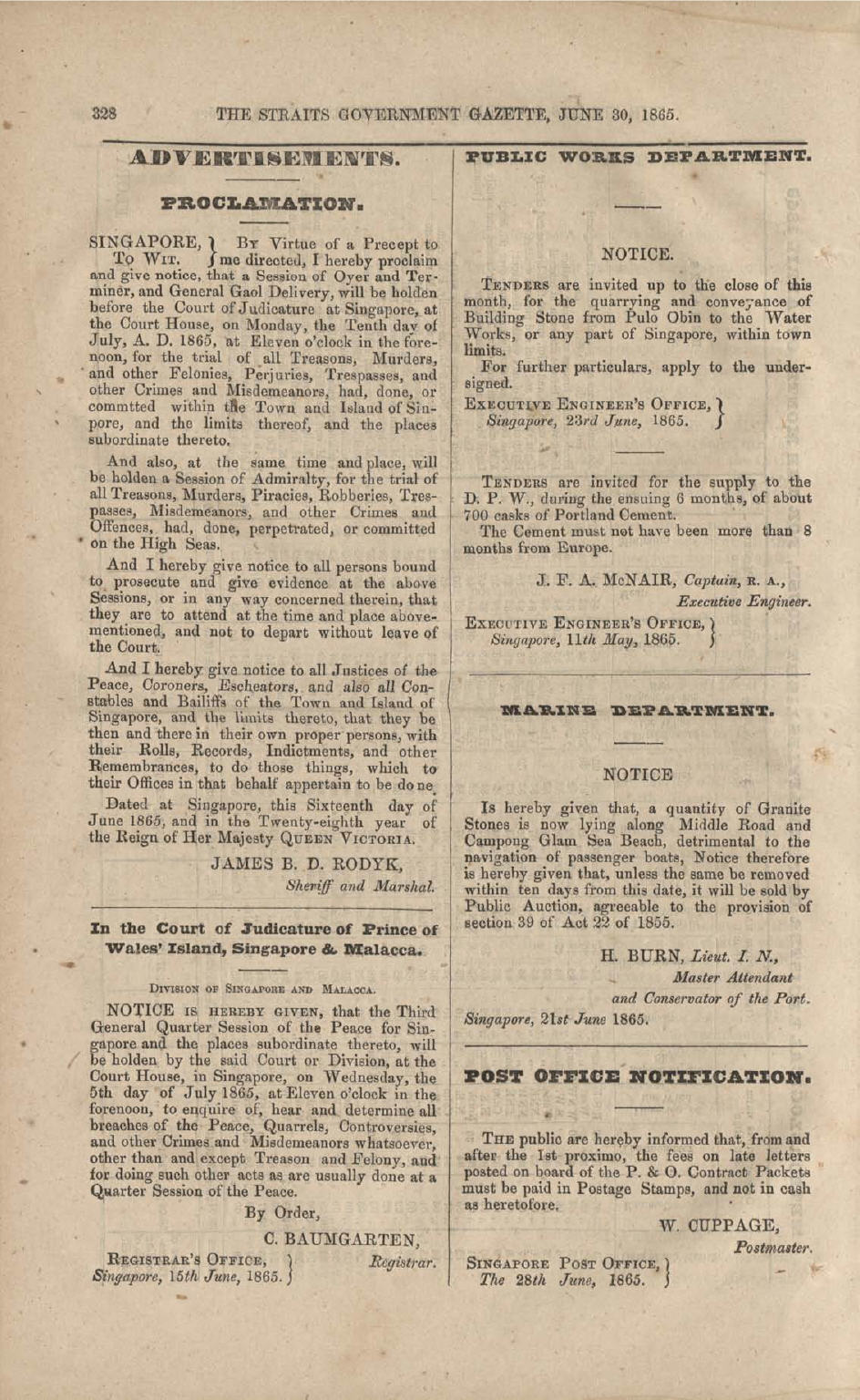
The Gazette of 30 June brings public construction into view through the materials it needed. A notice dated 23 June invited tenders for quarrying and conveying building stone from Pulau Ubin, printed as Pulo Obin, to the waterworks or to places within Singapore’s town limits. The request joined extraction and transport in one task. Stone was useful only if it could be obtained in the required form and delivered to the place where work was happening.
Another notice, dated 11 May and repeated on the same page, sought about seven hundred casks of Portland cement for the Public Works Department over the ensuing six months. It specified that the cement must not have been more than eight months from Europe. The time condition shows that procurement involved attention to a material’s journey and condition, rather than merely ordering a quantity by name.
The two notices identify different supply routes. Stone could come from an island close to Singapore, while the cement was connected with a longer route from Europe. A local building project could therefore depend on both regional extraction and imported manufactured material. This is a practical way to understand the port’s role in construction. Its shipping connections carried things used to make the town itself, not only goods passing through to other markets.
The notices are invitations for offers. They do not identify the winning contractor, prove that every cask was delivered or establish a completion date for the waterworks. Their historical value lies in showing the work being organised and the conditions the department set. A tender is part of a project’s sequence, just as a design, delivery record and completion report are different parts.
A marine notice on the same page identifies another problem involving stone. Granite lying along Middle Road and the Kampong Glam sea beach was described as obstructing passenger-boat navigation. The Master Attendant warned that, unless removed within ten days, it would be sold by public auction under the cited law. Materials valuable for construction could become a difficulty when placed where boats needed to move.
Read together, these notices show the coordination required in a growing town. Engineers wanted supplies brought in, while harbour officers wanted routes kept clear. The objectives were compatible, but storing and moving material had to fit around other uses of the waterfront. The year’s history becomes tangible through those ordinary tasks: quarrying, conveying, specifying freshness, clearing obstructions and deciding who had authority to act.
Sources: Gazette, 30 June 1865, p. 328: Public Works and Marine Department notices.
1 July: the post office offers a paid window service
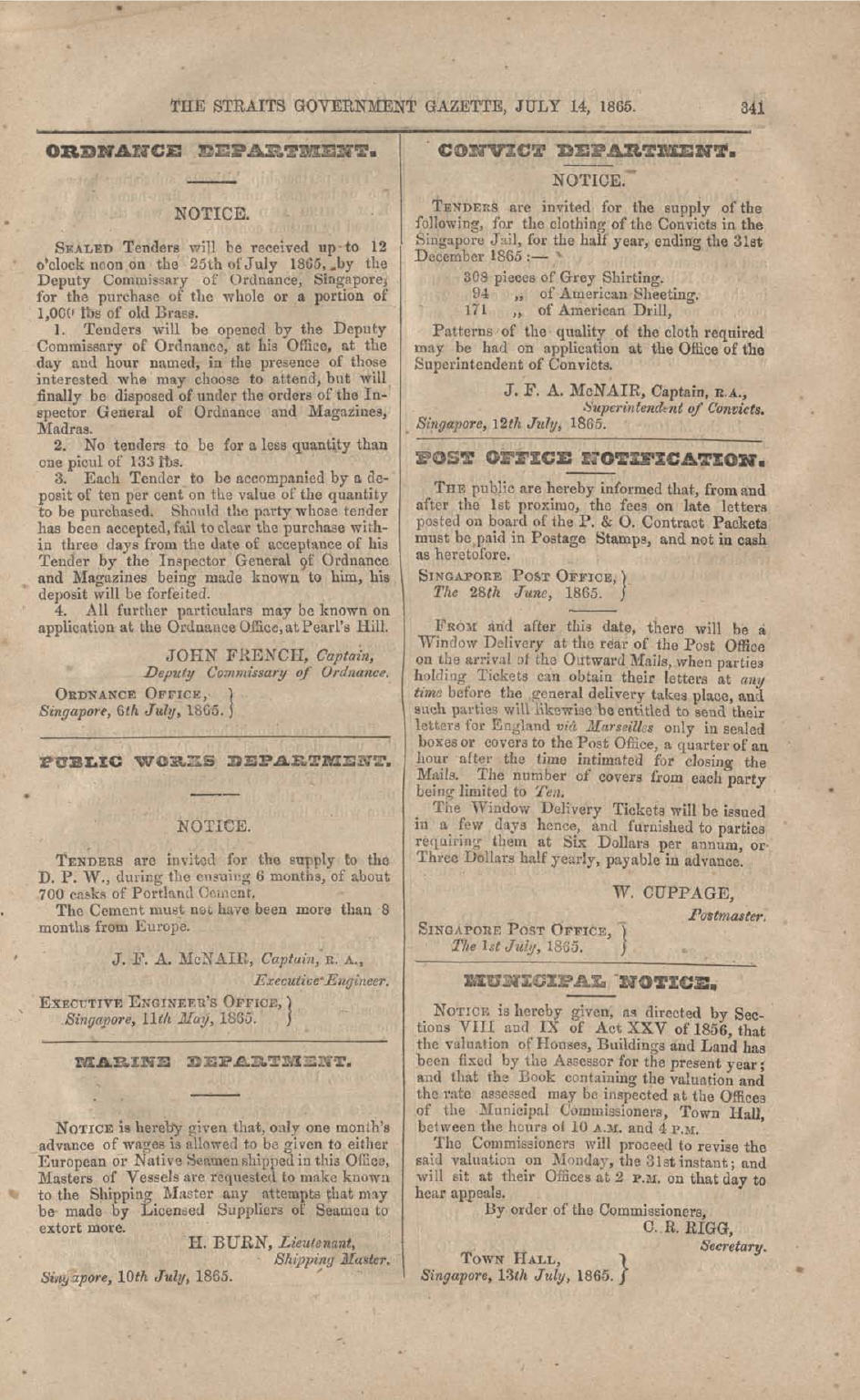
A post-office notice dated 1 July 1865 announced window delivery at the rear of the Singapore Post Office when outward mails arrived. People holding tickets could obtain their letters before the general delivery took place. The ticket was priced at six dollars a year or three dollars for half a year, payable in advance. This was a defined service for subscribing users, rather than a promise that every resident would receive all mail earlier.
The ticket also carried a dispatch privilege with a specific route and limit. Holders could send letters for England via Marseilles in sealed boxes or covers to the post office a quarter of an hour after the advertised closing time. Each party was limited to ten covers. Those details matter because the notice did not extend the privilege to every destination, every route or an unlimited quantity of letters.
The service linked time with payment. A person or business needing earlier collection and a small amount of extra dispatch time could buy an annual or half-yearly ticket. The notice does not tell us who subscribed or how much they valued the service. It does show the postal administration distinguishing a general delivery from an additional paid arrangement, with rules designed to keep the extra access within manageable limits.
A separate notice dated 28 June changed payment for late letters posted aboard P&O contract packets. From the first of the following month, the fee had to be paid in postage stamps rather than cash. Because the notice is dated in June, that commencement was 1 July. The change concerned the method of paying this particular late-letter fee. It was not the introduction of postage stamps to Singapore for the first time.
These two notices should be read together without being merged. One introduced a ticket-based collection and limited late-dispatch service at the post office. The other changed fee payment aboard specified mail ships. Both concerned the boundary between ordinary mail handling and a later or earlier opportunity, but the users, place and payment arrangements were different.
The records help make a maritime postal system understandable at the scale of a person carrying a letter. A published closing time, a ticket, a sealed cover and a stamp each had a role. The wider journey depended on ships and routes, while the local service depended on practical rules at an office or aboard a packet. In 1865, the post office was making those small but consequential arrangements explicit.
Sources: Gazette, 14 July 1865, p. 341: window-delivery notice dated 1 July; Gazette, 30 June 1865, p. 328: notice dated 28 June on late-letter fees.
4 August: promoters propose a railway to New Harbour
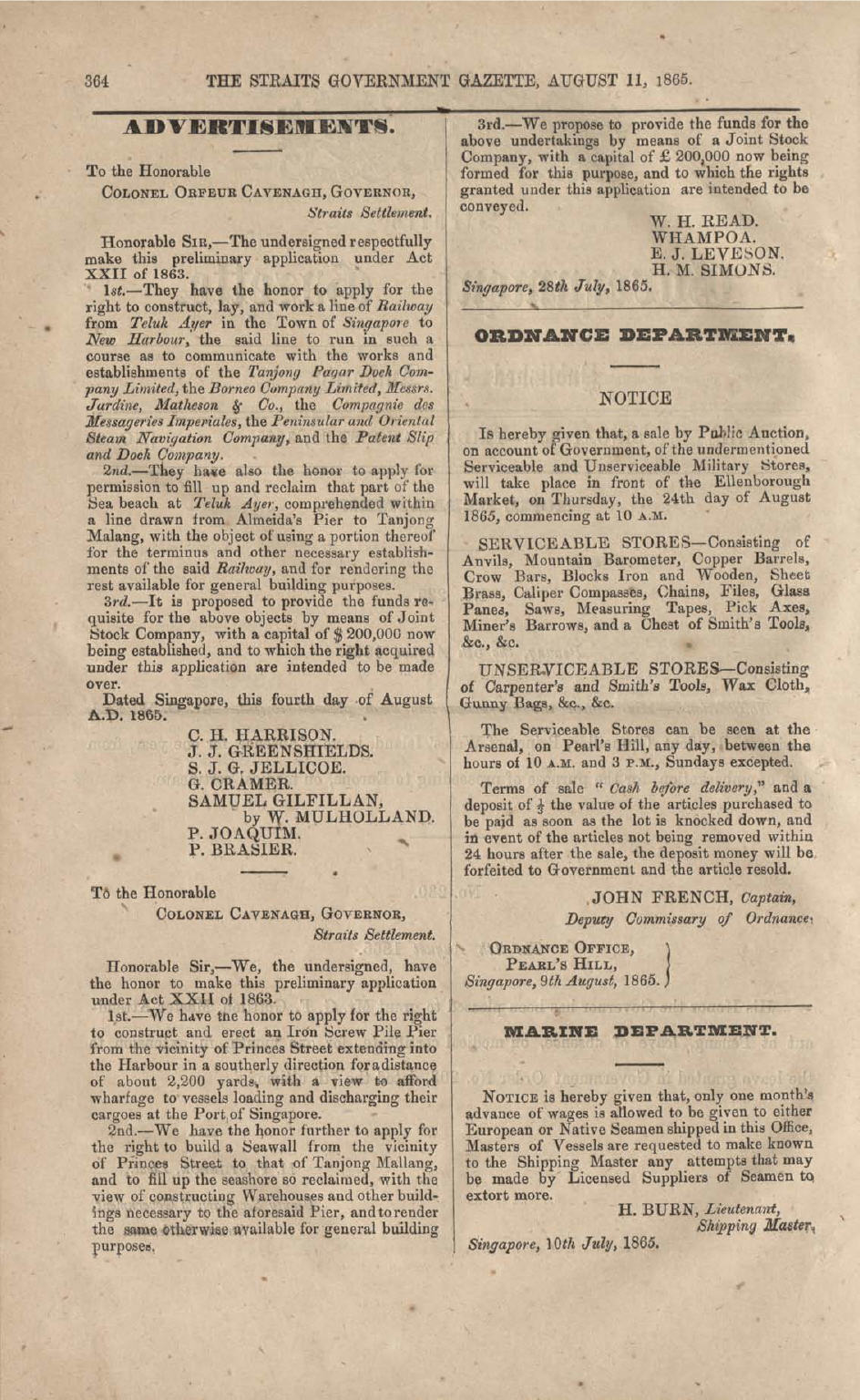
A preliminary application dated 4 August 1865 proposed a railway from Telok Ayer in Singapore town to New Harbour. Published in the Gazette on 11 August, it asked for the right to construct, lay and work the line under the relevant Indian Act. This is evidence of a proposed transport connection, not an announcement that a railway had already opened or that trains were running along the route.
The proposed line was to communicate with several named establishments. They included the Tanjong Pagar Dock Company, the Borneo Company, Jardine Matheson, the Messageries Impériales, P&O and the Patent Slip and Dock Company. Naming them explains the project’s intended geography. The railway was conceived as a connection between town and a chain of maritime and commercial facilities, rather than simply a line drawn between two abstract endpoints.
The application also sought permission to reclaim part of the Telok Ayer sea beach, within a stated line from Almeida’s Pier to Tanjong Malang. Some reclaimed land was intended for the railway terminus and associated establishments, while the rest would be available for general building purposes. Transport and property development were therefore combined in the proposal. A terminus needed land, and creating land could also create further sites for buildings.
The promoters proposed financing through a joint-stock company with capital of two hundred thousand dollars, then being established. The rights obtained through the application were intended to pass to that company. This separates several steps: an application for rights, formation of a company, raising capital and eventual construction and operation. The notice tells us what the promoters intended at that point; it does not prove that each later step occurred.
The signatures included C. H. Harrison, J. J. Greenshields, S. J. G. Jellicoe and other named promoters. The record thus identifies people prepared to put a proposal before the governor in a public form. It does not establish that every company listed as a potential destination had invested in the scheme or guaranteed its success. Being connected by a proposed route and being a subscriber to its capital are different relationships.
The application is valuable even without a completed railway. It shows that the problem of moving between town and harbour facilities was already being considered in 1865, with a defined route, intended users and a financing plan. Later transport projects should not be projected backwards, but neither should an unrealised or still-pending proposal disappear from history. It records how people understood the needs of the port and the kinds of solution they were prepared to pursue.
Sources: Gazette, 11 August 1865, p. 364: railway application dated 4 August.
28 July: another proposal joins a long pier with reclamation
Printed beside the railway application was a separate proposal dated 28 July 1865 for an iron screw-pile pier. Its promoters sought a structure extending southwards from near Princes Street into the harbour for about 2,200 yards, intended to provide wharfage for loading and discharging vessels. The stated length is a proposal’s specification, not a measurement of a pier known to have been completed that year.
The scheme also included a seawall from near Princes Street towards Tanjong Malang and the filling of the foreshore behind it. The reclaimed ground would support warehouses and other buildings needed for the pier, with additional land available for general building purposes. As with the railway application, the promoters combined transport infrastructure with the creation of usable land. The harbour edge was being imagined as a place that could be physically remade.
The signatories were W. H. Read, Whampoa, E. J. Leveson and H. M. Simons. They proposed a joint-stock company with capital of two hundred thousand pounds. The currency is important: the railway proposal on the same page stated two hundred thousand dollars. The matching numerals do not make the two proposals equal in value. No conversion is attempted here because a comparison would need an appropriate historical exchange basis and a clear understanding of what each estimate included.
Both applications addressed the governor under the same legal route, but they sought different works and named different groups of promoters. The pier proposal aimed to extend wharfage out from the town frontage; the railway proposal aimed to connect town with establishments farther along the harbour. Reading them side by side reveals more than one imagined response to the port’s needs.
The page also demonstrates why proposals belong in a careful annual history. They preserve ambitions, specifications, funding plans and the location of an intended intervention. They are weaker evidence of delivery. Describing them as applications lets us recognise the scale of commercial imagination in 1865 while leaving later approvals, revisions, construction or abandonment to records that actually establish those outcomes.
Sources: Gazette, 11 August 1865, p. 364: pier application dated 28 July.
Harbour administration reaches seamen, cargo boats and lost equipment
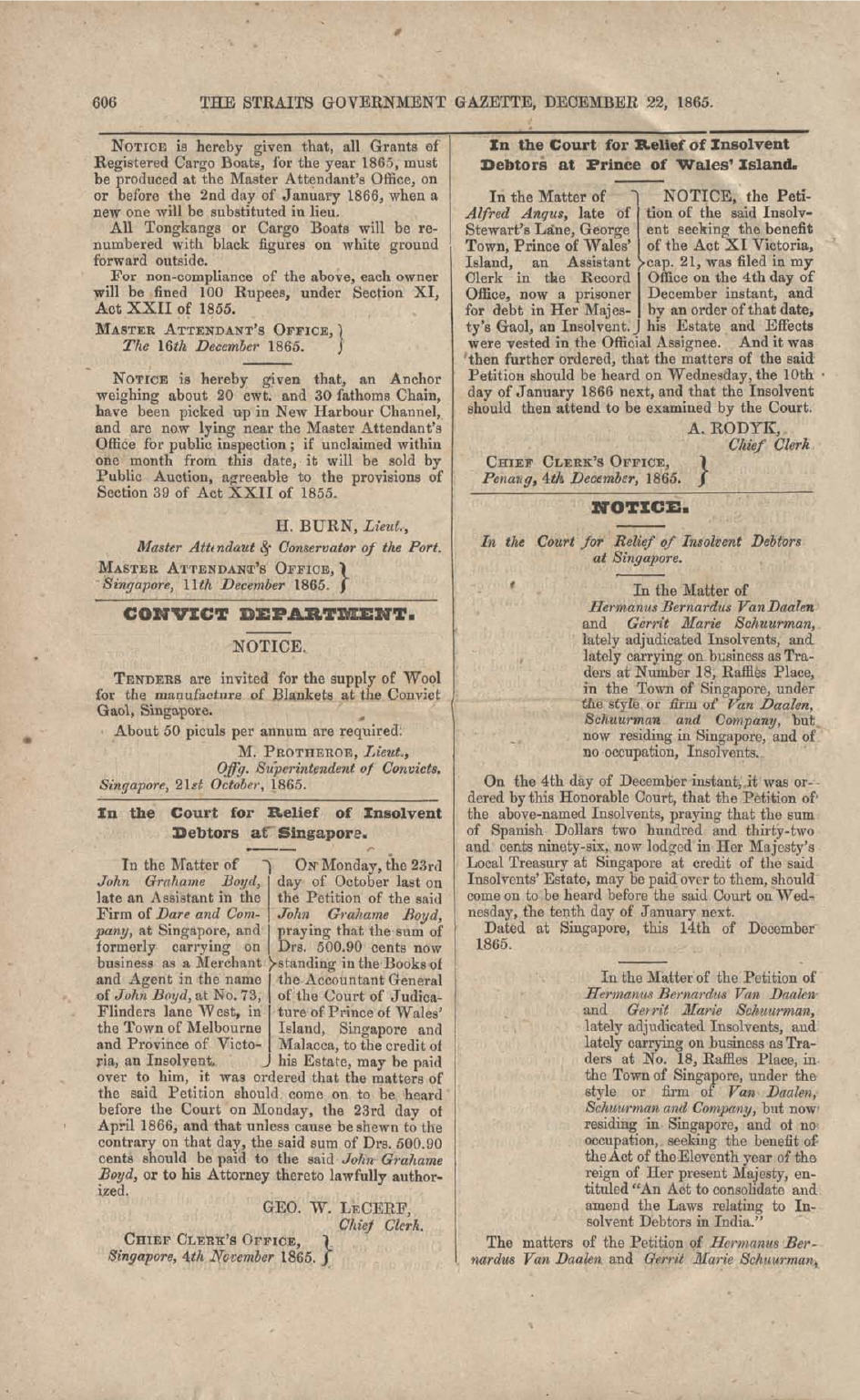
The port depended on many smaller craft and workers as well as ocean-going ships. A Marine Department notice dated 10 July 1865 stated that only one month’s advance wages could be given to seamen shipped through the office. It asked masters to report attempts by licensed suppliers of seamen to demand more. The notice applied to the groups described in the period language as European and native seamen, bringing both within its stated limit.
The arrangement shows the shipping office’s role in labour recruitment. Seamen, masters and licensed suppliers could be involved in preparing a crew for a voyage, and an advance payment was one part of that process. The notice establishes a rule and a reporting channel. It does not show every wage paid in the harbour or prove that demands above the limit ceased. Its importance is the attempt to regulate a particular transaction at the point where people were engaged for service.
At the end of the year, another notice addressed registered cargo boats. Owners were told to produce their 1865 grants at the Master Attendant’s Office by 2 January 1866 so that new ones could be substituted. Tongkangs and cargo boats were to be renumbered with black figures on a white ground on the forward outside part of the vessel. The notice linked a paper authorisation with a visible identifier on a working boat.
That connection made registration useful beyond the office. A document could establish the administrative record, while a number on the boat allowed the craft itself to be identified on the water. The specified colour contrast and position were practical details of visibility. The December announcement prepared the next year’s renewals, so it should not be called the first creation of a cargo-boat registration system.
A further notice concerned an anchor of about twenty hundredweight and thirty fathoms of chain recovered from New Harbour Channel. They were held near the Master Attendant’s Office for inspection and would be auctioned if unclaimed within a month. This reveals the port as a place where equipment could be recovered, stored, publicly identified and eventually disposed of through a procedure. The record does not state that the auction actually occurred.
These small notices give the harbour a human and material texture. Recruiting a crew, renewing a cargo boat’s papers and recovering an anchor are different tasks, but all require an office able to connect people with vessels, payments or property. They complement the large development proposals by showing the continuing administrative work that kept an already active port functioning.
Sources: Gazette, 14 July 1865, p. 341: seamen’s advances; Gazette, 22 December 1865, p. 606: cargo boats and recovered anchor.
28 December: amateur musicians gather at the Town Hall
The Amateur Musical Society gave its first concert at the Town Hall on 28 December 1865. Buckley’s account describes the society forming among the English community with roughly thirty to forty members, alongside an older German musical tradition associated with the Teutonia Club. NLB’s study of Euro-American art music independently confirms the concert date. The event belongs to a particular organised musical circle, rather than to the beginning of all music-making in Singapore.
The concert combined instrumental and vocal pieces. Buckley names the overture to The Caliph of Bagdad and a Haydn quintet, followed by glees or part-songs, a quartet, a duet and a solo. This variety shows how a relatively small group could assemble a public programme from different forms of performance. An orchestra, chorus and soloists required different kinds of preparation even when some of the same people contributed across them.
Neil Macvicar appears in the account as an important organiser and accompanist. Buckley connects him with work as a bookkeeper and with service at the cathedral organ. Music in this circle therefore depended partly on people whose ordinary occupations lay elsewhere. The concert was made possible through repeated practice, accompaniment and organisation, not only the moment when an audience heard the finished programme.
This is one subject on which Buckley identifies his own participation: he recalls singing a solo at that first concert. His account is still retrospective, but it is not simply an anonymous list copied without personal connection. His memories of praise and of later singers also reveal a participant’s perspective. We can use the programme and his role while recognising that judgments about musical quality are his and those of the reviewers he cites.
The Town Hall gave this activity a shared urban setting. It was a place where people assembled to hear music as well as for civic occasions. The concert’s significance does not depend on claiming that everyone in the town attended or had equal access to the society. It demonstrates one way a growing commercial settlement supported organised cultural activity alongside work, administration and shipping.
Ending the annual with music broadens the picture of 1865. The same town that issued scholarship rules, sought building materials and debated harbour projects also had residents investing time in rehearsal and performance. The surviving account lets us recognise that activity in concrete terms: a date, a hall, a society, a programme and named people helping to make it happen.
Sources: Buckley (1902), volume II, p. 724: Amateur Musical Society and its members; Concert programme and participant account, p. 725; NLB, Musical practices of Euro-American Art Music in Singapore: concert-date corroboration.


1865 in sequence
- 28 January: a government notification sets revised scholarship rules, published on 3 February.
- February: the replacement wooden Coleman Bridge is completed, according to Buckley’s annual account.
- 10 February and 3 March: Gazette notices record recognition and announcement of the Turkish consul at Singapore.
- April: the new Christian cemetery in Bukit Timah Road begins receiving burials.
- 15 April: the steamer Johore suffers a fatal explosion at New Harbour; rescue boats and sampans respond.
- 11 May and 23 June: Public Works notices invite supplies of cement and the quarrying and delivery of stone.
- 1 July: a dated notice announces the post office’s paid window service; the separate late-letter fee change also takes effect from this date.
- 7 July: the Gazette publishes recognition of Edward John Leveson as Italian consul, issued at Simla on 10 June.
- 28 July and 4 August: separate applications propose an iron pier with reclamation and a railway to New Harbour. Both appear in the 11 August Gazette.
- 25 August: the Gazette publishes the cemetery return for the quarter ending 30 June, signed on 5 July.
- December: notices address cargo-boat renewals for the coming year and equipment recovered from New Harbour Channel.
- 28 December: the Amateur Musical Society gives its first Town Hall concert.
A timeline becomes more useful when its verbs tell us what happened. Published, announced, proposed, completed and performed describe different kinds of event. The July postal notices also show why a document’s own date matters when a later issue repeats it. The notice dated 28 June makes the first of the following month 1 July, even when we encounter it in a later Gazette.
Worked source-reading examples
1. Turn scholarship rules into clear comparisons
The examination total was 1,560 marks. Half of that is 780, the stated minimum proportion for a senior candidate. One third is 520, the junior threshold. Two thirds is 1,040, the threshold specified for a pupil teacher competing for a senior scholarship. A good answer gives both the number and the category of candidate, because the same examination total supported different requirements.
The support amounts can also be compared. Six dollars a month for twelve months amounts to seventy-two dollars for one senior award; four dollars a month amounts to forty-eight dollars for one junior award. If all two senior and six junior places were paid for the full year, the calculation would be 144 plus 288, or 432 dollars. That is a calculation from the announced scheme, not a statement of actual expenditure or the number of awards eventually taken up.
2. Read the postal ticket as a bundle of defined services
An annual ticket cost six dollars and a half-year ticket three dollars. Two half-year payments therefore equal one annual payment at the advertised prices. The notice does not offer a discount for buying the full year. It offers specified access: collection at a window before general delivery and a limited extension for dispatching letters to England via Marseilles.
The extension was fifteen minutes, with no more than ten covers for each party. To explain the service accurately, include the route, the time allowance and the quantity limit. Then distinguish the separate shipboard notice, which required stamps rather than cash for late-letter fees aboard P&O contract packets. A stamp, a subscription ticket and a cover were different parts of these arrangements.
3. Keep currencies attached to project estimates
The railway application named capital of $200,000. The pier application named £200,000. It would be an error to call their proposed capital equal just because both numbers are two hundred thousand. A currency is part of a quantity, and a meaningful comparison would require a justified conversion for the period. The two documents also concern different works, so even a conversion would not make them identical projects.
Underline the words showing the stage each project had reached: preliminary application, proposed works and company being established. Then list what later evidence would be needed to describe an operating service, such as an opening report or a record of traffic. This method lets us study an ambitious plan as evidence of contemporary priorities while preserving the distinction between a proposal and its eventual outcome.
4. Ask what a burial total actually counts
The cemetery return lists thirty-one resident burials and fifteen non-resident burials for the quarter ending 30 June. Adding the two categories gives forty-six burials in the return. The geographical and institutional scope belongs beside the answer: these are recorded burials at this Christian cemetery for that quarter. They are not all deaths in Singapore or all burials at every cemetery.
There are also three dates to preserve. The period ended on 30 June, the registrar signed on 5 July and the Gazette published the return on 25 August. Each date answers a different question: when the reported activity occurred, when the account was certified and when readers could see it in that issue. This is a useful approach to any historical table that appears weeks after the events it records.
Original pages: scholarship rules; postal ticket notice; railway and pier applications; resident burial return and non-resident return.
Three learner routes
Primary readers: follow a letter through the rules
Draw a letter, a post-office window and a ship. Use the postal chapter to explain which notice concerns collecting mail, which concerns sending it and which changes the way a late fee is paid. Add the fifteen-minute allowance only to the service that actually offered it. The exercise turns a short official notice into a sequence of actions without pretending that every letter followed the same route.
Secondary readers: compare a completed crossing with a proposal
Set the Coleman Bridge chapter beside the railway application. For each, identify the place, the proposed or completed work, the approximate or stated money amount and the authority involved. Then explain what the evidence establishes about the project’s stage. A bridge can be completed while its quality remains disputed; an application can be detailed and accompanied by a funding plan while its later delivery is still a separate question.
Families: build a programme for one historical evening
Read the Town Hall chapter and list the different kinds of music named in the concert account: an overture, a quintet, part-songs, a quartet, a duet and a solo. Discuss how the number of performers and the preparation might change between them. Keep any imagined rehearsal clearly labelled as your own illustration. The original account gives a programme and some participants, leaving room for curiosity without turning imagination into evidence.
Frequently asked questions
Was Singapore already a Crown Colony in 1865?
The Gazette notices still show Singapore within the administration of British India. The constitutional transfer took effect in 1867. In 1865, notices issued at places such as Simla could be forwarded to the Straits governor and then republished locally, giving a visible example of the administrative connection.
Was the Coleman Bridge of 1865 the bridge seen today?
No. The 1865 work was a replacement wooden bridge, the second in the sequence at that crossing. Its history includes later replacements and alterations. Keeping the year and material together prevents the familiar modern crossing from standing in for an earlier structure.
Did the proposed railway open in 1865?
The evidence used here is a preliminary application dated 4 August, with an intended route, reclamation and company capital. It establishes the proposal. It does not establish an opening or a working train service. Those would need records of subsequent construction and operation.
What changed at the post office?
A notice dated 1 July announced a paid window service for earlier collection and a limited late-dispatch privilege on the England via Marseilles route. A separate notice required stamps for certain shipboard late-letter fees from 1 July. They were two specific changes, with different payment and handling arrangements.
How should the cemetery figures be used?
Use them as the cemetery’s recorded burials for the stated quarter, with the resident and non-resident categories preserved. The return is valuable evidence of a new service and its record keeping. It does not represent the island’s entire population or every death during that period.
Why include a concert in an annual history?
The 28 December concert records organised cultural activity in a named place by a named society. Its programme and participants show residents devoting time to rehearsal and performance alongside their ordinary occupations. That adds a concrete part of social life to the year’s administrative and commercial records.
What makes 1865 distinct?
The year offers a detailed view of a town being served, maintained and imagined. Scholarship rules linked money to subjects, thresholds and continuing study. A replacement bridge renewed a familiar crossing while raising questions about responsibility and durability. Postal notices adjusted the practical handling of letters, and cemetery returns recorded a new burial ground’s early work.
At the waterfront, the scale ranged from a lost anchor and numbered cargo boats to proposals for a railway, a long pier and reclaimed land. These records belong together because large ambitions depended on the same port world of movement, materials, vessels and administration. The distinction between a completed work, an operating service and a proposal allows each to contribute its own kind of evidence.
The Johore explosion and the Town Hall concert bring people into that wider picture in very different circumstances. Rescue boats, named victims and burials show the consequences of a maritime disaster. The December programme shows shared effort producing a cultural occasion. Taken together, the sources make 1865 more than a step towards later milestones: it was a year of specific decisions, losses, services and achievements in its own right.
Continue exploring Singapore
- Learning Tanjong Pagar: connect the harbour chapters with a present-day neighbourhood learning route.
- Singapore Atlas: explore more places and historical connections across Singapore.
- Return to the contents or begin the complete 1865 reading route.
Continue backward: History of Singapore | 1864