
Summary
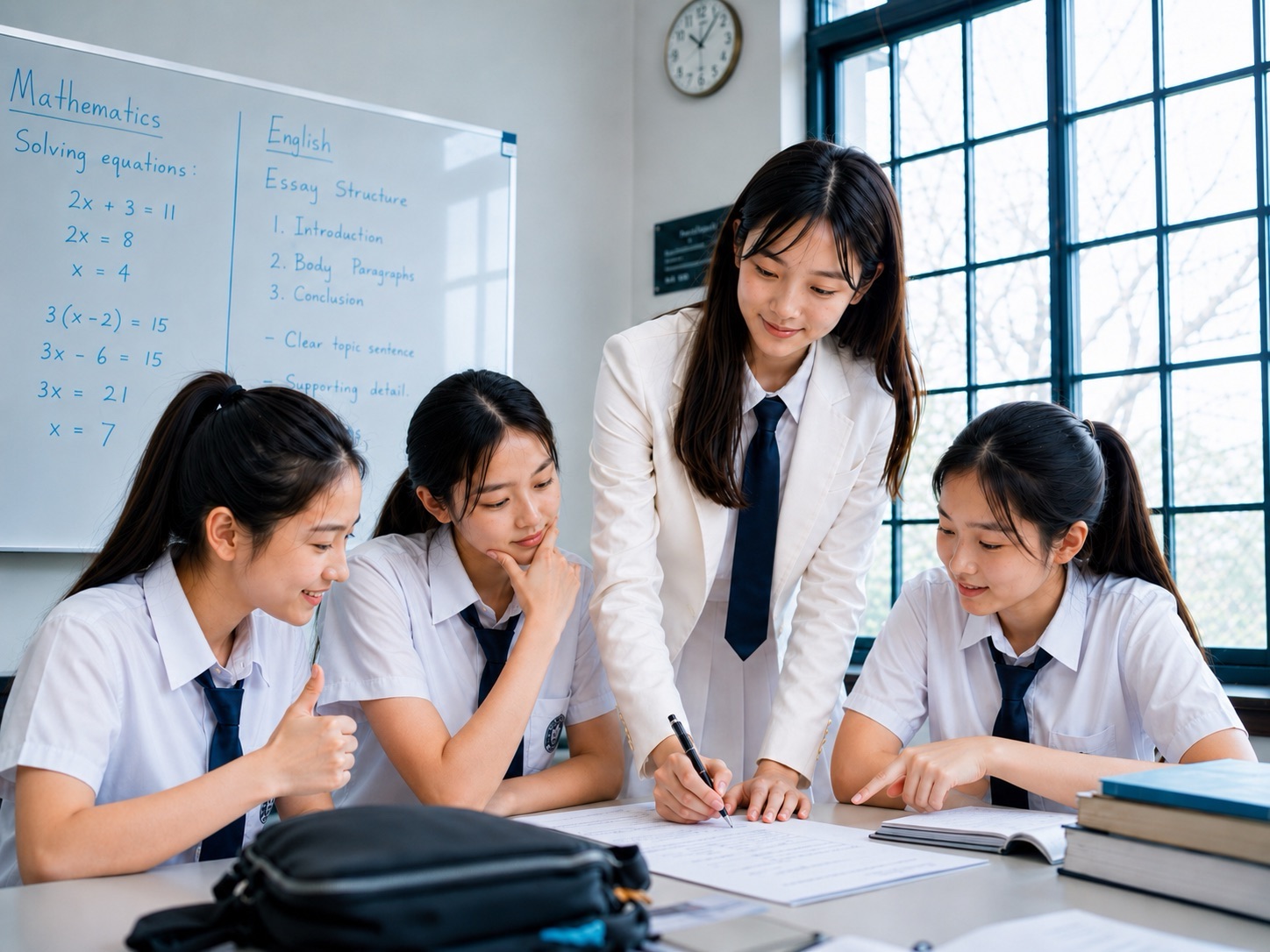
Number and Algebra is the main engine of Secondary 2 Mathematics.
It is where students learn to control symbols, equations, expressions, graphs, ratios, proportions, inequalities, algebraic fractions and problem-solving structure.
For Bukit Timah students, this strand matters because weak algebra in Secondary 2 often becomes a serious problem in Secondary 3.
If the child cannot expand, factorise, simplify, solve, substitute, rearrange and translate word problems into equations, upper-secondary Mathematics becomes heavier very quickly.
A strong Secondary 2 Number and Algebra foundation gives the child a better chance of moving into Secondary 3 with confidence, whether they are preparing for G2 Mathematics, G3 Mathematics, E-Math, or eventually Additional Mathematics.
Good tuition should therefore treat algebra not as one chapter, but as the operating language of the subject.
The goal is not merely to get answers.
The goal is to build control.
Number and Algebra is where Secondary 2 becomes serious
Secondary 2 Mathematics becomes serious when Number and Algebra becomes serious.
In Secondary 1, many students are still adjusting to secondary-school Mathematics.
They learn integers.
They learn basic algebra.
They learn simple equations.
They learn basic graphs.
They learn how Mathematics now uses more symbols, more steps and more abstract thinking than Primary School.
But in Secondary 2, the subject asks for more.
The letters begin to move.
The expressions become longer.
The equations become less direct.
The graphs begin to carry meaning.
The word problems become harder to translate.
The student must now work with structure.
This is the year where Mathematics stops being mainly about arithmetic comfort and becomes a test of symbolic control.
For many students, this is the real lower-secondary turning point.
They may still be able to calculate.
But can they manipulate?
They may still be able to follow a teacher’s example.
But can they start alone?
They may still understand one step.
But can they hold five steps without losing the sign, bracket, denominator or meaning?
That is the challenge of Secondary 2 Number and Algebra.
Algebra is not a chapter. It is the operating system.
One of the biggest mistakes students make is thinking algebra is just another topic.
It is not.
Algebra is the operating system of secondary Mathematics.
It appears in expansion.
It appears in factorisation.
It appears in algebraic fractions.
It appears in equations.
It appears in inequalities.
It appears in simultaneous equations.
It appears in graphs.
It appears in functions.
It appears in word problems.
It appears in future trigonometry, coordinate geometry, calculus and Additional Mathematics.
This is why weak algebra spreads.
A student may say:
“I am bad at graphs.”
But the deeper problem may be algebra.
A student may say:
“I cannot do word problems.”
But the deeper problem may be algebra translation.
A student may say:
“I don’t understand simultaneous equations.”
But the deeper problem may be equation control.
A student may say:
“I am careless.”
But the deeper problem may be poor algebra habits.
Algebra is often the leak behind many visible problems.
Good Secondary 2 Mathematics tuition must find that leak.
The first shift: from numbers to structure
Primary Mathematics is often driven by numbers.
Students calculate.
They compare.
They solve word problems.
They use models.
They look for quantities.
Secondary Mathematics still uses numbers, but it increasingly asks students to see structure.
This is a different kind of thinking.
The student must ask:
What is this expression doing?
Can it be simplified?
Can it be expanded?
Can it be factorised?
Can the equation be rearranged?
What does the variable represent?
What relationship is being shown?
What does the graph tell us?
What is the unknown?
What is the condition?
This is why Secondary 2 feels harder.
It is not only adding more topics.
It is changing the way the child must think.
The student is no longer only finding answers.
The student is learning to control mathematical language.
That language is algebra.
Ratio and proportion: the bridge from arithmetic to algebra
Ratio and proportion are important because they sit between arithmetic thinking and algebraic thinking.
Students often meet ratio in Primary School.
They may know how to compare quantities.
They may know how to use units.
They may know how to solve basic sharing problems.
But in Secondary 2, ratio becomes more connected to algebra, graphs, scale, speed, direct proportion, inverse proportion and real-world relationships.
This is where students must understand that ratio is not just a “topic”.
It is a way of describing relationships.
Two quantities can increase together.
One quantity can increase while another decreases.
A scale can connect a drawing to the real world.
A proportion can become an equation.
A graph can show a proportional relationship.
This is powerful.
But it also exposes students who memorised earlier methods without understanding.
They may know how to do one ratio question.
But when the form changes, they freeze.
Good teaching must show the structure behind ratio.
What is being compared?
What stays constant?
What changes?
What is the relationship?
How can we represent it?
Once students see ratio as a relationship, they become stronger.
Direct and inverse proportion train relationship thinking
Direct proportion and inverse proportion are often difficult because they require students to think about how quantities move together.
In direct proportion, one quantity increases as another increases.
In inverse proportion, one quantity increases as another decreases.
Students may memorise the formulas.
But memorising is not enough.
They must understand the behaviour.
If more workers complete a job, the time may reduce.
If speed increases, time for the same distance may reduce.
If the number of items increases at the same price per item, total cost increases.
If a map scale changes, the representation changes while the real distance remains connected.
These are not random question types.
They are relationship systems.
Secondary 2 students must learn to read the situation before they start calculating.
What are the quantities?
How are they related?
Is the relationship direct?
Is it inverse?
Is a constant involved?
Can the relationship be written as an equation?
This is the type of thinking that prepares students for upper-secondary Mathematics.
Expansion teaches precision
Expansion looks simple.
That is why many students rush it.
But expansion is a precision topic.
It reveals whether the student can handle brackets, signs, multiplication and like terms.
A student may know the method but still make repeated mistakes.
They forget to multiply every term.
They lose a negative sign.
They combine unlike terms.
They expand one bracket correctly but mishandle the next.
They skip too many lines.
They try to do too much mentally.
Expansion is not glamorous.
But it is important.
It trains the student to respect structure.
Every bracket means something.
Every sign means something.
Every term must be handled.
This is why tuition should not dismiss expansion mistakes as “small careless errors”.
A repeated expansion mistake is not small.
It is a sign that the student’s algebra control is not yet secure.
And if expansion is weak, later algebra becomes unstable.
Factorisation teaches the student to see hidden structure
Factorisation is one of the most important Secondary 2 skills.
Expansion opens structure.
Factorisation reveals structure.
The student must learn to see what is hidden inside an expression.
Is there a common factor?
Is there a difference of squares?
Is it a quadratic trinomial?
Can grouping help?
Can the expression be rewritten?
Can it be simplified after factorising?
This is where many students struggle.
They look at the expression and see a mess.
A stronger student sees pattern.
That is the goal.
Factorisation is not just a trick.
It is pattern recognition.
It is algebraic vision.
It teaches the student that an expression can be written in different forms, and each form can reveal something useful.
This matters greatly later.
A student who cannot factorise confidently will struggle with algebraic fractions, quadratic equations, graphs, functions and Additional Mathematics.
So Secondary 2 factorisation must be trained carefully.
Slow at first.
Then sharper.
Then mixed.
Then applied.
Algebraic fractions show whether the student really has control
Algebraic fractions are one of the most diagnostic parts of Secondary 2 Mathematics.
They reveal everything.
Does the student understand fractions?
Can the student factorise?
Can the student find a common denominator?
Can the student avoid illegal cancellation?
Can the student manage brackets?
Can the student simplify expressions carefully?
Can the student keep working neat?
Can the student handle a long expression without panicking?
Many students dislike algebraic fractions.
That is understandable.
The topic looks messy.
But the mess is useful.
It shows where the student’s algebra system is weak.
Some students cancel terms that cannot be cancelled.
Some students forget that addition and subtraction behave differently from multiplication.
Some students do not factorise before simplifying.
Some students lose negative signs.
Some students skip lines and cannot find their own mistake.
This is why algebraic fractions must be taught slowly and intelligently.
The tutor should not only show the answer.
The tutor should ask:
Why did this denominator appear?
Can this expression be factorised?
What can actually be cancelled?
What cannot be cancelled?
Where is the danger point?
This trains algebra respect.
And algebra respect protects marks.
Equations teach legal movement
Solving equations is one of the core skills of Secondary 2 Mathematics.
But many students treat equations as if symbols are being moved around by instinct.
That is dangerous.
An equation is a balance.
Every movement must be legal.
Every operation must preserve equality.
When students do not understand this, their working becomes fragile.
They change signs wrongly.
They multiply only one side.
They drop brackets.
They forget denominators.
They move terms without understanding.
They write unclear lines.
They guess.
Some may still get the right answer occasionally.
But the method is unstable.
Good tuition must train equation discipline.
One line at a time.
Clear operations.
Clear working.
Clear checking.
The student must learn that solving is not magic.
It is controlled movement.
That control becomes essential in Secondary 3.
Inequalities introduce conditions
Inequalities add another layer to equation solving.
Instead of finding one exact value, students work with a range of values.
This can be difficult because the thinking is different.
The student must understand symbols such as greater than, less than, greater than or equal to, and less than or equal to.
They must represent solutions on number lines.
They must understand interval meaning.
They must be careful when multiplying or dividing by a negative number.
They must answer according to the condition.
This is where students who blindly follow equation steps can get caught.
Inequalities demand understanding.
The child must know what the solution means.
Not just how to manipulate symbols.
This is an important step toward more mature Mathematics.
Simultaneous equations train multi-step thinking
Simultaneous equations are a major Secondary 2 topic because they train the student to handle more than one relationship at the same time.
One unknown can often be solved with one equation.
Two unknowns need two relationships.
This is simple in idea, but demanding in execution.
The student must define variables.
They must form equations.
They must choose substitution or elimination.
They must align terms.
They must multiply carefully.
They must add or subtract accurately.
They must substitute back.
They must interpret the answer.
This is where messy algebra becomes costly.
A small sign error can destroy the whole question.
But simultaneous equations are also a gift.
They teach control under pressure.
They teach students how to work through a longer process.
They teach students that Mathematics can solve situations where there are several unknowns.
Once students become good at simultaneous equations, their confidence often improves.
They realise they can handle multi-step work.
That is important for Secondary 3 readiness.
Word problems require translation
Many Secondary 2 students dislike word problems.
But the problem is often not the calculation.
The problem is translation.
The student cannot convert English into algebra.
They do not know what the variable should represent.
They do not know which sentence gives the relationship.
They do not know how to connect the quantities.
They form the equation wrongly.
They solve correctly but answer the wrong thing.
This is why tuition must teach translation explicitly.
Do not rush to the equation.
Read the situation.
Identify the quantities.
Define the variable.
Write the relationship.
Build the equation.
Solve.
Interpret.
Answer the question asked.
This sequence is powerful.
It gives students a way to begin.
And beginning matters.
Many students freeze not because they know nothing, but because they do not know how to start.
A good translation routine gives them a starting point.
Graphs are algebra made visible
Graphs belong inside Number and Algebra because they show relationships visually.
A graph is not just a drawing.
It is algebra made visible.
An equation gives the rule.
A graph shows what the rule does.
The gradient tells us how quickly something changes.
The intercept tells us where the relationship crosses an axis.
The shape tells us the nature of the relationship.
The point of intersection can represent a solution.
This is why graphs and equations should not be taught separately.
When students see the connection, the subject becomes more meaningful.
A straight line is not only a line.
It represents a linear relationship.
A curve is not only a curve.
It represents a changing relationship.
A point is not only a point.
It may satisfy an equation.
Graph sense helps students later in coordinate geometry, functions, quadratic graphs, trigonometry and calculus-related thinking.
Secondary 2 is where this sense should be built.
Linear graphs train relationship, not just plotting
Many students think graph work means plotting points accurately.
Plotting is important.
But it is only the beginning.
Students must also understand what the graph means.
What does the gradient represent?
What does the intercept represent?
What does the scale show?
What happens when the equation changes?
What does this point mean in context?
How does the graph connect to the table of values?
How does the graph connect to the equation?
This is where deeper learning happens.
A student who only plots may do well on simple graph tasks.
But when asked to interpret, compare or connect, they struggle.
Good tuition should therefore train students to read graphs.
Not just draw them.
Quadratic thinking begins with structure
For G3 students, Secondary 2 may introduce quadratic functions and quadratic equations.
This is an important step because quadratics behave differently from linear expressions.
A linear relationship produces a straight line.
A quadratic relationship produces a curve.
Factorisation becomes more important.
Roots become meaningful.
The shape of the graph begins to matter.
Students must understand that not all relationships are straight-line relationships.
This prepares them for upper-secondary Mathematics.
But it also exposes weak algebra quickly.
If factorisation is weak, quadratic equations become difficult.
If graph sense is weak, quadratic curves feel mysterious.
If students only memorise procedures, they may not understand what the roots or turning points represent.
So quadratic thinking must be built carefully.
It is not just another chapter.
It is the beginning of a more advanced mathematical world.
The hidden weakness: students can follow but cannot lead
One of the most common Secondary 2 problems is dependency.
The student understands when the teacher explains.
They can copy the example.
They can do the first few similar questions.
But when the question changes slightly, they cannot start.
This means the student can follow, but cannot yet lead.
In Mathematics, that is not enough.
Examinations require independent action.
The student must decide:
What topic is this?
What method fits?
What information is given?
What is unknown?
Which expression can be formed?
Which equation can be solved?
Which graph feature matters?
Where should I start?
This is why tuition should not help too quickly.
If the tutor gives every first step, the child becomes dependent.
Good tuition must guide, then release.
Explain.
Model.
Guide.
Let the student try.
Correct.
Give a variation.
Test independence.
That is how real confidence grows.
The mistake behind “careless”
Many Secondary 2 students explain mistakes with one word:
Careless.
But “careless” is often too vague.
A wrong sign may not be careless.
It may be poor sign control.
A wrong expansion may not be careless.
It may be weak bracket discipline.
A wrong equation may not be careless.
It may be a translation problem.
A wrong graph answer may not be careless.
It may be weak interpretation.
If every mistake is called careless, nothing improves.
Good tuition must name the mistake properly.
Was it a concept error?
Was it a method error?
Was it an algebra error?
Was it a reading error?
Was it a working error?
Was it a timing error?
Once the mistake is named, it can be repaired.
That is how students improve intelligently.
How good tuition builds Number and Algebra
A strong Secondary 2 Number and Algebra programme should be layered.
First, check arithmetic and fraction control.
Then repair expansion.
Then strengthen factorisation.
Then train algebraic fractions.
Then solve equations.
Then solve inequalities.
Then build simultaneous equations.
Then connect equations to graphs.
Then train word-problem translation.
Then mix topics.
Then test independence.
This sequence matters.
If the tutor rushes too quickly, the student may memorise without understanding.
If the tutor stays too easy for too long, the student may not be ready for upper-secondary demand.
The correct lesson must be responsive.
It must watch the child.
It must see whether the child is guessing, copying, understanding or controlling.
Then it must adjust.
That is proper teaching.
What Bukit Timah parents should look for
Parents do not need to know every algebra method to notice whether the child is struggling.
They can watch behaviour.
Does the child avoid algebra questions?
Does homework take too long?
Does the child copy from answer keys?
Does the child say, “I understand in class,” but cannot do the work alone?
Does the child lose marks from signs and brackets repeatedly?
Does the child panic when letters appear?
Does the child make the same factorisation mistake again and again?
Does the child struggle to form equations from word problems?
Does the child draw graphs but not understand them?
These are signals.
They show that Number and Algebra needs attention.
The earlier this is repaired, the better the Secondary 3 transition becomes.
Why this matters for Secondary 3
Secondary 3 Mathematics does not wait patiently for weak algebra.
It assumes students are ready.
The pace rises.
The questions become longer.
The links between topics become stronger.
The child must handle more abstract thinking.
If the student enters Secondary 3 with weak algebra, many topics become harder than they should be.
Functions become harder.
Graphs become harder.
Coordinate geometry becomes harder.
Trigonometry becomes harder.
E-Math becomes heavier.
A-Math, if taken, becomes very demanding.
This is why Secondary 2 is the right time to build Number and Algebra.
Not after the collapse.
Before it.
Build the control before the climb.
Number and Algebra is not there to punish the child
Many students begin to fear algebra because it exposes mistakes quickly.
But algebra is not there to punish them.
It is there to give them power.
With algebra, students can represent unknowns.
They can solve relationships.
They can model real situations.
They can interpret graphs.
They can generalise patterns.
They can move beyond arithmetic.
They can think with structure.
This is a beautiful step in education.
But it must be taught clearly.
When algebra is taught as random steps, students fear it.
When algebra is taught as structure, students begin to understand it.
And when they understand it, confidence returns.
Closing Thought
Number and Algebra is the control room of Secondary 2 Mathematics.
If it is strong, the child becomes more confident.
If it is weak, every future topic becomes heavier.
This is why Bukit Timah Secondary 2 Mathematics tuition must treat algebra seriously.
Not with fear.
With clarity.
Teach the line.
Repair the habit.
Strengthen the structure.
Build the translation.
Connect the graph.
Train independence.
A child who gains algebra control in Secondary 2 does not only become better at one strand of Mathematics.
The child becomes better prepared for Secondary 3.
And that is the real purpose of the year.
Secondary 2 Number and Algebra is where the student learns to stop merely following Mathematics.
They begin to operate it.
That is the upgrade.