
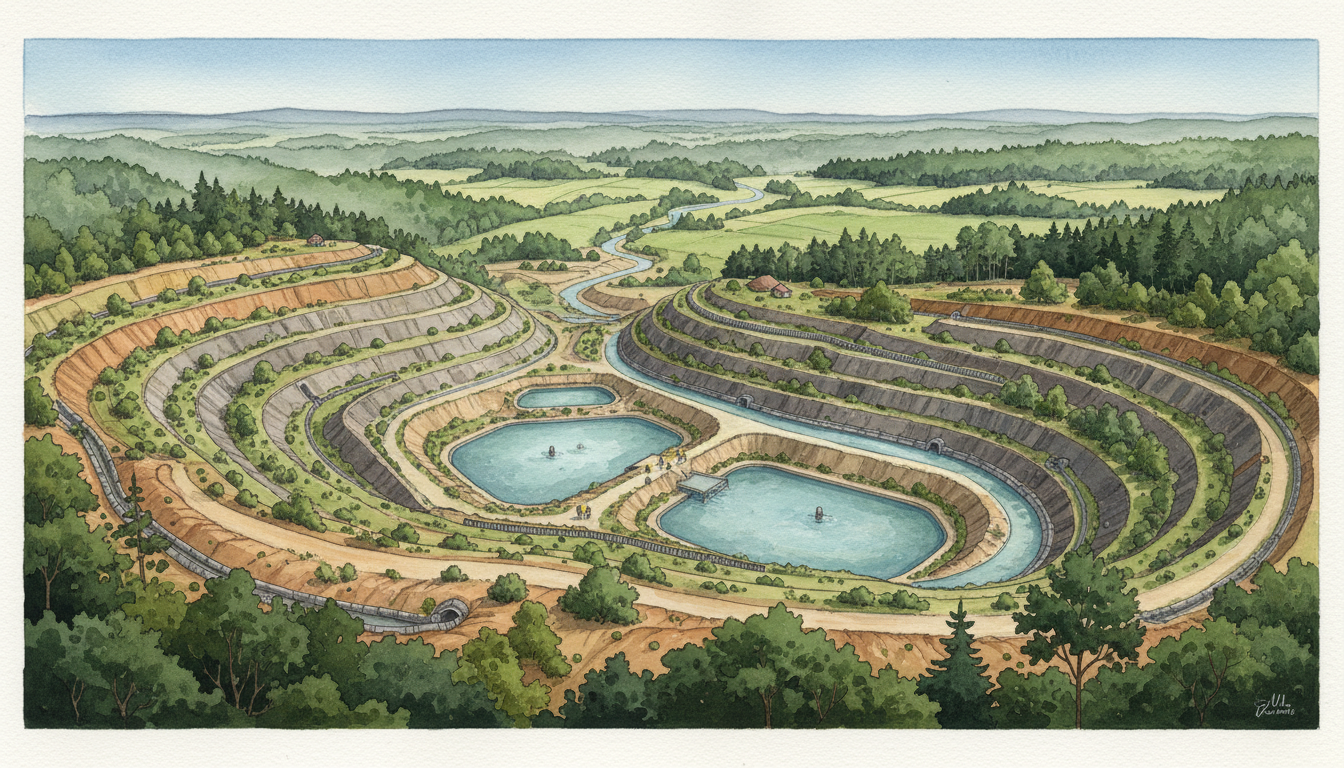
A mine can stop making money long before the land stops needing attention. Once digging ends, there may still be open pits, unstable slopes, tailings, dangerous shafts and water that requires treatment. If the mining company goes bankrupt or disappears, the problem does not vanish with its corporate registration. Someone must keep nearby residents safe and decide who finances the work.
Imagine a mine that once paid wages and local taxes. Production ends. The owners become insolvent, and the site fence begins to fail. A creek downstream shows signs of contamination. A community wants the government to act, while taxpayers ask why the company did not save enough money to clean up after itself.
Who pays for mine cleanup when the mining company disappears? The answer depends on the mine’s legal obligations, financial security deposited before failure, recoverable assets, insurance or special public funds, and whether it is a modern regulated mine or a historical site abandoned before modern requirements existed.
Quick answer: money should be arranged before the mine closes
The basic sequence is mining permit → closure and rehabilitation plan → estimated cleanup liability → financial security or industry contribution → periodic review → site closure or operator failure → responsible authority uses lawful funding and enforcement powers → site is made safe and monitored.
Where the mining company still exists and can meet its obligations, it should normally perform the rehabilitation it is legally required to do. Where it cannot, a government may be able to draw on a bond, cash security or guarantee. Where security is missing or insufficient, public programmes and taxpayers may bear costs while authorities explore lawful recovery from responsible parties.
A permit obligation is not the same thing as money already available. The best system needs both a legal duty to rehabilitate and a credible source of funds if the permit holder defaults.
What does mine rehabilitation involve?
Mine closure is not simply removing machinery and planting grass.
Work may include stabilising rock faces and tailings, filling or securing shafts, reshaping disturbed land, managing surface runoff, controlling contaminated drainage, protecting groundwater, treating water and restoring vegetation. Some sites need ongoing inspection or water treatment long after commercial operations end.
The required work depends on geology, minerals, mining methods, environmental approvals and future land use. A closed open-pit mine is different from an underground shaft or a tailings impoundment.
Reclamation, remediation and long-term monitoring overlap but are not identical. Reclamation restores disturbed land towards approved conditions. Remediation addresses contamination or other damage. Monitoring checks whether safety and environmental commitments continue to hold.
The cost estimate must be based on the work actually needed at that mine, not a generic cost per hectare.
Who is legally responsible at the start?
Mining legislation or the mine’s permit typically imposes rehabilitation conditions on the operator or other named responsible holder. The regulator can inspect, require plans, set deadlines and take enforcement action within its legal powers.
But responsibility can become complicated when assets are sold, ownership changes or a company enters insolvency. A creditor may have a security interest in equipment; an insolvency practitioner may control certain corporate decisions; a landowner and permit holder might be different legal persons.
It would be wrong to promise that every shareholder, parent company or director automatically becomes personally liable. Such liability depends on the applicable law, permits, guarantees and any proven wrongdoing.
For the public, the essential distinction is between who originally owed the obligation, who currently has lawful control, and which money the authority can actually access to prevent harm.
British Columbia: mine reclamation security
The Canadian province of British Columbia requires mine permittees to post reclamation security. Its government guidance, updated 22 January 2026, explains that the security is intended to cover the cost of reclaiming a mine if the operator defaults.
The amount is site-specific and reflects the outstanding reclamation liability and environmental or closure obligations. Officials can adjust it as mining disturbs new ground or as progressive reclamation reduces the remaining work.
The government holds the security until closure requirements have been satisfied; release is controlled through the prescribed official process. This matters because a company may be profitable today but insolvent when rehabilitation is due many years later.
The practical design is estimate the cost while the company is active, obtain real security, and update that protection as the mine changes.
Why the amount of the bond matters
Suppose an imaginary mine has an independently assessed remaining rehabilitation cost of $30 million. The regulator holds only $20 million of usable security when the company fails.
The difference is an illustrative $10 million funding gap, before any recovery from other responsible parties, assets or funding programmes. A regulator cannot solve that gap simply by pointing to a permit that says the former company must pay.
These numbers are hypothetical; they are not an estimate for a real British Columbia mine. The point is that the existence of a bond does not prove the bond is large enough.
Costs can rise because of inflation, new contamination evidence, changes in the site, contractor prices and the need for long-term treatment. Governments should review estimates and the financial strength of guarantees throughout the operating life.
Why progressive reclamation is helpful
A company can sometimes restore completed parts of a mine while production continues elsewhere. This is progressive reclamation.
It can reduce the amount of disturbed land left at closure and help officials judge whether proposed methods work. It may also reduce the eventual financial-security requirement once completed work has been verified.
However, removing some machinery or seeding one slope does not necessarily eliminate water-treatment obligations or make a tailings facility safe. The regulator must distinguish demonstrated completion from work merely promised.
A sensible system rewards verified reduction of liabilities while keeping security adequate for the work that remains.
Queensland: financial provision through a fund or surety
Queensland, Australia, offers another model. Its Financial Provisioning Scheme began on 1 April 2019 under the *Mineral and Energy Resources (Financial Provisioning) Act 2018*.
The scheme manages the state’s financial risk if resource-activity authority holders fail to meet rehabilitation obligations. Depending on the risk framework and authority, financial provision can involve contributions to a scheme fund or providing surety.
The Queensland environment department explains how an estimated rehabilitation cost is determined and used within the process, along with progressive rehabilitation and closure-plan requirements.
This is not merely another name for a private company’s savings account. It is a statutory mechanism that determines how risk and financial provision are managed at the state level.
What the Queensland fund can do
The Queensland Treasury explains that scheme funding can support lawful state responses where a resource holder does not meet its obligations and can support remediation of certain abandoned mining sites.
That does not mean every mine is financed through exactly the same mechanism. The scheme distinguishes risk categories, required contributions and sureties. Specific financial requirements depend on the authority and the current legislation.
Queensland was also reviewing elements of its Financial Provisioning Scheme in 2026. This illustrates an important principle: financial-assurance frameworks themselves need periodic review as the industry, costs and experience change.
A country should not describe a scheme’s existence as proof that public exposure has been reduced to zero. It must examine the fund’s resources, liabilities, legal powers and the quality of the risk estimates.
The United States: historic abandoned coal mines are a different problem
Modern mine closure failures and historic mining damage require different explanations.
The US Office of Surface Mining Reclamation and Enforcement explains that the Abandoned Mine Land (AML) Reclamation Program was established by Title IV of the *Surface Mining Control and Reclamation Act of 1977* to address hazards and environmental damage from historic coal mining.
The programme has been financed through fees on coal production, with legislative changes and further public investment over time. It is not simply a pot of money created by seizing a bond from every operator that fails today.
That distinction matters enormously. A legacy mine abandoned before modern rules may have no available operator or adequate security at all. Public programmes can then address dangers that cannot be remedied through ordinary enforcement against an active permit holder.
Do not assume that every abandoned metal mine or every current coal mine is automatically eligible for the same US legacy programme. Programme scope and eligibility are established by law.
How does a government choose which site to remediate first?
Where many mines are abandoned, officials may have less money than the total estimated need. The choice requires a documented risk-priority process.
Look first for immediate threats to life: accessible shafts, unstable ground, unsafe dams, dangerous structures or contaminated water reaching communities. Then consider long-term environmental risks, affected drinking-water sources, future land use, the cost of intervention and whether credible recovery funds exist.
Queensland’s abandoned mines programme manages named sites through investigation, design, remediation and care-and-maintenance activities.
The goal is not to make the oldest or most famous mine look tidy first. It is to reduce the most serious harm in a lawful, transparent order.
How bankruptcy changes the cleanup pathway
When a mining company becomes insolvent, the regulator needs legal and technical advice quickly. Equipment may be removed, essential staff may leave, and monitoring contractors may stop working if bills are unpaid.
A careful response identifies the mine’s permit conditions, the security held, existing closure plans, emergency hazards and any administrators or other legally responsible parties.
Authorities may need to secure a site before a final court or insolvency determination resolves financial claims. But they should not promise they may unconditionally take company property or recover all costs. Powers vary by jurisdiction.
This is a continuity-of-environmental-protection problem as well as a financial one.
The funding hierarchy: who might pay?
| Potential source | When it can help | Important limit |
|---|---|---|
| Mine operator | While legally responsible and able to comply | May have no remaining resources |
| Cash security or bond | When authorised to draw after default | Can be inadequate for actual costs |
| Guarantee or other surety | If valid and enforceable under its terms | Depends on creditworthiness and scope |
| Insolvency estate or other liable parties | If law permits recovery | Other claims and limited assets may constrain recovery |
| Industry-funded scheme | If site and expenditure qualify | Pool and eligibility rules differ |
| Public abandoned-mine programme | For eligible legacy or orphan sites | Taxpayer or industry funds are finite |
| Continuing public budgets | For urgent hazards or unfunded residual liabilities | Must be openly accounted for |
This is not a universal mandatory payment order. It is a map of possible sources that policymakers and communities should investigate under the relevant law.
Why long-term water treatment can dominate the cost
A site may look reclaimed from the road but still produce contaminated drainage. Acidic water can mobilise metals, while tailings and waste rock can require continuing monitoring.
A one-time construction budget may therefore underestimate total obligations. Governments should estimate future operating costs, possible plant replacement, monitoring and contingency actions.
If funds are released too early after landscaping is completed, a later public authority may inherit expensive environmental treatment with no dedicated revenue.
Closure acceptance should be based on demonstrated performance and lawful requirements, not on the operator’s wish to close its books.
Communities and Indigenous interests matter
Residents need to know whether drinking water and land are safe, which areas remain restricted and who receives reports of new hazards. Indigenous nations or traditional landholders may have legal rights and enduring cultural or environmental interests in the affected land.
Consultation should not occur only after all rehabilitation decisions are made. Communities may know where runoff crosses farmland, which paths children use or which areas have cultural significance.
But technical evidence still matters. Water quality and slope stability need testing and competent engineering, alongside legitimate community priorities.
A credible mine-closure system combines lawful authority, scientific monitoring, accessible public information and meaningful community participation.
A worked example: the company disappears
Consider a hypothetical copper mine with an approved closure plan. It is no longer operating. Its parent company enters insolvency proceedings while a contractor reports deteriorating drainage infrastructure.
Step one: the regulator confirms the legal status of the permit holder and the immediate site hazards.
Step two: officials secure dangerous areas and ensure essential inspections or water treatment continue where lawful.
Step three: the responsible agency reviews the closure cost estimate, available security and the guarantee’s enforceability.
Step four: public procurement or emergency contracting arranges the necessary work, within legal powers and funding approvals.
Step five: recovery options are pursued against legally responsible parties, without assuming every shareholder is personally liable.
Step six: a public report states what work is complete, the remaining risks, total costs and who currently finances monitoring.
This is an explanatory workflow, not a single country’s mandatory procedure. It distinguishes urgent safety action from the eventual allocation of legal and financial liability.
How governments can reduce future orphan-mine costs
Prevention is easier before the mine’s resources have disappeared.
- Require realistic closure and rehabilitation plans before disturbance begins.
- Update financial security when production, mine design or costs change.
- Verify progressive reclamation instead of accepting unsupported claims.
- Assess whether sureties and guarantees will be collectible when needed.
- Keep current information about ownership, permits and responsible entities.
- Budget for long-term or residual environmental risks where law requires.
- Conduct independent inspections and publish material deficiencies.
- Make the process for using financial security and reporting expenditures clear.
An important warning: a large headline bond figure means little without a site-specific cost estimate and confidence that the instrument can be called.
What should taxpayers ask?
A good public report should identify the operator or former operator, the reason a site is classed as abandoned, immediate risks, legally available funds, estimated outstanding work and what public budget is being used.
It should distinguish funds on hand, costs already incurred, anticipated costs, and money government hopes to recover.
An authority should not report money as recovered merely because it has filed a claim. Likewise, a commitment to investigate a contaminated site is not proof that the contamination has been removed.
The strongest accountability question is: Who is responsible for keeping this site safe next year, and is there money to do it?
Common misconceptions
“The mining company is gone, so nobody is responsible.” Public authorities may retain regulatory, emergency and environmental duties, even when recovery from the operator is difficult.
“A bond always pays the entire bill.” A security instrument can be too small, conditional, disputed or difficult to realise.
“All abandoned mines are recent corporate failures.” Many are legacy sites from before modern closure rules existed.
“Planting grass means the mine is safely closed.” Stability, contaminated water and long-term obligations may remain.
“Taxpayers must always pay everything.” Security, industry schemes and recoveries may fund part of the cost, depending on law.
“The government can always charge any shareholder.” Personal or corporate liability depends on specific legal grounds.
Frequently asked questions
What happens when the rehabilitation bond is insufficient?
Authorities may use the available lawful security and pursue other recoveries, but any shortfall may require eligible public or industry-funded programmes. The precise obligations depend on the jurisdiction.
Why not collect the entire cleanup cost before mining starts?
Regulators can require security for estimated future liabilities and update it as conditions change. Complete costs and long-term risks can remain uncertain, and different countries choose different forms and levels of security.
Is an abandoned mine always a pollution emergency?
No. Risks vary. Some sites need urgent safety measures; others need monitoring, restoration or limited intervention. Risk assessment guides priority.
Does the United States’ AML programme cover every abandoned mine?
No. Its federal coal legacy programme has defined legal eligibility and funding arrangements. Other sites can fall under different frameworks.
Can government recover money after the cleanup has begun?
It may be able to pursue legally responsible parties or available security, but recovery is not guaranteed. Emergency protection and legal recovery often proceed on different timelines.
Country connections and companion guides
Use How Canada Works, How Australia Works and How the United States Works for the national institutions behind the examples.
The sibling article How Is Resource Revenue Shared With the Regions That Produce It? explains how governments distribute money earned from extraction. This guide asks who finances the environmental obligations that can remain after extraction ends. Those are separate accounting and justice questions.
The How Countries Work | A–Z Guide to 195 Countries and Everyday Life is the master directory.
Official sources and further reading
- British Columbia — Reclamation securities for mines, updated January 2026.
- Queensland Treasury — Financial Provisioning Scheme.
- Queensland Government — Mining rehabilitation reforms.
- Queensland Government — Abandoned mine remediation projects.
- US Office of Surface Mining — Abandoned Mine Land Reclamation Program.
Evidence reviewed: 21 October 2026. Laws, security amounts and priorities can change. The financial example is illustrative; it is not a claim about an actual mine.
The final lesson
Mine cleanup needs a payer before the mine becomes a liability. Countries can protect communities by demanding realistic closure plans, financial provision, ongoing monitoring and clear public powers. When a company still disappears, they need to act on hazards, account for public spending and seek recovery where the law allows.
The whole system is mining permission → rehabilitation duty → credible security → verified work → operator failure contingency → safe cleanup → long-term monitoring → public accountability.