
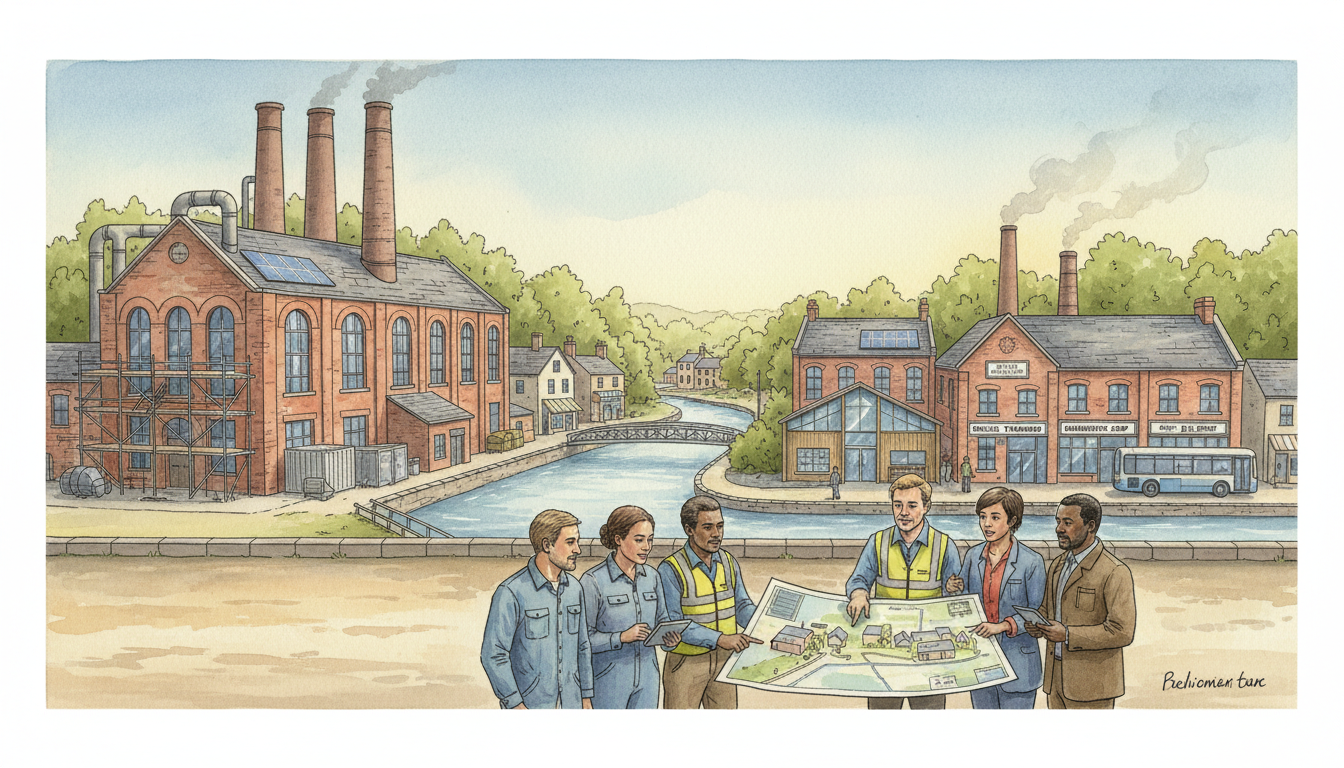
When a major industry declines, countries need two recovery plans: one for the people losing work and another for the place losing its economic foundation. Severance, unemployment benefits and retraining can help individual workers. But a town may still lose shops, suppliers, tax revenue and younger residents if no new activity replaces the industry.
Imagine a manufacturing town where one large plant employs 2,000 people and buys services from local repair firms, cafés and hauliers. Orders have been falling for years. A closure announcement affects the workforce immediately, but the town faces a second wave: smaller firms lose customers, housing prices may change and local government receives less revenue.
This is the question behind how countries help workers and towns when an industry declines. A good national response links immediate household protection to a credible long-term local economy. It avoids treating a training certificate, a single new factory or an optimistic jobs forecast as proof that the transition is complete.
Quick answer: protect incomes while rebuilding opportunity
The basic route is identify the industrial decline early → engage workers, employers and communities → maintain near-term household income and access to services → recognise transferable skills → connect people to real vacancies → invest in new firms and infrastructure → manage unused industrial sites → monitor job quality and local outcomes over years.
A worker programme can fund employment services, wage protection, retraining or relocation where authorised. A regional programme can support business creation, land remediation, connectivity, local suppliers, health services and investment.
The central distinction is worker adjustment ≠ regional economic recovery. They overlap, but neither substitutes for the other.
Why industry decline can spread beyond a factory gate
A large employer may support a network of contractors, transport providers, specialist services and community businesses. When it reduces production, spending falls throughout that network.
The local tax base may weaken at the same time that demand rises for unemployment support, healthcare or retraining. Houses can become harder to sell, which makes it difficult for residents to move for new work. Younger workers may leave, reducing school enrolment and worsening the challenge of financing local services.
A closed plant can also leave contaminated land, power connections, rail sidings and other assets. Some are valuable for new uses; others require costly remediation.
So a national programme has to understand direct jobs, indirect work, family income, local services and physical sites. Counting the announced factory jobs alone understates the problem.
Step one: distinguish a sudden collapse from a planned transition
A factory may close abruptly after a financial shock or bankruptcy. In that case, households may need urgent income and legal assistance. Other industries shrink over many years because technology, international competition, resource depletion or environmental policy changes demand.
A planned closure creates an opportunity to prepare workers and places before the last pay cheque. Public agencies can collect skills information, review affected supplier firms and identify suitable land uses.
Neither case should be reduced to a one-size-fits-all response. The most useful intervention depends on the speed of change, the age and skills of the workforce, nearby job markets and whether other economic activity is feasible.
The companion article Who Pays Unpaid Wages When an Employer Goes Bankrupt? addresses unpaid pay and insolvency rights. This article covers the broader employment and town-level transition.
Real example: US Appalachian coal-community investment
The Appalachian Regional Commission’s POWER Initiative targets places affected by changes in the coal economy. Its name stands for *Partnerships for Opportunity and Workforce and Economic Revitalization*.
The initiative supports projects that create jobs in other industries, attract private investment and train workers. That can include advanced manufacturing, entrepreneurship, healthcare, tourism and workforce development.
On 17 September 2026, ARC announced $45.5 million in awards to 47 projects across eight Appalachian states. The agency said the projects were expected to create or retain more than 1,100 jobs and prepare over 11,000 workers and students.
The word “expected” matters. These are projections at the award stage, not independently verified final job outcomes. To judge the programme, readers should later check actual employment, wages, business survival and whether the people affected by coal job losses benefited.
The example shows why helping a former mine worker does not automatically revive a town. The region needs businesses capable of employing workers and serving new markets after the original industry declines.
Real example: the European Just Transition Fund
The European Commission’s Just Transition Fund aims to limit social and economic costs in regions especially affected by the transition to climate neutrality.
The policy targets places with strong dependence on fossil fuels such as coal, peat and oil shale, or greenhouse-gas-intensive industrial processes. Support is tied to approved Territorial Just Transition Plans, rather than granted automatically to any place claiming to be affected.
Eligible activities can help diversify economic activity, create business opportunities and assist workers in a changing labour market. The wider Just Transition Mechanism can also support public investments in infrastructure, energy transition and land recovery under its respective rules.
This is an example of place-based policy. The fund is designed around specific regions with identifiable structural risks, not a generic promise that every worker everywhere will receive the same benefit.
It also demonstrates a major trade-off: public money should help create lasting alternatives rather than merely delay an unavoidable restructuring without a plan.
Real example: Australia’s Net Zero Economy Authority
Australia’s Net Zero Economy Authority is an independent statutory authority established to support workers, industries and regions through changes associated with the net-zero transition.
Its planning work identifies regions with significant industrial and energy changes, including coal-linked places such as Collie, the Hunter and the Latrobe Valley. The authority’s remit emphasises workers, communities, investment opportunities and coordination across governments.
That is a useful model of national capacity linked to regional plans. A central institution can convene different ministries, employers and communities, but the best investments depend on local land, infrastructure, workforce skills and actual business opportunities.
The authority’s existence is not proof that every displaced worker has already obtained a comparable new job. Outcomes require continuing evidence.
Why income support comes first
People need food, housing and medical care during a job transition. Training programmes cannot replace the rent payment due next week.
Depending on the country and employment classification, short-term protection may include statutory redundancy pay, unemployment insurance, wage guarantees, household assistance and pension or health-coverage continuity.
Different groups have different needs. A worker with a mortgage and school-age children may need immediate income stability. A near-retirement worker might face a very short remaining working horizon. A subcontractor whose contracts disappear may not qualify for the same employee protections.
A response should therefore assess who was employed, who was self-employed, whose income fell indirectly and which statutory protections actually apply.
Retraining must connect to genuine jobs
Governments often announce retraining after a factory closure. But training has little value if the nearest relevant vacancies are hundreds of kilometres away or pay far less than the worker’s previous job.
A serious skills programme begins with local employer demand. It identifies specific occupations, required certification, workers’ existing skills, paid training opportunities and the likely time until employment.
For example, a coal-plant electrician may already have electrical safety, maintenance and industrial-control skills. A useful transition plan should recognise that experience, then identify the additional qualifications actually needed for a new employer.
A displaced worker may also need childcare, transport or income support while studying. Training may have to be delivered around household responsibilities and adult learning needs.
The correct measure is sustained work at a usable wage, not just the number of certificates handed out.
What if the new jobs pay less?
Employment statistics can disguise a loss of household security. A worker who moves from a stable high-paid industrial role to several part-time low-paid jobs may be recorded as re-employed, but the family may still face financial distress.
Countries can assess wage changes, hours, job security, access to pensions, health benefits and travel costs when reporting re-employment outcomes.
Some transition arrangements may include lawful wage insurance, targeted income support or relocation help. Such programmes have costs and conditions, and different countries make different choices.
A good evaluation asks how many people maintain a sustainable income, not merely whether they have any employment.
Why towns need economic diversification
A town dependent on one firm or one commodity is exposed to a concentrated shock. Economic diversification seeks multiple employers, skills and markets so that the region is not vulnerable to the same single decision in future.
Possible opportunities depend on local conditions. An industrial region might reuse logistics corridors for manufacturing, energy equipment or warehousing. Another may develop tourism or health services. A coastal town may invest in marine industries. None of these alternatives should be assumed suitable without evidence.
National governments can support infrastructure, industrial sites, business services, research partnerships and finance. Local authorities can contribute land-use decisions, training relationships and knowledge of community needs.
The goal is not to recreate the old factory under a fashionable name. It is to build several viable sources of income and employment that can survive without perpetual emergency subsidy.
The role of supply chains and local firms
When a large employer closes, many affected workers may be employed by transport companies, maintenance suppliers or local shops rather than the headline company.
Government assistance should therefore examine the supplier network and local service economy. A programme restricted only to former direct employees can miss a large part of the shock.
Small firms may need help finding new customers, meeting technical standards, accessing finance or joining different supply chains. But grants must be tied to realistic demand and avoid supporting businesses with no viable market.
A local development plan should track supplier revenue and the number of independent customers, not simply count new business registrations.
What happens to the old industrial site?
A plant’s closure may leave valuable infrastructure alongside pollution or unsafe buildings. Before the land can support new activity, officials may need to determine ownership, environmental responsibility, remediation costs, utility connections and allowed future uses.
Cleaning a contaminated site and marketing it to new investors are not the same job. The relevant environmental and land-use authorities should identify who has legal responsibility for rehabilitation.
This article focuses on linking site redevelopment to workers and local recovery. Detailed engineering and zoning processes belong with dedicated environmental and town-planning explanations.
The public should be told whether a site is safe and available for new uses, what work remains and who is financing it.
Why consultation changes the quality of the plan
Workers know the actual skills and equipment used in their industry. Small firms understand local supply chains. Families can identify barriers such as childcare and transport. Indigenous and other local communities may have legal, cultural or land interests that cannot be ignored.
The ILO’s Just Transition Guidelines emphasise social dialogue among governments, workers and employers alongside social protection and decent work.
Consultation should occur early enough to influence choices, not only after a replacement industry has already been selected. It should include people facing indirect job losses and those who may otherwise be excluded from decisions.
A practical outcome is a transition plan with named responsible bodies, published funding, actual milestones and accessible feedback channels.
Who pays: national, regional or private actors?
Industrial decline often requires several funding sources. Employers may have obligations under labour, environmental or contractual law. National governments may fund unemployment support, training or regional grants. State and local authorities may provide infrastructure, land services and community support.
Private firms can invest in viable new industries, while public resources may reduce legitimate barriers to investment. But a region should not assume every proposed investor will materialise.
Where a public grant is offered, performance conditions should be clearly documented. The government may need to recover funds, revise milestones or terminate support if the project fails to meet agreed terms.
The funding chain is lawful programme → transparent selection → verified investment or service → workers and places receive benefit → public evaluation.
What should happen in the first year?
An effective first-year plan can use a simple sequence.
First month: establish reliable information about closures, affected workers, suppliers and urgent household needs. Publish a single access route for employment and social services.
First three months: connect affected people to income protection, counselling, skills assessments, employer interviews and available training. Begin assessing local economic and site conditions.
By six months: test actual vacancies and investment proposals. Identify potential industrial-site reuse, infrastructure gaps and finance arrangements. Adjust training where the jobs evidence is weak.
By one year: publish outcomes for re-employment, income changes, service continuity, supplier recovery and approved new projects. Explain what still has not worked.
These timings are illustrative planning checkpoints, not universal statutory duties. Large transitions may require many years. The essential principle is to combine short-term protection with a monitored long-term local strategy.
How do we know whether a transition succeeded?
The right indicators extend beyond announcements or allocated money.
- Number of displaced workers with a new job after six months, one year and longer periods.
- Wage levels, hours, employment security and pension coverage in new roles.
- Participation in training and confirmed placement in jobs needing those skills.
- Business survival, local investment and diversity of employers.
- Household poverty, housing stability and access to healthcare.
- New residents, out-migration and changes in the local tax base.
- Rehabilitation and productive reuse of industrial land.
- Public expenditure compared with delivered outcomes.
A region may attract a large new business but still leave many former workers without suitable jobs. Conversely, a smaller group of sustainable local firms may provide more resilient long-term employment than one highly publicised replacement plant.
Common failure modes
Training without vacancies: programmes produce certificates but no jobs.
One replacement megaproject: the town becomes dependent on a new single employer.
Ignoring indirect workers: contractors, shopkeepers and casual workers fall outside support.
Poorly funded public services: local schools and transport weaken during the transition, making investment less attractive.
Optimistic announcements treated as results: projected positions are counted as actual sustained jobs.
Weak environmental handover: old industrial sites remain contaminated or legally unusable.
No regional voice: investment plans overlook local conditions and people’s constraints.
Short political time horizons: programmes end before new industries are stable enough to support the community.
Frequently asked questions
Does retraining guarantee displaced workers new jobs?
No. Training is only helpful when suitable employment or business demand exists and workers can access the opportunities.
Should government save the old industry indefinitely?
That is a policy decision requiring economic, social and environmental evidence. Short-term support can protect workers, but sustaining an activity without a viable path may delay rather than prevent a painful transition.
Why support a town instead of simply helping people move?
Relocation may be right for some households, but others have care responsibilities, housing constraints, community ties or jobs that could be developed locally. A national response should assess both options fairly.
Is this only about coal and climate policy?
No. Similar problems arise in manufacturing, shipbuilding, textiles, fisheries and other industries affected by technology, trade or demand. Coal-transition programmes offer useful documented examples of the underlying principles.
Are projected jobs the same as jobs already created?
No. Grant announcements and business plans often describe expectations. Sustained employment needs later independent verification.
Related country guides and series links
Read How the United States Works and How Australia Works to place the examples in their national institutions.
The next companion topic on shrinking populations and public services is different: a town can lose residents without a single dominant industrial closure. This article concerns an industry-specific shock to workers, supply chains and a local economy.
See also Why Is Income Protection Different for Employees and the Self-Employed? and How Do Countries Fund Public Services in Regions With Smaller Tax Bases?.
Return to How Countries Work | A–Z Guide to 195 Countries and Everyday Life.
Official sources and further reading
- Appalachian Regional Commission — POWER Initiative.
- Appalachian Regional Commission — September 2026 coal-community awards.
- European Commission — Just Transition Fund.
- European Commission — Investment areas under the Just Transition Mechanism.
- Australia — Net Zero Economy Authority.
- ILO — Just Transition Guidelines.
- ILO — Active labour market policies for a just transition.
Evidence checked 21 October 2026. Grant totals and projected jobs are dated claims from their issuers; projected results should not be described as realised outcomes.
Final takeaway
A country does not recover from industry decline simply by announcing training or attracting one new company. It must protect workers’ incomes, build real pathways into sustained work, strengthen the town’s economic base and maintain essential services while the transition happens.
The full country-system chain is industrial shock → worker and supplier needs → immediate support → skills and investment → viable local jobs → stable public services → measured long-term recovery.