
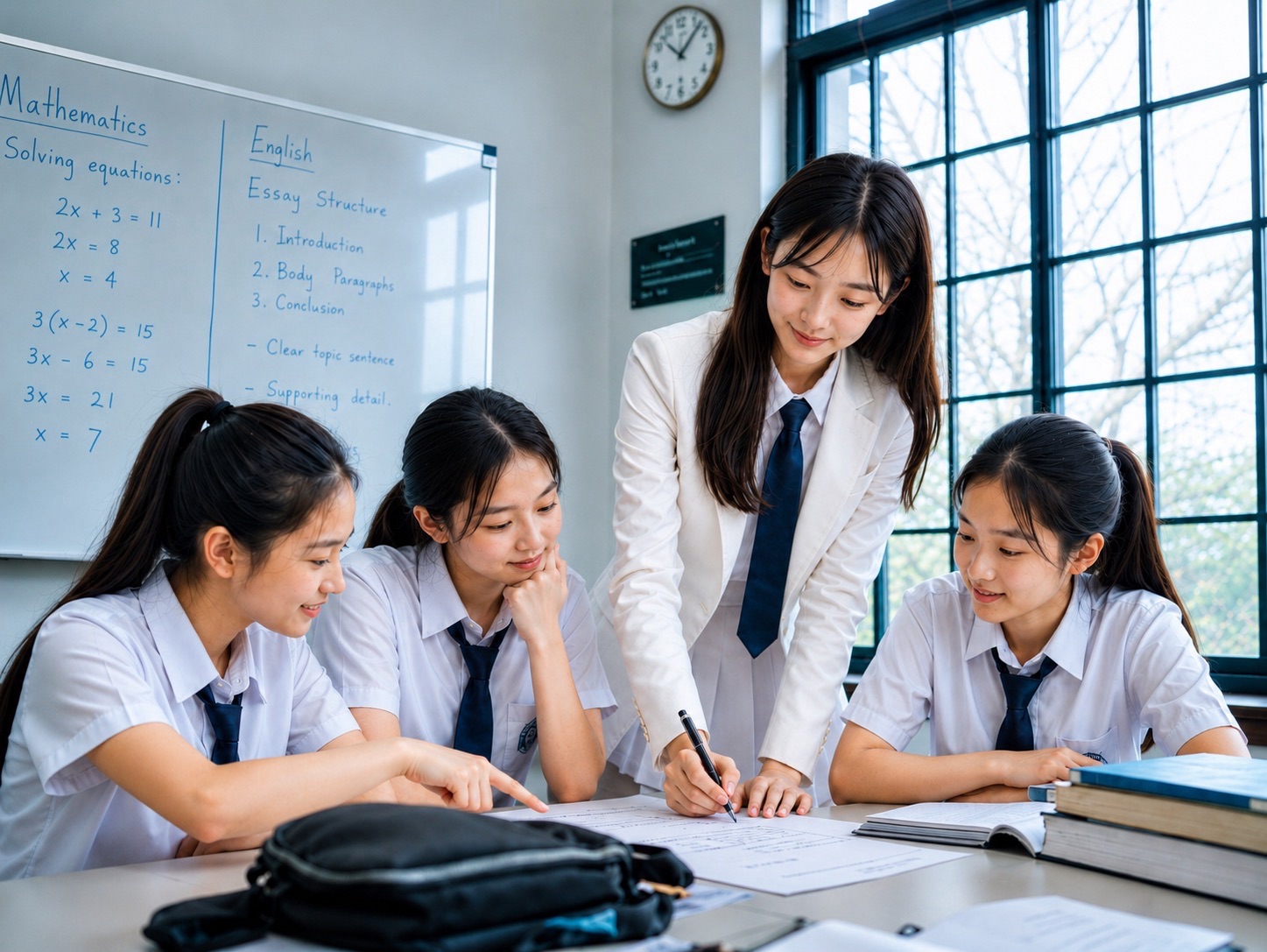
How eduKateSG Bukit Timah Secondary Mathematics Tutorials Work | Sec 1 to Sec 4 preserves one distinct reader job: The Sec 1 to Sec 4 Mathematics Progression. It supports the main Bukit Timah Secondary Mathematics route instead of duplicating it.
For class placement, use Secondary 1 Math Tuition Bukit Timah when relevant. For the wider reading architecture, use the Bukit Timah Secondary Mathematics and A-Math Article Directory.
eduKateSG uses premium 3-pax small groups near Sixth Avenue MRT so the tutor can inspect working closely, identify the actual failure point and reduce prompting as the student becomes more independent.
The Sec 1 to Sec 4 Mathematics Progression
The article’s special idea is kept because it answers a narrower question than the main commercial page. That separation gives readers a clearer route and reduces unnecessary overlap between pages.
- Secondary 1: build the symbolic bridge.
- Secondary 2: connect the lower-secondary network.
- Secondary 3: build the upper-secondary system.
- Secondary 4: prioritise, integrate and perform.
- Diagnose the first unstable point rather than treating every weak topic separately.
- Reduce support as independent mathematical control grows.
How the 3-Pax Tutorial Uses This Idea
The tutor can compare different solution routes, stop at the exact point where reasoning breaks and then return the learner to independent work. Practice is chosen for the mechanism that needs repair, not simply added by volume.
Extended Guide: The Sec 1 to Sec 4 Mathematics Progression
This page is the Secondary 1–4 high-performance progression guide. It keeps this specialised identity rather than competing as another generic tuition landing page. For current year-level and class routes, continue to the Bukit Timah Secondary Mathematics Directory.
eduKate’s Bukit Timah High Performance Sec 1 to Sec 4 Math Tuition helps students move from lower-secondary foundations into upper-secondary confidence and examination control. From Sec 1 transition, Sec 2 bridging, Sec 3 abstraction and Sec 4 execution, students are taught to understand concepts, correct mistakes, connect topics and perform under pressure. At eduKateSG, the goal is to help students catch up, keep up and move ahead with clearer thinking, stronger habits and calmer Mathematics confidence.
Secondary Mathematics with eduKate Bukit Timah is not one subject moving in a straight line.
It is a system.
Sec 1 is the transition year.
Sec 2 is the bridge year.
Sec 3 is the pressure year.
Sec 4 is the execution year.
A student who struggles in Sec 4 may not only have a Sec 4 problem. The weakness may have begun in Sec 1 algebra, Sec 2 graph work, Sec 3 trigonometry, or years of careless working that were never corrected properly.
This is why eduKateSG Secondary Mathematics tutorials do not treat Mathematics as a worksheet problem.
We treat it as a learning system.
The student must be diagnosed.
The weak parts must be repaired.
The correct habits must be trained.
The school syllabus must be supported.
The examination pathway must be prepared.
The student must learn how to think, work, check and perform.
Some students need Rescue.
Some need Growth.
Some need Distinction training.
Some need confidence.
Some need algebra repair.
Some need G2 support.
Some need G3 stretch.
Some need examination strategy.
Some need to stop hiding behind the word “careless” and start seeing the real mistake pattern.
Good Secondary Mathematics tuition is not simply more practice.
It is proper instruction.
It helps students catch up, keep up and move ahead.
What is High Performance Sec 1 to Sec 4 Math Tuition?
High Performance Sec 1 to Sec 4 Math Tuition is not simply harder tuition.
It is not about rushing students through more worksheets.
It is not about giving the most difficult questions immediately.
It is not about pressure for its own sake.
High Performance Mathematics Tuition means building a student who can understand, apply, connect, adapt and perform.
From Secondary 1 to Secondary 4, Mathematics changes shape.
Sec 1 is the transition year.
Sec 2 is the bridge year.
Sec 3 is the upper-secondary jump.
Sec 4 is the examination execution year.
A student who is not taught properly at Sec 1 may carry weak algebra into Sec 2.
A student who is unstable in Sec 2 may suffer when Sec 3 Mathematics becomes more abstract.
A student who cannot control algebra, graphs and trigonometry in Sec 3 may struggle badly in Sec 4.
A student who only knows topics separately may collapse when the national examination paper mixes everything together.
This is why High Performance Mathematics Tuition must be a system.
It must diagnose.
It must build.
It must connect.
It must train.
It must correct.
It must prepare the student for performance.
At eduKateSG, High Performance Sec 1 to Sec 4 Math Tuition is designed to help students catch up, keep up and move ahead.
The goal is not only better marks.
The goal is a stronger mathematical learner.
High Performance does not mean high pressure
Parents sometimes misunderstand the phrase High Performance.
They may think it means pushing the child harder all the time.
More homework.
More tests.
More worksheets.
More speed.
More pressure.
That is not high performance.
That is just more load.
High Performance Tuition is not about crushing the student.
It is about building the system that allows the student to carry the subject properly.
A high-performance student is not one who is always stressed.
A high-performance student is one who has control.
They know how to read a question.
They know how to start.
They know how to choose a method.
They know how to write clearly.
They know how to check.
They know how to recover when stuck.
They know how to perform under time.
That is performance.
Not panic.
Secondary Mathematics is a four-year build
Secondary Mathematics should not be seen as four separate years.
It is one connected build.
Sec 1 introduces the new language.
Sec 2 strengthens the bridge.
Sec 3 raises the level of abstraction.
Sec 4 tests the full system.
If a student only reacts year by year, problems can accumulate quietly.
A weak Sec 1 algebra habit becomes a Sec 2 equation problem.
A weak Sec 2 graph understanding becomes a Sec 3 function problem.
A weak Sec 3 trigonometry foundation becomes a Sec 4 examination leak.
A weak Sec 3 Additional Mathematics base becomes a Sec 4 calculus crisis.
This is why High Performance Tuition looks at the whole pathway.
We do not only ask:
“What topic is the student doing this week?”
We ask:
“What kind of mathematical system is this student building?”
That is the better question.
Sec 1: the transition year
Secondary 1 Mathematics is not Primary 7.
It is a phase shift.
Students move from primary-school problem types into a more symbolic and structured mathematical world.
Algebra becomes more important.
Negative numbers appear more often.
Equations become more formal.
Geometry becomes more reasoned.
Data handling becomes more organised.
Word problems require better translation.
Working must become clearer.
Some students are surprised by this.
They did well in Primary School because they could recognise common patterns.
But in Secondary 1, they need stronger symbolic control.
They must learn to use letters.
They must accept abstraction.
They must write proper mathematical steps.
They must explain reasoning more clearly.
High Performance Sec 1 Math Tuition therefore focuses on foundation and transition.
The student must not only get answers.
They must learn how secondary mathematics thinks.
What High Performance Sec 1 tuition builds
At Sec 1, we build the base.
The student must become comfortable with algebraic language.
They must understand that x is not frightening.
It is a tool.
They must learn to simplify, expand, factorise where appropriate, solve equations and organise working.
They must also build number sense, ratio understanding, geometry awareness and problem-solving discipline.
This is where habits matter.
If the student learns to skip steps too early, the habit becomes dangerous later.
If the student does not show working, mistakes become harder to find.
If the student memorises without understanding, they may pass early tests but struggle later.
So Sec 1 tuition must be patient and precise.
The goal is to build a student who can enter the secondary system calmly.
Not merely survive the first term.
Sec 2: the bridge year
Secondary 2 is often underestimated.
Parents may think Sec 2 is still early.
The major examinations are not here yet.
The pressure may feel lower.
But Sec 2 is important because it bridges lower-secondary foundations into upper-secondary demand.
The student’s algebra must become stronger.
Their graph sense must improve.
Their geometry must become more disciplined.
Their equation-solving must become more reliable.
Their ability to handle worded problems must mature.
Their reasoning must become clearer.
Sec 2 is where many hidden weaknesses become more visible.
The student may still pass.
But the working may be messy.
The algebra may be fragile.
The graph interpretation may be weak.
The careless mistakes may repeat.
The student may depend too much on familiar question forms.
This is dangerous because Sec 3 will raise the demand.
High Performance Sec 2 Math Tuition strengthens the bridge before the jump.
What High Performance Sec 2 tuition builds
At Sec 2, we focus on consolidation and readiness.
The student must become more independent.
They should not only follow the tutor’s explanation.
They should be able to attempt, explain and correct.
This is where route recognition begins to matter more.
The student must learn to see what a question is testing.
Is this algebra?
Is this geometry?
Is this a graph question?
Is this a ratio question?
Is this a problem-solving setup?
Is this asking for an equation?
Sec 2 tuition should also prepare students for subject-level movement and future pathway decisions.
Some students will continue into G2 Mathematics.
Some will take G3 Mathematics.
Some will later face Additional Mathematics.
Some may need stronger support before upper secondary.
The right Sec 2 tuition gives clarity.
It shows whether the student is truly ready.
Not just whether they scraped through the latest test.
Sec 3: the upper-secondary jump
Secondary 3 is where Mathematics changes again.
For many students, this is the real shock.
The subject becomes more abstract.
The pace becomes faster.
The questions become more demanding.
The working becomes longer.
The topics become more connected.
The marks become less forgiving.
Students who relied on memorised patterns may struggle.
Students who had weak algebra may suddenly feel exposed.
Students who were comfortable in lower secondary may discover that upper secondary Mathematics is a different machine.
Sec 3 is also where some students begin Additional Mathematics.
This creates another layer of demand.
E-Math and A-Math are not the same.
E-Math develops broad mathematical fluency across many areas.
A-Math demands deeper algebra, functions, trigonometry, logarithms and calculus-style thinking.
High Performance Sec 3 Math Tuition must therefore help students adjust to the new operating system.
What High Performance Sec 3 tuition builds
At Sec 3, we build upper-secondary control.
This means the student must handle more complex algebra.
They must read graphs more intelligently.
They must understand functions where required.
They must manage geometry and trigonometry with better discipline.
They must recognise question routes.
They must stop depending only on examples.
They must start thinking in structure.
For students taking Additional Mathematics, Sec 3 is especially important.
This is where the foundation for Sec 4 A-Math is built.
If Sec 3 algebra is weak, Sec 4 calculus becomes painful.
If Sec 3 functions are weak, graphs and transformations become confusing.
If Sec 3 trigonometry is weak, identities and equations become unstable.
Sec 3 tuition should not be reactive only.
It should build forward.
The student must not merely survive Sec 3.
They must prepare for Sec 4.
Sec 4: the execution year
Secondary 4 is the performance year.
By Sec 4, the student must stop thinking only chapter by chapter.
The examination tests the full system.
It tests whether the student can recognise, choose, solve, write, check and manage time.
A Sec 4 student may know many topics and still underperform.
Why?
Because the paper mixes topics.
Because timing matters.
Because careless mistakes become expensive.
Because hard questions can disturb confidence.
Because the student must decide what to do without being told the chapter.
Because working must be clear enough to earn marks.
High Performance Sec 4 Math Tuition therefore focuses on examination execution.
Not only revision.
Execution.
What High Performance Sec 4 tuition builds
At Sec 4, we train performance.
The student must know which topics are secure and which topics are leaking.
They must practise mixed questions.
They must learn paper strategy.
They must know how to protect easy marks.
They must know how to fight for harder marks without sacrificing the whole paper.
They must correct repeated mistakes.
They must reduce careless leakage.
They must manage time.
They must build confidence through trained control.
For A-Math students, this may involve calculus, trigonometry, logarithms, functions and full-paper precision.
For E-Math students, this may involve algebra, geometry, graphs, statistics, probability, mensuration and application questions.
The exact topics differ.
But the goal is the same.
The student must perform.
High Performance Tuition begins with diagnosis
Every student enters tuition with a different pattern.
One student may be weak in algebra.
Another may understand concepts but panic in tests.
Another may be careless because their working is messy.
Another may do well in class but badly in exams.
Another may be strong but not yet distinction-ready.
Another may have lost confidence after repeated poor results.
This is why diagnosis matters.
We look at:
Can the student start questions independently?
Can they explain their method?
Is the algebra clean?
Do they recognise topics?
Do they write enough working?
Do they repeat the same mistakes?
Do they manage time?
Do they panic when questions look unfamiliar?
Do they know how to correct?
The answer tells us what support is needed.
Without diagnosis, tuition becomes generic.
With diagnosis, tuition becomes targeted.
Rescue, Growth and Distinction
High Performance Tuition uses three broad support modes.
Rescue.
Growth.
Distinction.
These are not labels for the child.
They are working modes.
A student may be in Rescue for algebra, Growth for geometry and Distinction-ready for statistics.
Another may begin in Rescue and later move into Growth.
Another may already be capable but need Distinction training.
The point is not to judge.
The point is to teach the next correct step.
Rescue: when the student is losing control
Rescue is for students who are struggling badly.
They may fail tests.
They may avoid homework.
They may say they hate Math.
They may not know where to start.
They may copy solutions.
They may feel that school is moving too fast.
They may have weak foundations from earlier years.
For Rescue students, the first job is stability.
We do not begin by overwhelming them with hard questions.
We find the strongest available point and rebuild.
The student needs to feel:
“I can still learn this.”
That feeling matters.
Because a student who has lost confidence cannot be repaired by pressure alone.
Rescue tuition rebuilds the bridge.
Growth: when the student can cope but cannot stabilise
Growth is for students who are not failing badly but are not consistent.
They may pass, but marks fluctuate.
They can do familiar questions but struggle with variations.
They understand lessons but underperform in tests.
They make repeated mistakes.
They call everything careless.
They need better route recognition and stronger working habits.
For Growth students, the goal is consistency.
We train variations.
We connect topics.
We correct repeated mistakes.
We improve working.
We introduce mixed practice.
We build confidence with unfamiliar questions.
Growth is where many students make the biggest jump.
Because the foundation exists.
It just needs better structure.
Distinction: when the student needs precision
Distinction is for students aiming high.
These students may already be scoring reasonably well.
But high marks require precision.
They need harder question exposure.
They need speed without rushing.
They need cleaner presentation.
They need stronger checking.
They need full-paper strategy.
They need mark protection.
They need confidence with non-routine questions.
At this level, every small leak matters.
One missing condition.
One sign error.
One misread graph.
One poor final answer.
One weak explanation.
One timing mistake.
Distinction training is about reducing leakage.
It is not only about knowing more.
It is about performing better.
High Performance Tuition teaches working discipline
In Mathematics, working is not decoration.
Working is evidence.
It shows the method.
It protects marks.
It helps the student think.
It helps the tutor diagnose.
It helps the student check.
It prevents confusion in long questions.
Many students lose marks because their working is poor.
They skip too many steps.
They squeeze lines together.
They do mental steps too early.
They do not label values.
They copy expressions wrongly.
They use equal signs carelessly.
They do not show enough reasoning.
High Performance Tuition corrects this.
The student learns to write like a mathematician.
Clear.
Controlled.
Logical.
Readable.
This is not about neatness for its own sake.
It is about scoring.
High Performance Tuition trains route recognition
A major difference between average and strong Math students is route recognition.
Strong students know what a question is asking for.
They recognise the structure.
They see when a problem needs algebra.
They see when a graph is giving a clue.
They see when geometry requires a theorem.
They see when trigonometry is hiding inside a diagram.
They see when a word problem needs an equation.
They see when calculus is connected to gradient or area.
They see when probability requires careful counting.
This is not magic.
It is trained.
Students need exposure to variations.
They need guided correction.
They need to compare question types.
They need to learn why a method applies.
This is how they move from memorising examples to solving problems.
High Performance Tuition uses mistakes properly
Mistakes are not only failures.
They are information.
A good tutor uses mistakes to diagnose the student.
Was the mistake caused by concept weakness?
Algebra weakness?
Poor reading?
Wrong formula?
Weak route recognition?
Timing pressure?
Careless copying?
Poor presentation?
Lack of checking?
Each cause needs a different repair.
If the student only says “careless”, nothing improves.
If the student knows the exact pattern, the repair becomes possible.
This is why a Mistake Ledger is useful.
The student begins to see repeated errors.
Then the student can stop repeating them.
That is how marks move.
High Performance Tuition connects topics
Secondary Mathematics is connected.
Algebra supports equations.
Equations support graphs.
Graphs support functions.
Functions support calculus.
Geometry supports trigonometry.
Trigonometry supports upper-secondary problem-solving.
Statistics and probability require careful interpretation.
Mensuration requires spatial and formula control.
If students study topics as isolated boxes, they may do well in chapter practice but struggle in tests.
Tests mix ideas.
Examinations mix ideas.
Real problem-solving mixes ideas.
High Performance Tuition helps students connect the machine.
The student learns not only what each topic is, but how topics work together.
That is where stronger mathematical thinking begins.
High Performance Tuition prepares students for Full SBB pathways
Under the current Singapore secondary system, students may offer subjects at different levels as they progress.
This means parents and students need more precise understanding.
A student’s pathway matters.
G1, G2 and G3 are not personality labels.
They describe subject demand.
The tuition strategy must fit the student’s current level and future direction.
A G2 student may need stabilisation, confidence and bridging.
A G3 student may need deeper abstraction, speed and precision.
A student aiming to move into a stronger pathway needs careful foundation building.
A student already in a demanding pathway may still need Rescue or Growth support.
High Performance Tuition respects the pathway without limiting the child.
The goal is to help the student move properly from where they are.
High Performance Tuition is not one-size-fits-all
Generic tuition gives the same worksheet to everyone.
High Performance Tuition asks what the student needs.
A Sec 1 student may need transition support.
A Sec 2 student may need bridge strengthening.
A Sec 3 student may need algebra and topic connection.
A Sec 4 student may need exam execution.
A struggling student may need Rescue.
A capable student may need Distinction training.
A quiet student may need confidence.
A rushed student may need working discipline.
A careless student may need mistake analysis.
A strong student may need harder variations.
The teaching must fit the learner.
Otherwise, tuition becomes attendance without transformation.
How a High Performance lesson works
A High Performance lesson usually has several layers.
First, identify the focus.
What topic, skill or exam behaviour is being trained?
Second, check the student’s current control.
Can they start?
Can they explain?
Can they solve?
Can they write clearly?
Can they handle variation?
Third, teach or repair.
If the concept is weak, we explain.
If the method is fragile, we rebuild.
If the student is ready, we stretch.
Fourth, practise with purpose.
The questions are selected to build control, expose weakness or train performance.
Fifth, correct properly.
The student must know what went wrong and how to fix it.
Sixth, connect forward.
How does this skill affect future topics, tests or exams?
This is not random tutoring.
It is structured development.
Why small-group tuition helps
Small-group tuition works well for High Performance Mathematics because the tutor can still see the student.
In a large class, students can hide.
They can nod without understanding.
They can copy without learning.
They can avoid asking questions.
They can look busy while staying confused.
In a small group, the tutor can notice.
Who cannot start?
Who is making repeated algebra errors?
Who needs confidence?
Who is ready for harder questions?
Who is rushing?
Who is stuck?
Who is hiding behind silence?
The group also gives energy.
Students see others attempting, struggling, correcting and improving.
This creates momentum.
High Performance Mathematics needs both attention and challenge.
A small group can provide both.
Why tuition must sometimes slow down
High performance does not always mean moving faster.
Sometimes the correct move is to slow down.
Slow down to repair algebra.
Slow down to explain a concept.
Slow down to correct working.
Slow down to identify a repeated mistake.
Slow down to rebuild confidence.
Slow down so the student stops guessing.
This kind of slowing down is not weakness.
It is intelligent.
A cracked foundation must be repaired before the next floor is built.
If tuition only rushes forward, the student may look busy but remain unstable.
Proper slowing down saves time later.
Why tuition must sometimes move ahead
At other times, the correct move is to move ahead.
Some students are ready.
They understand quickly.
They need challenge.
They want stronger grades.
They benefit from seeing topics before school reaches them.
Moving ahead can give the student breathing room.
School lessons then become reinforcement instead of first exposure.
The student feels less panic.
But moving ahead must be done properly.
The student must still understand.
They must still practise.
They must still write clearly.
They must still learn to perform.
High Performance Tuition knows when to slow down and when to accelerate.
That judgment matters.
Sec 1 to Sec 4 is a confidence journey
Confidence is not built by praise alone.
Confidence is built by control.
A student becomes confident when they can start a question.
When they can recognise the route.
When they can write the working.
When they can correct a mistake.
When they can handle a variation.
When they can survive a difficult paper.
When they can see progress.
This is why High Performance Tuition builds technical confidence.
Not empty confidence.
The student learns:
“I know what to do.”
That is the confidence Mathematics needs.
The parent’s role
Parents do not need to teach Secondary Mathematics.
But parents can support the system.
They can ask better questions.
Not only:
“What marks did you get?”
But:
“What mistake keeps repeating?”
“Which topic is now stronger?”
“Which question could you not start?”
“Did you redo the correction?”
“Are you losing marks from concept, algebra or timing?”
“What is the next repair?”
These questions create clarity.
They also reduce panic.
A child improves better when the home supports structure, not fear.
What parents should watch for
Parents should watch for signs that the student needs help.
The child takes too long to finish homework.
They avoid Mathematics.
They say they understand but cannot score.
They make repeated careless mistakes.
Their marks fluctuate.
They cannot explain their working.
They depend heavily on answer keys.
They panic during tests.
They do well in chapter practice but fail mixed questions.
They lose confidence after Sec 3 begins.
They run out of time in Sec 4 papers.
These are not signs that the child is hopeless.
They are signals.
Good tuition reads the signal and builds the repair.
Civilisation improves when people learn how to think clearly.
Mathematics is one of the great training grounds for clear thought.
It teaches structure.
It teaches precision.
It teaches patience.
It teaches cause and effect.
It teaches correction.
It teaches proof.
It teaches performance under pressure.
High Performance Mathematics Tuition is therefore not only about marks.
Marks matter.
But underneath the marks, the child is learning how to organise thought.
A properly taught student becomes more capable.
They learn how to face difficulty without collapsing.
They learn how to repair mistakes.
They learn how to build from basics into complexity.
They learn how to perform when it matters.
That is education.
High Performance Math Tuition builds the student, not just the score
High Performance Sec 1 to Sec 4 Math Tuition is a complete pathway.
Sec 1 builds the transition.
Sec 2 strengthens the bridge.
Sec 3 handles the upper-secondary jump.
Sec 4 trains examination execution.
Along the way, students may need Rescue, Growth or Distinction support.
The right tuition does not treat them all the same.
It diagnoses.
It teaches.
It repairs.
It connects.
It trains.
It corrects.
It prepares.
A strong Mathematics student is not created by panic.
A strong student is built by clear instruction, good habits, useful practice and proper correction.
That is what High Performance Tuition means.
Not harder for the sake of harder.
Better.
Clearer.
Stronger.
More controlled.
A student who can catch up where they are weak.
Keep up with school.
Move ahead when ready.
And walk into the examination with a calmer, sharper, more capable mind.
Secondary Mathematics must be taught as a progression
A common mistake is to treat every Secondary Mathematics lesson as a standalone topic.
Today, algebra.
Tomorrow, graphs.
Next week, geometry.
Then statistics.
Then trigonometry.
Then exam papers.
This looks organised.
But it is not enough.
Secondary Mathematics is connected.
Algebra affects graphs.
Graphs affect functions.
Functions affect coordinate geometry.
Geometry affects trigonometry.
Ratio affects probability.
Fractions affect equations.
Equations affect word problems.
Lower-secondary habits affect upper-secondary performance.
The subject grows like a machine.
If one gear is weak, the next gear suffers.
This is why eduKateSG tutorials look at the student’s whole mathematical system.
Not only the current homework.
Not only the latest test.
Not only the visible mistake.
We ask:
Where did the weakness begin?
That question matters.
Because the visible problem is not always the root problem.
A student may say they cannot do trigonometry.
But the real problem may be algebra.
A student may say graphs are confusing.
But the real problem may be weak coordinate understanding.
A student may say they are careless.
But the real problem may be poor working discipline.
A student may say they cannot do word problems.
But the real problem may be weak translation from language into mathematical structure.
Good tuition must find the root.
We begin by seeing the student clearly
The first job of a Secondary Mathematics tutor is not to impress the student.
It is to see the student.
How does the student read the question?
Can they identify what is being tested?
Can they start independently?
Can they write proper working?
Can they manage algebra?
Do they skip steps?
Do they panic when stuck?
Do they check their answers?
Do they understand corrections?
Do they repeat the same mistake?
Do they know how to revise?
Do they lose marks because of knowledge, habit, speed or confidence?
These observations tell us more than a score alone.
Two students may both score 55%.
But one may need foundation repair.
Another may need timing practice.
Another may need topic connection.
Another may need confidence.
Another may need route recognition.
Another may need harder questions because they are underperforming relative to ability.
Same mark.
Different problem.
Different tuition.
That is why diagnosis matters.
The score is only the output
Parents often bring the test score.
That is useful.
But the score is only the output.
The real system is inside the working.
A student’s working shows how the child thinks.
It shows whether the student understands the method.
It shows whether algebra is stable.
It shows whether geometry reasoning is complete.
It shows whether the student is rushing.
It shows whether the student knows what the question wants.
It shows whether mistakes are random or patterned.
It shows whether the student is guessing, copying or solving.
At eduKateSG, the working matters.
Not because we want long solutions for show.
But because working is the evidence of thought.
When we correct working, we correct thinking.
When thinking improves, marks become more stable.
The three tutorial modes: Rescue, Growth and Distinction
Secondary Mathematics students usually need one of three broad tutorial modes.
Rescue.
Growth.
Distinction.
These are not labels for the child.
They are support modes.
A student may need Rescue in algebra, Growth in graphs, and Distinction training in statistics.
Another student may need Rescue after a bad term.
Another may be generally capable but need Growth because the marks are unstable.
Another may be strong but need Distinction training because small mark leaks are blocking top performance.
The purpose is not to judge.
The purpose is to match the support to the actual problem.
Because wrong support wastes time.
And in Secondary Mathematics, time matters.
Rescue mode: when the student is losing control
Rescue mode is for students who are struggling badly.
They may be failing tests.
They may be unable to start questions.
They may avoid homework.
They may copy worked solutions.
They may say they hate Mathematics.
They may feel that the school pace is too fast.
They may have lost confidence.
They may believe they are “not a Math person”.
This student does not need shame.
They need stabilisation.
The tutor must find the strongest available point and rebuild from there.
Sometimes that means going backwards.
That is not failure.
It is repair.
If algebra is broken, repair algebra.
If fractions are weak, repair fractions.
If the student cannot understand equations, slow down at equations.
If the student cannot read word problems, train reading and translation.
If the student panics, create small wins.
Rescue mode gives the student control again.
The first victory is not always a high mark.
Sometimes the first victory is:
“I can finally start the question.”
That matters.
Growth mode: when the student can cope but is inconsistent
Growth mode is for students who are not collapsing, but not stable.
They may pass tests.
They may understand lessons.
They may do homework.
They may know the formulas.
But the marks fluctuate.
They lose marks when questions look different.
They make repeated careless mistakes.
They struggle with mixed-topic questions.
They work too slowly.
They forget methods under pressure.
They can do examples but not variations.
Growth students need structure.
They need to move from:
“I know this chapter.”
To:
“I know what this question is asking.”
That is a major Secondary Mathematics jump.
Growth mode trains:
Route recognition.
Cleaner working.
Mistake analysis.
Mixed-topic practice.
Timed attempts.
Topic connection.
Exam confidence.
Reduction of mark leakage.
The student becomes more reliable.
That is the goal.
Distinction mode: when the student is aiming high
Distinction mode is for students who already have ability but need precision.
They may be scoring reasonably well.
They may want top-band performance.
They may be in a strong G3 pathway.
They may be preparing for Additional Mathematics.
They may need faster recognition.
They may need harder questions.
They may need full-paper discipline.
They may lose small but costly marks.
At high levels, the problem is often leakage.
One mark from a missing unit.
One mark from a sign error.
One mark from a weak geometry reason.
Two marks from poor timing.
One mark from unclear working.
One mark from not answering the exact question.
Individually, these look small.
Together, they cost the grade.
Distinction mode trains mark protection.
The student learns to be accurate, fast, calm and complete.
Distinction is not only about knowing more.
It is about leaking less.
We teach the level, but we train the learner
Under the current secondary school structure, students may offer Mathematics at different subject levels.
This matters.
A G2 student and a G3 student may not need the same pace, depth or examination demand.
But the subject level is not the whole child.
A G2 student may be hardworking, capable and ready to grow.
A G3 student may still have weak foundations.
A student may be strong in algebra but weak in geometry.
A student may be confident in class but panic in tests.
A student may be quiet, careful and slow.
Another may be fast, confident and careless.
So eduKateSG tutorials do not teach only the level.
We teach the learner.
The level tells us the demand.
The learner tells us the method.
How Sec 1 tutorials work
Sec 1 Mathematics is the transition year.
Students move from Primary Mathematics into secondary-level thinking.
Numbers are no longer enough.
Algebra appears.
Negative numbers become important.
Working must become clearer.
Questions become more symbolic.
Geometry needs reasons.
Graphs and data need interpretation.
The student must become more independent.
In Sec 1 tutorials, the goal is to settle the child into secondary Mathematics properly.
We check whether Primary school foundations are stable.
Fractions.
Percentage.
Ratio.
Speed.
Area.
Volume.
Word problems.
Basic number sense.
Careless habits.
Then we build the new Sec 1 system.
Algebra control.
Equation thinking.
Geometry language.
Graph reading.
Clear working.
Revision habits.
Confidence with unfamiliar questions.
Sec 1 is not only about the next test.
It is about building the base for the next three years.
A strong Sec 1 student has more options.
A weak Sec 1 foundation becomes expensive later.
How Sec 2 tutorials work
Sec 2 Mathematics is the bridge year.
This is where lower-secondary knowledge must become strong enough for upper-secondary demand.
Sec 2 students often look fine until the bridge begins to carry weight.
Algebra becomes more serious.
Graphs become more connected.
Geometry requires more reasoning.
Word problems become more layered.
Statistics and probability need careful interpretation.
Students must become more independent in revision.
In Sec 2 tutorials, the goal is to repair, build and extend.
Repair weak Sec 1 foundations.
Build stronger working habits.
Extend students who are ready for higher challenge.
For students who may eventually take Additional Mathematics, Sec 2 is extremely important.
A-Math does not begin from nowhere.
It depends heavily on lower-secondary algebra, equation-solving, graph understanding and confidence with abstraction.
A strong Sec 2 foundation gives the child options.
That is why Sec 2 tuition must not be treated as ordinary homework help.
It is upper-secondary preparation.
How Sec 3 tutorials work
Sec 3 Mathematics is the pressure year.
This is where the upper-secondary jump becomes real.
Students face heavier topics, faster pace and more serious tests.
For some students, Additional Mathematics also enters the timetable.
This changes the load.
A student may now need to manage both E-Math and A-Math.
E-Math is broad and rewards consistency.
A-Math is deep and rewards algebraic control.
Both require different study habits.
In Sec 3 tutorials, the goal is to stabilise, strengthen and sharpen.
Stabilise students who are losing control.
Strengthen students whose marks are unstable.
Sharpen students who are aiming high.
We train algebra, graphs, trigonometry, geometry, functions, coordinate work, problem-solving, topic connection and examination behaviour.
Sec 3 is where we want to prevent Sec 4 panic.
A student who enters Sec 4 with weak Sec 3 foundations will suffer.
A student who enters Sec 4 with control can focus on execution.
How Sec 4 tutorials work
Sec 4 Mathematics is the execution year.
This is where knowledge must become marks.
The student must revise the syllabus, repair weak areas, practise papers, manage time, protect method marks and perform under pressure.
In Sec 4 tutorials, we train examination engineering.
This includes:
Topic prioritisation.
Paper strategy.
Timed practice.
Full-paper stamina.
Mistake classification.
Algebra repair.
Route recognition.
Checking routines.
Mark protection.
Recovery after difficult questions.
Full papers are important.
But full papers alone are not enough.
A paper must produce a repair list.
What failed?
Why did it fail?
Was it content?
Was it timing?
Was it carelessness?
Was it algebra?
Was it confidence?
Was it topic recognition?
Was it poor checking?
Then we repair.
That is how papers become useful.
Otherwise, the student is just collecting more evidence of the same weakness.
Why algebra is treated seriously
Algebra is the operating language of Secondary Mathematics.
Weak algebra damages almost everything.
It affects equations.
Graphs.
Functions.
Coordinate geometry.
Trigonometry.
Mensuration.
Word problems.
Additional Mathematics.
Calculus.
Logarithms.
Indices.
Surds.
Many students think they have many different topic problems.
But often, the same algebra weakness is travelling through the syllabus.
That is why eduKateSG tutorials are strict about algebra.
Every line matters.
Every sign matters.
Every bracket matters.
Every transformation matters.
Every condition matters.
This is not being fussy.
This is training control.
A student who controls algebra controls more of Mathematics.
Why we train route recognition
Many students know formulas.
But they do not know when to use them.
This is one of the biggest problems in Secondary Mathematics.
The question does not always announce the topic clearly.
A graph question may require algebra.
A geometry question may require trigonometry.
A word problem may require equations.
A coordinate question may require gradient reasoning.
An A-Math question may require a hidden transformation or calculus route.
The student must learn to recognise structure.
What is given?
What is required?
What is hidden?
What method connects them?
What condition matters?
What is the safest route?
This is route recognition.
It is the difference between staring and starting.
Good tuition trains this deliberately.
Why we correct working, not only answers
The final answer matters.
But the working tells the truth.
A correct answer with poor working may not be reliable.
A wrong answer with good partial working may reveal strong thinking.
A messy solution may hide a weak habit.
A skipped line may hide a misunderstanding.
A sign error may reveal poor algebra control.
An unclear explanation may lose method marks.
This is why we correct working.
We want the student to think clearly on paper.
Clear working protects marks.
Clear working reduces panic.
Clear working helps the tutor find the real mistake.
Clear working gives the student a way to check.
In Mathematics, the page is not only a place for answers.
It is a place where thought becomes visible.
Why the mistake ledger matters
The mistake ledger is one of the most powerful tools in Secondary Mathematics.
Not as punishment.
As intelligence.
The student tracks repeated mistakes.
Sign errors.
Expansion errors.
Factorisation gaps.
Wrong formulas.
Misread questions.
Graph scale errors.
Missing geometry reasons.
Weak algebraic fractions.
Time losses.
Skipped units.
Questions that could not be started.
Questions that caused panic.
Over time, patterns appear.
The student begins to see the problem clearly.
Instead of saying:
“I am bad at Math.”
The student can say:
“I keep losing marks when algebra has fractions.”
That is much better.
Specific weakness can be repaired.
Vague fear cannot.
Why “careless” is not enough
Many students say they are careless.
Parents hear it often.
Tutors hear it often.
But careless is not a diagnosis.
Careless with signs may mean poor line control.
Careless with units may mean weak final-answer habits.
Careless under time pressure may mean poor paper strategy.
Careless in long questions may mean stamina problems.
Careless in unfamiliar questions may mean route uncertainty.
Careless after school may mean fatigue.
Careless because the student did not understand the method is not careless at all.
It is a concept gap.
So we open the mistake.
What kind of careless?
Where did it happen?
Why did it happen?
How do we prevent it next time?
That is how careless becomes correctable.
How small-group tutorials help
Secondary Mathematics needs observation.
A student can look fine while being lost.
They can nod.
They can copy.
They can complete part of the worksheet.
They can stay quiet.
They can leave without understanding.
In a small-group tutorial, the tutor can see more.
Who cannot start?
Who is copying?
Who is rushing?
Who has weak algebra?
Who needs confidence?
Who is ready for harder questions?
Who keeps repeating the same mistake?
Who needs Rescue, Growth or Distinction support?
The group also gives energy.
Students see others struggle, correct and improve.
This matters.
It reduces shame.
It normalises effort.
It helps students understand that Mathematics improvement is built through correction.
Not magic.
What happens inside a good tutorial
A strong tutorial is not just “teach and give worksheet.”
It has rhythm.
First, the tutor checks understanding.
Then the concept is explained clearly.
Then the student attempts.
Then the tutor watches the working.
Then mistakes are corrected.
Then the student tries a variation.
Then difficulty increases.
Then the topic connects to other topics.
Then speed or timing may be added.
Then mistakes are recorded.
Then weak areas are revisited.
This cycle matters.
Teach.
Attempt.
Expose.
Correct.
Repeat.
Connect.
Perform.
That is how Mathematics becomes stable.
Why we do not rush every student the same way
Some students need to slow down before they can speed up.
This is especially true when the foundation is weak.
If a student cannot handle algebra, rushing into full papers may only create more failure.
If a student cannot start questions, harder worksheets may only increase fear.
If a student does not understand corrections, more homework may only produce more copying.
But other students do need stretch.
A strong student should not be left doing only comfortable questions.
A capable student needs useful difficulty.
The art of tuition is knowing when to slow down and when to stretch.
That depends on the student.
Not the worksheet.
How we help students catch up
Some students come to tuition already behind.
For them, we identify the most important leaks.
We do not try to fix everything randomly.
We ask:
Which weak topics affect the most marks?
Which old gaps are damaging current topics?
Which errors repeat every week?
Which foundations block the next stage?
Which repairs will create the fastest stability?
Then we rebuild.
The first goal is control.
The student must feel less lost.
Once control returns, confidence can return.
Once confidence returns, practice becomes more productive.
Catch-up work must be calm and strategic.
Panic does not teach well.
How we help students keep up
Some students are not behind, but school pace is fast.
They need steady support.
They need lessons clarified.
Homework explained.
Mistakes corrected.
Tests prepared.
Revision organised.
School topics reinforced.
Weak areas caught early.
This is keep-up tuition.
It prevents small leaks from becoming large gaps.
The student stays aligned with school while slowly becoming more independent.
This is especially useful in Sec 1 and Sec 2, where early weaknesses can harden quietly.
It is also useful in Sec 3, where the load increases sharply.
Keeping up is not passive.
It is maintenance.
A well-maintained student is less likely to collapse later.
How we help students move ahead
Some students are ready for more.
They need stretch.
They need harder variations.
They need mixed-topic questions.
They need non-routine problems.
They need faster recognition.
They need deeper explanation.
They need distinction-level discipline.
They need early preparation for upper-secondary demand.
Move-ahead tuition is not about rushing blindly.
It is about building capability before pressure arrives.
A strong Sec 1 student can begin developing stronger algebra habits.
A strong Sec 2 student can prepare for Sec 3 demand.
A strong Sec 3 student can prepare for Sec 4 execution.
A strong Sec 4 student can protect top marks.
Moving ahead means building readiness.
Not showing off.
How we support G2 students
G2 students need strong, clear and respectful instruction.
The goal is not to make the child feel weaker.
The goal is to build confidence and control.
G2 tutorials often focus on:
Foundation repair.
Clear explanation.
Step-by-step working.
Algebra confidence.
Core topic mastery.
Useful variations.
Exam readiness.
Confidence with school pace.
Some G2 students need Rescue.
Some need Growth.
Some are ready for high performance within the G2 pathway.
Some may be ready to bridge into stronger mathematical thinking.
The important thing is to teach the child properly from where they are.
A pathway is not a wall.
A pathway is something the student can walk.
How we support G3 students
G3 students need stronger pace, deeper control and sharper performance training.
But G3 students are not automatically safe.
Some G3 students still need Rescue.
Some are unstable and need Growth.
Some are strong and need Distinction training.
G3 tutorials often focus on:
Algebra control.
Topic connection.
Mixed-topic questions.
Trigonometry.
Graphs.
Geometry reasoning.
Functions.
Exam timing.
Full-paper stamina.
Mark protection.
The goal is to make the student reliable.
Not only knowledgeable.
A G3 student must learn to perform under pressure.
That takes training.
How we support Additional Mathematics students
Additional Mathematics is a different mathematical engine.
It is not just more Mathematics.
It demands greater algebraic control, symbolic manipulation, route recognition and stamina.
Students taking A-Math often need a different tutorial approach.
They must learn to see hidden structure.
They must learn why methods work.
They must manage long solutions.
They must protect conditions.
They must handle unfamiliar questions.
They must stop treating A-Math like routine E-Math.
A-Math tutorials focus on:
Algebra as the foundation.
Functions and graphs.
Equations and inequalities.
Logarithms.
Trigonometry.
Differentiation.
Integration.
Coordinate geometry.
Problem-solving routes.
Exam performance.
For A-Math students, small mistakes can spread quickly.
So instruction must be precise.
We prepare students for school tests and national examinations
School tests matter because they reveal the current system.
National examinations matter because they decide important pathways.
Tutorials must respect both.
For school tests, we help students prepare the immediate topics and correct the current weaknesses.
For examinations, we train the broader system.
Paper timing.
Topic prioritisation.
Mixed practice.
Full-paper stamina.
Method marks.
Checking routines.
Recovery strategy.
Mark protection.
A student who only prepares topic by topic may struggle when the paper becomes mixed.
A student who only does full papers may fail to repair the topic gaps underneath.
Both are needed.
Topic strength.
Paper performance.
We train students to become independent
Good tuition should not make a student helpless.
The goal is not for the tutor to carry the student forever.
The goal is to make the student stronger.
A stronger student knows how to read questions.
How to start.
How to write working.
How to correct mistakes.
How to revise.
How to check.
How to ask better questions.
How to recover when stuck.
How to prepare for tests.
How to learn from failure.
This independence matters.
Because the examination is taken by the student.
Not the tutor.
Tuition must build the student’s internal system.
Parents should look for change, not only homework volume
More homework does not always mean better tuition.
A student can complete many worksheets and still not improve.
Parents should look for change.
Is the child starting questions more confidently?
Is working cleaner?
Are repeated mistakes reducing?
Does the child understand corrections?
Is algebra improving?
Are test preparations more organised?
Is the child less panicked?
Can the child explain methods better?
Are marks becoming more stable?
Does the child know what to revise?
These are important signals.
Improvement begins inside the system before it appears fully in the score.
The score matters.
But the system produces the score.
Why early support is better than late panic
Many parents wait until the results collapse.
This is understandable.
Everyone hopes the child will adjust.
Sometimes they do.
But when the warning signs are clear, early support is kinder.
A Sec 1 algebra weakness is easier to fix in Sec 1 than in Sec 4.
A Sec 2 graph problem is easier to fix before functions and coordinate geometry become heavier.
A Sec 3 A-Math struggle is easier to repair before the Sec 4 examination year.
A repeated careless habit is easier to correct before it becomes permanent.
Early support does not mean panic.
It means maintenance.
A bridge is easier to strengthen before it cracks badly.
Mathematics is more than marks.
It teaches structure.
It teaches the child how to face difficulty, break it down, organise thought, follow logic, correct errors and improve through effort.
This is civilisation work.
A society becomes stronger when children learn how to think clearly.
A child becomes stronger when confusion is turned into method.
That is what good tuition should do.
Not create fear.
Not create dependency.
Not create noise.
Proper instruction should make the child more capable.
A capable child carries light into the future.
What eduKateSG Secondary Mathematics tutorials are really for
Our Secondary Mathematics tutorials are for students who need to catch up.
For students who need to keep up.
For students who are ready to move ahead.
For students in Sec 1 who need the secondary transition to make sense.
For students in Sec 2 who need the bridge strengthened.
For students in Sec 3 who feel the upper-secondary pressure.
For students in Sec 4 who need examination execution.
For G2 students who need confidence and control.
For G3 students who need depth and performance.
For A-Math students who need route recognition and algebraic precision.
The lesson must match the student.
That is the key.
Closing thought: teach the next correct step
Secondary Mathematics is demanding because it reveals the truth of the student’s system.
It shows whether foundations are stable.
It shows whether algebra is controlled.
It shows whether working is clear.
It shows whether the student can recognise routes.
It shows whether mistakes are corrected.
It shows whether confidence can survive difficulty.
It shows whether preparation can become performance.
Good tutorials do not treat every student the same way.
They see the student clearly.
Then they teach the next correct step.
For one child, that step is confidence.
For another, algebra.
For another, route recognition.
For another, exam timing.
For another, G3 stretch.
For another, A-Math rescue.
For another, distinction-level mark protection.
That is how eduKateSG Secondary Mathematics tutorials work.
Diagnose the system.
Repair the leaks.
Build the habits.
Train the thinking.
Prepare the performance.
A clearer student.
A stronger pathway.
A better future.
What Progress Should Look Like
- The student can explain more of the reasoning.
- Repeated errors become easier to classify.
- Earlier Mathematics remains usable when the surface changes.
- The learner starts more questions without hints.
- Working becomes easier to inspect and repair.
- Support can be reduced without performance collapsing.
Class Details
Format: Premium 3-pax small-group tutorials
Duration: 1.5 hours weekly
Location: eduKateSG, 8 Fourth Avenue, Singapore 268674
Nearest MRT: Sixth Avenue MRT
Attendance: By appointment and suitable class placement
Frequently Asked Questions
Does this replace the main class page?
No. This article owns a narrower explanatory job and links into the main class and directory routes.
Do you teach ahead?
Yes, when the foundation is stable. Pre-teaching should make school learning clearer without hiding an older gap.
Are results guaranteed?
No. Tuition can improve diagnosis, practice, feedback and preparation, but outcomes depend on the learner’s starting point, attendance, practice, school demands and available time.
Helpful Reading
Arrange a Parent–Student Consultation
Properly taught kids shine a bright light into the future.