
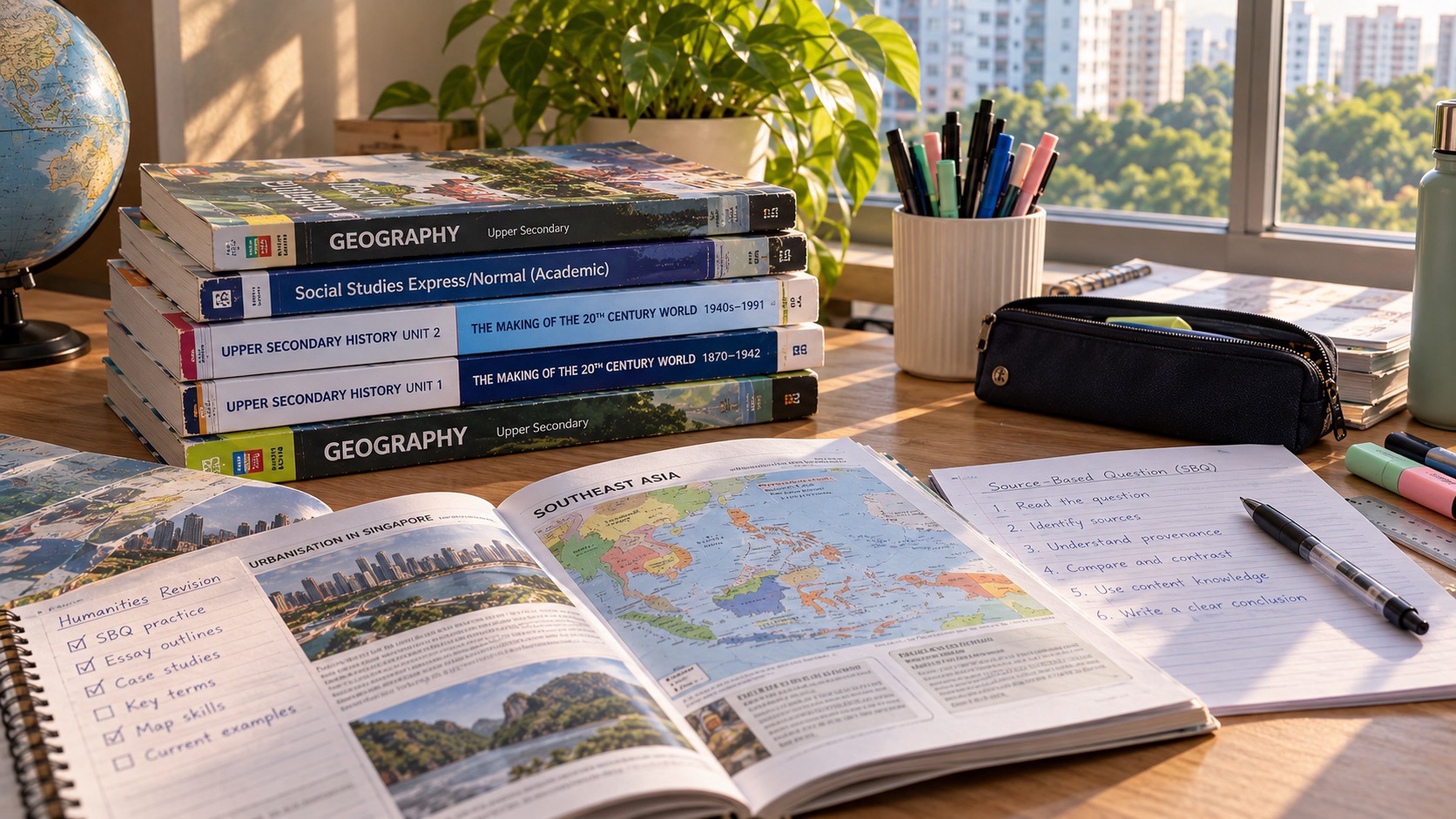
G2 Humanities (Social Studies, Geography) makes more sense when students realise that the subject is not just remembering textbook paragraphs or naming places. It is about understanding how people make decisions, how places and environments change, and how evidence supports a conclusion. The two components have different content, but both ask students to reason carefully from information.
This SEC Guide to G2 Humanities (Social Studies, Geography) explains the 2027 SEAB K229 syllabus, the two compulsory papers, what source-based reasoning and geographical analysis involve, common mistakes, practical worked examples and a four-week study routine. It aims to give students and parents an understandable, honest starting point without pretending that one revision shortcut can replace sustained learning.
Singapore’s first Secondary Education Certificate (SEC) examinations will take place in 2027. Paper arrangements described here come from the 2027 syllabus; students sitting later examinations should check their own year of SEAB documents and timetable.
What Is G2 Humanities (Social Studies, Geography)?
G2 Humanities K229 combines Social Studies and Geography. Both components are compulsory; they contribute equally to one Humanities subject result. Social Studies looks at citizenship, the way societies work, diversity and globalisation. Geography explores relationships between people and places, geographical methods, climate and tectonic hazards.
The designation G2 refers to the level at which the subject is taken under Full Subject-Based Banding. It broadly corresponds to the former Normal (Academic) examination standard. It is not a permanent judgement about a student’s potential or a label for every other subject they study. Different subjects can be taken at different levels when school arrangements and eligibility permit.
Good Humanities work begins with a deceptively simple habit: make a claim, identify evidence, explain how the evidence supports the claim, and recognise what the evidence cannot establish. Whether interpreting a cartoon, comparing two viewpoints or evaluating a flood-management proposal, that habit helps students respond to the actual question instead of merely repeating facts.
Official 2027 SEC Facts: Subject Code and Paper Structure
SEAB lists the 2027 syllabus as K229 — G2 Humanities (Social Studies, Geography). The earlier reference code is 2125. K229 must not be confused with K230 Humanities (Social Studies, History) or K231 Humanities (Social Studies, Literature in English), which have different second components.
The official examination scheme is straightforward:
- Paper 1: Social Studies — 1 hour 45 minutes, 50 marks, 50% of the subject result.
- Paper 2: Geography — 1 hour 45 minutes, 50 marks, 50% of the subject result.
- Both papers are compulsory. They are not alternatives; the Geography paper itself contains an internal choice.
- SEC G2 grades run from 1 to 6. Actual post-secondary pathways depend on broader admissions requirements and combinations of results.
- Social Studies uses an e-examination answer booklet for the 2027 scheme: candidates receive a hard-copy question paper and type answers in a digital answer booklet. School candidates should follow official training and examination instructions.
The two components are equally weighted, but a balanced revision plan still depends on what the learner actually finds difficult. Someone who can write strong Social Studies arguments but cannot interpret a Geography graph needs different practice from a student who knows the geography but struggles to cross-reference sources.
How Paper 1 Social Studies Works
Paper 1 lasts 1 hour 45 minutes and is worth 50 marks. It has two compulsory sections. The first uses evidence from sources; the second asks students to develop reasoned explanations about social issues.
Section A — Source-Based Case Study: 35 Marks
Students answer five compulsory questions on a source-based case study. Questions 1–4 are worth 25 marks in total and test handling specific sources. Question 5 is worth 10 marks and requires the use of multiple sources to consider the issue.
A source may be a text, photograph, infographic, statement or other material related to a societal issue. Students need to identify a viewpoint, draw a justified inference, compare sources or evaluate their usefulness or reliability according to the question. The correct response is not simply to copy a quote and announce that it proves the answer.
The case study can be set on any of the syllabus’s three Issues. The specific situation may be unfamiliar even if its underlying issue is in the syllabus. Students therefore need transferable source-handling skills, not just memorised answers to one past question.
Section B — Structured-Response Questions: 15 Marks
Section B contains two compulsory questions, worth 7 and 8 marks. They require explanation of a strategy, factor or perspective, with the longer response dealing with two factors or perspectives.
SEAB specifies that the Section B questions in a given examination will not be set on the same Issue as the Section A source-based case study. The practical implication is important: do not revise just one preferred Social Studies Issue and hope it appears everywhere.
A good structured response is reasoned rather than wordy. Identify the requested factor, explain the mechanism, give an appropriate example and return explicitly to the question. When comparing two views, develop both properly instead of writing a detailed first paragraph and a hurried sentence for the second.
The three Social Studies Issues
The 2027 G2 Social Studies syllabus is organised around:
- Issue 1: Exploring Citizenship and Governance. How citizens and government contribute to the good of society, why groups have different needs and why decisions involve trade-offs.
- Issue 2: Living in a Diverse Society. Identity, diversity, respect, common values, social harmony and differing responses to diversity.
- Issue 3: Being Part of a Globalised World. How countries and people are connected, how globalisation affects the economy and why its effects can create benefits, pressures and varied responses.
These topics involve people with different interests. Strong Humanities answers are not expected to pretend that one stakeholder always has a perfect solution. They should identify priorities and constraints, consider relevant evidence and make a supported judgement.
How Paper 2 Geography Works
Paper 2 is also 1 hour 45 minutes, worth 50 marks and contributing 50%. Its structure differs from Social Studies and includes a crucial choice in the second section.
Section A — Geography in Everyday Life: 25 Marks
Students must answer Question 1, which draws on Cluster 1: Geography in Everyday Life. The 2027 cluster covers Thinking Geographically, Sustainable Development and Geographical Methods.
The idea is to examine familiar environments using geographical thinking. Why might a neighbourhood park improve residents’ quality of life? Why do places mean different things to different people? How can a survey, observation, map or fieldwork method provide useful evidence?
Students should be able to describe geographical patterns, interpret data and make sensible statements about what a study can or cannot prove. Knowing a definition is useful, but applying it to an unfamiliar local example is what makes the knowledge functional.
Section B — Choose Climate or Tectonics: 25 Marks
Students answer either Question 2 on Cluster 2: Climate or Question 3 on Cluster 3: Tectonics. They do not answer both. Each option carries 25 marks.
- Climate includes Weather and Climate, Climate Change and Climate Action.
- Tectonics includes Plate Tectonics, Earthquakes and Volcanoes, and Disaster Risk Management.
Within the selected Section B question is a 6-mark judgement and decision-making response marked using generic level descriptors. The other parts are point-marked. An approved calculator may be used for Paper 2.
This paper design creates an important distinction between what students learn during the course and the choice they make in the examination. Students should follow their school’s teaching plan and the full syllabus rather than assuming that the presence of an either-or question means they can ignore important geographical thinking.
Understanding Geography Through Three Clusters
Cluster 1: Geography in Everyday Life
This cluster asks students to notice patterns around them. People, services, natural areas, transport links and places of meaning all interact. The environment is not merely the background of human activity: it influences what communities do, and communities can influence environmental conditions.
For example, a public park may offer recreation and cooler surroundings. But more visitors can also put pressure on paths and vegetation. A strong geographical explanation recognises both benefits and potential costs, and considers who experiences them.
Geographical methods matter here. Students may use maps, field observations, questionnaires, photographs or other data. They must ask whether the sample is representative, whether the method suits the question and whether the evidence supports a conclusion.
Cluster 2: Climate
This cluster connects weather observations, climate patterns, climate change and possible responses. Students should distinguish short-term weather from longer-term climate, and recognise that one unusual day’s temperature does not, on its own, establish a long-term trend.
Climate action requires attention to both mitigation, which aims to reduce causes such as greenhouse-gas emissions, and adaptation, which aims to reduce harms from changes that occur. A response can discuss how a proposal works, who benefits, its costs and its limits.
Avoid learning climate action as a set of slogans. Students should be ready to say why an option might succeed in one location but face financial, technological or institutional constraints in another.
Cluster 3: Tectonics
Tectonics explores how the movement of Earth’s plates helps explain the distribution of earthquakes, volcanoes and major landforms. Students learn about plate boundaries, physical processes, tectonic hazards and ways communities can manage disaster risk.
Understanding a plate-boundary diagram is more useful than reciting an unexplained list. Divergent, convergent and transform boundaries involve different patterns of movement and geological outcomes. A learner should explain the link between movement, hazard and possible impacts on people.
Disaster risk management is more than naming emergency supplies. It includes exposure, vulnerability, preparation, response and the capacity of communities to recover. A reasoned answer considers realistic constraints, including resources, building conditions, public information and local geography.
The Common Skill: What Counts as Evidence?
Social Studies often starts with people’s statements, perspectives and contexts. Geography often starts with observed patterns, measurements, maps and investigations. In both, students need to distinguish what is directly shown from what they are inferring.
Suppose a chart shows an increase in visitors to a park after new lighting is installed. The data may support the statement that recorded visits rose over the observed period. It does not by itself prove that the lights caused the increase: weather, holidays, population changes or improved counting may also matter.
In a Social Studies question, the same principle applies to statements. A person describing the benefits of the park may have genuine experiences, but another user could face different accessibility or safety concerns. Each source tells us something while carrying its own perspective and limitations.
This is the core difference between repeating a source and evaluating evidence.
Worked Social Studies Example: Inference and Cross-Reference
Consider two invented practice sources, not real reports or examination materials.
Source A: A resident says, “The town should install more covered walkways because families and older people need shelter in heavy rain.”
Source B: An invented council briefing says, “Covered walkways can increase accessibility, but construction costs and limited footpath space require careful prioritisation.”
If asked what Source A suggests, the student can infer that the resident views weather protection as an important accessibility need. The claim should be supported by the reference to families, older people and heavy rain.
If asked whether Source B supports Source A, a sensible response says there is partial agreement: both acknowledge an accessibility benefit, but B also emphasises practical constraints. A careful answer does not falsely say the two sources are completely opposed just because one mentions costs.
If asked which plan the council should adopt, the question has now moved beyond inference to judgement. Students might propose prioritising high-footfall routes used by those with greater accessibility needs, while recognising budget and design constraints. Such a proposal should be framed as a reasoned suggestion, not a claim about an actual council decision.
Worked Geography Example: Looking Beyond a Percentage
Consider another invented dataset used only to demonstrate geographical reasoning. A local survey records 40 people using a small park on a weekday morning and 60 people during a later survey. The apparent increase is 20 people, or 50% compared with the first count.
A weak conclusion is: “The new park benches caused a 50% rise in visitors.” The figures do not demonstrate that causal claim.
A stronger answer states that recorded park use was higher in the second observation, while noting possible effects of different weather, survey times or nearby events. To investigate whether benches helped, the researcher might repeat observations at comparable times and ask users about their reasons for visiting.
This demonstrates geographical methods, analysis and evaluation together. The calculation matters, but the interpretation is what turns numerical data into evidence.
Worked Geography Example: Choosing Between Responses
Imagine an invented riverside neighbourhood facing recurring surface flooding. Officials consider Option A, upgrading drainage channels, and Option B, adding more permeable green areas. Neither should automatically be declared the single universal answer.
A geographical response can establish criteria: expected effectiveness, costs, land needs, maintenance and effects on residents and ecosystems. Drainage infrastructure may offer targeted capacity improvements but carry significant construction costs. Green areas may help manage runoff and offer community benefits, but available space and local soil conditions matter.
A well-supported answer explains how each strategy addresses the problem and then makes a conditional judgement based on the given evidence. This is similar to the judgement-and-decision-making skill assessed in the Geography Section B question.
Why Students Commonly Lose Marks in G2 Humanities
A disappointing Humanities result often reflects a specific skill gap, not a lack of intelligence or effort. The following patterns help diagnose what went wrong.
- Description without inference: the student retells the source but never states what it suggests.
- Assertion without evidence: a conclusion is written without a supporting quotation, detail or data point.
- Mechanical reliability claims: “It is reliable because it is from the government” is used without evaluating purpose, context or corroboration.
- One-sided judgement: the student ignores trade-offs or an important alternative perspective.
- Overlong answers: paragraphs are detailed but miss the exact question or command word.
- Topic confusion: the learner mixes a cause, effect and response, especially in climate or tectonics.
- Graph-reading errors: wrong axis, period, unit or percentage base.
- Incomplete fieldwork reasoning: a method is named but its suitability or limitations are not explained.
- Evidence overreach: an observed correlation is presented as a proven cause.
- Choice mistake: a student attempts both Geography Section B options instead of answering one fully.
- Digital answer problems: insufficient typing practice interferes with clear, timely responses in the Social Studies paper.
The appropriate repair depends on the category. A learner who knows the content but cannot compare sources should practise cross-reference with two short texts. A student who can explain climate change but misreads graphs needs data-literacy practice. More memorisation will not automatically repair either problem.
A First-Principles Method for Improving G2 Humanities
Step 1 — Diagnose what the student can do independently
Use a recent marked school response and one fresh source or map. Ask the learner to say what the question is asking, what the available evidence shows and why the answer follows. Record problems under three headings: content knowledge, evidence handling and explanation or judgement.
Step 2 — Rebuild one weak connection at a time
For source-based work, begin with the difference between observation and inference. For geographical data, begin with axes, units and comparisons. A student who cannot identify a chart’s denominator is not yet ready to build a sophisticated argument from it.
Step 3 — Apply a controlled Fencing Method
Give a single short source and a clear question. Practise claim, evidence and explanation. Add a second source only after the learner can handle the first. Then add a differing perspective, questions of usefulness and an evaluative conclusion.
For Geography, start with one simple graph. Add a second variable, a map, an unfamiliar place and a decision-making question in stages. Increase complexity without abandoning the method.
Step 4 — Compare examples and non-examples
Show the difference between “This source is useful because it is detailed” and a response that identifies the information useful to a particular inquiry and its limitations. Show the difference between naming a flood-control strategy and explaining its mechanism and trade-offs.
Students learn more from seeing why an answer is insufficient than from repeatedly copying a supposedly perfect paragraph.
Step 5 — Retrieve and transfer
Revisit key concepts several days later and practise with fresh social issues, new graphs and unfamiliar cases. An answer that works only when a teacher prompts every sentence is not yet independent mastery. The goal is recognition and reasoning when the material changes.
A Four-Week G2 Humanities Study Plan
This is a starting cycle, not a claim that a complete SEC syllabus can be mastered in four weeks. Study duration and focus should reflect the student’s foundation, school sequence and other obligations.
Week 1 — Find the real bottleneck
Complete one short Social Studies source-based task, one structured response and a Geography data-interpretation exercise. Identify whether errors occur in reading, knowledge, evidence selection, explanation or timing. Choose two high-priority habits to repair.
Week 2 — Strengthen sources and geographical methods
For Social Studies, practise making an inference from one source and then cross-referencing with another. For Geography, practise chart reading, interpreting a small set of invented observations and noting limitations of a proposed fieldwork method.
Week 3 — Build explanations and judgement
Write short, structured responses that explain cause and effect rather than list factors. For Social Studies, consider how stakeholder needs and trade-offs influence decisions. For Geography, evaluate two possible responses to a climate or hazard issue against clear criteria.
Week 4 — Apply the method under assessment conditions
Attempt unfamiliar questions without guided notes. Introduce manageable timed practice, including typing Social Studies explanations where appropriate. Compare the error log with Week 1, then identify what still needs repair, what has stabilised and what can be extended.
A useful measure of progress is whether the student can point to evidence and explain its significance without the tutor telling them which sentence or graph value to use.
How a Focused Small-Group Humanities Tutorial Can Work
A 90-minute lesson may begin with a brief retrieval exercise, move to one carefully selected misconception, demonstrate how to analyse a source or graph, provide guided practice and finish with a fresh independent task. The tutor should ask learners to defend an interpretation and point to evidence.
At eduKateSG, our 3-pax tutorial approach is designed to make each learner’s thinking visible. Students can be questioned closely and corrected while they are still developing an answer. This is useful when a learner repeatedly writes plausible paragraphs that do not satisfy a question’s requirements.
But tuition is not automatically necessary. Some students progress well with school feedback, independent revision, discussion at home and careful correction of past work. A sensible learning decision looks at the child’s actual needs rather than assuming every family must purchase extra lessons.
Three Pathways: Repair, Stabilise or Extend
Repair foundations
A learner who struggles to start a response may need to understand basic command words, cause and effect, core topic concepts or how a quotation supports an inference. Repair the first unstable step before asking for a lengthy timed essay.
Stabilise exam performance
A student who performs well in class but inconsistently in tests should practise unfamiliar sources, question selection, concise paragraph structures and realistic timing. A checking routine can prevent answers from drifting away from the command word.
Extend reasoning
A confident student can evaluate why two sources reach different conclusions, distinguish a plausible explanation from a proven cause, and examine competing stakeholder priorities. The next challenge is nuanced thinking, not simply using longer words or producing more pages.
What Parents Should Do — and Avoid
Parents can support Humanities learning without being subject specialists. Ask, “What is your claim?”, “Where is the evidence?” and “Could someone interpret this differently?” Encourage the learner to explain a local environmental or community issue fairly, with reasons for more than one perspective.
Avoid treating a source as automatically true because its author appears official, or automatically false because the author has a clear opinion. Avoid telling students to memorise whole paragraphs when they do not know which question the paragraph answers. Encourage fact checking and careful acknowledgement of uncertainty.
Use official SEAB documents and the student’s teacher to verify examination requirements. The mark allocations here describe 2027 K229, and the school’s actual teaching schedule is the best starting point for deciding which topics to review this week.
Frequently Asked Questions
What is the 2027 SEC code for G2 Humanities (Social Studies, Geography)?
The 2027 SEAB code is K229. The older reference code is 2125. Do not confuse K229 with the Social Studies/History or Social Studies/Literature combinations.
Are Social Studies and Geography both compulsory?
Yes. Both are compulsory components under K229 and contribute 50% each to the overall subject result.
How long are the papers?
Paper 1 Social Studies is 1 hour 45 minutes, and Paper 2 Geography is also 1 hour 45 minutes. Each carries 50 marks.
How are Social Studies marks divided?
Section A has a 35-mark source-based case study with five questions. Section B has 15 marks across two compulsory structured-response questions.
Does Social Studies require typing answers in 2027?
The official syllabus states that candidates will receive a hard-copy question paper and a digital answer booklet for typed responses. Students should follow their school’s preparation and the final SEAB e-examination instructions.
Can students choose between Social Studies and Geography?
No. That is not the choice in K229. Both subject components are required. The choice occurs within Geography Section B, where a student answers Climate or Tectonics.
What must students answer in Geography?
They must answer Question 1 on Geography in Everyday Life, worth 25 marks, plus either Question 2 on Climate or Question 3 on Tectonics, worth another 25 marks.
Is a calculator allowed for Geography?
The 2027 syllabus permits an approved calculator for the Geography paper. Students must still interpret the quantities and data accurately.
Is memorising Social Studies examples enough?
No. Students need to interpret unseen sources, evaluate evidence, construct explanations and adapt their knowledge to a question. Examples are most valuable when students understand what they illustrate.
What is the difference between describing and evaluating in Geography?
Description reports what a pattern or source shows. Evaluation considers how strong, suitable, reliable or effective a conclusion or proposed method is, often with criteria, limitations and competing considerations.
Does G2 Humanities guarantee a particular post-secondary route?
No. Course eligibility depends on the admissions framework, relevant subjects and results, and other applicable requirements. Always check current MOE and institution guidance.
Should students study only the Geography Section B topic they prefer?
The exam allows a Section B choice, but students should follow the full school learning programme and the year’s syllabus rather than assume one topic can be ignored throughout the course. Strong geographical methods support both options.
When might small-group tutoring be useful?
When errors remain persistent despite purposeful school support and independent correction. Good tuition should identify the specific bottleneck and build independent reasoning rather than promise a grade outcome.
Official SEAB Sources and Further Reading
- SEAB 2027 G2 SEC syllabuses for school candidates — verifies the subject combinations and K229 code.
- SEAB 2027 K229 Humanities (Social Studies, Geography) syllabus — the official assessment scheme, topic content and paper choice instructions.
- SEAB SEC overview — examination structure, result levels and schedules.
- eduKateSG: Learn Everything About G2 Humanities (Social Studies, Geography) — related subject-learning guide.
- eduKateSG: G2 English Language SEC Guide — reading, vocabulary and precise explanations.
- eduKateSG: G2 Mathematics SEC Guide — data interpretation, percentages and reasoning.
- The eduKateSG Clementi small-group teaching model — first-principles diagnosis, purposeful practice and feedback.
Final Takeaway: How G2 Humanities (Social Studies, Geography) Works
G2 Humanities works by teaching students to interpret evidence, explain relationships and make supported decisions. In the 2027 SEC K229 examination, Social Studies contributes half the result through source-based and structured responses. Geography contributes the other half through everyday geographical thinking and a choice between Climate and Tectonics questions.
Strong preparation is not about writing the longest possible answer. It is about knowing what the question asks, choosing the right evidence, explaining the significance of that evidence and recognising important limits or competing perspectives. With deliberate, targeted practice, those behaviours can become more independent and dependable.
If students need closer feedback, a consultation about eduKateSG small-group learning should begin with a recent piece of marked work and one or two questions that the child cannot yet answer with confidence. The objective is to repair a foundation, stabilise current performance or extend well-established skills, without exaggerating what a few lessons can guarantee.
This educational guide reflects the SEAB-published 2027 K229 syllabus checked on 31 October 2026. Refer to the official authorities for the latest syllabuses, examination details and admissions rules.