
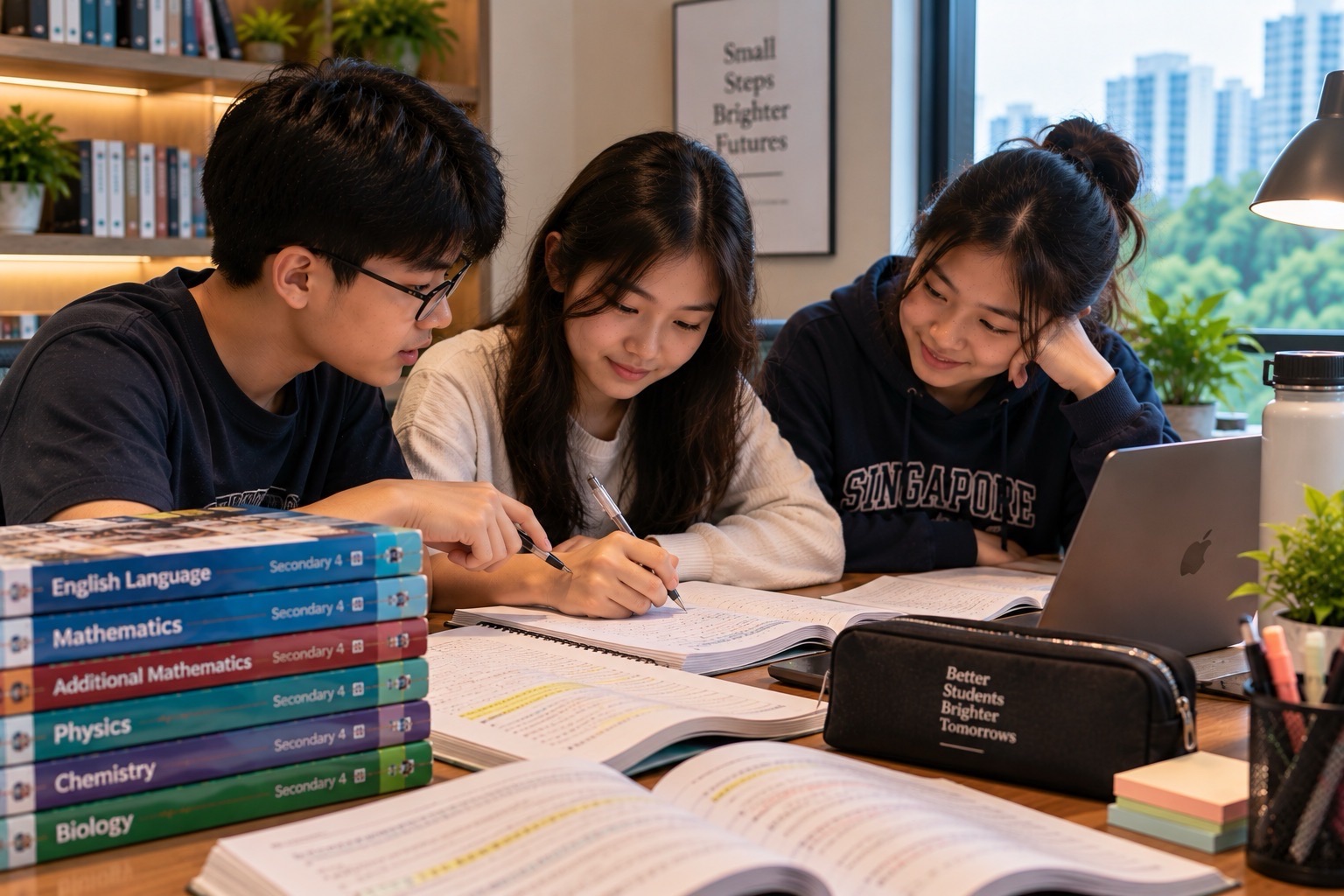
The most important fact about G2 SEC language examinations in 2027 is that they do not all use the same examination structure. English K200 has four papers. Chinese K220, Malay K221 and Tamil K222 assess writing, electronic reading, oral and listening with their own language-specific formats. Bengali K239, Gujarati K240, Hindi K241, Panjabi K242 and Urdu K243 use two written papers without separate oral and listening assessments.
This is a comparison of official SEAB subjects, not another examinable subject. The goal is to help parents check the correct syllabus before choosing resources, estimating study time or advising their child to practise particular paper types. The exact subject code matters more than the generic label ‘mother tongue’.
The assessment information comes from SEAB’s 2027 G2 school-candidate directory, with the English, Chinese, Malay, Tamil and Cambridge Indian-language syllabuses. The official language-specific documents control examination requirements. Study examples below are illustrative, not SEAB past-year questions.
Quick navigation
- Compare every G2 SEC language code
- English K200: four different communication tasks
- Chinese, Malay and Tamil K220–K222
- Bengali, Gujarati, Hindi, Panjabi and Urdu K239–K243
- Why language preparation commonly fails
- A practical preparation plan
- Common questions and official sources
All G2 SEC language subjects: the key differences
| 2027 subject | Code | Assessment components | Weights |
|---|---|---|---|
| English Language | K200 | Writing / Comprehension / Listening / Oral | 35% / 35% / 10% / 20% |
| Chinese Language | K220 | Writing / e-Reading / Oral / Listening | 30% / 30% / 30% / 10% |
| Malay Language | K221 | Writing / e-Reading / Oral / Listening | 30% / 30% / 30% / 10% |
| Tamil Language | K222 | Writing / e-Reading / Oral / Listening | 30% / 30% / 30% / 10% |
| Bengali / Gujarati / Hindi / Panjabi / Urdu | K239 / K240 / K241 / K242 / K243 | Composition / Language Usage and Comprehension | 45% / 55% |
Weights describe the percentage of the final grade. They do not establish subject entry eligibility, language choice or progression rules. Only the school and relevant MOE/SEAB instructions can confirm what subject level and language a particular child may take.
Why the actual subject code should appear on the revision folder
A parent searching only for ‘G2 language practice’ might download a paper that includes an oral component when the child is taking Urdu K243, or assign a Chinese-character writing minimum to a student taking Malay. The wrong structure wastes time and creates false expectations. Write the exact K-code and examination year on every revision plan.
English K200: four tasks, not one generic English mark
The 2027 K200 English scheme is Writing 70 marks at 35%, Comprehension 50 marks at 35%, Listening 30 marks at 10%, and Oral 30 marks at 20%. Writing and Comprehension each last 1 hour 50 minutes. Listening lasts about 45 minutes, and Oral Communication takes approximately 20 minutes including preparation.
Writing is not simply storytelling
Writing includes Editing, Situational Writing and Continuous Writing. Situational Writing requires 180–250 words addressed to a purpose and audience; Continuous Writing requires 250–400 words and developed content. A perfect-looking essay can still lose marks when it omits required points or answers a nearby but different question.
One useful exercise is to mark three elements before drafting: who will read the piece, what the task requires, and which facts the student must include. Then practise a new prompt, not merely rewrite a previously corrected essay.
Comprehension, listening and oral need distinct practice
Comprehension tests literal information, inference, evaluation and summary writing. Listening includes audio tasks and note-taking. Oral includes a video-based planned response and spoken interaction. A student who knows a great deal of vocabulary might still need help finding passage evidence or answering a live question directly.
For listening, review why a speaker’s changed plan was missed. For oral, ask whether the response actually answered the examiner’s question. For comprehension, require the pupil to identify the sentence that supports their inference. Those corrections are far more useful than telling the student simply to ‘work harder at English’.
Full guide: How G2 English Language K200 Works.
Chinese, Malay and Tamil: similar weights, different language tasks
The three local G2 language syllabuses share broad weightings: Writing 30%, Language Use and Reading 30%, Oral 30%, Listening 10%. Their language-and-reading papers are electronic. Oral involves reading aloud and interaction supported by video, while the exact question formats and written-language requirements differ.
G2 Chinese K220
Chinese Paper 1 includes a practical email of at least 120 Chinese characters and a composition of at least 240 characters. Language Use and Reading is a 90-minute electronic examination; oral and listening have their own components. A character count is not equivalent to the English or Malay word-count convention.
A Chinese learner may need targeted work on the intended reader, expressions that fit the register, or interpreting open-response comprehension. Memorising advanced set phrases without those foundations may not improve performance.
Full guide: How G2 Chinese Language K220 Works.
G2 Malay K221
Malay Paper 1 requires at least 100 words in functional writing and 200 words for the composition. Its 90-minute electronic Language Use and Comprehension paper tests context and reading. Malay oral communication involves reading aloud and a video-related discussion. The student also sits Listening.
Malay language preparation should respect its grammar, word formation, register and actual question demands. An English-language model does not automatically become an accurate Malay response through translation.
Full guide: How G2 Malay Language K221 Works.
G2 Tamil K222
Tamil Paper 1 includes a functional email of at least 90 words and a composition of at least 170 words. Its electronic Language Use and Reading assessment lasts 90 minutes. Oral and Listening are separately weighted skill components within the Tamil scheme.
A child who speaks naturally may still find formal Tamil writing or unfamiliar comprehension passages difficult. It is important to ask whether the issue is accurate script, grammar, task interpretation or text evidence. The intervention should suit the actual problem.
Full guide: How G2 Tamil Language K222 Works.
Five Cambridge Indian languages: the two-paper scheme
Bengali K239, Gujarati K240, Hindi K241, Panjabi K242 and Urdu K243 are covered in one official Cambridge-language syllabus. Paper 1 Composition is two hours and 45%. Paper 2 Language Usage and Comprehension is 90 minutes and 55%. These subjects have no separately listed Oral or Listening paper. The official syllabuses say they are available in October only.
| Assessed component | Task | Weight |
|---|---|---|
| Letter | Choose 1 of 2 topics; write at least 90 words | 15% |
| Essay | Choose 1 of 4 topics; write at least 170 words | 30% |
| Language Usage | Combination/separation, idioms, proverbs, word pairs, transformations, cloze and vocabulary | 30% |
| Comprehension MCQ | Seven items on about 250 words of prose | 7% |
| Open-ended Comprehension | Six items on about 240 words of prose | 18% |
These five language subjects share a paper scheme, not a common script or interchangeable grammar. A Hindi learner’s Devanagari practice should not replace the Gurmukhi written forms examined for Panjabi or the Urdu writing needed for K243. Use a qualified educator and the correct materials for the specific language.
SEAB’s printed idiom, proverb and word-pair lists are explicitly guides, not exhaustive question banks. Learning meaning through appropriate situations is more reliable than copying expressions without knowing their use.
- How G2 Bengali K239 Works
- How G2 Gujarati K240 Works
- How G2 Hindi K241 Works
- How G2 Panjabi K242 Works
- How G2 Urdu K243 Works
Six mistakes that consume language revision time
1. Studying for a paper the child is not actually taking
A family may use an oral preparation schedule copied from one language for a child taking a two-written-paper K243 subject. Oral language is valuable for development, but the examination revision allocation should reflect the child’s registered assessment. Check the actual code before allocating practice.
2. Using an incorrect writing-length rule
Chinese has character minimums, while the other syllabuses specify their own word requirements. An essay that meets the wrong limit can still be insufficient. Write the correct minimum beside the paper’s practice task, then focus on fulfilling content rather than padding the response.
3. Treating vocabulary as a collection rather than communication
An idiom can be memorised yet used in an inappropriate email. A child may know a dictionary translation but misread a sentence’s tone or grammatical relation. Teach the world first, then the appropriate expression, and then practise it in a changed situation.
4. Correcting only spelling and grammar
A formally accurate letter can fail to include a required proposal. A composition can be grammatical but irrelevant. Always review task fulfilment, organisation and evidence before polishing surface language.
5. Guessing at reading inference
A plausible interpretation is not sufficient without relevant text evidence. Require a sentence or event from the passage that makes the answer supportable. A short, accurate explanation is better than a longer unsupported response.
6. Repeating the same model and calling it mastery
A child who can reproduce the model letter or summary may still fail when the recipient, topic or text changes. After correction, use a fresh prompt. Independent transfer is the evidence that the skill has become available to the learner.
A practical revision plan that matches the actual paper
Step 1: confirm the subject, level and year
Ask the school for the exact subject entry. Match the code to the 2027 SEAB list and check examination delivery, writing lengths and paper weights. Previous syllabus names may still appear in commercial notes, but the assessment may have changed.
Step 2: sample the high-weight skills first
For English, examine Writing and Comprehension closely, then Listening and Oral. For K220–K222, sample all four broad components and the e-reading tasks. For K239–K243, sample composition and the three Paper 2 sections. Record the cause of each error.
| Cause | What it looks like | Useful correction |
|---|---|---|
| Task reading | An email misses a requested point | Map reader, purpose and key content before drafting |
| Language form | A grammatical pattern fails repeatedly | Teach the specific rule through varied sentences |
| Inference | A conclusion has no passage clue | Find the evidence and explain its relationship |
| Oral relevance | A fluent response does not answer the question | Practise direct answers and new follow-ups |
| Listening | A corrected plan is missed | Listen for changes, exceptions and final decisions |
| Time or software | A timed task remains unfinished | Use accurate paper lengths and school-authorised formats |
Step 3: use a four-week cycle
| Week | Main action | How to recognise progress |
|---|---|---|
| 1 — Diagnose | Attempt representative work and locate two repeatable weaknesses | The learner can name what must be repaired |
| 2 — Repair | Teach one written and one receptive/oral skill as appropriate | Fresh equivalent examples work independently |
| 3 — Transfer | Change the passage, audience, genre or video prompt | Skill remains accurate in unfamiliar contexts |
| 4 — Integrate | Practise relevant timed components and review results | Fewer repeated errors and a clear next target |
This is an organisational cycle, not a promise that four weeks can solve large language gaps. Meaningful reading, frequent speaking where appropriate, school feedback and sustainable study matter more than producing a thick stack of completed worksheets.
Frequently asked questions
Do all G2 languages have Oral and Listening?
No. English and the local Chinese, Malay and Tamil syllabuses have those components, while K239–K243 list only two written papers.
Which subjects use 45% Composition and 55% Language Usage/Comprehension?
Bengali, Gujarati, Hindi, Panjabi and Urdu, codes K239–K243.
Are Chinese, Malay and Tamil writing lengths the same?
No. Their broad percentage weights are the same, but their writing-length requirements and language-specific tasks differ.
Does this guide let families switch a child’s registered language?
No. Subject eligibility and entry are determined by MOE/SEAB rules and the school’s arrangements.
Can memorising more model essays guarantee higher marks?
No. Relevance, language accuracy, evidence and independent adaptation to new tasks are essential.
Official source documents and next reading
- SEAB: 2027 G2 SEC syllabuses for school candidates
- SEAB: K200 English Language syllabus
- SEAB: K220 Chinese Language syllabus
- SEAB: K221 Malay Language syllabus
- SEAB: K222 Tamil Language syllabus
- SEAB: K239–K243 Bengali, Gujarati, Hindi, Panjabi and Urdu syllabus
Checked 4 November 2026. This is a cross-subject navigation guide, not an additional examinable SEC paper. Follow the latest official document and school instructions whenever a requirement changes.
A useful next action
Write the child’s exact G2 subject code on the revision timetable, then list the component weightings from SEAB. Select one incorrect answer from the largest weak component, explain the earliest missing skill and retry it with new material. That gives preparation a direction without replacing independent learning with memorisation.
For questions about suitable learning support, contact eduKate Singapore. Confirm the tutor’s proficiency in the relevant language and actual class availability; no particular grade can be guaranteed.