
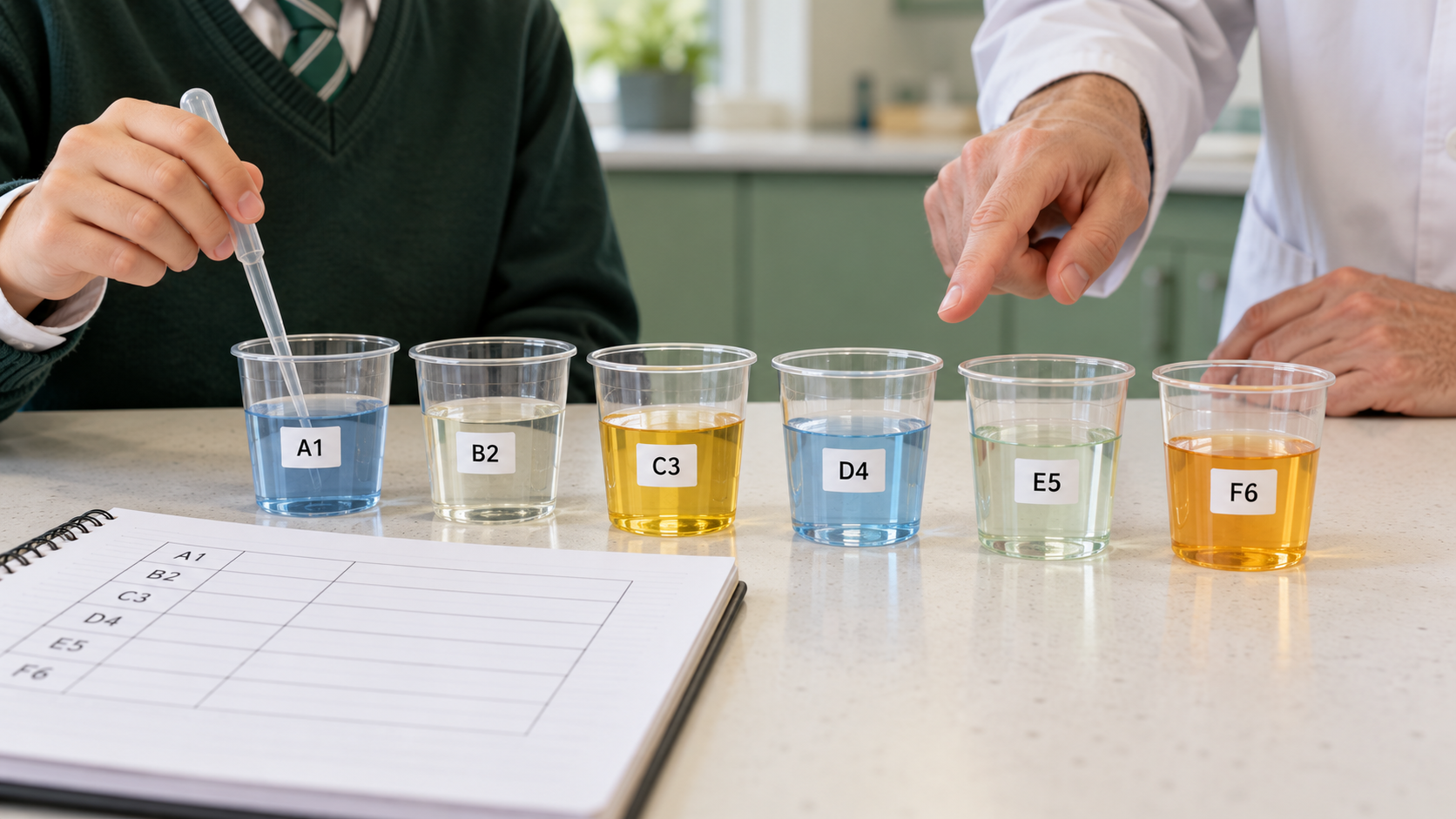
G3 Biotechnology in the 2027 Singapore-Cambridge Secondary Education Certificate (SEC) is an Applied Subject that combines scientific theory with a school-supervised research project. Its syllabus code is K375 (formerly NP04). Assessment consists of a 45-minute multiple-choice paper worth 20%, a 1-hour-45-minute structured paper worth 50%, and a 15-hour supervised structured project worth 30%.
This is not ordinary Biology with an extra laboratory practical. Students study gene technology, microbes, animal cell culture, plant biotechnology and their real-world uses, along with cells and biomolecules. The project measures planning, safe investigation, recorded evidence and critical evaluation. Only approved schools offer the Applied Subject, and SEAB’s updated subject directory states that 2028 will be the final year for Applied Subject examinations.
This guide explains the official 2027 format and realistic learning demands, including how to interpret DNA evidence without overclaiming, distinguish scientific observations from conclusions, and understand the project rubric without compromising its authenticity. Original, safe teaching examples and a four-week plan support students and parents choosing or preparing this subject.
- 2027 subject: G3 Biotechnology K375, former Applied Subject NP04.
- Paper 1: 45-minute 30-question multiple-choice examination, 30 marks, 20%.
- Paper 2: 1h45 structured questions, 80 marks, 50%; all compulsory.
- Paper 3: 15-hour structured project in Secondary 4, 100 marks, 30%.
- Project breakdown: Plan 15 marks, Experimental Skills 45, Report 40.
- Six key areas: Cells/Biomolecules; Gene Technology; Microbial Biotechnology; Animal Cell Culture; Plant Biotechnology; Applications.
- Eligibility: Approved schools only; agency subject fees may apply; last Applied Subject exam year 2028.
Official resources: SEAB’s 2027 K375 Biotechnology syllabus PDF and SEAB 2027 G3 school-candidate syllabus directory. The examination and project are governed by SEAB, the examining agency and the authorised school; all exercises below are independent teaching illustrations.
Quick answer: how G3 Biotechnology works
K375 works by asking students first to understand biological technologies, then apply scientific principles to unfamiliar numerical and experimental information, and finally demonstrate authentic school-supervised investigation. Theory accounts for 70% through Papers 1 and 2, and a 15-hour experimental project contributes 30%. Good results require accurate scientific claims, calculations, safe equipment handling and an honest evidence trail—not memorised diagrams alone.
SEC 2027: clarify the Applied Subject and its final-year limit
The SEC begins in 2027, reporting individual subjects at their G1, G2 or G3 levels. G3 Biotechnology is a distinct Applied Subject offered through approved schools rather than a universally available option. The earlier reference NP04 and current code K375 must not be mixed up with pure Biology K325.
SEAB’s G3 school-candidate catalogue, updated 26 October 2026, says the 2028 examination will be the last for Applied Subjects, including Biotechnology and Design Studies. Parents planning for a younger cohort must not assume K375 will continue indefinitely. Confirm actual eligibility, course arrangements, subject fees and pathways with the school before making an enrolment decision.
The syllabus introduces multidisciplinary knowledge and experimental work to students without requiring prior Biotechnology specialisation. That does not mean practical work is risk-free or should be replicated independently at home. Lab sessions, assessed project evidence, biological materials and waste disposal belong within the school’s authorised safety system.
The exact three papers, timing and marks
Paper 1 Multiple Choice: 45 minutes, 30 raw marks, 20% of the subject. All 30 questions are compulsory, each with four options. Students must recognise concepts and apply them to short situations rather than assume an MCQ can always be solved by remembering one definition.
Paper 2 Structured Questions: 1 hour 45 minutes, 80 marks, 50%. The paper has a variable number of structured questions and all are compulsory. Students may have to interpret scientific information, graphs or numerical data and apply principles to new contexts, not simply reproduce a memorised procedure.
Paper 3 Structured Project: 15 hours in Secondary 4, 100 marks, 30%. It comprises the Project Plan (15), Experimental Skills (45) and a Report (40). Students must follow official supervision and project arrangements; an unsupervised home experiment is not a substitute for their assessed work.
Project Plan: 3 hours are allocated for the plan and timeline in the authentic logbook. The marking concerns whether tests match the objective, controls are appropriate, replicates are considered and a workable timeline is set, not whether a project title sounds impressive.
Experimental Skills: three scheduled laboratory sessions are specified. Candidates follow authorised procedures, use equipment appropriately and safely, record observations, identify modifications truthfully and handle laboratory waste as instructed. These are assessed actions in real supervised facilities.
Report: 40 marks for reporting results, interpreting and evaluating data, considering improvements and demonstrating further investigative reasoning. A polished photograph or confident conclusion without actual measurements is inadequate.
Assessment objectives: approximately 30% of overall objectives concern Knowledge with Understanding, 40% Handling Information and Solving Problems, and 30% Experimental Skills and Investigations. Within the theory papers, the syllabus gives approximately 45% to knowledge and 55% to information/problem-solving, making reasoning essential.
Calculator: an approved calculator may be used in all papers. Candidates must still show appropriate working, units and sensible scientific interpretation where the question requires it.
Exam authenticity and school limitations: the project belongs to the candidate under the school’s official laboratory controls. A parent, tutor or AI service must not fabricate logbook observations, run experiments on behalf of the student, or produce the final assessed report as their own work.
The six syllabus areas explained from first principles
1. Biotechnology uses living systems to solve problems
Biotechnology connects biology with technological application, including medicines, food, agriculture and environmental work. A process should be evaluated by what biological system is used, what output is intended and what evidence shows it works.
A student should distinguish knowing a technique’s name from understanding its input, mechanism, limitation and consequence. The best exam explanation is specific to the case rather than announcing that biotechnology helps humanity in every circumstance.
- Identify the relevant biological concept or measured quantity
- Explain what evidence supports and what it does not
- Respect authentic school-supervised laboratory work
2. Cells provide the biological starting point
Prokaryotic bacteria differ from typical plant and animal eukaryotic cells in their organisation and structures. Students should understand membranes, genetic material, ribosomes, nuclei, mitochondria, chloroplasts where relevant, and what each organelle does.
When asked to compare cells, include similarities and differences rather than list only one. An unfamiliar diagram should be interpreted from visible evidence. Avoid asserting that all bacteria or all eukaryotic cells share every simplified textbook feature.
- Identify the relevant biological concept or measured quantity
- Explain what evidence supports and what it does not
- Respect authentic school-supervised laboratory work
3. Biomolecules have structures that support functions
Proteins, nucleic acids, carbohydrates and lipids play different roles. DNA carries hereditary information, some proteins act as enzymes or structural components, carbohydrates contribute to energy and structure, and lipids are important in membranes and storage.
Link a substance’s property to the specific biological role. A question about a protein’s function cannot be answered fully by merely repeating that proteins are important. Explain why structure and interactions matter.
- Identify the relevant biological concept or measured quantity
- Explain what evidence supports and what it does not
- Respect authentic school-supervised laboratory work
4. DNA, genes, chromosomes and genome are related but different
Genes are stretches of DNA associated with functional products, chromosomes organise genomic material, and a genome refers to an organism’s complete genetic material. Students who confuse these units may misinterpret an unfamiliar genetic diagram.
Build a concept map linking the terms and identify the scale of information in the question. Do not treat one gene as the whole genome or assume that every measured DNA fragment represents an entire chromosome.
- Identify the relevant biological concept or measured quantity
- Explain what evidence supports and what it does not
- Respect authentic school-supervised laboratory work
5. From DNA to RNA to proteins requires faithful information flow
The syllabus examines complementary base pairing, DNA replication, transcription and translation at a suitable level. The sequence matters because genetic information is copied or expressed through related but distinct processes.
Trace where information starts and which type of molecule carries it next. A student should understand the concept without claiming that DNA itself is translated directly into protein or that every change in a sequence has the same outcome.
- Identify the relevant biological concept or measured quantity
- Explain what evidence supports and what it does not
- Respect authentic school-supervised laboratory work
6. Mutations produce variation, not predetermined effects
A DNA sequence error may generate variation, but its consequence depends on the affected region and biological context. It is inaccurate to claim every mutation causes a disease or that every change is beneficial.
When interpreting a case, identify what sequence change is described, whether it changes a product and which additional evidence would be necessary to infer a biological effect. Avoid leaping from a band or sequence to a diagnosis.
- Identify the relevant biological concept or measured quantity
- Explain what evidence supports and what it does not
- Respect authentic school-supervised laboratory work
7. Recombinant DNA is an organised genetic-technology concept
The course covers plasmids, restriction enzymes, ligation, transformation, selection markers and recombinant protein production. These ideas explain how genetic material can be studied or used in biotechnology. They are not instructions for students to perform unsupervised biological modifications.
A safe teaching diagram can show the roles of different components conceptually. Emphasise what each stage accomplishes, why controls and verification are necessary, and why actual procedures must remain in authorised laboratory settings.
- Identify the relevant biological concept or measured quantity
- Explain what evidence supports and what it does not
- Respect authentic school-supervised laboratory work
8. PCR and gel electrophoresis answer different questions
Polymerase chain reaction is used to amplify specified DNA regions, while agarose gel electrophoresis separates DNA fragments for analysis. The existence of amplified DNA and the size pattern of fragments are different forms of evidence.
Practise interpreting teacher-provided fictional diagrams: which sample has a signal, which band is smaller, what a blank control could mean. Do not claim a gel by itself proves the full identity or health status of a person.
- Identify the relevant biological concept or measured quantity
- Explain what evidence supports and what it does not
- Respect authentic school-supervised laboratory work
9. Bioinformatics supports comparison, not automatic certainty
The syllabus mentions tools such as BLAST, Entrez, PDB and GenBank. A database comparison can reveal similarities, possible functions or sequence relationships, but outputs require careful interpretation and awareness of data quality.
Students should understand what kind of question a tool supports and what additional validation is needed. An online match does not replace a sound biological explanation or authorise a clinical diagnosis.
- Identify the relevant biological concept or measured quantity
- Explain what evidence supports and what it does not
- Respect authentic school-supervised laboratory work
10. Bacterial growth depends on conditions
Microbial Biotechnology studies growth phases and how temperature, pH, oxygen and nutrient conditions affect organisms. Different species may respond differently; textbook patterns are models rather than guarantees about every unknown culture.
Read a supplied growth curve for lag, exponential, stationary and decline phases, then explain the observed shape using general principles. Never substitute unsupervised microbial cultivation at home for school practical learning.
- Identify the relevant biological concept or measured quantity
- Explain what evidence supports and what it does not
- Respect authentic school-supervised laboratory work
11. Identifying bacteria requires more than shape
The syllabus includes morphology, nutritional requirements and the principles of Gram staining, biochemical tests and antibiotic susceptibility. No one characteristic always gives a complete species identification.
When reading a fictional case, distinguish what a test establishes from what it merely suggests. If several results disagree, say what additional information might resolve the conflict rather than force a confident unsupported conclusion.
- Identify the relevant biological concept or measured quantity
- Explain what evidence supports and what it does not
- Respect authentic school-supervised laboratory work
12. Microbial applications have benefits and constraints
Bacteria can play roles in food fermentation, enzyme production and agriculture. Some microbial processes may be useful in one context yet undesirable in another. Understanding applications requires the relevant substrate, product and control considerations.
An exam answer should describe why the particular use is helpful, which evidence supports it, and what safety or quality limits apply. Do not confuse the word probiotic with proof that any microbe has a demonstrated health benefit.
- Identify the relevant biological concept or measured quantity
- Explain what evidence supports and what it does not
- Respect authentic school-supervised laboratory work
13. Animal cell culture is a distinct biological system
The course introduces primary cultures, adherent and suspension cell lines, culture media, specialised equipment and controlled conditions. These differ from bacterial culture, both biologically and in equipment requirements.
Study the purposes of cell-culture vessels, incubators, microscopes and counting tools at a conceptual level. Real cell lines, cryogenic materials and culture procedures must only be handled under trained institutional supervision.
- Identify the relevant biological concept or measured quantity
- Explain what evidence supports and what it does not
- Respect authentic school-supervised laboratory work
14. Culture media components serve different functions
Animal cell media may contain water, amino acids, carbohydrates, serum, bicarbonate, antibiotics and indicators as relevant. Knowing the name of a component is less useful than knowing why it supports cells or indicates a condition.
Practise explaining one component’s intended function and the consequences of its omission in a hypothetical syllabus-level scenario. Avoid suggesting that a single standard mixture suits every cell line or experiment.
- Identify the relevant biological concept or measured quantity
- Explain what evidence supports and what it does not
- Respect authentic school-supervised laboratory work
15. Concentration and dilution demand careful units
Biotechnology includes molarity, percentage concentration, relative molecular mass, stock dilutions and the relationship C1V1 = C2V2. A misplaced unit can change a calculation by a thousandfold, independent of how well the student understands the laboratory equipment.
Work through safe paper-based concentration exercises using non-biological fictional samples. State what quantity is given, maintain consistent units and check whether the final answer is physically sensible before using it in an explanation.
- Identify the relevant biological concept or measured quantity
- Explain what evidence supports and what it does not
- Respect authentic school-supervised laboratory work
16. Plant tissue culture draws on developmental capacity
The syllabus covers totipotency, morphogenesis, micropropagation, plant growth regulators and relevant culture conditions. Students should explain why certain plant cells can develop into different structures under suitable conditions, without assuming any plant sample will behave identically.
Connect the concept to plant reproduction and applications in propagation or conservation. Actual media preparation and growth processes must follow school safety and project instructions, not unsupervised internet recipes.
- Identify the relevant biological concept or measured quantity
- Explain what evidence supports and what it does not
- Respect authentic school-supervised laboratory work
17. Genetic engineering in plants has trade-offs
The course includes plant transformation concepts and applications such as crop improvement, nutrition and molecular farming. A trait may help one objective but raise concerns about cost, ecology, ownership or equitable access.
Separate the intended benefit from evidence of real performance. Discuss reasonable ethical and environmental implications rather than treating all genetically modified crops as either automatically safe or automatically dangerous.
- Identify the relevant biological concept or measured quantity
- Explain what evidence supports and what it does not
- Respect authentic school-supervised laboratory work
18. Forensic DNA evidence has important limits
DNA profiling using short tandem repeats can help compare biological evidence and assess relationships under appropriate procedures. A pattern of agreement can be informative but does not by itself answer every question about how material arrived somewhere.
In a classroom reasoning exercise, distinguish what DNA comparison could support from broader claims of identity, guilt or chronology. Avoid presenting teaching-level diagrams as legally conclusive forensic evidence.
- Identify the relevant biological concept or measured quantity
- Explain what evidence supports and what it does not
- Respect authentic school-supervised laboratory work
19. Biologics depend on the production system
Biological products can be made using recombinant bacteria or animal cells. Different hosts may offer differences in production complexity, protein processing and functional quality. A correct choice depends on the specific product and intended use.
Compare advantages and limitations for a fictional biologic using relevant criteria, not slogans that one host is universally better. Explain why protein folding or post-translational modification may matter in some cases.
- Identify the relevant biological concept or measured quantity
- Explain what evidence supports and what it does not
- Respect authentic school-supervised laboratory work
20. Environmental Biotechnology requires measured outcomes
Bioremediation uses living organisms to help address environmental contamination or waste. The syllabus discusses examples such as oil-degrading bacteria, decomposition in waste treatment and plants extracting heavy metals.
The strongest answers distinguish a proposed remediation mechanism from measured evidence of reduced pollution. Real environmental interventions require professional oversight and cannot be inferred from a single classroom experiment.
- Identify the relevant biological concept or measured quantity
- Explain what evidence supports and what it does not
- Respect authentic school-supervised laboratory work
21. Ethics and society belong in scientific reasoning
Genome projects and gene applications raise questions about consent, privacy, discrimination, fairness and access. Scientific feasibility does not automatically determine whether a technology should be deployed in every context.
Use an ethical framework naming affected people, potential benefits, risks, safeguards and evidence gaps. Do not treat an imagined positive outcome as proof that consent, cost or environmental concerns can be ignored.
- Identify the relevant biological concept or measured quantity
- Explain what evidence supports and what it does not
- Respect authentic school-supervised laboratory work
22. Paper questions often use unfamiliar data
The syllabus explicitly expects handling information and solving problems in novel situations. Students may see tables, graphs, diagrams or numerical information not identical to their notes. Recognising the topic is only the starting point.
Read axes, units, sample sizes, conditions and controls before drawing a conclusion. Then explain why the evidence supports a particular answer and what remains uncertain. A correct formula without the right context may not earn the intended reasoning marks.
- Identify the relevant biological concept or measured quantity
- Explain what evidence supports and what it does not
- Respect authentic school-supervised laboratory work
23. Investigations need testable questions and controls
A useful investigation identifies what is changed, what is observed and which other relevant factors should be controlled. Replicates help evaluate variability. A polished report that lacks a clear comparison may not be able to support its claimed conclusion.
Learn experimental design through fictional datasets or safe teacher-approved examples. The actual 15-hour Paper 3 work must follow the official brief, school facilities and supervisor instructions.
- Identify the relevant biological concept or measured quantity
- Explain what evidence supports and what it does not
- Respect authentic school-supervised laboratory work
24. Laboratory logbooks should be truthful evidence
A school project may involve unexpected readings, changed schedules or inconsistent results. A good scientific record states what happened and why a change was made. Rewriting a logbook as though every experiment worked perfectly removes valuable evidence.
Document only real supervised observations, with units, labels and dates as required. Outside adults should never fabricate measurements, complete procedures or write the candidate’s assessed report.
- Identify the relevant biological concept or measured quantity
- Explain what evidence supports and what it does not
- Respect authentic school-supervised laboratory work
25. The experiment report is a scientific argument
The project report connects actual observations to analysis, limitations and possible improvements. An attractive chart with unclear units, no controls or an unsupported claim is not scientifically strong.
Begin with the investigated question, show relevant data, explain the observed pattern and evaluate uncertainties. Distinguish what a dataset establishes from what would need a better or larger experiment.
- Identify the relevant biological concept or measured quantity
- Explain what evidence supports and what it does not
- Respect authentic school-supervised laboratory work
26. Approved-school access and the 2028 limit matter
Biotechnology is not an option that every school can offer, and official examining-agency fees may apply. SEAB states that 2028 is the final Applied Subject examination year. This is a significant planning constraint for younger cohorts.
Ask the school about actual subject availability, registration, lab facilities, supervisor arrangements and future progression. Do not purchase a full course based on a webpage implying the subject will continue indefinitely.
- Identify the relevant biological concept or measured quantity
- Explain what evidence supports and what it does not
- Respect authentic school-supervised laboratory work
Original worked examples: data reasoning without unsafe experiments
Example 1 — a fictional dataset about sample signals
Imagine that a teacher supplies a purely fictional table of four already-measured sample signals: A = 8 arbitrary units, B = 12, C = 11 and D = 9. The question asks which signal is largest and whether the results show that one experimental treatment is universally best.
The largest value is B, but the broader conclusion is not warranted without knowing controls, uncertainty, replicate measurements and how the signals relate to the biological outcome. The numbers are teaching data, not real laboratory measurements.
Step 2 — distinguish an observation from an explanation
The observation is that B has the largest supplied value of 12. One cannot conclude that B definitely caused a greater biological effect unless the experiment’s design and comparability justify that inference.
This trains the difference between ‘highest measured signal’ and ‘proven best treatment’. An evidence-based response can be accurate while acknowledging incomplete information.
Step 3 — consider what the control tells us
If the fictional table provides a control reading, the learner must understand what baseline comparison it establishes. Without a specified control, attributing a difference to the treatment may be unsafe reasoning because some other factor could vary.
A useful written answer states which extra information is needed and why, rather than naming a universal best result from four values alone.
Step 4 — a safe hypothetical dilution calculation
Consider a school worksheet about a harmless coloured solution, not a biological material: a concentration of 10 arbitrary units per litre is diluted to 2 units per litre in a final 100 mL volume. Using C1V1 = C2V2, V1 = 2 × 100 ÷ 10 = 20 mL in consistent volume units.
This is a mathematical example to understand proportional concentration, not an instruction to prepare a biological sample. A learner should explain why a target concentration below the stock concentration needs a smaller stock portion than final volume.
Step 5 — show why units and assumptions matter
If concentrations have different units, convert before substitution. The calculated stock volume must not exceed the final volume for an ordinary dilution model with lower target concentration. A result of 200 mL stock for 100 mL total would signal a likely calculation or assumption error.
A correct numerical answer should carry relevant units and an interpretation of what the equation means, not merely a memorised rearrangement.
Step 6 — a fictional genetics interpretation
Imagine a teacher-provided diagram showing bands from two labelled DNA samples. Matching patterns at selected markers may be consistent with a particular relationship, but they do not independently prove a person’s identity, innocence, guilt or medical condition.
The learner should identify which marker evidence is supplied, what pattern is visible and what additional information would be required for a stronger claim. Do not turn a classroom DNA diagram into a real forensic conclusion.
Step 7 — a project planning question, not a live brief
For a separate non-assessed exercise, ask: how would a scientist decide whether a proposed treatment changes a measured property? The student can name the intended variable, an appropriate baseline, repeated measurements and meaningful comparison without performing any experiment.
The actual Paper 3 requires three scheduled laboratory sessions under authorised conditions. This exercise teaches investigation logic but must not be passed off as a candidate’s official project plan.
Step 8 — an honest results discussion
Suppose the fictional observations contradict the student’s hypothesis. A scientifically useful report would describe the results accurately, examine plausible limitations and explain what could be measured next. It should not edit data until it fits the prediction.
This demonstrates the difference between scientific improvement and fabricated success. A truthful analysis can be strong even when results are unexpected.
Step 9 — apply the method to a new subject area
Change the fictional dataset from a signal measurement to a model of plant growth or enzyme response, without supplying practical procedures. Ask the learner to interpret axes, compare controls and state an appropriately limited conclusion.
The skill is transferring evidence-based reasoning across gene technology, microbiology, cell culture and plant applications rather than memorising one graph.
Step 10 — integrate examination and project thinking
A structured question may ask for a calculation or interpretation; a project asks the student to demonstrate authentic planning, measurements and evaluation. Both use scientific reasoning but have different supervision and assessment conditions.
A tutor can teach the underlying concepts and check independently completed practice answers, but cannot produce the candidate’s project evidence or report.
Common errors and specific repairs
Calling K375 pure Biology
What goes wrong: Students prepare only Biology K325 material and ignore applied techniques.
Specific repair: Use the actual K375 six-area syllabus and project format.
Using the wrong paper weighting
What goes wrong: The project is assumed 50% or the MCQ is treated as most important.
Specific repair: Use 20% MCQ, 50% structured and 30% supervised project.
Treating project hours as unrestricted homework
What goes wrong: A candidate attempts an assessed procedure independently at home.
Specific repair: Follow the approved school’s supervised laboratory arrangements.
Confusing DNA, gene and genome
What goes wrong: Terms are used interchangeably.
Specific repair: Draw the relationship and identify the scale of information.
Claiming all mutations cause disease
What goes wrong: Variation is presented as uniformly harmful.
Specific repair: Describe the affected sequence and relevant evidence.
Confusing PCR with electrophoresis
What goes wrong: Amplification is described as separation by size.
Specific repair: Explain each process’s distinct conceptual purpose.
A gel is interpreted as legal proof
What goes wrong: One matching band is treated as conclusive identity evidence.
Specific repair: Limit conclusions to what the shown markers support.
Bacterial growth is assumed to be identical everywhere
What goes wrong: One model curve is used without considering conditions.
Specific repair: Interpret the actual curve and environmental context.
A database match is treated as a diagnosis
What goes wrong: Sequence similarity is equated to an established clinical conclusion.
Specific repair: Describe the tool’s evidence and need for validation.
Unit conversions omitted
What goes wrong: Microlitres, millilitres or molarity are mixed without conversion.
Specific repair: Standardise units before calculating and inspect plausibility.
No control in the conceptual design
What goes wrong: A claimed effect has no meaningful baseline.
Specific repair: Identify the comparison needed and discuss confounding.
A single reading is treated as definitive
What goes wrong: Variation and measurement uncertainty are ignored.
Specific repair: Check replicates, precision and context.
Graph axes are ignored
What goes wrong: Students describe a trend in the wrong units or direction.
Specific repair: Read axes, scales and labels first.
Ethical questions receive slogans
What goes wrong: A response says genetic technology is always good or bad.
Specific repair: Discuss benefits, risks, evidence and affected parties.
Project observations are fabricated
What goes wrong: An attractive report replaces actual recorded results.
Specific repair: Keep authentic supervised logbook evidence.
2028 Applied Subject limit overlooked
What goes wrong: Families assume the subject will be examined indefinitely.
Specific repair: Use SEAB’s updated final-year statement and school advice.
How to prepare for each assessed component
Paper 1 — 30-question MCQ
Create mixed, syllabus-appropriate practice questions on cells, genetic information, microbial behaviour, culture principles, plant science and applications. Require a short reason for rejecting one plausible distractor instead of guessing by familiar terminology.
Forty-five minutes is short enough that recognition and clear thinking matter. But a high MCQ score cannot replace Paper 2’s structured problem-solving or the authentic project.
Paper 2 — structured biological reasoning
Practise unfamiliar tables, diagrams, conceptual problems and calculations. Show relevant units and explain what an observation supports. The syllabus places substantial emphasis on handling information and solving problems, so a long list of definitions is insufficient.
After marking, identify whether the first error was concept, data selection, unit, calculation, unsupported inference or answer command. Reattempt a changed problem after feedback.
Paper 3 — planning and logbook
Understand what a testable investigation question, suitable controls, replicates and a realistic timeline do. Use fictional non-assessed classroom examples for training. In the actual three-hour planning stage, follow the issued brief and official logbook instructions.
A tutor or parent should not write the assessed plan or fabricate a sequence of test results. The value lies in the student’s own appropriate experimental decisions within school supervision.
Paper 3 — experimental skills and safety
Students practise measurement, lab organisation, instrument understanding and safe recording through authorised school training. The official project assesses genuine laboratory work in three scheduled sessions, including appropriate equipment handling and safety practices.
Do not attempt home bacterial growth, DNA manipulation or animal-cell work to mimic the assessed component. Actual safety and waste procedures must follow authorised staff and facilities.
Paper 3 — report, analysis and evaluation
Develop the skills of presenting labelled results, identifying trends, distinguishing correlation from causal evidence and evaluating limitations. The official report is worth 40 of the project’s 100 marks and should reflect only the candidate’s actual data.
A strong report can discuss an unexpected result honestly. A perfect-looking invented graph or externally written explanation compromises authentic assessment and does not demonstrate the student’s research capability.
Choosing the course and understanding progression
Families should confirm whether an approved school offers K375, the examining agency’s fees and the available course timetable. SEAB says the last Applied Subjects exam year is 2028, so this is a special constraint for younger learners.
Related Biology, Chemistry and further science pathways remain broader topics to explore, but do not infer eligibility or future programme availability from one impressive project.
Four-week diagnostic and learning plan
Week 1 — diagnose concepts and scientific literacy
Give the learner one cell comparison, a DNA information-flow diagram, a simple dataset, a concentration question and a discussion of experimental controls. Record which decision first went wrong: definition, model, evidence, unit or inference.
Select two foundational errors for repair. A student who understands cells but cannot read a graph needs a different plan from one who knows calculations but confuses genetic concepts.
Week 2 — rebuild data and calculation skill
Work through fictional data tables, trends, labels and safe abstract dilution calculations. Ask the learner to state the assumptions and explain why an answer is plausible. Review one ethical issue using specific affected parties.
Revisit an older error after two or three days using different numbers and context. The objective is independent transfer, not memorising a numerical result.
Week 3 — connect syllabus areas through scenarios
Use teacher-provided conceptual cases from gene technology, microbes, cell culture, plant science and applications. Identify the biological process, what evidence is given and what conclusion remains uncertain.
Review the Paper 3 planning and report criteria as concepts, but keep any real project entirely under the school’s authorised schedule and supervision.
Week 4 — integrate MCQ, structured and project reasoning
Complete selected timed MCQs and structured questions, then evaluate one fictional investigation plan and results table. Maintain a clear distinction between these independent training exercises and the student’s genuine assessed project.
Compare accuracy and reasoning with Week 1, then continue across remaining topics. Four weeks begins improvement; it does not replace course teaching or laboratory competency.
A sustainable weekly science-learning rhythm
- Explain one cell or biomolecule concept in a complete sentence.
- Trace one genetic-information relationship without copied notes.
- Interpret a graph with units and a justified conclusion.
- Solve one safe paper-based concentration or dilution calculation.
- Identify which experimental control would address a stated comparison.
- Discuss one ethical implication using evidence and affected groups.
- Review one previously incorrect answer on a new context.
- Keep authentic laboratory work and its records under school supervision.
What parents, schools and small-group tutors can do
Parents can ask the student what a result actually establishes and which observation would distinguish competing explanations. They do not need to operate laboratory instruments to discuss evidence quality. The child should be able to explain why a control or measurement matters.
Scientific subjects can reveal different gaps. One pupil may know gene terminology but misread an axis; another may calculate correctly yet overstate what a graph proves. A useful teacher targets the first recurring error with a small changed problem rather than simply assigning another long chapter.
An appropriate three-student tutorial can make scientific explanations and calculations visible, but cannot replace an approved school laboratory or the authentic 15-hour project. Parents, external tutors and AI systems should never conduct assessed experiments or create false logbook entries.
The 2028 final Applied Subjects examination date deserves special attention. Confirm school eligibility and current pathway information for the actual cohort before committing to a long-term subject plan.
The editorial format follows the immutable eduKateSG Clementi small-group tutorial reference: direct opening answers, first principles, honest examples, specific error repairs, realistic plans and authoritative sources.
Frequently asked questions
What is the official 2027 code?
K375 G3 Biotechnology, formerly NP04.
Can every school offer Biotechnology?
No. It is an Applied Subject for schools approved to offer it; examining-agency subject fees apply.
What are the paper weights?
Paper 1 MCQ 20%, Paper 2 Structured Questions 50%, Paper 3 Structured Project 30%.
How long are the written papers?
Paper 1 is 45 minutes; Paper 2 is 1 hour 45 minutes.
What does the MCQ contain?
Thirty compulsory questions with four options each.
How long is the structured project?
Fifteen hours in Secondary 4, following official school supervision and scheduling.
How is the project scored?
Project Plan 15 marks, Experimental Skills 45 marks and Report 40 marks.
How much time is set for the project plan?
The official syllabus allocates three hours to planning and timeline work.
Does the project use real laboratory work?
Yes, three scheduled laboratory sessions are part of its experimental-skills component.
Which syllabus topics are examined?
Cells and biomolecules, Gene Technology, Microbial Biotechnology, Animal Cell Culture, Plant Biotechnology and applications.
Are calculators permitted?
The official syllabus allows an approved calculator in all papers.
Can parents help conduct the assessed experiments?
No. The actual work and evidence belong to the candidate under authorised school supervision and safety rules.
What if the experiment produces unexpected results?
Record them honestly, analyse plausible reasons and evaluate limitations instead of altering the data.
Can Biotechnology continue indefinitely after 2028?
SEAB states that 2028 will be the final examination year for the Applied Subjects. Verify future options with the school.
Is this the same as G3 Biology K325?
No. Biotechnology K375 is an Applied Subject with different topics and a 15-hour project.
Where is the official syllabus?
Use the linked 2027 SEAB K375 PDF and the current G3 Applied Subjects directory.
Official documents and connected education guides
- SEAB official 2027 G3 Biotechnology K375 PDF
- SEAB SEC G3 2027 Applied Subject directory and final-year statement
- How G3 Biology Works | SEC Guide
- How G3 Design Studies Works | SEC Guide
- How G3 Computing Works | SEC Guide
- How G3 Nutrition and Food Science Works | SEC Guide
The lasting principle
Biotechnology becomes understandable when students distinguish a scientific model from an observation, an observation from an inference, and an inference from a justified conclusion. K375 rewards knowledge, new-problem reasoning and authentic supervised investigation. Those practices build a foundation for responsible science well beyond the SEC, while the course’s approved-school and final-year constraints must be considered honestly.