
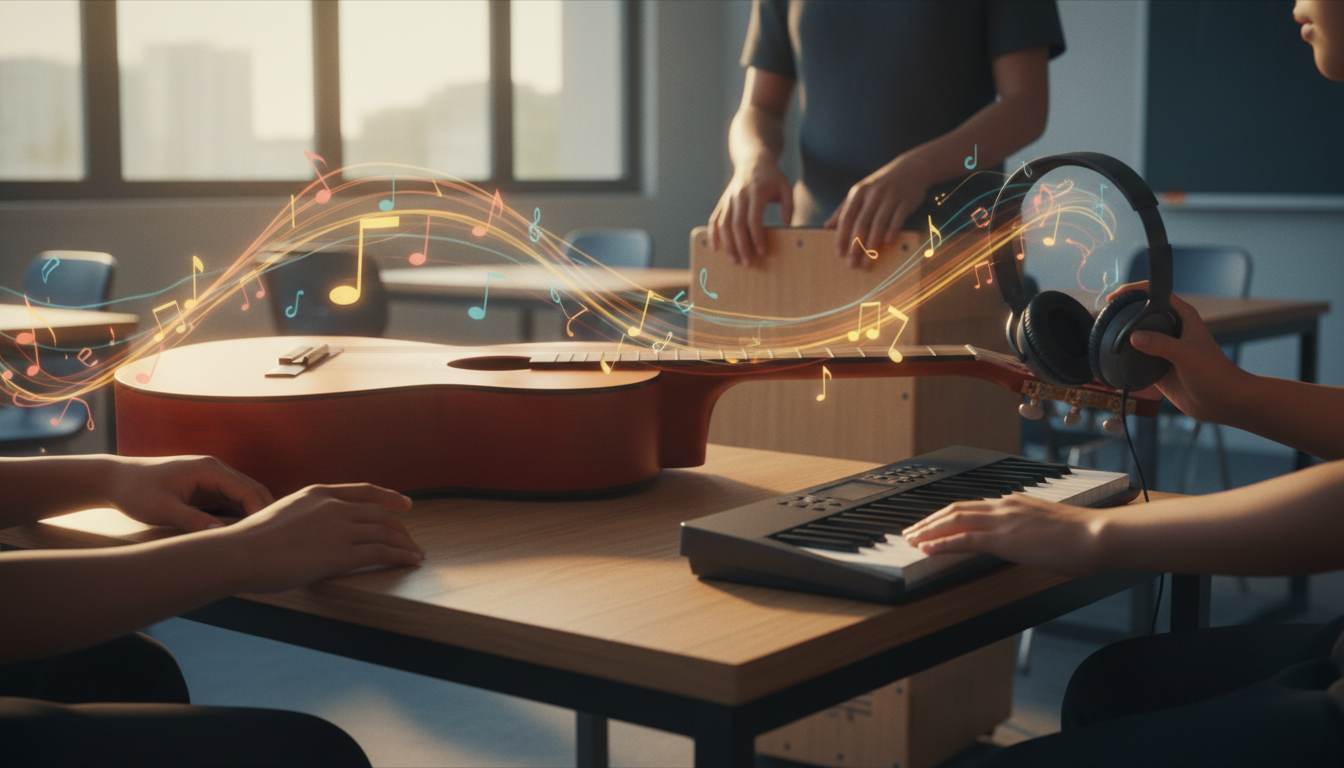
G3 Music Creating Paper 2, syllabus K350/2, is a 30%-weighted SEC 2027 coursework component that assesses an original composition and the student’s reflection on how it was developed. The assessment totals 50 raw marks: 40 for one composition and 10 for Reflection Notes. The composition must respond to one of SEAB’s six issued stimuli, be a complete piece of no more than three minutes, and follow the authorised nine-week, five-hour supervised creation arrangement.
Candidates may write for one to five acoustic, electronic or electric instruments and voices, with a separate allowance for the number of MIDI instruments and samples in DAW-based work. They must submit suitable notation or an appropriate recorded-technology format, with accurate acknowledgement of borrowed loops and samples. Their Reflection Notes are 400–500 words, explaining how the stimulus shaped the idea and how one or two technical challenges were addressed. Music teachers supervise and authenticate the candidate’s unaided work.
This guide explains the official Creating paper in clear terms, then teaches the deeper skills—turning a stimulus into a musical idea, shaping structure, using texture and timbre deliberately, documenting changes, interpreting the rubric and preparing an honest submission. An original conceptual example and a four-week non-assessed practice cycle help students prepare without outsourcing or prewriting the examined composition.
- Official subject: G3 Music K350, component K350/2 Creating.
- Subject weight: Creating Paper 2 contributes 30% of final Music grade.
- Raw marks: Composition 40 + Reflection Notes 10 = 50.
- Composing task: one response to one of six SEAB stimuli; duration at most 3 minutes.
- Supervision: up to five supervised composition hours across up to nine weeks.
- Instrument rule: 1–5 acoustic/electric/electronic instruments or voices; no equivalent MIDI/sample limit for DAW submissions.
- Reflection Notes: 400–500 words on stimulus, development and technical challenges.
- Authenticity: teacher-supervised, secured drafts, acknowledged loops/samples, candidate’s own work.
Official 2027 specification: SEAB G3 Music K350 syllabus, Creating Paper 2 and its marking criteria and SEAB’s 2027 G3 school-candidate subject directory. This guide is independent advice, not an issued stimulus, approved composition or a set of completed candidate Reflection Notes.
Quick answer: what Music Creating Paper 2 actually requires
A candidate chooses one official musical, text or context stimulus, creates one coherent complete musical work within the stated constraints, supplies a valid score/recording or technology-based equivalent and explains authentic compositional decisions in Reflection Notes. The marks reward creation and structuring in response to the stimulus (10), musical coherence (10), suitability of the chosen medium (10), communication of intentions in the submitted music/score (10), and Reflection Notes (10).
What K350 Paper 2 is, and what it is not
G3 Music is not assessed entirely through a performance or a written theory paper. Under SEC 2027, Paper 1 Music Studies is 40%, Paper 2 Creating 30% and Paper 3 Performing 30%. A student cannot compensate for an absent Creating submission simply by being a confident instrumentalist.
Higher Music K351 also contains the same core Music papers but requires choosing one additional elective paper—Research Essay, Higher Creating or Higher Performing—to qualify for the separate Higher Music award. Ordinary K350 Music Creating is not the same as the K351 Paper 22 Higher Creating elective, which has a different portfolio requirement and its own 50-mark rubric.
Paper 2 is coursework under the supervision of a school’s SEC Music teacher or an approved centre. The teacher is responsible for general guidance and authentication but may not raise the work beyond the candidate’s ability. An outside tutor, parent or AI assistant must not produce the final assessed composition or invent the candidate’s development record.
The official 2027 requirements, in order
Submission: one complete composition in response to one of six official stimuli released for the examination. The official possibilities are musical stimulus (given pitches or rhythmic motif), text stimulus (poem or lyrics), or context stimulus (one of two situations). Candidates choose the actual issued option, not any unrelated idea they already wish to submit.
Composition length and forces: the finished piece must be no more than three minutes long. When using acoustic, electric or electronic instruments and voices, the composition is for one to five instruments/voices. DAW and Audio Editor compositions have no corresponding limit on the number of MIDI instruments and samples, but still need compositional coherence.
Part 1 Composition: 40 marks. The rubric allocates 10 each to invention/structuring in response to stimulus, musical coherence, understanding of chosen media, and how intentions are communicated by the substantive score or technological recording.
Part 2 Reflection Notes: 400–500 words, 10 marks. The notes should explain how the stimulus generated and shaped musical ideas and one or two genuine technical challenges and responses. Merely listing the software used does not explain why a compositional decision was made.
Supervision limit: up to five hours of supervised time over up to nine weeks for the composition and notes. Rehearsing and recording usually lie outside that five-hour block, except where the recording itself is the assessed substantive document; in that case the recording must be completed in the supervised hours.
Timing: official stimuli are issued in July of the examination year, and the candidate’s composition is due by the October deadline announced by SEAB. Do not publish or rehearse an alleged 2027 stimulus before it is actually released.
Notation options: a properly edited staff score, suitable lead sheet with written commentary, graphic notation with performance notes, or a technology-based substantive recording and commentary may apply. Follow the matching evidence rule for the actual medium. Audio recordings supplied for illustration have specified file-format and quality requirements.
Technology and source acknowledgements: borrowed material, presets, loops and pre-recorded samples must be acknowledged in Reflection Notes and cover documents; certain raw audio files must be supplied separately for verification. Present borrowed loops as borrowed, not as evidence of the student’s original composition.
Integrity: school supervisors collect and securely store drafts; the music teacher’s statement is endorsed by the Principal, confirming the candidate’s unaided work. Unattributed plagiarism may lead to disqualification. External tutorials can teach general skills but cannot secretly compose the assessed submission.
The first principles of creating music for an actual purpose
1. A stimulus is a starting constraint, not an automatic complete piece
Given pitches, a rhythmic motif, text or a context provides material or purpose. It does not dictate every subsequent musical decision. A candidate must make original artistic choices that remain recognisably connected to the stimulus.
Practise with entirely invented non-assessed prompts during ordinary lessons. Explain what feature of the stimulus is musically useful and how it could lead to contrast, variation or shape without copying an external finished composition.
- Identify the actual musical purpose or evidence
- Explain how the chosen medium or structure supports it
- Preserve candidate ownership and authorised supervision
2. Identify what the intended audience should experience
An imaginative work can still lack focus if its intended effect is unclear. A context stimulus might suggest excitement, reflection or tension, but the student needs to choose musical devices that plausibly communicate that intention.
Describe the general intended effect in a sentence, then name which rhythmic, textural, timbral or structural choice would support it. Avoid claiming every listener will react identically.
- Identify the actual musical purpose or evidence
- Explain how the chosen medium or structure supports it
- Preserve candidate ownership and authorised supervision
3. Choose the actual medium early
A musical idea that is effective for one solo instrument may not translate directly to a large texture or a software soundscape. The medium’s pitch range, attack, duration, volume and expressive resources influence compositional choices.
Explore broad instrument capabilities before the assessed period and decide whether the official chosen forces are realistic. Stay within the one-to-five real-instrument rule where applicable and document intended performance requirements clearly.
- Identify the actual musical purpose or evidence
- Explain how the chosen medium or structure supports it
- Preserve candidate ownership and authorised supervision
4. Understand how an idea can develop
A motif or recognisable figure can recur, change or contrast across a short piece. The student should choose what stays recognisable and what changes, rather than repeat the same material unchanged for the whole duration.
In a non-assessed practice scenario, describe a hypothetical rhythmic idea being shortened, repeated or transferred to another register. Explain the effect of that change without writing the actual candidate’s examined motif.
- Identify the actual musical purpose or evidence
- Explain how the chosen medium or structure supports it
- Preserve candidate ownership and authorised supervision
5. Musical form is the listener’s map
A composition lasting under three minutes still needs a sense of beginning, progression and ending. Its structure may follow contrasting sections, an evolving process or another appropriate style, but parts should relate purposefully.
Make a simple abstract form diagram for practice—opening, development, contrast, return or conclusion—and explain why it supports the intended effect. The official submission needs a candidate-created structure fitting its own stimulus.
- Identify the actual musical purpose or evidence
- Explain how the chosen medium or structure supports it
- Preserve candidate ownership and authorised supervision
6. Rhythm and pulse can create direction
A steady pulse, syncopation, changed note lengths or an ostinato can influence energy and emphasis. Rhythm should support the chosen style and context rather than be complicated merely to look difficult on the page.
Compare two hypothetical rhythmic descriptions using precise musical terminology and ask what each would communicate. The task is evidence-based musical reasoning, not a claim that one rhythm always communicates one emotion.
- Identify the actual musical purpose or evidence
- Explain how the chosen medium or structure supports it
- Preserve candidate ownership and authorised supervision
7. Melodic contour carries recognisable shape
A melody can rise, fall, repeat or turn. Register, phrase lengths and recurring gestures affect how the listener notices its development. Complexity does not automatically lead to stronger melodic material.
Practise analysing a copyright-free classroom example with a short original contour described in words. Ask what can be varied while keeping the idea recognisable. The assessed melody itself must be produced by the candidate.
- Identify the actual musical purpose or evidence
- Explain how the chosen medium or structure supports it
- Preserve candidate ownership and authorised supervision
8. Harmony should be appropriate to the chosen musical tradition
Chord progressions, drones or other pitch frameworks can support a piece, but not every style relies on the same Western harmonic expectations. The candidate should explain the musical practice that suits the selected tradition.
Before composing, listen analytically to relevant educational sources and identify how harmony or pitch relationships function. Do not impose a memorised four-chord sequence on every Asian, jazz or contemporary practice without justification.
- Identify the actual musical purpose or evidence
- Explain how the chosen medium or structure supports it
- Preserve candidate ownership and authorised supervision
9. Texture is an organised relationship among parts
A single melodic line, chordal accompaniment and several interacting layers create different musical textures. More simultaneous notes do not guarantee stronger music and may obscure the central material.
In practice, sketch a conceptual layering plan describing what each part contributes at a moment. If one line is meant to lead, explain how the other voices support rather than drown it.
- Identify the actual musical purpose or evidence
- Explain how the chosen medium or structure supports it
- Preserve candidate ownership and authorised supervision
10. Timbre influences meaning and clarity
A bowed, plucked, struck or electronically generated sound has different attack and decay characteristics. Timbre can create contrast, support stylistic context and help distinguish structural events.
Ask what sound quality the intended effect needs and whether the chosen medium can produce it reliably. A dramatic instrument label is not a substitute for knowing how that instrument actually performs.
- Identify the actual musical purpose or evidence
- Explain how the chosen medium or structure supports it
- Preserve candidate ownership and authorised supervision
11. Register matters for performers and audiences
A line placed too high or low may be difficult or ineffective on the instrument or voice selected. A phrase can be technically possible yet unsuitable to its expressive purpose or the performer’s actual ability.
Learn realistic register and technical capabilities in lessons. The assessed work should be performable by the intended forces, not merely visually impressive in software.
- Identify the actual musical purpose or evidence
- Explain how the chosen medium or structure supports it
- Preserve candidate ownership and authorised supervision
12. Coherence is a relationship among choices
A composition can have individually attractive ideas but feel incoherent if sections are unrelated. Musical coherence depends on how materials develop and transitions link them into an intelligible progression.
Describe what the listener should recognise when one section returns or changes. Explain why an element of contrast is meaningful rather than simply inserted to create a louder moment.
- Identify the actual musical purpose or evidence
- Explain how the chosen medium or structure supports it
- Preserve candidate ownership and authorised supervision
13. Variation is more than decoration
Changing instrumentation, register or rhythm can develop an idea; a random pile of new ornaments can distract from it. The candidate should understand what remains the same and why the change occurs.
Practise discussing two broad variations of a fictional classroom motif. Name the altered feature and its intended effect, then consider whether the listener could still connect it to the earlier material.
- Identify the actual musical purpose or evidence
- Explain how the chosen medium or structure supports it
- Preserve candidate ownership and authorised supervision
14. Pacing needs attention inside a short duration
The three-minute maximum can encourage rushed transitions or many undeveloped ideas. A shorter composition is not automatically weak, but it must communicate a complete musical thought.
Plan an appropriately scaled concept with a clear overall movement. Avoid designing a twenty-minute structure and cutting unrelated fragments to fit three minutes.
- Identify the actual musical purpose or evidence
- Explain how the chosen medium or structure supports it
- Preserve candidate ownership and authorised supervision
15. Sound technology is a medium, not proof of authorship
A DAW makes arranging, editing and recording accessible, but ease of manipulating pre-recorded material does not make every loop or sample an original composition. Musical decisions should be clear, personally made and authentically documented.
Learn software functions in non-assessed work. For the final piece, follow SEAB’s restrictions on supervised hours, substantive recording format and required acknowledgement of borrowed material.
- Identify the actual musical purpose or evidence
- Explain how the chosen medium or structure supports it
- Preserve candidate ownership and authorised supervision
16. Looping requires purposeful design
Repeating an imported loop may maintain pulse but does not automatically demonstrate invention. A student should make identifiable original decisions about rhythm, texture, form, timbre or transformations that serve a context.
In hypothetical lessons, compare a loop repeated unchanged with a version whose arrangement develops. Discuss which listener information changes and why; do not provide copied finished music for the assessed piece.
- Identify the actual musical purpose or evidence
- Explain how the chosen medium or structure supports it
- Preserve candidate ownership and authorised supervision
17. Overdubbing and multitracking create new relationships
Layered recording can allow one performer to develop multiple musical parts. It can also obscure whether two lines are interacting meaningfully or merely adding density.
Ask what function each recorded layer serves and how a listener would recognise that function. Honest source identification and version control are part of responsible technological practice.
- Identify the actual musical purpose or evidence
- Explain how the chosen medium or structure supports it
- Preserve candidate ownership and authorised supervision
18. Reverb, delay and distortion need artistic reasons
Digital effects can change spatial impression, density and timbre. A very large reverb may make a sound distant but also blur articulation. More effects are not automatically more expressive.
Use non-assessed listening demonstrations of original or licensed materials to identify what changed. The candidate should be able to explain why a selected effect supports the intended context and why it is technically suitable.
- Identify the actual musical purpose or evidence
- Explain how the chosen medium or structure supports it
- Preserve candidate ownership and authorised supervision
19. A score is a communication document
A conventional score tells a performer what to play and when, using recognised notation. A lead sheet or graphic score can serve a different musical practice, but must still communicate intentions accurately enough to be performed or understood.
Choose notation appropriate to the style rather than trying to impress with a particular format. All submitted scores need checking and editing, including computer-generated notation.
- Identify the actual musical purpose or evidence
- Explain how the chosen medium or structure supports it
- Preserve candidate ownership and authorised supervision
20. Graphic notation needs clear explanatory rules
A graphic score can be imaginative but ambiguous if performers cannot understand what marks mean. The official scheme requires accompanying performance notes where alternative notation is used.
In a practice graphic representation, explain a symbol’s meaning and how it relates to duration or sound. A candidate’s submitted notation and instructions must be created and authenticated within the allowed procedure.
- Identify the actual musical purpose or evidence
- Explain how the chosen medium or structure supports it
- Preserve candidate ownership and authorised supervision
21. Lead sheets need sufficient performance information
A lead sheet may suit jazz or popular styles, but a sketch with only chord names might not communicate the intended musical idea adequately. SEAB also requires a written commentary with the relevant options.
Think about what a performer or examiner would need: melody, harmonic framework, rhythmic or groove details and interpretation where relevant. The actual substantive document must follow the officially accepted format.
- Identify the actual musical purpose or evidence
- Explain how the chosen medium or structure supports it
- Preserve candidate ownership and authorised supervision
22. Recording fidelity is part of communication
An audio submission should allow the examiner to understand what the candidate intended. Poor balancing or distorted levels can obscure an otherwise coherent arrangement, while an excellent recording cannot replace weak original musical material.
Practise simple listening checks in non-assessed sessions, and follow SEAB’s specified accepted audio formats and quality. Do not treat editing as a way to disguise who created the assessed work.
- Identify the actual musical purpose or evidence
- Explain how the chosen medium or structure supports it
- Preserve candidate ownership and authorised supervision
23. The stimulus must remain visible in the development
A work can become more elaborate but drift away from the chosen musical or textual starting material. The examiner needs evidence of the relationship between the issued stimulus and the final structure.
In learning exercises, make a short chain of idea, variation and resulting musical purpose. Reflection should describe what the actual candidate did, not what a model essay says a hypothetical composer might have done.
- Identify the actual musical purpose or evidence
- Explain how the chosen medium or structure supports it
- Preserve candidate ownership and authorised supervision
24. Reflection is about decisions and challenges, not biography
The 400–500-word notes should address how a stimulus shaped the music and which one or two technical challenges occurred and how the student approached them. A list of dates or software names does not provide sufficient explanation.
Use genuine records of supervised choices, and explain trade-offs in the student’s own language. Parents should not compose, edit into a new authorial voice or invent the student’s reflection.
- Identify the actual musical purpose or evidence
- Explain how the chosen medium or structure supports it
- Preserve candidate ownership and authorised supervision
25. An unexpected technical difficulty is useful evidence
Some candidates may experience impractical ranges, balance problems, awkward transitions or a software limitation. A truthful reflection can show awareness of a problem and a considered response. Pretending every draft worked immediately is less credible.
Keep authentic supervisor-controlled drafts and discuss the musical reason for the change. The Reflection Notes should not contain fabricated rehearsals or effects invented for the sake of a sophisticated story.
- Identify the actual musical purpose or evidence
- Explain how the chosen medium or structure supports it
- Preserve candidate ownership and authorised supervision
26. Teacher authentication protects genuine student authorship
The school supervises the work, collects drafts and verifies the final score and recording. This is a requirement, not a suggestion that any external collaborator may finish the music as long as the learner explains it later.
Prepare general skills before July, then follow school instructions exactly during the assessed period. External adults may help students understand the rubric but must not secretly contribute the actual musical material.
- Identify the actual musical purpose or evidence
- Explain how the chosen medium or structure supports it
- Preserve candidate ownership and authorised supervision
27. Borrowed samples and preset sources require acknowledgement
Using third-party loops or material without attribution can create an authenticity or copyright issue. The syllabus specifies acknowledgement in Reflection Notes, the SEAB cover page and submission of certain raw audio files for checking.
Maintain a clear account of where any borrowed material came from and which creative decisions the student made. Authentic acknowledgement is stronger than hiding a sample and claiming it as a personally played instrument.
- Identify the actual musical purpose or evidence
- Explain how the chosen medium or structure supports it
- Preserve candidate ownership and authorised supervision
28. The other two Music papers still need preparation
Creating is 30% of K350, but the pupil must also sit Music Studies 40% and Performing 30%. A strong composition does not replace skill in listening analysis or a technically and musically controlled recital.
Keep a balanced weekly learning plan and discuss how creative decisions relate to aural analysis and performance. Paper-specific guidance should never imply that one component is the whole qualification.
- Identify the actual musical purpose or evidence
- Explain how the chosen medium or structure supports it
- Preserve candidate ownership and authorised supervision
An original non-assessed conceptual composition example
1. A fictional stimulus about a quiet public garden
Imagine a teacher’s separate practice task asking students to describe the general idea of music for a fictional garden at dawn, without providing a real SEC musical motif, text or context brief. This is not one of the six actual K350 stimuli and will not be submitted.
The learner should begin by deciding what the audience might experience, such as a gradual sense of activity. The objective is to practise designing a concept rather than receive finished music from somebody else.
2. Define the intended musical contrast
One possible non-assessed concept is to contrast a sparse opening texture with a fuller passage later. This can communicate a development from stillness to activity, though different listeners may interpret it differently.
The student should explain which change in musical evidence supports that narrative, not assume the programme title alone makes the effect audible.
3. Choose a plausible medium conceptually
A learner might examine whether a single voice, an acoustic instrument or a modest electronic texture could communicate the intended contrast within three minutes. Each choice has strengths and limitations.
Discuss which sound characteristics matter and which performer or technical resources would be required. This conceptual comparison does not supply a ready-made assessed score.
4. Plan form without composing the candidate’s music
A simple teaching diagram might label opening, development and conclusion. The student can discuss how a recurring idea would help listeners recognise continuity while a change in dynamics or timbre could signal development.
Avoid assigning actual pitches, chord progressions or complete musical passages to the candidate’s examined brief. Those decisions must remain the student’s own supervised work.
5. Explain how texture can develop
At the beginning, fewer conceptual layers may allow attention to a primary musical line. Later, additional lines could change density. The meaningful question is what each layer contributes and whether the central idea remains clear.
A dense texture is not automatically better; it may obscure the intended line. This reasoning is useful in many musical styles but still depends on a particular candidate’s artistic intent.
6. Discuss a likely medium challenge honestly
If the hypothetical concept requires an instrumental line outside a performer’s comfortable range, the design might need a change of register or medium. The learner should explain the musical trade-off rather than ignore technical reality.
A genuine assessed reflection would describe only challenges actually faced in the candidate’s work; this teaching example does not assert any such challenge occurred.
7. Compare notation options
If the idea uses conventional instrumental parts, a readable staff score may be natural. If it uses a DAW-based soundscape, the required substantive audio and commentary could be more suitable under SEAB’s format rules.
The learner should understand what the examiner needs to assess and what file evidence the chosen option demands. A format is a communication tool, not an escape from authorship requirements.
8. Evaluate a change with a clear reason
In the fictional lesson, a student might say that a layer was conceptually removed because it masked the intended melodic focus. The reasoning is stronger when it connects an observation, choice and likely listener effect.
Do not invent a rehearsal transcript, DAW revision history or listener test as though it came from the actual examined composition.
9. Link the idea to reflection concepts
A useful learning discussion asks: what feature of the practice prompt initiated the idea? How was it shaped? Which technical limitation was considered? How might a different decision change the effect? These are questions, not a prewritten Reflection Notes submission.
Actual 400–500-word notes must remain the candidate’s own account of authentic work completed under supervision.
10. Test transfer on an unrelated imagined prompt
Change the fictional practice from a garden to a community celebration or journey. Ask the learner to choose an intended contrast and suitable medium without seeing the previous concept.
A learner who can explain different coherent options demonstrates growing compositional judgment rather than copying one ready-made school-garden soundscape.
11. Check paper-specific restrictions
Even a good practice exercise should reinforce that the real official composition is no longer than three minutes and has the relevant instrument or DAW limits. The school issues the actual stimulus in July.
A general exercise cannot replace the genuine nine-week supervised period. The external lesson should stop at knowledge and decision-making strategies.
12. Distinguish learning from assessment submission
Parents can ask how a musical choice supports an intention, and teachers can show a hypothetical rubric example. Neither should provide completed assessed music, fabricated logs or reflection text that is presented as the candidate’s own.
The right educational outcome is the student’s independent ability to make and justify musical decisions using the current official brief.
Common problems and precise repairs
Confusing Paper 2 with the whole Music grade
Symptom: The student ignores 40% Music Studies and 30% Performing.
Repair: Plan for K350’s 40/30/30 subject distribution.
Using a guessed official stimulus
Symptom: A teacher’s invented task is presented as SEAB’s actual 2027 brief.
Repair: Use only the official stimuli issued in July.
Working past the permitted supervised time
Symptom: The student assumes the five hours can be extended through home composing.
Repair: Follow the authorised nine-week, five-hour process.
Producing a work longer than three minutes
Symptom: A good musical idea exceeds the official duration.
Repair: Plan a complete structure scaled to no more than three minutes.
Applying the real-instrument count to MIDI tracks
Symptom: The instrument limit is misunderstood across media.
Repair: Read the official DAW exception and chosen submission route.
Not acknowledging borrowed loops
Symptom: A sample from a third party is presented as original performance.
Repair: Credit sources and preserve required raw files.
Choosing technology for appearance alone
Symptom: A polished DAW sound conceals weak musical structure.
Repair: Explain original ideas and musical relationships.
Score cannot be interpreted
Symptom: Notation is incomplete or unclear.
Repair: Use correctly edited appropriate notation and performance notes.
Wrong submission option
Symptom: The candidate supplies a raw recording when score-plus-commentary is required.
Repair: Confirm the exact option and all supporting documents with supervisor.
Reflection is a diary of dates
Symptom: The notes do not explain stimulus or compositional decisions.
Repair: Describe genuine choices and one or two actual challenges.
Reflection is too long or short
Symptom: The notes ignore the 400–500-word range.
Repair: Review length after ensuring authentic content.
Composition lacks clear relation to stimulus
Symptom: The work could have been written without reference to the issued prompt.
Repair: Explain how musical material arises from the stimulus.
Texture is dense without purpose
Symptom: Many simultaneous parts obscure the central idea.
Repair: Assign each layer a musical function.
Musical ideas do not cohere
Symptom: Sections are unrelated despite individually attractive moments.
Repair: Use motivated development or contrast.
Instrument range is impractical
Symptom: The intended performer cannot reliably realise the score.
Repair: Learn medium capabilities before final decisions.
Recording hides intended detail
Symptom: Balance or distortion obscures musical choices.
Repair: Follow appropriate technical format and listening checks.
Source acknowledgement is missing
Symptom: Preset, sample or text material is not credited.
Repair: Follow SEAB cover and reflection disclosure requirements.
Drafts are kept outside authorised custody
Symptom: The assessed work process cannot be authenticated.
Repair: Let school supervisors collect and secure official drafts.
Parent or AI creates assessed material
Symptom: The work no longer represents the candidate’s unaided authorship.
Repair: Teach general skills without creating their submission.
Music terms used without musical explanation
Symptom: A reflection names timbre or syncopation but never explains their effect.
Repair: Connect technical vocabulary to actual choices and intent.
Preparing for Paper 2 without compromising authenticity
Before July: learn broad composing principles
Use entirely non-assessed, teacher-designed or self-directed practice cases to explore phrase development, musical form, instrumentation, texture, and simple notation or recording. These exercises should not be submitted as the examined piece.
Learn how to describe a musical decision in ordinary technical language. Then stop short of supplying a candidate’s final response to SEAB’s actual future stimulus.
Understand the rubric before starting
Review the five ten-mark criteria: stimulus response, coherence, chosen medium, communication of intentions and reflection. Ask what each assesses and which evidence a candidate would need to create authentically.
A student should not assume a polished recording alone satisfies stimulus development or Reflection Notes. Use the rubric as a planning compass, not a script to paste into the final submission.
Clarify the notation or recording route with the teacher
For a conventional acoustic score, understand what must be notated; for a lead sheet or graphic notation, identify the additional written commentary or performance notes; for DAW work, check the substantive audio and raw-file requirements.
Different media lead to different submission evidence. The authorised supervisor and current SEAB instructions control exactly what the candidate submits.
Keep original work under supervision
From July to October, follow the assigned official stimulus and five supervised hours across up to nine weeks. Observe the storage and verification rules for drafts and teacher-authenticated sources.
Do not extend composition into secret home production or outsource technical editing beyond what SEAB permits. The candidate’s own work and skill development are assessed.
Write genuine Reflection Notes independently
Use the 400–500-word limit to explain how the actual stimulus shaped the real composition, and which real challenges occurred. A good reflection connects choices, consequences and thought, not generic praise.
Parents may help the learner understand the meaning of reflection but should not invent events, write the candidate’s final explanation or impersonate their authorial voice.
Balance Paper 2 with Listening and Performance
K350 Music Studies is 40% and Performing 30%, so regular aural analysis and instrumental or vocal practice remain important. Creating can reinforce those skills but does not replace them.
Coordinate school coursework milestones with the broader preparation plan instead of neglecting other SEC subjects.
Four-week non-assessed learning cycle before the official project
Week 1 — identify creative reasoning strengths
Give the learner an invented context separate from the official exam and ask what audience experience it suggests. Discuss how a basic motif, timbre or texture could reflect that intention.
Avoid writing the student’s actual examined composition or pretending the fictional prompt is one of SEAB’s six stimuli.
Week 2 — explore musical coherence conceptually
Analyse short original or lawfully accessible practice examples for beginning, development, contrast and ending. Ask what the listener can recognise and what changes meaningfully.
Record which concepts the student can explain independently and practise a second invented example with different intended effects.
Week 3 — understand medium and evidence options
Compare staff notation, lead sheet, graphic score and DAW recording as communication methods, then review why certain formats require commentary, raw files or performance notes.
Use non-assessed practice only. The school must still choose the authorised procedure for the actual examination.
Week 4 — rehearse the language of honest reflection
Discuss an invented creative challenge and ask the learner to articulate a possible trade-off and revision as a general reasoning exercise. Review the official five assessment criteria and the real 400–500-word note length.
Once the official July stimulus is issued, the authentic candidate creates and records their own decisions within school supervision; this practice cycle remains separate.
A sustainable weekly creative-musicianship routine
- Listen analytically to a lawful example and describe one musical feature.
- Explain an original conceptual motif or texture change in words.
- Identify how a medium’s capabilities affect a hypothetical musical idea.
- Compare two abstract forms for different intended listener effects.
- Read suitable notation and describe what information it communicates.
- Practise documenting one real non-assessed creative decision honestly.
- Review any source acknowledgement required for licensed materials.
- Continue separate Music Studies and performance practice.
Parents, music teachers and appropriate tutoring
Parents can ask what an idea communicates and why a medium suits it, without attempting to compose the assessed work. A child may need practice explaining musical terms, using notation clearly or thinking about structure, all of which can be taught through separate examples.
The school’s SEC Music teacher supervises the authentic Paper 2, collects drafts and authenticates the final submission. External adults should respect that boundary: teacher guidance and independent education are different from producing a child’s coursework.
A three-student learning group may be useful for general musicianship discussion and feedback where a qualified Music tutor is available. It cannot make an assessed composition more genuinely authored by the student through outside production or editing.
This guide adapts the immutable eduKateSG Clementi small-group article structure: immediate useful facts, clear first principles, original non-assessed examples, common error repairs, a realistic plan and authoritative source links.
Frequently asked questions
What is the 2027 SEC code for Music Creating?
Paper K350/2 under G3 Music K350.
What percentage does Creating contribute?
30% of the full Music result.
What are the raw marks?
One composition 40 marks plus Reflection Notes 10, total 50.
How many compositions are required?
One complete piece responding to one of six official stimuli.
What is the maximum composition duration?
Three minutes.
How many instruments or voices are permitted?
One to five for acoustic/electronic/electric real-instrument or vocal forces; the official DAW MIDI/sample exception is different.
How long is the authorised composing period?
Up to nine weeks with up to five supervised composition hours.
When does the candidate receive the stimulus?
July in the year of examination; submission is due in October on SEAB’s notified date.
What can be used as a stimulus?
Two musical choices, two text choices and two context choices in the published structure.
How long are the Reflection Notes?
400–500 words.
What are the five ten-mark rubric criteria?
Stimulus response/structure, coherence, chosen medium, communication of intentions and Reflection Notes.
Can candidates use a DAW?
Yes, following the appropriate substantive recording, commentary, source-acknowledgement and verification rules.
Must loops and presets be acknowledged?
Borrowed loops and pre-recorded samples need the specified acknowledgement and raw-file evidence.
Can a parent or AI produce the assessed composition?
No. School-supervised candidates must submit their own unaided authenticated work.
Is Paper 2 the same as Higher Music’s Paper 22?
No. Higher Music’s elective Higher Creating has a distinct multiple-composition portfolio and award rules.
Where is the authoritative specification?
SEAB’s 2027 K350 syllabus, linked below.
Official sources and connected guides
- SEAB official 2027 Music K350 Creating Paper 2 PDF
- SEAB G3 2027 syllabuses
- How G3 Music Works | SEC Guide
- How G3 Higher Music Works | SEC Guide
- How G3 Higher Music Research Essay Works | SEC Guide
The lasting principle
Music Creating is the disciplined conversion of an idea into an intelligible musical experience. The K350 Paper 2 rubric rewards original thinking shaped by an actual stimulus, coherence, suitable forces, clear communication and truthful reflection. Those creative abilities matter beyond any single SEC result, but the examined submission must remain the candidate’s own supervised work.