
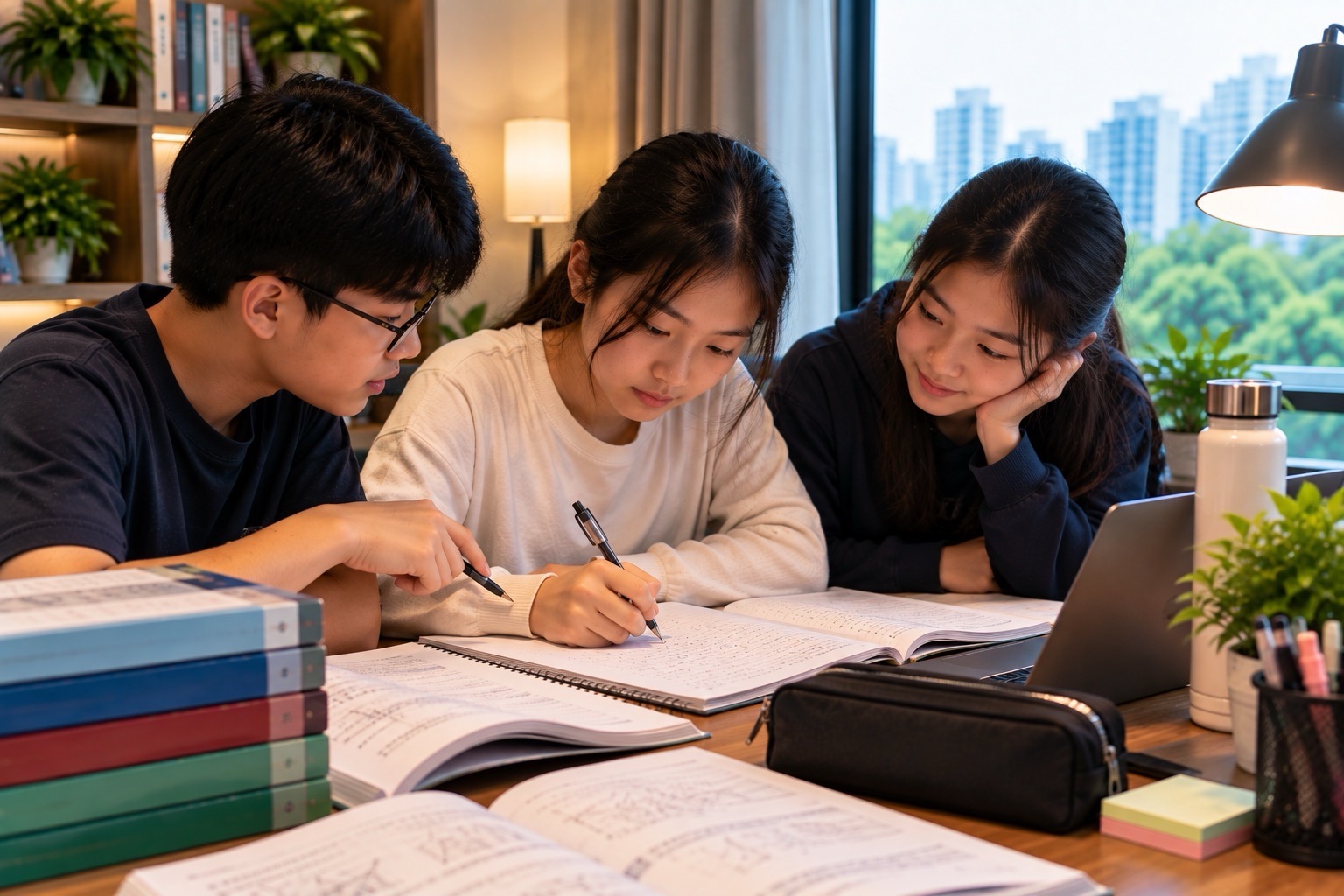
G3 Panjabi under Singapore’s 2027 Secondary Education Certificate (SEC), syllabus K361, has two compulsory written papers: Composition 45% and Language Usage/Comprehension 55%. Paper 1 lasts two hours and Paper 2 one hour thirty minutes. The subject tests a student’s ability to write purposeful Panjabi, handle its script and grammatical expressions accurately, and understand unfamiliar prose rather than merely speak confidently about familiar subjects.
Candidates write one shorter functional response of about 120 Panjabi words, chosen from letter, report, dialogue or speech, and an essay of about 200 words selected from three topics. Paper 2 includes word combination or separation, idioms, proverbs, word pairs, sentence transformation, cloze, seven objective questions based on a roughly 280-word passage, and open comprehension with vocabulary from a roughly 270-word passage.
This guide makes the official syllabus useful to parents and students, explaining Gurmukhi literacy, vowel marks, context-dependent expressions, sentence order, writing structure, source evidence, practical revision and common misconceptions. The original teaching example and four-week plan are independent educational material, not a substitute for reading the real exam instructions or a promise of an A1.
- 2027 code: K361 Panjabi; former reference 3203.
- Paper 1: Composition, 2 hours, 90 raw marks scaled to 45, worth 45%.
- Paper 1 Section A: 30 marks, one ~120-word letter, report, dialogue or speech from two choices.
- Paper 1 Section B: 60 marks, one ~200-word essay from three choices.
- Paper 2: Language Usage and Comprehension, 1h30, 110 raw marks scaled to 55, worth 55%.
- Language Usage: 50 marks, including word operations, Panjabi idioms/proverbs/pairs, transformations and cloze.
- Objective Reading: 7 MCQs from about 280 words, 14 marks.
- Open Reading: 6 questions plus vocabulary from about 270 words, 46 marks.
- Availability: November only; separate Panjabi reference lists in the official combined document are guides, not exhaustive.
Official syllabus: SEAB 2027 G3 Panjabi K361 PDF and SEAB G3 school-candidate subject directory. The same combined document covers Bengali, Gujarati, Hindi and Urdu, but their distinct scripts and expressions should not be used as substitutes for the Panjabi syllabus. SEAB and school instructions govern actual examination administration.
Quick answer: how Panjabi K361 works
G3 Panjabi works by assessing two forms of literacy. Paper 1 asks candidates to create a short purpose-driven response and a developed essay; Paper 2 tests language forms and expressions within context, factual comprehension and open interpretation of new prose. The 55% second paper means the student needs more than good storytelling and a memorised proverb list.
Understanding G3, the SEC and the Panjabi subject entry
From 2027, the Singapore-Cambridge SEC records an individual subject at G1, G2 or G3 level. G3 preserves the corresponding former O-Level academic standard. This subject’s name is written Panjabi in SEAB’s directory, with code K361, even though many English speakers also use the spelling Punjabi in general discussion.
The previous Panjabi reference was 3203. It shares a combined 2027 SEAB PDF and the broad 45/55 assessment scheme with Bengali K358, Gujarati K359, Hindi K360 and Urdu K362. These subject codes are not simply interchangeable languages. Each has its own correct written language, idiomatic use, grammar and official reference lists.
Panjabi literacy in Singapore commonly involves Gurmukhi written materials; a learner must follow the correct script and spelling conventions provided by their school. The official paper assesses Panjabi reading and writing, not a generic Roman-letter transcription or another language’s alphabet.
The two compulsory papers and their exact 2027 marks
Paper 1 — Composition: 2 hours, 90 raw marks weighted to 45, contributing 45% of the final grade. The candidate answers one question from Section A and one from Section B. These sections are not alternatives to each other.
Paper 1 Section A: a functional writing task worth 30 raw marks. Two prompts are offered, and the candidate chooses one letter, report, dialogue or speech of approximately 120 Panjabi words. The actual form matters because each has a different audience and structure.
Paper 1 Section B: a longer essay worth 60 raw marks. Three topics are offered, and the candidate chooses one, writing approximately 200 words. The question may require narrative, explanation or another reasoned response, so memorised content must not replace attention to the prompt.
Paper 2 — Language Usage and Comprehension: 1 hour 30 minutes, 110 raw marks weighted to 55 and therefore worth 55%. A comprehensive study plan covers all three sections rather than only the first grammatical exercises.
Paper 2 Section A: Language Usage worth 50 raw marks. The official question types include combination or separation of words, idioms, proverbs and words in pairs, sentence transformation and cloze passage. Language understanding must be demonstrated in the relevant Panjabi context.
Paper 2 Section B: objective comprehension worth 14 raw marks. Candidates answer seven multiple-choice questions based on a Panjabi prose passage of approximately 280 words, distinguishing the actual information from plausible distractors.
Paper 2 Section C: open-ended comprehension and vocabulary worth 46 raw marks. Six questions use a Panjabi passage of about 270 words, followed by a vocabulary question. Answers should address the exact question in natural Panjabi and avoid unsupported speculation.
Examination weights: Paper 1’s 90 raw marks are weighted to 45 and Paper 2’s 110 raw marks to 55, giving the 45/55 final distribution. The source does not add an independently weighted oral or listening examination for K361.
Reference expressions: the combined official PDF has a dedicated Panjabi section containing idioms, proverbs and word pairs. SEAB describes these lists as a guide and not exhaustive. Study their meaning and use, not merely the item numbers or neighbouring language lists.
Examination availability: November only. Any specific rules about permitted reference materials that are not expressly stated should be checked against the actual question paper and current school/SEAB instructions rather than inferred from the separate Japanese or Thai language rules.
How Panjabi language and literacy work from first principles
1. Gurmukhi literacy needs accurate whole-word recognition
Gurmukhi is a writing system used for Panjabi, with consonants, vowel signs and other marks that combine into complete written words. Recognising basic letters is a useful start, but the G3 paper requires reading and writing full prose and compositions.
Use authentic school reading material to connect script form with word meaning. Practise a short phrase, then explain a complete sentence. Reading fluency matters because a pupil who decodes every symbol laboriously may not retain the full meaning of a longer passage.
- Explain the real Panjabi sentence or task
- Use the subject-specific Gurmukhi word or form accurately
- Reattempt independently in a different context
2. Vowel signs carry real spelling and meaning information
Panjabi words use vowel signs that affect pronunciation and written identity. A learner may know the consonant letters but write the wrong vowel mark, creating an inaccurate word or an expression different from the intended meaning.
Keep a teacher-verified list of recurring spelling errors drawn from marked work, with each word in a complete meaningful sentence. Revisit the correct form in a changed context after several days rather than repeat isolated copying only.
- Explain the real Panjabi sentence or task
- Use the subject-specific Gurmukhi word or form accurately
- Reattempt independently in a different context
3. Nasalisation and gemination marks should be understood
The Gurmukhi writing system includes marks associated with nasalisation and consonant length, such as bindi, tippi and addak in their appropriate settings. A pupil can overlook a small mark while focusing on the more familiar letters.
Learn the correct form from a qualified Panjabi teacher, paying attention to the real word and meaning. Avoid inventing generic transliteration rules that may fail across different vowel environments or words.
- Explain the real Panjabi sentence or task
- Use the subject-specific Gurmukhi word or form accurately
- Reattempt independently in a different context
4. Script is not a one-to-one copy of Roman spelling
Romanised Panjabi phrases can help a beginner hear an expression, but their spelling conventions vary and may fail to capture the exact Gurmukhi forms required in a written examination. A fluent speaker may therefore need a separate literacy plan.
Use real Panjabi script from school materials as the foundation for writing practice. Ask the learner to recognise, write and then use the word in a new sentence, so comprehension and accurate form reinforce each other.
- Explain the real Panjabi sentence or task
- Use the subject-specific Gurmukhi word or form accurately
- Reattempt independently in a different context
5. Panjabi sentence order differs from English
Panjabi commonly uses subject–object–verb ordering, while ordinary English places the main verb before the object. Translating English word by word may produce an unnatural Panjabi sentence even when the vocabulary is familiar.
A simple illustrative pattern is ਅਸੀਂ ਕਿਤਾਬਾਂ ਪੜ੍ਹਦੇ ਹਾਂ (‘We read books’). Identify the person, object and verb phrase, then change the object or participant and construct another correct sentence with teacher feedback.
- Explain the real Panjabi sentence or task
- Use the subject-specific Gurmukhi word or form accurately
- Reattempt independently in a different context
6. Postpositions and case forms communicate relationships
Panjabi uses grammatical constructions and postpositions to indicate places, participants, possession and other relations. Going to a venue, being at a venue and handing something to a recipient are different situations.
Use a fictional school trip to identify actor, destination, location and recipient. The child should explain how the chosen form conveys the required relationship and test it on a second context.
- Explain the real Panjabi sentence or task
- Use the subject-specific Gurmukhi word or form accurately
- Reattempt independently in a different context
7. Verbs need appropriate tense, person and agreement
Panjabi verb forms can indicate time, aspect and agreement with the relevant participant depending on the construction. A student who uses a form heard in family conversation without checking the written context may produce a grammatical mismatch.
Create short present, past and future examples with different actors and ask which event is completed, ongoing or planned. The examination essay needs internal time consistency, especially in a narrative.
- Explain the real Panjabi sentence or task
- Use the subject-specific Gurmukhi word or form accurately
- Reattempt independently in a different context
8. Respectful and familiar address require different forms
A report to a school leader or a speech to fellow students differs from a private discussion between friends. The choice of address and verb forms should reflect the actual reader and communication purpose.
Before writing, record the intended audience, requested action and relevant level of formality. Avoid assuming that difficult-sounding or highly formal vocabulary is always stronger than natural accurate language.
- Explain the real Panjabi sentence or task
- Use the subject-specific Gurmukhi word or form accurately
- Reattempt independently in a different context
9. The official word-combination questions need explanation
Paper 2 includes combining or separating words. Recognising a phrase is not sufficient if the candidate does not understand the relationship between its components or the rule being tested.
Use Panjabi-specific classroom examples and teacher guidance, explaining the combined form’s meaning and checking the result. Do not borrow a mechanical Hindi word-operation pattern without confirming its applicability.
- Explain the real Panjabi sentence or task
- Use the subject-specific Gurmukhi word or form accurately
- Reattempt independently in a different context
10. Idioms have figurative rather than merely literal meaning
An idiom may be learned as a common cultural expression whose effect depends on context. The student might recognise every written word yet misunderstand the figurative message. This can affect both language-usage questions and essay style.
Select one Panjabi idiom from the official language-specific guide list, explain it in plain language and write a realistic example where it fits. Then identify a near-miss situation in which its use would be misleading.
- Explain the real Panjabi sentence or task
- Use the subject-specific Gurmukhi word or form accurately
- Reattempt independently in a different context
11. Proverbs should not be automatic essay decorations
A proverb communicates an observation, judgement or lesson. Inserting it into the final sentence of every composition may sound formulaic or contradict the character’s actual experience.
Ask what the proverb means and which event in the essay supports it. If it does not arise naturally from the argument or plot, omit it. Correct use matters more than quantity.
- Explain the real Panjabi sentence or task
- Use the subject-specific Gurmukhi word or form accurately
- Reattempt independently in a different context
12. Paired words are conventional forms to learn in context
The syllabus lists Panjabi words in pairs. These should be practised as meaningful expressions rather than arbitrary pairs of translated English synonyms. Their use may depend on register, grammatical setting and the sentence’s larger sense.
Study authentic examples and ask the pupil to place the pair in a new sentence. Then change the topic and verify that the expression remains natural; this shows more progress than recalling a list position.
- Explain the real Panjabi sentence or task
- Use the subject-specific Gurmukhi word or form accurately
- Reattempt independently in a different context
13. Sentence transformations must preserve the original event
Transforming a Panjabi sentence may require a change in grammatical construction, but the new version should not alter the actor, time, negative condition or central claim unless the question specifically asks for it.
Before rewriting, identify who did what and when. After rewriting, compare those facts. A technically well-formed but semantically different sentence is not equivalent to the source.
- Explain the real Panjabi sentence or task
- Use the subject-specific Gurmukhi word or form accurately
- Reattempt independently in a different context
14. Cloze answers need grammar and discourse context
A cloze passage may contain a blank that could accept several familiar words in isolation, but only one may fit the logical relationship or grammatical form of the whole paragraph.
Read the passage once for gist before making the first choice. After inserting the response, reread the full clause and explain why a tempting alternative contradicts the surrounding material.
- Explain the real Panjabi sentence or task
- Use the subject-specific Gurmukhi word or form accurately
- Reattempt independently in a different context
15. Functional letters begin with an actual reader
In Section A, a letter may request information, give a suggestion or respond to an event. The candidate needs to communicate useful details within about 120 words, not spend half the answer on elaborate but irrelevant greetings.
Identify recipient, subject, key information, reason and suitable closing. The student should be able to answer the question: what can the reader understand or do after receiving this letter?
- Explain the real Panjabi sentence or task
- Use the subject-specific Gurmukhi word or form accurately
- Reattempt independently in a different context
16. Reports should reflect what happened, not invented praise
A report can describe a school or community activity through time, place, actions and outcomes. It is not simply an opinion essay. A pupil may lose relevance by presenting planned activities as completed or claiming the entire audience enjoyed an event without evidence.
Organise facts clearly and distinguish observation from interpretation. For a fictional event, use only the facts supplied or reasonable illustrative details allowed by the task.
- Explain the real Panjabi sentence or task
- Use the subject-specific Gurmukhi word or form accurately
- Reattempt independently in a different context
17. Dialogue depends on meaningful turns
A dialogue needs two speakers who ask and answer relevant questions, consider new information and progress towards a purpose. Alternating two unrelated paragraphs under different names does not show authentic interaction.
Use a fictional school event where one student proposes a meeting, another points out a schedule conflict and the first suggests an alternative. Each line should connect logically with the previous one.
- Explain the real Panjabi sentence or task
- Use the subject-specific Gurmukhi word or form accurately
- Reattempt independently in a different context
18. Speech writing must address a particular audience
A short speech to students may identify a shared issue and offer reasons for a proposed action. The structure should support the listener rather than reproduce a generic essay opening or stock moral.
Plan the topic, central message, two supporting ideas and closing. A developed reason is more valuable than several declarations that an issue is important.
- Explain the real Panjabi sentence or task
- Use the subject-specific Gurmukhi word or form accurately
- Reattempt independently in a different context
19. A 200-word essay needs sustained development
Section B provides more room than the 120-word functional response. The learner can develop a story, explanation or argument according to the actual prompt. However, length alone cannot correct an off-topic or repetitive answer.
Write a short thesis or event plan, assign each paragraph a clear role and end with a consequence or conclusion that follows. Use familiar accurate Panjabi expressions before adding more difficult vocabulary.
- Explain the real Panjabi sentence or task
- Use the subject-specific Gurmukhi word or form accurately
- Reattempt independently in a different context
20. Narrative writing follows cause and consequence
An effective story involves a situation, challenge or meaningful change, action and outcome. A string of daily events that never connects into a point can be linguistically understandable but narratively weak.
Choose one central moment and show what the protagonist does in response. Avoid an ungrounded dramatic twist merely because a memorised model once contained one.
- Explain the real Panjabi sentence or task
- Use the subject-specific Gurmukhi word or form accurately
- Reattempt independently in a different context
21. Objective comprehension is not keyword matching
Section B has seven MCQs from about 280 Panjabi words. A wrong option may mention the same place or person but alter the time, cause or speaker’s intention. A learner who reads quickly for familiar names can be misled.
Locate the precise passage evidence and compare the entire option, including restrictions and negative phrases. Explain why the strongest distractor is inconsistent with the source.
- Explain the real Panjabi sentence or task
- Use the subject-specific Gurmukhi word or form accurately
- Reattempt independently in a different context
22. Open comprehension requires supported explanation
Section C asks six open questions followed by vocabulary on a roughly 270-word passage. Students may know where the answer is located but copy an irrelevant paragraph without naming the reason or inference.
Read the question’s command, select the relevant clue and answer in clear Panjabi. Distinguish literal fact from interpretation, and avoid inventing a character’s background when the passage is silent.
- Explain the real Panjabi sentence or task
- Use the subject-specific Gurmukhi word or form accurately
- Reattempt independently in a different context
23. Vocabulary-in-context depends on the writer’s intention
A word can have related senses, and the exact meaning in a prose passage may depend on the surrounding situation or tone. Reciting the first English translation is not always a suitable response.
Read the full sentence and its neighbours. Explain what the author actually means and use the word in a fresh sentence with the same sense. If the context is ambiguous, avoid claiming an unsupported certainty.
- Explain the real Panjabi sentence or task
- Use the subject-specific Gurmukhi word or form accurately
- Reattempt independently in a different context
24. The higher-weighted second paper needs dedicated preparation
Paper 2 contributes 55% but lasts 90 minutes, with a 50-mark language-usage section and a 46-mark open-reading section as well as the objective MCQs. Focusing only on attractive essays underprepares a major part of the assessment.
Create a balanced timetable with specific time for transformations, figurative language, objective reading and concise open responses. Review which task type repeatedly consumes time and why.
- Explain the real Panjabi sentence or task
- Use the subject-specific Gurmukhi word or form accurately
- Reattempt independently in a different context
25. Family speech and written Panjabi are related but not identical
Panjabi family communication can develop confidence and cultural connection. Formal reading, Gurmukhi spelling, reports, idioms and long unfamiliar prose are additional literacies that may require deliberate practice.
Encourage natural discussion and reading while respecting the school’s academic language standard. A pupil who speaks fluently but writes hesitantly is showing a particular learning need, not a universal lack of ability.
- Explain the real Panjabi sentence or task
- Use the subject-specific Gurmukhi word or form accurately
- Reattempt independently in a different context
Original worked example: a school sports-day announcement
1. Invented school sports-day communication
Imagine a fictional school planning a sports day and asking students whether an additional shaded rest area would be helpful. A pupil is asked to write a Panjabi letter to a school representative explaining one benefit, a practical consideration and a suggestion. This is an independent teaching case, not an official SEC prompt.
The first task is to identify the audience and intended effect. A long story about winning a race is not the same as a practical letter about a school event.
2. Make a relevant content plan
One possible benefit is a place for participants to rest between activities. Relevant considerations include available space, supervision and access for students with different needs. A suggestion might ask the school to assess suitable locations rather than claim an area has already been approved.
Each point should serve the recipient. The about-120-word response cannot afford paragraphs that are purely decorative.
3. Use a short Panjabi clause accurately
An illustrative simple sentence is ਅਸੀਂ ਕਿਤਾਬਾਂ ਪੜ੍ਹਦੇ ਹਾਂ (‘We read books’). This demonstrates a subject, object and verb phrase; it does not answer the sports-day letter. A learner must apply a similar sentence-building method to the actual event and reader.
The controlled example is deliberately short. A qualified Panjabi teacher should check the pupil’s new expressions and correct register before full assessed writing.
4. Preserve a proposal’s uncertainty
The school is only considering the shaded area. A student must not write that it has already improved athletes’ recovery or that the entire school voted for it. The letter can describe a plausible benefit without presenting speculation as recorded fact.
This distinction supports both honest composition and accurate reading. An announcement about a proposed measure is different from evidence of a completed outcome.
5. Explain a practical constraint without exaggeration
A sensible letter might acknowledge that the chosen area needs adequate room and supervision. It should not invent exact budget figures or claim staff shortages unless the prompt provides those facts.
A developed recommendation connects benefit, constraint and a feasible next action. That is a stronger response than a generic demand that the school must do more.
6. Convert the topic into a report
Suppose a different Section A task asks for a report on an already completed sports event. The report should record relevant facts: activity, timing, participants and outcome where supplied. It should not simply repeat a future letter proposal.
The same subject matter now needs a different organisation. Recognising the required genre is part of the examined writing skill.
7. Convert it into a speech
If the prompt asks for a short speech encouraging participation, the learner could identify an inclusive school value, explain a practical reason and suggest how students can help. The audience is fellow pupils, not the school administrator receiving a letter.
A coherent speech develops a central message. Adding a proverb only makes sense if it supports that message rather than serving as a generic ending.
8. Convert it into a dialogue
Imagine two classmates discussing whether a scheduled sports event clashes with an activity. One raises a concern, the other checks the timetable and they agree on a reasonable action. Each line should respond to the latest information.
This teaches purposeful conversational logic in written form, without asserting that a separate Panjabi oral SEC paper exists.
9. A fictional objective-reading timetable
Suppose an invented notice says the race begins at nine but registration closes at eight-thirty. A candidate who answers that students can register at nine has confused event start with registration deadline.
The actual Paper 2 source is in Panjabi, but the evidence habit transfers: identify which time the question requests and which condition applies.
10. A Panjabi idiom exercise
A qualified teacher selects one authentic Panjabi idiom from the official K361 guide and explains its figurative meaning. The learner then makes two original situations: one where the idiom fits naturally and one where it would misrepresent the speaker’s meaning.
This builds contextual judgement rather than rote copying. The official list is a guide, not a guarantee that every exam expression is listed.
11. A longer essay on teamwork
If Section B asks about cooperation in school, the learner needs a developed 200-word answer with a central view, relevant examples and a sensible qualification. It should not simply paste the sports-day letter and add more greetings.
The chosen prompt may require a personal narrative or an argument instead, so the student must select an organisation suited to the question.
12. Practise open comprehension inference
Imagine a fictional Panjabi passage describing a pupil who hesitates to join a race but later volunteers after encouragement from classmates. A question asks why the pupil’s action changed. The response must identify the supported cause rather than invent an athletic award or family pressure.
A concise clear answer grounded in passage evidence is stronger than a long unsupported psychological explanation.
13. Use a new context to prove mastery
Replace sports day with a library notice, school transport arrangement or community activity. Ask the learner to write a new formal response, choose a context-suitable idiom, transform a sentence and answer an unfamiliar passage question.
Improvement is shown when the same reasoning works without the original model. The educational aim is flexible written Panjabi, not memorisation of one sports example.
Common mistakes and targeted repairs
Panjabi confused with another South Asian language
What goes wrong: An old Gujarati or Hindi revision list is treated as K361 idiom content.
Targeted repair: Use the dedicated Panjabi language section of the official PDF.
Generic four-paper language format assumed
What goes wrong: The study plan invents separately weighted oral and listening marks.
Targeted repair: Use K361 Paper 1 45% and Paper 2 55%, both written.
Raw marks mistaken for weight
What goes wrong: The 110-mark second paper is reported as 110% of the subject.
Targeted repair: Follow the official 55% final scaling.
Only one Writing section answered
What goes wrong: A pupil writes the essay and skips the shorter functional task.
Targeted repair: Complete one chosen question from each required section.
Wrong genre
What goes wrong: A speech prompt receives a letter or a report is written as opinion.
Targeted repair: Identify the actual form and reader before drafting.
Gurmukhi vowel sign miswritten
What goes wrong: A word is recognised in speech but spelt incorrectly.
Targeted repair: Practise full authentic written phrases.
Nasalisation or length mark overlooked
What goes wrong: The learner ignores a small meaningful orthographic mark.
Targeted repair: Use teacher-verified Gurmukhi words and delayed corrections.
Romanised text substitutes for script
What goes wrong: The pupil practises spoken approximations but not full Panjabi writing.
Targeted repair: Read and write actual subject-standard script.
English order copied
What goes wrong: A clause has awkward word order or unclear action.
Targeted repair: Identify subject, object and verb before composing.
Verb agreement or tense changed
What goes wrong: A future plan becomes a completed event.
Targeted repair: Check actor and timeline before selecting forms.
Register inconsistent
What goes wrong: A letter to a principal sounds like a casual chat.
Targeted repair: Use appropriate respectful or familiar forms.
Idiom chosen only for style
What goes wrong: The expression does not suit the described situation.
Targeted repair: Explain the real figurative meaning and context.
Proverb contradicts the story
What goes wrong: A universal moral is pasted onto an unrelated ending.
Targeted repair: Use a saying only when evidence in the composition supports it.
Word pair used unnaturally
What goes wrong: A memorised pair is inserted without attention to the sentence.
Targeted repair: Learn natural full-sentence examples.
Sentence transformation changes the original meaning
What goes wrong: The writer reverses actor, time, negation or certainty.
Targeted repair: Compare the original and transformed facts explicitly.
Cloze answer picked from familiarity
What goes wrong: The word fails grammatical role or paragraph logic.
Targeted repair: Read the complete text before choosing.
MCQ chosen from an obvious keyword
What goes wrong: The option changes the registration deadline or person.
Targeted repair: Verify every decisive detail against source evidence.
Open response only copies the story
What goes wrong: The answer never states the requested reason.
Targeted repair: Use a direct inference with relevant text support.
Paper 2 revision underweighted
What goes wrong: The child prepares mainly model compositions.
Targeted repair: Protect study time for the 50-mark language and 46-mark open sections.
No independent retry after feedback
What goes wrong: The pupil memorises one correction but repeats it later.
Targeted repair: Reattempt a changed example after a delay.
How to prepare for the actual examination sections
Paper 1 Section A: functional Panjabi writing
Practise different letters, reports, dialogues and speeches. Read the actual prompt, identify the intended audience and select only the information necessary to complete the task. Produce an organised response of about 120 words.
The section carries 30 raw marks. A pupil who understands the subject but misses the genre or recipient requires content-planning feedback rather than another generic essay model.
Paper 1 Section B: one developed essay
Compare three new prompts and select one that can be addressed accurately. Plan an event sequence or an explanation with two or three distinct ideas, then write around 200 words in natural Panjabi.
Rehearse both Writing sections in the shared two-hour paper only when the learner can produce relevant independent paragraphs.
Paper 2 Section A: 50 marks of language usage
Use authentic Panjabi-specific words, idioms, proverbs and pairs from the official guide and classroom examples. Practise combination/separation, sentence transformation and contextual cloze.
After correction, require the pupil to explain why the answer is appropriate. A memorised list does not replace correct use in a new passage.
Paper 2 Section B: seven passage-based MCQs
Read an unfamiliar passage, identify its main purpose and answer seven questions with specific source evidence. Pay attention to dates, negation, cause and shifts in viewpoint.
Review one plausible distractor per item and explain what makes it inconsistent with the text. Then use a different passage to test transfer.
Paper 2 Section C: open comprehension and vocabulary
Practise six direct or inferential questions plus interpreting a vocabulary word in context. Use clear written Panjabi rather than copying long passages without answering the command.
This section carries 46 raw marks, making precise explanation an important independent skill alongside language usage.
Integrated two-paper exam practice
Build realistic timed tasks for two-hour Writing and 90-minute Language/Comprehension, checking completion and accuracy. Keep a separate error log for script, grammar, relevance, idioms, source reasoning and time.
An appropriate revision plan should reflect the 45/55 grade distribution and the student’s demonstrated needs, not a generic preference for worksheets.
Four-week diagnostic and repair plan
Week 1 — classify the main Panjabi literacy obstacles
Ask for one functional-writing answer, an essay plan, a few language-usage items, objective reading and a short open response. Identify the earliest wrong decision in script, word order, register, figurative meaning or inference.
Select two high-impact patterns and record an independent reattempt later in the week.
Week 2 — strengthen Gurmukhi and contextual expression
Practise difficult written forms in authentic complete phrases, then use a new report or letter prompt. Review an idiom and a proverb in contexts where they are relevant and irrelevant.
Retest after two or three days with changed vocabulary and ask the learner to explain the decision.
Week 3 — build prose comprehension and essay development
Read fresh Panjabi passages and distinguish explicit facts from inference. Write a developed essay paragraph and one sentence transformation, checking meaning fidelity.
After feedback, repeat on unfamiliar material rather than copy the marked answer.
Week 4 — integrate the 45/55 paper scheme
Complete selected timed components from Paper 1 and Paper 2, including high-mark language usage and open comprehension. Review incomplete or repeatedly wrong items.
Continue the plan based on independent progress. Four weeks is a useful repair cycle, not complete syllabus coverage or a guarantee of final grades.
A sustainable weekly Panjabi-learning routine
- Read one short unfamiliar Panjabi prose passage for meaning.
- Practise one difficult Gurmukhi word or mark in a complete phrase.
- Use one idiom from an authentic list in a new suitable sentence.
- Transform a sentence without changing its original claim.
- Write a short functional response for a specified reader.
- Answer a seven-MCQ-style question with exact text evidence.
- Write one concise open comprehension response in Panjabi.
- Reattempt an earlier wrong choice after a delay with changed material.
Parent guidance and small-group learning
Parents can encourage meaningful Panjabi conversation while respecting that the SEC specifically tests reading and writing. A child comfortable speaking with family may still need Gurmukhi spelling, idiom use and unfamiliar prose inference. Those are identifiable skills rather than broad judgements about intelligence.
Use a qualified Panjabi teacher for accurate written forms, natural register and language-specific proverbs. Avoid assuming that a Hindi or Gujarati expression automatically belongs in the Panjabi course just because the SEAB document contains all five languages.
An appropriate three-student tutorial may give each learner a chance to explain why a word pair fits or why a comprehension inference is supported. Group size is not a grade guarantee, and some pupils already make strong progress through school teaching and independent reading without additional paid support.
The article follows the educational structure of eduKateSG’s immutable Clementi Mathematics small-group reference: direct information, explained foundations, original worked examples, specific error repairs, a realistic plan and official sources. The actual learning content remains Panjabi-specific.
Frequently asked questions
What is the 2027 Panjabi SEC code?
K361, with an earlier reference of 3203.
Why is the name written Panjabi rather than Punjabi?
Panjabi is SEAB’s official subject title spelling; Punjabi is also a common English-language spelling outside the examination directory.
How many examination papers are required?
Two written papers: Composition and Language Usage/Comprehension.
What are their weights?
Paper 1 45% and Paper 2 55%.
How long are the papers?
Paper 1 two hours; Paper 2 one hour thirty minutes.
What does Section A Writing require?
One letter, report, dialogue or speech of about 120 Panjabi words, selected from two prompts, worth 30 raw marks.
How long is the essay?
Approximately 200 Panjabi words, selected from three topics, for 60 raw marks.
What topics appear in Language Usage?
Word combination/separation, idioms, proverbs, word pairs, sentence transformation and cloze, for 50 raw marks.
How is objective comprehension assessed?
Seven MCQs from approximately 280 Panjabi words, worth 14 marks.
What is open comprehension?
Six questions and a contextual vocabulary question on a roughly 270-word passage, worth 46 marks.
Does the syllabus provide Panjabi expressions for study?
Yes. The combined PDF includes separate Panjabi idiom, proverb and word-pair lists, described as guides and not exhaustive.
Does K361 contain separate oral and listening exams?
No such separate components appear in its published 2027 two-paper scheme.
When is the exam offered?
November only according to the official syllabus.
Can a child use Hindi-language word lists for K361?
Not as a substitute. Panjabi script, grammar, expressions and the official language-specific list differ.
Where should parents check the latest rules?
Use the SEAB 2027 K361 PDF and G3 school-candidate syllabus directory linked above.
Official documents and related SEC guides
- SEAB official 2027 G3 Panjabi K361 syllabus and language-specific lists
- SEAB 2027 G3 school-candidate subject directory
- How G3 Bengali Works | SEC Guide
- How G3 Gujarati Works | SEC Guide
- How G3 Hindi Works | SEC Guide
- How G3 Urdu Works | SEC Guide
The lasting principle
G3 Panjabi rewards a learner who can read the right written forms, use idioms and grammar in a fitting context, write for the actual audience and support reading conclusions with evidence. The strongest revision system helps pupils make these language decisions independently across new tasks. That competence remains valuable far beyond the 2027 SEC.