
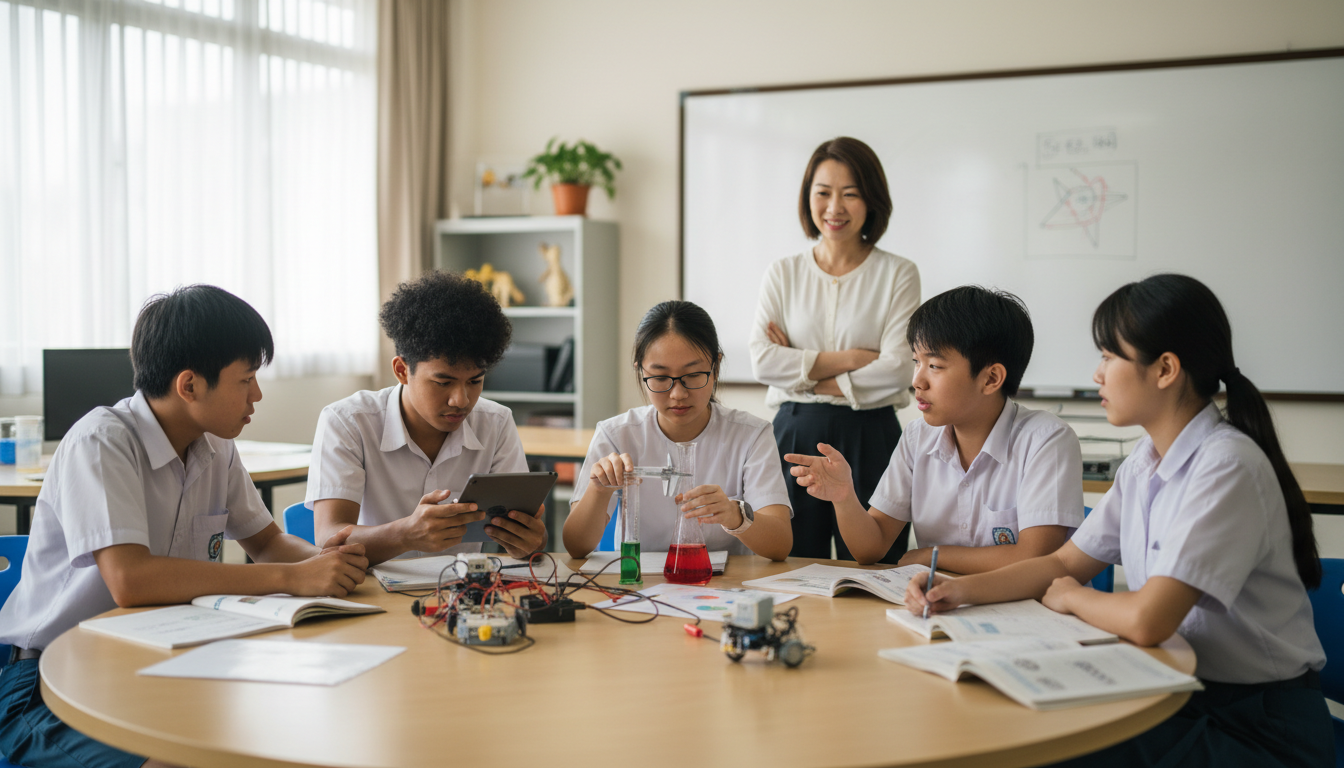
G3 Science Combined Practical Paper 5 is the 2027 Singapore-Cambridge Secondary Education Certificate laboratory examination for students taking two G3 science disciplines. It is one ninety-minute paper covering the pair selected by the candidate, not three separate science practicals or a standalone Physics, Chemistry or Biology paper.
The official syllabus codes are K326 Science (Physics, Chemistry), K327 Science (Physics, Biology) and K328 Science (Chemistry, Biology). Every combination has the same Paper 5 duration and overall weighting: thirty marks and fifteen percent of the combined result. Within the paper, one or two compulsory questions are set on each of the two sciences.
- K326: Physics and Chemistry
- K327: Physics and Biology
- K328: Chemistry and Biology
- Paper 5: 1h30, 30 marks, 15% of final combined Science grade
- Other exams: 40 MCQs worth 20%; two discipline-specific structured papers worth 32.5% each
- Practical evaluation: modification/extension may be tested without execution and worth 10–20% of practical marks
- Reference rule: only provided Chemistry Practical Notes permitted; no personal notes
The authoritative source is SEAB’s 2027 G3 Science K326/K327/K328 syllabus (assessment scheme on pages 6–7 and practical topics from page 55), listed in the 2027 G3 syllabus directory. The examples here are original fictional data for safe learning, not examination predictions.
Quick navigation
- Official 2027 assessment
- What practical skills really mean
- Original combined worked example
- First-principles preparation
- Strategies for all combinations
- 90-minute learning session
- Common errors and repairs
- Four-week revision cycle
- Frequently asked questions
- Official references and subject guides
The Official 2027 Combined Science Assessment Scheme
Candidates take Paper 1, Paper 5, and two subject-appropriate structured-response papers. Physics is Paper 2, Chemistry Paper 3 and Biology Paper 4 in this combined-science framework. The 2027 Paper 5 is set at the same time across the three combinations, with subject-specific practical questions shared where a science appears in more than one combination.
- K326: Paper 1 MCQ, Physics Paper 2, Chemistry Paper 3 and combined Practical Paper 5.
- K327: Paper 1 MCQ, Physics Paper 2, Biology Paper 4 and combined Practical Paper 5.
- K328: Paper 1 MCQ, Chemistry Paper 3, Biology Paper 4 and combined Practical Paper 5.
- Paper 1: 40 compulsory MCQs, 60 minutes and 20%.
- Each structured paper: 65 marks, 75 minutes and 32.5%.
- Paper 5: 30 marks, 90 minutes and 15%; one or two compulsory practical questions on each science.
- Chemistry Practical Notes are supplied where relevant; personal reference material is prohibited.
A 15% practical paper can be important for the final result, but its value should not be exaggerated by assuming each discipline receives another independent 15%. The student’s actual mark is based on the single combined Paper 5.
How Combined G3 Science Practical Paper 5 Actually Works
The entire practical is one ninety-minute examination
All three G3 combined Science codes use Paper 5, which lasts one hour thirty minutes for thirty marks and contributes fifteen percent of the final subject grade. This time is for both sciences combined; it is not ninety minutes per discipline or two individual sittings.
The student should learn the registration code before using practice material. Paper 5 is the one common practical format for K326, K327 and K328, but the experiment types depend on the two component sciences actually selected.
The three permitted Science combinations
K326 is Science (Physics, Chemistry), K327 is Science (Physics, Biology), and K328 is Science (Chemistry, Biology). Each combination has a common Paper 1 multiple-choice test, two appropriate structured written papers and the combined practical Paper 5.
A school timetable or revision guide must use the matching pair. A K327 candidate needs Physics and Biology practical training, not a Physics/Chemistry mock. Do not assume every pupil registered for SEC Science takes all three disciplines in Paper 5.
Paper 5 has compulsory questions from each subject
The syllabus says one or two compulsory questions are set on each of the two sciences. A candidate who finishes a preferred subject’s task but misses the other has left a required part of the same practical paper unanswered.
Read the full set of tasks promptly and recognise which measurements, drawings and data analyses must be completed. No official fixed split of the thirty marks by subject should be invented; the actual 2027 paper specifies the marks.
Common Physics questions across two combinations
The Physics practical question or questions are identical for K326 and K327. This allows candidates to understand which Physics skills transfer between combinations while retaining different second-science content.
A Physics measurement worksheet used in K326 can be useful to a K327 learner, provided the content is appropriate. But the rest of the mock paper needs to be replaced with Biology, not presented as a full K327 simulation.
Common Chemistry questions across two combinations
Chemistry practical question or questions are shared across K326 and K328. The subject-specific observations and quantitative reasoning therefore use the same Chemistry assessment standard in those two combinations.
Students can transfer learning about recording titres, interpreting colour change, supplied notes and basic calculations, but should check which second practical discipline is being examined within the full 90 minutes.
Common Biology questions across two combinations
Biology practical question or questions are shared across K327 and K328. Specimen observation, drawing and measurement concepts may be useful to both cohorts without making the entire paper identical.
A K328 candidate should not use Physics to replace Chemistry simply because the Biology task looks familiar. Practise the enrolled combination as an integrated process after strengthening each discipline separately.
Practical skills are more than remembering an experiment name
SEAB’s experimental objectives include following instructions, using techniques and equipment, recording observations and estimates, interpreting results, planning investigations and suggesting improvements. A candidate can memorise ‘osmosis’ yet misread a scale, or know a physics formula but choose the wrong measured values.
The correct preparation method is to identify the specific wrong decision in a marked practical attempt. Then teach the relevant scientific idea and ask whether the student can apply it to a changed table, specimen or question.
Observation versus inference: a rule across every science
A numeric reading, visible precipitate, cell structure or physical motion can be observed. An inferred cause or identity is an explanation based on that evidence and the relevant scientific principles. These should not be mixed into one unsupported statement.
For each practice item, write first what was actually recorded, then what it may mean. That prevents the Chemistry candidate from guessing an ion from one colour and the Biology candidate from adding an organelle that was not visible in an image.
Variables and fair comparisons
A controlled comparison asks what is deliberately varied, which response is measured, and what relevant conditions should remain consistent. The appropriate controls differ between an electrical investigation, a chemical rate comparison and a biological mass-change study.
Ask the pupil to identify an experimental question and name one meaningful control with a reason. An isolated list of ‘temperature, mass, time’ is not sufficient when the question concerns a particular causal relationship.
Graphs: two scientific contexts, one general skill
Graphs can express how a quantity responds to time, length, concentration or another variable. A student should select suitable axes, write units, plot observations accurately and describe trends before explaining them.
The same graphing rule transfers among sciences, but the meaning of a gradient changes with the variables. A Physics gradient may describe a physical constant under an idealised model, while a Biology curve may show a measured response with no linear rate throughout.
Units protect against plausible-looking errors
The practical assessment may involve seconds, centimetres, cubic centimetres, grams, millimetres, volts or other quantities. Confusing a unit can make a correct formula produce a result that does not answer the task.
Write a quantity label and unit beside every meaningful measured value. Convert where the formula requires it, such as centimetres to metres or cm³ to dm³, before calculation. Ask whether the final unit makes sense for the requested answer.
Precision: record what the instrument can justify
Different instruments have different scales and resolutions. A student should not copy the same number of decimal places into a burette table, ruler measurement and digital stopwatch record without considering the apparatus and instructions.
In a supervised school practical, record genuine readings consistently. In a printed example, identify the scale resolution before reporting a value. Extra unsupported digits do not make a reading more precise.
How Physics contributes to Paper 5
The Physics practical scope includes measurements of length, time, volume, mass/weight, temperature, electric current and potential difference. It can also involve forces, moments, heat, optics and other stated investigation contexts.
A learner needs to identify the correct quantity and use a suitable relationship. For a fictional timing task, total time for multiple cycles differs from one period. In a fictional circuit task, the resistance calculation must use a voltage and current referring to the same component.
Physics: pendulum timing and repeated readings
Timing several complete oscillations may improve the practicality of estimating an average period compared with timing only one. The learner must correctly count the complete cycles and divide the total elapsed time by that number.
If an original table reports fifteen oscillations in thirty seconds, the average period is 2.0 seconds. That is a mathematical practice example, not a prediction about the equipment SEAB will use in a particular sitting.
Physics: graphs and slopes in context
A Physics graph may allow a student to identify a relation and calculate a gradient or derived value. The gradient is change in the vertical quantity divided by change in the horizontal quantity, which depends on the axes selected.
Practise deciding what the axes mean before applying any familiar equation. Do not treat a plotted line’s height as its gradient or assume every line passes through the origin when data do not support that.
Physics: optics and electrical diagrams
The syllabus includes practical optics and basic circuit measurements. Correct geometry, scale references and reading of relevant electrical quantities matter. A mistake such as measuring a refraction angle from the surface rather than the normal can change an answer.
Use teacher-provided paper diagrams and fictional readings for independent practice. Real rays, glassware, electrical supplies and magnetic apparatus remain under authorised school supervision, with the candidate following the given instructions.
How Chemistry contributes to Paper 5
The Chemistry portion may examine quantitative measurements, qualitative observations, rates, chromatography, filtration or related practical work. The task may provide the Chemistry Practical Notes needed to interpret specific tests and ions.
A strong Chemistry candidate distinguishes visible observations from chemical identities, subtracts initial from final readings where appropriate, uses consistent volume units and draws only conclusions supported by the supplied evidence.
Chemistry: the supplied Practical Notes are not a complete answer
SEAB allows the provided Chemistry Practical Notes and prohibits other reference materials. The notes can help interpret a precipitate, gas test or ion reaction, but they do not tell the candidate what was actually observed.
During practice, use a fictional observation table with the permitted reference material. The pupil should locate the relevant entry and compare it carefully with the entire stated pattern, not guess a name from one familiar colour.
Chemistry: titres are changes, not absolute scale readings
In a fictional titration dataset, the delivered volume is the difference between final and initial burette readings. If a sample begins at 1.20 cm³ and ends at 26.00 cm³, its titre is 24.80 cm³.
Do not take the final reading alone or average the initial readings. If the question then asks for concentration, check which reaction ratio, volume and unit conversion the supplied information actually permits. Actual reagents and titration equipment require school supervision.
Chemistry: qualitative inference must remain modest
A white precipitate or colour change can be meaningful, but it may not uniquely identify every possible substance without appropriate other tests. Similarly, a chromatogram’s matching spots may support a comparison without proving all underlying molecules are identical.
Write the observation separately and ask what the combined documented tests support. Follow the official Notes and the question’s wording, particularly when it asks for a general conclusion rather than a specific ion identification.
How Biology contributes to Paper 5
The Biology portion can test observation of specimens, line drawings, labels, measurement, magnification and interpretation of physiological or experimental data. A candidate may encounter familiar or unfamiliar material and is expected to reason from what can genuinely be seen.
Learning the names of every plant organelle does not automatically give the skill of drawing from a real specimen. Practise with new printed images and safe fictional measurements, using school facilities for actual tissue or indicator work.
Biology: magnification needs compatible units
Magnification compares image size with actual size. A student who divides millimetres by micrometres without converting can produce an answer wrong by a factor of one thousand.
In a fictional diagram, a drawn object 50 mm long represents an actual object of 0.25 mm, so magnification is 200 times. The result has no millimetre unit because both lengths cancel.
Biology: measurement, percentage and biological meaning
A change in specimen mass or length can be interpreted quantitatively, but the calculated percentage needs the correct reference value. The biological explanation also depends on what surrounding conditions the question provides.
In fictional numbers, an initial mass of 4.0 g becoming 4.4 g is a ten-percent increase relative to the initial mass. That arithmetic does not prove a particular mechanism without the biological setting.
Biology: line drawings are scientific communication
A line drawing should represent visible structures and their proportions clearly, with labels and magnification where requested. Decorative shading and invented internal details can make an answer less precise despite looking artistic.
Use approved image references for independent practice and compare the labels with what can be resolved at the image’s stated magnification. Actual specimen manipulation and sharp instruments belong in the school laboratory.
A proposed modification may be asked without execution
The 2027 combined practical syllabus requires candidates to suggest a modification or extension in one or more questions, without carrying it out. Depending on the context, this element accounts for ten to twenty percent of Paper 5 practical marks.
An improvement identifies a limitation and explains why a specific adjustment might reduce it. An extension changes or expands the scientific question. The candidate should not treat these answers as an instruction to improvise a new experiment during the sitting.
Improvements need a problem and a mechanism
‘Repeat more carefully’ is a weak improvement because it does not identify what was wrong. Useful evaluation asks which observation or measurement was uncertain, whether the proposed change addresses that source and how the result might be affected.
For a fictional time-measurement task, a specific inconsistency could justify better definition of timing endpoints. For a biological drawing, unclear boundaries could justify a more suitable observation method under supervision. The answer should match the problem.
Extensions must remain related and testable
An extension may investigate a further variable or a new but related question. A proposal unrelated to the original aim does not show that the student understands the experiment’s scientific logic.
Write what new condition would be compared, what response would be measured and why the comparison would add knowledge. Keep it appropriate to the student syllabus and centre safety arrangements.
Do not assume exam topics can be predicted from apparatus lists
The syllabus lists examples of apparatus and practical tasks but notes that actual requirements vary. The same scientific skill can be tested using unfamiliar material, data-logger output or a different diagram.
Practise identifying the underlying variables, reading instruments, handling graph questions and evaluating evidence. A guide that promises a particular year’s specimen or reagent without official release is not trustworthy.
References: Chemistry Practical Notes are the exception
The combined Paper 5 bars notebooks, textbooks and other outside reference material. The Chemistry Practical Notes supplied in the question paper are the stated exception. Candidates should not assume that a calculator display or personal notes supply definitions.
Learn the relevant scientific language, units and drawing conventions before entering. During revision, gradually remove the notes after learning and attempt new questions under the real restriction.
Hands-on safety: laboratories are not home tutorials
A combined practical can involve hot apparatus, electrical supplies, chemicals, sharps or biological materials. Schools are responsible for proper preparation, supervision, protective measures and compliance with institutional rules.
This guide uses only paper-based reasoning and fictional examples outside the laboratory. Physical experiments should be learnt in appropriate approved school sessions, and parents should not collect bodily samples or improvise gas tests for revision.
Time management across both sciences
The same ninety minutes contains both disciplines and may include recording readings, a graph, drawing, interpretation and modification. A candidate who spends all time perfecting one sketch can leave important tasks in the other science untouched.
In a school-supervised mock, note how much time was spent obtaining necessary observations versus completing answers. Build a realistic approach based on marks actually printed, not a fixed invented Physics-versus-Chemistry minute allocation.
Learning from a poor practice result
A low practical mark can reflect an incorrect instrument reading, a weak scientific explanation, unfamiliar apparatus, time pressure or a missing modification. Each has a different remedy, so simply retaking the same mock may not correct the problem.
Use a short error register by skill rather than by subject alone: observation, quantity, inference, graphing, planning and timing. Then retest the repeated failure with a fresh safe example after feedback.
What practical competence means beyond the examination
The deeper skill is knowing how evidence supports a scientific conclusion and how a claim could be wrong. A candidate should be able to explain both what a graph shows and what additional measurement would strengthen confidence.
This thinking is useful in everyday decisions about scientific information, technology and health claims. The educational objective is reliable reasoning, not merely a correct answer in one familiar laboratory worksheet.
An Original Integrated Worked Example: Physics, Chemistry and Biology
The following is an original, completely fictional integrated Paper 5 practice exercise with three independent small examples. A real candidate would encounter only the two disciplines in their registered combination. No chemicals, electrical equipment, live specimens or laboratory procedures are involved here.
First consider a Physics timing card: fifteen complete oscillations are reported to have taken 30.0 seconds. The average period per oscillation is 30.0 ÷ 15 = 2.00 seconds. The raw time and the derived period are different quantities.
Suppose a second fictional timing card gives 30.6 seconds for fifteen oscillations, an average of 2.04 seconds. The values differ slightly. A student should report that difference honestly rather than adjust the measured result to the previous one.
Next consider a separate Chemistry measurement card: an imaginary burette starts at 1.20 cm³ and ends at 26.00 cm³. The difference is 24.80 cm³ of delivered liquid. It would be wrong to report the final scale reading of 26.00 cm³ as the titre.
Another fictional Chemistry trial gives 24.90 cm³. If the question appropriately asks for the average of these two titres, the result is 24.85 cm³. That number alone does not tell us the concentration of an unknown reactant without the relevant further information.
Now consider a Biology diagram card: the printed drawing has a length of 50 mm and is stated to represent an actual object 0.25 mm across. The magnification is 50 ÷ 0.25 = ×200. The units cancel. No actual specimen needs to be handled.
For a second Biology data task, an imaginary mass rises from 4.0 g to 4.4 g. The relative change is (4.4−4.0)/4.0 × 100% = 10% increase. This supports a measured increase but does not by itself establish every biological cause.
These examples map to combinations. K326 uses the Physics timing and Chemistry reading concepts; K327 uses Physics and Biology; K328 uses Chemistry and Biology. The exact real examination questions are not predicted by this exercise.
Now add a fictional graph: a measured variable rises quickly over four intervals and then becomes nearly unchanged. The candidate should describe the trend using labels and units before interpreting the physical, chemical or biological meaning within the given question.
A modification question might ask about reducing uncertainty in a reading. The correct response must name the actual source: for example, inconsistent scale alignment, limited instrument resolution or unclear image endpoints. It must then state why a proposed change would improve the evidence.
An extension could instead ask what related condition might be investigated in future work and how the result could be compared with the original. The student need not perform it; the published combined syllabus explicitly allows a proposed modification or extension without execution.
The lesson is not to memorise the numbers 2.00, 24.80 or ×200. It is to identify what was measured, select the right calculation, retain units, distinguish observation from inference and show the reasoning clearly on unfamiliar material.
All datasets and examples here are original teaching constructions, not actual practical results. Physical examination methods require school-supervised laboratories, genuine observations and full compliance with safety requirements.
Our First-Principles SEC Practical Preparation System
The teaching structure adapts eduKateSG’s immutable three-student Clementi tutorial reference: identify the first unstable decision, rebuild the principle, model an example, remove prompts, practise unfamiliar transfer and revisit after a delay. The same diagnosis-to-retest process can be applied to each of the two registered sciences without pretending all practical equipment is interchangeable.
1. Verify the actual two-subject combination
Before practice, confirm whether the pupil takes Physics/Chemistry, Physics/Biology or Chemistry/Biology. A wrong mock can confuse which questions and equipment belong to the relevant exam.
2. Diagnose the first practical misunderstanding
Inspect one genuine marked question or school-supervised result. Locate the exact error: measurement, wrong sample, missing unit, image-size conversion, unsupported chemical identification or unclear modification. A single total paper mark cannot show this.
3. Rebuild the principle using safe evidence
Choose a short fictional dataset, printed image or paper graph. Explain why the correct method fits and why the earlier decision failed. Actual specimen handling, chemical tests and electrical setups remain school-supervised.
4. Transfer the skill to a new context
Change the values, graph orientation, observation or subject setting without changing the underlying method. The learner should identify a quantity and make the correct choice independently, rather than reproduce an earlier solution.
5. Integrate both disciplines with genuine timing
In a supervised school mock, rehearse completing the two sciences’ compulsory tasks under ninety minutes. Check whether time is lost during apparatus work, drawing, reading or checking, and adapt within the actual paper rules.
6. Evaluate and retrieve after a delay
Use a precise error register with original decision, correction and later unfamiliar retest. A student who improves on a second new item has stronger evidence of readiness than one who merely makes a corrected original page look perfect.
Preparation Strategies for K326, K327 and K328
K326: Physics and Chemistry
Practise both physical measurements and chemical qualitative/quantitative interpretation, then combine them within one ninety-minute school-supervised mock. Use the correct Chemistry Practical Notes context.
K327: Physics and Biology
Practise physical quantities and graphs alongside biological observation, clear line drawing and magnification. Ensure the two practical disciplines both receive attention in timing rehearsals.
K328: Chemistry and Biology
Work on honest chemical observation, numeric reasoning, specimen recognition and biological data. The chemistry notes help with chemical interpretation, while biological drawings still require independent competence.
Across all three: identify the command word
Measure, describe, calculate, deduce, suggest and explain require different outputs. Read the question before using a memorised method and verify units, evidence and the requested final answer.
Modification: give a scientific reason
Choose one significant limitation and show how an adjustment might address it. If proposing an extension, identify the new testable question and relevant comparison; execution is not required for this assessment element.
Paper 5 in ninety minutes: finish both subjects
Use a real supervised school mock to examine apparatus timing, graphing, writing and the second discipline’s tasks. Do not assume a predetermined thirty-mark split or official minute allocation that the syllabus has not provided.
No personal references or unsupervised experiments
Only the supplied Chemistry Practical Notes are permitted as reference. Rehearse safe data interpretation independently and reserve all actual physical equipment and specimen work for authorised school instruction.
A Focused 90-Minute Safe Learning Session
- 10 minutes: retrieve a unit, observation and variable distinction without notes.
- 15 minutes: diagnose a genuine error in the pupil’s registered science pair.
- 20 minutes: model one safe fictional calculation or graphing technique.
- 20 minutes: try a different evidence task from the second registered science independently.
- 15 minutes: plan a modification or extension and explain its reasoned effect.
- 10 minutes: record the correction and schedule a later independent retest.
This session uses paper-based educational material; it is not a substitute for the supervised national practical, despite sharing its ninety-minute duration. School laboratories provide the safe equipment and genuine hands-on skills required.
Common Errors and Specific Repairs
A candidate practises all three sciences for one Paper 5
Repair: Use only the registered pair K326, K327 or K328.
Paper 5 is mistaken for the standalone practical Paper 3
Repair: Check the ninety-minute, thirty-mark/fifteen-percent combined format.
The full 15% is attributed to Physics or Chemistry alone
Repair: Recognise the weighting is shared across both sciences in Paper 5.
Physics total oscillation time is called one period
Repair: Divide by the count of complete oscillations.
A Chemistry final burette reading is called the delivered volume
Repair: Subtract the initial reading.
A Biology drawing uses invented structures
Repair: Label only clearly observed features and draw proportionately.
Millimetres are divided by micrometres without conversion
Repair: Convert to the same unit before magnification.
Recorded numbers lack meaningful units
Repair: Label measured quantities before calculating or graphing.
A graph trend is presented as proof of an unseen cause
Repair: Describe the observed pattern and qualify scientific interpretation.
The Chemistry Notes are treated as permission to bring all textbooks
Repair: Use only the provided reference exception.
A supposed improvement says simply ‘repeat carefully’
Repair: State the identified limitation and how the particular change addresses it.
The modification is physically attempted without instruction
Repair: Treat it as a written proposed adjustment when execution is not required.
A mock ends before the second science is completed
Repair: Practise a full two-discipline time plan under supervision.
A model-answer observation replaces what was actually measured
Repair: Record genuine experimental results and explain differences honestly.
Students use unsafe chemical, tissue or electrical setups at home
Repair: Use safe paper tasks outside school and authorised labs for physical work.
Four-Week SEC Practical Revision Cycle
Four weeks is a repeatable preparation cycle for pupils who have already received substantial school laboratory instruction. It cannot replace the whole practical syllabus or guarantee marks.
Week 1 — Map the exact combination and baseline skills
Confirm K326, K327 or K328. Use a safe Physics, Chemistry or Biology paper question as relevant to diagnose measurement, observation, conversion and graph errors. Review the school’s existing practical feedback.
Week 2 — Strengthen the first discipline’s weakest operations
For Physics focus on units or graphs; for Chemistry on observations or quantitative data; for Biology on drawing or magnification, depending on the enrolled pair. Retest corrected principles after a delay.
Week 3 — Integrate the other discipline and evaluation
Use fresh fictional data and school-provided specimen or instrument images for the second component. Practise one reasoned modification/extension and teach the student to finish every compulsory question.
Week 4 — Rehearse the complete ninety-minute practical
Take a properly supervised school mock when available, review time use across both sciences and classify errors. Follow with focused safe theory/data retests so that improvements survive unfamiliar contexts.
Frequently Asked Questions
What is G3 Science Practical Paper 5 in 2027?
A compulsory ninety-minute, thirty-mark practical worth fifteen percent of the combined G3 Science result.
Which codes take it?
K326 Physics/Chemistry, K327 Physics/Biology and K328 Chemistry/Biology.
Are all three sciences examined in one Paper 5?
No. Only the two registered sciences.
How many questions are set on each science?
One or two compulsory practical questions per discipline.
Is the Physics part identical across K326 and K327?
Yes. The official syllabus specifies common Physics question(s).
Are Chemistry questions shared between K326 and K328?
Yes. The Chemistry question(s) are common to the respective combinations.
Are Biology questions shared between K327 and K328?
Yes. Their Biology practical question(s) are common.
What does Paper 5 contribute to the final grade?
Fifteen percent of the combined Science grade, not fifteen percent per science.
What about the other exam papers?
Paper 1 MCQ contributes twenty percent and the two structured discipline papers contribute 32.5% each.
Are Chemistry Practical Notes available?
Yes, the notes are the permitted reference exception supplied within Paper 5.
Can candidates bring personal notebooks?
No. Other reference material is not permitted.
Are graphs and calculations examinable?
Yes. Measurement, presentation of data, interpretation and problem-solving are practical skills.
Does the exam include biological line drawings?
The Biology practical scope includes clear line drawings, labelling and magnification as possible assessed skills.
How much can a modification or extension be worth?
Depending on context, ten to twenty percent of practical marks, without needing the proposed modification to be executed.
Is the combined paper as long as standalone Physics/Chemistry/Biology?
No. The standalone K323–K325 Paper 3 lasts 110 minutes for forty marks and twenty percent.
Is independent hands-on lab work at home required?
No. All physical experimentation should follow qualified school supervision; safe data practice is suitable for independent revision.
Can an online guide predict the 2027 specimen or chemical?
No. The syllabus describes scope and skills; actual annual questions should not be invented.
What’s the fastest useful next step?
Check the registered code and a recent marked practical, identify the exact first error and practise its correction on fresh safe material.
Official Sources and Detailed Science Guides
- Official SEAB 2027 K326/K327/K328 G3 Science syllabus
- 2027 SEC G3 syllabus directory
- eduKateSG small-group teaching reference
- Physics Practical Paper 5: Detailed Preparation
- Chemistry Practical Paper 5: Detailed Preparation
- Biology Practical Paper 5: Detailed Preparation
- Standalone Physics Paper 3: Understand the Difference
- Standalone Chemistry Paper 3: Understand the Difference
- Standalone Biology Paper 3: Understand the Difference
The Next Useful Study Step
Start by confirming the two-science code, then review one genuine Paper 5 practice result. Identify whether the earliest lost marks came from reading instructions, measurement, graphing, unsupported inference, the second discipline or time use. Correct that exact issue on unfamiliar safe data and request school-supervised practical rehearsal where appropriate.
eduKateSG · Independent 2027 SEC educational guidance, not official SEAB material. No specialist laboratory service or examination result is guaranteed.