
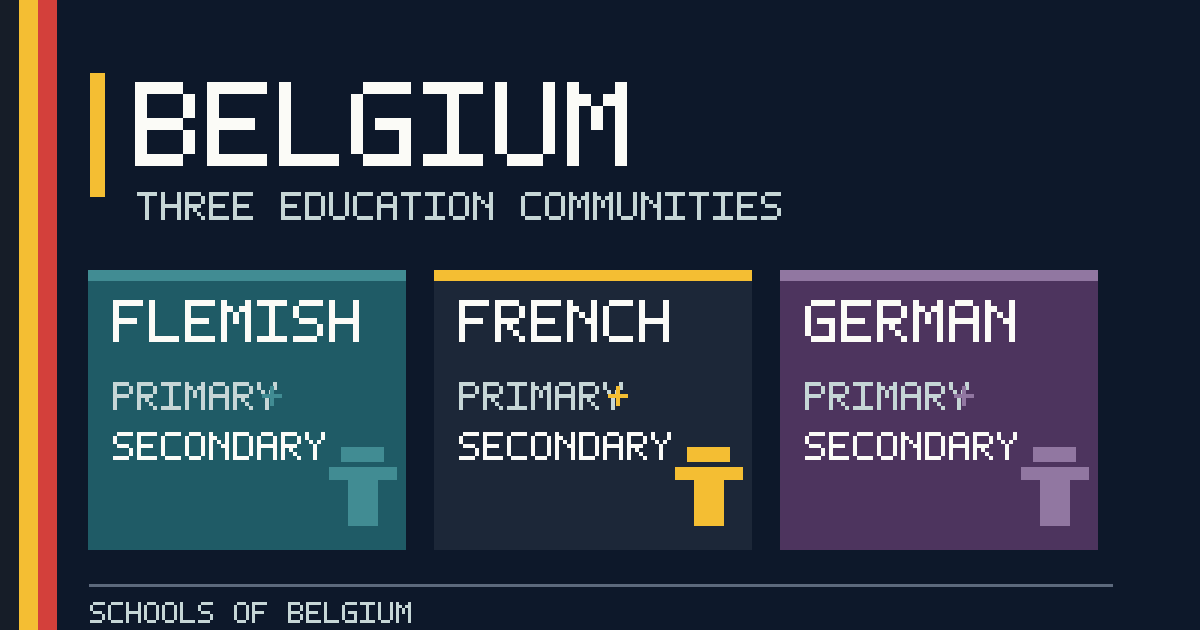
Belgium does not have one federal Ministry of Education controlling every school. The Flemish (Dutch-language), French and German-speaking Communities each exercise the principal education powers, while the Belgian federal government retains specific matters such as the obligation to attend education and minimum conditions for awarding qualifications. Brussels contains schools associated with different language communities; it does not constitute a separate fourth ministry setting one unified Brussels curriculum.
The 2026–27 operating picture differs substantially by community. In Flanders, new minimum primary learning goals are being introduced progressively, with Dutch, mathematics and science-and-technology goals required in early years in 2026–27. The French Community has issued a 17 July 2026 legal order setting June 2027 dates for CEB, CE1D and CESS assessments, and raised relevant certification thresholds for that session. In the German-speaking Community, a June 2026 education decree changed school and training provisions, and a new literacy-promotion pilot began at seven schools in 2026–27. These rules belong to different administrations.
The answer a parent needs starts with one question: Which Community’s education system does the school belong to? From there the family can find the correct minister, curriculum, compulsory-education arrangements, pupil-admission guidance and examination authority. This reader-first guide provides that decision map, real worked examples, dated official references, common errors and practical steps for transfers and qualification recognition.
Belgium’s education authorities at a glance
| What to check | Direct answer as of 18 October 2026 |
|---|---|
| Federal education minister for all schools? | No. School education is primarily a Community competence. |
| Dutch-language system | Flemish Community / Flemish Department of Education and Training; Education Minister Zuhal Demir. |
| French-language system | French Community / Fédération Wallonie-Bruxelles; Education Minister Valérie Glatigny. |
| German-language system | German-speaking Community / Ostbelgien; Education and Training Minister Jérôme Franssen. |
| Compulsory education | Normally from the school year when a child turns five to age eighteen; part-time pathways may apply from fifteen. |
| Flemish 2026–27 change | Phased new minimum learning goals; the precise year and subjects matter. |
| French Community June 2027 | CEB, CE1D, CESS assessment rules and dates issued in July/August 2026. |
| German-speaking 2026 change | June education/training decree; 2026–27 literacy pilot at seven schools. |
| Brussels school authority | Depends on the language/community affiliation of the actual school. |
| Start with | Belgium official education system guidance. |
Quick navigation
- Who governs schools and why Community is not Region
- 2026 ministers and the three separate administrative channels
- Five-to-eighteen compulsory education and school choice
- Flemish curriculum and secondary routes
- French Community tronc commun and CEB / CE1D / CESS
- German-speaking school rules and literacy reform
- Brussels language choice, special education and credentials
- Worked parent cases, frequently asked questions and sources
1. Why education powers belong to language Communities
Belgium is a federal state with three Communities and three Regions. The Communities are based principally on language and cultural affiliation, while the Regions are territorial governance units. Federal reform distributed most school-education competence to the Flemish, French and German-speaking Communities. The official Belgian state website explicitly lists education among Community powers. This is the organising fact of the country’s school administration.
A family reading about a ‘Belgian ministry’ should avoid replacing the three Communities with the three Regions. Flanders is both a Region and a Community with connected institutions, which makes the names look interchangeable there; Wallonia and the French Community are not identical, and Brussels has distinctive arrangements. A school in Brussels can follow a Dutch-language or French-language education system, each with its relevant Community rules.
The federal authorities continue to control specified common matters. The official description includes compulsory education and minimum qualification-award conditions. This makes Belgium neither a single national ministry model nor three wholly disconnected systems. The right approach is to identify the Community first and then check the federal boundary when age obligations or qualification recognition are at stake.
2. The federal government’s limited but important education role
Belgium’s federal government does not normally prescribe the day-to-day lessons of every first-year secondary class. Its retained powers include the compulsory aspect of education, certain minimum requirements for qualifications and teacher pensions. Those matters matter to all Communities but do not authorise the federal government to replace every Community’s curriculum or examination scheme.
For families, this explains why a federal overview can tell them that education is compulsory while not supplying the exact registration calendar for a French-language Brussels school or the Dutch-language examination requirements for a Flemish secondary school. The same constitutional territory can contain multiple school systems.
A good governance guide separates the rule maker, delivery system and receiving institution. The federal level states a common obligation; a Community government issues an education framework; an organising body and school provide learning; a university or receiving employer applies particular admission or recognition conditions.
3. The Flemish Education Minister and administrative channels
In Flanders, Zuhal Demir has been the Flemish minister responsible for education in the 2024–29 government. The Flemish Department of Education and Training provides information about schools, new minimum goals, enrolment and qualification pathways. Government decisions, departmental implementation guidance and the individual school’s regulations play different roles.
Flanders contains government and publicly funded or recognised schools with different organising bodies. The existence of a funded school network does not mean the minister directly marks each pupil’s homework. School boards, teachers and school leadership translate approved goals into programmes and regular assessment within applicable rules.
A parent should start with Vlaanderen.be for current rules about basic and secondary education, then use the named school and organiser for administrative applications. If an error concerns a specific qualification or exam before the Flemish secondary Examination Commission, the rules of that service rather than a generic ministry statement determine the next step.
4. French Community schools and the Minister of Education
The French Community—often called Fédération Wallonie-Bruxelles—governs French-language education within its jurisdiction. In 2026, Valérie Glatigny is Minister of Education and Adult Education. Official circulars, decrees, regulations and examination documents set out how its school system operates and how changes apply to particular years.
The ministry’s role includes curriculum standards, the staged common-core reform, external certification, school-support arrangements and policy governing the education workforce. A distinction is necessary between a press release announcing a government decision and a final decree published with an effective date. The official Gallilex legal register provides a strong way to verify that distinction.
Families should use the French Community’s education portal for relevant school documents and dates. A child preparing for CE1D or CESS does not need the Flemish Exam Commission’s paper list; the two systems use different qualifications and procedures.
5. The German-speaking Community’s own education administration
The German-speaking Community governs education in the German-language area of eastern Belgium. Its education portal Ostbelgien Bildung contains school regulations, administrative notices, teacher resources, training guidance and information on the school system. Jérôme Franssen is identified in 2026 as Minister for Education, Training and Employment; the Community’s institutions are not a small branch office of the French-language ministry.
A June 2026 decree approved by its Parliament altered multiple education and training provisions, including personnel, homework and qualification-recognition matters. The source is dated 1–2 June 2026, and its detailed effect depends on the particular measure. It would be misleading to replace that with a vague claim that all German-speaking school curricula were completely rewritten.
Families can use the Community education portal and the school to clarify current rules. A pupil considering a vocational route may need different official guidance than a pupil entering an ordinary primary school. Region or country labels alone cannot determine the awarding system.
6. Why Brussels requires an extra school-language check
Brussels is geographically one Region, yet its schools can belong to different language-community education systems. Two schools on neighbouring streets can follow separate curriculum documents, examination expectations and enrolment procedures. A family must identify whether the chosen institution is Dutch-language or French-language, not merely enter ‘Brussels’ into a national school search.
Admission priority can also have language-related rules. Vlaanderen.be explains specific priority provisions for Dutch-speaking Brussels schools, including conditions involving a parent’s Dutch knowledge and documentary evidence. These rules should be read as the applicable official enrolment framework, not inferred from the family’s surname or language preference.
Educational fit involves more than administration. A bilingual or internationally mobile child may be very strong at mathematics but need help with academic Dutch or French. Parents should compare classroom language, subject options, future qualifications, travel and learning support rather than assume proximity alone settles the decision.
7. Compulsory education from age five to eighteen
Belgium’s official public information says compulsory education begins in the year the child reaches age five—changed from six from September 2020—and generally continues to age eighteen. Full-time compulsory education usually applies until around age fifteen, after which recognised part-time combinations of learning and training may satisfy the obligation under the applicable rules.
This does not mean that a fifteen-year-old can simply stop education. A lawful training pathway must be distinguished from absence without a recognised plan. Equally, compulsory education should not be confused with a requirement that every family choose only one type of school; different authorised pathways can have their own procedures.
For a learner entering Belgium from abroad, ask the actual Community authority and school about registration, school year, language support and any rules for recognised home education. The child’s date of birth and prior schooling matter; one age-based chart is insufficient to decide placement.
8. School organising bodies and publicly funded provision
Education is delivered by schools managed by different organising authorities or networks. Belgium’s constitutional freedom of education permits distinctions between official/public provision and free or privately organised networks within regulatory and funding requirements. Parents should not assume every school belongs directly to the Community government simply because it is subsidised.
An organising body has responsibilities concerning school administration, personnel and the school project, while the Community creates major regulatory and curricular conditions. The school board and staff bring those conditions to life in lessons, reports and support programmes. This helps explain why two schools using the same Community framework can differ in approach.
Families should compare language, authorised education level, school project, curriculum, examination outcomes and available learning support. A prestigious school brand is not a substitute for a clear description of the pupil’s actual programme and recognised next qualification.
9. Flemish 2026–27 minimum primary learning goals
Flanders has introduced new minimum learning goals for basic education, with a phased rollout. Its official guidance specifies that in the 2026–27 year the new compulsory goals for Dutch, mathematics and science and technology apply in kindergarten and the first three primary years. Later year groups enter the revised arrangements over subsequent years rather than all changing simultaneously.
This nuance matters. A family’s child in the fifth primary year does not automatically have the same implementation timetable as a child in the second year. Nor should an older textbook be assumed illegal simply because new goals have begun for younger cohorts. The teacher can explain which part of the framework applies now.
At home, a parent can support vocabulary, regular reading, number sense and conversation about what the child has learned. A strong ministry policy should connect clear knowledge expectations with teacher training, materials and diagnostics rather than place every responsibility on families.
10. Understanding the Flemish move toward explicit knowledge
Government guidance describes the minimum-goals reform as a stronger focus on knowledge progression, including language, mathematics and science. The aim is to make expected competencies more explicit at defined points such as the end of kindergarten, the fourth year and the end of primary education. The term ‘minimum’ describes what pupils are expected to know; it does not imply that ambitious students should stop learning there.
Teaching might build from concrete representations of fractions to comparisons, operation rules and applications. Literacy lessons may move from vocabulary and listening to increasingly complex texts and inference. These are illustrative sequences showing how a goal becomes instruction; the actual year-by-year content must be checked with current official learning goals.
A ministry can approve targets, but evidence of success requires appropriate teacher preparation and pupil work. An official timetable of implementation proves when a duty applies, not that every pupil has already reached the intended standard.
11. Flemish secondary education: 1A, 1B and later pathways
Flemish ordinary secondary education consists of three broad stages. The first includes 1A and 1B entry routes depending on a pupil’s primary certificate and admission rules, followed by later choices of study domain and finality. The government explains that the reform of secondary education, including seventh years, was completed for 2025–26.
An entry route should not be used as a permanent label of potential. A pupil entering 1B may receive learning tailored to missing foundations and under the right conditions move to 1A. Different later study programmes prepare for higher education, work or mixed pathways; the exact diploma requirements depend on the programme.
A family transitioning from a foreign system should collect subject records and ask the receiving school how mathematics, language and scientific knowledge map to the intended course. Admission and credit decisions follow the official school system, not an international grade-conversion guess.
12. The Flemish Examination Commission in 2026
The Flemish secondary Examination Commission (Examencommissie secundair onderwijs) provides routes for obtaining recognised examination-based qualifications outside conventional school progression, subject to its own rules. Its official 2026 page explains changes to several first-grade 1A and 1B subjects and how candidates may carry forward certain previous marks.
For example, the 1B subject Natuur en ruimte replaces a combination of geography and science, with specific transfer conditions for older exam results. Technology components were reorganised as well. A candidate who has passed only one of two old components should not assume automatic credit for the new combined subject.
This case demonstrates that qualification administration is precise. Families should use the new subject fiche and the exam service’s own transfer rules rather than assume a different Community examination or a prior-year document establishes eligibility.
13. French Community: what the common core seeks to do
The French Community’s tronc commun is a staged curricular framework intended to make core learning more coherent across the early school years and into lower secondary progression. It includes French, mathematics, sciences, cultural and artistic development, technologies, languages, citizenship and other learning domains. Its implementation has been phased, so a given grade and year must be identified before declaring a new syllabus fully in operation.
A core principle is to support knowledge acquisition and reduce avoidable gaps or repetition. That requires differentiation and personalised support, not simply a new chapter title. A child with strong mathematical reasoning but weaker reading may need carefully adapted access to a problem without losing intellectual challenge.
Families should compare the current reference framework against the actual school’s learning plan. The curriculum is a policy instrument; classroom progress is the outcome that should be monitored through specific student work.
14. CEB in June 2027: a dated, community-specific assessment
The French Community’s 17 July 2026 legal order established the 2026–27 external CEB sessions for the mornings of 21, 22, 24 and 25 June 2027. CEB stands for Certificat d’études de base and is associated with completion of primary education or specified alternative routes. This is a French Community examination, not a Belgian federal national paper.
The Community’s 2026 legal reform increases success expectations for the June 2027 CEB, including minimum subject and overall thresholds under the applicable decree. Parents should consult the final examination guidance and school for the precise conditions and the role of the class council.
A pupil should develop reading comprehension, number reasoning, scientific understanding and historical-geographic literacy. The best preparation begins with the child’s actual weaknesses rather than using a past paper from an outdated curricular framework as the only teaching resource.
15. CE1D: the lower-secondary external assessment
CE1D is the Certificat d’études du premier degré de l’enseignement secondaire within the French Community. The 2026–27 calendar sets external assessment dates in June 2027, including modern languages, mathematics, French and sciences. The legal order lists the mathematics paper on 21 June, French on 22 June and sciences on 23 June, with language tests taking place within their specified period.
The 2026 reform concerning certification thresholds also applies to relevant CE1D examinations from June 2027. These dates and rules belong to this Community and this academic year; they should not be copied into a Flemish secondary student’s revision planner.
Preparation should combine understanding with assessment familiarity. A weak mathematics score can arise from number concepts, reasoning or reading instructions; each requires a different approach. School guidance remains necessary because the conditions for certification can involve more than a simple international-style percentile.
16. CESS: upper-secondary certification in the French Community
CESS, the Certificat d’enseignement secondaire supérieur, concerns upper-secondary completion in the French Community. The July 2026 legal order set its common external history examination for 18 June 2027 and French examination for 21 June 2027 in relevant pathways, with particular competencies specified for the session.
An important qualification is that examination structure and eligibility differ by pathway and cohort. An article saying every Belgian secondary student must take the same CESS papers is false. Dutch-language secondary students use a different certificate system, and pupils in German-language schools have their own recognised arrangements.
A student applying to higher education should keep the exact qualification name, awarded status, subject record and any requirements of the receiving institution. Obtaining a certificate and receiving a university place are related but separate steps.
17. The 2026 French Community certification threshold change
The French Community adopted legal changes in March 2026 addressing success thresholds for CEB, CE1D and CESS, with application specified for 2026–27 external certification. A ministerial explanation said the CEB would require at least 50% in each evaluated domain and 60% overall; the relevant CE1D and CESS external exams would require a 60% threshold. The legal text and published exam instructions take priority over summary headlines.
The change matters to families who may rely on older practice guides describing different cut-offs. A pupil who achieved a score sufficient under an earlier rule cannot assume an identical result automatically meets the new threshold. Yet certification decisions still have legally defined school council or jury responsibilities.
The practical response is to check the precise exam year and subjects, identify which types of decisions are governed by the new threshold and plan learning around demonstrated competence rather than just the numerical target.
18. French Community reforms and teacher workload
During 2026 the French Community government debated changes in teacher workload, administrative simplification, financing and curriculum implementation. Minister Valérie Glatigny’s official notices describe a spring set of administrative-simplification measures and budget-related school support. These policy changes have specific steps through government readings and legal adoption; not every press release has the same legal status.
Reducing unnecessary paperwork can give school leaders more time for pedagogy, but a shorter form does not automatically produce improved student learning. Teachers still need sufficient preparation and guidance to apply the curriculum accurately. Researchers should evaluate implemented measures, teacher time and classroom outcomes separately.
Parents can ask whether the school has communicated new assessment or progression requirements and whether the teaching plan remains stable. A governance reform should make rules clearer and support pupils, not create uncertainty that families are expected to resolve alone.
19. German-speaking Community: the June 2026 education decree
On 1 June 2026 the German-speaking Community Parliament adopted a decree containing measures relating to education and training; the official education portal described them on 2 June. Topics included education staff, qualifications, homework-law provisions, apprenticeship pathways and adjustments to support mechanisms. This is a specific package, not proof that the entire education system was replaced overnight.
The Community’s school governance involves education authorities and organisers, including publicly organised and municipal schools. Its official service guidance explains that many primary institutions operate under municipal authorities while other institutions are directly organised or supported by the Community. Parents should identify the correct organiser for administrative matters.
Where a school problem relates to the new decree, read its actual relevant section and effective date. A German-speaking student should not be advised on the basis of French CEB rules or Flemish 1B exam changes.
20. The October 2026 German-speaking literacy pilot
Jérôme Franssen’s education and training ministerial site reports that a three-year literacy-support pilot began in seven schools at the start of the 2026–27 academic year, with an event on 1 October 2026. The project works with the Autonome Hochschule Ostbelgien. That is a concrete example of pedagogy being developed locally rather than imposed as an all-Belgium national programme.
Seven participating schools is the pilot’s reported scope. It would be false to claim every German-speaking school was already involved or that measurable improvement in reading had been established after just the initial months. Sound evaluation would follow teacher preparation, pupil participation, diagnostic outcomes and later reading progress.
A family whose school participates can ask what literacy practice changes, which pupils receive support and how progress is documented. Non-participation does not mean the child has no access to ordinary literacy education; the pilot is an additional initiative.
21. Ostbelgien’s 2026–27 study grant adjustment
The German-speaking Community’s official education portal announced a reform of study assistance for 2026–27 involving an increase in the benefit and new income thresholds. The portal reports a 50% increase in study assistance. That percentage describes a programme change, not an automatic award to all students or every family.
Eligibility, level of study, income conditions and application dates must be checked from the responsible Community service. The existence of a benefit should be distinguished from a family’s successful application. Families with low or middle incomes should use the official page rather than a third-party page with an expired deadline.
Financial access matters educationally because travel, books and other costs can affect participation. Policy effectiveness should be judged by reach and student opportunities rather than only the monetary headline.
22. Vocational education and the dual-training routes
Belgium has vocational, technical and academic secondary opportunities, but precise names and certificates depend on the Community. In the German-speaking Community, dual apprenticeship arrangements and training centres play a particular role. Flemish secondary education uses study domains and different finalities. French Community technical and qualifying routes have their own qualification requirements.
This is why ‘Belgian vocational diploma’ is too vague for an international application. The applicant needs the issuing authority, route, educational level, year and subjects or occupational standards. A training course that develops strong skills may not have the same university admission status as a general secondary certificate.
Students should ask whether their intended pathway permits higher education, what further entrance conditions apply and which body verifies the award. Vocational education should be evaluated for actual competence and progression, not presented as a universal lesser option.
23. Home education and school attendance
Belgian compulsory education can be met through legally recognised arrangements beyond ordinary full-time attendance in some circumstances, but rules for home education, notification and inspection depend on the relevant Community. The German-speaking Community’s official guidance explicitly mentions prescribed registration and inspection of home education, reflecting constitutional freedom of education alongside public responsibilities.
A family cannot assume that a commercial online course automatically satisfies compulsory education simply because a platform offers lessons in Dutch or French. The legitimate procedure requires checking Community law, deadlines, monitoring and any examination requirements. Internationally mobile families should ask which authority would recognise the resulting academic record.
Teaching at home can provide educational value, but a recognised qualification needs the appropriate certification route. The safe decision is to obtain written guidance before withdrawing a child from a registered school.
24. Multilingual learning and language-sensitive diagnosis
Belgium’s Community structure means the main language of schooling is not a minor attribute. A pupil moving from a French-language to a Dutch-language school may know mathematics and science concepts yet be unable to express reasoning with the expected new vocabulary. The same applies when a family arrives from another country and seeks a German-speaking Community school.
Teachers should assess concept knowledge separately from academic language where feasible. For example, the learner might solve a fraction equation when shown symbols but struggle with a written instruction containing ‘at least’ or ‘no more than’. Understanding those terms may be the immediate barrier. The curriculum’s mathematics expectations should not be confused with language fluency alone.
A parent can support the transition by keeping prior school work, recording textbooks and instructional language, and arranging with teachers a realistic sequence of language and subject support. The educational objective is integration with genuine understanding, not simply memorising translated answer templates.
25. Inclusion, disability and school support
Each Belgian Community provides its own regulations and services for pupils requiring additional learning or disability-related support. The names of available arrangements can differ. A family should not assume a French Community special-education procedure is the same as a Flemish learning-support network or an Ostbelgien support service.
Good support begins with the student’s functional needs and learning strengths. A pupil with strong verbal reasoning but slower reading may need accessible texts or targeted literacy teaching. A child with a physical disability may need a building and classroom adjustment. The school and competent Community authority determine applicable arrangements within law.
School quality should be judged by access and participation, not only by examination results. Families should seek a written support plan where appropriate and ask who will review progress, how data are kept private and how disputes can be addressed.
26. Cross-Community qualification recognition
A pupil who completes one Community’s senior secondary programme receives a qualification issued under that system. International students and employers often translate all such awards as a ‘Belgian high-school diploma’, but the detailed certificate name and recognition procedures still matter. The Belgian federal minimum conditions for qualification awards coexist with Community-level content and certification routes.
Moving between systems may require recognition of previous study or a school placement decision. The receiving school or university should confirm the procedure, and some foreign qualifications require formal evaluation. A parent should retain exact dates, transcripts, awarding bodies and subject descriptions instead of only a translated grade label.
Qualification recognition and admission are not synonyms. An award may be legitimate yet not meet a particular course’s language, subject or selection prerequisites. Get written answers from the receiving institution before making a costly move.
27. Worked example: family moving from Flanders to Brussels
Imagine a Year 6 pupil living in Flanders whose family moves to Brussels in 2026. The first question is whether the family wants Dutch-language or French-language schooling. The second is which education authority governs the school, what registration or priority rules apply and what support the child needs. The family should not assume every school in Brussels applies Flemish minimum goals.
If the family chooses a Dutch-language school, the Flemish enrolment and admission guidance applies. If it chooses a French-language school, the pupil may encounter different certificates and learning sequences. A curriculum comparison should cover reading language, mathematics content and subject terminology rather than focus exclusively on age.
This is a teaching illustration, not a reported individual pupil’s story. It demonstrates how an accurate ministry guide prevents a wrong administrative application and helps educators design a genuine learning transition.
28. Worked example: preparing for a French Community CEB
A pupil will sit the French Community CEB in June 2027. Their family checks the legally published dates—21, 22, 24 and 25 June—then reviews the current success criteria and subject documents with the teacher. Because the 2026 reform changes thresholds, an older study website cannot serve as the sole source.
An initial diagnostic finds that the child reads informational texts confidently but struggles with fraction comparisons. The teacher asks the child to compare 3/4 and 5/8 by expressing them as 6/8 and 5/8: the first fraction is greater. If the pupil can explain this but later fails a word problem, comprehension and representation may need attention.
The correct process is official exam requirements, targeted teaching, mixed-task practice and careful verification of real progress. The fraction problem is an original teaching example, not an extracted CEB question or a prediction of the next exam.
29. Worked example: choosing a Flemish secondary route
A pupil has completed primary school and is entering Flemish secondary education. With the primary certificate, the ordinary 1A route may be available; without it, the 1B path has particular conditions and opportunities. The parent should inspect the current 2026 admission requirements, ask about later study options and avoid treating the child as permanently limited by one route.
Suppose the pupil has difficulty with negative-number arithmetic. The teacher can check whether 3 − 7 is understood as −4 by using a number line, then test whether the pupil can apply the idea to a temperature decrease. If the calculation is accurate but the application fails, the hidden problem may be interpretation rather than arithmetic.
This original example models first-principles diagnostic teaching. It does not claim that an individual school uses a specific entrance paper. The governing school and Community rules determine formal placement and progression.
30. A four-week practical information and learning plan
In Week 1, record the pupil’s Community, school, grade, instructional language and intended qualification. Find the exact current rule for admission, exam or curriculum. Ask the teacher for two samples of recent work. This prevents a family from relying on the wrong Community’s documents.
In Week 2, identify one literacy and one mathematics prerequisite that need work, and practise the underlying idea with small, accurate examples. In Week 3, apply the knowledge to different representations and unfamiliar questions. Use student explanations to find errors. In Week 4, review the new work, compare against the starting evidence and confirm any unresolved administrative decision with the competent school or authority.
This is a practical framework rather than a claim that a child will gain a certain examination grade after four weeks. The measure of progress is genuine ability to explain and transfer knowledge, alongside correct administrative documentation.
31. How to audit a Belgian education-policy announcement
First, identify whether the announcement comes from the Flemish, French, German-speaking or federal level. Second, find the dated decree, circular, ministerial decision or official guide. Third, record the academic year and students covered. Fourth, check the school’s implementation. Fifth, look for student participation and learning evidence before claiming success.
An example is the Flemish phased primary reform: the 2026–27 year requires particular minimum goals for certain primary years, not for all grades at once. Another example is the French Community certification threshold change, whose first application is specified for June 2027. The German-speaking literacy pilot is an activity in seven schools, not a universal achieved outcome.
This evidence chain is the difference between useful public education writing and a shallow list of ministries. It allows parents to act and researchers to preserve the limits of every claim.
Frequently asked questions
Is there a single Belgian education minister?
No. The Flemish, French and German-speaking Communities have the principal education responsibilities, while the federal government retains limited common powers.
Who are the 2026 education ministers?
Zuhal Demir in Flanders, Valérie Glatigny for French Community school education and Jérôme Franssen for education and training in the German-speaking Community.
Which education ministry governs Brussels?
It depends on the school’s language-community affiliation. Dutch-language and French-language schools in Brussels follow their respective Community rules.
When is education compulsory?
Normally from the year the child reaches five until eighteen, with permitted part-time pathways generally from fifteen under the applicable rules.
Are the three Regions the same as the three Communities?
No. Regions are territorial authorities and Communities are principally language-based authorities. The distinction is essential for school governance.
What changed in Flemish primary education for 2026–27?
A phased rollout requires new minimum goals for Dutch, mathematics and science and technology in kindergarten and early primary years; later groups follow their specified timetable.
Do all Flemish Year 6 students sit the French CEB?
No. CEB is a French Community certification exam, not a single Belgian federal assessment.
When are the French Community 2027 CEB exams?
The legal order specifies the mornings of 21, 22, 24 and 25 June 2027.
What are CE1D and CESS?
French Community external certification assessments for relevant lower-secondary and upper-secondary completion stages.
Did French Community pass thresholds change?
Yes. A March 2026 decree changed specified external certification thresholds for application from the 2026–27 examination year. Read the current legal and school guidance.
What happened in German-speaking education in 2026?
The Community adopted an education-and-training decree in June and began a three-year literacy pilot at seven schools in 2026–27.
Can pupils transfer between Communities?
Transfers are possible through procedures but grade placement, language support, subject equivalence and recognised qualifications require school and Community-specific confirmation.
Is the Flemish 1A/1B pathway identical to French CE1D?
No. They belong to distinct systems and serve different administrative functions.
Can home education satisfy compulsory education?
Community rules provide specified possibilities and procedures. Registration, monitoring and certification requirements must be checked with the competent Community.
Does a Belgian secondary qualification guarantee university admission?
No. Recognition of the qualification and the receiving university’s own entry conditions are separate questions.
How should a family plan extra lessons?
Start with the applicable Community curriculum and the learner’s actual work, diagnose concept and language gaps, teach prerequisites and retest understanding rather than repeating generic past papers.
Names and terms for accurate research
- Flemish Community: Dutch-language education authority operating in Flanders and relevant Brussels institutions.
- Fédération Wallonie-Bruxelles: French Community education system.
- Deutschsprachige Gemeinschaft / Ostbelgien: German-speaking Community.
- Tronc commun: phased French Community core curricular reform.
- CEB: Certificat d’études de base, French Community.
- CE1D: lower-secondary external certification in the French Community.
- CESS: upper-secondary completion certificate in the French Community.
- 1A / 1B: first-year Flemish secondary entry routes.
- Minimumdoelen: Flemish minimum learning goals.
- Examencommissie: Flemish secondary Examination Commission.
- Study grant: support with a particular Community’s eligibility and year-specific rules.
Official and dated sources
- Belgium.be: education administered by three Communities
- Belgium.be: constitutional powers of the Communities
- Belgium.be: limited federal education powers
- Belgium.be: compulsory education ages and part-time routes
- Flanders: phased primary minimum goals for 2026–27 through 2030–31
- Flanders: secondary education structure and finalities
- Flemish secondary Examination Commission: 2026 subject changes
- French Community: 17 July 2026 examination-calendar order for June 2027
- French Community Gallilex: 19 March 2026 certification-threshold decree
- French Community Minister: CEB / CE1D / CESS changes for June 2027
- Ostbelgien: 1 June 2026 school-and-training decree explained
- Ostbelgien: German-speaking Community school service and literacy resources
- Jérôme Franssen: 2026–27 literacy pilot and education portfolio
Continue reading within the eduKate Belgian education library
- Schools of Belgium | Flemish, French and German-speaking school systems
- Tutors of Belgium | Curriculum and assessment-aware tutoring
- Immutable Clementi tutor and learning model
Reviewed 18 October 2026 against federal and Community-level official publications. This independent guide is not a government-issued rule. Each legal date and examination belongs to the specified Community and cohort. Classroom and qualification decisions require the responsible school’s current written guidance.